
Most law firms redesign their websites every three to five years. Not because they planned to, but because the site stopped working. Leads dried up. The homepage looked like it was built in 2017 (because it was). A potential client called to say the contact form didn't work on their phone.
The pattern is predictable. A firm launches a site, it performs well enough for a few years, and then performance slowly degrades until someone finally says, "We need a new website." By that point, the firm has already lost months of potential leads. The scale of the problem is significant: research on law firm website performance found that while 87% of firms have a website, only 35% have ever gained a client from it.
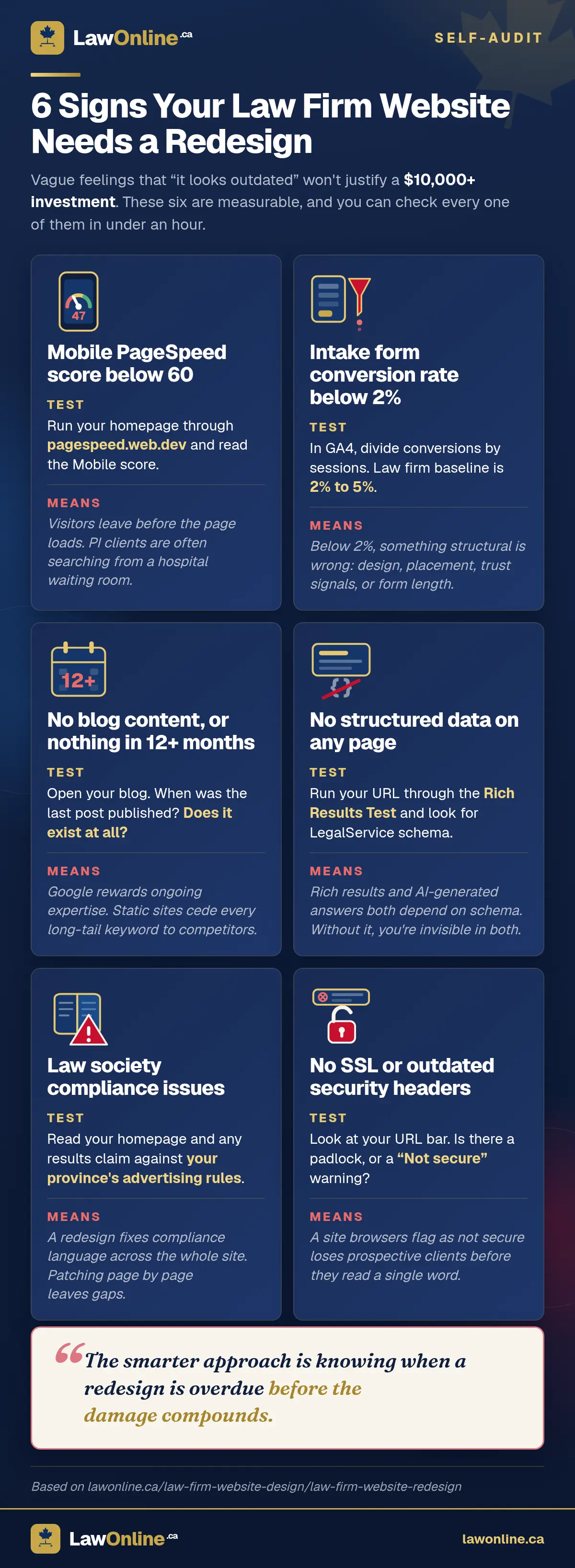
The smarter approach is knowing when a redesign is overdue before the damage compounds. This guide covers how to tell when your law firm website needs a redesign, what the process involves, what it costs in Canada, and how to avoid repeating the same mistakes with your next site.
6 Signs Your Law Firm Website Needs a Redesign
If your website isn't generating consultations, the problem is almost always measurable. Vague feelings of "it looks outdated" aren't enough to justify a $10,000+ investment. But concrete performance failures are. Google's core updates have also raised the bar for page experience and content quality, so sites built before 2024 often need more than minor tweaks to stay competitive.
Here's what to look for:
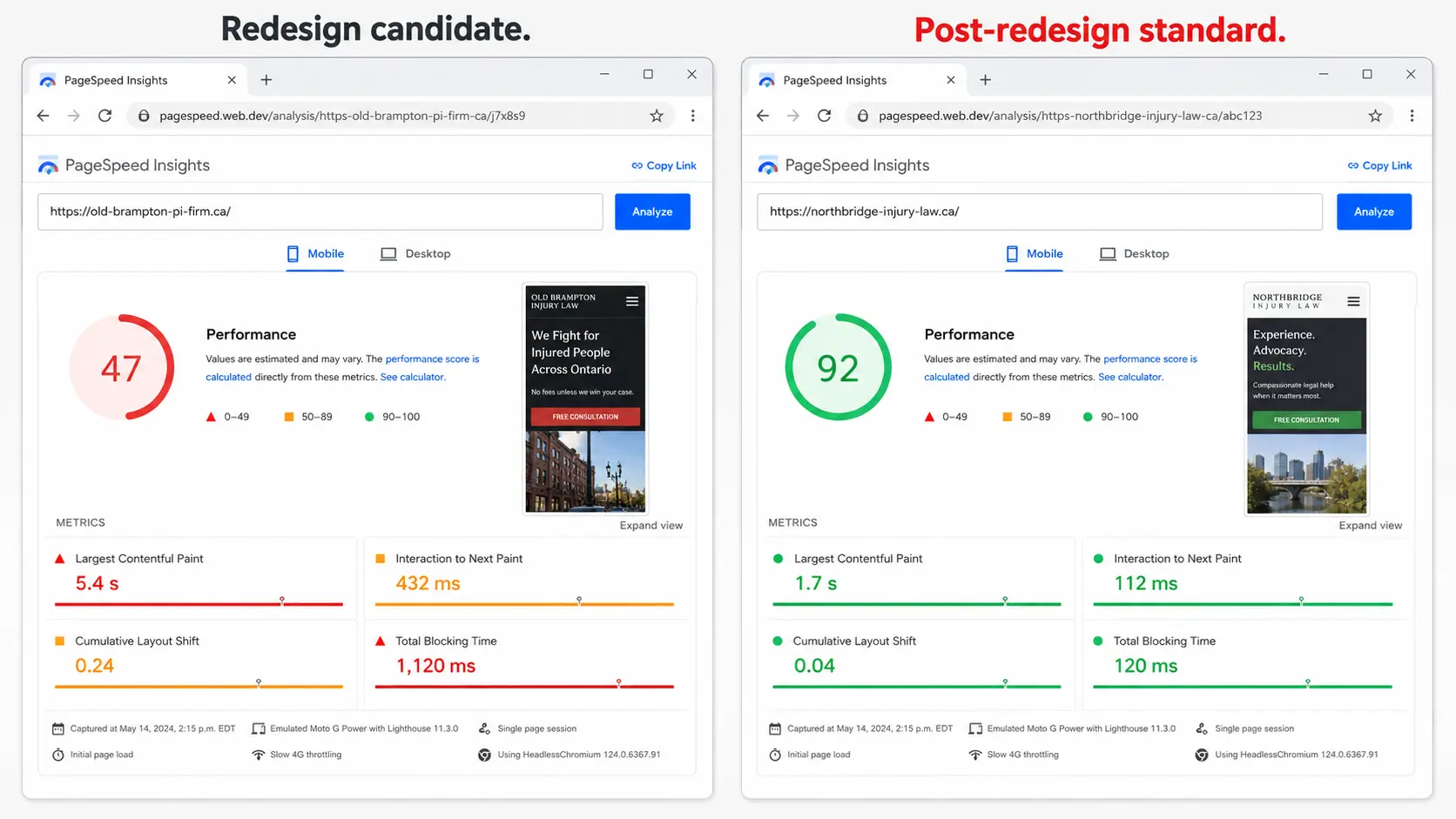
Your mobile experience is broken. Run your site through Google's PageSpeed Insights. If your mobile performance score is below 60, visitors are waiting too long for your pages to load, and many of them are leaving before the page finishes rendering. The numbers back this up: 76% of potential clients will see a law firm's website on their phone during the decision process, and even a 0.1-second improvement in load time can boost lead generation conversions by over 20%. For personal injury firms, this is especially costly. Most accident-related searches happen on mobile devices, often late at night or from a hospital waiting room. A PI firm with a contact form that only works on desktop is invisible to the people most likely to need a lawyer right now. Our guide to Core Web Vitals for law firms breaks down exactly what these scores mean and where your thresholds should be.
Your intake form conversion rate is below 2%. If your website gets traffic but nobody fills out the contact form, the problem is usually design, placement, or trust signals. A well-designed law firm website converts between 2% and 5% of visitors into form submissions. Below 2%, something structural is wrong, and our conversion optimization guide walks through the specific fixes that move this number. Trust signals matter more than many firms realize: 98% of potential clients read online reviews before hiring a law firm, and 47% won't even consider a firm with less than a four-star rating. If your site doesn't surface reviews, credentials, and results prominently, you're losing people before they ever reach the contact form.
You have no blog content, or nothing published in 12+ months. Search engines reward sites that demonstrate ongoing expertise. A personal injury firm with no blog is competing against firms that publish regularly on topics like car accident claims, slip-and-fall injuries, and WSIB disputes. If your site has five static pages and nothing else, you're ceding every long-tail keyword to your competitors.
Your site has no structured data. LegalService schema, LocalBusiness markup, attorney Person schema: these help Google understand what your firm does and where you practice. If your site has none of this, you're missing opportunities to appear in rich results and AI-generated answers.
You're running into law society compliance issues. Every provincial law society has rules about how lawyers can advertise. The Law Society of Ontario, for example, restricts the use of testimonials and prohibits unverifiable performance claims on websites. If your current site has language that doesn't comply, a redesign is the cleanest way to fix it rather than patching individual pages.
Your site lacks SSL or has outdated security headers. If your URL still shows "http://" without the padlock, browsers are actively warning visitors that your site isn't secure. For a law firm, that's a trust killer.
Law Firm Website Redesign vs. Refresh vs. New Build: Which Do You Need?
Not every underperforming website needs a full tear-down. The right scope depends on what's broken and how deep the problems run.
A refresh is a visual and performance update on top of your existing site structure. You keep the same CMS, the same URL structure, and most of the same content. The design gets modernized, page speed improves, and you fix specific conversion issues. Timeline: two to six weeks. Cost: the lowest of the three options.
A refresh makes sense when your site's architecture and content are fundamentally sound, but the design looks dated and the technical performance has degraded. A personal injury firm in Brampton with solid practice area pages but a slow, cluttered homepage might only need a refresh.
A redesign means new structure, new content strategy, new design, and potentially new technology. You're rethinking how the site is organized, rewriting or significantly revising content, and building a modern frontend. Timeline: six to fourteen weeks.
This is the right choice when the problems go deeper than aesthetics. If your URL structure is a mess, your content doesn't match what people search for, or your site was built on a platform that limits what you can do, a redesign addresses all of it.
A new build from scratch is for firms that need to start over entirely. Maybe you don't own your current site. Maybe you're migrating away from a provider that controls your domain and content. Maybe your firm has grown from a solo practice to a multi-office operation, and the original site can't scale. Timeline: ten to twenty weeks. Cost: highest, but also the highest potential upside.
What Does a Law Firm Website Redesign Actually Involve?
A proper redesign follows six stages. Skipping any of them creates problems that surface weeks or months after launch.
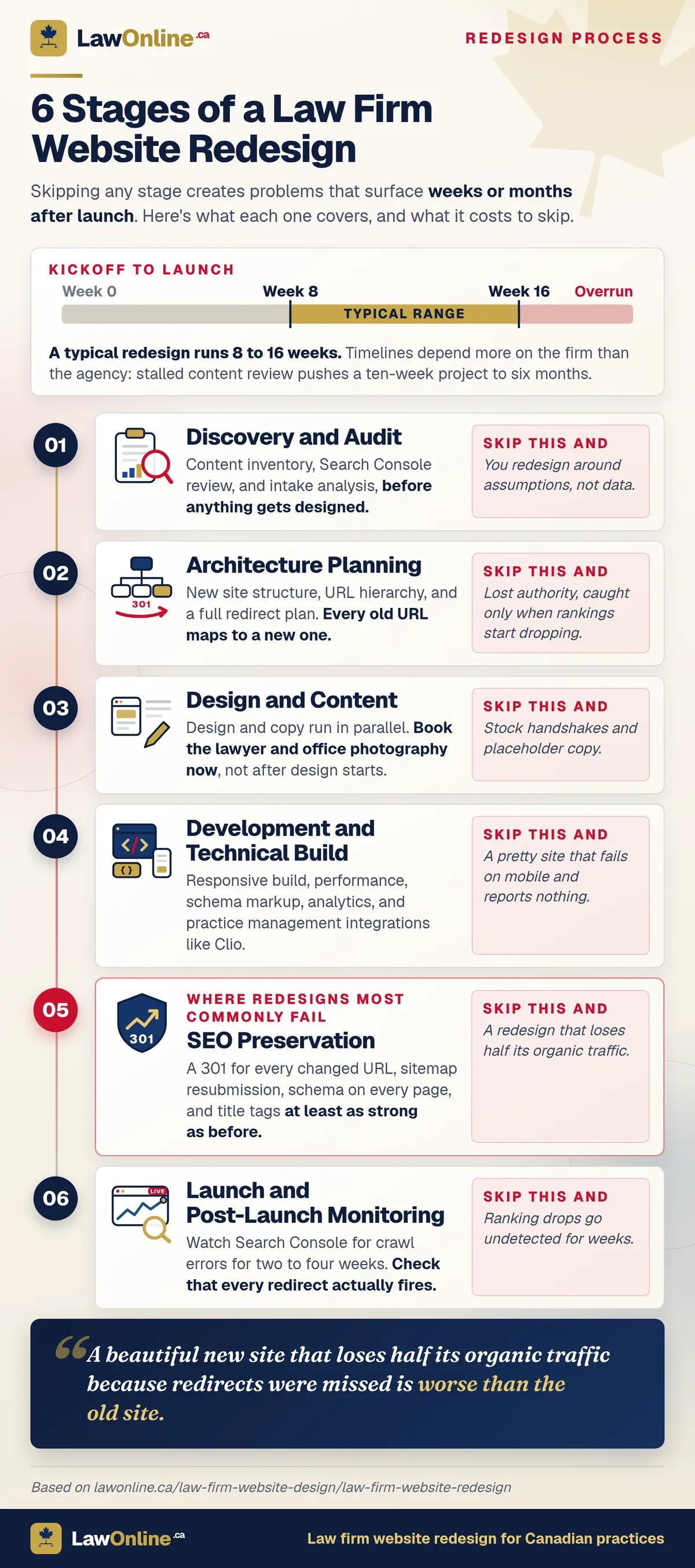
Stage 1: Discovery and Audit
Before anything gets designed, you need to understand what you're working with. This means a full content inventory of your existing site, a review of your Google Search Console data to identify which pages actually drive traffic, and an analysis of your intake process to understand where leads come from and where they drop off.
For a PI firm, this stage often reveals surprises. Pages you thought were important might get almost no traffic, while a blog post about car accident claims in Ontario might be your top performer. That insight shapes every decision that follows.
Stage 2: Architecture Planning
This is where you map out the new site's structure. How many practice area pages do you need? What's the URL hierarchy? If URLs are changing, you need a complete redirect plan. Every old URL must map to a new one, or you lose the SEO authority those pages have built over the years.
If you're changing domains or switching hosting providers, this stage overlaps with website migration planning. The redirect map is the most technically critical deliverable of the entire project.
Stage 3: Design and Content
The visual design and content writing usually happen in parallel. Your redesign partner creates mockups or prototypes while writers develop practice area copy, blog content strategy, and service page messaging.
Every firm needs to plan for visual assets at this stage. Photos of the lawyers, the office, and the client intake areas should be scheduled before design work begins, not after. Stock photos of handshakes and gavels don't build trust with someone who just got into a car accident and needs a real lawyer.
Stage 4: Development and Technical Build
The approved designs get built into a working site. This includes responsive development for mobile and tablet, performance optimization, schema markup implementation, analytics configuration, and any integrations with tools like Clio or practice management software. Our guide to law firm website development covers what each of those components involves and what general developers typically miss.
The choice between WordPress and a static site gets made here if it wasn't decided earlier. Each approach has trade-offs in cost, maintenance, and performance.
Stage 5: SEO Preservation
This is where redesigns most commonly fail. A beautiful new site that loses half its organic traffic because redirects were missed is worse than the old site.
SEO preservation requires 301 redirects for every URL that changed, resubmission of your sitemap to Google Search Console, verification that structured data (schema markup) is in place on every page, and confirmation that title tags, meta descriptions, and heading structure are at least as strong as what you had before.
Stage 6: Launch and Post-Launch Monitoring
Launch day isn't the finish line. For the first two to four weeks after launch, monitor Google Search Console for crawl errors, watch your analytics for traffic changes, and check that all redirects are working. Ranking fluctuations in the first few weeks are normal. Sustained drops are not.
How Long Does a Law Firm Website Redesign Take?
A typical law firm website redesign takes eight to sixteen weeks from kickoff to launch. The range is wide because timelines depend more on the firm than the agency.
The most common cause of delay is content. Lawyers are busy, and reviewing website copy often falls to the bottom of the priority list. A redesign that should take ten weeks can stretch to six months if partner review cycles stall at every stage.
Other common delays include waiting on professional photography, law society review of marketing claims (required in some provinces), and scope changes mid-project. The best way to stay on schedule is to designate one person at your firm as the point of contact with decision-making authority.
What Does a Law Firm Website Redesign Cost in Canada?
Redesign costs vary significantly based on scope, but here are realistic ranges for Canadian law firms in 2026:
| Redesign Type | Cost Range (CAD) |
|---|---|
| Visual refresh (existing CMS, existing content) | $3,000 to $8,000 |
| Full redesign (new design, content rewrite, development) | $8,000 to $20,000 |
| Enterprise multi-practice rebuild (50+ pages) | $20,000 to $50,000+ |
Most small to mid-size firms fall into the $8,000 to $20,000 range for a full redesign. That includes custom design, professional copywriting, SEO setup, and a structured launch process. Our detailed pricing breakdown covers costs by firm size, region, and feature set.
Is a Law Firm Website Redesign Worth the Investment?
The return on that investment can be substantial. A 2026 industry benchmark from Siana Marketing found that legal services websites see an average 485% ROI from redesign projects, with a typical break-even time of 6.2 months and a 41% lift in conversion rate. For personal injury firms, the math is even more straightforward. A single signed PI client from a motor vehicle accident case can generate $15,000 or more in contingency fees. If your current site is losing even one viable lead per month due to poor performance, the redesign pays for itself quickly.
The more expensive option is doing nothing. A site that doesn't convert is a monthly cost with no return. You're paying for hosting, possibly paying for an agency retainer, and getting nothing back.
How to Choose a Law Firm Website Redesign Agency
The agency you choose matters more than the platform or the design. A firm that specializes in law firm websites will handle things a generalist agency won't even think about.
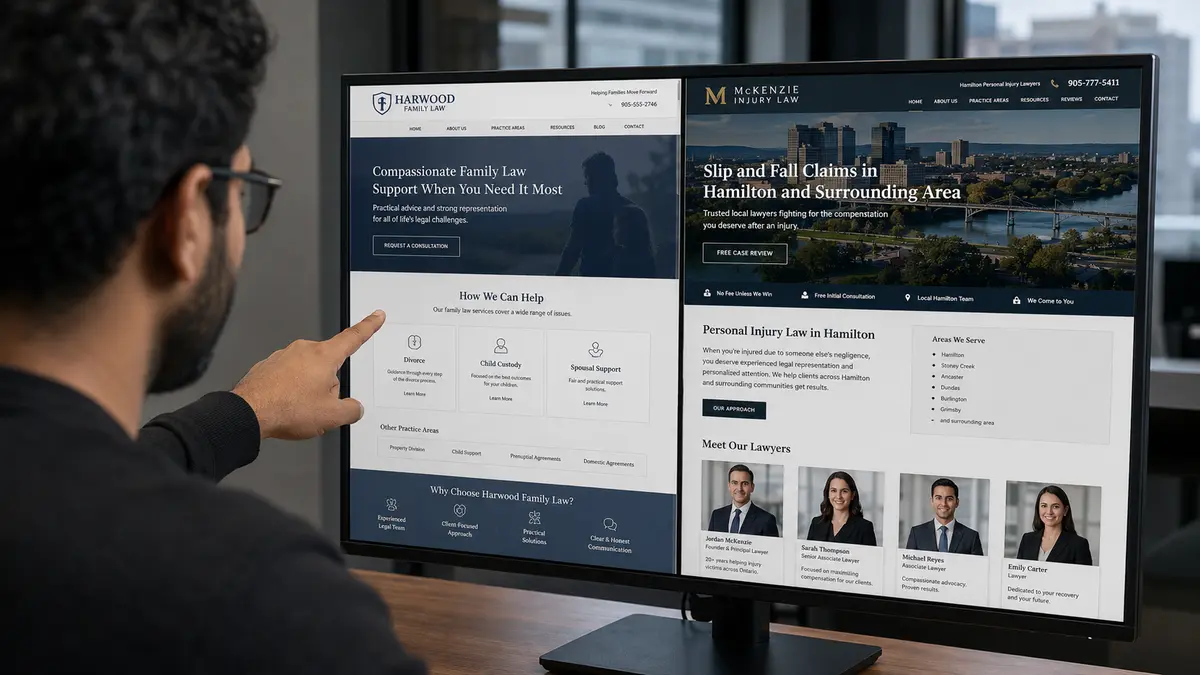
Look for Canadian law firm experience. An agency that's built sites for restaurants, dentists, and landscapers doesn't understand law society advertising rules, legal intake workflows, or how to structure content for practice-area SEO. Ask for examples of law firm sites they've built. Our guide to choosing a law firm web designer covers the full evaluation criteria and red flags in detail.
Ask about their SEO process. A redesign without an SEO plan is a recipe for lost rankings. Your partner should have a documented process for redirect mapping, keyword preservation, schema implementation, and post-launch monitoring. If their answer to "how do you handle SEO during a redesign?" is vague, keep looking.
Demand structured handoff documentation. When the project ends, you should receive login credentials, a site architecture document, a redirect map, and documentation for anything custom-built. If the agency doesn't provide this, you'll be dependent on them for every future change.
Check who owns what. Before you sign anything, confirm that you own the domain, the design, the code, and the content. If the contract says otherwise, negotiate or walk away.
Law Firm Website Redesign Checklist: What to Do Before You Start
Use this pre-redesign checklist to avoid weeks of back-and-forth and thousands of dollars in scope changes.
Confirm you own your domain. Log in to your domain registrar and verify that the domain is registered in your firm's name, not your current agency's. If you don't have access, get it transferred before the redesign begins.
Baseline your analytics. Export your current Google Analytics and Google Search Console data. You need a clear picture of current traffic, top-performing pages, and lead sources so you can measure the redesign's impact.
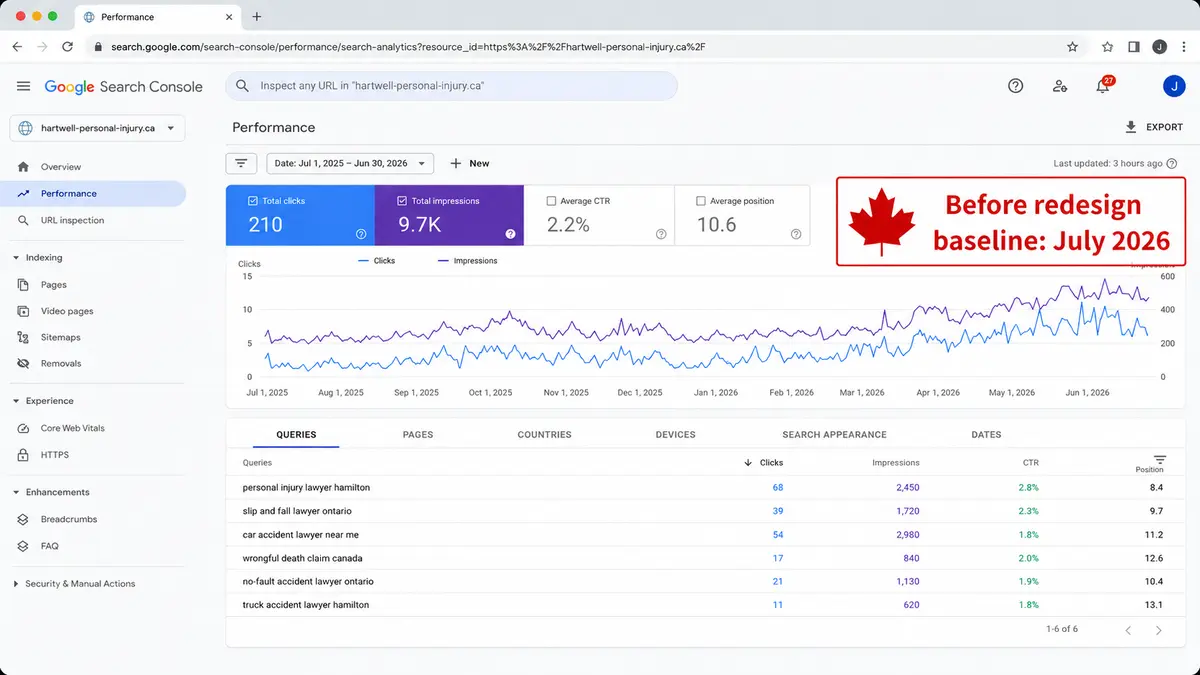
Audit your content. Identify which pages are worth keeping, which need rewriting, and which should be retired. Bring this inventory to your kickoff meeting.
Document your intake workflow. How do leads currently reach you? Phone, form, chat, email? What happens after someone submits a form? Your redesign partner needs to understand this to design an effective conversion path. It's worth noting that 42% of potential client inquiries arrive outside standard business hours, so your new site needs a way to capture leads when nobody's answering the phone.
Own your accounts. Make sure your firm has direct access to Google Analytics, Google Business Profile, and any other marketing tools connected to your website. If your current agency controls these accounts, request access or transfer before the project starts.
A Redesign Is a Business Decision, Not a Design Exercise
The goal of a law firm website redesign isn't a prettier homepage. It's a site that generates more consultations, ranks for the terms your potential clients search for, and represents your firm accurately. There's a reason 65% of law firms say their website delivers the highest return on investment of any marketing channel, and 64% plan to increase their website optimization budget in the coming year.
If your current site isn't doing those things, the cost of waiting is measured in lost clients. Every month you run a site that doesn't convert, a competitor's site is capturing the leads that should have been yours.
A redesign done right is an investment with a measurable return. A redesign done poorly, or with the wrong partner, repeats the same cycle that brought you here. Choose carefully, own your assets, and build something that works.
Talk to LawOnline about your redesign to get a clear-eyed assessment of what your current site needs.