
A law firm's brand is every impression a potential client has before they pick up the phone. It's the website, the Google reviews, the way your receptionist answers, the tone of your blog posts, the colours on your business card. Brand management is the practice of making all of those impressions consistent, intentional, and aligned with the kind of clients and cases the firm wants to attract. This page covers what law firm branding involves, why it matters in a competitive market, and how we approach brand work for Canadian firms.
Table of Contents
- What Does Law Firm Branding Cover?
- Why Does Branding Matter for Law Firms?
- Branding for Personal Injury Firms
- What Makes Up a Law Firm's Brand Identity?
- Community Involvement
- Media Relations
- How Does Brand Positioning Work for Law Firms?
- What's the Difference Between Reputation and Branding?
- How LawOnline Approaches Brand Work
- Law Firm Branding by the Numbers
- Ready to Talk About Your Brand?
- Frequently Asked Questions
What Does Law Firm Branding Cover?
Law firm branding is the work of defining and communicating what makes a firm different, trustworthy, and worth hiring. The key areas are: voice and tone (how the firm writes and speaks), positioning (who the firm serves and what it does differently), reputation (what clients and peers say about the firm), brand promise (the experience a client can count on every time), community involvement (the firm's presence in its local area), and media relations (how the firm communicates with press and positions its lawyers as authoritative sources).

Most law firms don't think of themselves as having a brand. They have a logo, a website, and a reputation in their local legal community. That's their brand, whether they've intentionally shaped it or not. The question isn't whether your firm has a brand. It's whether that brand is working for you or against you.
A personal injury firm in Kitchener with a dated website, inconsistent colours across its print and digital materials, and no clear positioning looks interchangeable with every other PI firm in the region. A firm with a cohesive visual identity, clear messaging about the kinds of cases it handles, and a consistent voice across every touchpoint stands out. The second firm gets more referrals, converts more website visitors, and commands stronger retainers.
Branding isn't decoration. It's the reason one firm gets the call and another doesn't.
Why Does Branding Matter for Law Firms?
Seventy-five percent of potential clients visit two to five law firm websites before contacting a firm (FindLaw Consumer Legal Needs Survey, 2023). That comparison happens fast. Research suggests visitors form a first impression of a website in under a second. If your firm's website looks generic, disorganized, or dated during that fraction of a second, the visitor moves to the next tab.
Strong branding solves three problems that most law firms face.
Differentiation. In competitive practice areas, clients struggle to tell firms apart. A personal injury firm in Toronto competes with dozens of other PI practices, many with similar credentials and overlapping service descriptions. Clear brand positioning, the specific claim about who you serve and why you're the right choice, is what makes one firm memorable and another forgettable.
Trust at first contact. A potential client visiting your website for the first time is making a trust assessment. Professional visual design, consistent tone, clear messaging, and a modern website all signal competence. Inconsistency signals the opposite. If your LinkedIn profile, Google Business listing, and website all look like they belong to different firms, that's a trust problem.
Referral recognition. The strongest firms build brands that referral sources remember. When a family law lawyer refers an accident case, they don't flip through a directory. They think of the PI firm whose name, visual identity, and reputation come to mind immediately. That kind of recall is built through consistent branding over time.
Branding for Personal Injury Firms
Personal injury is the practice area where branding matters most and where it's done worst. PI firms face a commoditization problem: potential clients often see them as interchangeable. "We fight for you." "No fees until you win." "Aggressive representation." Every PI firm's website says some version of the same thing.
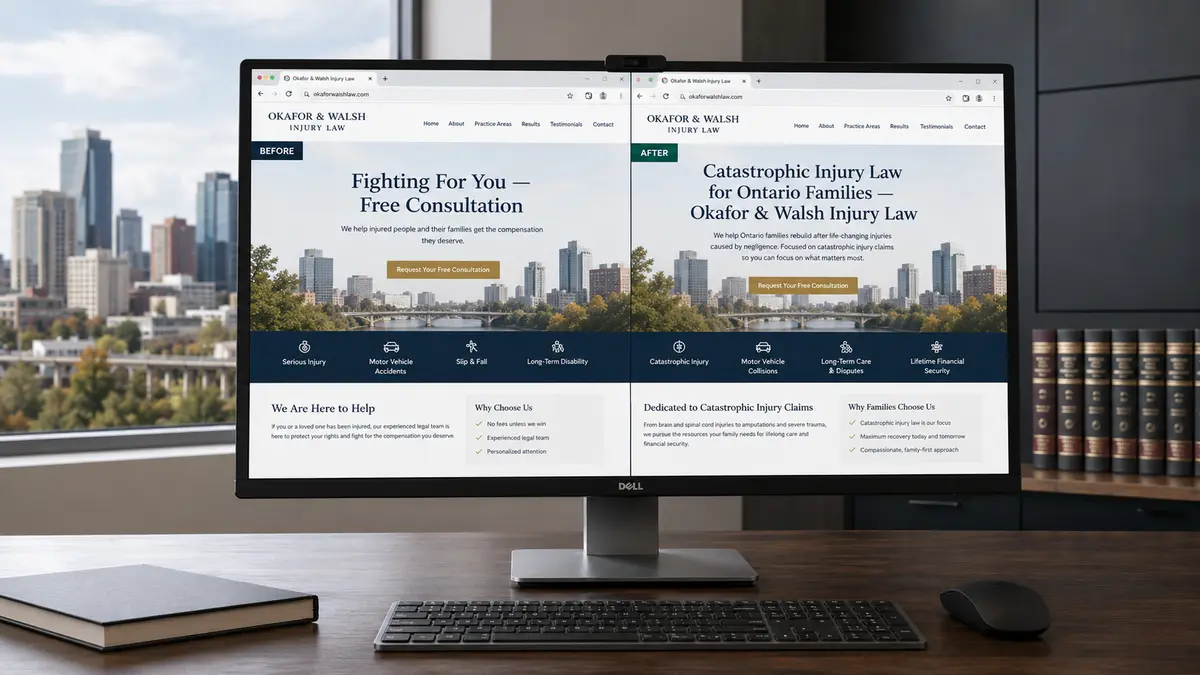
The firms that break through the noise do it with specificity. A PI firm that positions itself as the catastrophic injury practice for the Niagara region, with messaging that speaks directly to clients dealing with spinal cord injuries or traumatic brain injuries, occupies a different space in a potential client's mind than one that claims to handle "all types of personal injury."
Effective PI firm branding starts with honest answers to hard questions. What types of cases does the firm actually want? Which cases deliver the highest value? What does the firm do better than its direct competitors in the same geography? The answers to those questions become the foundation of the brand positioning.
For a personal injury firm, brand identity also needs to balance authority with approachability. The visual design should signal professional competence, but the tone needs to feel human. People searching for a PI lawyer are often dealing with pain, financial stress, and uncertainty. A brand that comes across as cold or corporate repels the very clients it's trying to attract. A brand that feels empathetic, clear, and direct earns the consultation.
Brand consistency across touchpoints matters more for PI firms than almost any other practice area, because PI clients interact with the firm across more surfaces: the Google listing, the website, the intake call, the initial consultation, ongoing case updates, and eventually the settlement discussion. Every touchpoint either reinforces the brand or undermines it.
What Makes Up a Law Firm's Brand Identity?
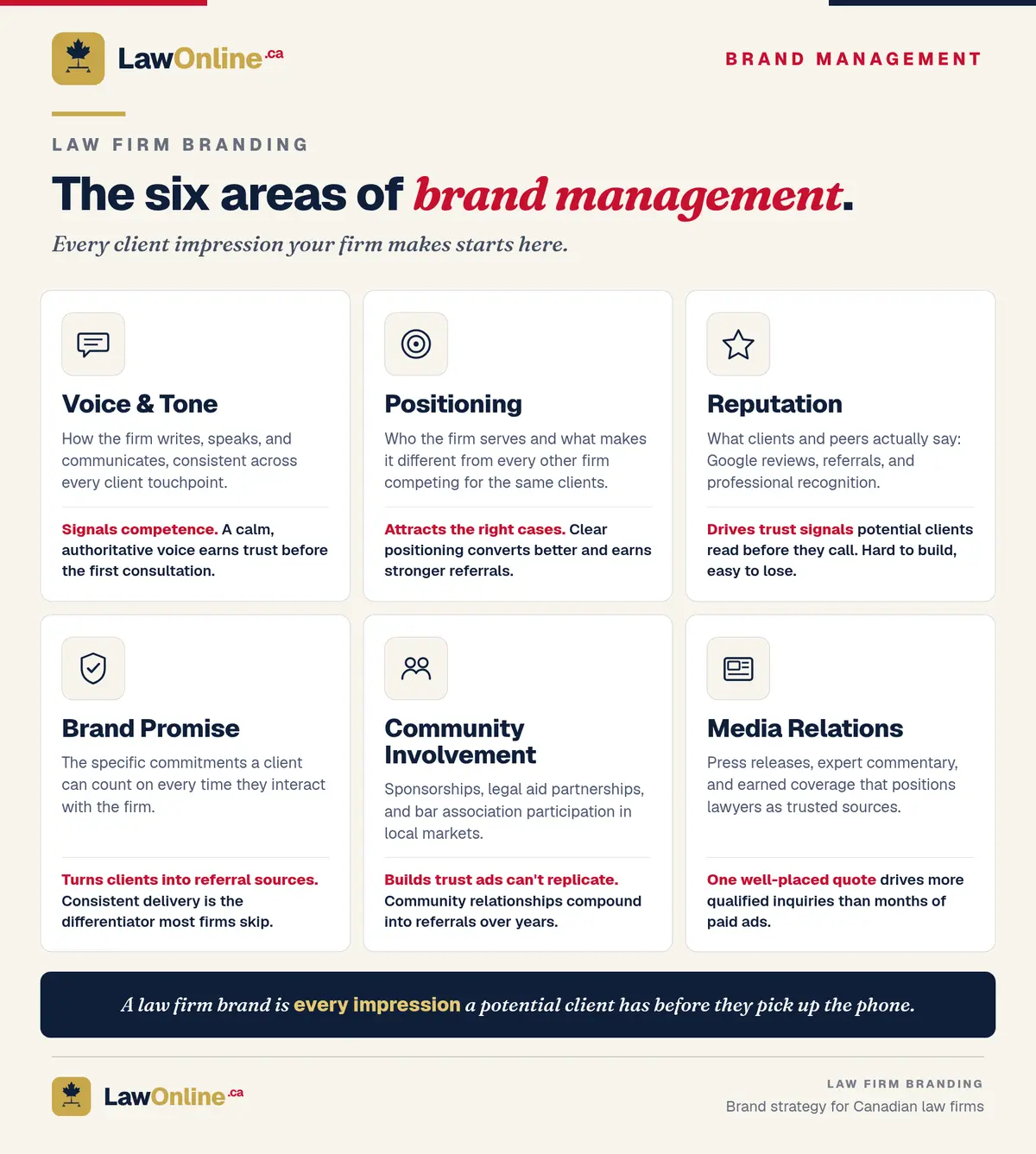
Law firm brand management covers six key areas. Each one shapes how potential clients perceive the firm before they ever speak to a lawyer.
Voice and Tone
How the firm writes and speaks. Voice is the firm's personality expressed in language. It stays consistent. Tone shifts based on context: a blog post about limitation periods is informative and authoritative; a social media post congratulating a team member is warm and collegial.
Most law firms default to a stiff, formal voice that creates distance. "Our firm is committed to providing exemplary legal representation" sounds like every other law firm. "We handle motor vehicle accident cases in Ontario, from the first call to settlement" sounds like a firm that actually does the work.
Positioning
The strategic decision about who the firm serves and what makes it different. Positioning answers the question a potential client asks themselves within seconds of landing on the website: "Is this firm right for my situation?"
A PI firm that positions itself as the catastrophic injury practice for southwestern Ontario has clearer positioning than one that claims to handle "all types of personal injury across Canada." Narrower positioning attracts better-fit clients and fewer tire-kickers.
Reputation
What clients, peers, and the broader community say about the firm. Reputation is built through results, reviews, professional recognition, and word of mouth. It overlaps with branding but isn't the same thing. Branding is what you say about yourself. Reputation is what others say about you.
Google reviews are the most visible component of a law firm's reputation in 2026. A PI firm with 150 five-star reviews on its Google Business Profile carries more trust than one with 12 reviews, regardless of how polished the website is. Review generation and response should be a deliberate part of brand management, not an afterthought.
Brand Promise
The experience a client can count on every time they interact with the firm. Brand promise is the bridge between what the marketing says and what the client actually experiences. If the website promises responsive communication and the intake team takes three days to return a call, the brand is broken.
The most effective law firm brands make simple, specific promises and deliver on them consistently. "We return every call within four hours." "You'll have a direct line to your lawyer." "We explain every step of the process in plain language." These aren't taglines. They're operational commitments that become the firm's reputation over time.
Community Involvement
Active participation in the local community is one of the most effective brand builders a law firm has. Sponsoring a local charity event, partnering with a legal aid clinic, hosting free legal information seminars, and supporting bar association initiatives all increase brand visibility with the people who matter most: potential clients and referral sources who live and work in the same geography as the firm.
Community involvement works because it creates trust signals that advertising can't replicate. A Hamilton personal injury firm that sponsors a local sports league and participates in community legal clinics builds familiarity in ways a Google Ads campaign doesn't. These relationships compound over years and show up as referrals, reviews, and brand recall at exactly the moment a potential client is deciding who to call.
The most effective community involvement connects the firm to its target client base. A wills and estates practice that partners with a seniors' centre reaches the demographic it serves. A PI firm that supports events in immigrant communities expands its referral network into underrepresented markets. Done well, community involvement isn't just good citizenship. It's brand strategy.
Media Relations
A consistent presence in local and national media builds authority that no amount of advertising replicates. Media relations for law firms includes press releases for significant case outcomes (where Law Society advertising rules permit), positioning individual lawyers as expert sources for journalists and news outlets, and responding to media requests when legal commentary is needed on issues relevant to the firm's practice area.
Getting quoted in a regional newspaper, a legal publication, or a national outlet as a subject matter expert creates third-party validation that potential clients notice and referral sources remember. A single well-placed article can drive more qualified inquiries than months of paid advertising, because it carries the credibility of editorial endorsement rather than a paid placement.
Media relations is most effective when it's consistent and proactive. Waiting for a journalist to call rarely works. A steady stream of press releases, media pitches, and commentary builds the firm's reputation as a reliable, quotable expert, and that credibility is what generates coverage over time.
How Does Brand Positioning Work for Law Firms?
Brand positioning is the answer to "why should a client choose this firm over every other option?" It's the strategic foundation that everything else (visual identity, messaging, content, advertising) is built on.
Strong positioning has three qualities:
- Specificity. It names who the firm serves and what it does differently. "We handle catastrophic injury cases for families in the Calgary area" is positioning. "We provide quality legal services" isn't.
- Credibility. It makes claims the firm can back up with evidence. Results, credentials, experience, and client reviews all support positioning. Claims without evidence are just slogans.
- Relevance. It addresses what the target client actually cares about. A PI client cares about whether the firm understands their specific situation and has a track record with similar cases. They don't care about the firm's founding date or the number of offices it has.
Positioning doesn't mean turning away clients outside the niche. It means leading with a clear, specific message that attracts the right clients in disproportionate numbers. A firm positioned around catastrophic injury will still take strong soft-tissue cases. But the positioning ensures that when someone in the target audience is comparing firms, this one stands out.
What's the Difference Between Reputation and Branding?
Branding is what you put into the market. Reputation is what the market says back. They overlap, but they're different disciplines with different levers.
Branding is internal and controllable. The firm decides its visual identity, its messaging, its positioning, its voice. These are strategic choices that can be changed, refined, and improved through deliberate work.
Reputation is external and partially controllable. The firm can influence its reputation through excellent client service, active review generation, thoughtful responses to reviews, and consistent delivery on its brand promise. But it can't dictate what clients say. A single bad review is visible to every potential client who searches for the firm.
The relationship between the two is reinforcing. Strong branding sets expectations. Consistent delivery builds reputation. Strong reputation validates the brand. The cycle compounds.
Where firms get into trouble is when branding and reputation diverge. A firm that markets itself as client-centred and responsive but routinely takes days to return calls has a brand-reputation gap. Potential clients will notice, because they read the reviews. The fix isn't better marketing. It's better operations.
For firms concerned about online reviews and public perception, reputation management is a service that sits alongside branding. It includes review generation systems, response templates, monitoring across platforms, and crisis response protocols.
How LawOnline Approaches Brand Work
We approach law firm branding as a strategic exercise built around the cases the firm wants and the clients it needs to reach. Every engagement starts with understanding the firm's positioning, then we build the channels and presence that reinforce it.
Discovery. We start by understanding the firm's practice areas, target case types, competitive landscape, and growth goals. A personal injury firm in Edmonton competing for catastrophic injury cases has different brand needs than a family law practice in Ottawa focused on high-net-worth divorces. The discovery process surfaces what makes the firm genuinely different and what the target clients care about.
Positioning. Based on discovery, we define the firm's brand positioning: who it serves, what it does differently, and why the target audience should choose it. This becomes the strategic foundation for every other brand decision.
Voice and messaging. We define the firm's tone of voice and develop core messaging for the website, practice area pages, social media, and client communications. Every message is checked against the positioning and against provincial Law Society advertising rules.
Media relations. We help firms build a presence beyond their own channels. That means drafting press releases for significant verdicts, settlements, and firm milestones (where provincial Law Society rules permit disclosure), positioning individual lawyers as expert sources for journalists in their practice area, and developing a communications calendar that generates steady earned media over time. A lawyer quoted as an expert source in a regional outlet carries authority that a display ad never will.
Community strategy. We identify the community involvement opportunities that align with the firm's target client base and practice areas: sponsorships, legal aid partnerships, speaking engagements, pro bono programs, and bar association participation. From there, we help the firm build a consistent presence in those channels. Community visibility compounds, and the firms that start early build advantages that are hard to replicate.
Implementation. Brand identity is only valuable if it's applied consistently. We build the brand into the firm's website, content marketing, and SEO strategy so that every digital touchpoint reinforces the same identity.
Law Firm Branding by the Numbers
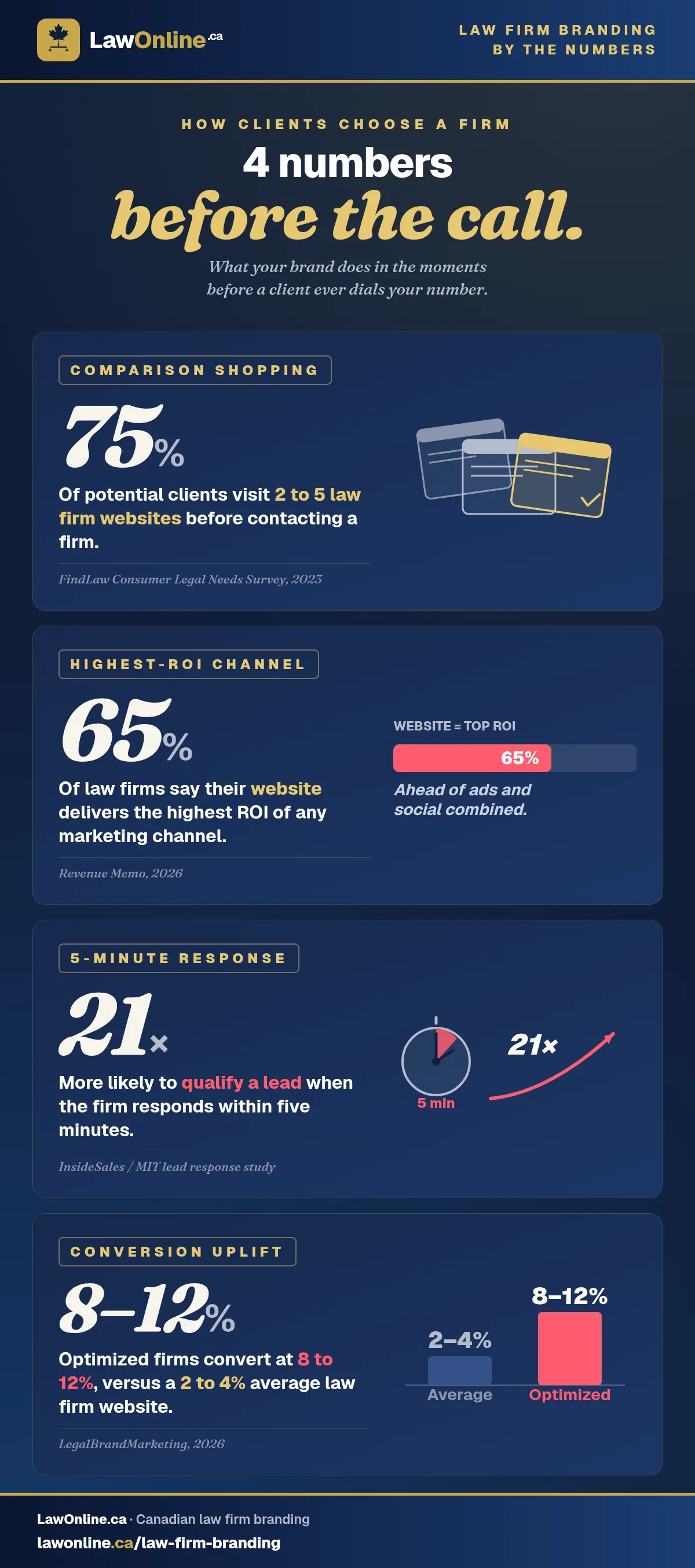
- 75% of potential clients visit 2-5 law firm websites before contacting a firm (FindLaw Consumer Legal Needs Survey, 2023)
- 65% of law firms say their website delivers the highest ROI of any marketing channel (Revenue Memo, 2026)
- Average law firm website converts at 2-4%; optimized firms convert at 8-12% (LegalBrandMarketing, 2026)
- Firms that respond to inquiries within five minutes are 21× more likely to qualify the lead (InsideSales/MIT lead response study)
Ready to Talk About Your Brand?
If your firm looks like every other firm in your market, branding is the problem. We'll review your current brand presence, identify where consistency breaks down, and show you what a positioning-driven brand strategy looks like for your practice areas and competitive landscape. Built around attracting the right clients and commanding the retainers your work deserves.
This is a strategic conversation, not a design pitch. No obligation, no pressure.
Frequently Asked Questions
What's the difference between brand management and a marketing retainer?
A marketing retainer typically covers execution: SEO, paid ads, content production, and reporting. Brand management covers the strategic layer underneath: how the firm is positioned, how it communicates, how it shows up in the community, and what story its media presence tells. The two reinforce each other. Brand management sets the direction; the marketing retainer executes it. Most LawOnline engagements combine both so the firm's day-to-day marketing reinforces its long-term brand positioning.
How much does law firm brand management cost?
Scope determines cost. A focused engagement covering positioning, voice and messaging, and a social media strategy costs less than a full brand management program that adds media relations, community strategy, reputation monitoring, and ongoing channel management. During our initial conversation, we scope the work and provide transparent pricing before anything begins. For context on broader marketing costs, see our guide to law firm marketing costs in Canada.
How long does a law firm brand strategy engagement take?
The strategy phase includes positioning, voice and messaging, and channel planning. It typically takes four to eight weeks. Implementation (rolling out the strategy across social media, content, press releases, and community channels) runs on an ongoing basis from there. The positioning work comes first, because executing brand management without a clear strategic foundation produces activity that doesn't compound into recognition or referrals.
Can a small firm benefit from branding?
Small firms benefit more, not less, from strong branding. A solo PI practitioner competing against large firms with bigger marketing budgets can't outspend them. Clear positioning and a distinctive, professional brand are the levers that don't require a large budget. A solo practitioner in London who's clearly positioned as the go-to firm for motorcycle accident cases in southwestern Ontario has stronger brand recall than a large firm that claims to do everything.
How does branding affect SEO?
Branding affects SEO in two ways. First, branded searches (people searching for the firm by name) are a positive ranking signal. Strong brand awareness increases branded search volume, which signals authority to Google. Second, a consistent brand voice and professional design improve on-site engagement metrics. Visitors stay longer, click deeper, and convert more often on a site that feels trustworthy and cohesive, all of which contribute to the site's SEO performance.
Should a law firm hire a branding agency or a marketing agency?
It depends on what the firm needs. A branding agency specializes in identity design and positioning. A marketing agency handles the broader scope: SEO, content, advertising, and lead generation. For most law firms, the practical answer is a marketing agency that includes brand strategy in its scope of work, because branding is most effective when it's integrated into the firm's marketing execution rather than delivered as a standalone project.