Search engine optimization gets you traffic. Conversion rate optimization (CRO) determines what happens after people arrive.
Most law firms invest heavily in the first and almost nothing in the second. That means they're paying to attract visitors who leave without making contact. Law firm website conversion optimization is the missing piece. We see this pattern constantly: a firm will spend $5,000 a month on SEO and ads, driving real traffic to a website that converts at barely 2%. The problem isn't the marketing. It's the website.
Industry benchmarks put the median law firm website conversion rate at around 2%, roughly 20 leads per 1,000 visitors. Top-performing firms reach 8% to 12%. That gap isn't a traffic problem. It's a website problem. Moving from 2% to 5% doesn't require more traffic or a higher ad budget. It requires understanding why visitors leave without converting and fixing those friction points.
This guide covers practical conversion optimization for Canadian law firm websites, with specific attention to the patterns that matter most for personal injury and other high-volume consumer practice areas.
What Conversion Rate Optimization Means for Law Firm Websites
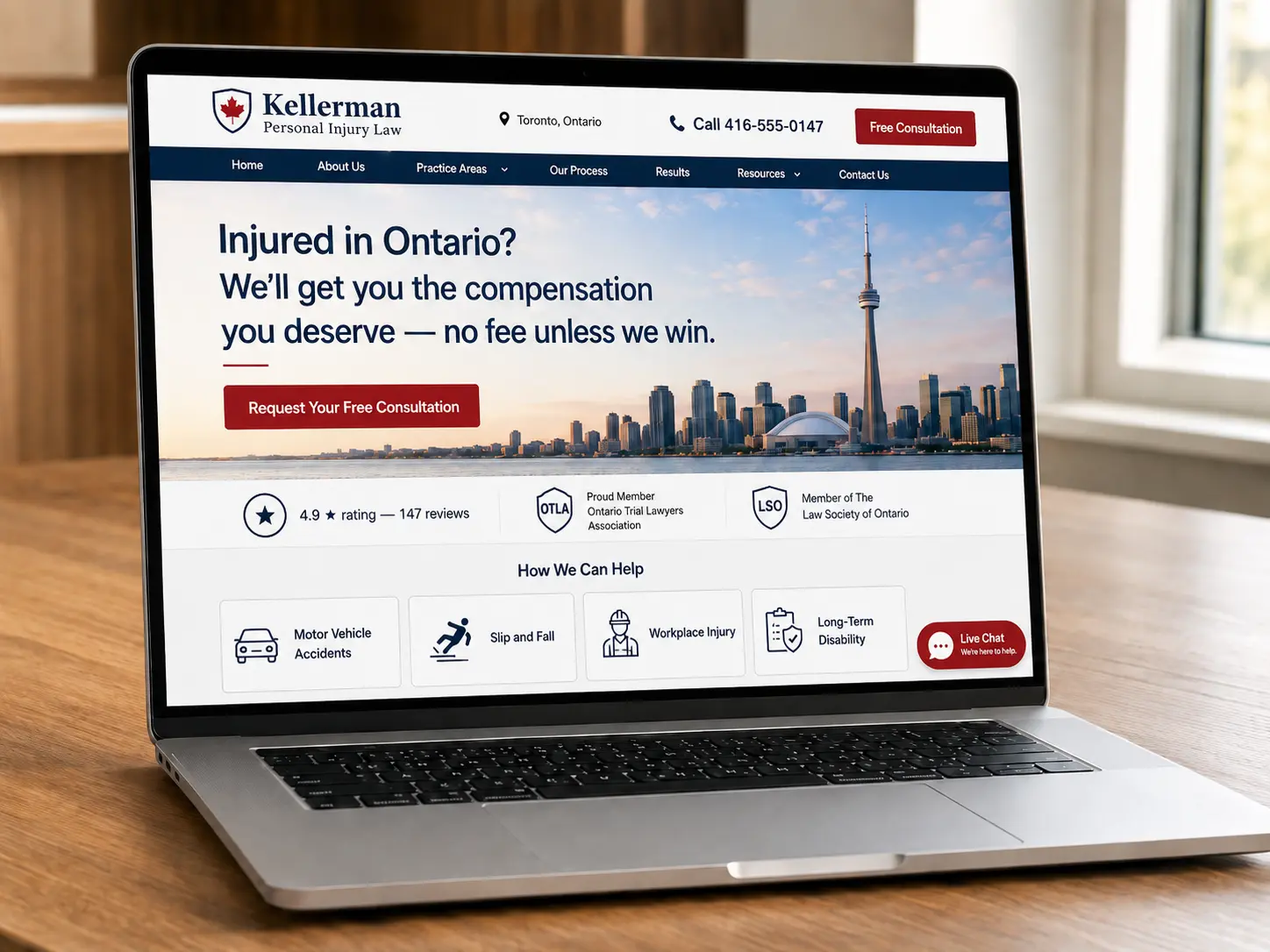
A "conversion" on a law firm website is any action that moves a visitor toward becoming a client. The primary conversions are:
- A phone call
- A contact form submission
- A live chat message
- A request to schedule a consultation
Secondary conversions include downloading a resource, signing up for a newsletter, or clicking through to a case results page. These don't produce clients directly, but they indicate engagement and move prospects through a longer consideration cycle. For Canadian firms, any email newsletter opt-in must comply with CASL (Canada's Anti-Spam Legislation), meaning you need express consent before adding someone to a mailing list.
It's worth noting how clients actually initiate contact. Industry data from MyCase shows that 46% of clients first contact law firms by phone, while 27% reach out by email. Your website needs to make both channels frictionless, not just the contact form.
CRO is the process of increasing the percentage of visitors who take those actions. It's different from UX design (which focuses on usability) and from SEO (which focuses on traffic), though it overlaps with both. CRO is specifically about the gap between "arrived at the site" and "made contact."
Why Most Law Firm Websites Don't Convert Well
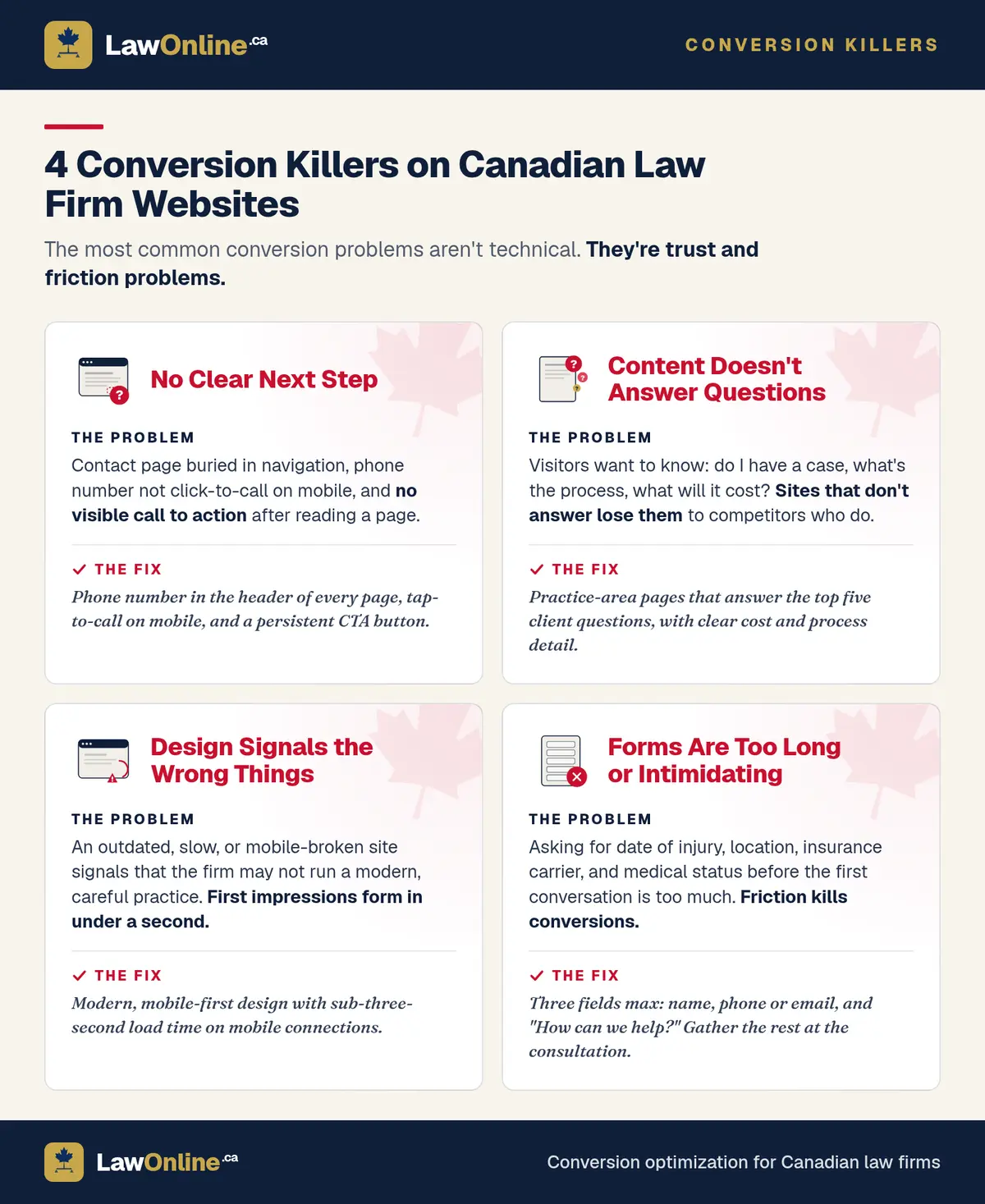
The most common conversion problems on law firm websites aren't technical. They're trust and friction problems.
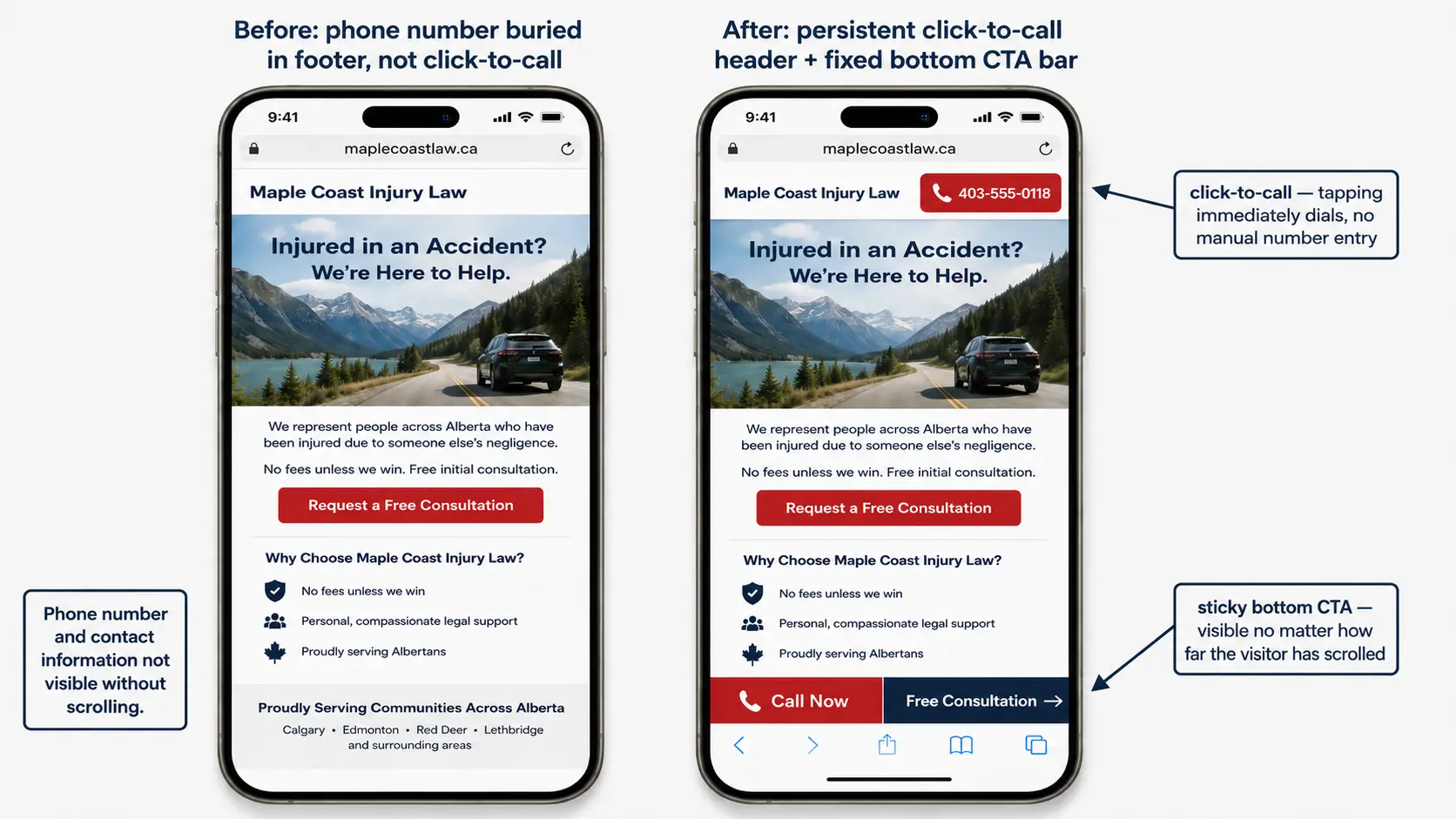
Visitors don't know what to do. Many law firm sites have a contact page buried in the navigation, a phone number in the header that's not click-to-call on mobile, and no clear next step after reading a page. If a visitor reads about your personal injury practice and has to hunt for how to reach you, many will leave.
The site doesn't answer the questions visitors actually have. A personal injury prospect's questions are usually: Do I have a case? What's the process? What will it cost me? How long will it take? What have you done for people like me? Sites that answer none of these, or bury the answers, lose prospects who go find a site that does answer them.
The design signals the wrong things. Law is a trust-intensive service. A website that looks outdated, loads slowly, or doesn't work properly on a phone signals, whether fairly or not, that the firm may not be running a modern, careful practice. First impressions are formed in under a second.
Forms are too long or too intimidating. A contact form that asks for date of injury, location, description of accident, insurance carrier, and current medical status before you've even had a conversation is asking for a lot from someone who just wants to know if you can help.
Friction kills conversions.
The Law Firm Contact Conversion Funnel
Before optimizing anything, map how a visitor is supposed to get from arriving at your site to making contact. The funnel typically looks like this:
- Lands on a page (home, practice area, blog post, city landing page)
- Reads enough to understand what the firm does and that it might be relevant
- Sees trust signals that reduce the risk of reaching out
- Finds a clear, low-friction path to make contact
- Converts
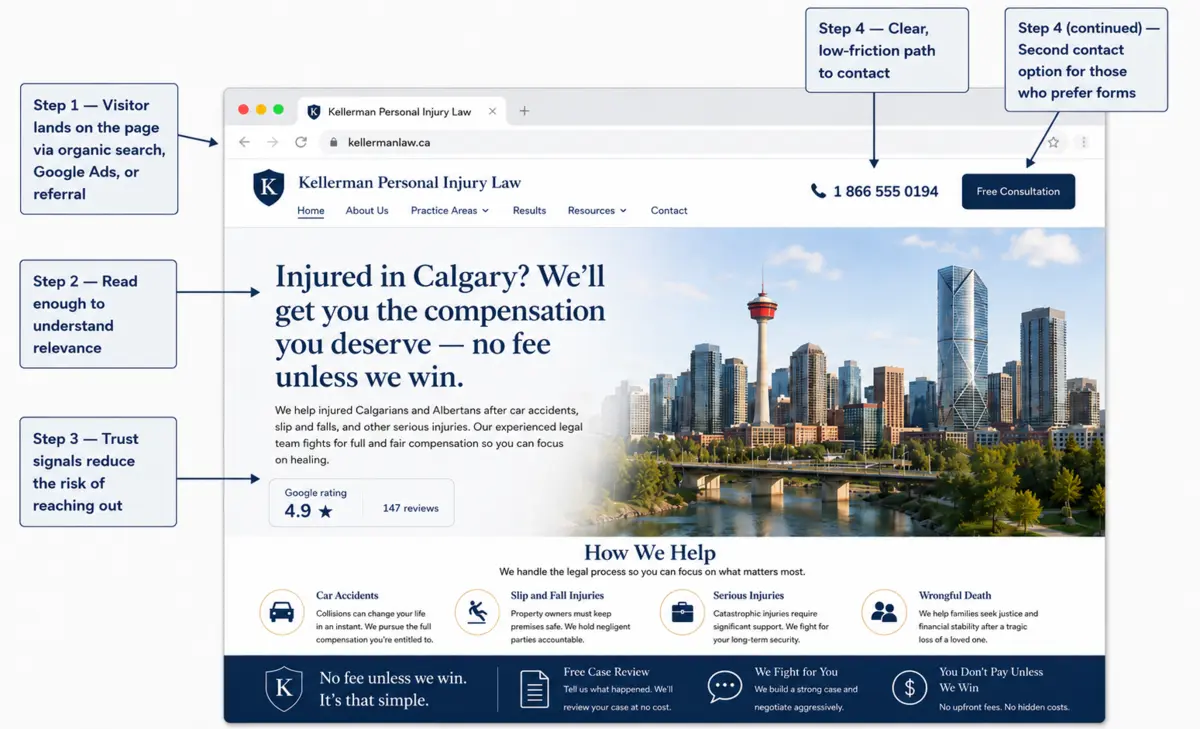
Optimization happens at each stage of this funnel. A problem at step 2 means your content isn't speaking to visitor intent. A problem at step 4 means your call-to-action design is failing. Identifying where visitors drop off, using tools like Google Analytics, Hotjar, or Microsoft Clarity, tells you where to focus.
High-Impact CRO Changes for Law Firm Websites
1. Make Contact Options Obvious and Persistent
Your phone number should be:
- In the header of every page, prominently placed
- A click-to-call link on mobile (a
tel:link, not plain text) - Large enough to read at a glance on all devices
On mobile, where a significant percentage of personal injury leads originate, people searching immediately after an accident, click-to-call isn't a nice-to-have. It's essential. A visitor using their phone after a car accident isn't going to manually type your phone number. If clicking your number doesn't immediately dial, you've lost them.
For personal injury firms, consider a sticky header or a fixed bottom bar on mobile that shows the phone number and a "Free Consultation" button at all times, no matter how far down the page the visitor has scrolled.
2. Clarify the Value Proposition on Every Page
Most law firm home pages lead with something like: "Experienced. Dedicated. Results." This communicates nothing. Visitors want to know: what do you do, for whom, where, and why should I trust you over the next firm I find?
A more effective approach for a personal injury firm might be:
"Injured in Ontario? We help accident victims get the compensation they deserve. Contingency fee: you pay nothing unless we win."
This communicates the practice area, the geography, the client promise, and the risk-reversal (contingency fee) in one sentence. Every page of your site should answer the visitor's implicit question: am I in the right place?
Landing pages for specific search terms, "Toronto motorcycle accident lawyer," "Waterloo slip and fall attorney", should be hyper-specific to that search intent. The visitor arrived because of that exact phrase; the page should immediately confirm they're in the right place.
3. Reduce Form Friction
Contact forms should ask for the minimum information needed to start a conversation. For a personal injury firm, that's typically:
- Name
- Phone number or email
- One open-ended question: "What happened?" or "How can we help?"
That's it. You can gather additional information during the consultation. A form that asks for eight fields, including details about injuries and insurance, introduces friction that will cause a significant percentage of prospects to abandon without submitting.
A/B testing form length is one of the highest-impact CRO tests you can run. In legal marketing, shorter forms consistently outperform longer ones.
One requirement that's easy to miss: Canadian law firms collecting personal information through contact forms are subject to PIPEDA (and provincial equivalents in BC, Alberta, and Quebec). Link to your privacy policy from the form itself and make clear how the information will be used. It's a legal requirement, and it also functions as a trust signal.
4. Add Social Proof at Conversion Points
Social proof, evidence that others have trusted you and had good outcomes, is one of the most powerful conversion factors. It should appear close to your calls to action, not buried on a separate testimonials page.
Effective social proof for law firm sites includes:
- Client testimonials with full names (or first name + city at minimum), placed on practice area pages and the home page
- Case results, settlement amounts or verdict values, with appropriate disclaimers, placed on PI practice area pages
- Review scores, a Google rating widget or a display of your star rating from Google near your contact form
- Badges and affiliations, Law Society membership, OTLA membership for PI firms, any awards or recognition
For personal injury firms, case results are particularly powerful. A page that shows "Recent Settlements" with amounts like "$850,000 for a rear-end collision victim" and "$1.2M for a TBI from a slip and fall" gives a prospect a concrete picture of what working with you can achieve. Include appropriate disclaimers about results varying by case.
In Canada, displaying testimonials and case results is permitted in most provinces, but you need to comply with your law society's advertising guidelines. Ontario (LSO), BC (Law Society of BC), and Alberta each have specific rules about disclaimers, prohibited claims, and the use of client endorsements. Review your provincial rules before publishing case results or testimonial sections on your site.
5. Optimize for Mobile
More than half of all web traffic is mobile, and for personal injury law the proportion is often higher, people search for lawyers on their phones, frequently shortly after an accident. A site that's technically mobile-responsive but hasn't been tested and refined for mobile UX will lose a large percentage of those visitors.
Test your site on actual mobile devices, not just a browser emulator. Key checks:
- Is the phone number click-to-call?
- Does the contact form work well on a small touchscreen?
- Do buttons and links have enough tap target size that they're easy to hit?
- Does the page load in under three seconds on a mobile connection?
- Is text readable without pinching or zooming?
Google's Core Web Vitals metrics, which now directly influence search rankings, overlap heavily with mobile performance. A fast, mobile-optimized site converts better and ranks better simultaneously.
6. Improve Page Speed
Page speed is a conversion factor independent of mobile. Google's mobile benchmarking data shows the impact clearly: when page load time increases from one second to three seconds, the probability of a visitor bouncing rises by 32%. At five seconds, it rises by 90%. At ten seconds, 123%. The first five seconds of load time have the highest impact on whether a visitor stays or leaves.
For law firm sites, common culprits are:
- Unoptimized images (photos that are 5MB instead of 200KB)
- Too many third-party scripts (chat widgets, analytics tools, Facebook Pixel, all loading at once)
- Low-quality hosting
Run your site through Google PageSpeed Insights. Anything below 70 on mobile is impacting your conversions and your rankings. The fixes are usually technical but tractable.
7. Use Live Chat or SMS for Immediate Connection
Live chat converts well for law firm websites because it reduces the commitment barrier. A visitor who isn't sure they have a case and isn't ready to call may be willing to type a quick question. Chatting feels less serious than a phone call, and for someone in a stressful situation, a car accident, a workplace injury, that lower barrier matters.
For personal injury firms, some operators run staffed chat during business hours and use a chatbot to capture after-hours inquiries. Even capturing a name and phone number with a message like "We're currently closed, leave your number and we'll call you first thing tomorrow" converts better than a silent, closed site.
SMS opt-in at the form level, "Text is also fine if you prefer", appeals to younger clients who are more comfortable texting than calling or emailing.
8. Create Dedicated Landing Pages for Campaigns
If you're running Google Ads, the landing page matters as much as the ad. Sending traffic from a "Toronto personal injury lawyer" ad to your home page, where visitors have to figure out they're in the right place, loses money. A dedicated landing page that mirrors the ad's messaging, confirms the practice area and geography, and presents a single focused call to action converts significantly better. Unbounce's conversion benchmark data shows legal industry landing pages convert at a 6.3% median, more than three times the ~2% average for law firm websites overall.
Dedicated landing pages for specific ad campaigns or high-volume organic search terms should:
- Match the search intent exactly
- Remove navigation options that take users away from the conversion goal
- Include social proof relevant to the specific situation (e.g., testimonials from car accident clients for a motor vehicle accident page)
- Have one primary call to action (call or form)
Measuring Conversion Performance on Your Law Firm Website
You cannot improve what you don't measure. At minimum, track:
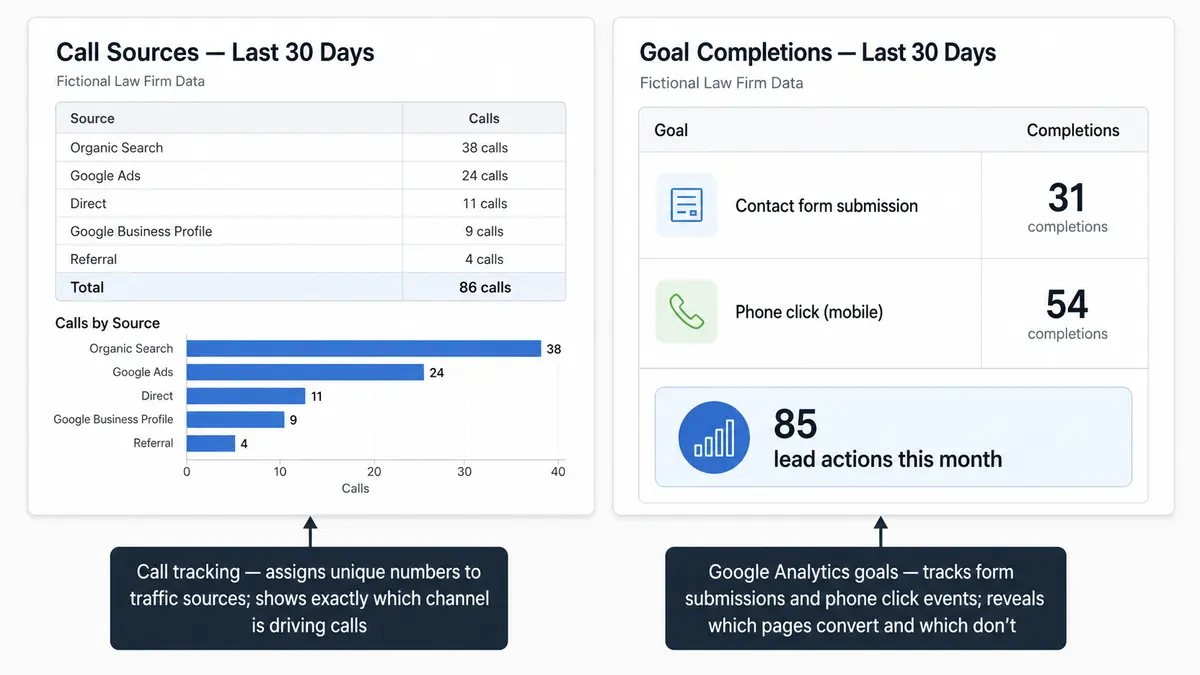
Goal completions in Google Analytics. Set up conversion goals for form submissions and phone call clicks. If you're not tracking these, you're operating blind.
Call tracking. Tools like CallRail assign unique phone numbers to different traffic sources, so you can see whether calls come from organic search, Google Ads, or direct traffic. For law firms spending on PPC, call tracking is essential, it lets you calculate cost per lead accurately.
Conversion rate by page. Which pages on your site drive the most conversions? Which high-traffic pages have poor conversion rates? Both answers point to optimization opportunities.
Session recordings and heatmaps. Tools like Hotjar and Microsoft Clarity (free) show where visitors click, where they scroll, and where they stop engaging. These sessions reveal UX friction you might never discover just looking at aggregate analytics.
The Economics of CRO for Law Firms
The ROI case for CRO is compelling, especially for high-value practice areas.
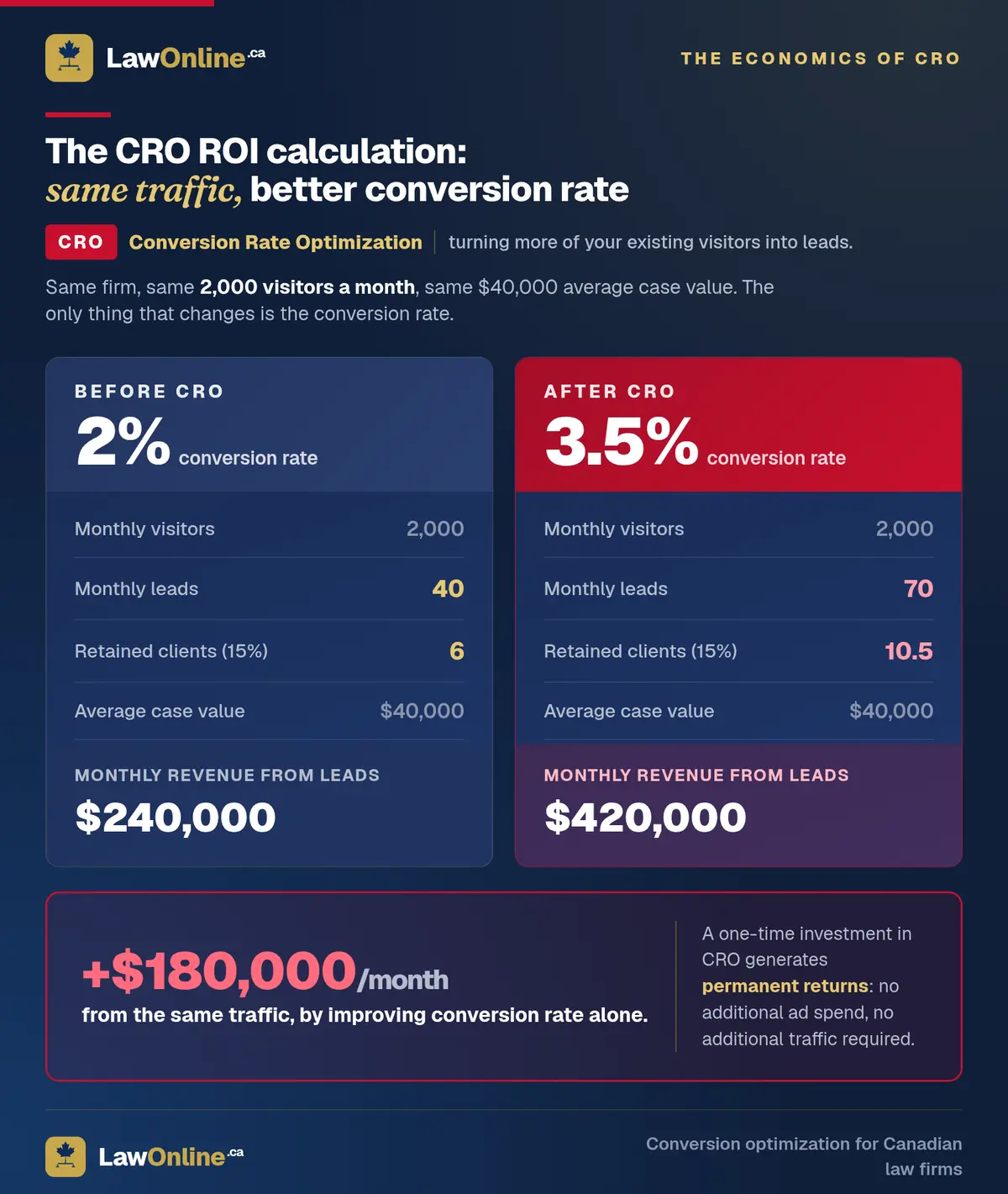
Suppose a personal injury firm's website receives 2,000 visitors per month and currently converts at 2%, producing 40 leads per month. Of those, 15% become retained clients (6 clients). Average case value is $40,000. Monthly revenue from website leads: $240,000.
If CRO work improves conversion rate from 2% to 3.5%, a realistic improvement through the changes described above, leads increase to 70, retained clients to 10.5, monthly revenue to $420,000. The same traffic, better conversion rate, $180,000 more in monthly revenue.
That's the math. The work required to get there is a one-time investment: redesigning contact forms, improving page speed, adding social proof, building a mobile-optimized contact experience. Maintenance is minimal.
CRO is one of the few marketing investments that generates permanent returns without ongoing spend. Once your site converts better, it converts better for every visitor going forward.
The Bigger Opportunity
Most law firm marketing conversations focus on how to get more traffic. The harder question is what happens to the traffic you already have.
In our experience, that's usually where the bigger opportunity lives. Closing the gap between traffic and leads doesn't require a new SEO campaign or a bigger ad budget. It requires understanding where visitors drop off and removing the friction between them and picking up the phone.
LawOnline.ca helps Canadian law firms build websites and marketing systems that convert. Law firm website conversion optimization doesn't have to be complicated, but it does have to be intentional. If you want to know how your site stacks up, reach out for a free conversion audit.