We run technical SEO, local search, and content programs built specifically for Canadian law firms. Below: what law firm SEO involves, how costs scale by practice area and firm size, and what makes the Canadian market different.
Table of Contents
- Why Does Law Firm SEO Matter?
- How Much Should a Law Firm Invest in SEO?
- What Does LawOnline Charge?
- What's the Difference Between SEO, GEO, and AEO?
- Why Is Local SEO Critical for Law Firms?
- What Actually Moves Law Firm Rankings?
- How Does SEO Differ by Practice Area?
- How Does Firm Size Affect SEO Strategy?
- How Is SEO Different in Canada vs the United States?
- What Does Year One of Law Firm SEO Look Like?
- Law Firm SEO by the Numbers
- What LawOnline Does Differently
- Ready to Talk About SEO?
- Frequently Asked Questions
Why Does Law Firm SEO Matter?
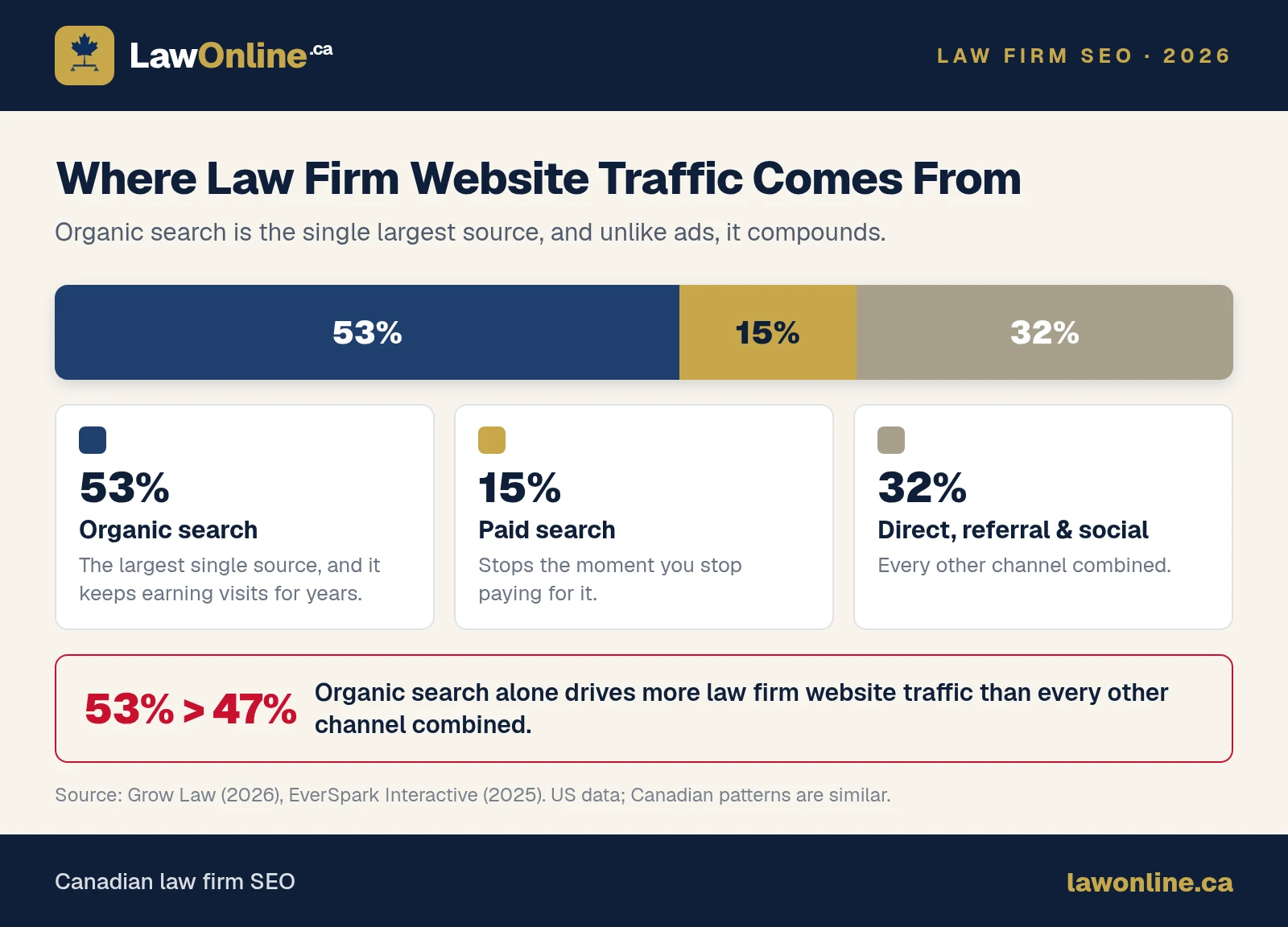
Law firm SEO is how potential clients find you. 96% of people looking for a lawyer use a search engine. 64% go directly to Google. If your firm doesn't appear on the first page of results, those clients are calling your competitors instead.
SEO for lawyers is the process of making your firm's website visible in search results when people look for the legal services you offer. It's the difference between a firm that gets a steady stream of qualified inquiries and one that relies entirely on referrals and paid ads.
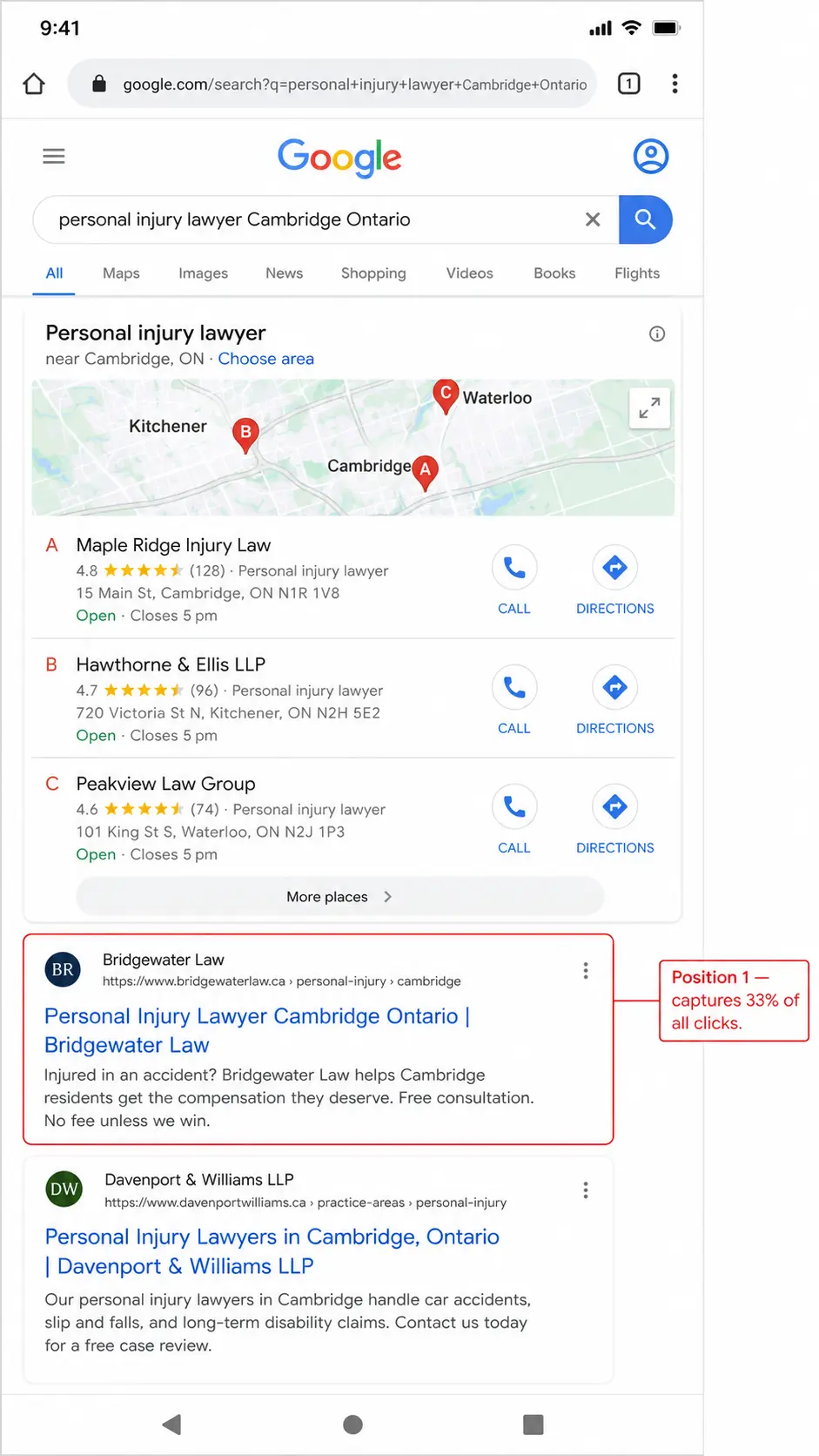
The numbers back this up. Organic search drives 53% of all law firm website traffic, compared to just 15% from paid search. Top-ranking firms capture 33% of all search traffic for their target terms. And organic search is responsible for 66% of phone call conversions to law firms (First Page Sage, 2025; Grow Law, 2026). These are US figures, but the pattern holds in Canada.
Paid ads stop working the moment you stop paying. SEO compounds. A well-optimized practice area page or blog post published today continues generating inquiries for years. That compounding is why legal content marketing is the foundation of any serious SEO program. Every well-targeted page keeps earning visits long after publication. For personal injury firms spending tens of thousands monthly on Google Ads, the math is worth examining: SEO delivers a 526% return on investment over three years, breaking even at roughly 14 months.
How Much Should a Law Firm Invest in SEO?
Law firm SEO in Canada typically costs between $1,500 and $10,000 per month. The industry average sits around $4,889 per month, with a median of $4,083. What your firm should invest depends on your market, practice areas, and how competitive your target keywords are.
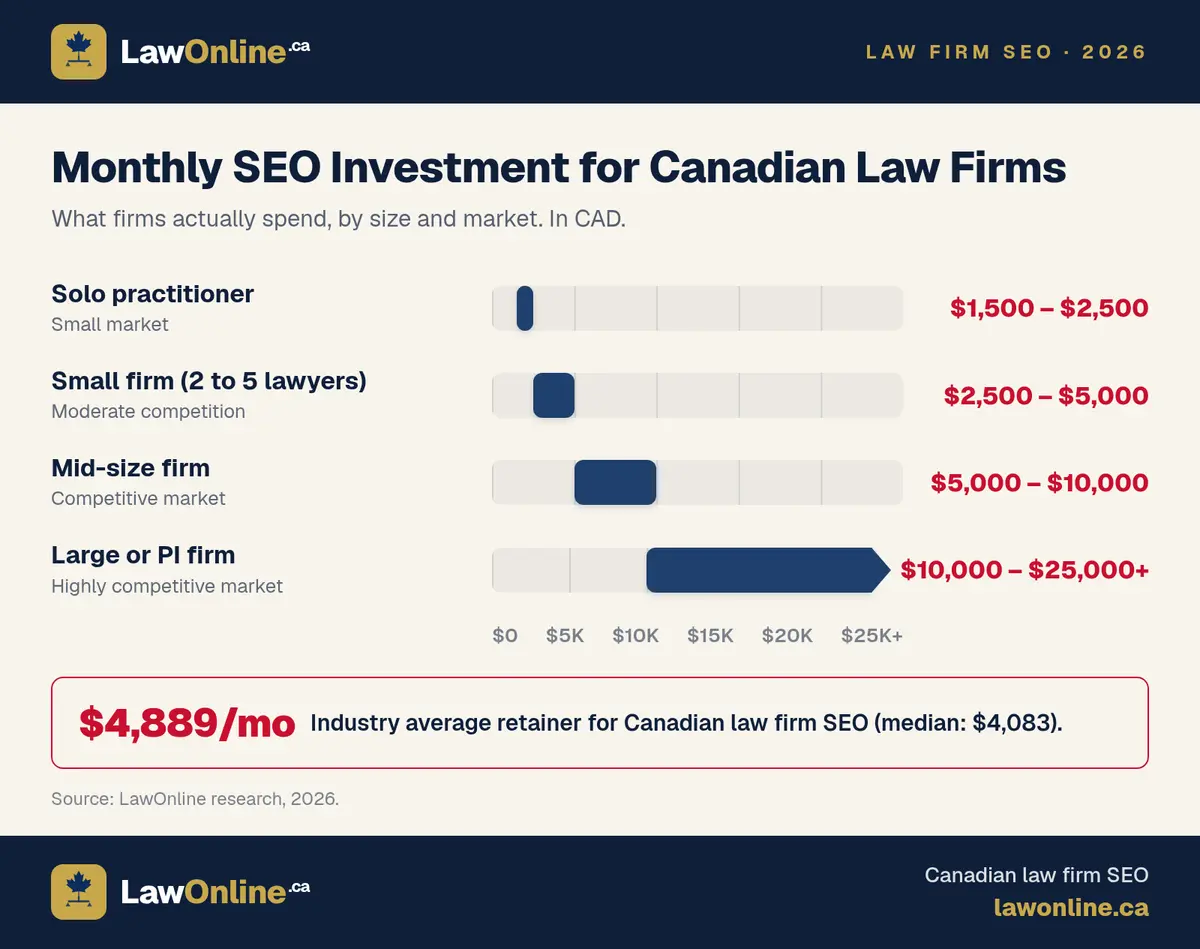
Full investment ranges by firm profile:
| Firm Profile | Monthly SEO Investment |
|---|---|
| Solo practitioner, small market | $1,500 to $2,500 |
| Small firm (2 to 5 lawyers), moderate competition | $2,500 to $5,000 |
| Mid-size firm, competitive market | $5,000 to $10,000 |
| Large or PI firm, highly competitive market | $10,000 to $25,000+ |
Where you practice matters as much as firm size. A family law firm in Kitchener or Cambridge can achieve strong results for $1,500 to $2,500 per month. A personal injury firm competing for "personal injury lawyer Toronto" needs $5,000 to $15,000 per month to gain ground against established incumbents. Multi-location firms targeting multiple cities routinely invest $10,000 to $25,000 or more.
A common question we get is whether SEO is worth it compared to paid advertising. Competitive legal keywords in Google Ads cost $200 or more per click in Canadian markets. SEO takes longer to ramp up, but once it does, the unit economics are dramatically better. A personal injury firm with a $25,000 average case fee that generates five additional qualified leads per month from organic search produces $37,500 in expected monthly revenue from a $3,000 to $5,000 investment. For a detailed breakdown of pricing tiers and what each level delivers, see our guide to law firm SEO costs in Canada.
What Does LawOnline Charge?
We publish our starting prices so you know where you stand before the first call. Every engagement is scoped to your market and practice areas, and you'll get the exact price in a written proposal before any work begins.
SEO: from $1,500 per month + HST
- One to two new articles a month, written for your practice areas
- Ongoing technical and on-page SEO: site fixes, page titles, structured data, and internal links
- GEO and AEO for AI search, at no extra charge
- A plain-language monthly report on the work we did, your rankings and search traffic, your visibility in AI answers, the inquiries you're getting, and what's next
The starting tier suits small and mid-size firms in smaller markets. Firms in larger cities or in competitive practice areas like personal injury need more content and more work per month, and we'll quote that once we've looked at your market. Google Business Profile management isn't part of the SEO retainer. It's priced separately below.
Google Business Profile management: from $600 per month + HST
- Weekly posts to your profile
- Responses to your Google reviews
- Review requests and photo updates
- A monthly report on the calls, direction requests, and website clicks your listing brings in, plus your reviews and where you show up in the local map results
Pricing is per location, and firms with more than one location get a discount. There's no setup fee. See Google Business Profile management for what's included.
Contract terms
Both services are month-to-month, with 30 days' notice to cancel. The one exception: if your website needs a substantial refresh before SEO can take hold, such as major on-page work, we ask for a three-month commitment to cover it, and the same 30 days' notice applies after that. We offer discounts for longer commitments.
Ready to get started? Tell us about your firm and we'll send a proposal with your exact price.
What's the Difference Between SEO, GEO, and AEO?
Three acronyms, one goal: making sure potential clients find your firm when they search for legal help. SEO, GEO, and AEO each target a different surface where that search happens, and understanding the distinctions matters because the tactics aren't identical.
SEO (Search Engine Optimization)
SEO is the practice of optimizing your website so it ranks higher in traditional search engine results on Google, Bing, and other search engines. It covers technical factors like site speed and mobile performance, on-page work like keyword targeting and content structure, and off-page signals like backlinks and citations. When someone searches "family lawyer Kitchener" and your firm appears on the first page, that's SEO working.
GEO (Generative Engine Optimization)
GEO focuses on getting your firm cited in AI-generated answers from tools like ChatGPT, Google AI Overviews, and Perplexity. Instead of ranking in a list of blue links, the goal is making your content the source that AI tools pull from when generating responses to questions like "What should I do after a car accident in Ontario?" or "How does child custody work in Alberta?" GEO requires structured, authoritative content that AI systems can parse and attribute, including clear heading hierarchies, self-contained answer paragraphs, and well-structured FAQ sections.
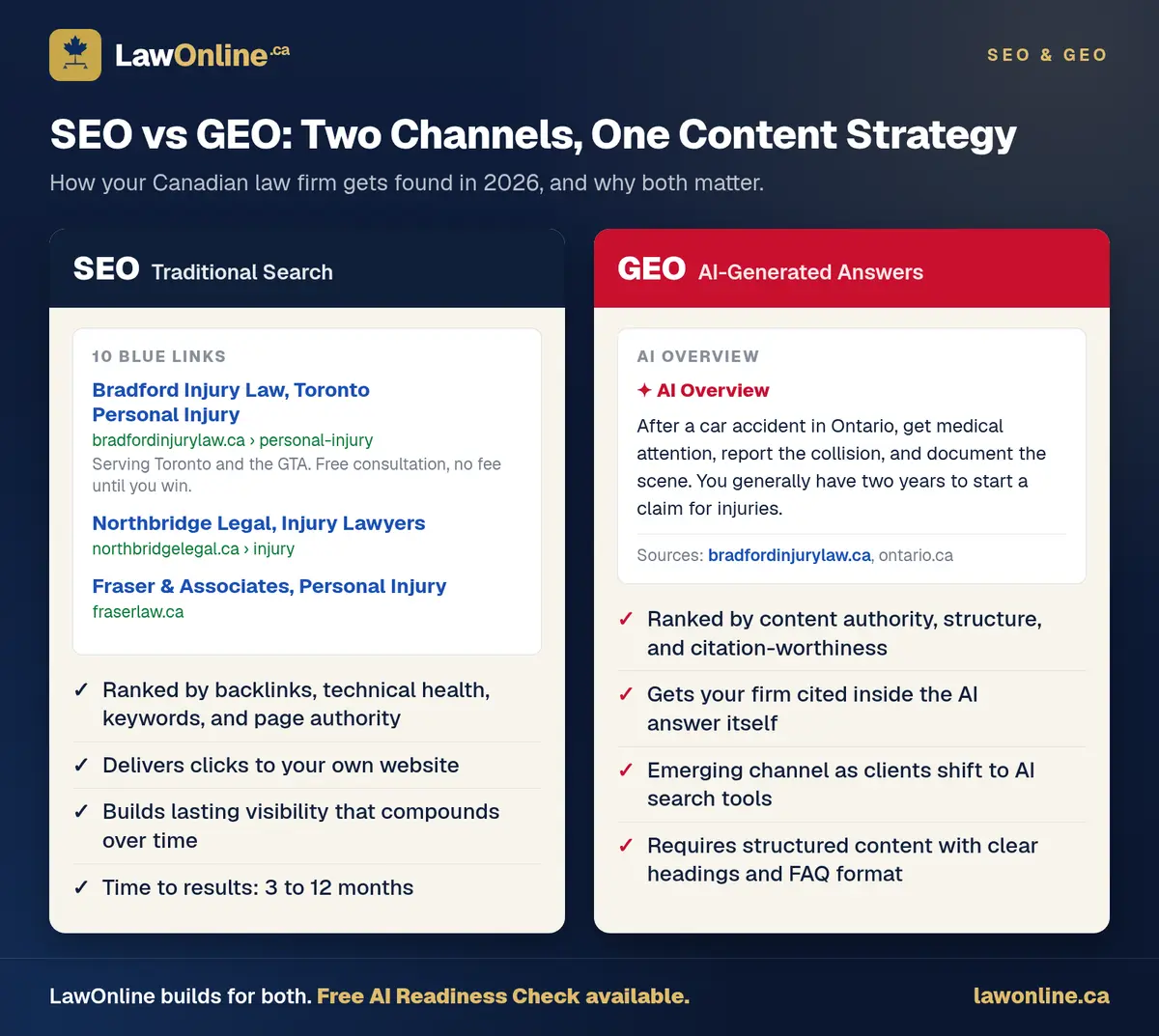
AEO (Answer Engine Optimization)
AEO targets the direct-answer features built into traditional search engines: featured snippets, People Also Ask boxes, knowledge panels, and voice search results. When Google pulls a definition or step-by-step answer directly onto the results page without requiring a click, that's answer engine territory. AEO overlaps with both SEO (the answers come from your website) and GEO (the formats that win featured snippets also tend to get cited by AI tools), but its specific focus is on structuring content so search engines select it as the single best answer to a question.
In practice, the overlap between these three disciplines is substantial. The same well-structured, authoritative content that ranks in traditional search also tends to win featured snippets and get cited by AI tools. That's why LawOnline treats SEO, GEO, and AEO as one integrated program rather than three separate line items. Every piece of content we produce and every technical optimization we implement is designed to perform across all three surfaces. Some agencies charge separately for GEO or AEO as add-on services, but we don't, because the work involved is the same work done well.
AI adoption among lawyers themselves has grown from 19% in 2023 to 79% in 2024 (SeoProfy, 2026). Potential clients are adopting AI search tools even faster. Firms that invest across all three channels now will have a significant visibility advantage over those that wait. Our free AI readiness check evaluates how well your current site performs across both traditional and AI-powered search.
Where we get your firm found
 Google Search
 Google Maps
 Bing
Bing ChatGPT
 Gemini
 Perplexity
 Claude
Why Is Local SEO Critical for Law Firms?
Local SEO determines whether your firm appears in Google's "Map Pack," the top three local results that show up for searches like "personal injury lawyer near me" or "divorce lawyer Kitchener." For most law firms, this is where the highest-intent traffic comes from. Someone searching with a location qualifier is typically ready to hire.
The data is striking: an optimized Google Business Profile generates seven times more clicks than an unoptimized one. Proper calls to action on your website increase conversions by 161%. And sites with correct heading structure rank 38% higher than those without (Grow Law, 2026).
Local SEO for law firms involves several interconnected elements:
- Google Business Profile optimization: Complete and accurate listing with photos, practice areas, service descriptions, and regular posts
- NAP consistency: Your firm's name, address, and phone number must match exactly across every directory, citation, and website mention
- Local citations: Listings in Canadian legal directories, provincial bar association listings, and local business directories
- Review management: Generating and responding to Google reviews (while staying within Law Society advertising rules)
- Location-specific content: Practice area pages that reference your specific jurisdiction, local courts, and regional legal nuances
For a deeper dive into local search tactics, read our guide to local SEO for Canadian law firms.
What Actually Moves Law Firm Rankings?
Five things consistently separate law firms on page one from everyone else. Neglect any one of them and the others have to work harder to make up for it.
- Local search authority. A complete, actively managed Google Business Profile, identical name, address and phone details everywhere the firm is listed, and citations from Canadian legal directories, law society listings and local business sites. For most firms, the map pack is where the highest-intent searches end.
- Depth by practice area. One thin page per practice area isn't enough. A personal injury firm that ranks has separate pages for car accidents, slip and falls, long-term disability and the other matters it handles, each answering the questions clients actually ask, all linked back to the main practice page.
- Technical performance. Google uses Core Web Vitals as ranking signals: main content loading in under 2.5 seconds, responses to taps in under 200 milliseconds, and a layout that doesn't jump around. Heavy hero images, chat widgets and bloated themes are the usual culprits on law firm sites.
- E-E-A-T signals. Named lawyer authors, substantive lawyer bios, links to law society and bar association profiles, and case results presented within the advertising rules. Our E-E-A-T guide for law firms has a full self-audit checklist.
- Internal linking. A hub page for each practice area, supporting pages that link back to it, and blog posts that point to the pages that matter most. Pages that receive more internal links carry more weight, so the structure decides where your ranking strength goes.
How Does SEO Differ by Practice Area?
Different practice areas face fundamentally different SEO landscapes. The keyword competition, client value, search intent, and content needs vary dramatically. A strategy that works for a personal injury firm won't work for a business law practice, and vice versa.
Personal Injury
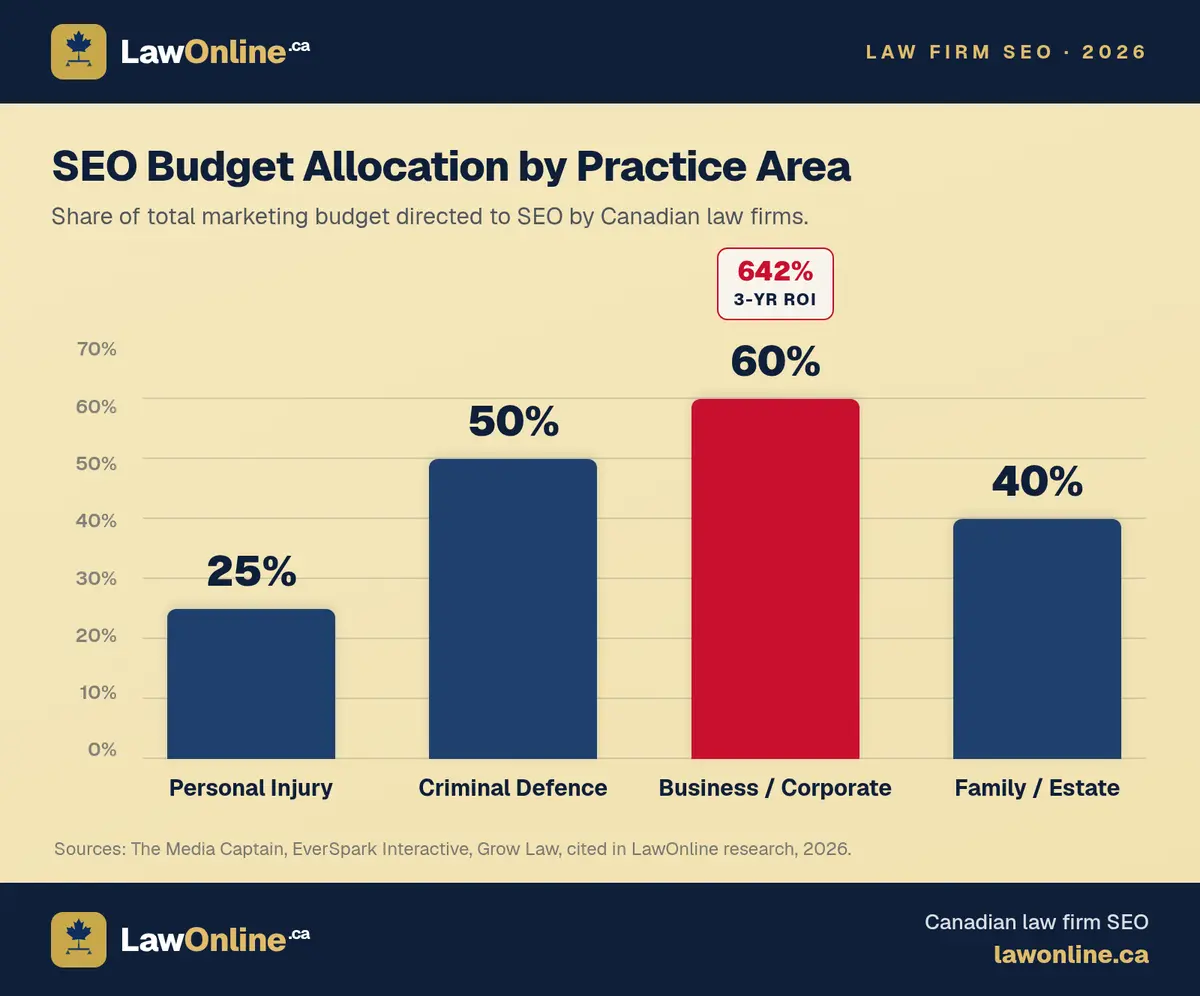
Personal injury is the most competitive SEO space in legal. The potential case values are high, which means firms are willing to spend aggressively on both SEO and PPC. Despite this, 96% of personal injury firm homepages rank for their primary practice area, the highest of any practice category (The Media Captain). PI firms allocate only 25% of marketing budgets to SEO because they rely heavily on paid search for immediate lead generation. But the firms that invest in organic rankings alongside PPC build a durable competitive advantage that compounds over time.
Content strategy for PI firms focuses on accident types, injury processes, and jurisdictional guides. Pages like "What to do after a car accident in Ontario" or "How long do I have to file a personal injury claim in Alberta?" drive consistent, high-intent traffic.
Criminal Defence
Criminal defence firms allocate 50% of their marketing budgets to SEO. The search behaviour is different from PI: potential clients are often searching in urgent, high-stress situations. They need to find a lawyer quickly and need to trust the firm immediately. Content that answers specific procedural questions, like "What happens at a bail hearing in Ontario?" performs well because it demonstrates expertise at the moment someone needs it most.
95% of criminal defence firm homepages rank for their primary practice area. The competition is intense in major metros but drops significantly in mid-sized cities.
Business and Corporate Law
Business law firms lead all practice areas in SEO budget allocation at 60%, and see the highest three-year ROI at 642%. The reason is straightforward: business clients do extensive research before choosing a firm. They read thought leadership content, compare firm capabilities, and evaluate expertise through published materials. A robust content and SEO strategy directly influences which firms make the shortlist.
Content for business law firms skews toward guides, industry analysis, and explanatory articles on topics like corporate restructuring, shareholder agreements, and regulatory compliance.
Family Law and Estate Planning
Family law and estate planning firms allocate about 40% of budgets to SEO. These practice areas generate high search volume, but the keyword competition is moderate compared to PI or criminal defence. The opportunity lies in comprehensive content: guides on separation agreements, child custody arrangements, property division, and estate planning basics. The searches are deeply personal, and potential clients spend considerable time researching before making contact. Firms with thorough, empathetic content convert at higher rates.
How Does Firm Size Affect SEO Strategy?
What works for a solo practitioner in Barrie won't work for a 200-lawyer Bay Street firm. The competitive landscape, budget, and goals are completely different.

Solo Practitioners and Small Firms (1 to 5 Lawyers)
The advantage of a small firm is focus. You can dominate hyper-local search terms that larger firms ignore. A solo family law practitioner in Guelph faces far less SEO competition than a Toronto firm, and can rank on page one with a well-optimized website, an active Google Business Profile, and a modest content program.
Priority for small firms: Google Business Profile, local citations, a handful of strong practice area pages, and one to two blog posts per month on topics your potential clients actually search for. The investment is modest relative to the return. If writing isn't a fit for your team, our content marketing team handles topic research, drafting, and ongoing publishing at this cadence. For more on marketing as a smaller practice, see our solo practitioner marketing guide.
Mid-Size Firms (6 to 30 Lawyers)
Mid-size firms typically serve multiple practice areas across one or two cities. The SEO challenge is managing competing priorities: which practice areas get the most content investment? Which locations matter most? How do you build authority across several distinct service lines without diluting your focus?
The answer is usually a structured content calendar that rotates across practice areas based on their contribution to firm revenue, combined with dedicated location pages and ongoing technical SEO maintenance. Mid-size firms also benefit from more sophisticated analytics to track which content generates inquiries for which practice groups.
Large Firms (30+ Lawyers)
Large firms face different SEO challenges: brand protection, multi-location visibility, and competitive intelligence. They're often competing with other large firms for broad, high-volume keywords at the provincial or national level. Content programs at this scale involve multiple authors, thought leadership pieces, and integration with the firm's broader marketing and PR strategy.
Technical SEO becomes more important at scale. Large law firm websites tend to accumulate technical debt: slow page loads, broken internal links, duplicate content, and poor mobile experiences. Regular technical audits and site health maintenance are essential. For more on the technical side, see our article on website speed and Core Web Vitals for law firms.
How Is SEO Different in Canada vs the United States?
Most SEO advice online comes from American agencies targeting American law firms. Canadian law firm SEO requires a fundamentally different approach because the market is structurally different, and strategies that work south of the border often fail here.
Smaller Markets, Lower Search Volume
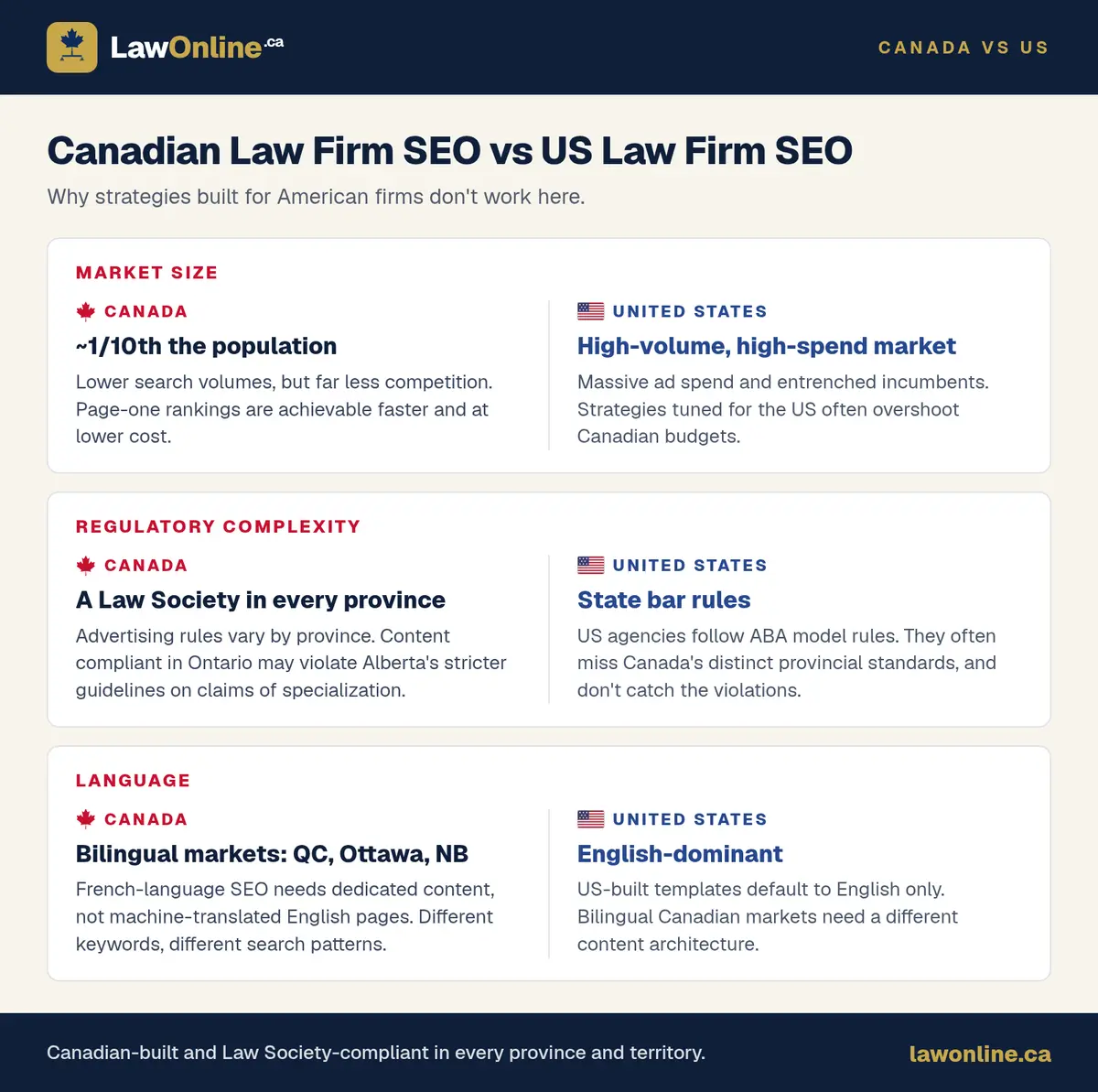
Canada has roughly one-tenth the population of the US. This means lower search volumes for most legal keywords, but also less competition. A keyword like "personal injury lawyer" gets far fewer monthly searches in Canada than in any single large US state. The opportunity is that a well-executed SEO strategy can achieve first-page rankings faster and at lower cost than in comparable US markets.
Provincial Regulation
Every Canadian province has its own Law Society with distinct advertising rules. Content that complies with the Law Society of Ontario's rules might violate Alberta's stricter guidelines on claims of specialization. Any SEO agency working with Canadian law firms needs to understand these differences and ensure that all content, from practice area pages to blog posts to Google Business Profile descriptions, complies with the rules of the relevant province. For more on this topic, see our guide to Ontario lawyer advertising rules.
Bilingual Considerations
Firms in Quebec, Ottawa, and parts of New Brunswick serve bilingual markets. French-language SEO is a distinct discipline: the keywords, search patterns, and competitive landscape differ from English. Firms serving francophone clients need dedicated French content, not machine-translated versions of English pages.
Different Competitive Dynamics
The US legal advertising market is enormous and aggressive. Canadian firms face less overall competition for search visibility, but the gap between firms that invest in SEO and those that don't is widening. As more Canadian firms recognize the value of digital marketing, the window for easy organic wins is closing. For a detailed comparison of how the two markets differ, read our article on Canadian vs US legal marketing.
What Does Year One of Law Firm SEO Look Like?
Misaligned expectations end more SEO campaigns than bad tactics do. SEO typically takes three to six months to show measurable movement and six to twelve months to gain traction on competitive terms. Here's what a realistic first year looks like for a firm in a competitive market:
- Months 1 to 3: foundation. A technical audit and fixes, Google Business Profile cleanup, a content audit, and a keyword map built from real search data. Rankings rarely move yet. What you should see is the work itself, documented.
- Months 4 to 6: content and on-page work. New practice area pages and posts go live, existing pages get on-page fixes, and internal links start building topical authority. Long-tail searches such as "how long does a personal injury claim take in Ontario" start reaching page one. Head terms usually haven't moved much.
- Months 7 to 12: ranking movement. Primary keywords start climbing, the firm may begin appearing in the map pack, and calls and form submissions from organic search start rising.
Year one builds the foundation. It won't outrank a competitor that has invested for five years. Firms that commit to the full twelve months, without cutting the budget when month three hasn't produced leads, are the ones that see year two pay off.
Law Firm SEO by the Numbers
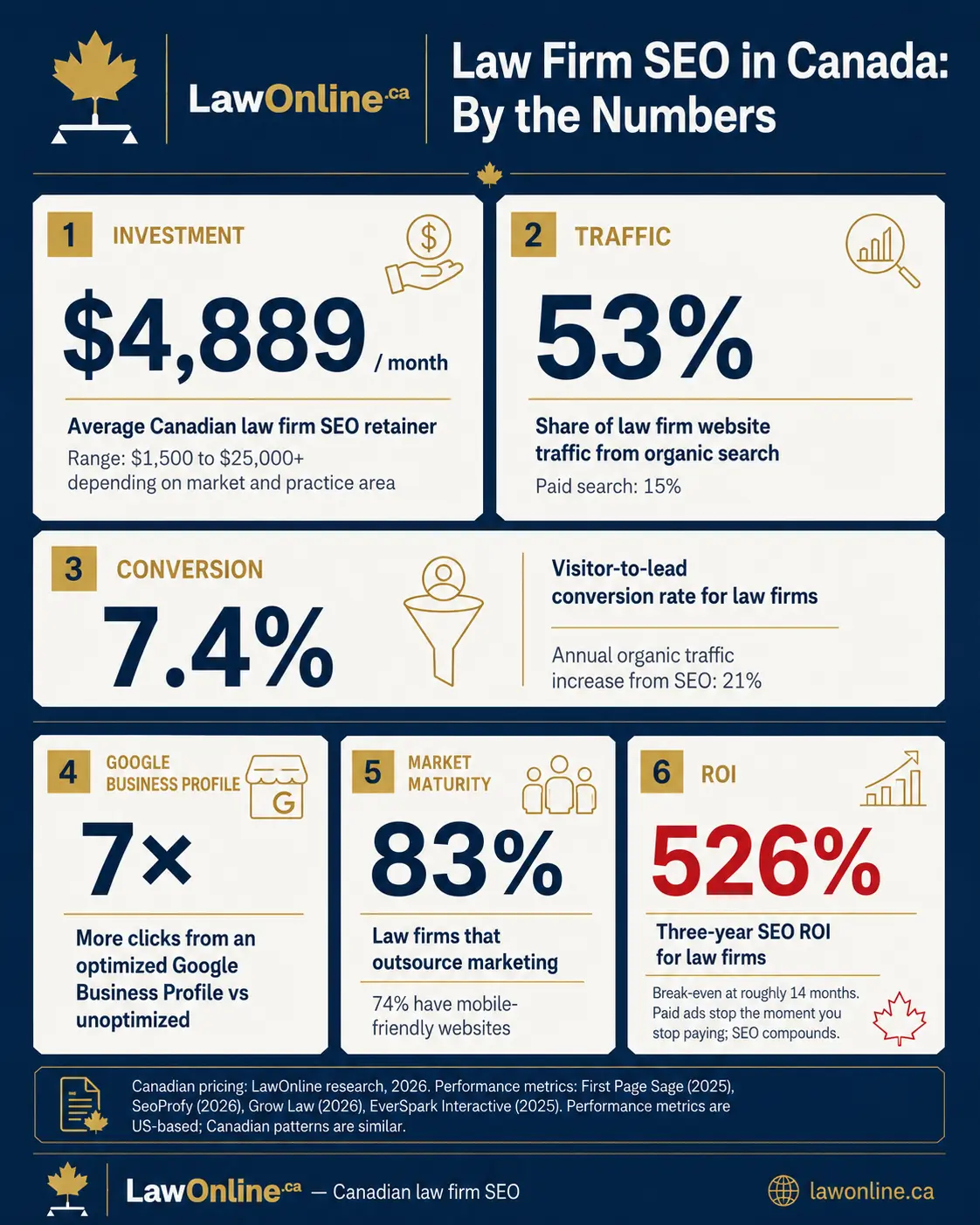
The following benchmarks combine Canadian pricing data from our own research with North American industry statistics on search behaviour and SEO performance.
| Metric | Value |
|---|---|
| Typical monthly SEO investment (Canada) | $1,500 to $10,000 |
| Average monthly SEO retainer (Canada) | $4,889 |
| Competitive market monthly spend (Toronto, Vancouver, Calgary) | $5,000 to $15,000 |
| Organic search share of law firm traffic | 53% |
| Visitor-to-lead conversion rate | 7.4% |
| Annual traffic increase from SEO | 21% |
| Law firms outsourcing marketing | 83% |
| Firms with mobile-friendly websites | 74% |
| Google Business Profile click increase (optimized vs not) | 7x |
Canadian pricing: LawOnline research (2026). Performance metrics: First Page Sage (2025), SeoProfy (2026), Grow Law (2026), EverSpark Interactive (2025). Performance metrics are US-based; Canadian patterns are similar.
What LawOnline Does Differently
Your marketing team, not another agency. Most SEO agencies hand you a monthly rank report and call it done. We operate more like an embedded member of your team than a vendor at arm's length. We learn your practice areas, your retainer economics, and the kinds of cases you actually want before we write a strategy. We attend to your firm's marketing the way a dedicated hire would, but without the overhead of a full-time salary, benefits, and management. When something isn't producing signed cases, we change it.
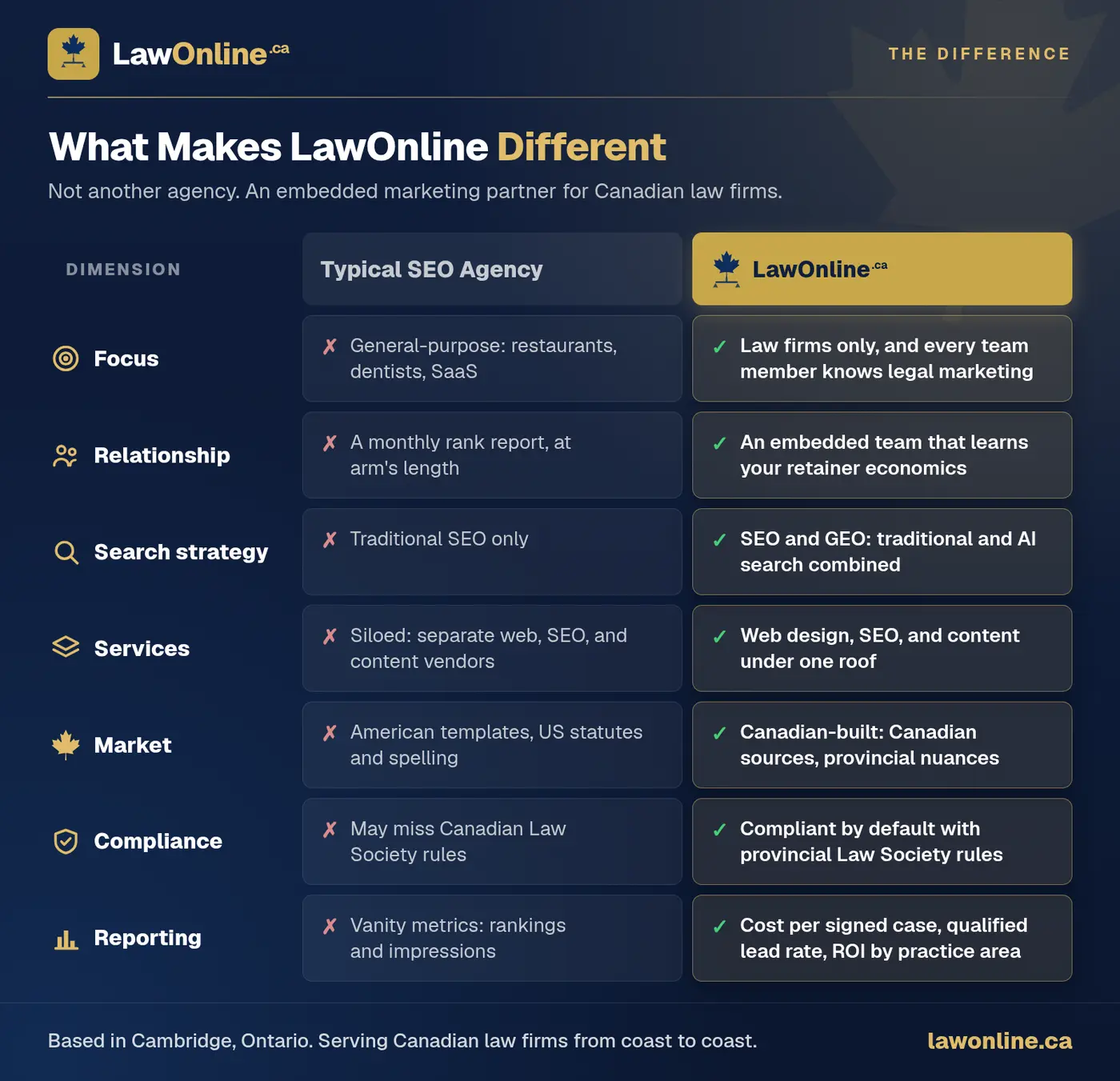
SEO, GEO, and AEO in every engagement. We don't treat AI visibility as an afterthought or an upsell. Every SEO engagement includes generative engine optimization and answer engine optimization because the work that ranks your site in traditional search is the same work that wins AI citations and featured snippets. Some agencies charge separately for GEO or AEO as premium add-ons, but we don't, because splitting them into separate line items doesn't reflect how search actually works. Our free AI readiness check shows you exactly where your firm stands today.
Law firms only. We don't do SEO for restaurants, dentists, or SaaS companies. Every member of our team understands legal terminology, law firm business models, and the ethical boundaries of legal marketing in Canada. That specialization shows in the quality and compliance of everything we produce.
Integrated with web design and content. Law firm SEO services don't exist in a vacuum. Search performance depends on how your website is built and the content you publish. We handle all three, so nothing falls through the cracks between vendors.
Canadian-specific. We write for Canadian firms, cite Canadian sources, and understand provincial regulatory differences. Most legal SEO agencies are American. Their templates reference US statutes, use American spelling, and ignore the nuances of Canadian markets.
Ethical SEO, compliant by default. All content and optimization work complies with provincial Law Society advertising rules. No unverifiable claims, no misleading testimonials, no fee advertising that violates provincial standards. We use white-hat SEO methods exclusively. No link schemes, no cloaking, no shortcuts that put your firm's reputation at risk.
Transparent reporting. We report on the metrics that determine whether your marketing is a cost centre or a profit centre: cost per signed case, qualified lead rate, and ROI by practice area. Those numbers come from a simple intake tracker your team fills in as leads come in, and once it's filled in, they're in every monthly report. You'll know exactly what your SEO investment is producing.
Ready to Talk About SEO?
If your firm isn't showing up where potential clients are searching, SEO is almost certainly part of the solution. We'll review your current search visibility, identify the gaps, and show you what a strategic SEO plan looks like for your specific practice areas and market.
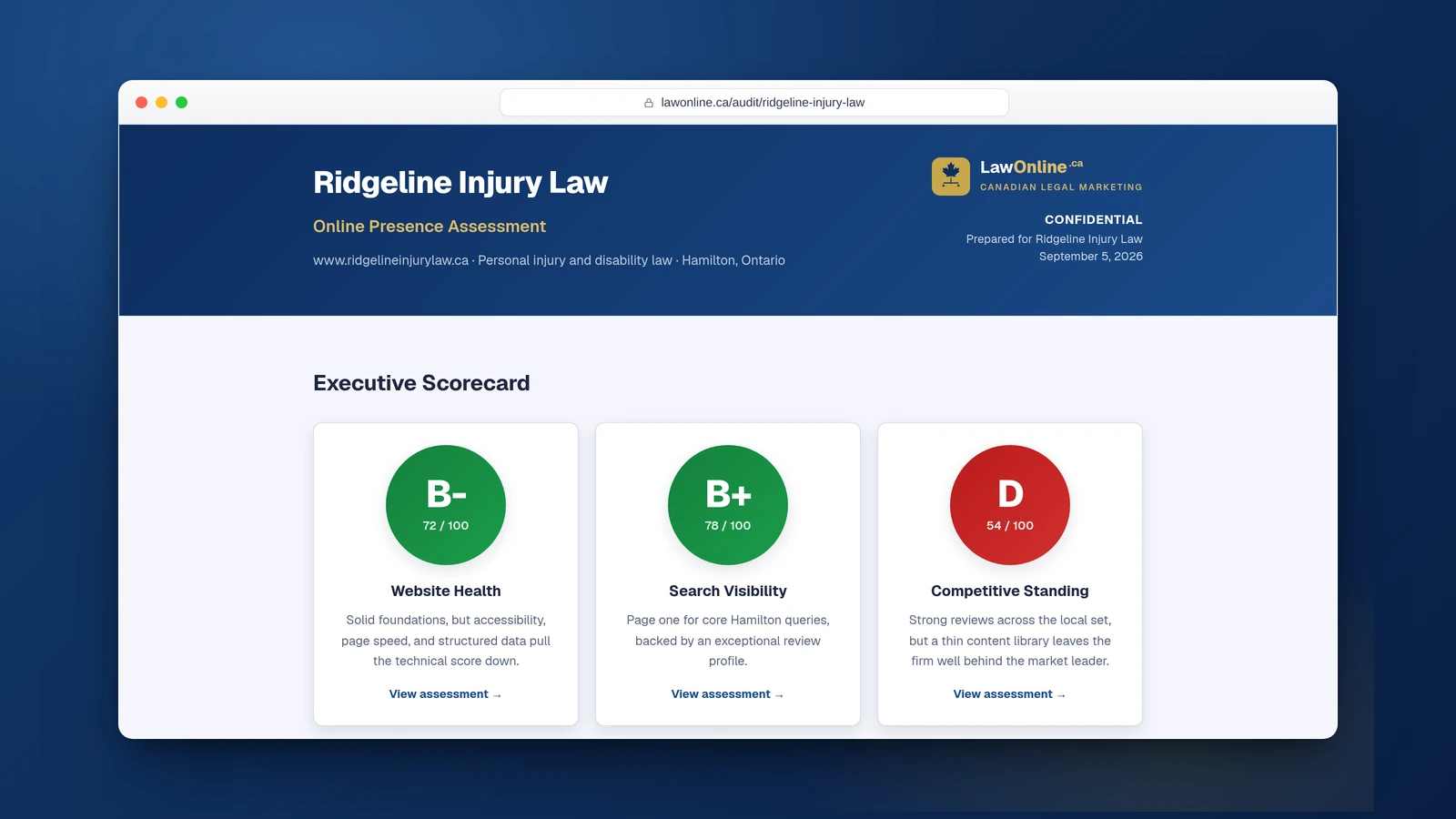
Not sure where you stand? Our free website audit evaluates your site's technical health, search visibility, and competitive positioning. It's a good starting point before any conversation about strategy.
Frequently Asked Questions
What is law firm SEO?
Law firm SEO is the process of optimizing a law firm's website and online presence so it ranks higher in search engine results for the legal services the firm offers. It includes technical SEO (site speed, mobile optimization, structured data), on-page SEO (practice area pages, blog content, keyword targeting), local SEO (Google Business Profile, citations, reviews), and increasingly GEO (generative engine optimization for AI search tools). The goal is to generate qualified client inquiries from people actively searching for a lawyer.
Is SEO for lawyers different from general SEO?
Yes. SEO for lawyers operates under constraints that most industries don't face. Legal content is classified by Google as YMYL (Your Money or Your Life), meaning it faces stricter quality evaluation for accuracy, authoritativeness, and trustworthiness. Provincial Law Societies regulate what law firms can claim in advertising, which limits copy that would be standard practice in other industries. Search behaviour is overwhelmingly local: potential clients search for a lawyer in their city, not nationally. And the competitive landscape varies dramatically by practice area, with personal injury keywords among the most expensive in any industry. Generic SEO strategies built for e-commerce or services businesses consistently underperform for law firms.
How much does law firm SEO cost in Canada?
Law firm SEO in Canada typically costs between $1,500 and $10,000 per month, with an industry average around $4,889. Solo practitioners in smaller markets can compete effectively at $1,500 to $2,500 per month, while personal injury firms in Toronto or Vancouver often invest $5,000 to $15,000. LawOnline's SEO starts at $1,500 per month plus HST, month-to-month, and we'll give you an exact price in writing before any work begins. For a detailed breakdown, see our guide to law firm SEO costs in Canada.
How much does Google Business Profile management cost?
LawOnline manages Google Business Profiles from $600 per month plus HST per location, with discounts for firms with more than one location. That covers weekly posts to your profile, responses to your Google reviews, review requests, photo updates, and a monthly report on the calls, direction requests, and website clicks your listing brings in. There's no setup fee, and it's month-to-month. It's a separate service from our SEO retainer, so you can run it alone or alongside SEO.
How long does it take for law firm SEO to show results?
Most law firms begin seeing measurable improvements in search rankings within three to six months, with significant traffic growth between six and twelve months. SEO is a long-term investment that compounds over time. Unlike paid ads, the rankings and traffic you build through SEO continue generating inquiries without ongoing ad spend.
What's the difference between SEO, GEO, and AEO?
SEO focuses on ranking your website in traditional search results on Google, Bing, and other search engines. GEO (Generative Engine Optimization) focuses on getting your firm cited in AI-generated answers from tools like ChatGPT, Perplexity, and Google AI Overviews. AEO (Answer Engine Optimization) targets direct-answer features like featured snippets, People Also Ask boxes, and voice search results. All three matter because clients now use traditional search, AI tools, and direct-answer features to find lawyers. LawOnline includes SEO, GEO, and AEO in every engagement at no additional charge.
Should a law firm hire an SEO agency or handle SEO in-house?
Most law firms outsource SEO. Industry data shows 83% of law firms outsource their marketing, with 28% specifically outsourcing SEO. The technical complexity, ongoing algorithm changes, and time commitment make SEO difficult to manage alongside a legal practice. A specialized legal SEO agency brings industry expertise, established processes, and the ability to stay current with Google's evolving guidelines.
Is SEO worth it for small law firms and solo practitioners?
Yes. Small firms and solo practitioners often benefit the most from SEO because they can target hyper-local, niche keywords that larger firms overlook. A solo family law practitioner in a mid-sized city faces far less competition than a personal injury firm in Toronto. Local SEO, Google Business Profile optimization, and targeted content can generate a steady stream of qualified inquiries at a fraction of what paid advertising costs. Read our solo practitioner marketing guide for more.
Do you guarantee rankings?
No. Nobody controls where Google ranks a site or what AI tools recommend, so an agency that guarantees first-page rankings is promising something it can't deliver. What we commit to is the work: what we'll do each month, in writing, and a monthly report that shows what it produced.
Do you work with other law firms in my city?
Not in your practice area. We take on one firm per practice area in each city, so we're never competing against ourselves for the same searches. If that spot is already taken in your market, we'll tell you on the first call.
What's in the monthly SEO report?
A plain-language summary of the work we did, your rankings and search traffic, your visibility in AI answers, the inquiries you're getting, and what's next. If your team fills in a simple intake tracker as leads come in, the report also shows cost per signed case and ROI by practice area.
How much of our time does SEO take?
As much or as little as you want. Some firms like to talk through every topic, and others prefer to hear from us once a month. The one thing we always need is your approval before we publish anything that states the law or facts a lawyer has to verify.
Can you work on our existing website?
Yes. We work on any platform, including WordPress, Wix, Squarespace, and agency-built systems, as long as we have login access. We can publish the work ourselves or send it to whoever manages your site, whichever you prefer.
Do you build links?
We build citations, your firm's listings in legal and local directories, as part of the SEO retainer. Beyond that, we focus on content good enough that other sites link to it on their own, because bought or traded links are a risk to your rankings.
What happens if we cancel?
You give us 30 days' notice, and you keep everything: every article we wrote, every fix we made to your site, and full access to your accounts. Nothing we did is tied to us.
Do you offer French SEO?
Yes. Firms serving francophone clients need dedicated French content, not machine-translated versions of English pages. We plan the French keywords and pages, and the French copy comes from a certified translator, either one we arrange or your firm's own.