
Law firm web design isn't the same as website design for a restaurant, a dental practice, or a software company. The audience is different, the conversion goal is different, the regulatory environment is different, and the stakes of getting it wrong are different.
Most law firms don't discover this until after launch.
Web design for law firms operates under a different set of constraints than virtually any other industry. This guide covers what that means in practice: what separates a legal website that generates retainers from one that generates nothing, what the key design decisions are, and what's different about the Canadian market.
What Law Firm Web Design Actually Means
Most lawyers, when they say "web design," mean how the site looks. The colour palette. The fonts. Whether the homepage feels authoritative.
That part matters, but it's the smallest part.
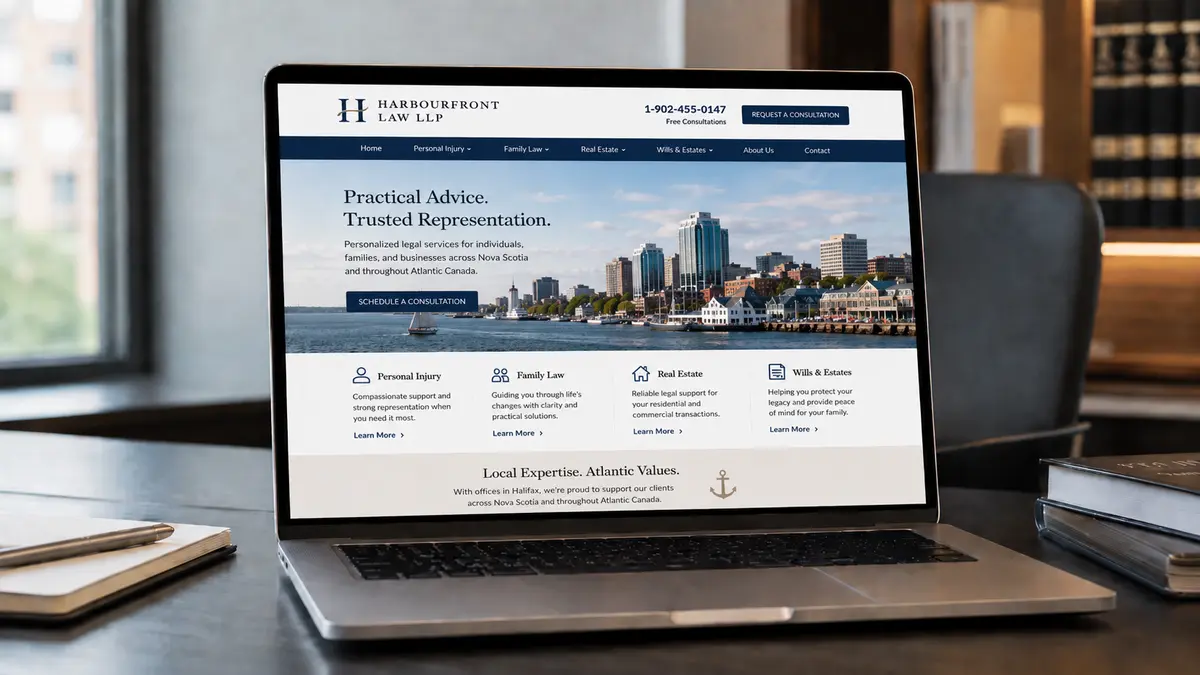
Law firm web design is the practice of building a website architecture, visual identity, and technical foundation specifically for legal practices and their prospective clients. It includes:
- Intake architecture: how the site moves a prospective client from search result to consultation request, and what happens to that request when it arrives
- Practice area structure: how individual pages are built to answer the questions prospective clients are actually searching for
- Trust signal design: what visual and content elements reduce anxiety and move a visitor toward calling
- Technical performance: responsive design, speed, mobile optimization, Core Web Vitals, and security configuration specific to legal sites
- Search optimization: the schema markup, URL structure, and content architecture that help Google understand what your firm does and where
When these pieces are built together and built correctly, a law firm website becomes a client acquisition system. When they're assembled separately or skipped entirely, it becomes a brochure. For a detailed breakdown of what the technical build involves, from intake architecture to accessibility compliance, see our guide to legal website design and development.
How Law Firm Web Design Differs from General Web Design
A general web designer builds for usability and visual appeal. A law firm web designer builds for a very specific conversion goal: getting a prospective client to contact the firm.
The difference shows up everywhere.
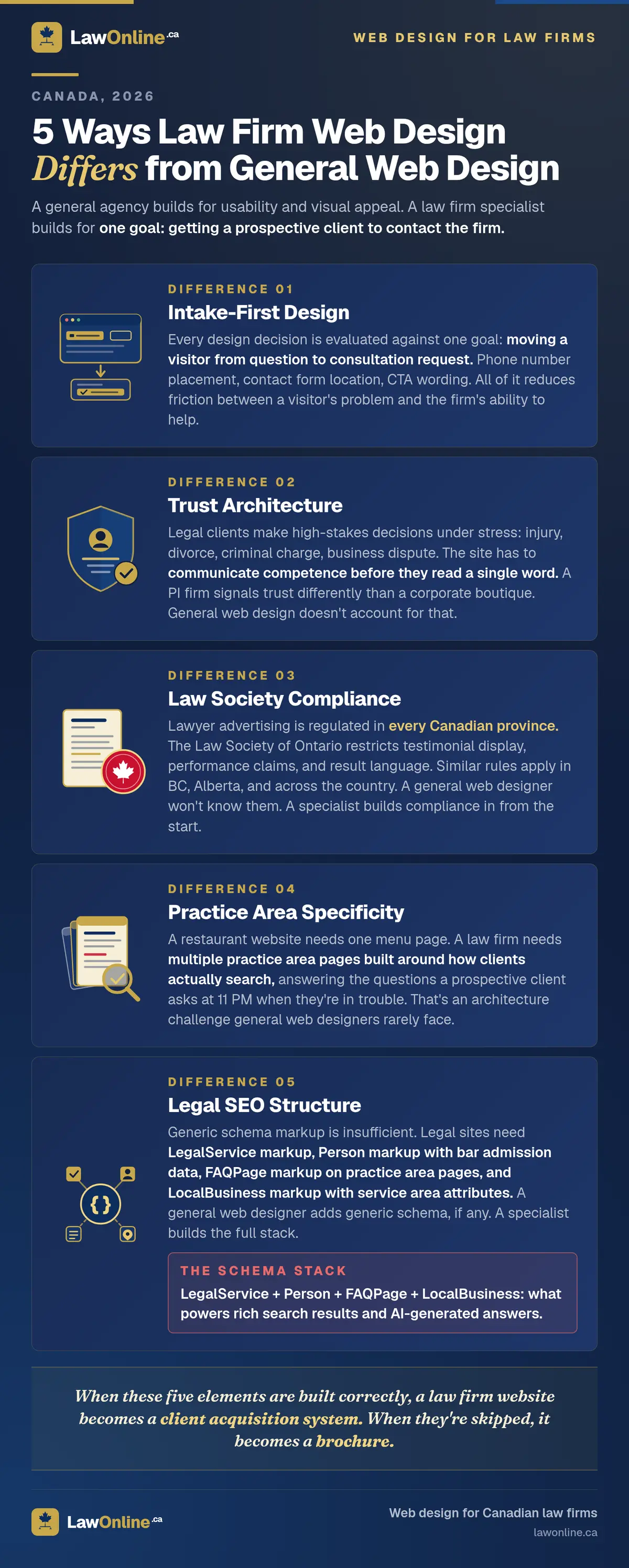
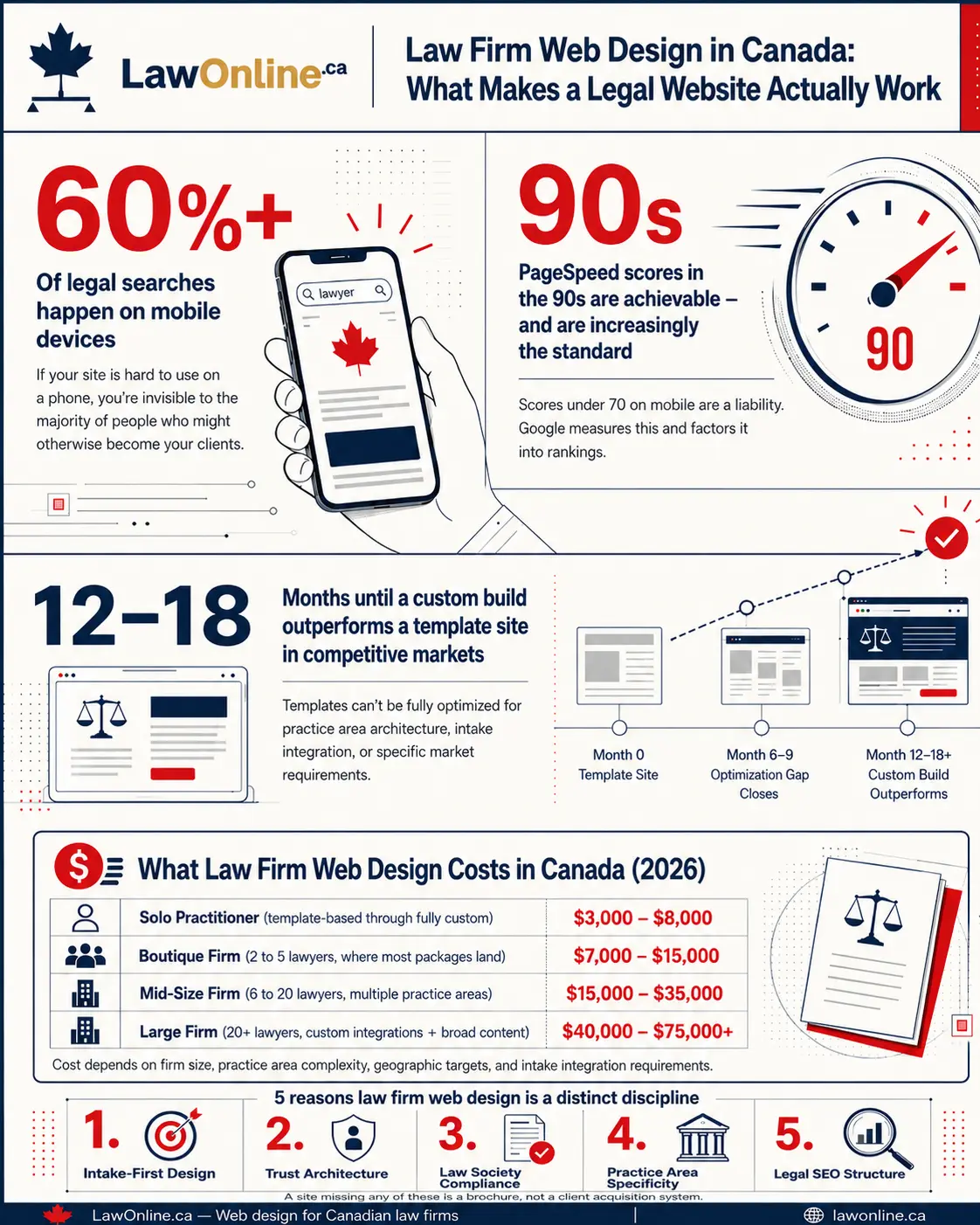
Intake-first design. A law firm site exists to generate consultations. Every design decision should be evaluated against that goal. The phone number placement, the contact form location, the CTA wording, the practice area page structure: all of it should reduce friction between a visitor's question and the firm's ability to answer it. A design that looks polished but buries the phone number three clicks deep will underperform a plainer site that makes contacting the firm easy.
Trust architecture. Legal clients are making high-stakes decisions under stress. They're searching for a lawyer because something has gone wrong: an injury, a divorce, a criminal charge, a business dispute. The website they land on needs to communicate competence and trustworthiness before they read a single word of copy. A personal injury firm's website signals trust differently than a corporate boutique's. A 2026 law firm website trends report describes this shift as a move from static brochures to "trust builders" that lead with client problems and outcomes rather than firm credentials. The observation comes from US markets, but the principle is universal. Law firm web design accounts for this; general web design typically doesn't.
Law society compliance. Lawyer advertising is regulated in every Canadian province. The Law Society of Ontario restricts how testimonials are displayed, what performance claims are permissible, and how results are presented. Similar rules apply in BC, Alberta, and across the country. A general web designer won't know these rules. A law firm specialist builds compliance in from the start, which means you're not scrambling to remove content after the site launches.
Practice area specificity. A restaurant website needs one menu page. A law firm website needs multiple practice area pages built around how clients actually search, and each one needs to answer the questions a prospective client asks at 11 PM when they're in trouble and looking for help. Building those pages correctly is a content and architecture challenge that general web designers rarely face.
Legal SEO structure. Search visibility for law firms requires specific technical implementation: LegalService schema markup, Person markup with bar admission data, FAQPage markup on practice area pages, LocalBusiness markup with service area attributes. These aren't optional extras. They're what powers rich search results and positions firm content for AI-generated answers. A general web designer will add generic schema markup, if any. A law firm specialist builds the full stack.
What a Law Firm Website Needs to Work
Not every firm needs the same thing. A solo practitioner handling a single practice area in one city has different requirements than a 40-lawyer regional firm. But certain elements are non-negotiable regardless of size.
The Canadian Bar Association's website redesign guide recommends that firms rate their existing site against six core elements before starting a rebuild: information architecture, brand consistency, content system, migration plan, governance, and SEO strategy. It's a useful evaluation framework, and most of what follows maps directly to those categories.
A Mobile-First Homepage That Loads Fast
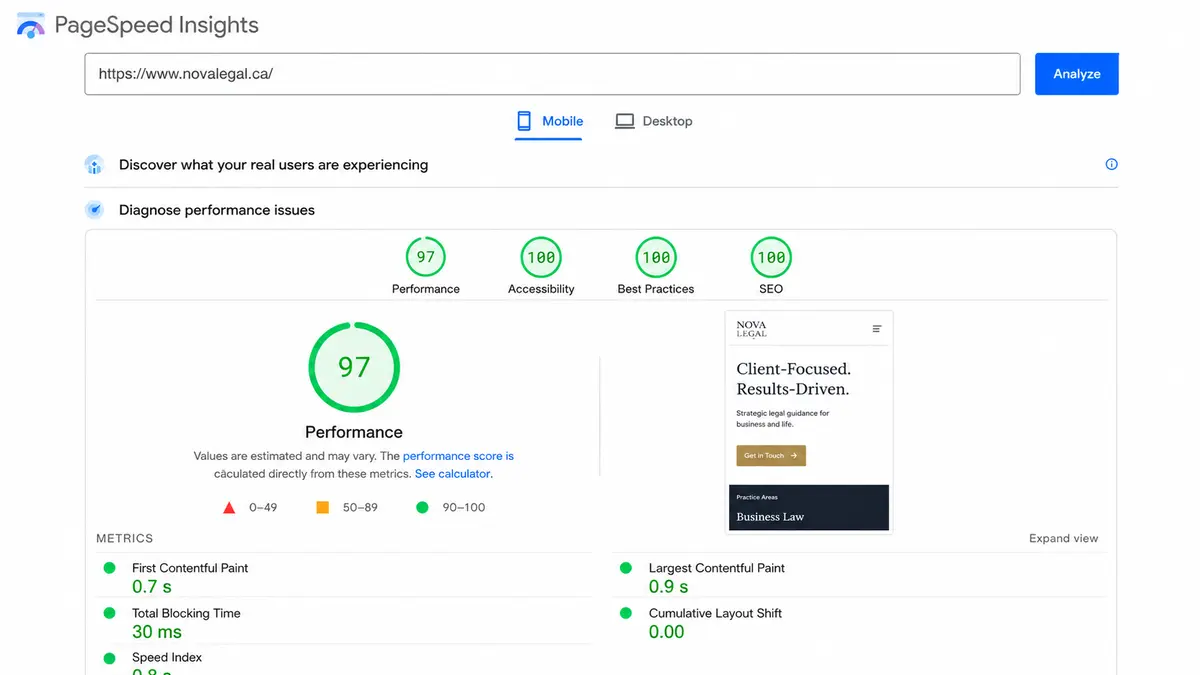
More than 60% of legal searches happen on mobile devices. A homepage that loads slowly, displays poorly on a phone, or makes it hard to find a phone number will lose those visitors to competitors before they read anything. Google measures this and factors it into rankings. PageSpeed scores under 70 on mobile are a liability. Scores in the 90s are increasingly achievable with a responsive, mobile-first technical build.
Practice Area Pages That Answer Real Questions
Thin practice area pages that say "We handle personal injury cases" and nothing else rank poorly and convert poorly. A well-designed practice area page answers the questions a prospective client would actually type: what does the process look like, how long will it take, what does it cost, what should I do first, what happens if the other side has a lawyer and I don't.
These pages need to be specific enough to be useful and indexed by Google for the right queries. Building them correctly is the difference between a site that attracts a steady stream of qualified inquiries and one that doesn't.
Intake Integration
When a prospective client fills out a contact form at 11 PM, what happens? If the answer is "it goes to a general inbox that someone checks in the morning," that firm is losing cases to firms that respond within minutes.
Law firm web design at a serious level connects intake forms to case management systems: Clio, uLaw, PracticePanther, Filevine, or whatever the firm uses. It routes inquiries by practice area and urgency. For personal injury and family law firms where response time is a direct conversion variable, this integration is a core design requirement, not an add-on.
Trust Signals Built Into the Structure
Trust signals are the visual and content elements that answer the question every prospective client is silently asking: "Should I call this firm?" For a personal injury practice, trust signals include professional headshots of the lawyers actually handling cases, clear presentation of results (with proper disclaimers), and recognizable bar association credentials. For a corporate boutique, trust signals lean toward experience with named clients and professional recognition.
These need to be designed into the page structure, not bolted on. A contact page buried behind a navigation menu doesn't signal availability. A homepage with no lawyers pictured doesn't signal that real people will handle your case. Law firm web design builds these signals in from the start.
Law Society Compliance
Advertising compliance isn't just about what you say. It's about how you display testimonials, how you present results, what performance claims are permissible, and what language is and isn't allowed in specific provinces.
Most law firms don't have time to cross-reference their website against the rules of professional conduct. A specialist web design team handles this as standard practice. It doesn't add time or cost to the project, because it's built into the process.
Practice Area Considerations in Canadian Law Firm Web Design
Different practice areas have different conversion dynamics, and web design should reflect them.
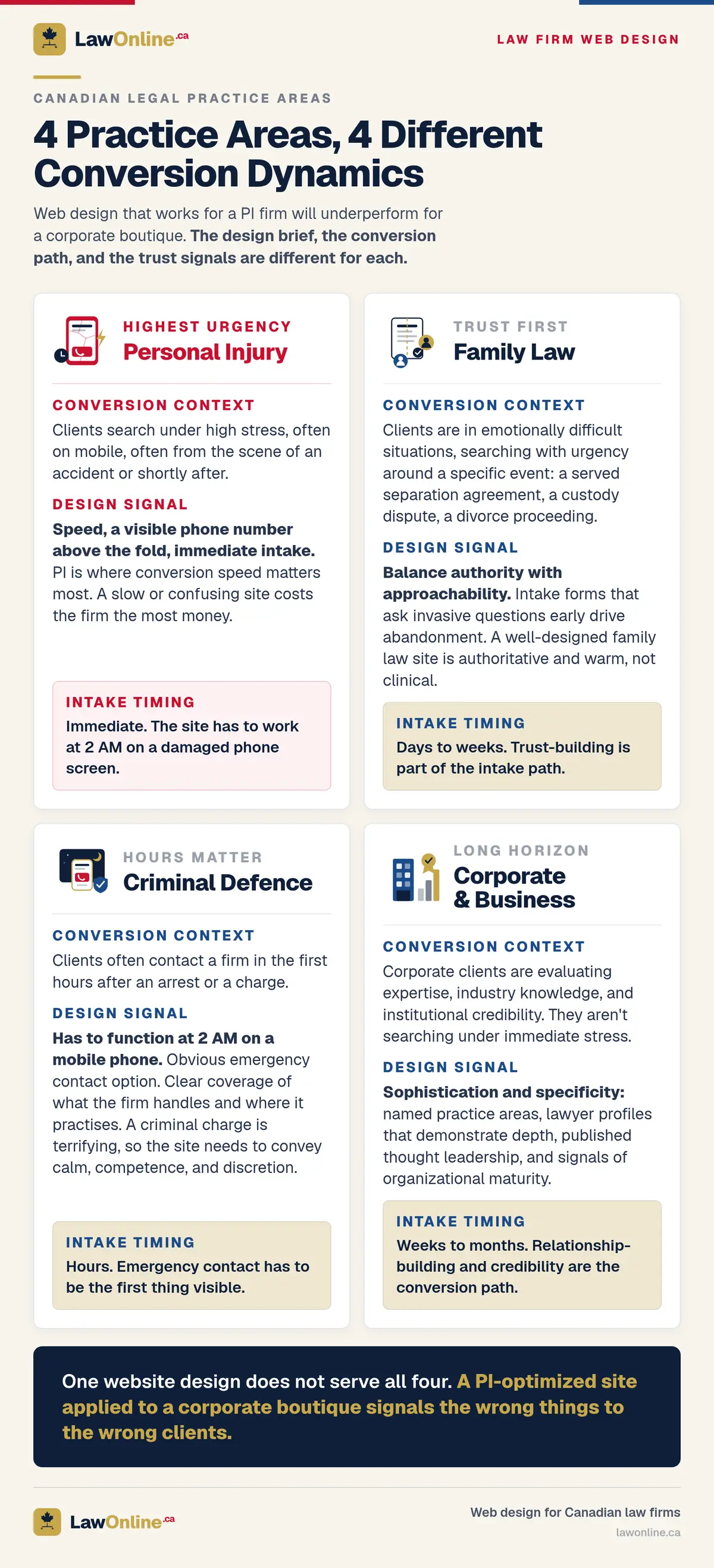
Personal injury. PI clients are searching under high stress, often on mobile, and often from the scene of an accident or shortly after. The site needs to be fast, easy to navigate, and have a visible phone number above the fold. Practice area pages need to address the most common accident types with specificity. The intake process needs to be immediate. PI is the practice area where conversion speed matters most, and where a slow or confusing website costs the firm the most money.
Family law. Family law clients are in emotionally difficult situations and often searching with urgency around a specific event: a served separation agreement, a custody dispute, a divorce proceeding. The web design needs to balance authority (you handle difficult cases) with approachability (you're safe to contact). Intake forms that ask invasive questions early in the process drive abandonment. A well-designed family law site is authoritative and warm without being clinical.
Criminal defence. Criminal defence clients often contact a firm in the first hours after an arrest or charge. The site needs to function at 2 AM on a mobile phone, have an obvious emergency contact option, and make it immediately clear what the firm handles and where they practice. Trust signals are critical. A criminal charge is a terrifying situation, and the site needs to convey calm, competence, and discretion.
Corporate and business law. Corporate clients search differently. They're evaluating expertise, industry knowledge, and institutional credibility. Design should lean toward sophistication and specificity: named practice areas, lawyer profiles that demonstrate depth, published thought leadership, and clear signals of organizational maturity. The conversion path is longer and more deliberate than PI or family law.
Common Law Firm Web Design Mistakes
Understanding what good law firm web design looks like is easier when you know what bad looks like.
Stock photo overload. Scales of justice, gavels, and suited lawyers shaking hands convey nothing about a specific firm. They signal that no one put real effort into the site. Clients make subconscious decisions about trustworthiness from the homepage in under a second. Stock-heavy sites lose.

Generic practice area pages. "Our personal injury lawyers fight for you" is not useful to a prospective client. It doesn't answer any question. It doesn't rank for specific searches. A well-written practice area page for motor vehicle accidents covers what happens after an accident, how liability is established, what a typical timeline looks like, and what the firm's experience with that specific case type is.
No mobile optimization. Building a beautiful desktop site and treating mobile as an afterthought was a mistake in 2020. In 2026, it's a disqualifying technical failure. Web design for lawyers who want to be found must be responsive and mobile-first. If your site is hard to use on a phone, you're invisible to the majority of people who might otherwise become your clients.
Buried intake. If reaching the contact form requires three clicks, you're asking a stressed prospective client to work to give you their business. Phone numbers should be visible without scrolling. Contact forms should be one click away from every page. The intake process should be the easiest thing to find on the site.
Ignoring schema markup. LegalService, Person, LocalBusiness, and FAQPage markup are what Google uses to understand what your site is, who you are, and what geographic area you serve. Sites without this markup compete at a significant disadvantage in local and practice-area search results. For a complete breakdown of what legal website schema markup involves, see our law firm website design service overview.
Template sites. Template-based sites can look professional and launch quickly, but they come with a structural ceiling. They can't be fully optimized for practice area architecture, custom intake integration, or the specific competitive requirements of a given market. They're a starting point, not a destination. For most firms competing in anything but the least competitive markets, a custom build outperforms a template within 12 to 18 months.
Law Firm Web Design and Search Rankings
A well-designed law firm website is built to rank. The two go together by design, not by accident.
Web design for law firms that ranks well isn't an accident. The elements that drive search rankings in legal markets are built into the design and development process when done correctly:
- Practice area pages written around specific query intent
- Location-structured pages for firms serving multiple cities
- Technical performance that meets Google's Core Web Vitals thresholds
- Schema markup that communicates professional identity and service area
- Internal link architecture that builds authority across the cluster
Law firm web design that treats SEO as an afterthought (something to bolt on after launch) consistently underperforms design that builds search architecture in from the start. The site structure, the URL schema, the heading hierarchy, the internal links, and the content depth all need to be coordinated from the beginning.
The Canadian Bar Association makes a related point: firms should define key performance indicators and implement web analytics from the start of any website project, not after launch. Most firms skip this step entirely, redesign their site, and then can't tell whether the new version is actually performing better than the old one. A basic measurement plan covering inquiries, conversion rate, organic visibility, and content engagement should be part of the project scope from day one.
Our law firm website design service builds this architecture in by default. The site structure, content depth, and technical implementation are planned together from the start, not retrofitted after launch.
How Much Does Law Firm Web Design Cost in Canada?
Cost depends significantly on firm size, practice area complexity, the number of geographic targets, and whether the build includes custom intake integration.
For a solo practitioner, a professional law firm website in Canada typically costs $3,000 to $8,000, depending on whether the build is template-based or fully custom. Boutique firms with two to five lawyers land in the $7,000 to $15,000 range, which is where most Canadian law firm website packages sit. Mid-size firms with multiple practice areas and locations run $15,000 to $35,000. Larger firms with custom integrations and broad content requirements can reach $40,000 to $75,000+.
For a complete tier-by-tier breakdown with what's included at each price point, see our guide to law firm website costs in Canada.
Frequently Asked Questions
What is law firm web design?
Law firm web design is the practice of designing and building websites specifically for legal practices. It differs from general web design in its focus on client intake architecture, practice area content structure, law society advertising compliance, legal SEO implementation, and trust signal design for prospective legal clients. A well-designed law firm website functions as a client acquisition system, not just a digital brochure.
How is web design for law firms different from regular web design?
Several elements distinguish law firm web design from general web design. Law firm sites require practice area pages built around specific legal searches, compliance with provincial law society advertising rules, intake integration with legal case management software, legal-specific schema markup (LegalService, Person with bar admissions, FAQPage), and trust-signal design calibrated to prospective legal clients who are often in stressful situations. General web designers rarely have experience with these requirements.
Does law firm web design affect Google rankings?
Yes, significantly. A law firm website built with proper technical SEO architecture, practice area content depth, location-structured pages, and correct schema markup will outrank a site built without those elements. Law firm web design and SEO are not separate disciplines: the design decisions made during the build directly determine how competitive the site is in local and practice-area search results.
What makes a good law firm website?
The fundamentals: fast load times (under two seconds on mobile), clear calls to action on every page, practice area pages that answer real questions prospective clients search for, visible phone numbers without scrolling, mobile-first design, and proper technical implementation. Beyond the fundamentals, a good law firm website has strong trust signals specific to the practice area, intake integration that doesn't let leads fall through the cracks, and search architecture that builds rankings over time.
How long does law firm web design take in Canada?
A professional law firm website typically takes 10 to 16 weeks from kick-off to launch. Solo practitioner sites with focused scope can complete in 8 to 10 weeks. Larger firms with custom intake integrations, multiple practice areas, and bilingual content requirements typically need 14 to 16 weeks. For a phase-by-phase breakdown of the process, see our law firm website design process guide.
Should I use a law firm web design specialist or a general agency?
A general agency can build a functional site. What dedicated law firm web designers reliably deliver that general agencies miss: law society compliance, legal intake architecture, practice area content structure, and legal SEO implementation. These gaps don't always appear at launch. They show up 6 to 12 months later when the site isn't generating inquiries. For most law firms in competitive markets, a specialist law firm web design agency pays for itself through better search performance and higher conversion. For a step-by-step evaluation process, see our guide to choosing the right law firm web designer.