
Hiring a law firm web design agency in Canada is different from hiring a freelancer, and hiring a specialist law firm agency is different from hiring a general digital agency. Those distinctions matter more than most law firms realize until they're three months into a project that isn't working.
This post explains what a law firm web design agency actually does, when an agency makes more sense than a solo designer, how Canadian agencies are structured and priced, and what questions to ask before you sign a contract.
What Is a Law Firm Web Design Agency?
A law firm web design agency is a multi-person team that builds and supports websites specifically for legal practices. The team typically includes a project manager, one or more designers, front-end and back-end developers, and often an SEO or content specialist.

Law firm web design companies range from large full-service agencies with dedicated legal teams to small boutiques that specialize in a single practice type. The distinction between a law firm web design agency and a general web design agency is specialization. A general agency will take any client: restaurants, dental practices, e-commerce stores, law firms. A law firm specialist has built its entire practice around the specific requirements of legal websites: law society advertising compliance, client intake integration, practice area architecture, and legal search optimization.
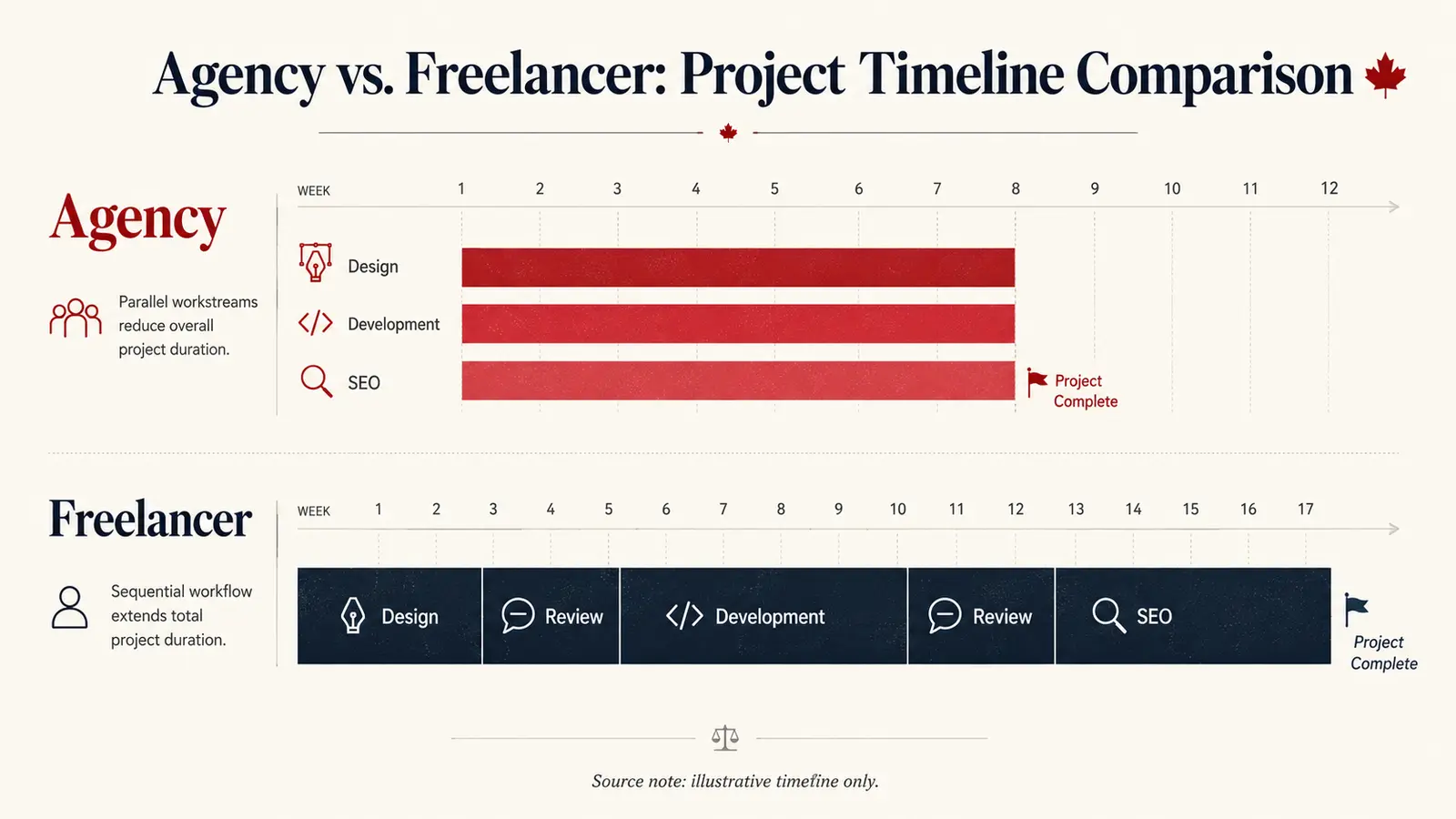
The distinction between an agency and a freelancer is capacity and continuity. A freelance designer or developer is usually one person, sometimes with a few subcontractors. They're often less expensive and can be excellent, but they have bandwidth limits and single points of failure. If your freelancer gets sick, takes another project, or moves on, your project stalls. An agency has redundancy built in, dedicated account management, and a defined process that doesn't depend on any single person.
For a small boutique or a solo practitioner who needs a clean, functional site and has a clear scope, a freelancer can be the right call. For firms that need intake integration, deep practice area coverage, bilingual content, or ongoing support, an agency typically handles the complexity better.
What a Law Firm Web Design Agency Does
The scope varies by agency, but a full-service law firm web design agency handles all of the following. That scope matters because most law firm sites fall short. A 2024 industry analysis found that only about 35% of law firm websites are effectively set up to convert visitors. The rest fail on speed, mobile experience, trust signals, or intake infrastructure. A specialist agency exists to close that gap.
Site strategy and architecture. Before any design work starts, the agency defines the site structure: which practice area pages you need, how they're organized, which geographic targets matter, how the homepage and about page position the firm. This isn't just a sitemap. It's a content strategy grounded in how prospective clients search for legal help in Canada.

Visual design. The design team creates a visual identity that works for your practice: professional without being cold, authority-signalling without being unapproachable. For personal injury firms, the design brief usually emphasizes trust, accessibility, and urgency. For corporate boutiques, it leans toward precision and restraint. A specialist agency has built enough law firm sites to know the difference.
Front-end and back-end development. Building a high-performance law firm site requires real development work. Practice area page templates, mobile-first responsive design, Core Web Vitals optimization, security configuration, and proper performance tuning. An agency with developers on staff can do this at a level that a design-only freelancer cannot.
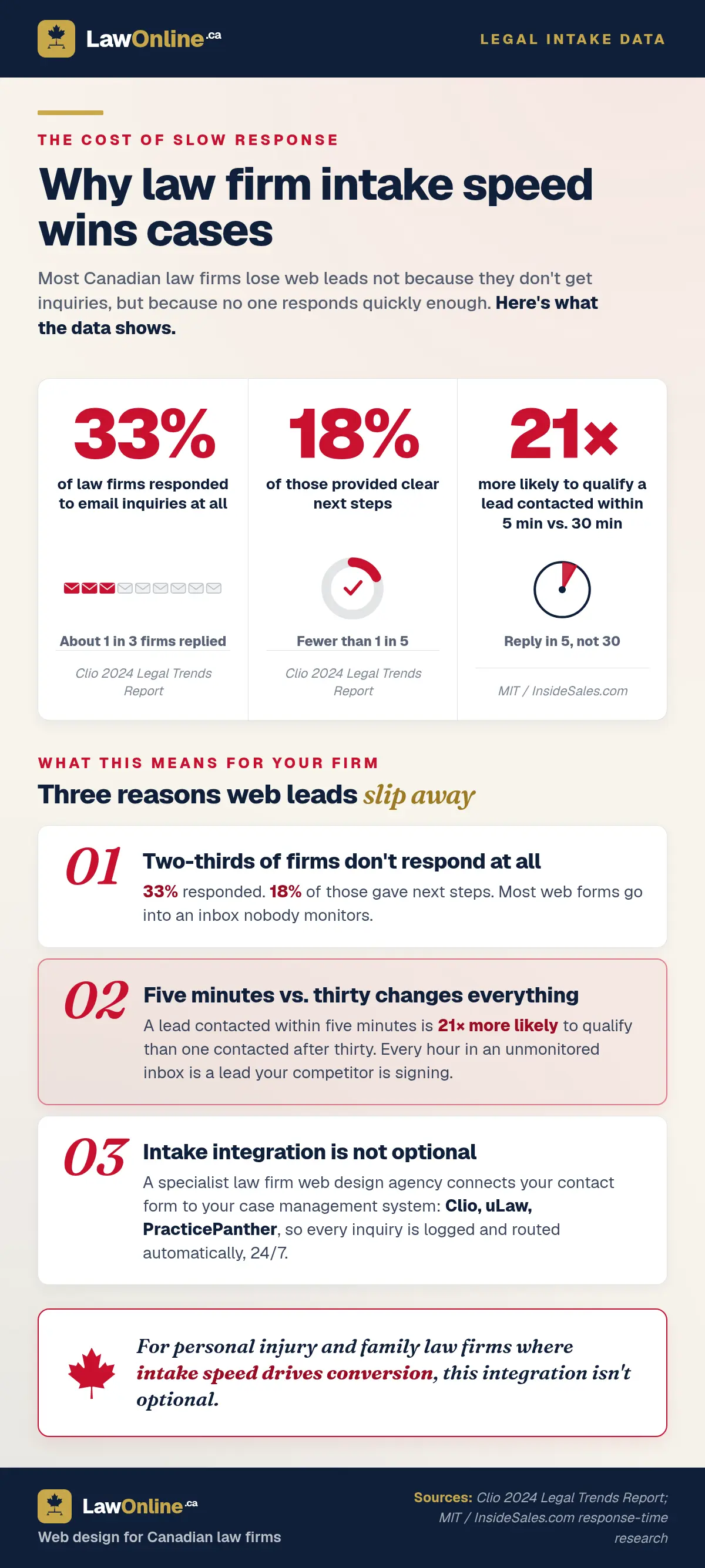
Client intake integration. This is often where law firm web design agencies earn their fees. Connecting contact forms to case management systems like Clio, uLaw, Filevine, or PracticePanther requires technical work that most agencies cannot do. For personal injury and family law firms where intake speed drives conversion, this integration isn't optional. A 2024 Clio Legal Trends Report secret shopper study found that only 33% of law firms even responded to email inquiries, and just 18% of those provided clear next steps. Research from MIT and InsideSales.com shows that contacting a web lead within five minutes makes you 21 times more likely to qualify them than waiting just 30 minutes. Every hour a lead sits in an unmonitored email inbox is a lead that may sign with a faster-responding competitor.
Legal SEO implementation. A specialist law firm web design agency builds with search in mind from day one: correct LegalService schema markup, optimized page titles and meta descriptions, location-structured pages for multi-city firms, and internal link architecture that signals authority to Google. This differs from general web SEO the same way a law firm's intake process differs from a restaurant's reservation system.
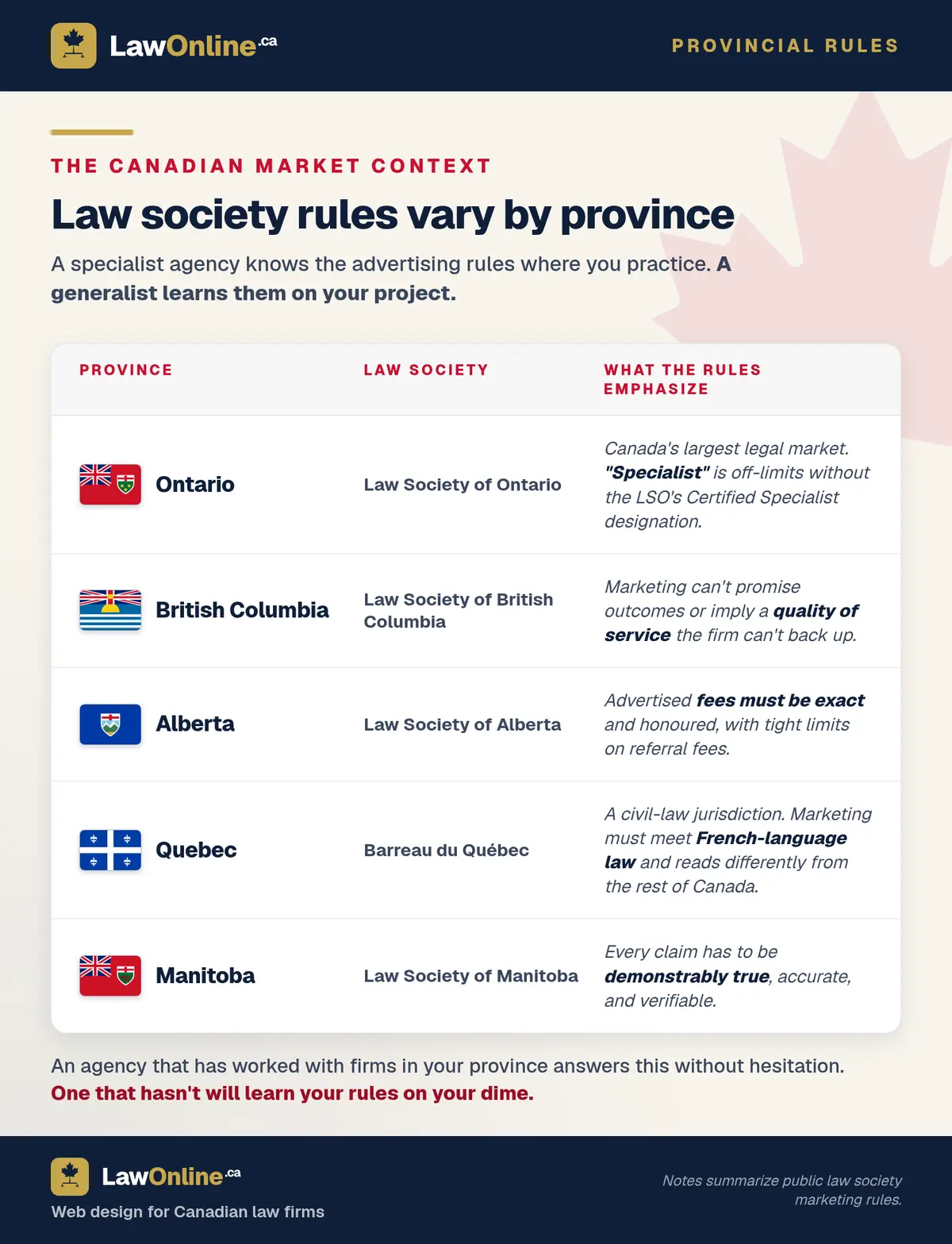
Law society compliance review. Lawyer advertising is regulated. In Ontario, the Law Society of Ontario's Rules of Professional Conduct restrict how testimonials can be displayed, what performance claims are permissible, and how results are presented. A law firm web design agency that has worked with dozens of law firms knows these rules. A general agency will learn them on your project.
Ongoing support and maintenance. Most agencies offer retainer arrangements for post-launch updates: new practice area pages, staff changes, content additions, plugin updates, and monitoring. This is a meaningful advantage over a freelancer who may not be available when you need a change made quickly.
Agency vs. Freelancer: Which Makes More Sense for Your Firm?
Neither is universally better. The right choice depends on your firm's size, scope, and what you need after launch.
Choose an agency when:
- Your site has more than 10 practice area pages
- You need intake integration with case management software
- Your firm serves multiple cities and needs location-specific content
- You want ongoing account management and post-launch support
- Your practice involves complex compliance requirements (regulated advertising, bilingual content)
- You're in a competitive market like Toronto or Vancouver where technical quality is a real differentiator
A freelancer may be sufficient when:
- You're a solo practitioner or small boutique working with an independent law firm web designer on a limited budget
- Your site has a narrow scope: five to eight pages, one practice area, one city
- You don't need custom intake integration
- You have a clear, fixed scope and don't anticipate ongoing changes
- You already have someone internally who can manage post-launch updates
One important caveat for personal injury practices: if you're running a PI firm in any mid-size or large Canadian market, an agency almost always makes more sense. The intake integration requirements and the competitive density of PI search results typically demand both the technical depth and the ongoing capacity that agencies provide.
How Canadian Law Firm Web Design Agencies Are Priced
Pricing structures vary by agency, but most fall into one of three models.
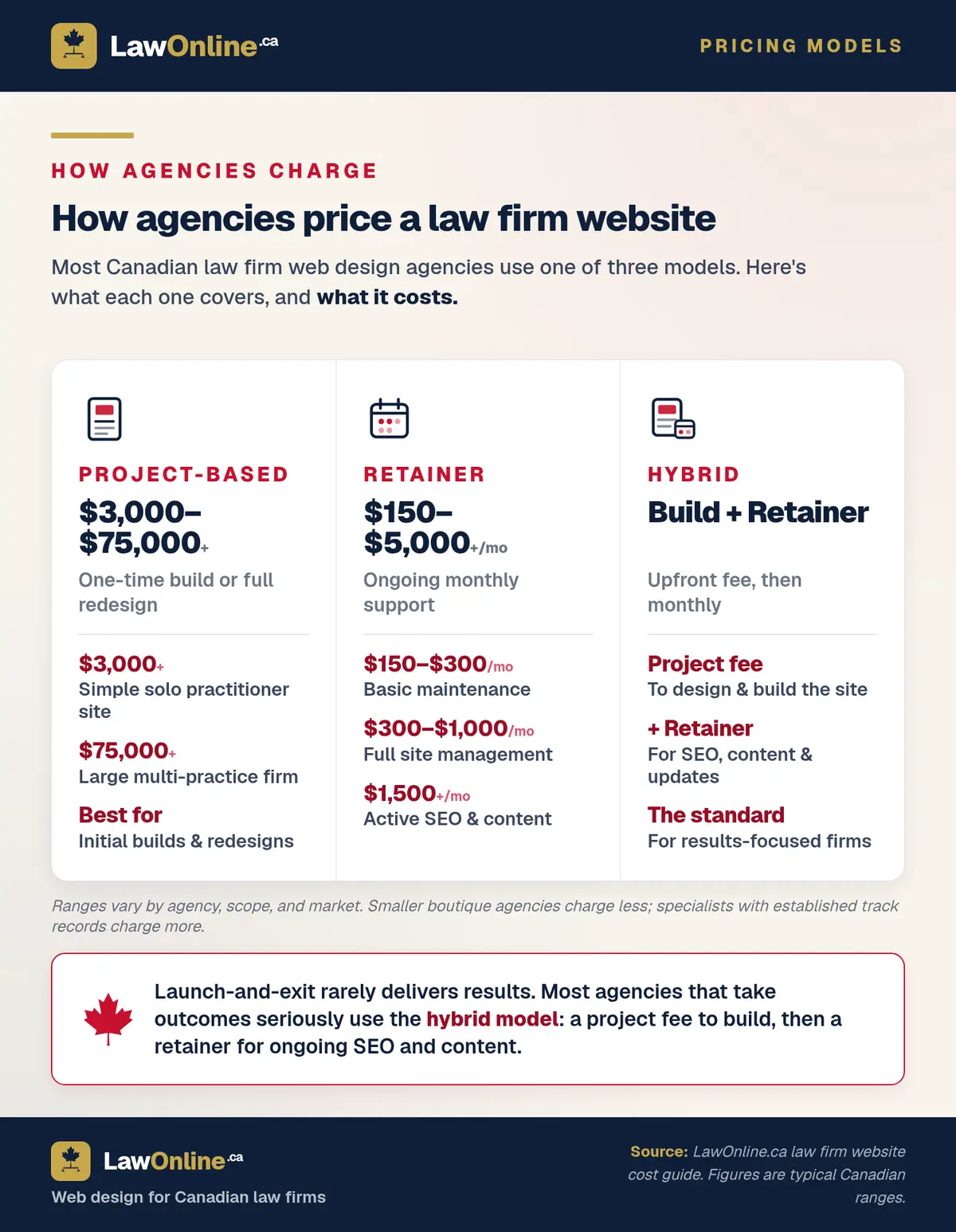
Project-based pricing. A fixed scope, fixed price engagement for the design and build of your site. Typical range in Canada: $3,000 to $75,000+, depending on firm size, the number of pages, complexity of integrations, content strategy, and the agency's own positioning. A simple solo practitioner site sits at the low end; a large multi-practice firm with custom integrations sits at the top. Smaller boutique agencies charge less; firms with established track records and specialists on staff charge more. Project-based work is most common for initial builds and full redesigns. For context, a GoodFirms survey of small-business web projects found that the average professionally designed website costs around $3,200, in line with where simpler law firm sites start. More complex law firm sites climb well beyond that because compliance, practice area content architecture, and the competitive value of legal search rankings require work that most web projects don't.
Retainer-based pricing. A monthly fee covering ongoing support after launch. Basic maintenance (plugin updates, security monitoring, backups, and minor content changes) runs roughly $150 to $300 per month. Full website management with performance monitoring and analytics reporting runs $300 to $1,000 per month. A retainer that includes active SEO and content production costs more: effective legal SEO rarely works below $1,500 per month, and full-service retainers reach $5,000 or more. Most law firms that get results from their websites are on some form of ongoing retainer.
Hybrid model. Many agencies charge a project fee for the initial build and a retainer for post-launch support. This is increasingly the standard for law firm web design agencies that take results seriously, since launch-and-exit arrangements don't typically deliver measurable outcomes.
For a detailed breakdown of what different scopes cost and what drives prices in each tier, see our complete guide to law firm website costs in Canada.
How to Choose a Law Firm Web Design Agency
Several criteria separate agencies that will get you results from agencies that will take your money and deliver a mediocre site.
A demonstrable track record with law firms. Ask for a client list and visit those sites. Run them through Google's PageSpeed Insights. Review the practice area content. If the law firm sites in an agency's portfolio are slow, thin on content, or look like generic templates, that's what they'll build for you. A portfolio of 20 law firm sites means the agency has solved the same problems you'll face. A portfolio where law firms are three of forty clients means they're learning on your project.
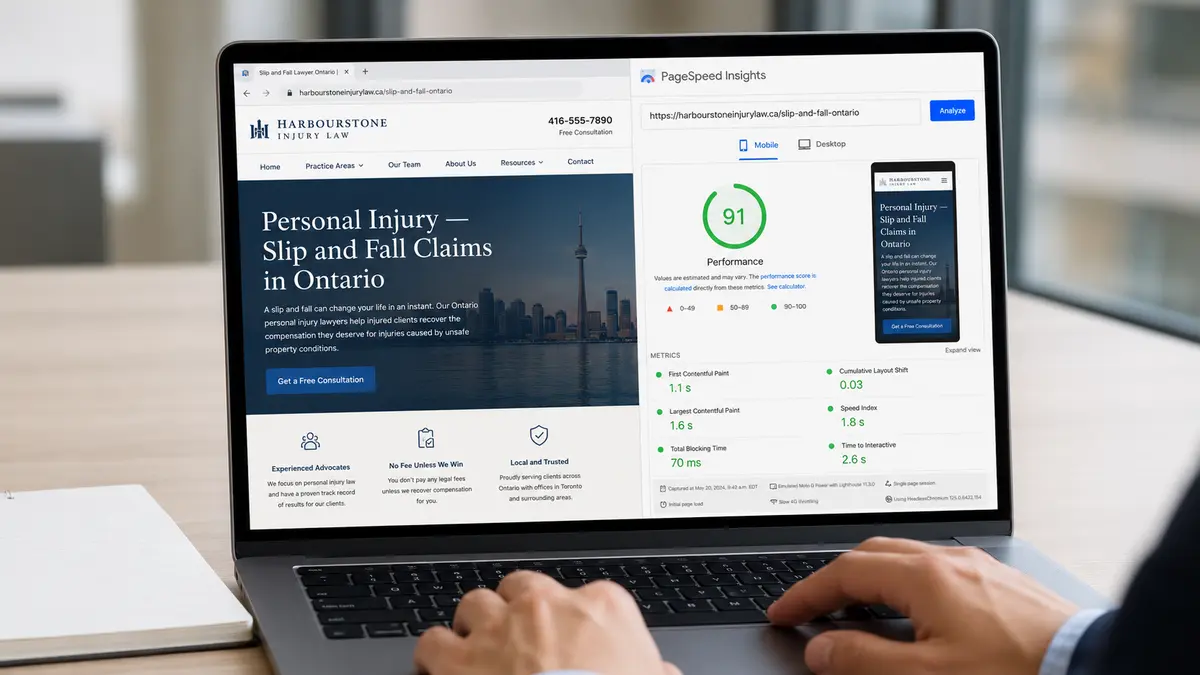
Depth on the technical requirements. Ask how they handle intake integration. Ask what schema markup they implement for law firms. Ask what their post-launch Core Web Vitals process looks like. If the answers are vague, the technical work will be vague too.
Knowledge of Canadian law society rules. Ask directly: "How do you handle law society advertising compliance for our province?" For Ontario firms, they should know the Law Society of Ontario's restrictions on testimonials, results, and performance claims without you having to explain what those are. For a deeper look at what Ontario requires, see our guide to Ontario lawyer advertising rules.
A defined discovery and strategy process. Agencies that skip discovery and jump straight to design are designing without direction. A genuine specialist will spend time understanding your practice areas, your competition, and your target clients before showing you a single mockup.
Clear ownership terms. Before signing, confirm that you own your domain, your content, and your code. Some agencies build sites on proprietary platforms that trap you with them. If leaving means losing your site, you have no leverage over the relationship. A professional agency will offer a clean handover.
Red Flags When Evaluating Agencies
No law firm examples in the portfolio. A claim of legal expertise without demonstrable law firm work is a claim you should ignore.
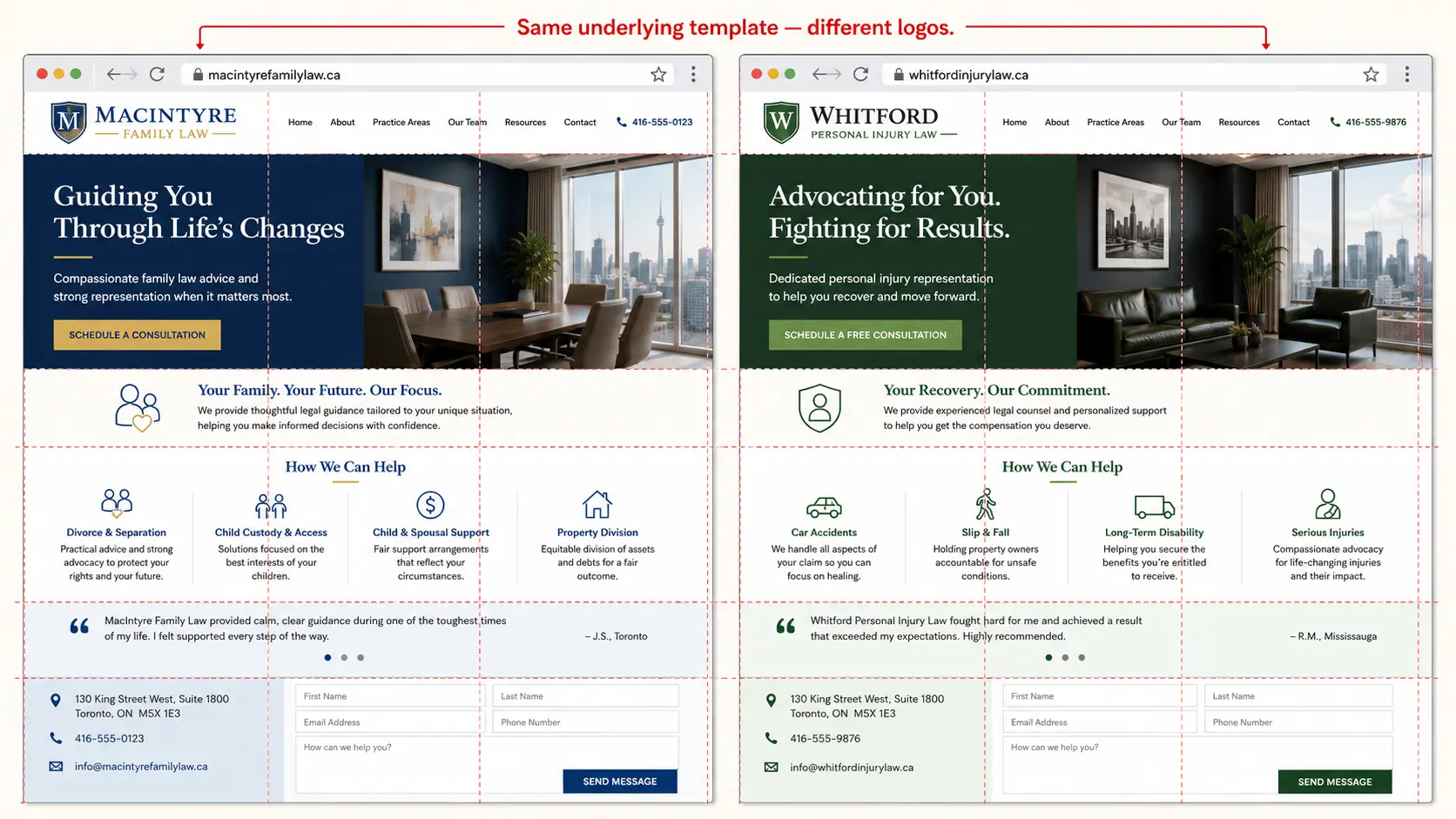
Template sites with different logos. If every law firm in an agency's portfolio has the same structural layout with different colours, they're reselling templates at custom-site prices. You'll rank behind firms with purpose-built sites that reflect genuine practice architecture.
No intake integration experience. For PI and family law firms, an agency that doesn't know Clio is an agency that doesn't know your workflow.
Vague content strategy. If the proposal is all design and no content plan, your site will launch with placeholder or thin copy that doesn't rank for anything. Law firm sites need deep, expertise-demonstrating practice area content. An agency that doesn't talk about content isn't building you a site that will generate clients.
Long-term exclusivity contracts. Some agencies lock clients into multi-year agreements with heavy exit penalties. A confident agency stands behind results with shorter commitments. Month-to-month or annual agreements with standard notice periods are normal. Three-year locked contracts with clawback clauses are not.
Performance claims they can't substantiate. "We'll get you to the top of Google" without specific data on how, over what timeline, and with what methodology is not a performance guarantee. It's a sales line. Ask for examples of ranking improvements they've driven for comparable law firms in comparable markets.
Questions to Ask Before Signing
Knowing how to choose a law firm web design agency comes down to the questions you ask before signing. Before committing, ask these in the discovery call:
- Which of your law firm clients can you share references for, and what have their results been?
- How do you handle law society advertising review in our province?
- What happens to our content, domain, and code if we leave?
- How are intake forms connected to our case management system?
- What does your post-launch SEO and performance monitoring process look like?
- What's included in your retainer, and what's billed additionally?
- Who is our day-to-day contact and how quickly do you respond to requests?
- Can you show organic traffic growth for a current client twelve months after launch?
- What's your process if we need a change made urgently?
The answers will tell you whether the agency understands legal practice requirements or is treating you like any other client in a diverse portfolio. For a broader look at evaluating individual designers as well as agencies, see our complete guide to choosing a law firm web designer.
Choosing a Law Firm Web Design Agency in Canada: What the Market Looks Like
Law firm web design agencies in Canada are concentrated in the major markets: Toronto, Vancouver, Calgary, Montreal, and Ottawa. Most operate as remote-first teams and work with clients nationally, but local presence can matter for two reasons.
First, Canadian law society rules vary by province. An agency that has worked with law firms in Ontario understands the Law Society of Ontario's specific requirements. One that has worked primarily with Alberta or British Columbia firms may need to come up to speed on provincial differences.
Second, local search signals matter for most law practices. An agency with experience driving local search results in your specific market understands the competitive landscape you're in. Results in Toronto mean competing against dozens of established practices. Results in Barrie or Kitchener mean a different competitive reality. An agency that knows your market can calibrate accordingly.
That competitive landscape is larger than most firms realize. Canadian Industry Statistics data shows roughly 33,350 legal services establishments across the country, the vast majority of them small firms. With website adoption in professional services well above 80%, tens of thousands of law firm sites are competing for the same prospective clients in organic search. A firm's website isn't just competing against the practice down the street. It's competing against every legal site in its practice area and geography.
For any law firm in a competitive Canadian market, the question isn't whether to use a specialist law firm web design agency. It's which one.
Frequently Asked Questions
How much does a law firm web design agency charge in Canada?
Project fees for a complete law firm website build range from roughly $3,000 for a simple solo practitioner site to $75,000+ for a large multi-practice firm with custom integrations. Post-launch retainers range from about $150 to $300 per month for basic maintenance up to $5,000 or more per month for full-service management with active SEO and content. For a full tier-by-tier breakdown, see our law firm website cost guide.
How long does it take a law firm web design agency to build a site?
Most professional law firm website builds take 10 to 16 weeks from kick-off to launch. Solo practitioner sites with limited scope can complete in 8 to 10 weeks. Multi-practice firms with custom intake integrations and bilingual content typically need 14 to 16 weeks. For a phase-by-phase breakdown of the build timeline, see our law firm website design process guide.
Should I choose a local agency or can I work with one remotely?
The most important factor is law firm experience, not geography. Most Canadian law firm web design agencies operate remotely and work with clients across the country. If you're in Ontario, work with an agency that knows Ontario's Law Society requirements, regardless of where their office is located. Local presence matters less than provincial regulatory knowledge and demonstrated law firm portfolio work.
What's the difference between a law firm web design agency and a legal marketing agency?
A law firm web design agency focuses primarily on website design and development, though many also offer SEO and content services. A legal marketing agency typically has a broader scope: paid advertising, reputation management, Google Business Profile management, email marketing, and website management under one umbrella. For law firms that want comprehensive marketing support beyond the website itself, a full-service law firm web design and marketing partner may be worth considering.
Do I need a specialist law firm web design agency, or can a general web design company do the job?
General agencies can build functional websites. What they reliably miss are the legal-specific elements: law society advertising compliance, intake integration with legal practice management software, practice area content architecture, and legal SEO implementation. These gaps don't always show up on launch day. They show up six months later when the site isn't generating inquiries and the rankings aren't moving. For most competitive Canadian markets, the focus should be on finding the best law firm web design agency you can, not just any agency. See our breakdown of common law firm website design mistakes for what typically goes wrong when generalists build law firm sites.