
Most law firms hire a web designer the same way they'd hire one for any small business. They pick an agency with a nice portfolio, describe what they want, and wait for a finished product.
The result is usually a clean-looking site that functions exactly like a restaurant website or a dental clinic homepage, except with stock photos of gavels. It looks fine. It doesn't convert.
Legal website design and development is a different discipline. Law firm website development isn't regular web design with legal content pasted in. It's a set of architectural, technical, and regulatory requirements that general agencies don't know how to build for, because they've never had to.
This guide breaks down what those requirements are, why they matter, and what Canadian law firms should demand from any agency building their site.
What Does "Legal Website Design & Development" Actually Mean?
It means building a website that's engineered specifically for how legal clients find, evaluate, and contact law firms. That includes the visual design, but it also includes the technical architecture, intake systems, compliance requirements, and search optimization that a legal site needs to actually generate clients.
General web design agencies build for aesthetics and basic functionality. A polished layout, a contact form, maybe some animations. For a restaurant or an e-commerce store, that's enough. But law firm web design demands more than a good-looking template.
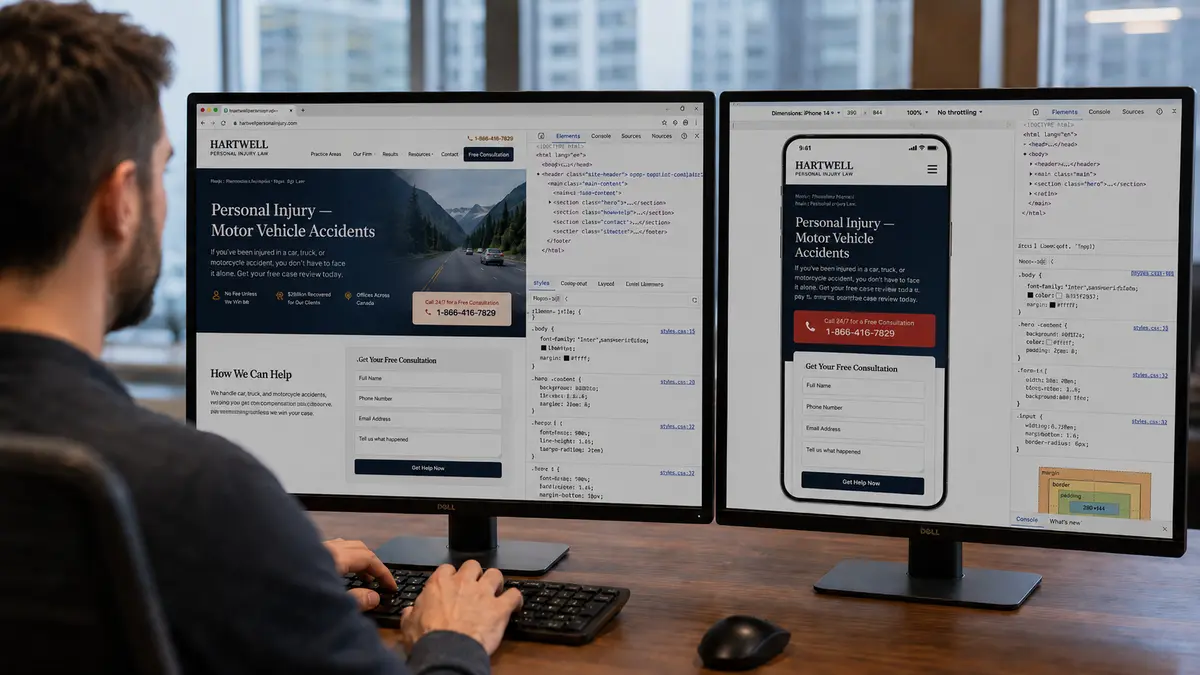
A personal injury firm's website needs intake triage that distinguishes an emergency inquiry from a general question. It needs practice area pages that match how prospective clients actually search ("car accident lawyer," not "motor vehicle litigation"). It needs trust signals like case results, professional credentials, and association memberships that reduce the anxiety a person feels before calling a lawyer for the first time.
And it needs all of this wired together so that when someone fills out a form at 11 p.m. on a Saturday, the inquiry reaches the right person within minutes. Not Monday morning. Minutes.
Most agencies that say they do legal website design have built two or three law firm sites. That's not specialization. Real law firm web development means understanding the full chain from search query to signed retainer, and building every element of the site to support it.
What's the Technical Side of Legal Web Development?
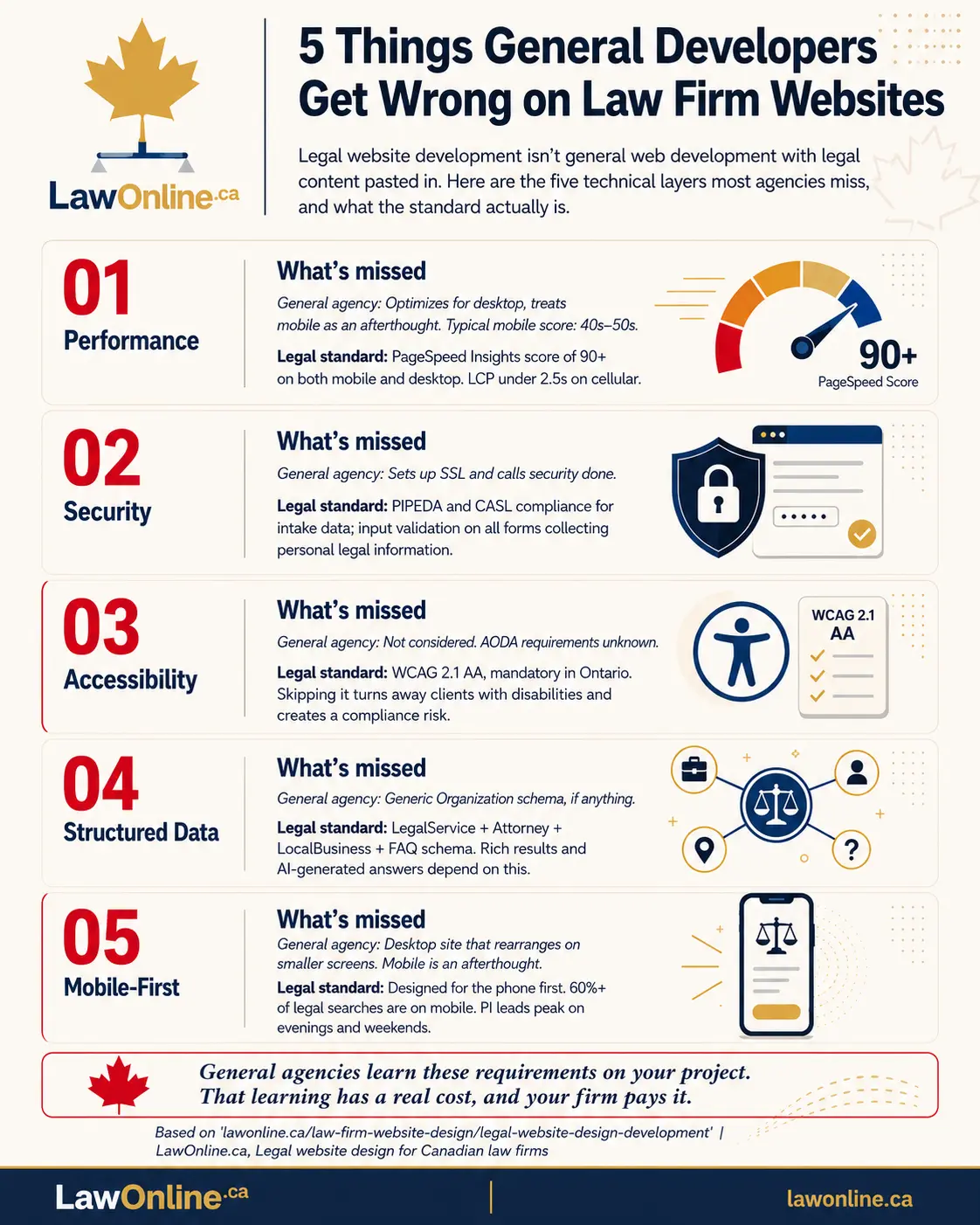
Law firm web development has five technical layers that general agencies frequently miss: performance, security, accessibility, structured data, and mobile-first architecture. Missing any one of them means the site underperforms where it matters most.
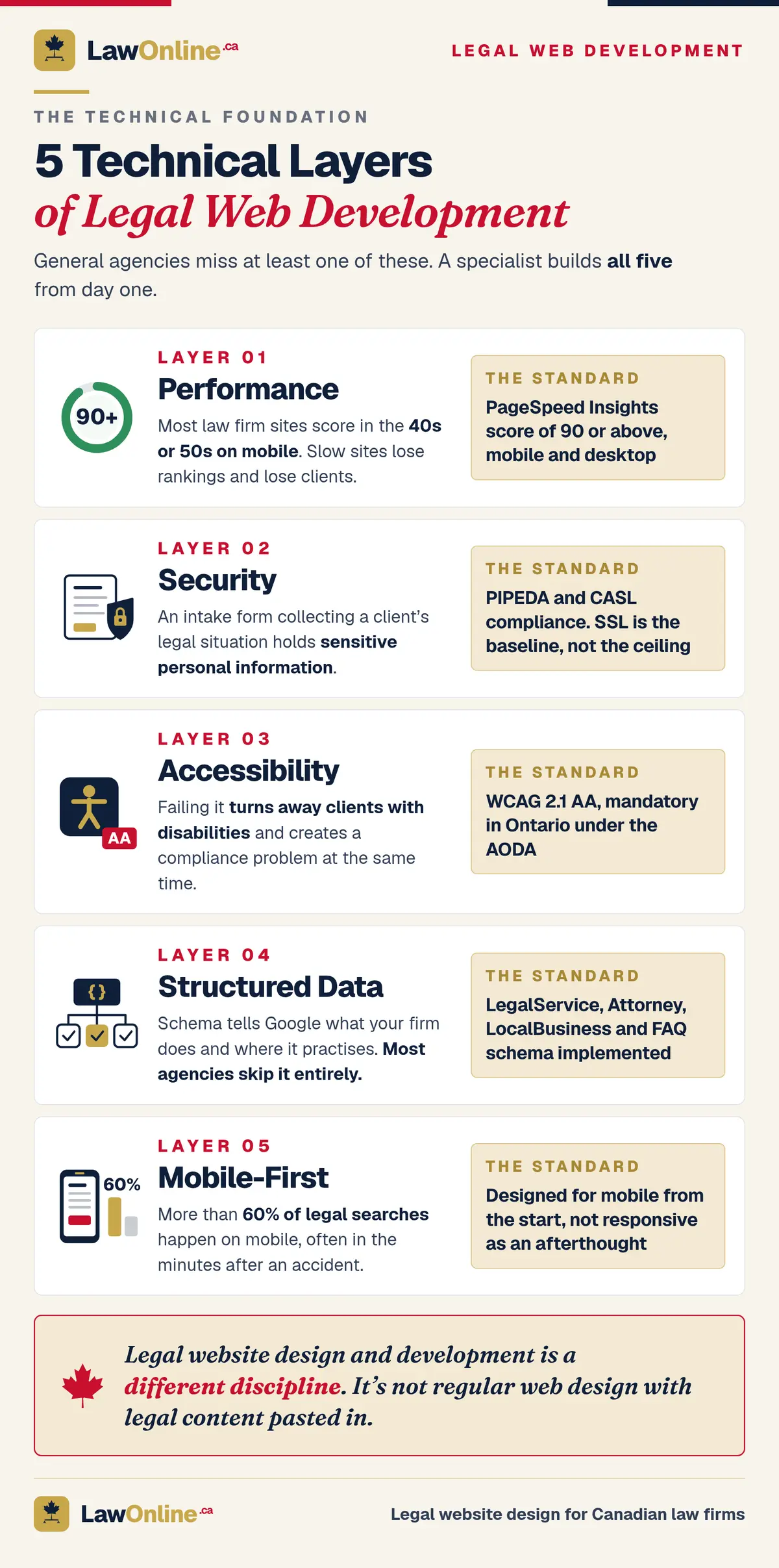
Performance. Google's Core Web Vitals directly affect where your site ranks. A law firm website that takes four seconds to load on mobile loses rankings and loses prospective clients who won't wait. The target is a PageSpeed Insights score of 90 or above on both mobile and desktop. Most law firm sites score in the 40s or 50s on mobile because the agency that built them optimized for desktop and treated mobile as an afterthought.
Security. SSL is baseline. Beyond that, Canadian law firm websites need to comply with PIPEDA (the federal privacy law governing how personal information is collected, used, and disclosed) and CASL (anti-spam legislation). An intake form that collects a prospective client's legal situation is collecting sensitive personal information. The site's data handling, storage, and transmission all need to reflect that.
Accessibility. Canadian website accessibility requirements come from multiple levels of government. The federal Accessible Canada Act carries penalties up to $250,000. Ontario's AODA requires WCAG 2.1 AA standards. British Columbia and Manitoba each have their own accessibility legislation. This isn't optional, and a personal injury firm's site that fails these standards is turning away clients with disabilities and creating a compliance problem at the same time.
Structured data. Schema.org markup tells search engines what your firm does, where it's located, and what practice areas it covers. LegalService, Attorney, LocalBusiness, and FAQ schema types help Google generate rich results for your firm. Most general agencies skip this entirely, and the firm never knows what it's missing because the absence is invisible.
Mobile-first. More than 60% of legal searches happen on mobile devices. For personal injury, the number is higher. People search for lawyers in the minutes and hours after an accident, almost always from their phone. A site that's merely responsive (desktop layout that rearranges on smaller screens) isn't enough. It needs to be designed for mobile from the start, with touch-friendly intake forms, prominent phone numbers, and fast load times on cellular connections.
How Does Law Society Compliance Affect Website Design?
Every piece of copy on a law firm's website is subject to the advertising and marketing rules of the applicable provincial law society. Getting this wrong doesn't just hurt credibility. It can trigger a regulatory complaint.
The rules differ by province. The Law Society of Ontario prohibits advertising that's misleading, and it defines "misleading" broadly. The Law Society of British Columbia has specific restrictions on testimonials. Alberta, Nova Scotia, and other provinces each have their own variations.
Common issues that general agencies create without realizing it:
- Superlatives. Calling a firm "the best personal injury lawyer in Toronto" or "top-rated" can violate advertising rules unless the claim is objectively substantiated.
- Guaranteed outcomes. Any language suggesting a specific result ("We'll get you the compensation you deserve") is problematic in most provinces.
- Fee advertising without context. "Free consultations" is generally fine, but quoting specific fee structures without appropriate disclaimers can create issues.
- Testimonials. Some provinces restrict or prohibit client testimonials. A general web designer might add a testimonials carousel because it's standard practice for other businesses, without checking whether it's permitted in that firm's jurisdiction.
This is where legal website design separates from general web design most sharply. Every word on the site needs to be reviewed against the applicable law society's rules before it goes live. An agency that doesn't do this is creating a liability, not a marketing asset.
For a closer look at how this review fits into the broader law firm website design process, including the compliance stage, see our process breakdown.
Where Does Legal Web Development Actually Earn Its Value?
Intake architecture is where the real ROI of law firm website development lives. A well-designed intake system converts visitors into consultations. A poorly designed one loses them quietly, every day, without the firm ever knowing.
Most law firm websites treat the contact form as the final destination. A visitor fills it out, it goes to a shared inbox, and someone gets back to them when they can.
That's not an intake system. That's a suggestion box.
Proper intake architecture connects the website to the firm's practice management and CRM tools. Clio Grow, Lawmatics, PracticePanther, LEAP: the website should route inquiries directly into whichever system the firm uses to manage its pipeline. When someone fills out an intake form, the system should log the lead, tag it by practice area, and notify the appropriate person immediately.
For personal injury firms, speed-to-lead is critical. Research consistently shows that contacting a lead within the first hour dramatically increases conversion rates compared to waiting six or twelve hours. A PI firm that doesn't respond to a web inquiry until the next morning is losing that lead to the firm that responded in fifteen minutes.

This means the intake system needs to work around the clock. Any law firm website developer who doesn't build for after-hours routing, automated confirmations, and mobile push notifications is leaving the most valuable leads on the table. Source attribution that tells the firm exactly which page and which search term generated the inquiry is equally non-negotiable.
Call tracking adds another layer. Firms that use dynamic number insertion can track which pages generate phone calls, which campaigns drive them, and what the cost per lead actually is. A personal injury firm running Google Ads alongside organic search needs this data to allocate budget intelligently. Without it, you're guessing.
What Should You Look for in a Legal Web Design Agency?
Look for an agency that builds exclusively or primarily for law firms, gives you full ownership of your site, and provides post-launch support. Everything else is secondary.
Specialization matters. An agency that handles website development for law firms every day understands the intake flow, the compliance requirements, and the content structure that converts legal searches into consultations. An agency that built one law firm site between a yoga studio and an auto dealership doesn't have that understanding. Ask for their legal portfolio specifically, not their general portfolio.
Ownership is non-negotiable. You should own your domain, your content, your code, and your data. If the agency uses a proprietary platform that locks you in, you'll pay migration costs and lose SEO equity if you ever want to leave. This happens more often in legal website development than firms expect: the agency builds on their own system, and when the relationship ends, the firm discovers they can't take their site with them.
Post-launch support. A website launch isn't the end of the project. Content needs updating, performance needs monitoring, and search optimization is ongoing work. Ask whether the agency offers a retainer for post-launch performance, or whether they build and walk away.
Red flags to watch for:
- Package pricing with no mention of SEO scope or content strategy
- "Custom" designs that are clearly template modifications with swapped colours and logos
- No discussion of intake integration, analytics, or conversion tracking
- Pricing that seems unusually low for the Canadian market, which often means offshore execution with a Canadian front office
For a full breakdown of what firms typically charge, see our guide to law firm website cost in Canada.
How Much Does Legal Web Development Cost in Canada?
Expect to pay $3,000 to $7,500 for a basic legal website build, $7,500 to $25,000 for a mid-market law firm website development project with custom design and CRM integration, and $25,000 or more for a multi-location or enterprise-level site with advanced functionality.
The range is wide because the scope varies enormously. A solo practitioner in family law needs a different site than a ten-lawyer personal injury firm with three offices across Ontario. For comparison, a 2025 Canadian pricing analysis puts the typical small business website at $2,000 to $4,500 for a basic 5-to-10-page build. Legal sites sit above that range because they require compliance review, intake integrations, and practice-area content strategy that general builds don't include.
The main cost drivers:
- Practice area complexity. A firm that handles one practice area needs fewer pages than one covering six. Each practice area page should be built as its own landing page, targeting its own keyword set.
- Number of locations. Multi-location firms need separate pages per office, each with unique content and local schema markup. Duplicating the same content across location pages hurts rather than helps.
- Intake integrations. Connecting the site to Clio, Lawmatics, or another CRM adds development time. So does call tracking, live chat, and after-hours routing.
- Content scope. Does the build include content strategy and writing, or just design and development? Content is often the biggest variable. A twenty-page site with professionally written, SEO-optimized practice area content costs significantly more than one where the firm provides their own copy.
The ROI framing is straightforward for personal injury firms. One additional PI retainer per month, at a $10,000 or higher contingency fee, covers the full cost of a mid-market website build within the first year. The question isn't whether you can afford a proper legal website. It's what you're losing by not having one.
For a detailed breakdown by tier, see our full guide to law firm website costs.
The Bottom Line
Legal website design and development is a specific discipline with requirements that don't exist in general web design. Law Society compliance, intake architecture, legal schema markup, and practice-area content strategy are all components that a generalist agency will miss, and they're the components that actually drive client acquisition.
Canadian law firms evaluating their website, whether it's a new build or a redesign, should work with a law firm web design agency that understands these requirements from day one. Not one that learns on your project.
For more on what legal website design and development looks like in practice, start with our hub page and explore the resources throughout this guide.