
The word "custom" gets thrown around loosely in law firm website design. One lawyer website design agency might call a WordPress theme with swapped colours and a new logo "custom," while another uses it to mean a site coded from scratch. Before you can make a smart decision between a custom law firm website and a template-based one, you need to know what those terms actually mean and where the real trade-offs are.
What Do "Custom" and "Template" Actually Mean?
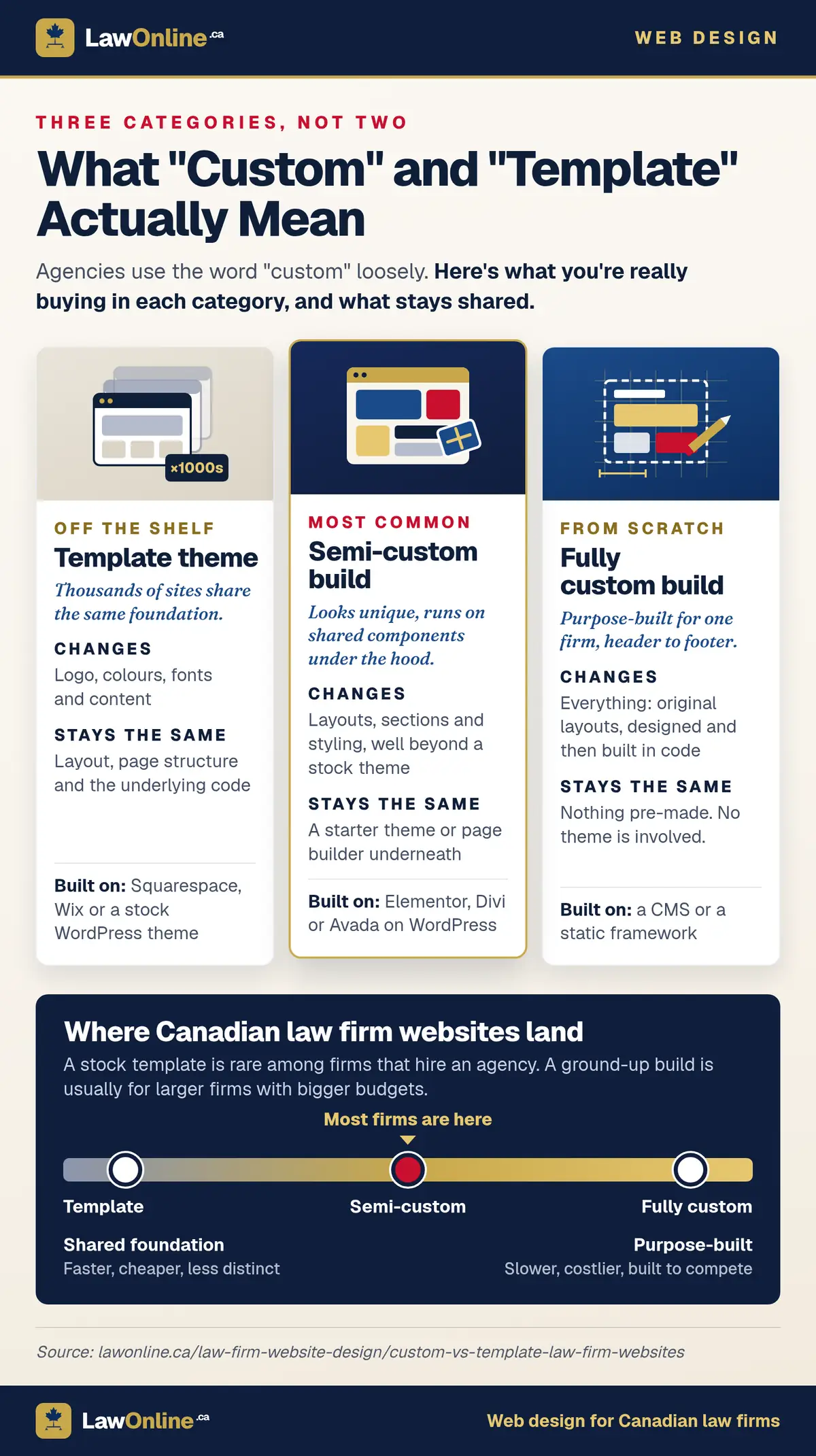
There are three broad categories, not two.
Template-based (off-the-shelf theme). You pick a pre-built theme from WordPress, Squarespace, Wix, or another platform. The designer changes the logo, colours, fonts, and content, but the layout, page structure, and underlying code stay largely the same. Thousands of other sites share the same foundation. Free templates exist on all of these platforms, but for a professional firm they come with trade-offs in security, support, and design quality that make a paid theme the safer starting point. Among closed platforms, Squarespace and Wix work for new solos who want to get online fast, but they lack the plugin ecosystem and ownership portability that WordPress offers.
Semi-custom (page builder or starter theme). A designer starts with a flexible starter theme or page builder like Elementor, Divi, or Avada on WordPress, then customizes layouts, sections, and styling well beyond what a stock theme offers. The result looks unique even though it runs on shared components under the hood.
Fully custom (designed and coded from scratch). A designer creates original page layouts, a developer builds them in code, and the site is assembled on a CMS or static framework with no pre-made theme involved. Everything from the header to the footer is purpose-built for that firm.
Most Canadian law firm websites fall into the middle category. A fully stock template is rare among firms that hire an agency, and a ground-up custom build is usually reserved for larger firms with bigger budgets.
Where Do Templates Win?
Templates aren't automatically bad. For certain firms at certain stages, they're the right call.
Speed. A template site can launch in two to four weeks. A custom build typically takes eight to sixteen weeks. If you need your solo practitioner website live before you can start accepting clients, time matters more than pixel-perfect design.

Lower upfront cost. A template-based law firm website typically runs $3,000 to $6,000 in Canada, compared to $7,000 to $15,000+ for a custom design. That gap is meaningful when you're investing in a practice that hasn't generated revenue yet. It's a widespread concern: a 2024 Appara survey of Canadian legal technology adoption found that 62% of firms identify budget constraints as their biggest barrier to adopting new technology. A firm's website is often where that tension shows up first.
Easier iteration. If you're still figuring out your practice areas, your ideal client, or your geographic focus, a template gives you a foundation you can evolve without committing to a design that's expensive to change later.
What about the ads I see for websites for $500?
Even for a site built from a template, lawyers need unique legal content written specifically for their firm. That's where the bulk of the cost for a properly built law firm website comes from. A website for $500 or $1000 will not only have a generic copy-and-paste design, it will also have generic copy-and-paste content that will never get you found in search engines or AI overviews. A good law firm website has properly structured practice areas, lawyer bios, depth content, and conversion optimization that simply isn't possible with boilerplate filler content. When it comes to law firm websites, the old adage is certainly true: "you get what you pay for".
For a deeper comparison of what each pricing tier includes, our law firm website cost breakdown covers the full spectrum from solo builds to 50+ page platforms.
Where Do Custom Law Firm Websites Win?
A custom law firm website earns its cost when the site has to do more than exist. It has to compete.
Conversion performance. Every element on a custom site can be designed around how potential clients actually behave: where they look first, what makes them trust you, and what gets them to pick up the phone. Template layouts are designed for general appeal, not for converting someone who just searched "car accident lawyer near me" and has three tabs open.
Differentiation. If your competitors all use the same WordPress theme (and in some Canadian markets, they literally do), a custom design is an immediate signal that your firm takes its public image seriously. That signal matters to the kind of client who compares multiple firms before calling.
Complex practice structures. A full-service firm covering personal injury, family law, real estate, and immigration needs a site architecture that handles distinct practice areas, multiple locations, and different intake paths, all while respecting the governing Law Society's advertising rules. Templates struggle with that level of structural complexity because the page hierarchy is fixed. The CBA's Legal Ethics in a Digital Context guidelines add to the list: a firm's website needs to meet WCAG accessibility standards, include disclaimers that prevent intake forms from creating inadvertent lawyer-client relationships, and comply with marketing rules that differ across provinces. A custom build handles those at the architecture level. Templates rely on plugins and patches, if they address them at all.
SEO and page speed. A custom site gives you a structural SEO advantage from day one. Without the bloated CSS, JavaScript, and unused features that template themes carry, your pages load faster and score better on Core Web Vitals, which directly affect your Google rankings. Your developer also has full control over schema markup, internal linking architecture, and crawl paths, the technical foundations of law firm website SEO that templates handle poorly if they handle them at all.
Long-term ownership. A custom site built on open-source technology like WordPress belongs to you. No proprietary builder locks you in, and any competent developer can maintain or modify it. Template sites built on closed platforms or agency-proprietary builders can trap you.
What About the Middle Path?
The most common approach among Canadian law firm web agencies is a custom design built on WordPress. There's a reason it's the go-to website builder for law firms: you get original layouts and purpose-built page structures without the cost of building a CMS from scratch, because WordPress handles the content management layer.
This middle path makes sense for most firms because it delivers the visual and structural benefits of custom design while keeping the site easy to update. A marketing coordinator can publish blog posts and update attorney bios without involving a developer, and you get access to WordPress's plugin ecosystem for intake integrations, analytics, and online payments without custom development for each feature.
For a detailed comparison of WordPress against static site generators and other platforms, see our WordPress vs. static sites breakdown.
How Should Your Firm Decide?
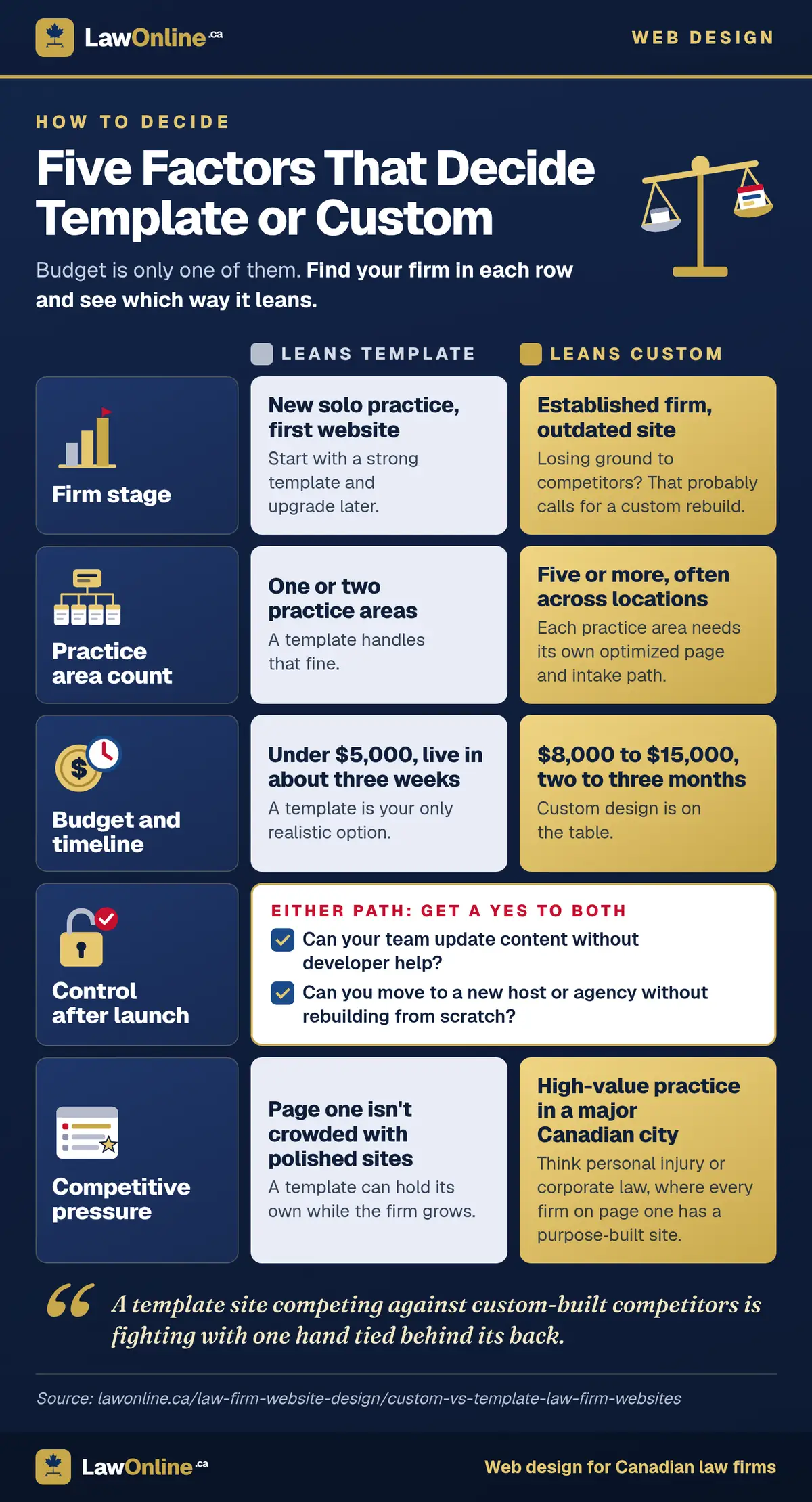
Whether you're evaluating a law office website design proposal or comparing agencies, the right choice depends on five factors, not just budget.
Firm stage. Small law firm website design doesn't have to start with a custom build. A new solo practice can launch on a strong template and upgrade later. An established firm with an outdated site that's losing ground to competitors is usually a stronger candidate for a law firm website redesign.
Practice area count. One or two practice areas? A template handles that fine. Five or more, especially across multiple locations? Custom architecture is worth the investment because each practice area needs its own optimized page with distinct content and intake paths.
Budget and timeline. If you need a site in three weeks for under $5,000, a template is your only realistic option. If you can invest $8,000 to $15,000 and wait two to three months, custom design is on the table.
Who controls the site after launch. Ask your agency directly: can your team update content without developer help? Can you move the site to a different host or agency without rebuilding from scratch? These questions matter more than how the site looks on launch day.
Competitive pressure. In high-value practice areas like personal injury or corporate law in major Canadian cities, the firms on page one of Google all have polished, purpose-built sites. A template site competing against custom-built competitors is fighting with one hand tied behind its back.
What Are the Red Flags in Template Law Firm Websites?
Not all template builds are equal, and a few law firm website best practices will help you tell the good options from the ones that will cost you later.
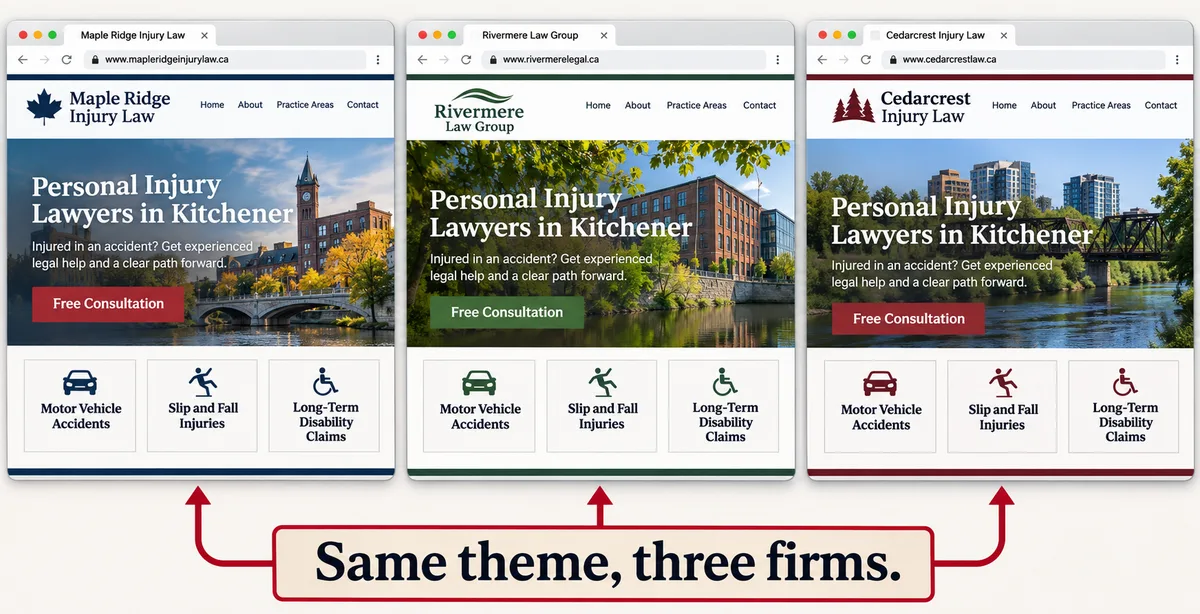
Shared designs you can spot. If you can find two other law firms using the same layout, prospective clients can too. Run competitor sites through Google's PageSpeed Insights while you're at it. Performance tells you what design alone can't.
Slow, bloated themes. Many popular WordPress themes ship with dozens of features your firm will never use, and every unused feature still adds weight to your pages. A theme that loads in 4+ seconds on mobile is costing you visitors. Core Web Vitals directly affect your search rankings, and bloated templates regularly fail these benchmarks.
Plugin bloat. Template builds often rely on five or six plugins to achieve what a custom build handles natively. Each plugin is a potential security vulnerability, a performance drag, and a maintenance dependency. For law firms handling sensitive client data through intake forms and portals, that risk adds up.
Locked-in builders. Some agencies build on proprietary platforms where the site can't be exported or moved. If you leave, you start over. Before signing any web design contract, confirm in writing that you'll own the domain, the hosting account, the code, and the content. Our guide to law firm website ownership walks through how to verify each one.
What Does a Custom Law Firm Website Actually Cost in Canada?
A custom-built law firm website in Canada typically costs between $7,000 and $15,000 for a small firm, and $15,000 to $35,000 for a mid-size firm with more complex requirements. Those figures reflect 2026 pricing across Canadian agencies and include original design, development, professional copywriting, foundational SEO setup, and CMS integration.
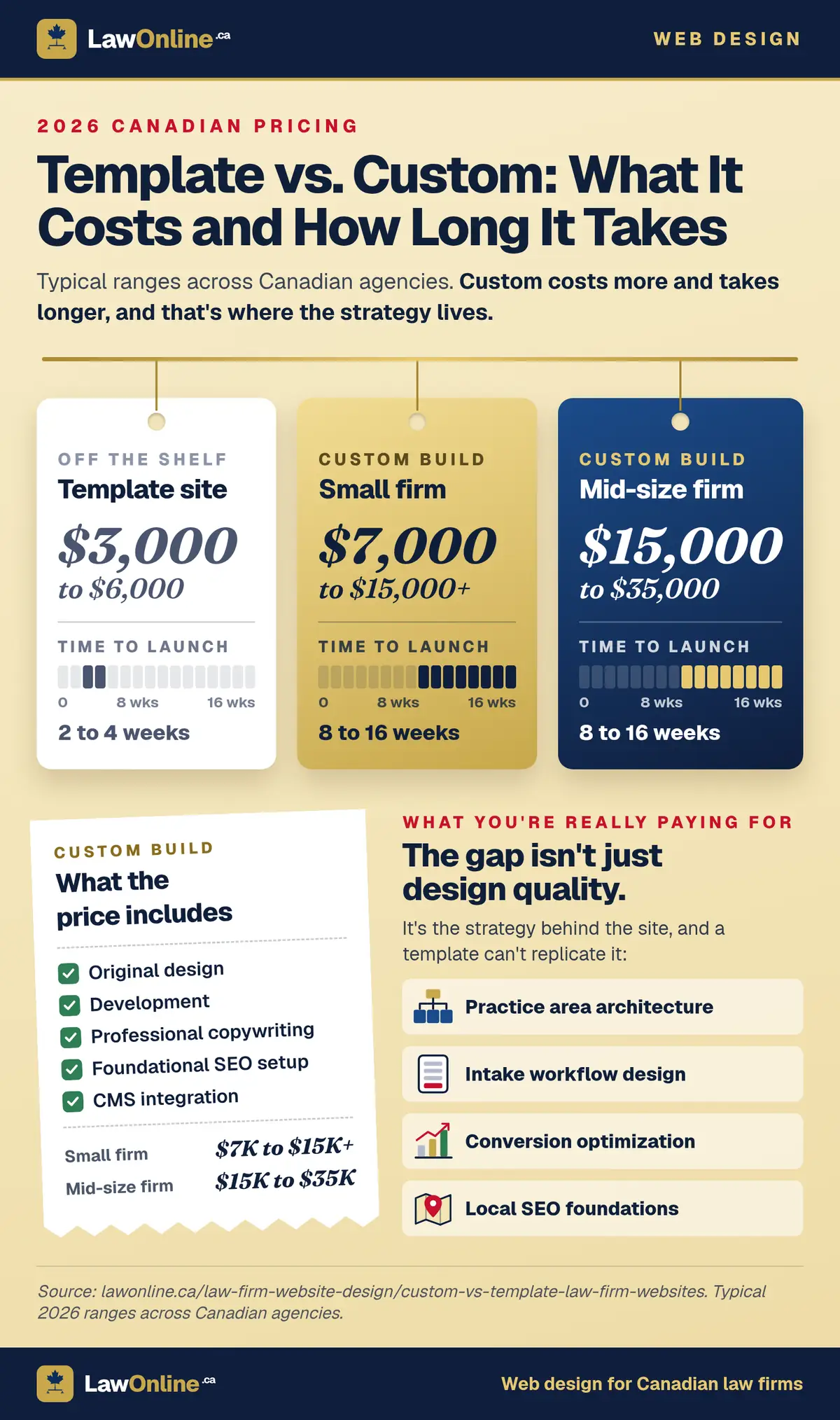
What separates that law firm web design cost from a template build isn't just design quality. It's the strategy behind the site: practice area architecture, intake workflow design, conversion optimization, and local SEO foundations that a template can't replicate.
A custom site isn't the right legal website design choice for every firm, but for firms ready to compete seriously for clients online, it's the investment that pays for itself.