
If your law firm is paying a marketing company for a website, there's a reasonable chance you don't actually own it.
Many Canadian lawyers pay $500 to $2,000 per month for a website they can't take with them if they ever cancel, because the domain, the platform, or the code belongs to the agency, not to the firm. To find out if you own your website, start with a WHOIS lookup on your domain name. If the registrant is your marketing company rather than your firm, you don't control the most critical piece of your online presence.
This isn't a fringe problem. In a 2024 survey of marketing leaders, 81% of marketing teams identified website ownership as a persistent challenge, and more than a third of leaders who believed they should own their website reported they didn't actually control it. If ownership is that murky at companies with dedicated marketing departments, the problem runs deeper at small law firms that hand their entire web presence to an outside vendor.
It's one of the most common ways law firm marketing contracts lock firms into relationships that are painful and costly to exit. Our law firm website migrations and hosting guide explains your options when you're ready to switch.
Here's what website ownership means, how to check yours, and how to protect yourself going forward.
What "Owning Your Website" Actually Means
Ownership of a law firm website has four components. You need to control all four to truly own it.
Your domain name. This is your web address (e.g., smithlawfirm.ca). If you don't control the domain registrar account, your agency can hold your domain hostage when you cancel, or let it lapse by accident. It's not a theoretical risk. Firms have lost control of their domain this way, forced to start over with a new domain and lose years of SEO equity overnight.
Your hosting account. Your website lives on servers somewhere. If your agency controls the hosting account and you can't log in independently, they can take the site offline the moment you cancel. This is especially damaging for PI firms running active digital ad campaigns that point to landing pages on that domain.
Your CMS and platform. If your site is built on a proprietary platform owned by your agency (not WordPress, Squarespace, or another transferable CMS), the entire site design may be non-portable. You'd be starting from scratch.
Your content and code. The written content, photos, and custom code on your site may be considered intellectual property of the agency under certain contract terms, even if you paid for it on a monthly basis. Canada doesn't have a work-for-hire doctrine like the United States. Under the Copyright Act, the person who creates a work owns the copyright by default, so unless your contract explicitly assigns content ownership to your firm, the agency that wrote your page copy and shot your photos likely retains it.
Owning your website means having independent access to all four layers, the domain, the server, the CMS, and the content.
The Three Types of Law Firm Website Vendors
Not all vendors structure ownership the same way. Most fall into one of three categories.
You Own It
Some marketing companies (including LawOnline.ca) build websites that the law firm fully owns from day one. The domain is registered in the firm's name, the code and content are delivered as the firm's property, and the firm can move the site to any host it chooses. Monthly fees, if any, cover ongoing SEO, maintenance, or marketing, not a licence to use the site.
Under this model, if you fire your marketing company Monday morning, a new one can be managing your site by Tuesday afternoon. Zero disruption to your online presence.
You License It
Many mid-market vendors sell a hosted service. You pay monthly, and for that monthly fee you get use of a website. The site is often built on a proprietary platform, and monthly payments are essentially a subscription. If you cancel, the site goes offline. You may retain your content as text, but the design, structure, and domain are often owned or controlled by the agency.
This model is common among vendors who specialize in specific practice areas, including PI-focused vendors that offer "turnkey" plaintiff law firm websites. The sites look great and convert well, but the firm has no exit option without starting over.
Fully Rented
At the extreme end, some firms are paying for a website where they own nothing: not the domain, not the hosting, not the content copyright. The site exists entirely at the pleasure of the agency relationship. These arrangements are usually the result of a rushed onboarding or an aggressive sales process where the contract terms weren't reviewed carefully.
We've talked to firms that spent five years with a vendor under this arrangement. When they finally tried to leave, they lost everything: domain, Google Business Profile verification, years of SEO equity. Rebuilding from scratch after half a decade is brutal, and entirely avoidable.
How to Check Your Domain Ownership
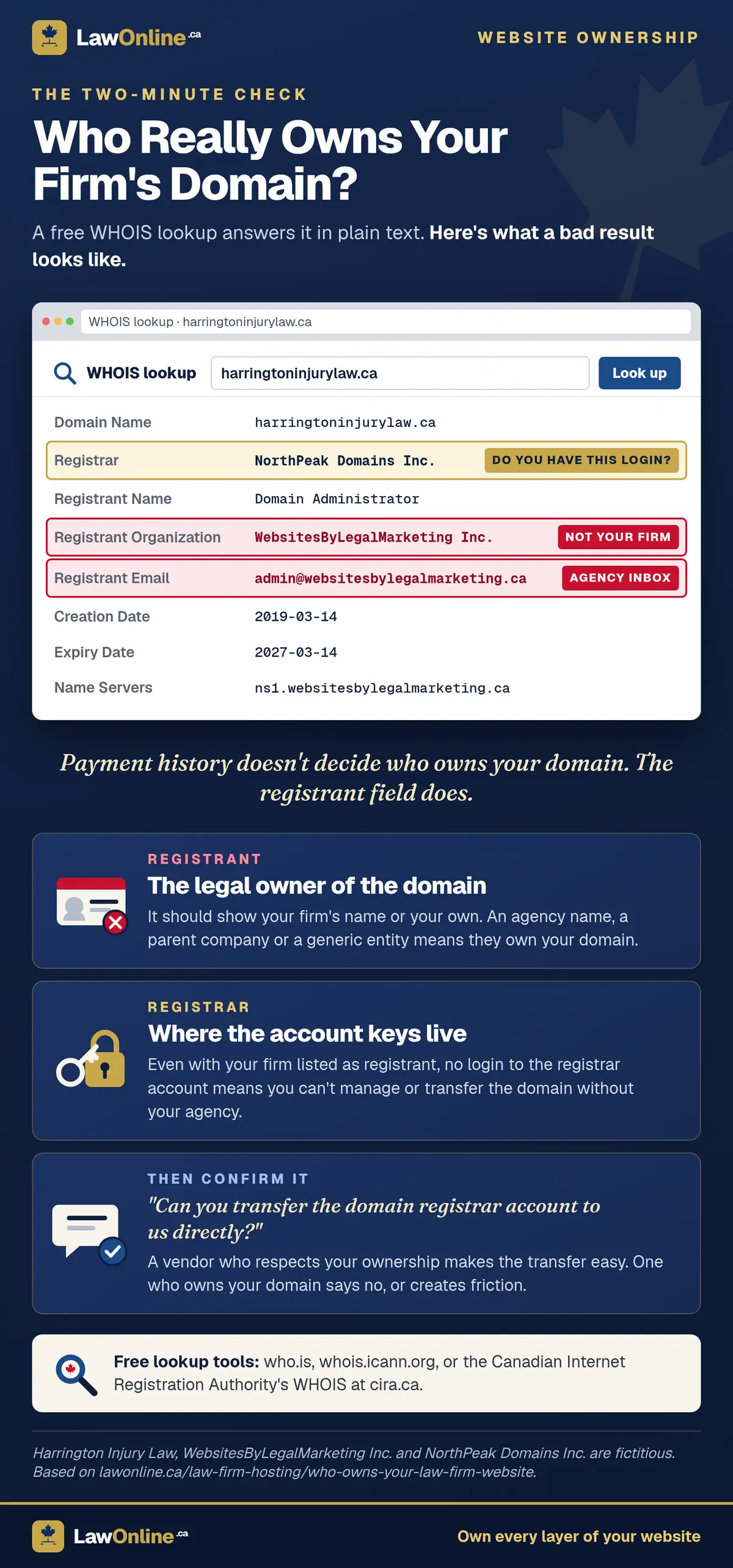
This takes two minutes. Go to a WHOIS lookup tool, who.is, whois.icann.org, or the Canadian Internet Registration Authority's WHOIS at cira.ca, and enter your domain name.
Look at the Registrant field in the results. This is the legal owner of the domain. If it shows your firm's name or your personal name, you're in good shape for the domain at least. If it shows your marketing agency's name, a parent company, or a generic entity like "WebsitesByLegalMarketing Inc.", they own your domain.
Also check the Registrar field. This tells you which company controls the account where the domain is registered. Even if your firm is listed as registrant, if you don't have login credentials for that registrar account, you can't manage or transfer the domain without going through your agency.
To fully confirm domain control, ask your agency: "Can you transfer the domain registrar account to us directly?" A vendor who owns the domain will either say no or create friction. A vendor who respects your ownership will facilitate the transfer without issue.
If your firm uses a .ca domain, you have an additional layer of protection. The Canadian Internet Registration Authority (CIRA) administers all .ca registrations and has a formal domain dispute resolution process for registrants who believe a domain is being held improperly. It's not a quick fix, but it's a real recourse that many firms don't know exists.
Red Flags in Law Firm Website Contracts
Before you sign (or renew), read these sections carefully.
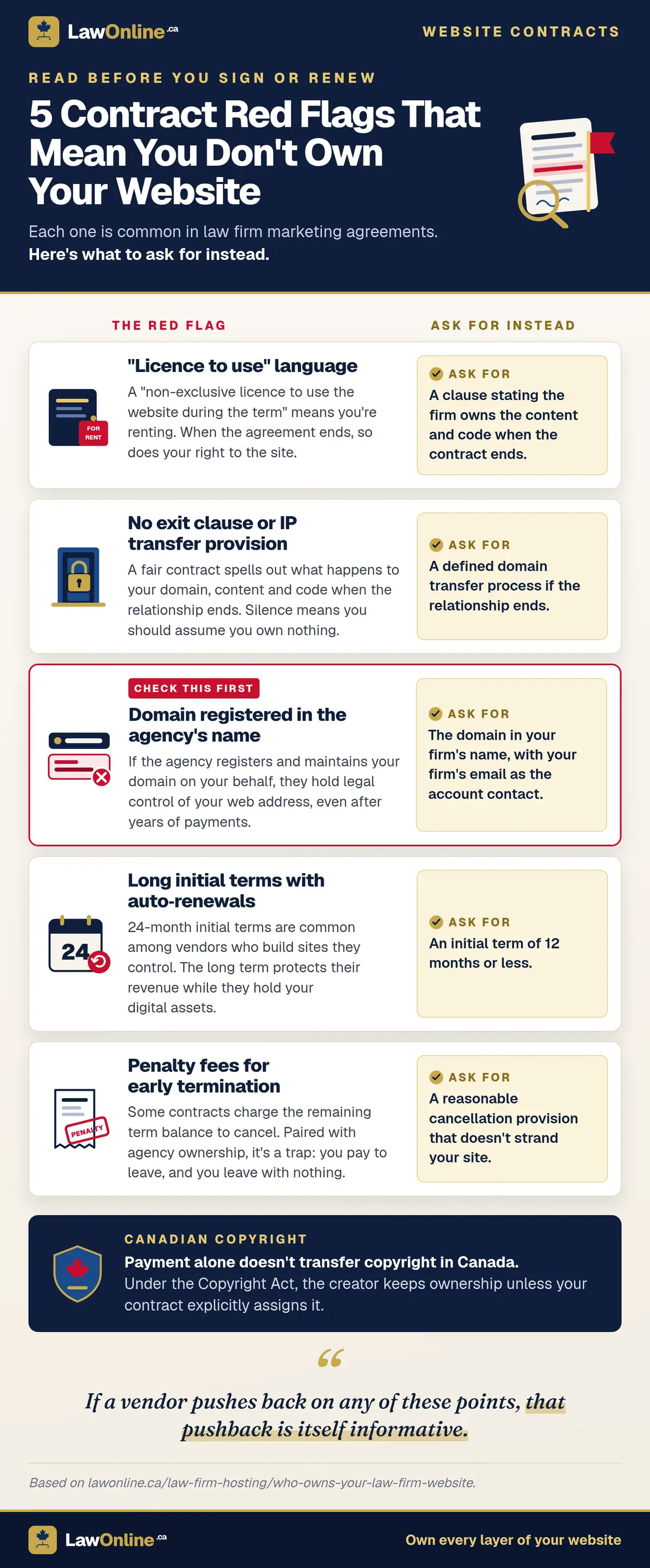
"Licence to use" language in the website section. This phrase signals that you're renting the site, not buying it. A contract that says the agency grants you a "non-exclusive licence to use the website during the term of the agreement" is telling you clearly: if the agreement ends, so does your right to use the site.
No exit clause or IP transfer provision. A fair contract specifies what happens to the domain, content, and code when the relationship ends. If there's no clause addressing this, assume you own nothing.
Domain registered in agency's name. If the contract specifies that the agency will register and maintain the domain on your behalf, that's a warning sign. Push to have the domain registered in your firm's name with your email address as the account contact.
Long initial terms with auto-renewals. 24-month initial terms are common among vendors who build sites they control. The long term protects their revenue while they hold your digital assets.
Penalty fees for early termination. Some contracts include cancellation fees equal to the remaining term balance. Combined with site ownership provisions, this creates a trap: you pay to leave and you leave with nothing.
What Happens When You Leave a Vendor Who Owns Your Site
The outcome depends on how aggressively the vendor enforces their contract terms, but the worst-case scenarios are genuinely disruptive.
For a personal injury firm in active litigation, losing your website can mean:
- Active Google Ads campaigns pointing to dead URLs
- Referral links from injury blogs returning 404 errors
- Calls routed through a tracking number the vendor controls going to the vendor, not to you
- Loss of your Google Business Profile if the agency managed the verification email
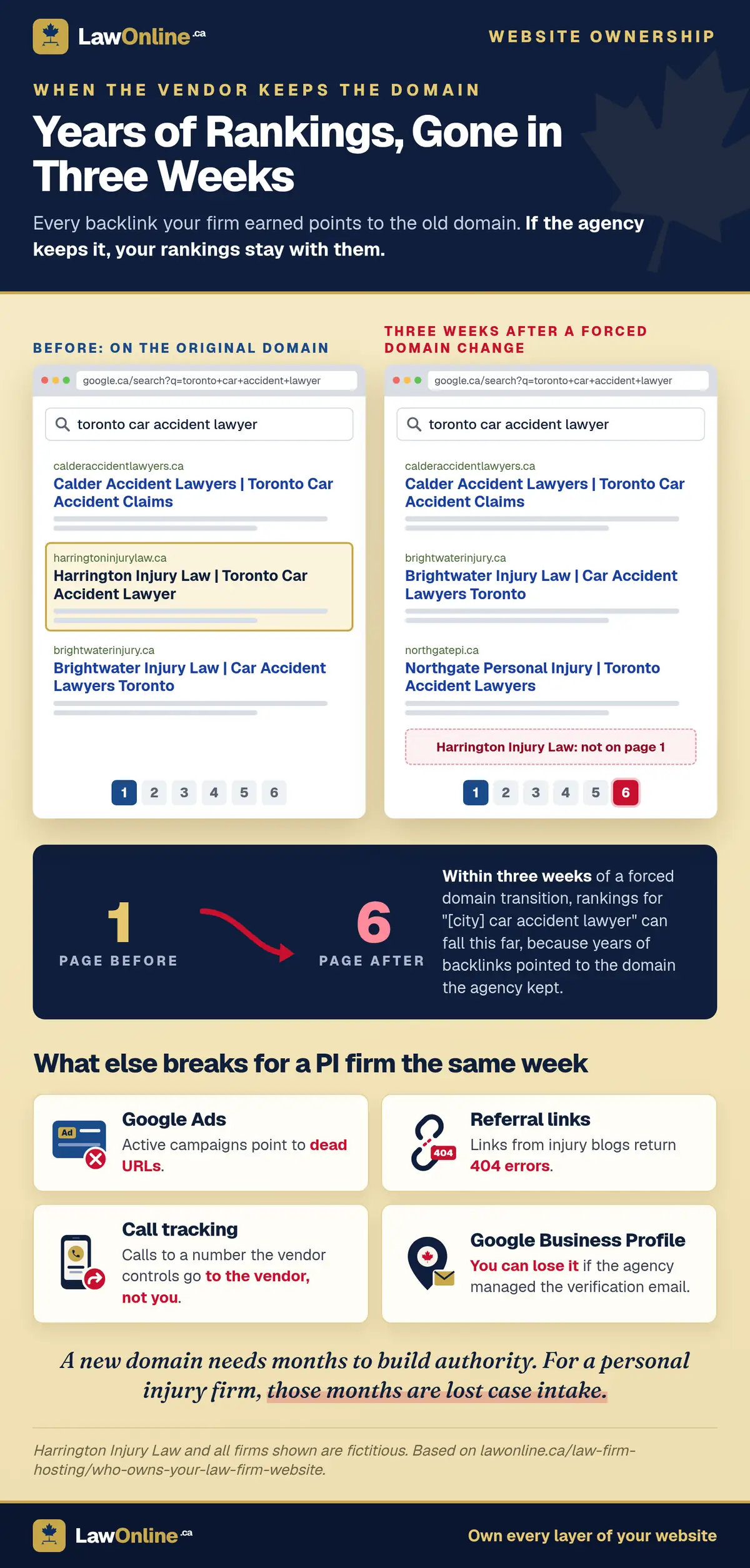
Rankings for "[city] car accident lawyer" can drop from page 1 to page 6 within weeks of a forced domain transition, because years of backlinks pointed to the old domain the agency kept.
The cost of that visibility gap is real. A Statistics Canada survey found that 51% of Canadians who experienced a serious legal dispute searched the internet for information, while only 33% contacted a legal professional directly. For most people, Google comes before a referral. When your website goes dark, you're invisible to the majority of potential clients at the exact moment they're looking for help.
Even in an amicable split, rebuilding from zero costs money and time. A new domain needs months to establish authority in Google's index. In competitive PI markets like Toronto, Vancouver, or Calgary, those months represent real lost case intake.
How to Protect Yourself: A Contract Checklist

Before signing any law firm website agreement, verify the following:
- The domain is registered in the firm's name, with the firm's email as account contact
- The firm has independent login credentials for the domain registrar
- The firm has independent login credentials for the hosting account
- The contract explicitly states that the firm owns the content and code on termination
- There is a defined process for domain transfer if the relationship ends
- Any proprietary platform is identified, and a data export provision is included
- The initial term is 12 months or less, or there is a reasonable cancellation provision
If a vendor pushes back on any of these points, that pushback is itself informative. Vendors who build websites with genuine ownership structures for their clients don't need to retain control of your domain or restrict your exit options.
Frequently Asked Questions
Who owns my law firm website if I've been paying monthly for years?
Payment history doesn't determine ownership. What matters is who is named as the registrant on your domain and what your contract says about IP and content rights. Check your domain WHOIS and re-read your agreement's termination clause.
Can my marketing agency keep my domain if I cancel?
If the domain is registered in their name, they have legal control of it, even if you've been paying for the site for years. Your only recourse would be through your contract or legal action. This is why domain registration should always be in the firm's name, not the agency's.
What should I do if I discover my agency owns my domain?
Don't cancel abruptly, because that may prompt the agency to lock or redirect the domain before you can act. Instead, follow this sequence:
- Review your contract for any domain transfer or IP provisions that apply on termination.
- Request a transfer in writing. Ask your agency to transfer domain registrar ownership to your firm. Keep a paper trail.
- Negotiate during the transition, not after. If you're planning to leave, make domain transfer a condition of an orderly handoff rather than an afterthought.
- Use CIRA's dispute process if your domain is
.caand the agency refuses to cooperate. CIRA has a formal resolution process for registrant disputes. - Consult a commercial litigator if significant brand equity is at stake and the agency won't negotiate. A breach-of-contract or unjust-enrichment argument may apply depending on your agreement and payment history.
Does my contract's IP section matter if I paid for everything?
Yes. Payment alone doesn't transfer copyright in Canada. Under the Copyright Act, the creator retains ownership unless the contract explicitly assigns it. If your agreement's IP section doesn't state that content produced for your firm belongs to your firm, the agency likely owns it by default, regardless of what you paid.
The Bottom Line
In Ontario alone, the Federation of Law Societies counts 9,484 sole practitioners and 2,910 firms with two to ten lawyers. Nearly 29% of Canadian law firms plan to increase their investment in legal-specific technology. As that spending grows, the question of law firm website ownership gets more urgent, not less.
Many Canadian law firms, including personal injury firms with aggressive digital marketing budgets, are unknowingly renting their online presence from their marketing company. If you can't answer "yes" to all of these questions, you may not truly own your website:
- Is my domain registered in my firm's name?
- Do I have login access to the domain registrar account?
- Do I have login access to my hosting account?
- Does my contract confirm that I own the content and code?
At LawOnline.ca, every website we build is owned entirely by the law firm. Your domain is registered in your name. Your content and code belong to you, and you can move the site to any host you like. If you ever leave, you leave with everything. That's the only arrangement we'll offer, because it's the only arrangement that's actually fair.
If you want a second opinion on your current website agreement, or if you're evaluating whether to stay with your current vendor, contact us. We're happy to review your contract terms and tell you plainly what you own, at no charge.