Personal injury is the most competitive SEO vertical in Canadian legal marketing. It's not close, and it hasn't been for years.
The economics explain everything. A single signed motor vehicle accident case in Ontario can generate $50,000 to $200,000 in contingency fees. Slip and fall claims, spinal cord injuries, wrongful death. The case values are high across the board, and that attracts aggressive marketing spend from every firm in every major Canadian market. Google Ads bids for "personal injury lawyer Toronto" routinely exceed $80 per click. In Vancouver and Calgary, the numbers are comparable.
That competition isn't limited to paid search. PI firms in Toronto, Vancouver, Ottawa, and Edmonton are investing heavily in organic search too, building content libraries, optimizing Google Business Profiles, and chasing the same high-value keywords your firm needs. The firms winning at personal injury lawyer SEO aren't necessarily the biggest spenders. They're the ones with the most systematic approach to keyword targeting, content production, and technical SEO.
This post is the system. It's the specific SEO strategy a Canadian personal injury firm needs to compete for organic rankings in 2026, from keyword selection through content calendar through realistic timeline expectations.
Why Is Personal Injury SEO Structurally Harder Than Other Practice Areas?
Personal injury law firm SEO faces competitive pressures that don't exist in family law, real estate, or corporate practices. Understanding these structural differences is the first step toward building a strategy that accounts for them rather than ignoring them.
"Near Me" Local Intent Dominates
When someone is injured in a car accident, they don't search for "best personal injury lawyer in Canada." They search for "car accident lawyer near me" or "personal injury lawyer Brampton." The injury happened in a specific place. They want someone close.
The scale of that local demand is enormous. Across North America, "personal injury lawyer near me" generates an estimated 368,000 monthly searches, with "car accident lawyer near me" adding another 165,000. Canadian search patterns follow the same concentration. PI firms compete in tight geographic clusters where a dozen firms are fighting for the same city-level and neighbourhood-level queries. You can't outrank a Toronto competitor by being the best PI firm in Calgary. The competition is hyperlocal.
Cross-Border Keyword Competition
Canadian PI firms face a problem that corporate lawyers don't: American personal injury firms and content farms targeting Canadian searches. US firms spend millions on content optimized for terms like "car accident settlement" and "slip and fall compensation." Google sometimes surfaces that US content for Canadian searchers, particularly for informational queries. Your content has to be specifically, unmistakably Canadian to compete. Generic PI content written by US-trained writers or American-tuned AI models won't cut it.
Law Society Advertising Rules Vary by Province
PI marketing isn't uniform across Canada. The Law Society of Ontario's advertising rules differ from British Columbia's and Alberta's, particularly around contingency fee advertising and testimonials. A PI firm in Vancouver can say things in their marketing that an Ontario firm can't. This means your SEO content strategy has to account for your province's specific rules, and "one size fits all" PI content calendars built for the US market can create compliance problems.
PPC Competition Distorts Organic CTR
In most PI keyword searches, the top four results are paid ads. Below those, you'll often see aggregator sites like Injured.ca and directory listings before any organic law firm results appear. Even when your firm ranks on page one organically, the click-through rate is compressed because so many paid results sit above you.
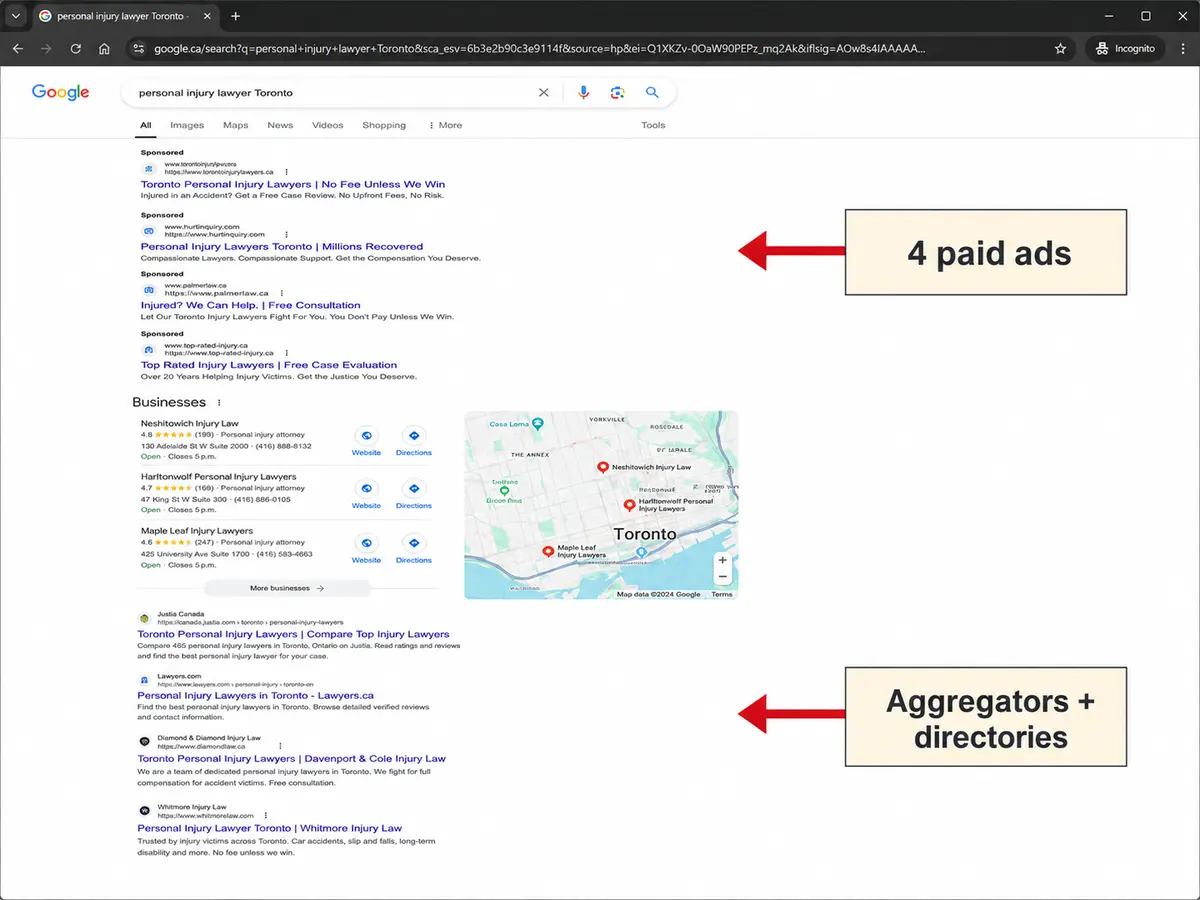
AI Overviews are making this worse. Google's AI-generated answer panels now appear on a growing share of legal searches, with 2026 industry data estimating they show up on roughly 78% of legal queries. When an AI Overview is present, click-through rates on top-ranked organic results drop by about 34.5%. For PI keywords, that means a page-one ranking delivers fewer clicks than it would have even two years ago, adding another layer of compression on top of the paid ads and directories already sitting above you.
This makes ranking in the top three organic positions critical for PI keywords. Position five or six, which might generate decent traffic in a less competitive practice area, generates almost nothing in PI.
Every Competitor Is Running Both Channels
Most PI firms are investing in Google Ads and SEO simultaneously. They're not choosing one or the other, and the cost gap between channels explains why: a 2026 cost-per-lead analysis puts Google Ads CPL for personal injury at roughly $442, compared with about $183 for SEO. Paid search delivers leads faster but at more than double the per-lead cost, so firms that can afford it invest in both simultaneously. That means the firms you're competing against organically are also spending aggressively on paid search, reinforcing their brand visibility and click-through rates. A firm that shows up in both paid and organic results for "personal injury lawyer Mississauga" gets more clicks than a firm that shows up in only one. Organic-only strategies work, but they take longer to build momentum against competitors running both channels.
What Keywords Should a Personal Injury Firm Target?
The right keyword strategy for a PI firm isn't a flat list of terms. It's a matrix built across four dimensions: accident types, injury types, location modifiers, and intent modifiers. Each dimension unlocks a different layer of search visibility.
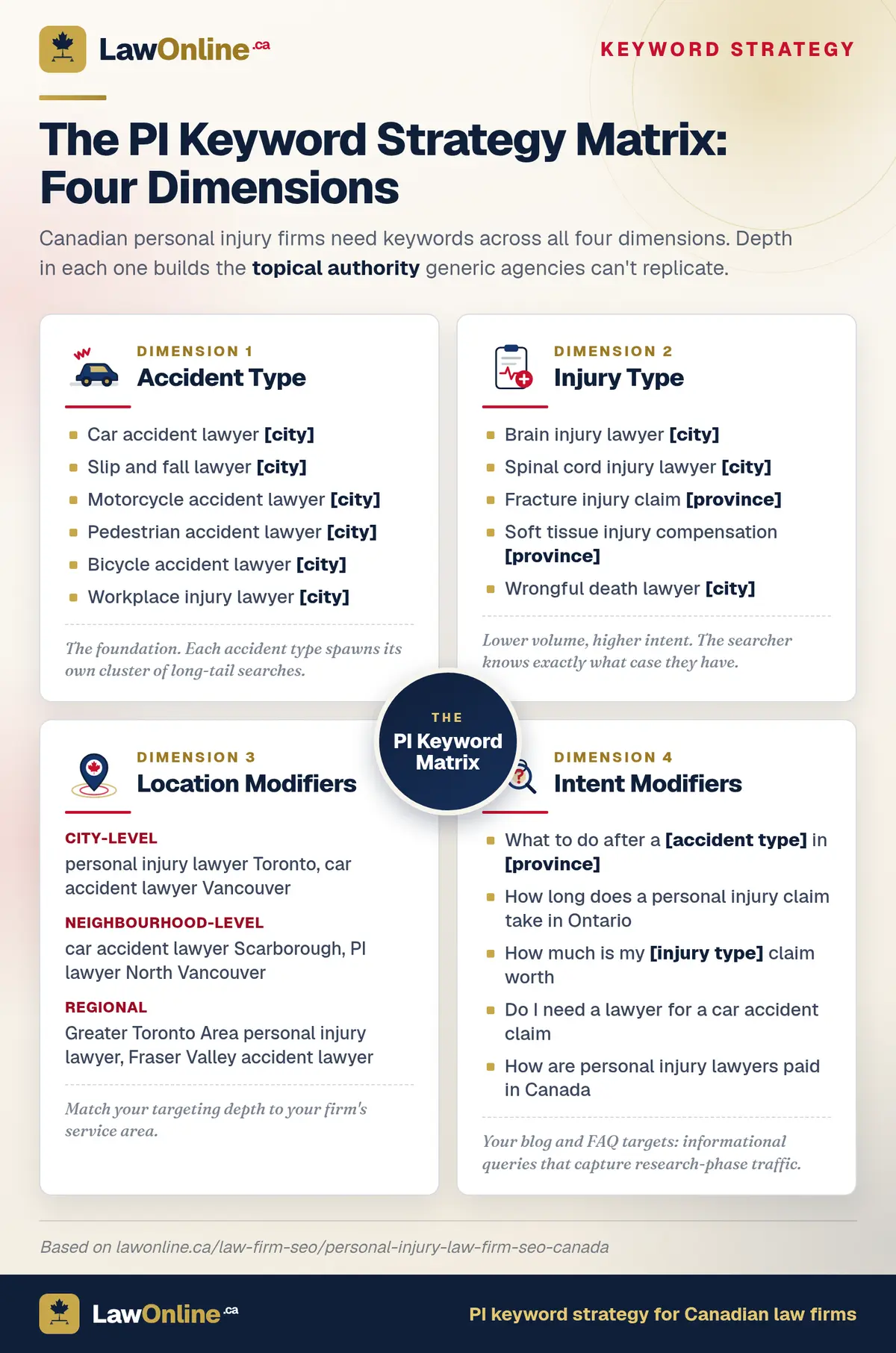
Accident Type Keywords
These are the foundation. They map directly to the kinds of cases your firm handles:
- Car accident lawyer [city]
- Slip and fall lawyer [city]
- Motorcycle accident lawyer [city]
- Pedestrian accident lawyer [city]
- Bicycle accident lawyer [city]
- Workplace injury lawyer [city]
Each accident type generates its own cluster of long-tail searches. "Car accident lawyer Toronto" is the head term, but people also search for "what to do after a car accident in Ontario," "how long do I have to file a car accident claim," and "car accident settlement timeline Ontario."
Injury Type Keywords
These attract searchers looking for representation for a specific injury, not just a specific accident:
- Brain injury lawyer [city]
- Spinal cord injury lawyer [city]
- Fracture injury claim [province]
- Soft tissue injury compensation [province]
- Wrongful death lawyer [city]
Injury-type keywords tend to have lower search volume than accident-type keywords, but they signal higher intent. Someone searching for "spinal cord injury lawyer Toronto" knows exactly what kind of case they have and is actively looking for counsel.
Location Modifiers
Geographic targeting happens at three levels:
- City-level: "personal injury lawyer Toronto," "car accident lawyer Vancouver"
- Neighbourhood-level: "car accident lawyer Scarborough," "PI lawyer North Vancouver"
- Regional: "Greater Toronto Area personal injury lawyer," "Fraser Valley accident lawyer"
The depth of your location targeting should match your firm's service area. A two-partner PI firm serving Kitchener-Waterloo doesn't need to target "personal injury lawyer Ontario." A ten-lawyer firm with offices in Toronto and Ottawa might.
Intent Modifiers
These are the questions people ask before they're ready to call a lawyer:
- "What to do after a [accident type] in [province]"
- "How long does a personal injury claim take in Ontario"
- "How much is my [injury type] claim worth"
- "Do I need a lawyer for a car accident claim"
- "How are personal injury lawyers paid in Canada"
Intent-modifier keywords are where your content strategy lives. Each one is a blog post or FAQ page that captures traffic, builds topical authority, and moves searchers closer to contacting your firm.
How Firm Size Should Shape Your Keyword Approach
A two-partner PI firm and a ten-lawyer PI firm shouldn't approach this keyword matrix the same way.
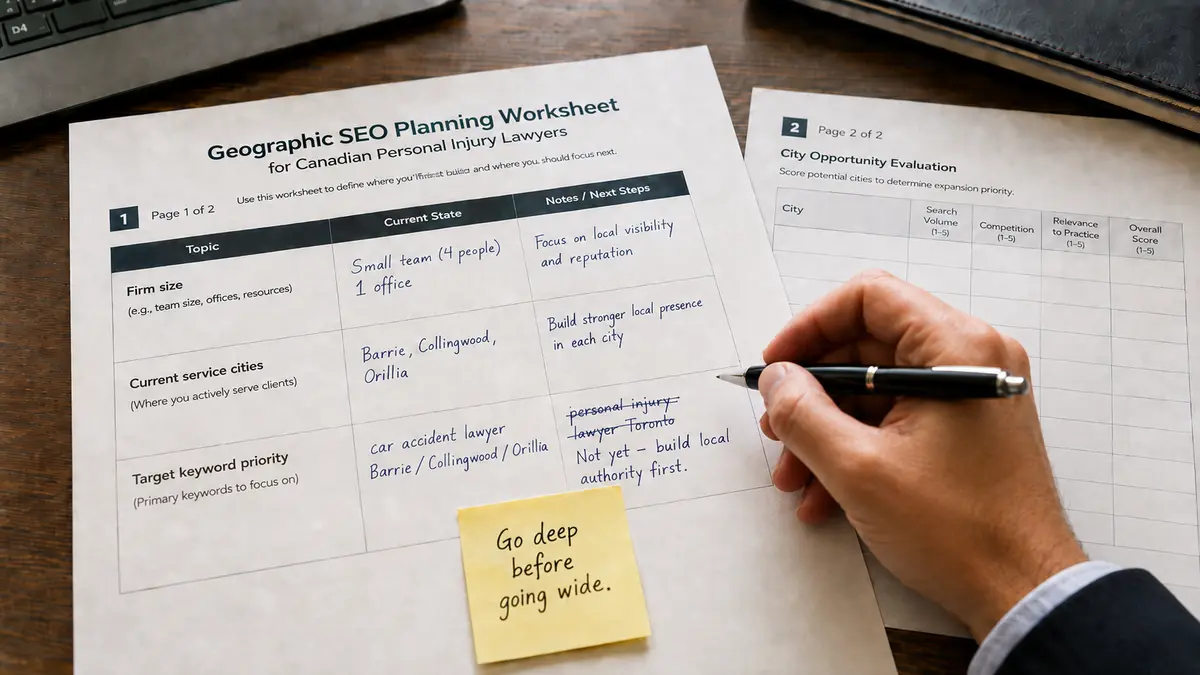
The smaller firm should go deep rather than broad. Pick your top two accident types (usually car accidents and slip and falls, because they're the highest volume) and your primary city. Build comprehensive content clusters around those terms before expanding to other accident types or locations. Depth beats breadth when your content production capacity is limited.
The larger firm should go broad and then deep. Cover all major accident types across multiple cities, build location-specific landing pages, and produce content for each injury type. With more lawyers, more practice areas, and more office locations, you have the surface area to compete across more of the matrix simultaneously. But even a ten-lawyer firm should prioritize. Don't try to rank for everything at once. Pick the highest-value quadrant of the matrix first and build outward.
When Should a PI Firm Target Local vs. Provincial vs. National Keywords?
The right geographic scope depends on your firm's size, office locations, and growth strategy. Getting this wrong wastes months of content production on keywords that don't match your practice.
Hyper-Local Targeting (1-2 Lawyer Firms)
If you're a solo practitioner or a two-partner PI firm serving one city, your SEO strategy should be aggressively local. Target city-level and neighbourhood-level keywords. Optimize your Google Business Profile with precision, because research on local PI searches suggests the top-ranked GBP listings capture roughly 42% of all local clicks. The difference between appearing in the map pack and not appearing is often the difference between getting calls and silence. Build content around local accident scenarios: specific intersections, local hospitals, provincial court procedures relevant to your jurisdiction.
Hyper-local targeting works because the competition is narrower. You're not trying to outrank a national firm; you're trying to be the most visible PI lawyer in Barrie or Kingston or Kelowna. That's achievable for a smaller firm with a focused strategy.
Provincial Authority (Multi-City Firms)
A firm with offices in Toronto and Ottawa, or Vancouver and Victoria, should build provincial-level authority. That means creating content that covers province-wide topics (Ontario's accident benefits system, BC's no-fault insurance changes) while also building city-specific landing pages for each office location.
The provincial approach requires more content but generates significantly more total search visibility. You're competing for both city-level queries in each market and provincial informational queries that attract traffic from across the province.
National Targeting (Rarely Right for PI)
Personal injury law is jurisdiction-specific. Limitation periods, insurance regimes, court procedures, and even terminology differ province by province. A national SEO strategy usually doesn't make sense for PI firms because someone searching for "personal injury lawyer" in Halifax needs an entirely different legal framework than someone in Calgary.
The exception is informational content that applies broadly, like "how contingency fees work in Canada" or general injury-type explainers. But even those should be tagged with provincial specifics to maximize relevance.
The "10 Posts Per City" Mistake
Some SEO agencies sell PI firms on a strategy of publishing near-identical pages for every city in their province. "Personal Injury Lawyer Toronto." "Personal Injury Lawyer Mississauga." "Personal Injury Lawyer Brampton." Each page has the same content with the city name swapped out.
This hasn't worked since 2018, and it's gotten worse. Google's helpful content updates specifically target this kind of templated, low-value content. If you've already built these pages, they're likely doing more harm than good. The better approach is fewer, higher-quality location pages with genuinely distinct content, local context, and unique information about practicing in that specific market. We cover this in detail in our guide to why most law firm SEO in Canada fails.
What Are the 3 Technical Must-Haves for PI Firm Websites?
Before you invest in content, your PI firm's website needs three technical foundations in place. Without them, even excellent content won't rank or convert.
Mobile Page Speed Under 2.5 Seconds
Most personal injury searches happen on mobile devices, often immediately after an accident. Someone sitting in a car after a collision, in an emergency room waiting area, or at home the evening of an injury is searching on their phone. If your site takes four seconds to load on a mobile connection, they've already tapped the back button and clicked the next result.
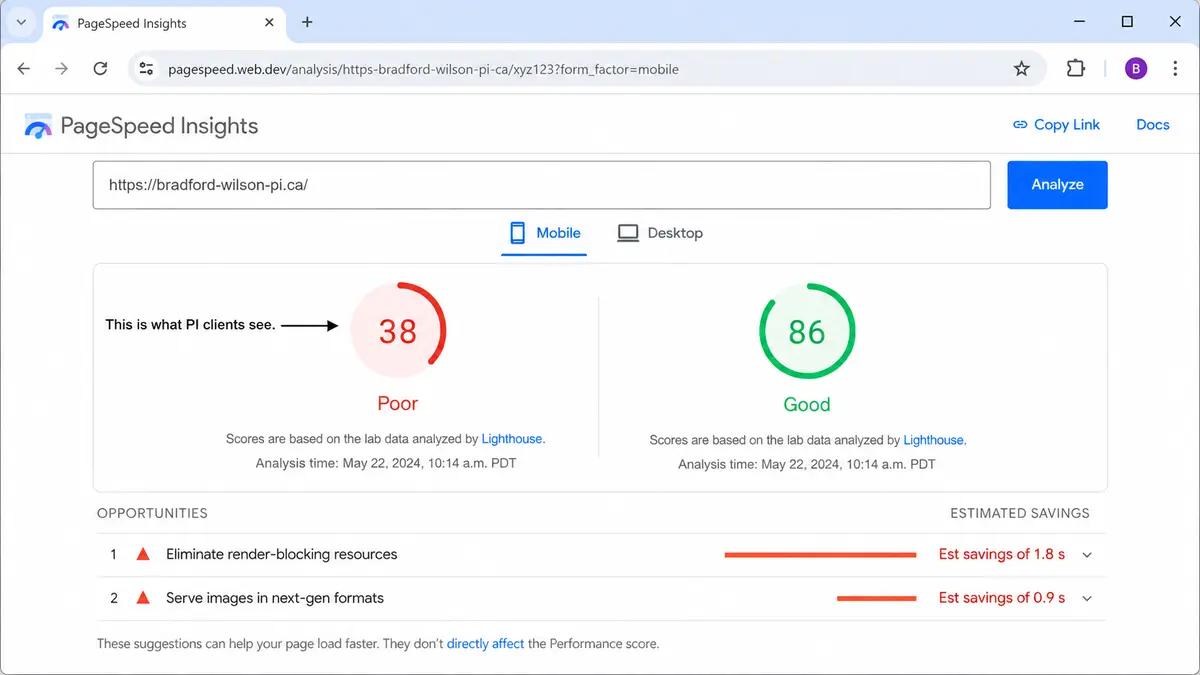
Google's Core Web Vitals set specific thresholds for page speed, interactivity, and visual stability. For PI firms, the most critical metric is Largest Contentful Paint (LCP), which should be under 2.5 seconds. Large hero images, unoptimized videos, and bloated JavaScript bundles are the usual culprits. We break down the full technical checklist in our law firm website speed guide.
Schema Markup on Every Location Page
Structured data tells search engines exactly what your page is about in a machine-readable format. For PI firms, two schema types matter most:
- LocalBusiness schema on every office location page, including your address, phone number, business hours, and service area
- Attorney schema (or LegalService) on practice area pages, connecting your firm to specific legal services
Properly implemented schema won't directly boost your rankings, but it makes your site eligible for rich results, those enhanced listings in Google that show star ratings, business hours, and contact information directly in the search results. For competitive PI keywords, rich results significantly improve click-through rates.
Clear CTA Architecture
A PI firm website that ranks well but doesn't convert visitors into consultations is wasting its SEO investment. Industry benchmarks put the average personal injury website conversion rate at about 3.2%, but well-optimized landing pages can reach 5% to 8%. On the same traffic, that gap can double a firm's monthly consultation volume. The conversion architecture for a PI site needs to be aggressive without being obnoxious:
- Phone number visible above the fold on every page
- Click-to-call functionality on mobile (no one wants to memorize a number and switch apps)
- Contact form with three fields or fewer (name, phone, brief description)
- Free consultation offer prominent on every practice area page
The goal isn't just ranking. It's getting the phone to ring.
What Should a PI Firm's 12-Post Content Calendar Look Like?
Content production for personal injury SEO should be systematic, not random. Here's a 12-post calendar framework that covers the highest-value topics and creates a reinforcing internal linking structure that strengthens your main practice area page.
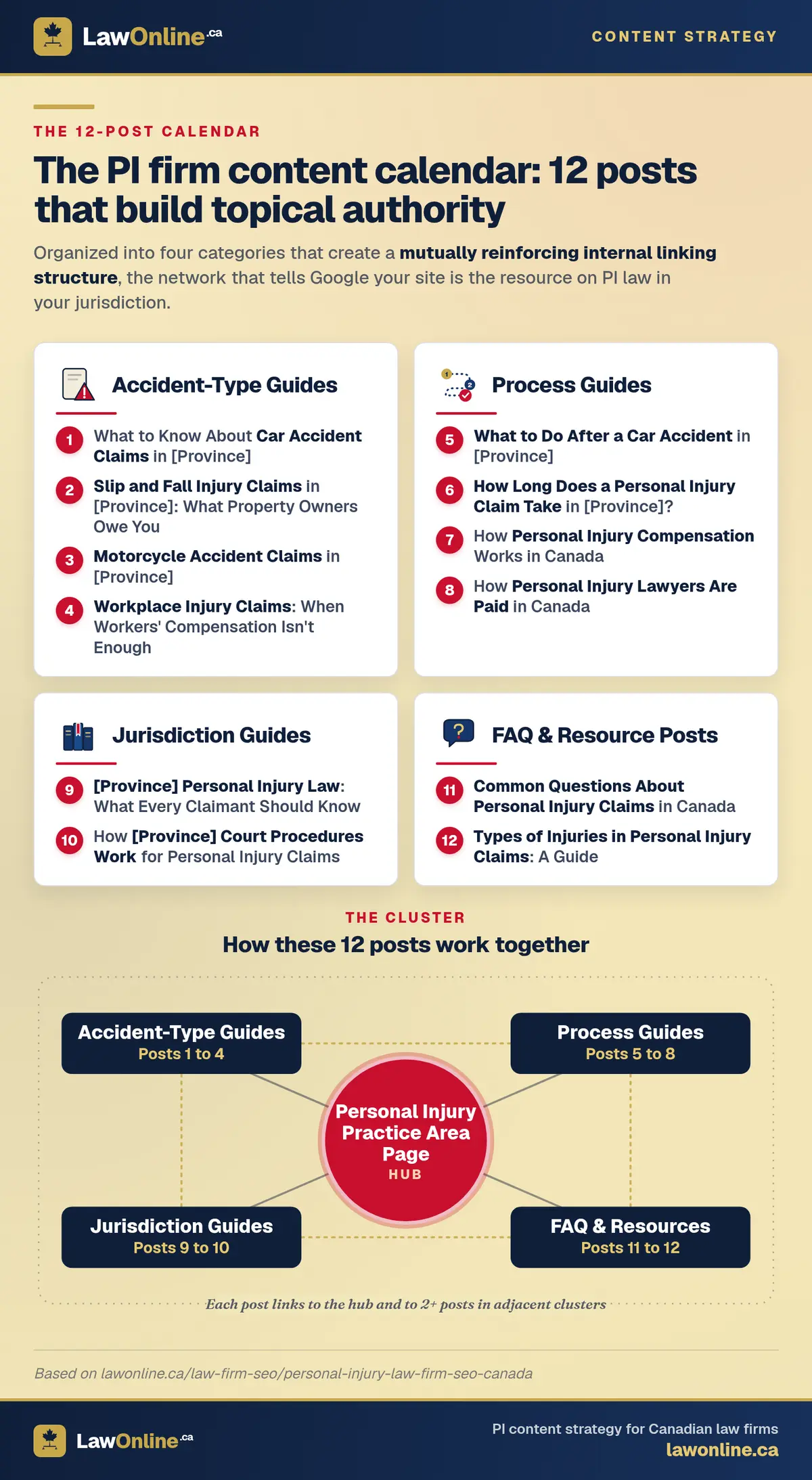
4 Accident-Type Guides
- What to Know About Car Accident Claims in [Province] - Your highest-volume topic. Cover the claims process, common mistakes, insurance company tactics, and when to hire a lawyer.
- Slip and Fall Injury Claims in [Province]: What Property Owners Owe You - Premises liability, occupiers' liability legislation, evidence preservation, seasonal hazards (ice and snow claims are uniquely Canadian).
- Motorcycle Accident Claims in [Province] - Higher severity injuries, different insurance considerations, common fault disputes at intersections.
- Workplace Injury Claims: When Workers' Compensation Isn't Enough - The line between WSIB/WCB claims and civil tort claims, when a third-party claim applies, employer negligence scenarios.
4 Process Guides
- What to Do After a Car Accident in [Province] - Step-by-step guide from the scene of the accident through the first consultation with a lawyer. High search volume, high conversion potential.
- How Long Does a Personal Injury Claim Take in [Province]? - Realistic timelines for different case types, what causes delays, limitation periods.
- How Personal Injury Compensation Works in Canada - Damages categories, the difference between general and special damages, how provincial deductibles work, structured settlements.
- How Personal Injury Lawyers Are Paid in Canada - Contingency fees explained, what percentage is standard, what costs are covered, the difference between fees and disbursements.
2 Jurisdiction Guides
- Ontario Personal Injury Law: What Every Claimant Should Know - (Or your province.) Overview of the tort and accident benefits systems, the Insurance Act threshold, limitation periods, relevant courts and tribunals.
- How [Province] Court Procedures Work for Personal Injury Claims - Discovery, mediation, pre-trial conferences, trial timelines. This is the kind of content that demonstrates genuine legal expertise.
2 FAQ and Resource Posts
- Common Questions About Personal Injury Claims in Canada - Structured as an FAQ with natural-language questions. "Do I need a lawyer for a minor car accident?" "Can I still claim if I was partially at fault?" "What if the other driver doesn't have insurance?"
- Types of Injuries in Personal Injury Claims: A Guide - Brain injuries, spinal cord injuries, soft tissue injuries, fractures, chronic pain. Each section links to relevant accident-type guides and process guides.
How These 12 Posts Work Together
Each post links to at least two other posts in the calendar and to your main personal injury practice area page. The accident-type guides link to relevant process guides. The FAQ post links to everything. The jurisdiction guides provide the legal framework that makes your accident-type content more authoritative.
The result is a content cluster, a network of interlinked pages that tells Google your site is a comprehensive resource on personal injury law in your jurisdiction. That topical authority signal is what separates firms that rank from firms that publish content and wonder why nothing happens.
What Does a Realistic Year-One SEO Timeline Look Like for a PI Firm?
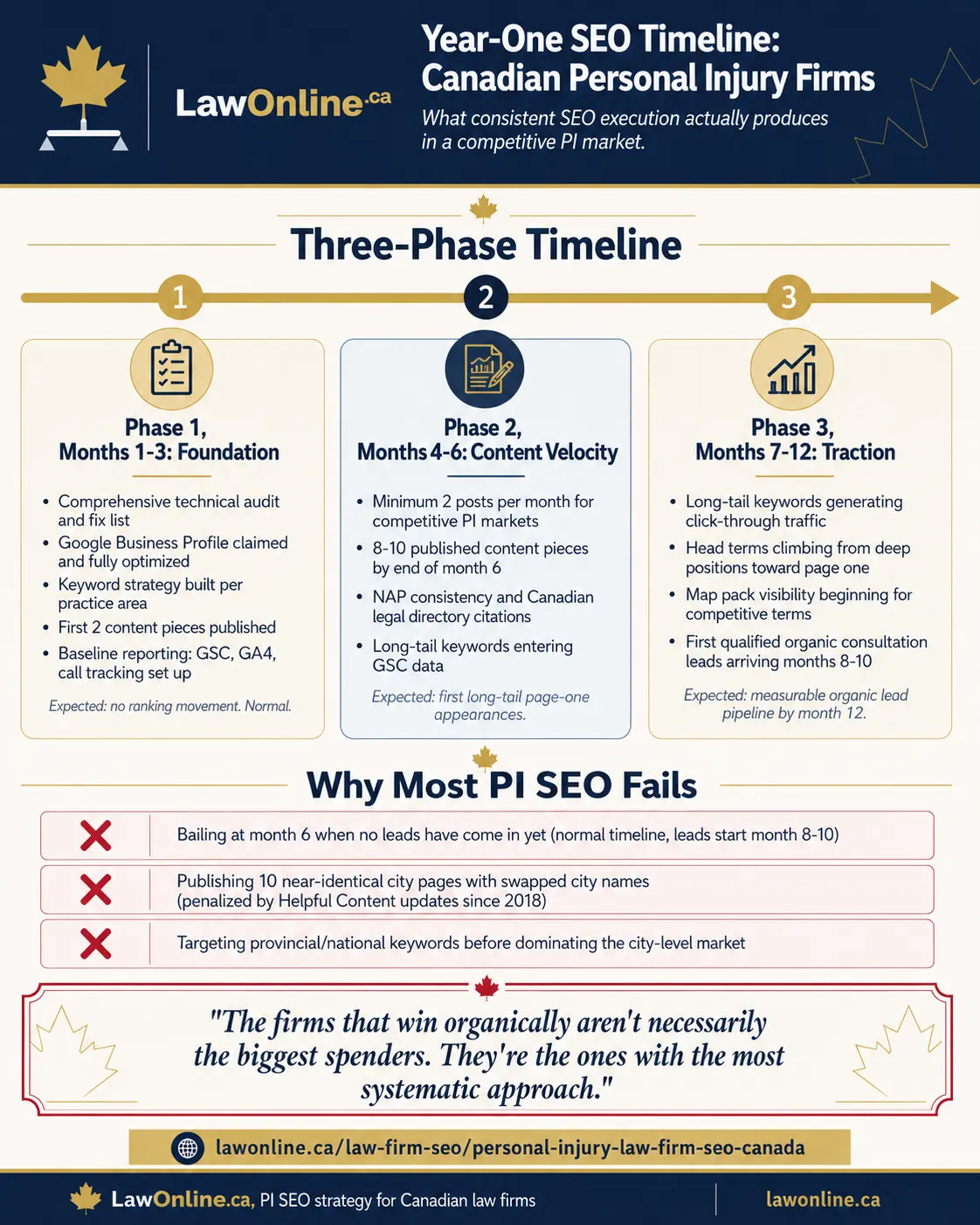
A mid-size PI firm in a competitive market like Toronto should expect the following trajectory. Results vary by market size and existing domain authority, but this framework reflects what consistent execution actually produces.
Months 1 to 3: Foundation
The first quarter is about fixing what's broken and establishing the baseline. That means a comprehensive technical audit to identify speed issues, crawl errors, and structural problems. It means claiming and fully optimizing your Google Business Profile with accurate categories, service descriptions, and photos. And it means publishing your first two content pieces from the calendar above.
During this phase, you won't see meaningful ranking improvements. That's normal. You're building the foundation everything else depends on. For a broader look at what each phase of an SEO engagement should deliver across all practice areas, see our law firm SEO services guide.
Months 4 to 6: Content Velocity
With the technical foundation in place, months four through six are about consistent content production. Two posts per month is the minimum velocity for a competitive PI market. Simultaneously, build local citations across Canadian legal directories and ensure your NAP (name, address, phone number) data is consistent everywhere your firm appears online.
By the end of month six, you should have eight to ten published content pieces targeting your priority keywords. Long-tail variations will start showing up in Google Search Console data, even if they're not yet driving significant traffic.
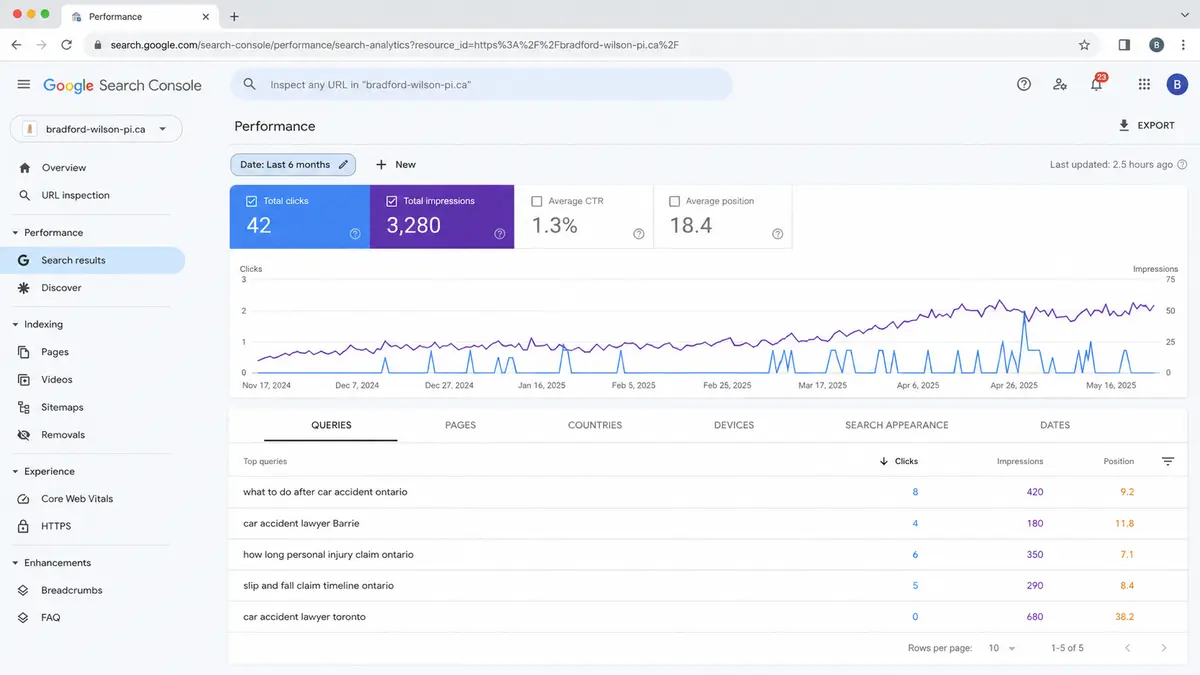
Months 7 to 12: Traction
This is where the compounding effect starts. Your long-tail keywords, the "what to do after" and "how long does it take" queries, will begin ranking on page one. You'll see click-through traffic from these informational queries. Some of that traffic will convert into consultations.
Your head terms, "personal injury lawyer [city]," will move from deep positions into page two and potentially low page one, depending on your market's competitiveness. Short-tail ranking is a slow climb in PI because the competition is fierce, but the trajectory should be clearly upward by month ten.
The realistic expectation: first qualified organic leads from SEO content typically arrive between months eight and ten. That's not a failure of the strategy. That's the normal timeline for building organic authority in the most competitive legal vertical in Canada. The firms that bail at month six and call SEO a waste of money are the ones their competitors are grateful for.
What's the Next Step for Your Firm's SEO?
Personal injury SEO isn't a set-it-and-forget-it project. It's an ongoing competitive discipline that requires consistent execution across technical optimization, content production, and local search management. The firms that treat it systematically, with a clear keyword matrix, a structured content calendar, and realistic timeline expectations, are the ones that build sustainable organic pipelines.
If your firm is ready to build that pipeline, our law firm SEO services are built specifically for Canadian firms in competitive practice areas like personal injury. We understand the provincial nuances, the competitive landscape, and what it actually takes to rank in markets where everyone is spending aggressively.
The best time to start was a year ago. The second best time is now.
If you're comparing providers, our guide to the best law firm SEO companies in Canada covers seven agencies, including PI-specialist options at different price points. For the evaluation process itself, our guide to choosing a law firm SEO agency walks through the questions, red flags, and contract considerations that matter most.