Most law firm websites are optimized for how lawyers think about their practice, not how potential clients describe their problem. A family lawyer might build pages around "divorce law" and "matrimonial property," while their clients are searching "how to file for divorce in Ontario" and "what happens to the house when you separate."
Keyword research for law firms closes that gap. It maps the language your potential clients actually use to the content and structure of your website, so Google can connect them to you when they need legal help.
The numbers confirm this. A 2022 Statistics Canada survey found that 51% of Canadians who experienced a serious legal problem searched the internet for help, while only 33% contacted a legal professional directly. More potential clients are typing legal questions into Google than are calling a law firm. Keyword research answers the most basic question a firm can ask: how do clients find lawyers? It tells you exactly what they're searching for.
This guide explains how keyword research works for law firms, what tools to use, and how to prioritize what you find.
Why Keyword Research Is Different for Law Firms
Law firm keyword research isn't the same as keyword research for a software company or an e-commerce store. A few specific factors make identifying the right law firm SEO keywords harder.

High commercial intent, low search volume. People searching for a lawyer have a specific problem and often a timeline. "Personal injury lawyer Toronto" has strong commercial intent. But it also has real competition, because every PI firm in Toronto is trying to rank for the same phrase. Search volumes for legal terms are lower than consumer products, but the value of a single new client is much higher, which changes the math on what's worth ranking for.
Practice area and geography both matter. A criminal defence lawyer in Calgary and one in Halifax are not competitors, and they're not targeting the same keywords. "Criminal defence lawyer Calgary" and "criminal defence lawyer Halifax" are entirely separate keyword opportunities. For most Canadian law firms, local + practice area combinations are the core of the strategy.
Canada has more than 141,000 active legal professionals according to the Federation of Law Societies of Canada's 2022 statistics. A term like "lawyer near me" puts all of them in the same race, but "wrongful dismissal lawyer Brampton" narrows the field to the firms that actually serve that city and practice that law.
Clients search at different stages. Some potential clients are in early research mode, searching things like "what is contributory negligence" or "how does estate probate work in Ontario." Others are ready to hire and searching "estate lawyer near me." A strong keyword strategy covers both, because the informational searchers become clients too — just not today.
The audience for that earlier-stage content is larger than most firms expect. Statistics Canada's Canadian Legal Problems Survey found that 18% of Canadian adults, roughly 5.5 million people, experienced a serious and difficult-to-resolve legal problem within a three-year period, and many searched online before doing anything else. A Canadian Forum on Civil Justice national survey found that 37.5% said the information they found online wasn't helpful. That gap between what people search for and what they actually find is exactly what keyword-driven content is meant to close.
Regulated advertising adds constraints. The Law Society of Ontario and other provincial law societies regulate how lawyers can advertise and what claims they can make. This matters for landing page copy, but it doesn't change which keywords you target.
The Core Types of Keywords for Law Firms
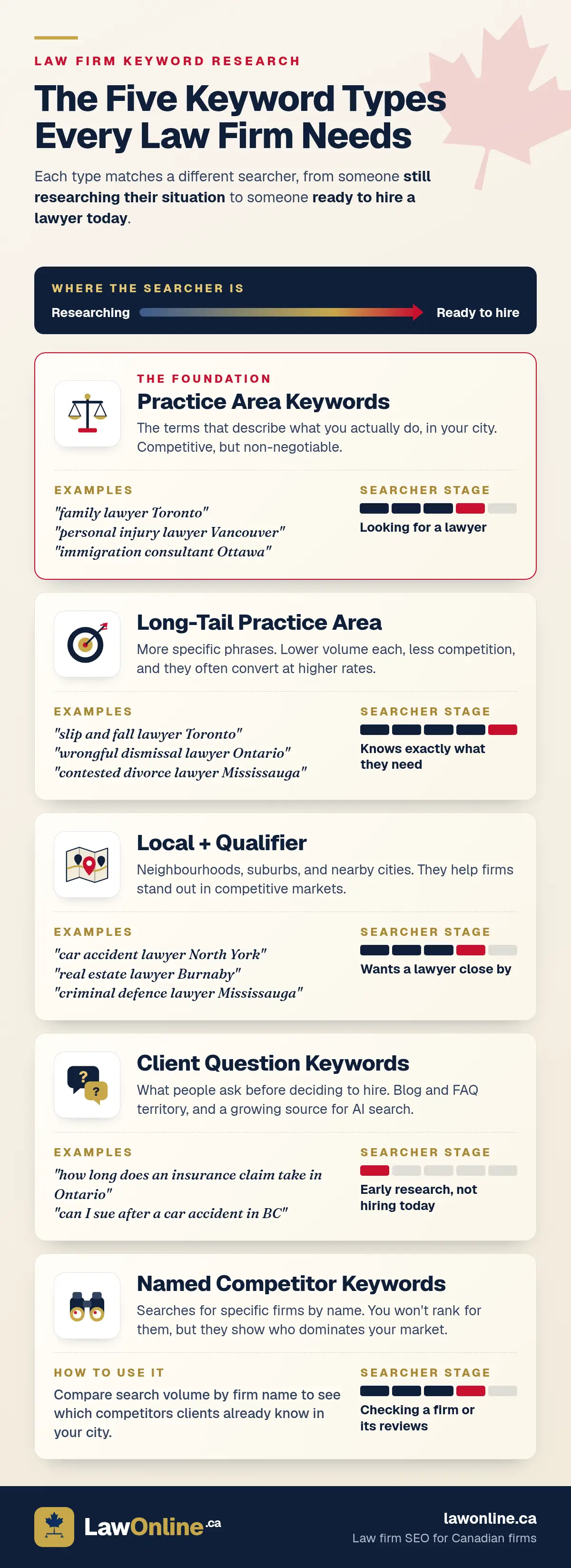
The best keywords for lawyers fall into five types, and a complete strategy uses all of them.
Practice Area Keywords
These are the foundation. Every law firm needs to rank for terms describing what they actually do. A few examples:
- "family lawyer Toronto"
- "personal injury lawyer Vancouver"
- "immigration consultant Ottawa"
- "corporate lawyer Hamilton"
These terms are competitive but non-negotiable. If you don't rank for your core practice area terms in your city, potential clients can't find you. The goal isn't to rank for all of them immediately. It's to identify which ones represent real opportunities, given your competition.
Long-Tail Practice Area Keywords
Long-tail keywords are more specific phrases. They get less search volume individually, but often convert at higher rates because they match a more specific need. Examples:
- "slip and fall lawyer Toronto"
- "wrongful dismissal lawyer Ontario"
- "contested divorce lawyer Mississauga"
- "startup business lawyer Canada"
These phrases are less competitive than head terms and often more relevant to what a specific client is actually looking for. A client searching "wrongful dismissal lawyer Ontario" knows exactly what they need. They're further along in their decision process than someone searching "employment lawyer."
Local + Qualifier Keywords
For firms in competitive markets, adding geographic specifics helps. Neighbourhoods, suburbs, and nearby cities all count:
- "car accident lawyer North York"
- "real estate lawyer Burnaby"
- "criminal defence lawyer Mississauga"
Firms with multiple locations can build location-specific pages for each. A firm with offices in both Ottawa and Kingston, for example, would maintain separate pages optimized for each city.
Client Question Keywords
These are informational queries — questions potential clients type when they're trying to understand their situation before deciding whether to hire a lawyer. For personal injury:
- "how long does an insurance claim take in Ontario"
- "can I sue after a car accident in BC"
- "what is the statute of limitations for personal injury in Ontario"
These keywords are where law firm content marketing does its heaviest work — blog posts and FAQ pages that answer questions potential clients are already asking. They won't convert immediately, but they build trust and bring in organic traffic from people who may become clients. They're also increasingly important for AI-driven search tools that pull answers directly from websites.
Named Competitor Keywords
Some people search for specific firms by name to find their website or check reviews. You're unlikely to rank for a competitor's exact name, but understanding who people are searching for in your market tells you who the dominant players are.
Tools for Law Firm Keyword Research
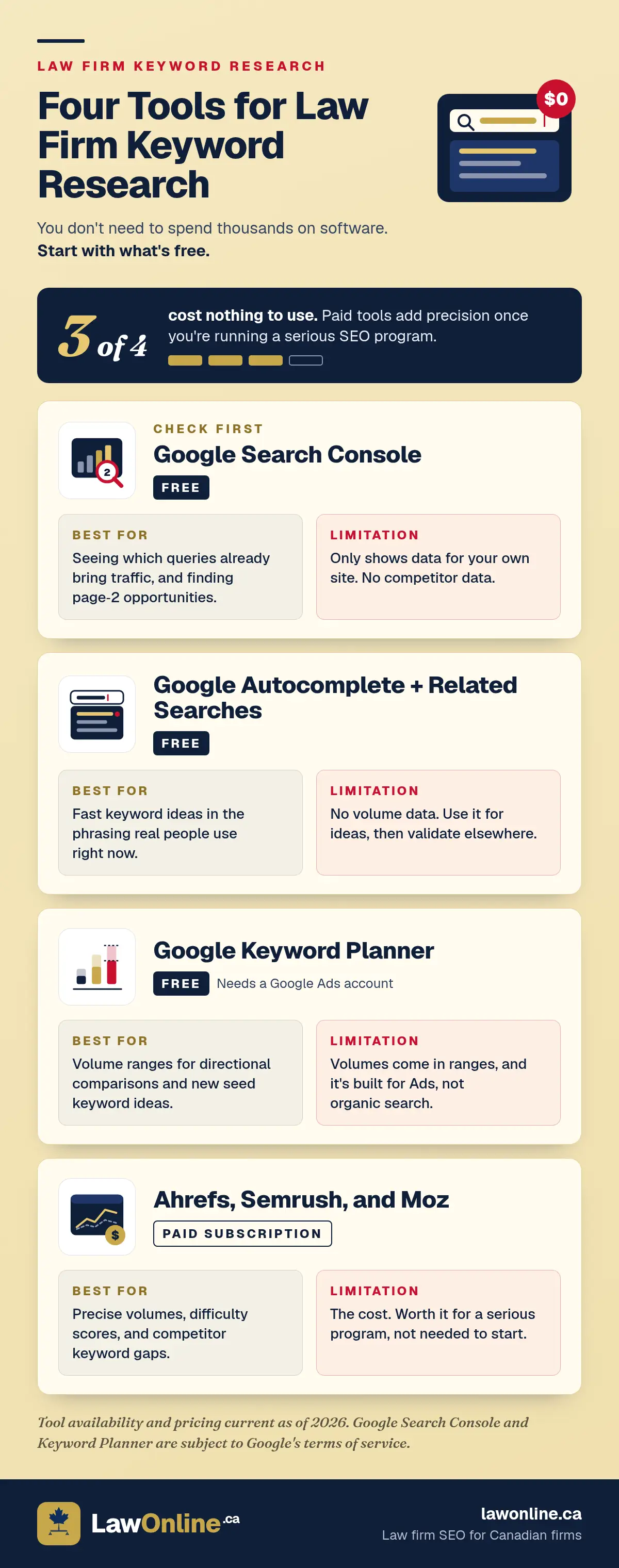
You don't need to spend thousands of dollars on keyword tools to do this well. Start with what's free.
Google Search Console
If your website has been live for more than a few months, Google Search Console is the most valuable keyword tool you have — and it's free. It shows you exactly what queries are driving impressions and clicks to your site, which pages are ranking, and where you're sitting on page 2 or 3 with the potential to move up.
For keyword research, go to the "Search results" report and sort by impressions. You'll often find keywords you didn't know you were ranking for, which are opportunities to strengthen those pages. You'll also find keywords with high impressions and low click-through rates, which usually means your title tag and meta description aren't compelling enough to earn the click even though Google thinks you're relevant.
Google Search Console is the first place to check before any keyword research project. It tells you where you are before you plan where to go.
Google Autocomplete and Related Searches
Type a seed keyword into Google and watch what the autocomplete suggests. "Personal injury lawyer Ontario" will surface a half-dozen related phrases that real people search. Scroll to the bottom of the search results page and check "Related searches" for more.
This isn't rigorous keyword research, but it's fast and it reflects current search behaviour. Use it to generate ideas you can validate with volume data from other tools.
Google Keyword Planner
Google Keyword Planner is designed for Google Ads, but it gives reasonable volume estimates for organic keyword research. You need a Google Ads account to access it, but you don't need to be running ads. Enter seed keywords and see what volume ranges come back. Because it's aggregated into ranges, it's better for directional decisions than exact planning.
Paid Keyword Research Tools
Ahrefs, Semrush, and Moz all provide more precise volume data, keyword difficulty scores, and competitive analysis. These tools are useful for understanding what your competitors rank for and finding keyword gaps. They're worth the cost if you're managing a serious SEO program, but they're not essential to get started.
How to Prioritize What You Find
Keyword research generates a list. Prioritization turns that list into a law firm SEO strategy. Three factors drive prioritization:
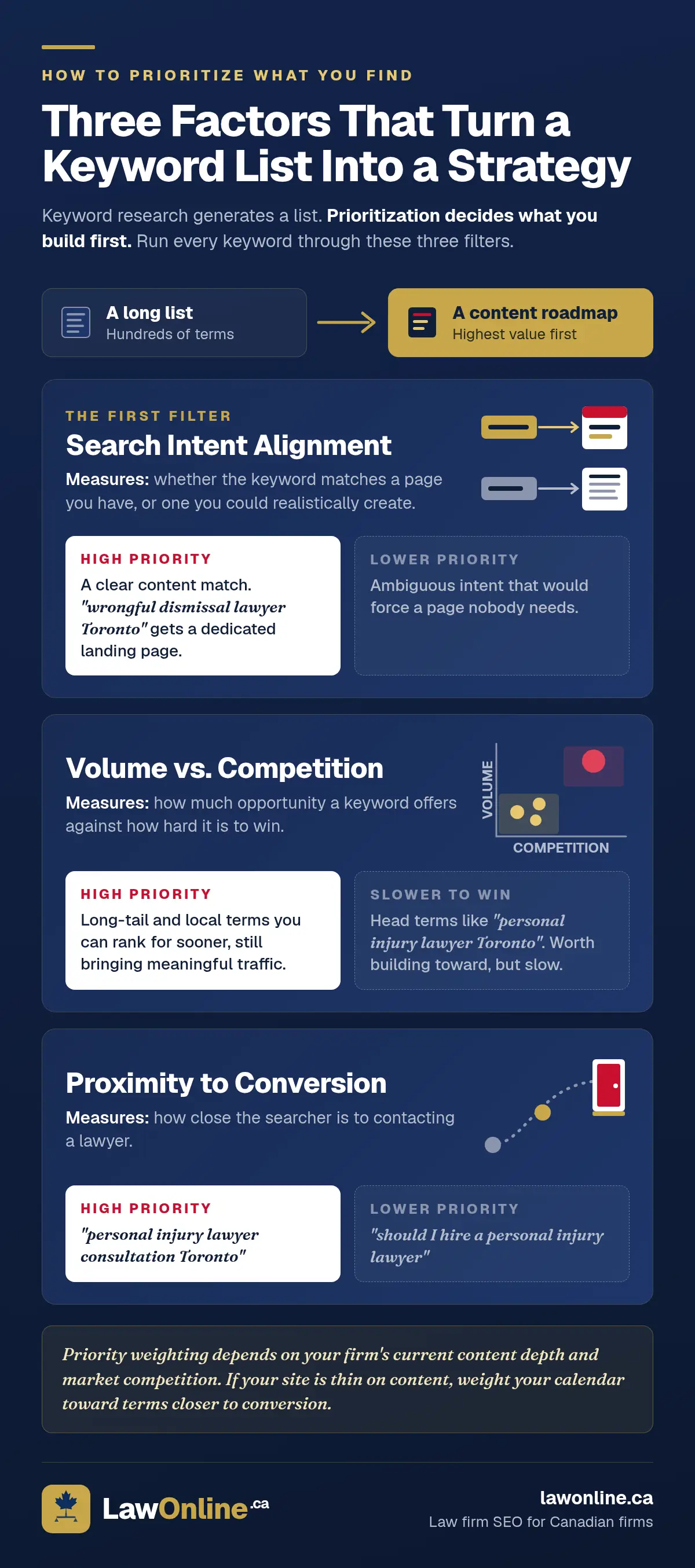
Search intent alignment. Does this keyword match a page you already have, or a page you could realistically create? "Wrongful dismissal lawyer Toronto" should have a dedicated landing page. "How does wrongful dismissal compensation work in Ontario" belongs on a blog post. Matching keyword intent to content type is the first filter.
Volume vs. competition. High-volume keywords ("personal injury lawyer Toronto") are worth targeting, but they're competitive. Lower-volume, lower-competition terms can rank faster and still generate meaningful traffic. Balance your strategy between head terms you're building toward and long-tail terms you can win sooner.
Proximity to conversion. A potential client searching "should I hire a personal injury lawyer" is earlier in their decision than one searching "personal injury lawyer consultation Toronto." Both matter, but the second type of keyword is more directly connected to a new client inquiry. Weight your content calendar toward terms closer to conversion if your site is thin on content.
How We Do This for Our Clients
When we take on a new client's law firm search engine optimization work, the first full pass of keyword research usually takes one to two weeks before we start creating or restructuring content, and we revisit it every month as new ranking data comes in. The sequence looks like this:
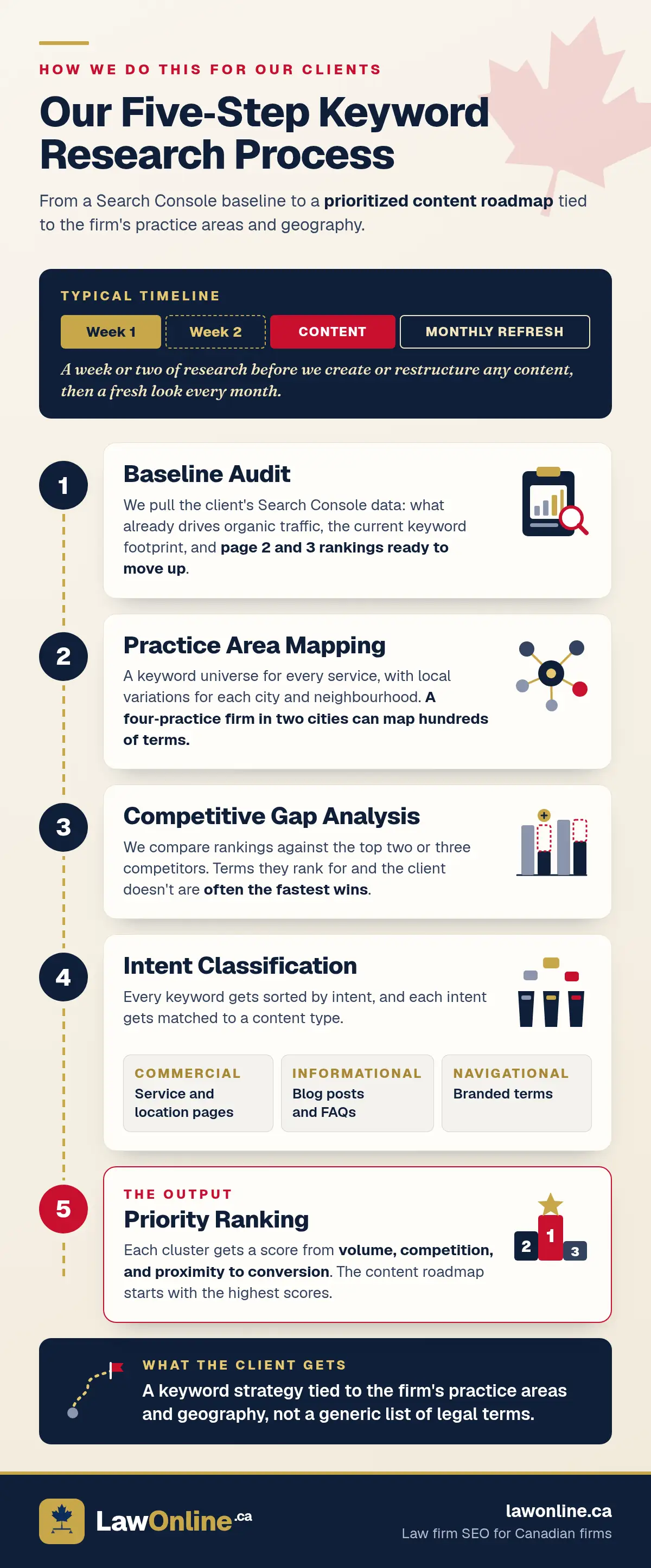
Baseline audit. We pull the client's Search Console data to understand what's already driving organic traffic, where there are ranking opportunities on page 2 or 3, and what the current keyword footprint looks like.
Practice area mapping. We build a keyword universe for every service the firm offers, including all local variations for cities and neighbourhoods they can realistically serve. A four-practice-area firm in two cities can generate a target list of hundreds of relevant terms.
Competitive gap analysis. We compare the client's keyword rankings against their top two or three competitors to identify terms those competitors rank for that the client doesn't. These gaps are often the fastest wins.
Intent classification. We sort every keyword by intent: commercial (service pages, location pages), informational (blog posts, FAQs), and navigational (branded terms). Each intent type gets matched to a content type.
Priority ranking. We assign a priority score to each cluster based on volume, competition, and proximity to conversion, then build a content roadmap around the highest-value opportunities.
That process produces a keyword strategy that's tied directly to the firm's practice areas and geography, not a generic list of SEO-friendly legal terms. The difference in results is significant. Firms that rank for the right terms get inquiries from people who need exactly what they do. Firms that rank for generic terms get traffic that doesn't convert.
Internal Links and Keyword Consistency
One detail that often gets overlooked: the way you link internally across your site affects how Google understands your keyword targets. If your personal injury page exists at /personal-injury-lawyer/ but you always link to it with anchor text like "our services," Google has no signal that the page is about personal injury law.
Use descriptive anchor text that includes your target keywords when linking between pages. This applies to your navigation, your blog posts, and your service area pages. It's a small detail that compounds over time.
For a deeper look at how this fits into the broader framework, see our guide on law firm SEO strategies and on-page SEO for law firms.
The Right Starting Point
If you're trying to improve your firm's organic search performance, keyword research is where to start. Not design, not content, not backlinks. It's the prerequisite for a sound law firm marketing strategy, because every other decision follows from what your potential clients actually search for.
A few hours in Google Search Console and Google Keyword Planner will give you a working list. From there, the questions are which terms represent real opportunities, how to structure your content around them, and how to prioritize the work. Those questions get harder to answer at scale, but they're answerable.
If you're trying to figure out how to get clients for a law firm through organic search, a proper keyword analysis for your specific practice areas and markets is the first step.