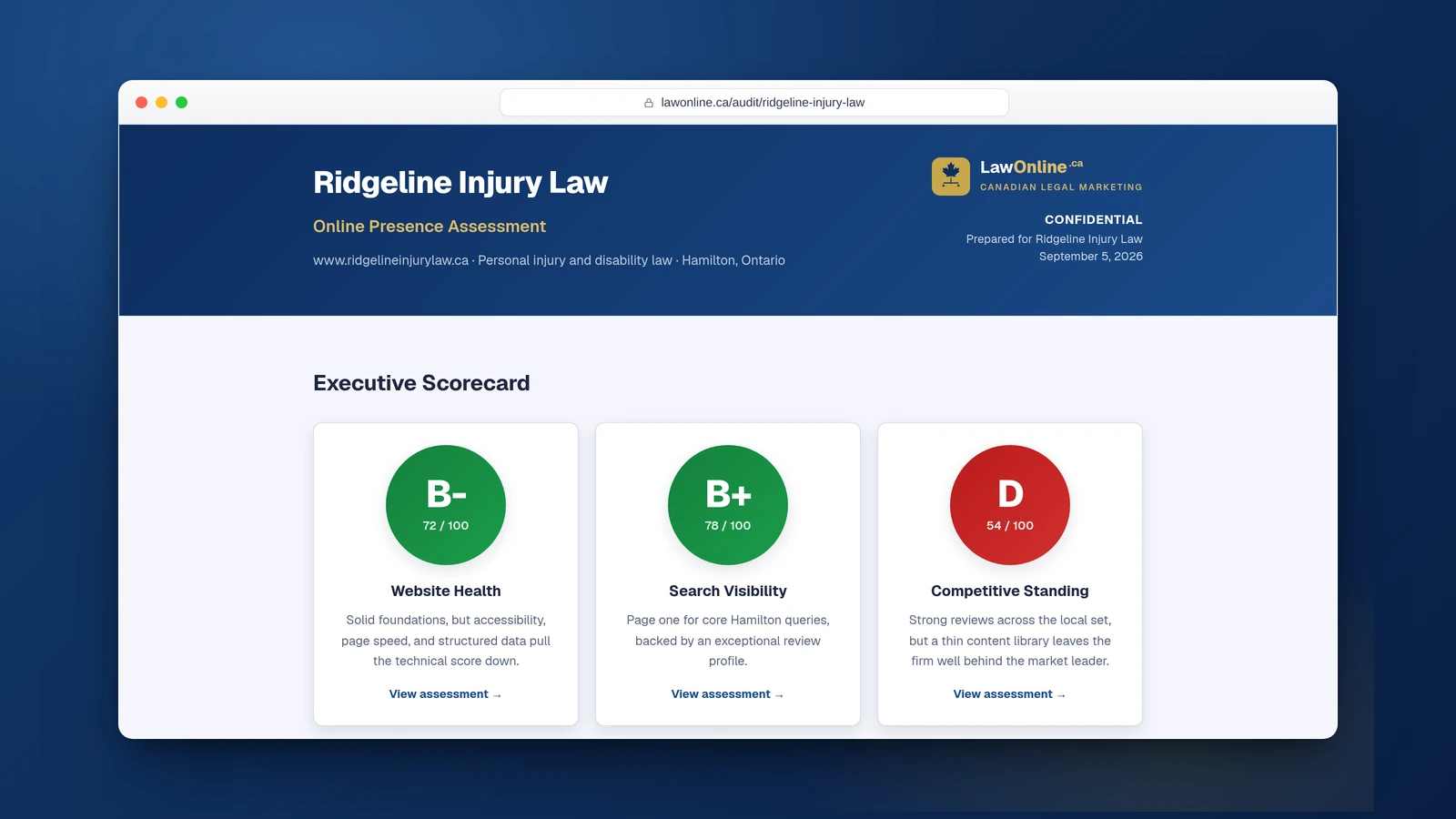
Every law firm SEO proposal reads the same way. Two pages, a bulleted list of "services included," a monthly retainer number, and a promise about "ongoing optimization." What none of them explain is what you're actually paying for.
That vagueness is the problem. A personal injury firm in Toronto pays $4,000 a month for "law firm SEO services" and gets what, exactly? Monthly reports? Blog posts nobody reads? A "technical audit" that's really just a screenshot from a free scanning tool? The gap between what an agency's sales deck promises and what the contract actually delivers is where most firms lose money.
This post breaks down what legitimate SEO for lawyers actually includes, what each phase of a proper engagement looks like month by month, and the specific questions to ask before you sign anything.

What Do Law Firm SEO Services Actually Cover?
Most agencies describe SEO for lawyers in broad strokes: "technical optimization," "content strategy," "link building," and "monthly reporting." Those terms aren't wrong. They're just vague enough to mean almost anything.
Here's what each service area should actually involve when it's done properly.
Technical SEO means auditing your site's infrastructure and fixing problems that prevent Google from crawling, indexing, and ranking your pages. That includes site speed, mobile responsiveness, crawl errors, broken links, duplicate content, schema markup, and Core Web Vitals. Technical SEO for law firms often uncovers chronic issues because many sites run on outdated WordPress themes or page builders that generate bloated code. A proper technical audit produces a prioritized fix list with timelines, not a generic score from a free tool. The payoff is measurable: a 2025 Ignite Visibility case study on a US multi-location healthcare provider found that combining regular technical audits with hyper-local content and Google Business Profile optimization produced a 115% increase in organic visitors and a 75% jump in booked appointments. Those technical fundamentals, including crawl health, page speed, and proper indexation, apply identically to a Canadian law firm site.
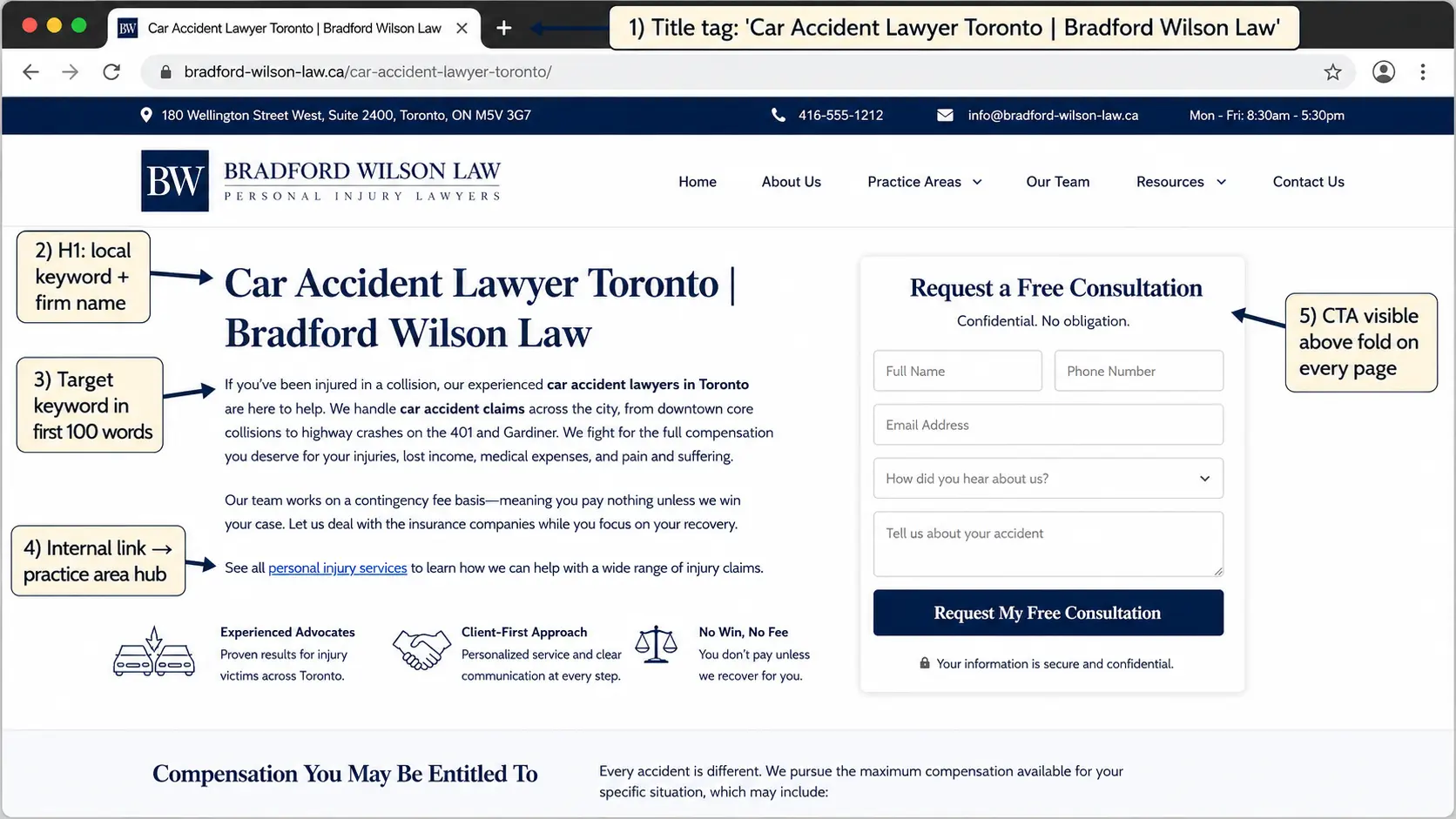
On-page SEO covers the elements Google reads directly on each page: title tags, meta descriptions, heading structure, internal linking, and structured data. For a PI firm, this means every practice area page has a unique title tag targeting the right local keyword ("car accident lawyer Toronto," not "personal injury services"), a meta description that drives clicks, and proper H1/H2 structure that signals topic relevance to search engines and AI systems.
Content creation is where most agencies either shine or completely fail law firms. Good legal content isn't just well-written. It needs to demonstrate E-E-A-T (Experience, Expertise, Authoritativeness, Trustworthiness), comply with provincial Law Society advertising rules, and target keywords people actually search for. An agency writing your content should understand that the Law Society of Ontario restricts certain claims about outcomes and specializations, and that similar rules apply in every province.
Local SEO encompasses everything tied to your geographic visibility: Google Business Profile management, local citation building, NAP consistency, review generation, and local link acquisition. For most law firms, local SEO drives more direct client inquiries than organic blog traffic.
Link building means earning backlinks from authoritative, relevant websites. For law firms, quality matters far more than quantity. A single link from a provincial bar association directory or a respected legal publication carries more weight than fifty links from generic business directories.
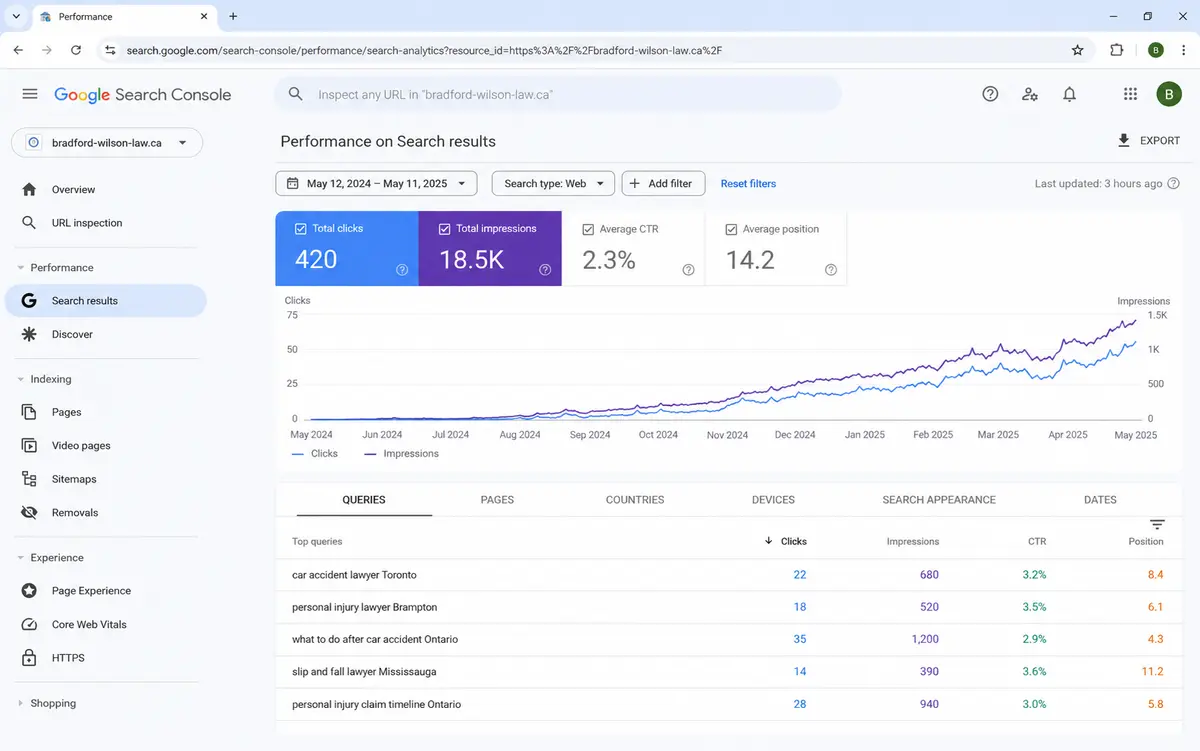
Reporting and analytics should connect SEO activity to business outcomes, not just show traffic graphs. Keyword rankings from Google Search Console, lead form submissions, phone call tracking, and cost-per-lead calculations tell you whether SEO is working. Pageview counts alone don't.
What Should a Law Firm SEO Engagement Deliver Each Month?
A well-structured engagement follows a predictable arc. The first few months look fundamentally different from month seven or month ten, and any agency that promises identical deliverables from month one through month twelve doesn't understand how SEO works.
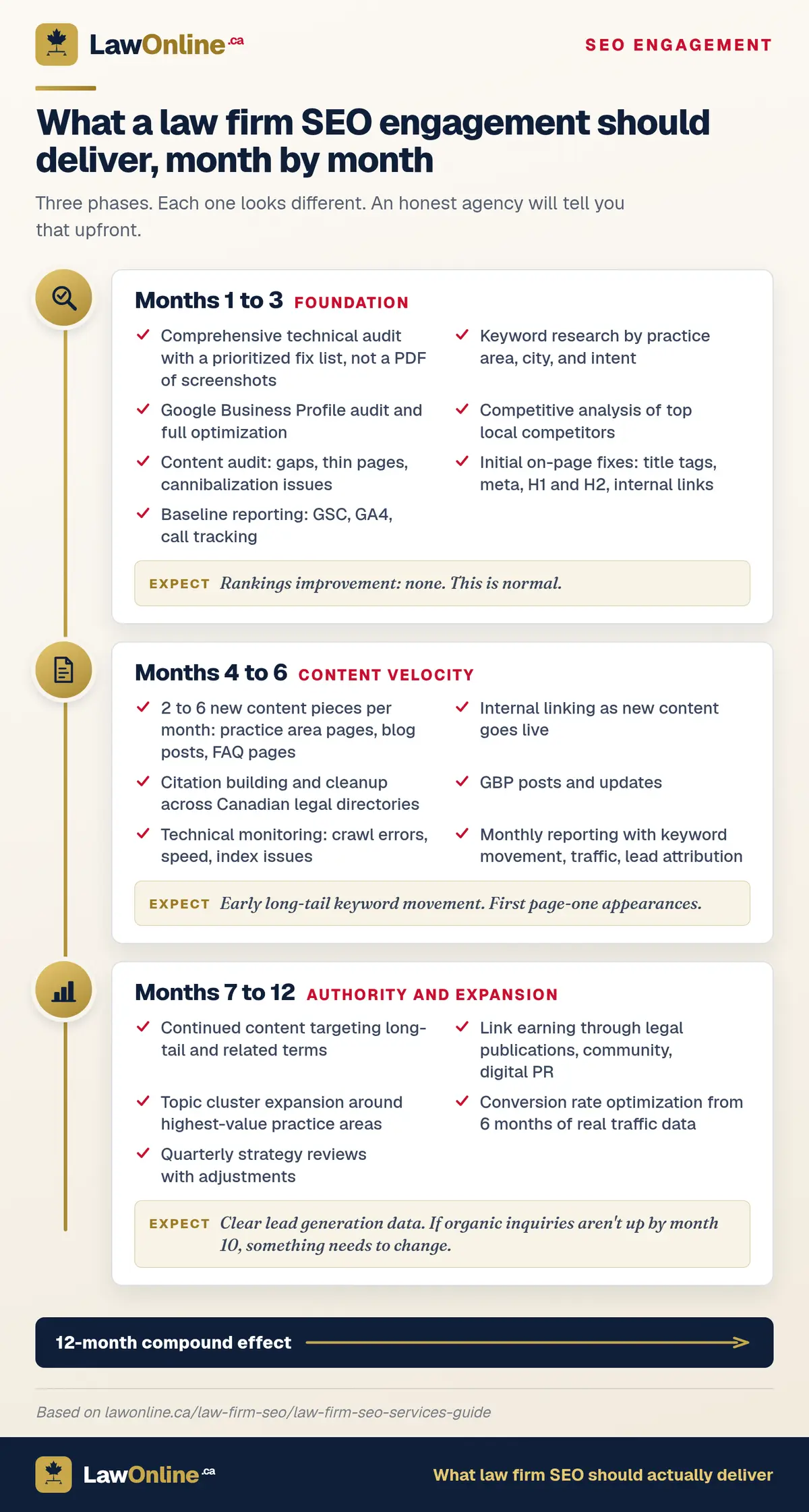
Months 1 to 3: Foundation
The first quarter is diagnostic and structural. You're not going to see ranking improvements yet, and an honest agency will tell you that upfront.
Law firm SEO deliverables during this foundation phase include:
- A comprehensive technical audit with a prioritized fix list (not just a PDF of screenshots)
- Keyword research organized by practice area, city, and search intent
- Google Business Profile audit and optimization
- Competitive analysis showing what your top local competitors are doing
- A content audit identifying gaps, thin pages, and cannibalization issues
- Initial on-page fixes: title tags, meta descriptions, heading structure, internal links
- Baseline reporting setup with GSC, GA4, and call tracking
For a personal injury firm in a competitive market like Toronto or Vancouver, this phase often reveals that existing pages are targeting keywords nobody searches for, or that five different pages are competing against each other for the same term.
Months 4 to 6: Content Velocity
Once the technical foundation is solid, the focus shifts to content production and local authority building.
Monthly SEO deliverables at this stage should include:
- 2 to 6 new content pieces (practice area pages, blog posts, or FAQ pages depending on the strategy)
- Internal linking optimization as new content goes live
- Citation building and cleanup across legal directories
- GBP posts and updates
- Ongoing technical monitoring for crawl errors, speed regression, and index issues
- Monthly reporting with keyword movement, traffic trends, and lead attribution
This is where you'll start seeing early ranking movement. Not page one yet for competitive terms, but noticeable improvement in position tracking and impressions. The gains can be dramatic once foundation work is in place. A 2025 Reach One Marketing case study documented a US local services business achieving 550% organic traffic growth within five months of completing a comprehensive technical audit, keyword strategy, and content overhaul, along with over 80 new inbound calls per month from organic search alone. Results in competitive Canadian legal markets won't ramp that fast, but the compounding pattern is the same.
For a complete timeline of what year one looks like in practice, see our post on what actually moves rankings for Canadian law firms.
Months 7 to 12: Authority and Expansion
By the second half of year one, the strategy should shift toward authority building and expanding your keyword footprint.
Expect:
- Continued content production targeting longer-tail and related keywords
- Link earning through legal publications, community involvement, and digital PR
- Topic cluster expansion around your highest-value practice areas
- Conversion rate optimization based on six months of real traffic data
- Quarterly strategy reviews with adjustments based on what's working
Results compound over time. A family law firm that publishes thirty pieces of targeted content over twelve months builds a content library that continues generating traffic and leads well beyond the initial investment period. A PI firm that builds deep practice area clusters around car accidents, slip-and-falls, and wrongful death creates a topical authority footprint that's extremely difficult for competitors to displace.
This is also the phase where you should see clear lead generation data. If organic inquiries aren't increasing by month ten, something in the strategy needs to change.
What Should Every Law Firm SEO Proposal Include?
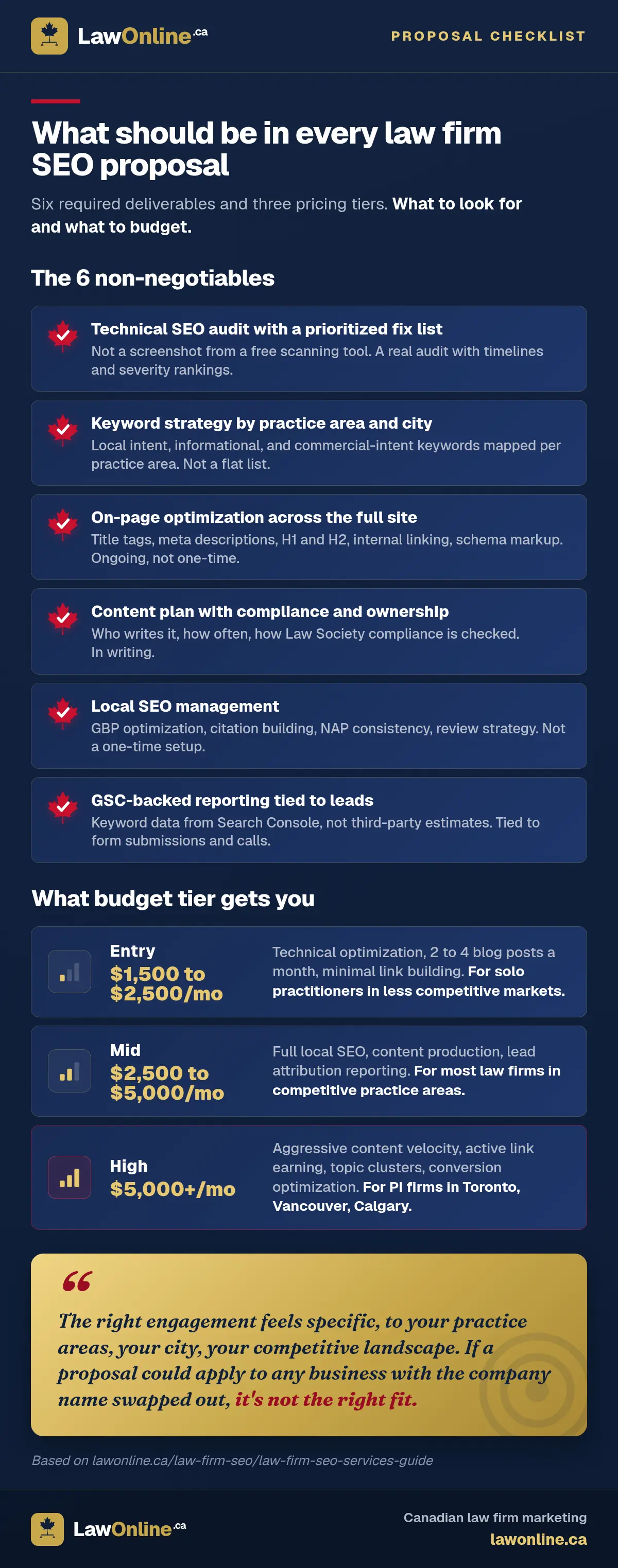
A serious SEO proposal for a law firm should include six specific deliverables. If a proposal you're evaluating is missing any of these, ask why.
1. A Technical SEO Audit With a Prioritized Fix List
Not a screenshot from SEMrush or Ahrefs. A real audit that catalogs every technical issue on your site, ranks them by impact, and includes a timeline for fixing them. Crawl errors, page speed issues, mobile usability problems, broken links, duplicate content, missing schema markup: each issue should have a clear severity level and a planned resolution date.
2. A Keyword Strategy Organized by Practice Area
Your agency should deliver a keyword map showing which terms they're targeting for each practice area, in each city you serve. The map should distinguish between local intent keywords ("personal injury lawyer Mississauga"), informational keywords ("how long does a car accident claim take in Ontario"), and commercial investigation keywords ("best personal injury lawyer Toronto reviews").
3. On-Page Optimization Across Your Site
Title tags, meta descriptions, H1 headings, internal linking, and schema markup for every important page. This isn't a one-time deliverable. It's ongoing optimization that adapts as new content gets published and rankings shift.
4. A Content Plan With Clear Ownership and Compliance
Who writes the content? What's the monthly volume? How do they handle Law Society compliance?
These questions matter. Content that violates provincial advertising rules can expose your firm to regulatory complaints. Your proposal should explain the content review process, including how legal accuracy and regulatory compliance are verified before publication.
PI firms face particular scrutiny here. Claims about case outcomes, settlement amounts, or specialization credentials are regulated in most provinces. An agency that doesn't mention compliance in its content workflow doesn't understand legal marketing.
5. Local SEO Management
Google Business Profile optimization and ongoing management, citation building and cleanup, NAP consistency auditing, and a review generation strategy. Local SEO isn't a one-time setup. GBP profiles need regular posts, photo updates, Q&A monitoring, and review responses.
6. Transparent, GSC-Backed Reporting
Monthly reports should show keyword rankings from Google Search Console data, not third-party position estimates. They should track organic leads (form submissions, phone calls), not just sessions. And they should connect SEO activity to revenue where possible.
If your agency's reports show traffic going up while your phone isn't ringing, something is wrong.
What Gets Promised but Shouldn't Be?
Some promises in law firm SEO proposals aren't just ambitious. They're red flags. They reveal that an agency either doesn't understand how search engines work or is deliberately misleading you.
"Guaranteed first-page rankings." Nobody can guarantee rankings. Google's algorithm considers hundreds of factors, many outside anyone's control. An agency that guarantees specific positions is either lying or planning to target keywords so obscure that ranking for them is meaningless. Google itself warns against agencies that guarantee rankings.
Backlinks from link farms or irrelevant sites. If an agency promises "500 backlinks per month," that's your cue to walk away. Quality link building for law firms means earning links from legal directories, bar associations, local business organizations, and legal publications. Mass-produced links from unrelated websites don't just fail to help. They can trigger penalties that tank your entire site.

AI-generated content without legal review. AI tools can assist with research and drafts, but publishing AI-generated legal content without attorney review and Law Society compliance checking is reckless. The quality bar for legal content is higher than most industries. Content that's factually wrong or regulatory-noncompliant does real damage. We cover this in depth in our post on why most law firm SEO in Canada fails.
Social media management bundled as "SEO." Social media and SEO are different disciplines. If an agency bundles Facebook posting and Instagram management into their SEO retainer, they're padding the deliverable list. Social signals don't directly influence search rankings. Social media has its own value, but it isn't SEO and shouldn't be billed as such.
Vanity metrics in reports. Monthly reports showing pageviews and "impressions" without tying them to actual inquiries are designed to look good, not prove value. If your agency can't show you which keywords are driving phone calls and contact form submissions, their reporting isn't transparent enough.
How Much Do Law Firm SEO Services Cost by Tier?
Law firm SEO services in Canada typically fall into three pricing tiers. What you need depends on your market's competitiveness, the number of practice areas you're targeting, and how aggressively you want to grow.
Entry tier: $1,500 to $2,500 per month. This covers technical optimization, basic on-page fixes, 2 to 4 blog posts per month, and minimal link building. It's suitable for solo practitioners or small firms in less competitive markets, like family law practices in mid-sized cities. You'll see gradual improvement, but don't expect to compete for high-value PI keywords at this budget.
Mid tier: $2,500 to $5,000 per month. Adds dedicated content production, full local SEO management (GBP, citations, review strategy), more aggressive on-page optimization, and monthly reporting with lead attribution. Most law firms targeting competitive practice areas in medium-to-large cities need at least this level of investment to move the needle.
High tier: $5,000 and above per month. Full-service SEO with aggressive content velocity, active link earning campaigns, topic cluster development, conversion rate optimization, and strategic consulting. This is where personal injury firms in Toronto, Vancouver, and Calgary typically need to be. Competition for PI keywords in these markets is intense, and firms spending less than $4,000 per month are almost certainly losing ground to competitors who aren't holding back.
Retainer length matters too. Month-to-month agreements give you flexibility but limit what an agency can strategically commit to. Six-to-twelve month commitments typically come with better pricing and allow for the kind of compounding strategy that SEO requires.
For a detailed breakdown of pricing by practice area and city, see our full guide on how much law firm SEO costs in Canada.
How Should You Evaluate an SEO Proposal Before Signing?
Before committing to a law firm SEO retainer, ask these five questions. The answers will tell you whether you're looking at real lawyer SEO services or just a generic package with legal keywords swapped in.
"Who writes the content, and what's their legal industry experience?"
The person writing your blog posts and practice area pages needs to understand legal concepts, provincial regulations, and the way potential clients search for legal help. "We use AI to draft and then editors review" isn't good enough if those editors don't know the difference between a tort and a contract dispute.
"How do you handle Law Society compliance?"
Every province has advertising rules that apply to your website content. If the agency can't name the specific Law Society rules in your jurisdiction and explain their compliance process, they haven't worked with law firms before.
"What does month three look like?"
This question separates agencies with real plans from agencies with sales decks. By month three, you should have a completed technical audit, a keyword strategy, implemented on-page optimizations, and initial content in production. If the answer is vague or noncommittal, the timeline is too slow.
"How do you measure success, and how do you attribute leads to SEO?"
Rankings matter, but what you're really buying is clients. The agency should explain how they track which inquiries came from organic search, whether through call tracking, form attribution, or CRM integration.
"What happens if we cancel after six months?"
You should own everything: your content, your site changes, your data, your Google Search Console and Analytics access. Some agencies use proprietary platforms that hold your website hostage or remove content they created when you leave. Others retain admin access to your Google Business Profile, which gives them leverage you didn't agree to. Get ownership terms in writing before you sign.
For a comprehensive checklist of what to look for and what to avoid, read our guide on how to choose a law firm SEO agency in Canada.
Choosing the Right Law Firm SEO Services
SEO for lawyers isn't a commodity. The difference between an agency that understands the legal industry and one that's repurposing its playbook from another vertical shows up in every deliverable, from the content they produce to the keywords they target to the way they measure success.
If you're evaluating agencies, our law firm SEO program covers the full scope of what modern legal SEO services look like: technical foundations, local search, content strategy, and authority building. It's built specifically for how Canadian law firms need to compete online, not adapted from a template that worked for someone else.
The right engagement will feel specific. Specific to your practice areas, your city, your competitive landscape. If a proposal could apply to any business in any industry with the company name swapped out, it's not the right fit.