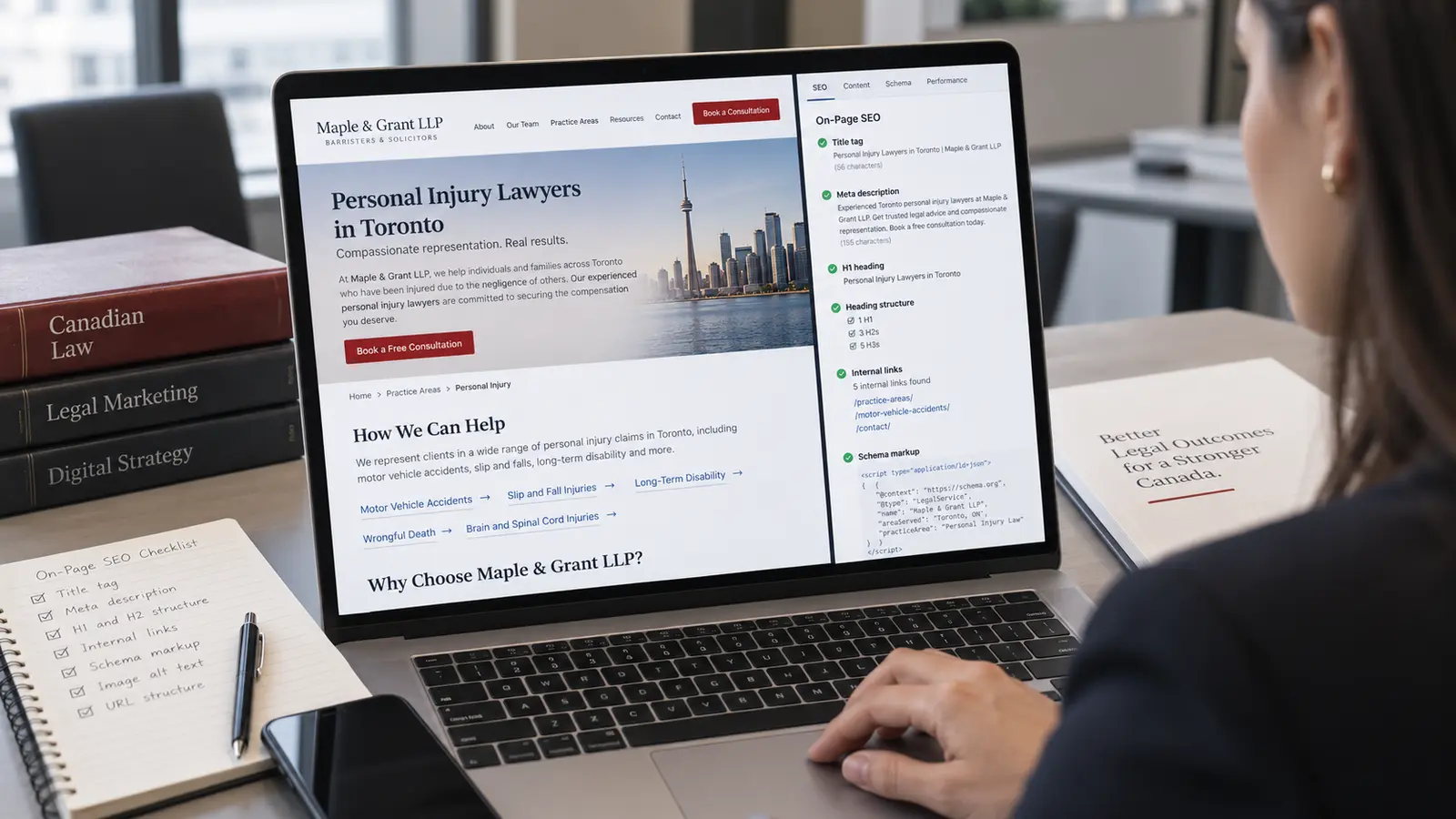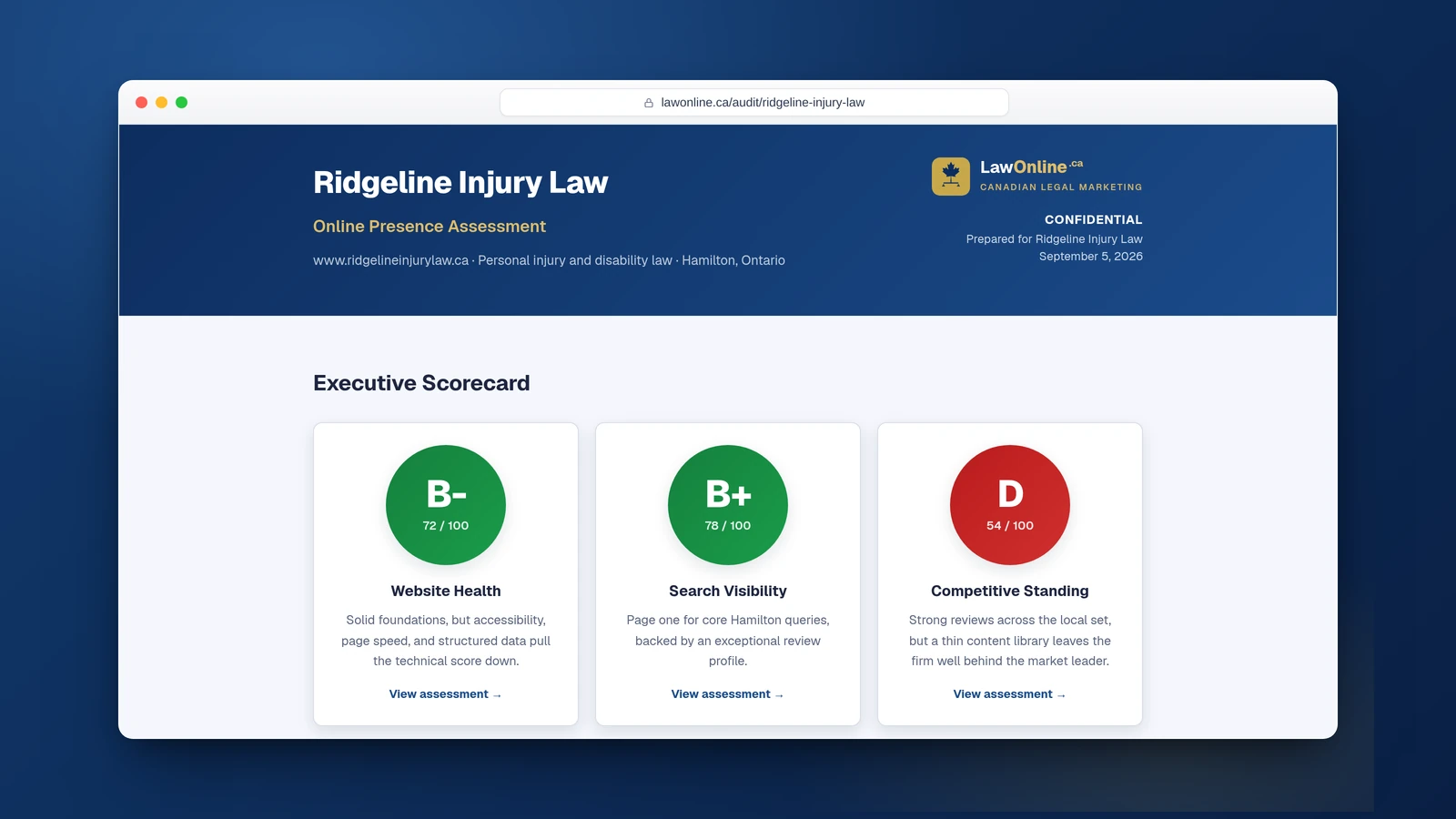
You've cleaned up your title tags. Your practice area pages have proper heading structure and schema markup. Your site loads fast. But you're still stuck on page two or three for the searches that matter.
The missing piece is almost always off-page SEO, specifically backlinks. On-page optimization tells Google what your pages are about. Backlinks tell Google whether your site is authoritative enough to deserve a prominent ranking. Both signals matter, but for competitive legal keywords in Canada, a technically sound site with few or no backlinks will lose to a less polished competitor that has accumulated genuine external authority.
This guide explains how backlinks work for law firm websites, which sources actually move the needle, and how to build links without running into the practices that get sites penalized.
Why Do Backlinks Matter for Law Firm SEO?
A backlink is a link from one website to yours. When an authoritative site links to your law firm's website, it passes a portion of its credibility to your domain. Google's engineers originally called this PageRank, and it remains central to how the algorithm evaluates authority two decades later.
For legal searches, this matters a lot. "Personal injury lawyer Toronto" and "family law firm Ottawa" are among the most competitive keyword categories in Canadian digital advertising. Pay-per-click costs for these terms can run $50–200 per click. Ranking organically requires more than just good on-page SEO; it requires demonstrating authority to Google at the domain level, and backlinks from credible sources are the clearest signal that domain authority exists.

The SEO industry invests heavily in this channel. A 2025 international survey of 536 SEO professionals found that 47% spend more than $1,100 CAD (£600) per month on link building alone, and the survey noted that competitive verticals like legal services spend the most. Sixty-one percent of respondents expected their link-building budgets to increase, not shrink. That pattern isn't new: a 2017 enterprise SEO survey of 240 specialists found that 85% were already maintaining or increasing link-building budgets, even though respondents consistently ranked it as the single hardest SEO strategy to execute.
The quality of the links matters far more than the quantity. A single link from the Law Society of Ontario or a regional legal news publication carries more weight than fifty links from low-quality directories or unrelated websites. Google's algorithm is sophisticated enough to evaluate the relevance and authority of the linking domain, not just the existence of the link.
What Makes a Good Backlink for a Law Firm?
Not all backlinks are equally valuable. Three factors determine how much authority a link transfers:
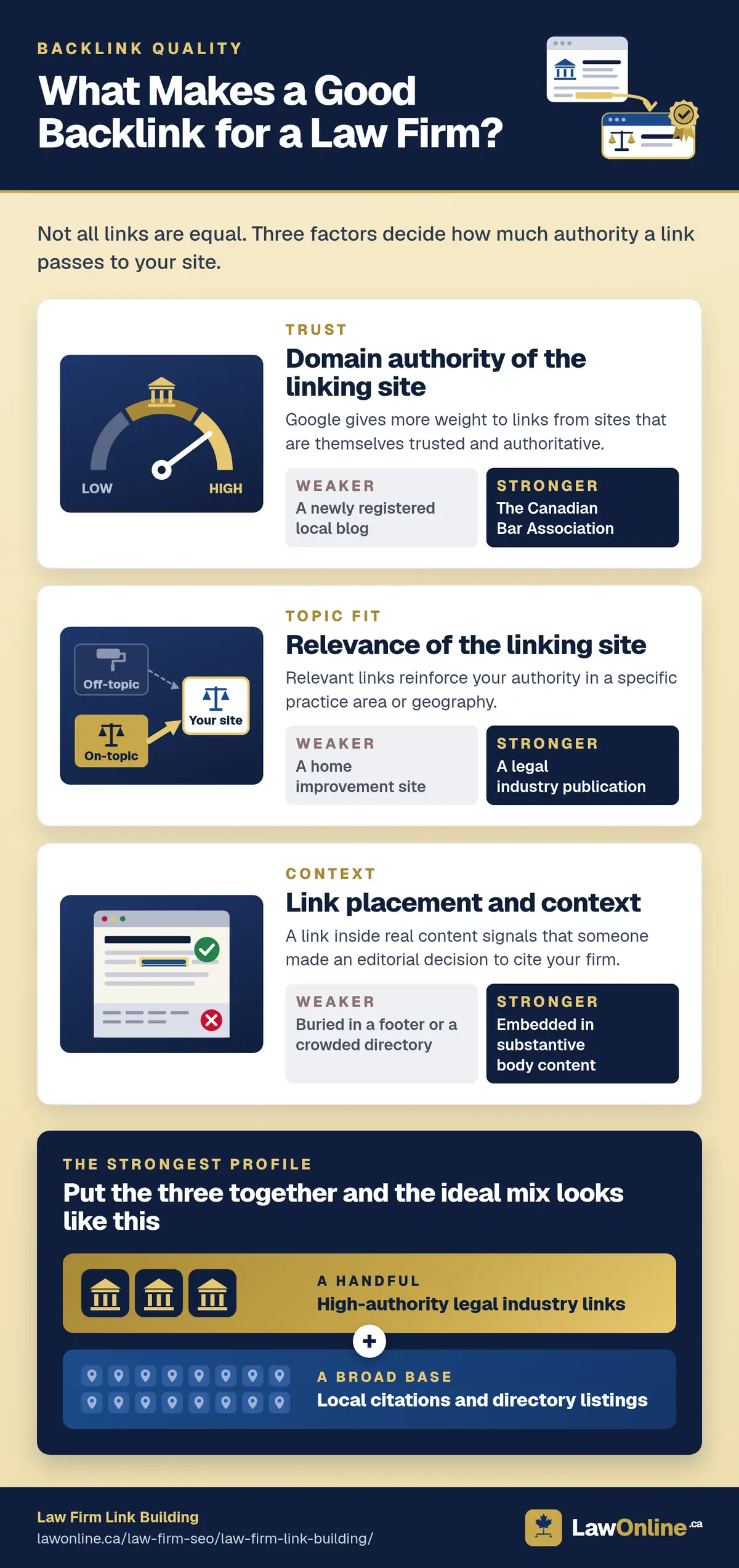
Domain authority of the linking site. A link from the Canadian Bar Association carries substantially more weight than a link from a newly registered local blog. Google gives more weight to links from sites that are themselves trusted and authoritative.
Relevance of the linking site. A link from a legal industry publication is more relevant to a law firm than a link from a home improvement site. Relevance signals reinforce your topical authority in a specific practice area or geography.
Link placement and context. A link embedded naturally within substantive body content is more valuable than a link buried in a footer or crammed into a directory listing alongside thousands of other firms. Contextual links signal that a real editorial decision was made to reference your firm.
The strongest backlink profile for a Canadian law firm combines a handful of high-authority legal industry links with a broader base of local citations and directory listings.
Where Can Canadian Law Firms Earn Legitimate Backlinks?
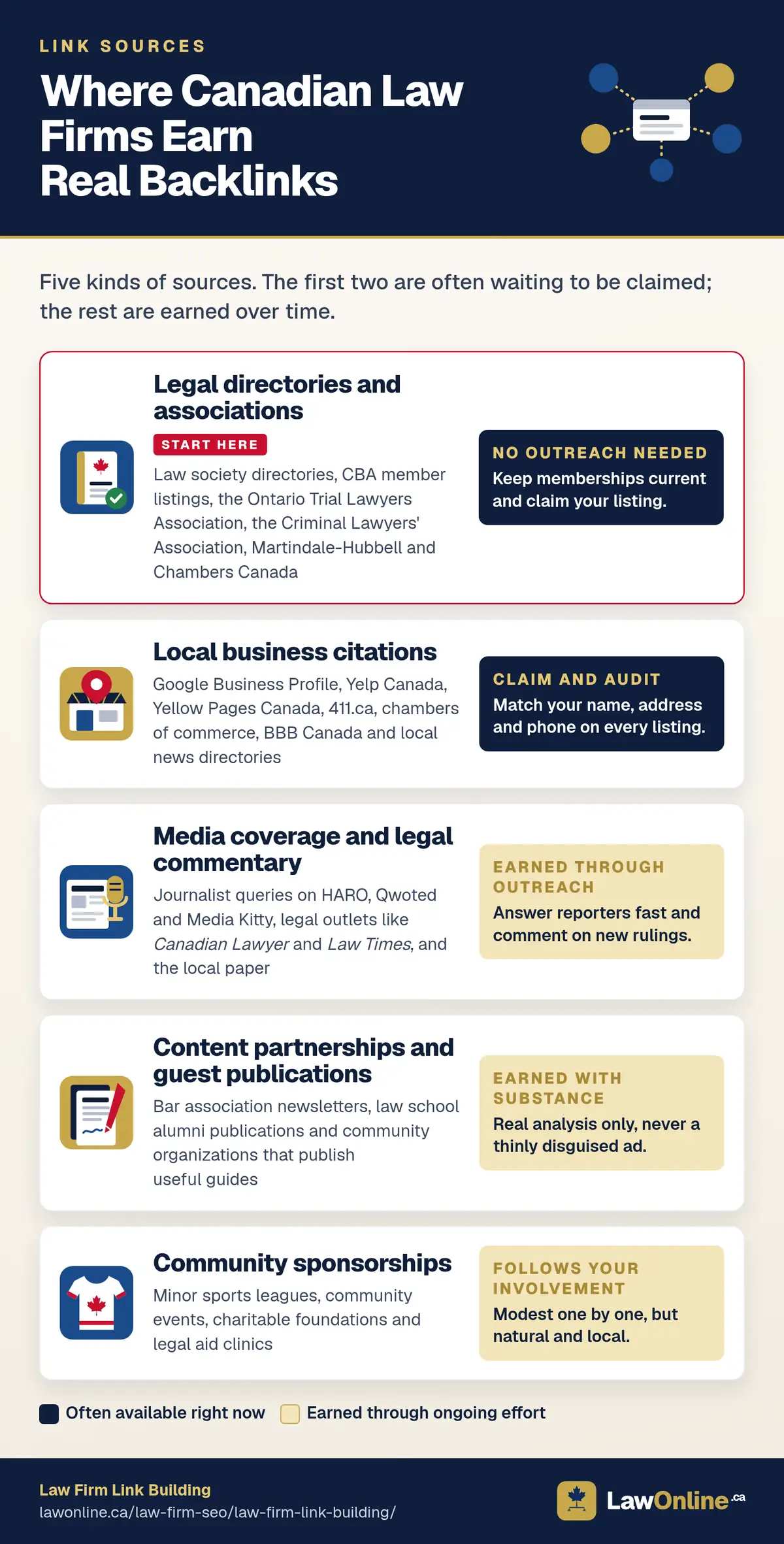
Legal Directories and Professional Associations
The most natural starting point for law firm link building is the professional directory ecosystem. These sources are editorially credible, highly relevant, and trusted by Google because they have real gatekeeping: you have to be a licensed lawyer to be listed.
- Law society websites. The Law Society of Ontario's lawyer directory, the Law Society of BC's Find a Lawyer tool, and equivalent directories in other provinces all link to law firm websites. These are among the most authoritative legal links available to Canadian firms.
- Canadian Bar Association member listings. CBA member firms are often listed on provincial branch sites and section pages, many of which carry external links.
- Specialty bar associations. The Ontario Trial Lawyers Association, the Criminal Lawyers' Association, and similar practice-area associations list members with links to firm websites.
- Martindale-Hubbell and Chambers Canada. These peer-review directories require editorial vetting and carry strong authority signals because the links are earned, not purchased.
These links don't require outreach. If your memberships are current and your listing is claimed, many of these are available right now.
Local Business Citations and Citation Building
Local SEO authority is built in part through consistent citations, meaning mentions of your firm's name, address, and phone number (NAP), across local business directories and community sites. While not all citations carry a dofollow link, the combination of consistent NAP data and inbound links from local directories reinforces your geographic authority for city-specific searches.
Key local citation sources for Canadian law firms:
- Google Business Profile. Not a traditional backlink, but a citation with enormous authority for local search. A fully claimed and optimized profile with consistent NAP data is foundational.
- Yelp Canada, Yellow Pages Canada, 411.ca. These remain crawled by Google and contribute citation signals even when the links are nofollowed.
- Local chambers of commerce. Most chamber member directories carry followed links. These are also editorially credible because membership is verified.
- Better Business Bureau Canada. An accredited BBB listing carries a meaningful backlink from a trusted domain.
- Local news site business directories. Many Canadian regional newspapers and news sites maintain local business listings. A link from the local paper's legal directory is both valuable and geographically relevant.
Citation consistency matters as much as quantity. If your address appears differently across directories ("Suite 200" vs "#200" vs "2nd Floor"), that inconsistency confuses Google's local algorithm. A citation audit, checking your NAP data across the major directories and correcting discrepancies, often has a measurable impact on local rankings.
Media Coverage, Digital PR, and Legal Commentary
Earned media is one of the highest-value link-building strategies available to law firms. When a journalist cites a lawyer as an expert source in a news article, the resulting link carries substantial authority because it reflects a genuine editorial decision. The broader SEO industry has recognized this: in a 2025 international survey of 536 SEO professionals, 73% named digital PR as a key link-building tactic for the year, making it the most commonly planned method in the survey. For law firms, this kind of outreach doesn't mean hiring a publicist. It means being available when journalists need an expert source and publishing content worth referencing.
Personal injury lawyers are natural sources for journalists covering accident cases, insurance disputes, and civil litigation. Family lawyers are sought for commentary on divorce law changes, child support rulings, and estate disputes. Criminal defence lawyers appear regularly in coverage of high-profile cases and law reform debates.

Practical ways to build media relationships:
- Respond to journalist queries. Services like Help a Reporter Out (HARO), Qwoted, and the Canadian equivalent Media Kitty connect journalists with expert sources. Subscribing to the legal category and responding quickly to relevant queries can generate links from outlets like Canadian Lawyer, Law Times, and mainstream news organizations.
- Publish commentary on recent decisions. When the Supreme Court of Canada releases a significant decision in your practice area, a well-written analysis published on your own site, promoted to legal journalists via social media or email, gives reporters a citable source with a reason to link.
- Local news outreach. For firms focused on specific cities or regions, building a relationship with the legal reporter at the local paper is often more achievable than national media and equally valuable for local search authority.
Legal Content Partnerships and Guest Publications
Law firms can earn links through substantive content contributions to other credible sites. This approach works best when the contribution is genuinely editorial: an article, analysis, or resource that the host site publishes because it adds value for their readers.
- Bar association publications. Many provincial bar associations and specialty sections publish member-contributed articles in newsletters and online. These carry strong authority and are editorially vetted.
- Law school publications. Contributing a practice guide or case comment to a Canadian law school's alumni magazine or online publication often generates a link from an .edu-equivalent domain.
- Non-legal local publications. An immigration lawyer contributing a guide for newcomers to a community organization's website, or an estate lawyer contributing an article to a local financial planning resource, earns a relevant link while demonstrating community expertise.
The content needs to be substantive. A 300-word article that's essentially a thinly disguised ad will not be accepted by credible publications and wouldn't earn meaningful authority even if it were.
The payoff from this approach can be significant. In a US case study from the regulated financial-services industry, Siege Media reported that a search-driven content strategy for Lexington Law generated over 190 links in one year and a 413% increase in organic traffic. A single data-driven article targeting "millennial spending habits" acquired 99 unique linking root domains on its own. The principle translates directly to Canadian legal practice: a family law firm publishing original research on divorce trends in Ontario, or an immigration practice creating a comprehensive guide to processing timelines, gives journalists and professional organizations something substantive to cite on an ongoing basis.
Community Sponsorships and Local Involvement
Law firms that sponsor local organizations, including minor sports leagues, community events, charitable foundations, and legal aid clinics, often receive a link from the sponsored organization's website. These links are modest in individual impact, but they contribute to a natural and geographically relevant backlink profile.
For personal injury and family law firms in particular, sponsoring community events and legal aid organizations also reinforces the public service positioning that matters for reputation-dependent practices.
The Canadian legal community network makes this more viable than it might seem. Pro Bono Ontario's 2022 impact report documented 260 participating law firms and legal departments, 34,000 clients served across more than 500 communities, and over $5.2 million in legal services delivered. Organizations like PBO, local legal clinics, and bar association chapters maintain active websites that link to participating and sponsoring firms. Even straightforward professional-community sponsorships are within reach: the Manitoba Bar Association's 2024-25 sponsorship package priced a conference sponsorship starting at $500 for a coffee break up to $2,500 for an awards ceremony, with each tier including signage, newsletter recognition, and social media acknowledgement.
What Link-Building Practices Should Law Firms Avoid?
Google's spam policies explicitly address link schemes, and the consequences for law firm websites that engage in them are severe: manual penalties that can drop a site from search results entirely, sometimes for months.
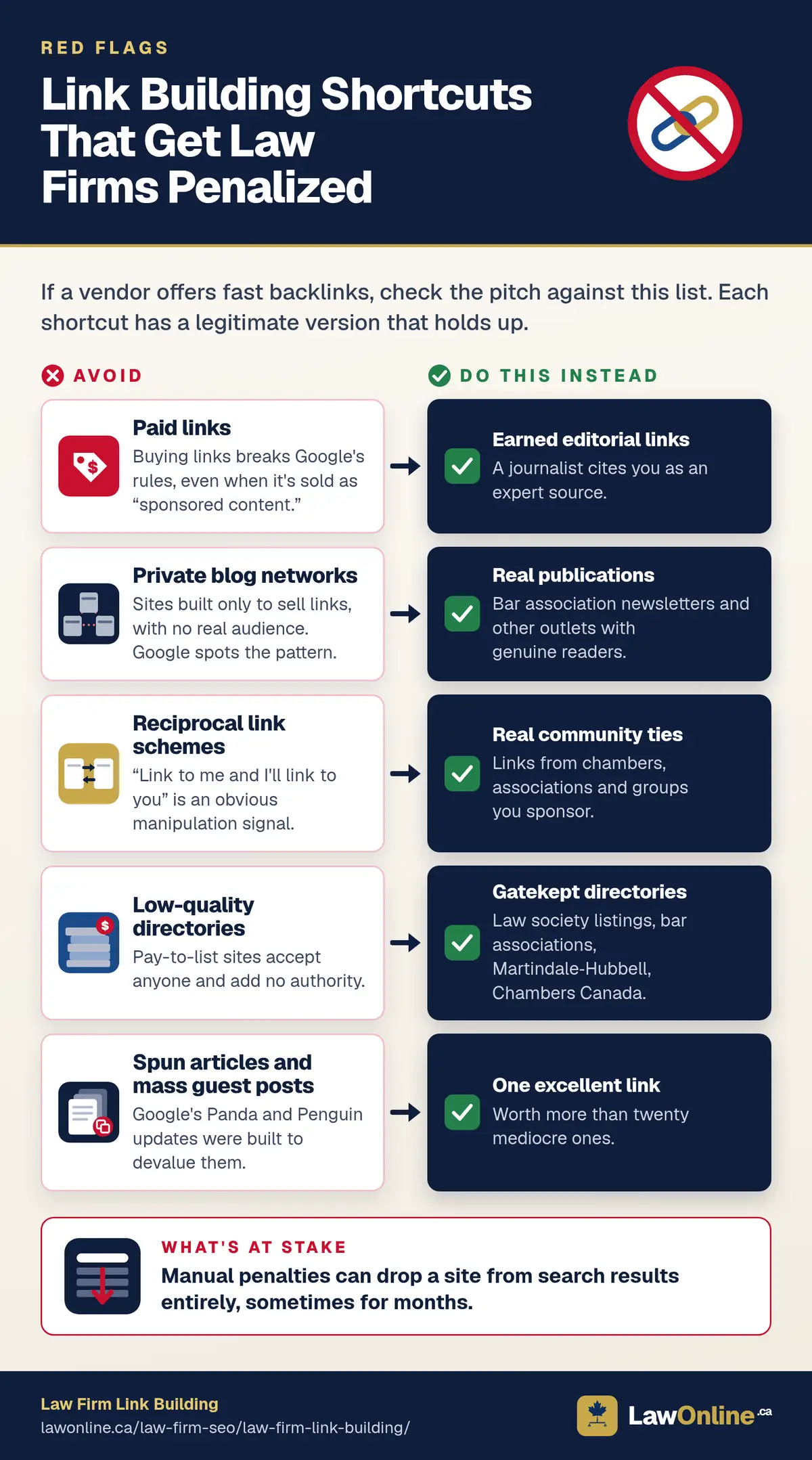
Paid links. Buying links, paying a site to add a link to your firm, violates Google's guidelines regardless of how the transaction is structured. Some link-selling operations disguise their offering as "sponsored content" or "advertorial placement," but Google evaluates the pattern of links, and a sudden influx of paid links from low-quality sites is a clear signal of manipulation.
Private blog networks (PBNs). These are networks of sites created specifically to generate backlinks, often sold by SEO agencies as a shortcut to fast rankings. The sites look real but have no genuine audience or editorial standards. Google has become effective at identifying PBN patterns, and firms that use them often find themselves penalized after algorithm updates.
Reciprocal link schemes. "Link to me and I'll link to you" arrangements across unrelated sites are manipulative and add no real value. A mutual link between two law firms in the same practice area in the same city is a particularly obvious signal.
Low-quality directory submissions. There are thousands of directories that accept any submission for a fee. Mass submissions to these directories add no authority and contribute to a low-quality backlink profile that can harm rankings over time.
Article spinning and mass guest posting. Publishing the same article (or slight variations of it) across dozens of low-quality sites to generate links is a technique that Google's Panda and Penguin updates were specifically designed to devalue. Any outreach-based link building campaign should prioritize one excellent link over twenty mediocre ones.
How Long Does Law Firm Link Building Take to Show Results?
Off-page SEO is slower than on-page work. Fixing your title tags and heading structure can start showing results in weeks as Google re-crawls the updated pages. Backlink authority accumulates over months.
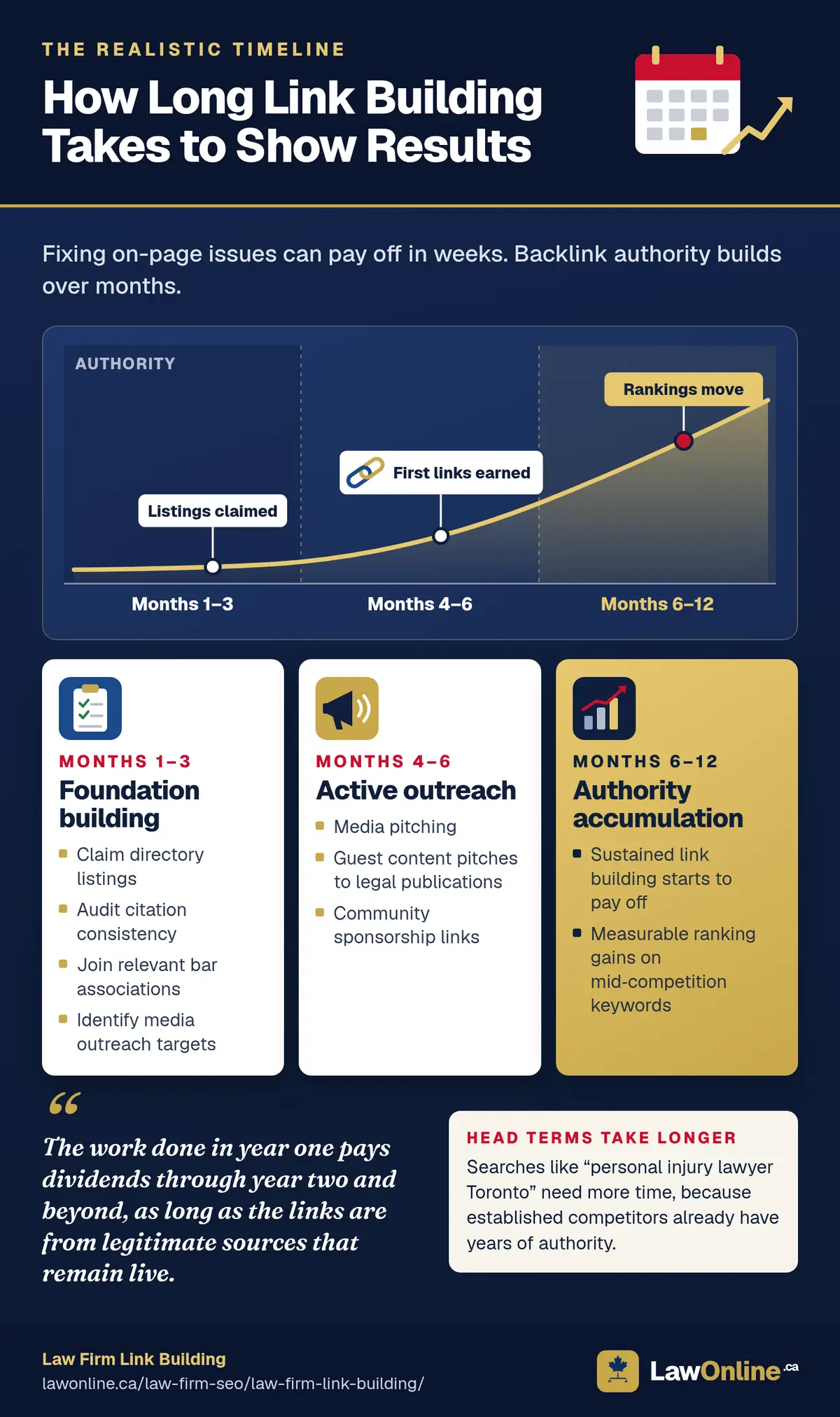
A realistic timeline for a Canadian law firm starting from a low-authority baseline:
- Months 1–3: Foundation building: claim directory listings, audit citation consistency, join relevant bar associations if not already a member, identify media outreach targets.
- Months 4–6: Active outreach: media pitching, guest content pitching to legal publications, community sponsorship links.
- Months 6–12: Authority accumulation: sustained link building starts to show measurable ranking improvement for mid-competition keywords. High-competition terms like "personal injury lawyer Toronto" require longer timelines because the established competitors have years of authority already.
The compounding effect of backlinks means the work done in year one pays dividends through year two and beyond, as long as the links are from legitimate sources that remain live.
How Does Off-Page SEO Connect to the Rest of Your Law Firm's SEO Strategy?
Off-page authority amplifies on-page work; it doesn't replace it. A site with strong backlinks but poor on-page SEO is leaving ranking potential unrealized. A site with excellent on-page work but no external authority won't compete for contested terms. Both are necessary.
Similarly, off-page SEO and local SEO work together. The local citations that contribute to your map pack rankings also contribute to your organic domain authority. Google Business Profile signals, local link relevance, and NAP citation consistency are all part of the same geographic trust picture.
Law firms that treat link building as a one-time project rather than an ongoing strategy tend to plateau. The competitors ranking above you on page one are continuing to earn links. Maintaining ranking position requires continuing to earn authority, not as aggressively as the initial build, but consistently.
What Results Can Law Firms Realistically Expect from Link Building?
Specific results depend on the baseline, the competition in your market, and the quality of the links you earn. Some general patterns from legitimate off-page SEO campaigns:
- Firms with thin backlink profiles (fewer than 50 referring domains) that implement a structured link-building program typically see domain authority improvements within six months.
- Local citation cleanup alone, fixing inconsistent NAP data and claiming unclaimed directory listings, often produces measurable local ranking improvements within 60–90 days.
- A single high-authority link from a law society, legal publication, or major news organization can have a more significant impact than dozens of low-quality directory listings.
What you should not expect: overnight results, guaranteed ranking positions, or a proportional relationship between the number of links and your keyword rankings. Off-page SEO is probabilistic. The right links, to the right pages, from the right sources, improve your probability of ranking; they don't guarantee it.
Building Law Firm Authority Isn't a DIY Project
Effective law firm link building requires time, editorial relationships, and a clear understanding of which sources actually carry weight in the Canadian legal market. The tactics that work, including media outreach, bar association content, and local authority building, are sustained programs, not one-time campaigns.