Case volume isn't the same as case value. For PI firms looking to grow revenue rather than just headcount, the question isn't only "how do I get more cases?" but "how do I get better cases?" This requires a different law firm marketing approach, different positioning, different content, different conversion signals, from the tactics that generate high volumes of minor injury referrals.
This guide covers how Canadian personal injury law firms can use their marketing to attract serious and catastrophic injury cases.
Why High-Value Cases Require Different Marketing
Minor personal injury cases and catastrophic injury cases come from the same universe of potential clients, but they arrive through different channels and evaluate firms differently.
Minor injury claimants (soft tissue, sprains, minor fractures) often self-select to any accessible PI firm. They respond to convenience, speed, and "no-win no-fee" messaging. Google Search Ads, high review counts, and fast response times win this market.
Serious and catastrophic injury clients (spinal cord injury, traumatic brain injury, amputation, severe burns, wrongful death) and their families behave differently. These cases are life-altering. Claimants and their families spend more time evaluating lawyers, consult multiple firms, ask more sophisticated questions, and care deeply about demonstrated expertise and case results. They also often come through medical referrers, physiatrists, neurologists, rehabilitation specialists, who make referrals based on professional trust, not advertising.
The financial gap between these categories is enormous. Ontario's standard accident-benefit framework caps minor injury claims at $3,500 in medical and rehabilitation benefits, non-catastrophic claims at $65,000, and catastrophic claims at up to $1 million under FSRA's standard benefit structure. A single catastrophic file can represent more revenue than dozens of minor claims combined. BC and Alberta have their own frameworks with different catastrophic injury thresholds and referral structures, but the same principle applies across every province: serious injury cases carry dramatically higher value than minor claims.
Settlement data confirms the gap. A closed-claims study commissioned by the Government of Newfoundland and Labrador examined 1,741 automobile injury claims and found an average total settlement of $39,580 per claimant. But the most severely injured claimants averaged $44,332 in pain-and-suffering damages alone, roughly 76% more than the overall pain-and-suffering average of $25,208. More than 98% of those claims settled through negotiation, not trial, so these figures reflect typical outcomes rather than outlier verdicts.
The marketing implications:
- Positioning matters more than visibility. A firm that looks like it handles everything and anyone won't be chosen for a $2 million TBI file.
- Content depth signals expertise. Injury-specific educational content demonstrates the firm understands their type of case.
- Proof is more important than volume. One well-documented successful catastrophic case is more persuasive than 200 five-star reviews about minor files.
- Referral relationships with medical professionals are essential. The majority of serious PI cases come through healthcare providers.
Positioning Your Firm for Serious Injury
Before any tactical marketing changes, the fundamental question is whether your firm is positioned as a serious injury specialist, or whether your website, advertising, and messaging suggest a general PI shop.
Signs that your positioning isn't differentiated:
- Your homepage says something like "injured in an accident? Call us" with no mention of injury type or complexity
- Your case results section (if it exists) features only minor settlements under $100,000
- Your lawyer bios don't mention specific injury types or complex litigation experience
- Your blog covers only basic topics (what to do after a car accident, how long does a PI case take)
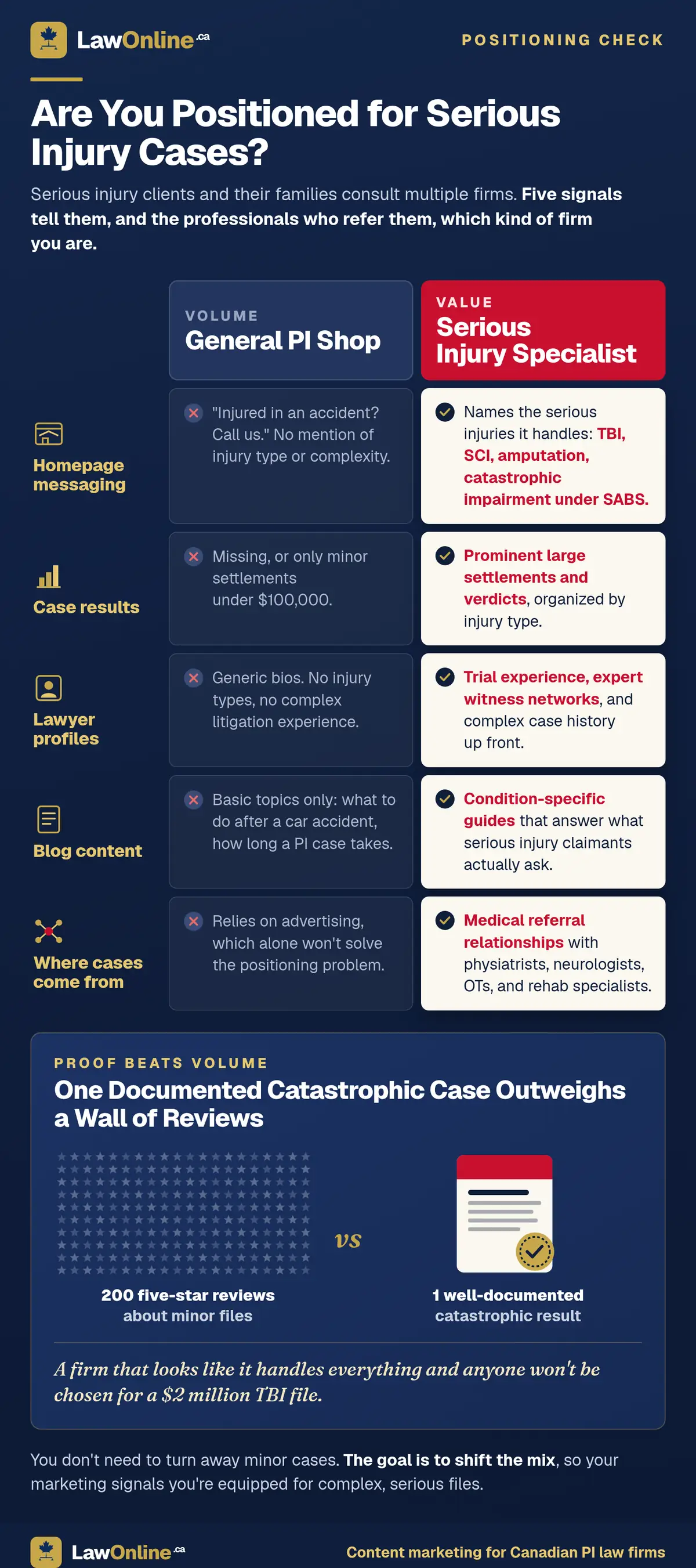
Firms that attract high-value cases typically do the opposite:
- Website language references specific serious injury types (TBI, SCI, amputation, chronic pain syndrome, catastrophic impairment under SABS)
- Case results are prominent and include large settlements and verdicts
- Lawyer profiles emphasize trial experience, expert witness networks, and complex case history
- Content addresses the specific questions serious injury claimants actually ask
You don't need to exclude minor injury cases from your practice. But your marketing should signal that your firm is equipped for, and interested in, complex serious files.
Injury-Specific Content Marketing
Educational content is the most powerful tool for attracting serious injury clients who aren't yet ready to call a lawyer, and for demonstrating expertise to medical and legal referrers.
The Content Types That Work for Serious Injury
Condition-specific guides. Write detailed, accurate guides on the injuries you handle. Not generic ("what is a traumatic brain injury?") but law-practice-specific ("How TBI affects your personal injury claim in Ontario: what you need to know about assessment, causation disputes, and damages"). These demonstrate depth and are more likely to be shared by healthcare providers who find them accurate and useful.
Topics to cover:
- Traumatic brain injury and the personal injury claim process in Ontario
- Spinal cord injury: understanding the SABS catastrophic impairment designation
- Chronic pain syndrome and its role in serious personal injury claims
- Wrongful death claims in Ontario: who can claim and what damages are available
- Amputations and serious orthopaedic injuries: documenting long-term losses
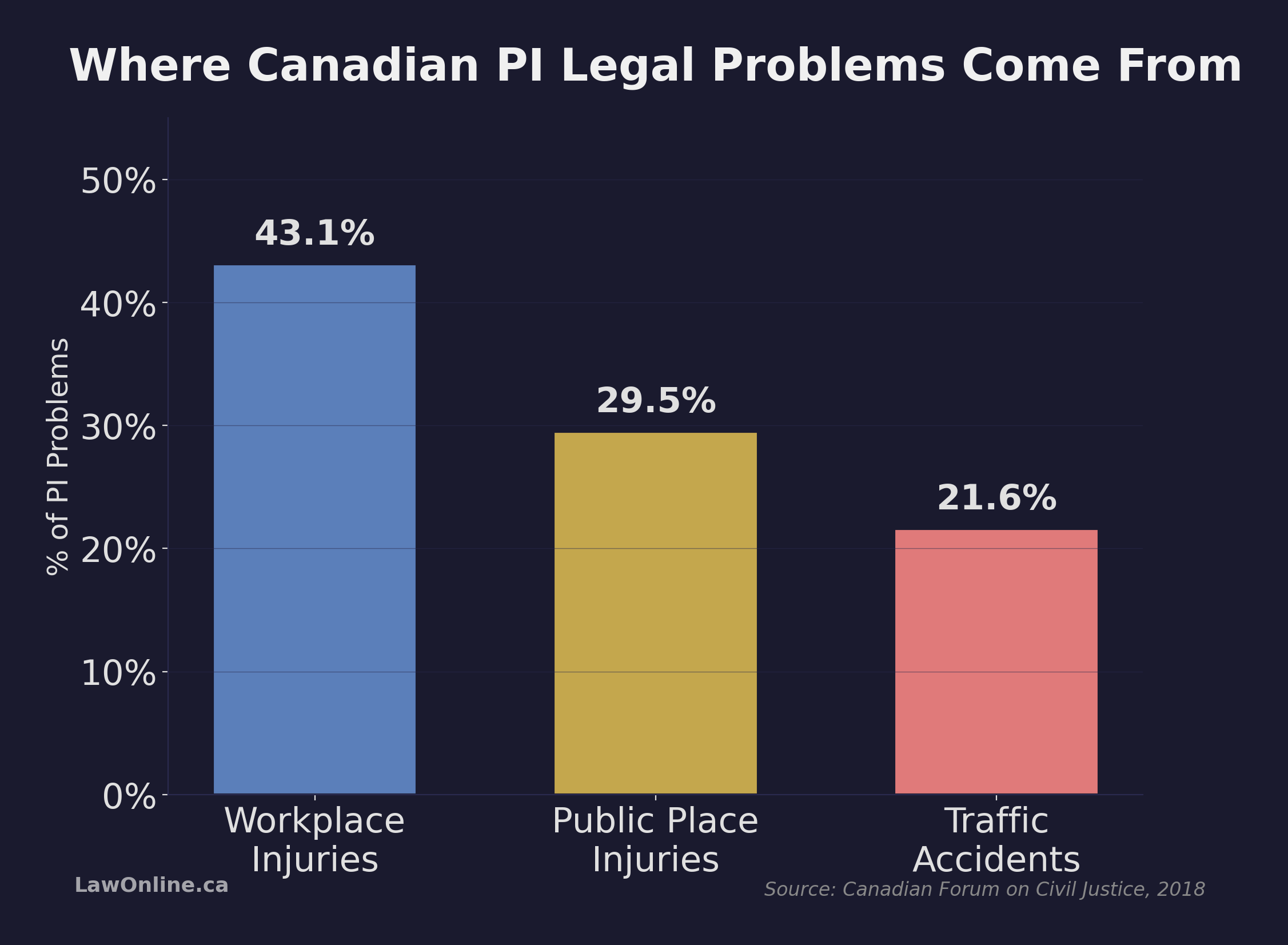
The data supports thinking beyond motor vehicle accidents. A national survey by the Canadian Forum on Civil Justice found that 43.1% of personal-injury legal problems reported by Canadians involved workplace injuries, 29.5% involved injuries in a public place or commercial establishment, and just 21.6% involved traffic accidents. Most PI firms concentrate their content on car accident scenarios because that's what competitors write about, but the single largest category of injury-related legal problems is actually workplace injuries.
Case type explainers. Serious injury often arises from specific accident types, industrial accidents, commercial truck collisions, pedestrian and cyclist incidents, slip and falls with severe consequences. Write about the specific legal complexities of these scenarios: multiple defendants, product liability overlap, employer liability, government defendant involvement. Sophisticated clients and referring professionals recognize this as real expertise.
Long-term damages content. What distinguishes catastrophic claims from minor ones is the scope of future loss: lost income, future care costs, home modification, attendant care, and loss of competitive advantage. Content that explains how these damages are calculated, what expert witnesses are involved, and why documentation matters will attract more sophisticated claimants than content that focuses on the accident itself.
Publishing and Distribution
Injury-specific content should be:
- Published on your own website (for SEO and direct visitor value)
- Promoted through LinkedIn to build professional referrer awareness
- Shared with or linked for medical professionals in your referral network
- Structured with schema markup (FAQ, Article) to improve search visibility for specific queries
Target search queries include: "TBI personal injury lawyer Ontario," "spinal cord injury lawyer Toronto," "catastrophic impairment SABS lawyer," "traumatic brain injury settlement Canada," and condition-specific variants.
Building Medical Referral Networks for Serious Cases
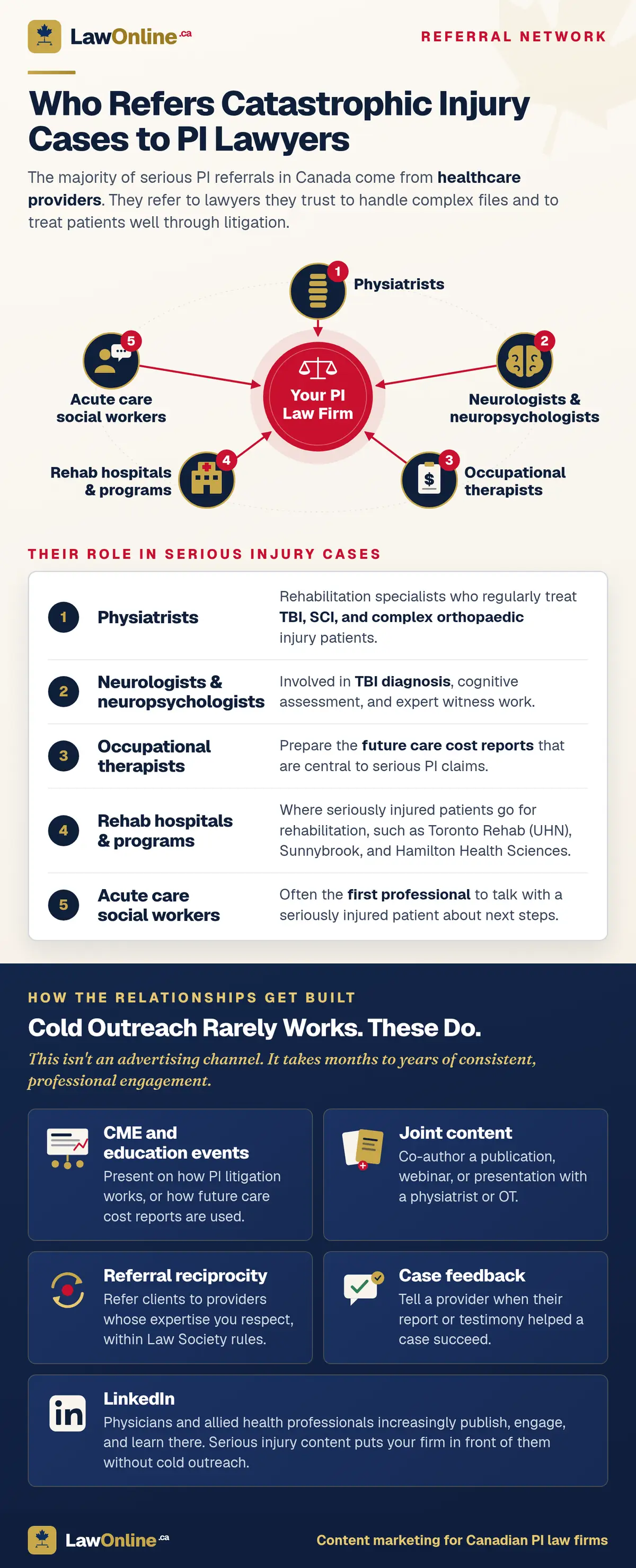
The majority of catastrophic personal injury referrals in Canada come from healthcare providers, physiatrists, neurologists, rehabilitation medicine specialists, occupational therapists, and social workers who work with seriously injured patients. These providers refer to lawyers they trust to handle complex files competently and to treat patients well through the litigation process.
This isn't an advertising channel. It's a relationship-building effort that takes months to years to develop and requires consistent, professional engagement.
Who to Target
For serious PI cases, the most valuable referral relationships are with:
- Physiatrists (physical medicine and rehabilitation specialists), regularly work with TBI, SCI, and complex orthopaedic injury patients
- Neurologists and neuropsychologists, involved in TBI diagnosis, cognitive assessment, and expert witness work
- Occupational therapists, prepare future care cost reports that are central to serious PI claims
- Rehabilitation hospitals and programs, Toronto Rehab (UHN), Sunnybrook, Hamilton Health Sciences, regional programs
- Social workers in acute care settings, often the first healthcare professional to have a conversation with a seriously injured patient about next steps
How to Build These Relationships
Cold outreach rarely works. Medical professionals receive constant solicitation. The approaches that do work:
CME and education events. Sponsoring or presenting at continuing medical education events gives you face time with physicians in a professional context. Topics like "what physicians need to know about personal injury litigation" or "how future care cost reports are used in claims" are genuinely useful to healthcare providers and position your firm as a knowledgeable collaborator.
Joint content. Collaborating with a physiatrist or OT on a publication, webinar, or presentation (even informally) creates a mutual relationship and a credibility signal for both parties.
Referral reciprocity. Referring your clients to specific healthcare providers for treatment or assessment creates natural reciprocity, not in a way that violates Law Society rules, but organically through demonstrated respect for their expertise.
Case feedback. When a medical professional's report or testimony contributes to a successful outcome, letting them know (in general terms, where appropriate) reinforces that the collaboration worked and that you appreciate their contribution.
LinkedIn. For physicians and allied health professionals, LinkedIn is increasingly the professional network where they publish, engage, and learn. Being visible there, with content that demonstrates your expertise in serious injury claims, puts your firm in front of the right referral audience without cold outreach.
Website Signals That Attract Serious Cases
Your website communicates who you are to both potential clients and referring professionals. For firms targeting serious injury cases, several specific elements matter. Beyond the credibility signals below, injury-type landing pages are also a cornerstone of personal injury law firm SEO because they give search engines clear topical signals about your expertise and match the specific queries potential clients use.
Case Results
Publicly displaying case results, where permitted by Law Society Rules of Professional Conduct, is one of the most important credibility signals for high-value cases. A family evaluating who to hire for a wrongful death claim will look for evidence that the firm has handled similar cases successfully.
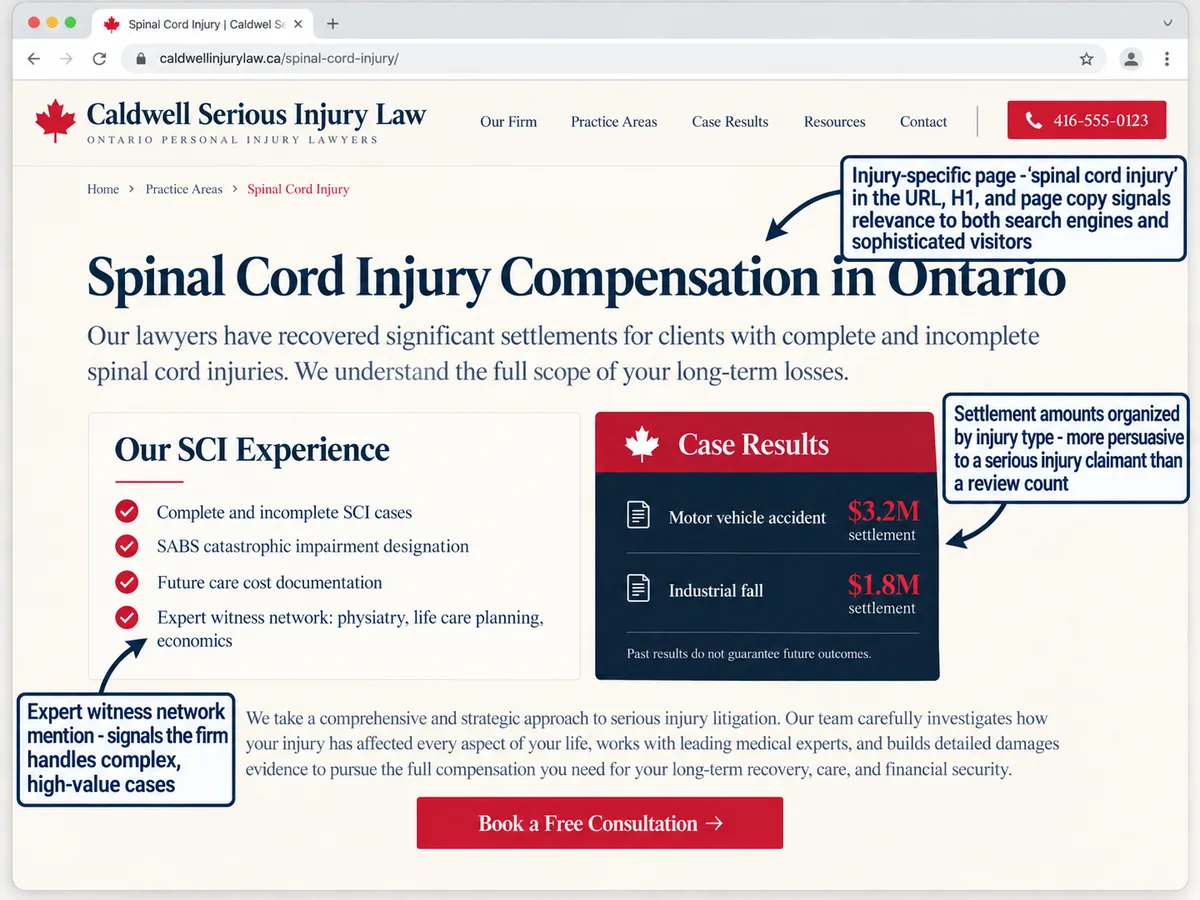
Ontario law firms can display settlement amounts without specifying client names or details. Organize case results by injury type (TBI, SCI, wrongful death, catastrophic motor vehicle accident) to make relevance immediately clear.
Note: Law Society of Ontario rules require that results not be misleading or guarantee outcomes. Use accurate language ("this case settled for" rather than "we won") and include appropriate disclaimers about case outcomes depending on individual circumstances.
Lawyer Profiles
Serious injury cases require experienced trial counsel. Lawyer profiles that emphasize trial experience, specific injury categories handled, expert witness relationships, and significant case outcomes communicate to both clients and referrers that the firm is capable of serious litigation.
Generic bios ("John Smith is a dedicated personal injury lawyer who cares about his clients") don't attract complex cases. Specific, experience-forward profiles do.
Expert Witness Network
Major serious injury claims are won or lost on expert testimony, the quality of the neuropsychologist who assesses cognitive impairment, the economist who calculates loss of competitive advantage, the life care planner who documents future costs. A firm profile or content that references working with the leading experts in these fields signals sophistication to sophisticated clients.
Advertising for Serious Injury Cases
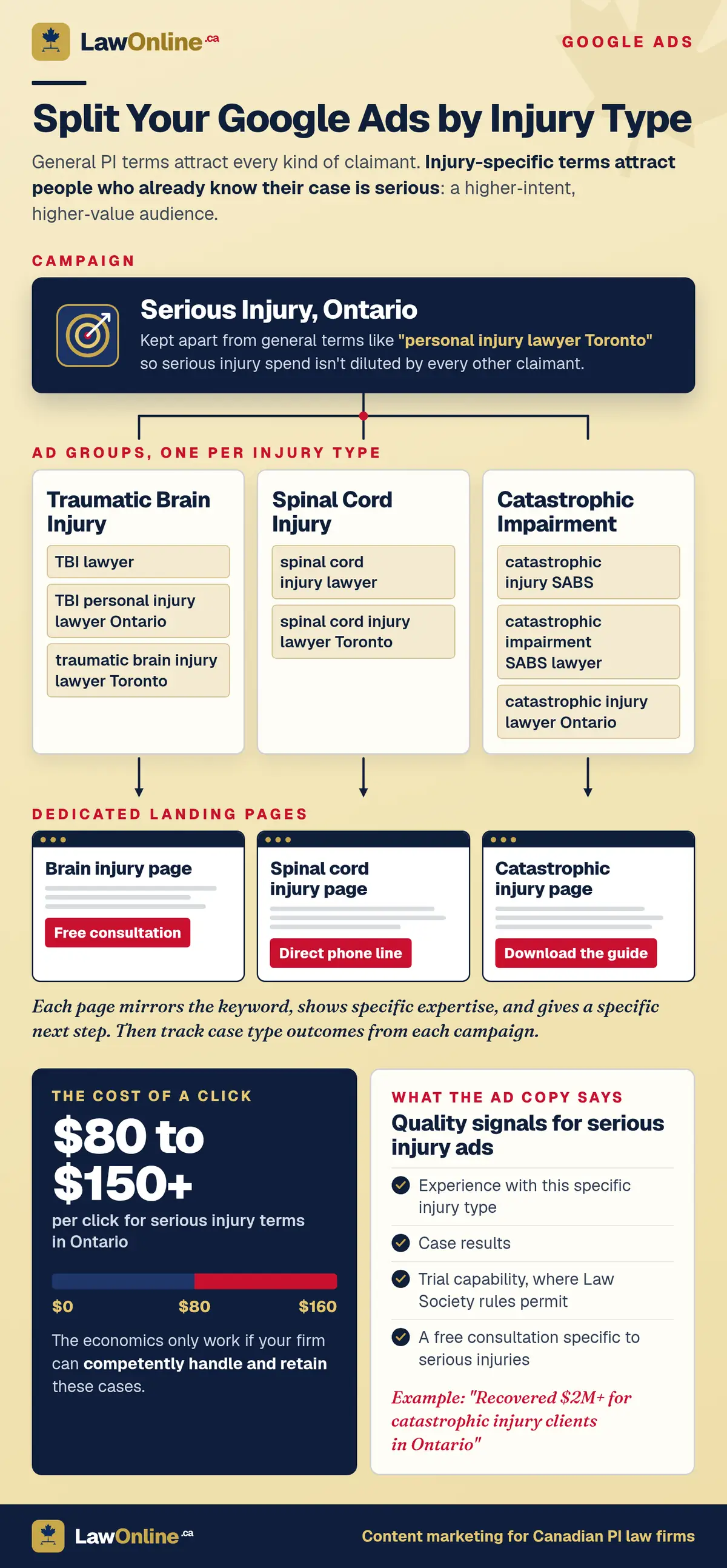
Paid search for serious injury keywords is viable but expensive. Terms like "traumatic brain injury lawyer Toronto" or "catastrophic injury lawyer Ontario" have CPCs of $80 to $150 or higher. The economics only work if your firm can competently handle and retain these cases.
Keyword Strategy
Separate your Google Ads campaigns by injury type. General PI terms ("personal injury lawyer Toronto") attract all types of claimants. Injury-specific terms ("TBI lawyer," "spinal cord injury lawyer," "catastrophic injury SABS") attract people who already know their injury type is serious, a much higher-intent, higher-value audience.
Create dedicated landing pages for each injury type that mirror the keyword intent, demonstrate specific expertise, and provide specific calls to action (a consultation form, a direct phone line, a download of an injury-specific guide). Our practice area page copywriting guide covers the structure that makes these pages rank and convert.
Quality Signals in Ads
Ad copy for serious injury should emphasize:
- Experience with this specific injury type
- Case results (e.g., "Recovered $2M+ for catastrophic injury clients in Ontario")
- Trial capability (if applicable and permitted under Law Society rules)
- Free consultation specific to serious injuries
Avoid generic PI advertising language in ads targeting serious injury keywords, it signals that your firm isn't specialized and reduces the conversion rate of expensive clicks.
Intake Process for Serious Cases
Serious injury claimants and their families are under enormous stress. They may be calling on behalf of a spouse in hospital or a child who has suffered a brain injury. The intake experience must reflect the gravity of the situation.

Key intake considerations for serious cases:
- First-call experience matters. Whoever answers should be empathetic, unhurried, and clearly knowledgeable about serious injury claims. A rushed or generic intake script is immediately disqualifying.
- Offer to come to them. For catastrophic claimants who can't travel, offering a hospital or home visit signals commitment.
- Don't screen by case value at first contact. Claimants often don't yet know the full scope of their case. Screen on facts, not perceived value.
- Speed matters less than competence signals. A minor injury client cares most about how quickly you respond. A catastrophic injury claimant cares more about whether your firm is the right firm. Take time to demonstrate that fit.
Measuring Whether Your Approach Is Working
Attracting higher-value cases is a longer-term marketing effort than generating volume. Track:
- Average case value by referral source, are medical referrals generating higher-value files than paid search?
- Case type mix over time, is the proportion of serious injury files increasing?
- Content performance, are injury-specific pages attracting traffic for relevant queries?
- Referral relationship activity, how many active medical referral relationships does the firm have, and are they generating referrals?
These metrics take six to twelve months to show meaningful trends. Firms that expect immediate results from positioning changes will stop before the strategy has time to work.
What Not to Do
Don't abandon minor cases entirely. Volume cases provide cash flow and staff development opportunities. The goal is to shift the mix, not eliminate an entire category.
Don't exaggerate case results. Law Society rules and client trust both require accurate representation of outcomes. Firms that inflate results lose credibility with the sophisticated audience they're trying to attract.
Don't confuse advertising with referral development. Ads can generate awareness and some serious injury leads, but the medical referral network is the dominant channel for catastrophic cases. Advertising alone won't solve the positioning challenge.
Don't neglect intake. The best marketing in the world produces nothing if your intake process loses serious injury leads because it was designed for quick-turn minor claims.
Getting Started: A Personal Injury Law Firm Marketing Plan
This personal injury lawyer marketing plan gives firms a practical starting sequence for shifting toward higher-value serious injury cases:
- Audit your website positioning. Does your homepage, lawyer bio, and practice area page signal serious injury expertise? If not, update those pages first.
- Add injury-specific content. Write two or three detailed guides for the injury types you handle most. Publish them, index them, and promote them through LinkedIn.
- Identify three to five medical referral relationships to develop. Start with professionals you already know or have worked with. Be methodical and patient.
- Separate your PPC campaigns by injury type. Create specific injury-type ad groups with dedicated landing pages. Track case type outcomes from each campaign.
- Refine your intake process for serious cases. Train the person who answers the phone. Create a separate intake form or flow for serious injury inquiries.
The shift from a high-volume minor injury practice to a practice that attracts and retains serious and catastrophic cases doesn't happen overnight, and it builds on the same strategic foundation described in our personal injury law firm marketing guide. Firms that do it consistently build significant competitive advantage, because the majority of their competitors are still competing on volume.
LawOnline.ca helps Canadian personal injury law firms build marketing systems that attract the right cases, not just more cases. Contact us to discuss your firm's positioning and growth strategy.