
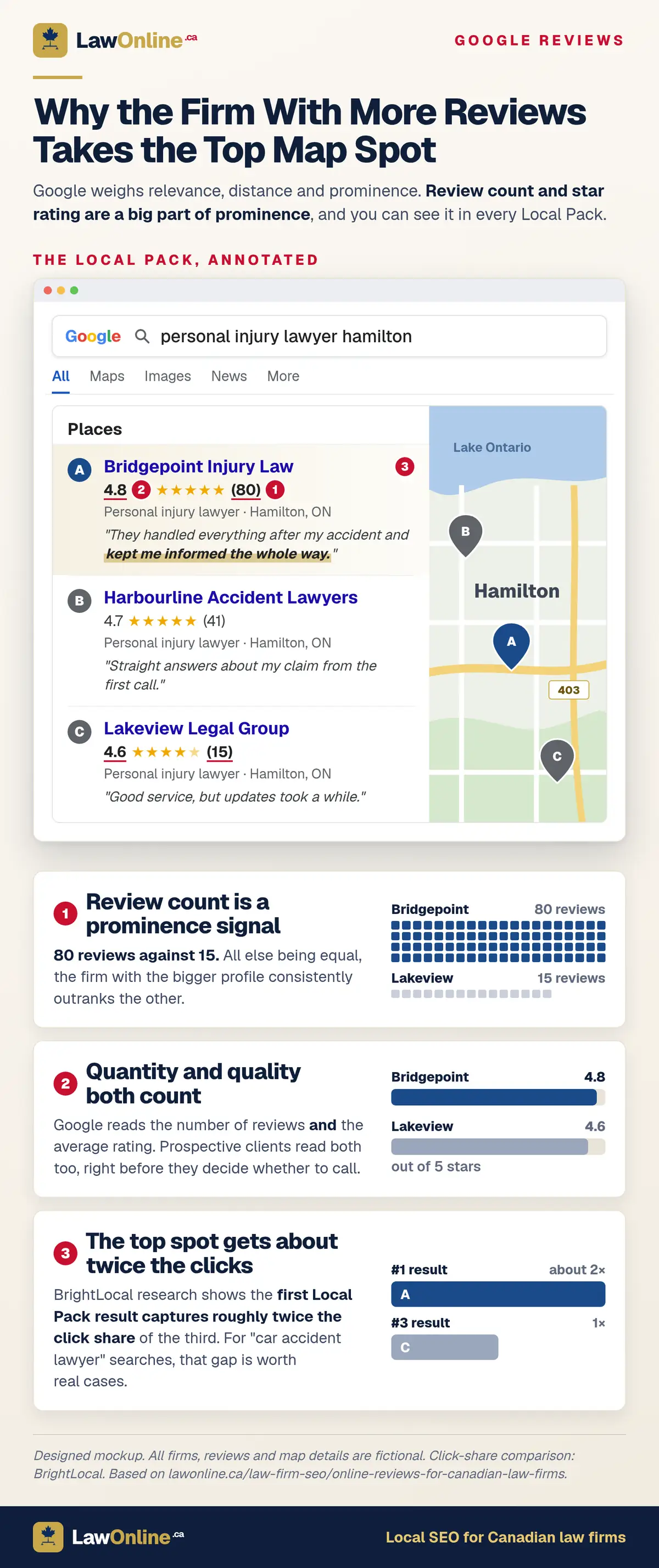
If you search "personal injury lawyer Hamilton" right now, the three firms that appear in the Local Pack, the map-based results at the top of the page, almost certainly have more Google reviews than the firms that appear below them.
This isn't coincidence. Google's local ranking algorithm uses review count and average rating as explicit signals. A firm with 80 reviews at 4.8 stars will consistently outrank a firm with 15 reviews at 4.6 stars, all else being equal. Reviews are also the first thing prospective clients look at when deciding whether to call. They're social proof at the moment of highest intent.
Most Canadian law firms treat lawyer reviews as something that happens organically. A grateful client occasionally leaves one. That approach loses to firms with a system.
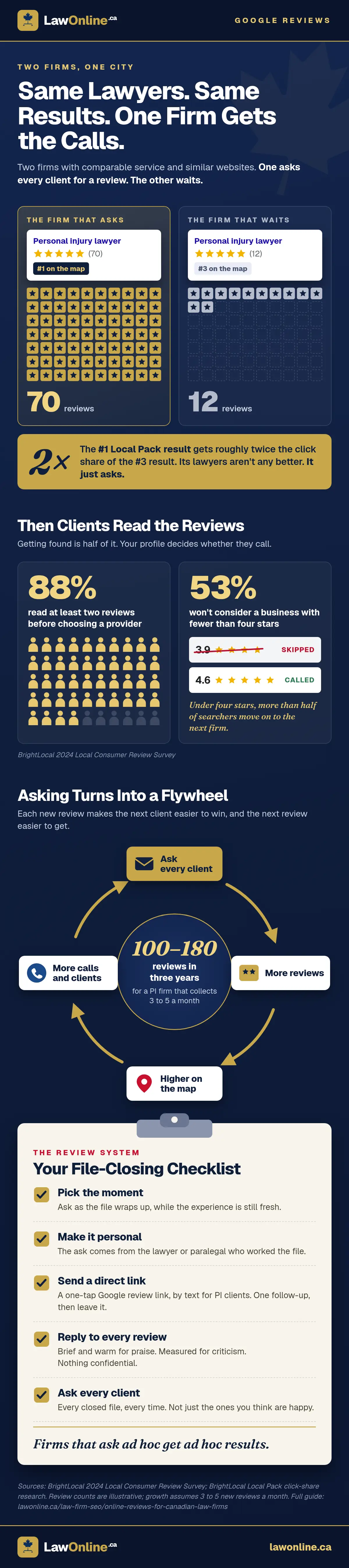
It's a common pattern: Two firms offer comparable service and results and have similar websites, but one has 70 Google reviews and the other has 12, so the first firm gets more calls even though its lawyers aren't any better. The only difference is that the first firm actively requests reviews, while the second one doesn't.
This guide covers how to build a review acquisition program that's systematic, compliant with professional conduct rules, and effective.
Why Reviews Matter More Than Most Lawyers Think
The data on this is Canadian, recent, and unambiguous. A 2025 national survey by the Retail Council of Canada and Caddle found that 86% of more than 2,000 Canadian shoppers consider ratings and reviews essential to their purchase decisions. Reviews ranked as the second most influential purchase factor, tied with personal recommendations from friends and family, behind only price. That survey covers all consumer categories, not just legal, but the implications are strongest for high-stakes purchases: 96% of respondents said they read more reviews as the price goes up. Legal services are exactly that kind of decision.
Reviews and Local Search Rankings
Google's local search algorithm weighs three primary factors: relevance, distance, and prominence. Review quantity and quality are major components of prominence, alongside the other signals covered in our guide to local SEO for Canadian law firms. A firm that actively collects and responds to reviews will consistently outperform firms that don't, regardless of how long they've been in practice or how well-designed their website is.
For personal injury firms, where "car accident lawyer [city]" queries carry enormous commercial value, the difference between ranking #1 and #3 in the Local Pack isn't trivial. Research from BrightLocal shows that the first Local Pack result captures roughly twice the click share of the third result. It's one reason reviews sit near the top of any plan for SEO for personal injury lawyers.
Reviews and Conversion Rate
Once a prospective client clicks on your firm's listing, your review profile heavily influences whether they call, a pattern we cover in more depth in how clients find and choose lawyers in Canada. Bright Local's 2024 Local Consumer Review Survey found that 88% of consumers read at least two reviews before choosing a service provider, and 53% won't consider a business with fewer than four stars. The same Retail Council of Canada study found that 79% of Canadian shoppers trust star ratings more when written reviews accompany them, and nearly half look for reviews posted within the previous month. A high star average alone isn't enough.
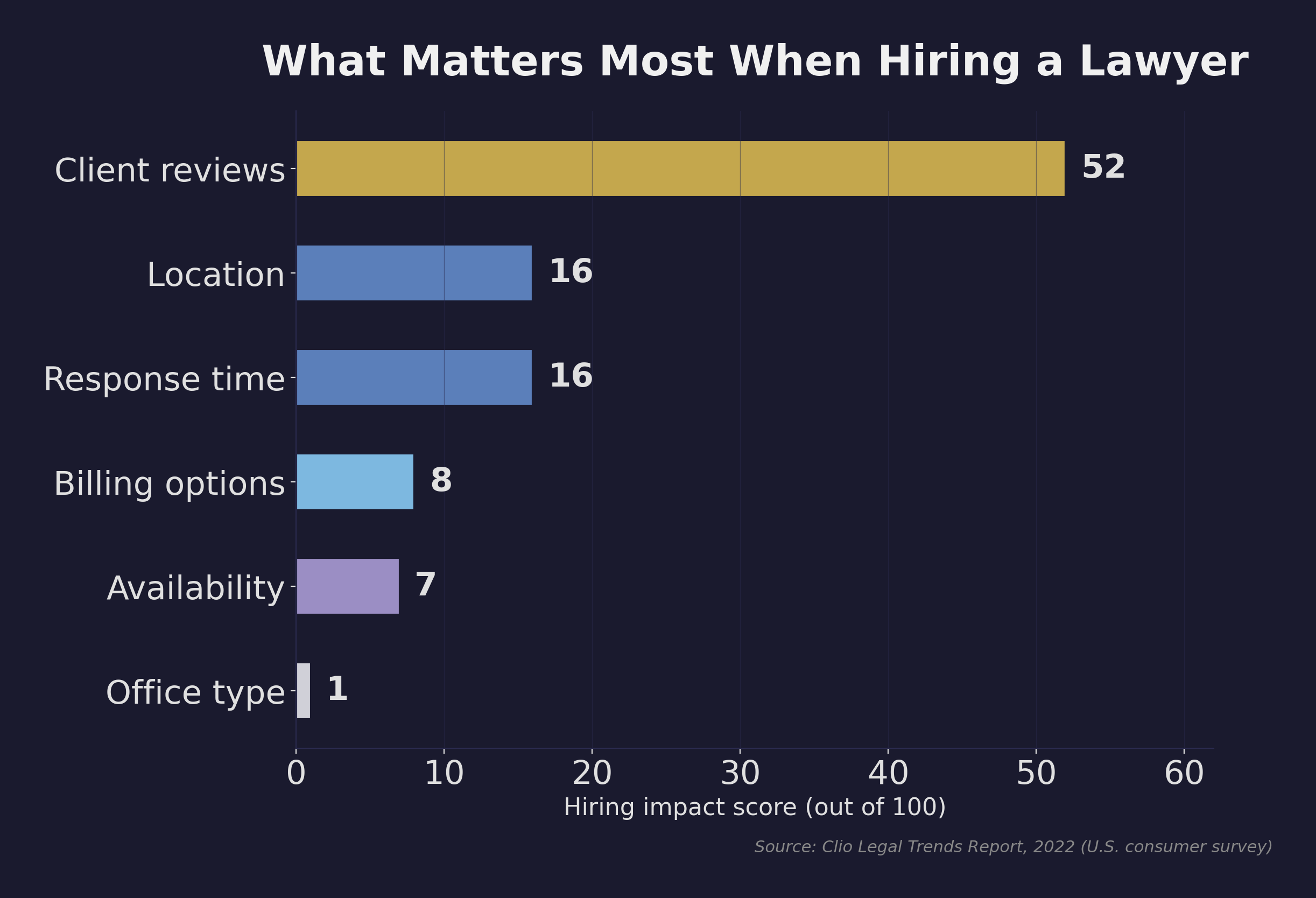
The legal-specific data is just as striking. Clio's 2022 Legal Trends Report surveyed 1,168 US consumers and used statistical analysis to determine which attributes most influenced lawyer-hiring decisions. Client reviews scored 52 out of 100 on the hiring impact scale, more than three times higher than the next factors (location and response time, each at 16). No equivalent Canadian legal-consumer study exists, but the finding offers a useful benchmark: when people choose a lawyer, reviews carry more weight than where the office is, how fast the firm responds, billing options, and availability combined.
For personal injury clients, this effect is amplified. These are people who are often vulnerable, injured, stressed, uncertain about the legal process, and they're putting a significant decision in your hands. They will read your reviews carefully. A profile with 60 detailed, positive reviews carries substantially more trust than one with 8.
Where Reviews Live
Google Business Profile is by far the most important platform. Google Business Profile reviews feed directly into local search rankings and appear prominently in search results, the Local Pack, and Google Maps. If you're going to focus your energy anywhere, it's here.
Facebook reviews matter for firms that use Facebook advertising or have a strong Facebook presence. They're less directly tied to search rankings.
Yelp sees lighter use in Canada than in the US for legal services. Worth having a claimed, complete profile, but not worth significant effort to collect reviews there.
Law Society Compliance: What You Can and Can't Do
Before building a review program, understand the rules. Law Society conduct guidelines across Canadian provinces prohibit testimonials that could mislead prospective clients. The specifics vary by province (our guide to Ontario's lawyer advertising rules covers testimonials and reviews), so confirm your local Law Society's current guidance, but the general principles are consistent:
- You can ask clients to share their own experience. Requesting a review isn't a testimonial endorsement in the sense regulated by most conduct rules.
- You can't offer anything of value in exchange for a review. No gift cards, no fee discounts, no reciprocal services.
- You can't coach specific language. Asking a client for an honest review is fine. Drafting a review for them to post is not.
- You can't ask only the happy clients. Google's review policy prohibits selectively soliciting positive reviews. That rules out "if you're happy with our service" wording, and it rules out review gating, where satisfied clients get the Google link and unhappy ones get a private feedback form. Google can remove reviews collected this way.
- You cannot post fabricated or misleading reviews. This is both a conduct issue and a violation of platform terms.
The safest and most effective approach, asking every client for an honest review in their own words, is entirely permitted under virtually every provincial Law Society's guidelines.
Negative reviews have a legal side, too. Law Society of Ontario continuing legal education materials on defamation treat negative online reviews, including Google reviews, as a source of legal and professional risk for lawyers. Suing the reviewer is usually a poor option. In Ontario, a review of a professional's services generally counts as expression on a matter of public interest, so the reviewer can use the province's anti-SLAPP law (section 137.1 of the Courts of Justice Act) to ask the court to dismiss the claim early. If that motion succeeds, the lawyer is normally ordered to pay the reviewer's full legal costs. That leaves two better responses: reply calmly, without confirming the person was a client or revealing anything confidential, and build a review profile strong enough that one critical review doesn't define your firm.
Building a Review Acquisition System
Step 1: Identify the Right Moment to Ask
Timing matters. The best time to ask is when the matter wraps up, while the experience is still fresh. Make the ask a standard step in closing every file, not something you save for the clients you think are pleased.
For personal injury firms: ask when the settlement is confirmed or when the file is about to close. The client is relieved, often grateful, and the experience is fresh. Don't wait months, by then, the emotional peak has passed and the client has moved on.
For family law firms: this is more delicate, since matters often end without a clear "win." Ask when the file closes, regardless of outcome. Clients often rate how the process was handled, not just the result.
For wills and estates: ask immediately after a completed signing appointment. The interaction is typically positive and the client feels a sense of accomplishment.
For real estate law: ask after the close of a purchase or sale, when the client is in a good mood. The turnaround is quick and the reviews can follow the same rhythm as your transaction volume.
Step 2: How to Ask Clients for Google Reviews
A generic "please leave us a review" email that goes to every closed file performs poorly. A personal request, from the lawyer or paralegal who worked on the file, performs significantly better.
The most effective message is brief, direct, and explains why the review matters:
"Hi [Client name], it was a pleasure working with you on your claim. If you have two minutes, I'd really appreciate an honest review of your experience on Google. Reviews help other injured people in [city] find us when they need help. Here's the direct link: [link]."
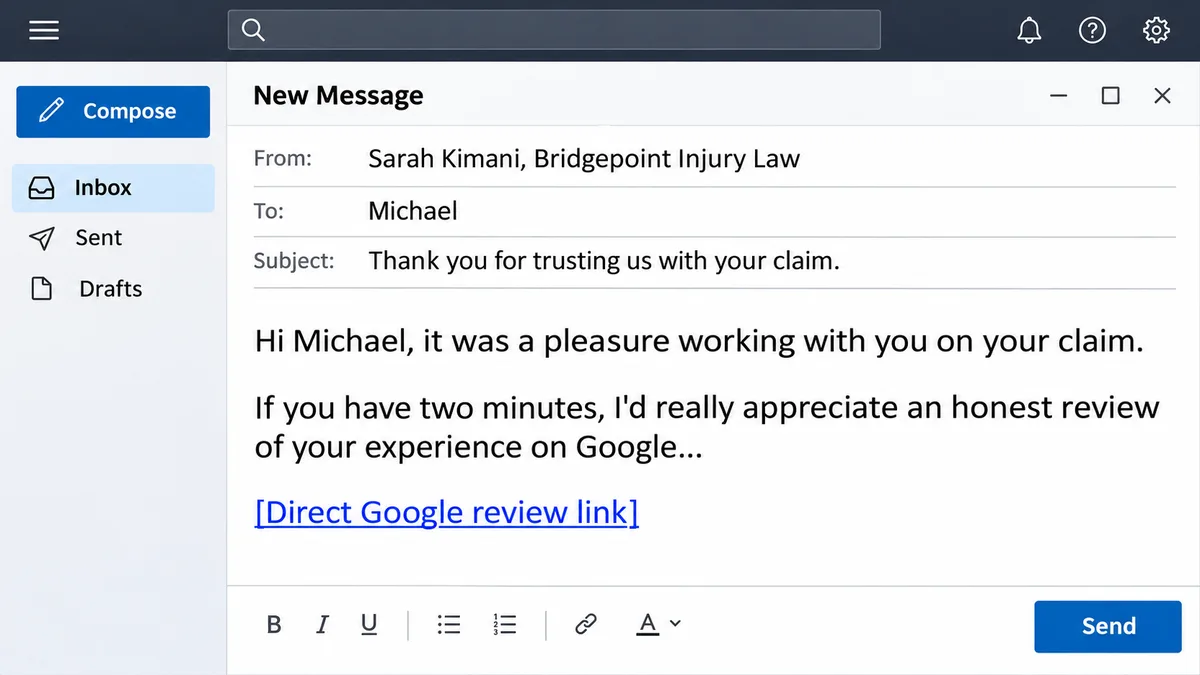
That's it. No scripts, no multi-paragraph request. A direct, human ask from someone the client knows.
For personal injury firms with high file volume, this can be semi-automated through your CRM or case management system, trigger an email when a file status changes to "closed/settled" and pull in the client name and lawyer name as variables.
Step 3: Remove Friction
Every step between "I'd be happy to leave a review" and the review actually appearing is an opportunity for the client to drop off. Make it as easy as possible:
Create a Google review link. In your Google Business Profile manager, you can generate a short URL that takes the client directly to the review dialog, no searching for your firm, no navigating through the listing. This Google review link is what you include in every email and text message. If you can't find it in the dashboard, search for your firm in Google, click "Ask for reviews" on your Business Profile, and copy the link from there.
Print a Google review QR code. Generate a QR code from your Google review link (any free QR code generator works) and print it on your closing letters, appointment follow-up cards, or reception desk signage. For personal injury firms that handle files over months, a QR code on the final letter catches clients at the exact moment they're most willing to write something.
Send the link over text if appropriate. For personal injury clients, a brief text message at file close often gets higher response rates than email. Keep it identical in tone to the email example above, personal, short, with the direct link.
Don't ask through too many channels at once. Sending an email and two follow-up text reminders within the same week is aggressive and will feel intrusive. One initial ask, one follow-up a week later if no review appears, then leave it.
Step 4: Respond to Every Review
Responding to reviews signals to Google that your profile is active and managed, which modestly improves ranking. More importantly, it signals to prospective clients reading your reviews that your firm is responsive and professional.
How to Respond to Positive Google Reviews
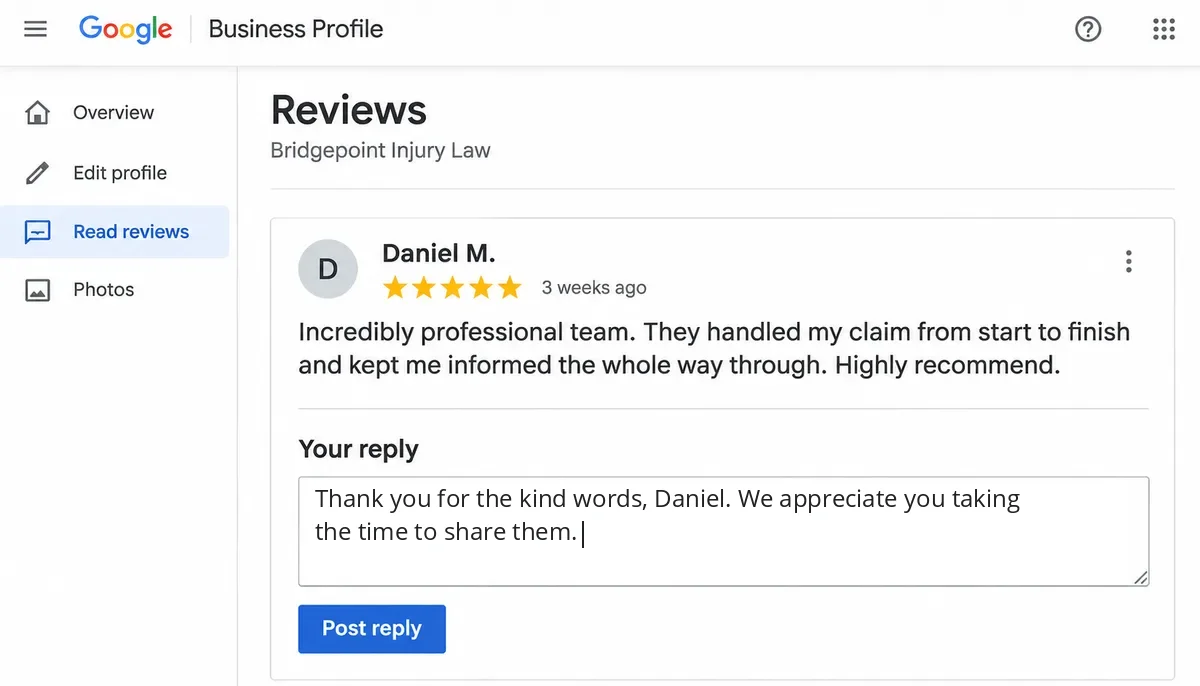
Keep responses brief and personal. Don't copy-paste the same response to every review, that's obvious and looks mechanical.
"Thank you for the kind words, [Name]. We appreciate you taking the time to share them."
Don't confirm the reviewer was a client or mention anything about their matter. Your confidentiality duty covers even the fact that someone retained you.
How to Respond to Negative Google Reviews
Negative reviews are uncomfortable, but how you handle them is watched closely by prospective clients. A measured, professional response to a critical review often increases trust, it shows you take feedback seriously.
What not to do: argue with the reviewer, reveal private details to refute their account, or threaten legal action. These responses backfire badly in public forums.
A simple, professional response to a critical review:
"Thank you for your feedback. We're sorry to hear your experience didn't meet your expectations. We take client satisfaction seriously and invite you to contact us directly so we can understand what happened."
If the review is defamatory or clearly fake, report it to Google for removal rather than engaging publicly.
It's also worth noting that a few negative reviews aren't the disaster most firms think they are. The Retail Council of Canada survey found that 95% of Canadian shoppers actively look for at least a few negative reviews before committing to a purchase, and 62% grow suspicious when a business has a flawless five-star score. A profile with 70 reviews, a 4.7-star average, and two thoughtfully handled critical reviews looks more credible than a profile with 15 reviews and a perfect 5.0.
Step 5: Build It Into Your Practice Culture
The difference between firms with 10 reviews and firms with 80 reviews is almost never about the quality of service. It's about whether asking is a consistent part of how the firm closes files.
The data from inside the legal profession confirms this gap. A 2024 Thomson Reuters survey of 330 Canadian lawyers found that 93% include firm reputation in their definition of success and 92% include client satisfaction ratings. But when asked what they actually track, only 50% measure reputation and just 46% measure client satisfaction. Most firms say reputation matters enormously and then do nothing structured to build or monitor it. A systematic review program closes that gap.
Personal injury firms that consistently collect 3–5 new reviews per month will have 36–60 new reviews per year. Over three years, that's 100–180 reviews. That kind of accumulation compounds, more reviews means better rankings, better rankings means more clients, more clients means more reviews.
Firms that ask ad hoc get ad hoc results.
This is one of the simplest competitive advantages in legal marketing, and one of the most underused.
Platforms for Managing the Process
Birdeye and Grade.us are reputation management platforms designed specifically for this workflow, automated review requests, multi-platform tracking, and response management from a single dashboard. For firms with high file volume, these can be worth the subscription cost.
Clio Grow, the client intake component of Clio, includes review request functionality. If your firm is already on Clio, check whether this feature is part of your subscription.
For smaller firms or lower-volume practices, a simple system works fine: a review request email template, a direct Google review link, and a calendar reminder for your assistant to follow up one week after close.
What a Strong Review Profile Looks Like
For context on what to target:
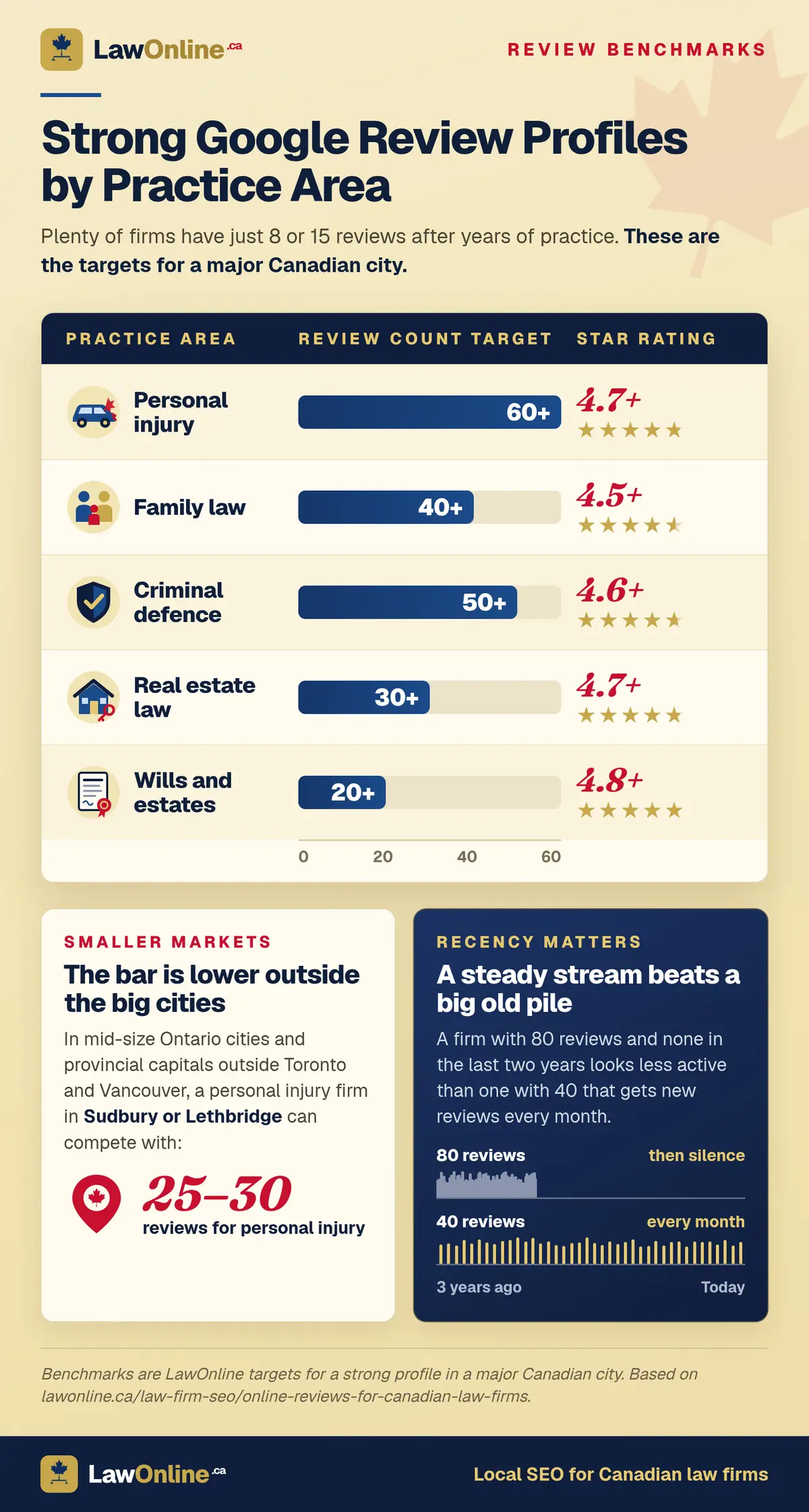
| Practice Area | Strong Review Profile (Major Canadian City) |
|---|---|
| Personal injury | 60+ reviews, 4.7+ stars |
| Family law | 40+ reviews, 4.5+ stars |
| Criminal defence | 50+ reviews, 4.6+ stars |
| Real estate law | 30+ reviews, 4.7+ stars |
| Wills and estates | 20+ reviews, 4.8+ stars |
In smaller markets, mid-size Ontario cities, provincial capitals outside Toronto and Vancouver, the threshold is lower. A personal injury firm in Sudbury or Lethbridge can compete effectively with 25–30 reviews.
Recency matters too. The Retail Council of Canada survey found that 49% of Canadian shoppers specifically look for reviews posted within the past month, so a stale profile is almost as bad as a thin one. A firm with 80 reviews whose most recent one is two years old looks less active than a firm with 40 reviews and a steady stream of new ones every month. Aim for consistency over bursts.
The Competitive Advantage
Most law firms in most Canadian markets aren't actively managing their Google reviews. They may have 8 or 15 lawyer reviews accumulated over years of practice. A firm that systematically collects reviews, asking every client, responding to every review, building a profile that grows month over month, will develop a significant and durable competitive advantage in local search.
That advantage is difficult for competitors to replicate quickly. You can't shortcut a year of consistent review collection. Firms that start now and stay consistent will own that advantage for years.
LawOnline.ca helps Canadian law firms build review acquisition systems as part of our law firm SEO services, and responses to your Google reviews are part of our Google Business Profile management for law firms. Contact us to learn how.