Ask a lawyer how clients find them and you'll usually hear one of two answers: referrals or Google. Both are partially right. Neither tells the full story, and the gap between perception and reality is where most law firm marketing goes wrong.
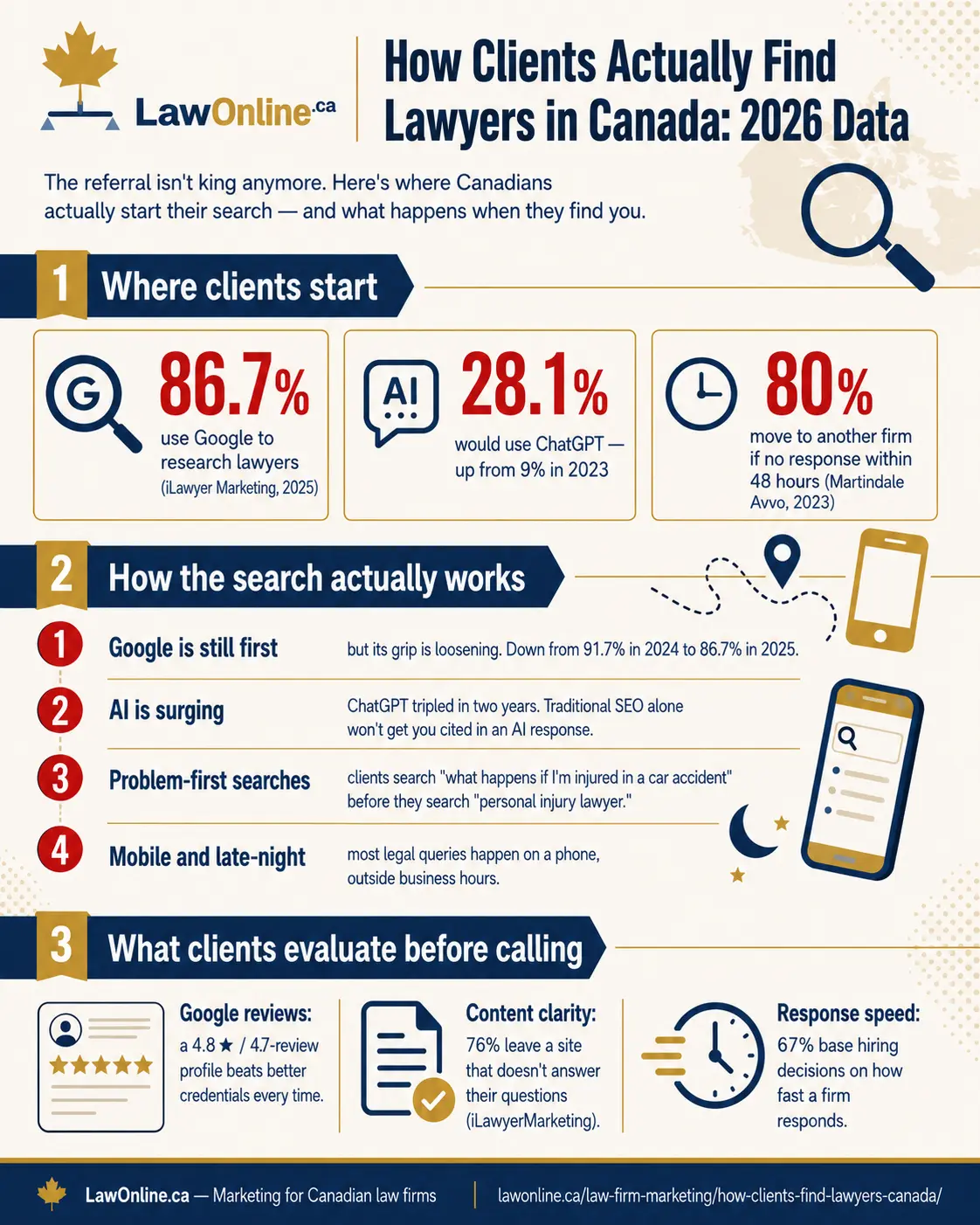
In 2026, the path most Canadian clients take to a lawyer starts with a Google search, not a phone call to a friend. A 2025 consumer survey found that 86.7% of people would use Google to research lawyers when facing a legal issue. That number has been consistent for years. What hasn't been consistent is everything else. ChatGPT, social media, AI search summaries, and a dozen other channels are reshaping how people find and evaluate legal help. Canadian firms that still think in terms of "Google versus referrals" are missing the bigger picture.
This post breaks down what the data shows about how people find legal help, why the conventional wisdom only gets it half right, and what it means for how your firm should be positioning itself.
Is the Referral Still King?
Do referrals still work for law firms? Yes, they still happen, and they're still valuable. But they aren't the dominant source of new business that many lawyers believe them to be.
According to a MyCase benchmark report, the top three lead sources for law firms are Google, the firm's website, and client referrals, in that order. Referrals come third, not first. While this data comes from US firms, the pattern holds in Canada as well. The Canadian Bar Association and various provincial legal aid studies have consistently found that the majority of Canadians who need a lawyer start their search online rather than asking a friend or family member.
Provincial law societies like the Law Society of Ontario operate their own lawyer referral services precisely because so many people don't have a personal connection to a lawyer. This holds especially true for people facing a legal issue for the first time. The average Canadian hires a lawyer once or twice in their lifetime outside of real estate transactions. They don't have a rolodex of trusted legal contacts.

A US study by CallRail found that 91% of law firms rely on repeat clients for business. That speaks to how many firms haven't built a reliable engine for attracting new clients at all. Referrals and repeat business are passive. You can't scale them. You can't target them. A firm that relies entirely on referrals has outsourced its growth to chance.
The firms that grow consistently show up when someone who doesn't know any lawyers goes looking for one.
How Canadians Actually Search for a Lawyer
The way people search for lawyers doesn't look like what most firms expect. It doesn't start with "best lawyer in Toronto" or "top criminal defence firm." And increasingly, it doesn't even start on Google.
Google still dominates, but the landscape is shifting
A 2025 survey of 1,052 US consumers by iLawyer Marketing found that 86.7% would use Google to research lawyers for an important legal issue. That's down from 91.7% in 2024 and 90% in 2023. Google is still the default starting point, but its grip is loosening. Canadian search behaviour tracks closely given similar internet usage patterns and digital infrastructure.
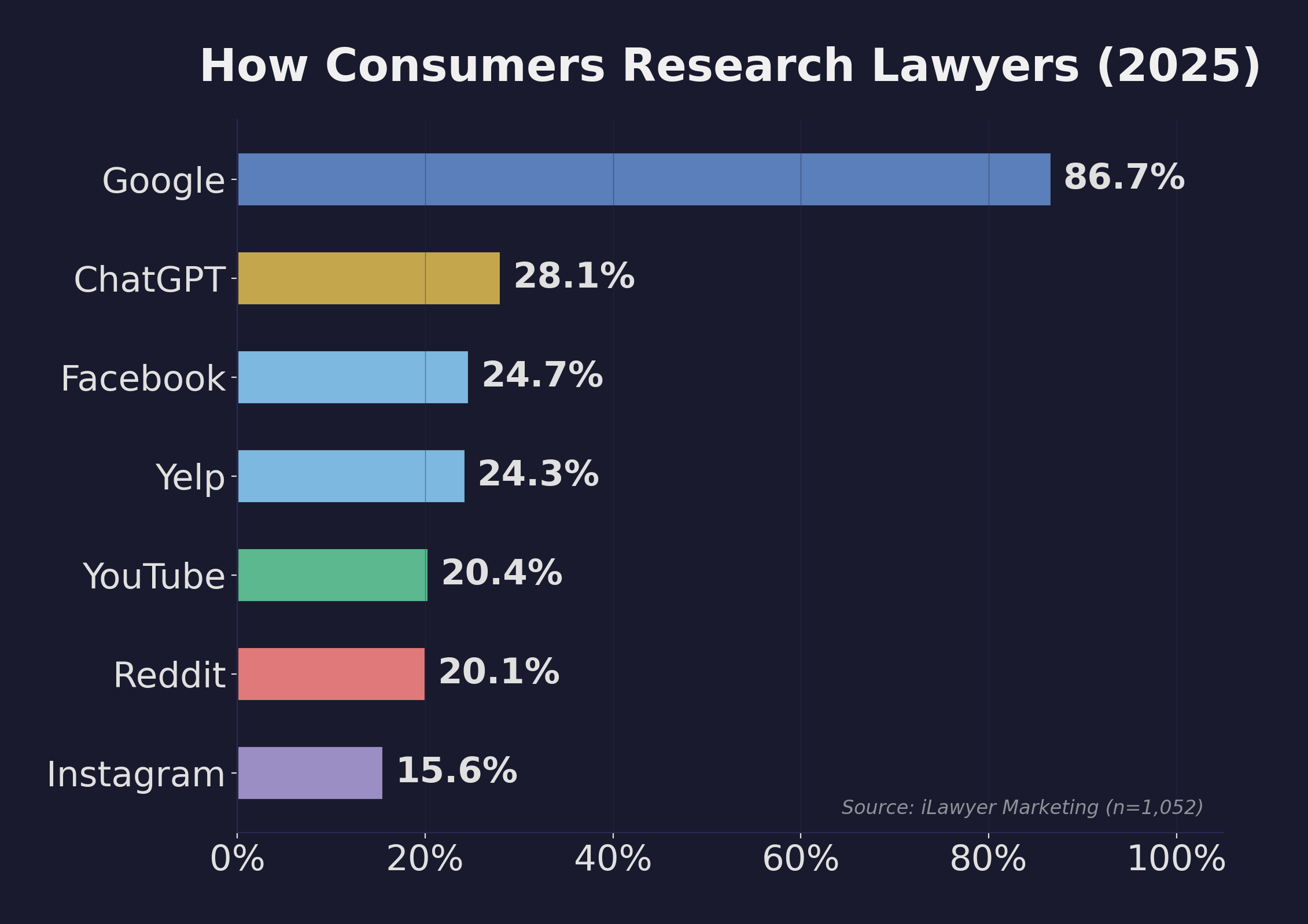
The rest of the top platforms tell an interesting story. Facebook (24.7%), Yelp (24.3%), and YouTube (20.4%) round out the top five. Reddit sits at 20.1% and Instagram at 15.6%. These aren't small numbers. One in four potential clients checks social media and review platforms before ever contacting a firm.
For Canadian firms, swap Yelp for Google Reviews and legal directories as the primary review platforms. The underlying behaviour is the same: people check what others have said about you before they reach out.
A separate industry report cites that 96% of people seeking legal help start with a search engine and over one-third research online before contacting any lawyer (Andava Legal Marketing Report, 2025). That reinforces the same point: if you're not visible online, you don't exist to most potential clients.
ChatGPT and AI are changing the game
The most dramatic shift in the 2025 data is ChatGPT. It's now the second most-used platform for researching lawyers, with 28.1% of consumers reporting they'd use it. That's up from 20.5% in 2024 and just 9% in 2023. It tripled in two years.
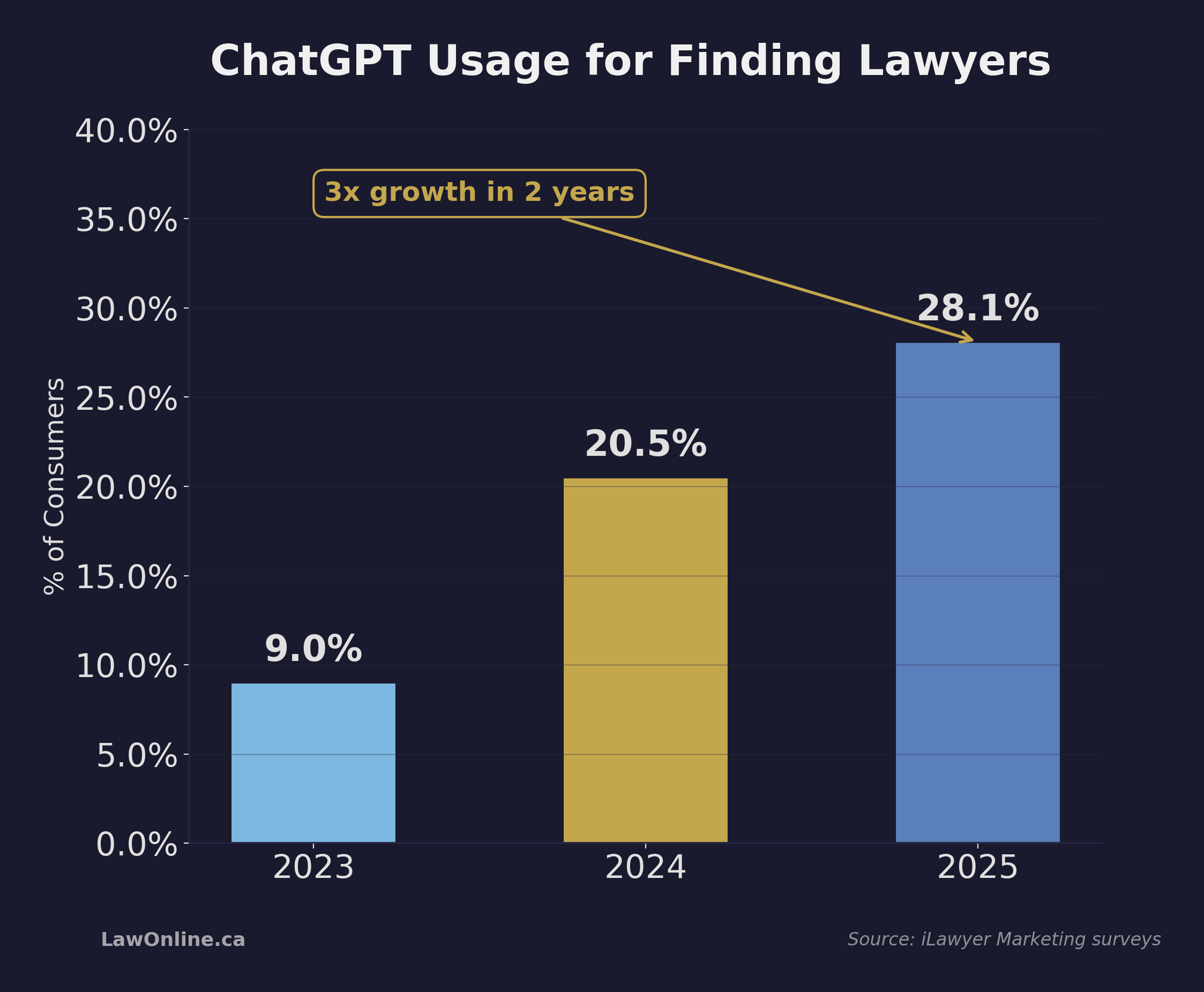
This isn't a novelty anymore. Nearly three in ten people are asking AI for lawyer recommendations. And the way AI surfaces results is fundamentally different from Google. According to Best Lawyers, AI platforms prioritize peer-reviewed recognition, third-party validation, and structured data over keywords. Traditional SEO tactics alone won't get you cited in an AI response.
There's a compounding problem. About 60% of Google searches now end without a click, thanks to AI-generated summaries providing direct answers (Best Lawyers, 2025). Gartner predicts a 25% decline in traditional search engine volume by 2026. Sites that appear below AI summaries lose up to 79% of their traffic.
For Canadian law firms, this means two things. Your Google presence still matters enormously, but you need to optimize for AI readability alongside traditional SEO. And being mentioned in AI responses requires strong third-party signals: directory listings, reviews, published credentials, and structured website data. As we explored in Law360 Canada, this shift is creating a genuine visibility gap that many firms haven't recognized yet.
Problem-first searches
Someone who slipped on an icy sidewalk outside a store doesn't type "personal injury lawyer." They type "can I sue if I fell on ice in Ontario" or "who pays my medical bills after a slip and fall." Someone who was rear-ended at a red light searches "what to do after a car accident that wasn't my fault" before they ever look for a specific lawyer. A person dealing with a workplace injury types "can I get compensation for a back injury at work in Canada."
It's the same across other practice areas. Someone served with divorce papers searches "how long does a divorce take in Canada" before "family lawyer near me." Someone facing criminal charges types "what happens if I get charged with assault in Ontario."
These are informational queries. The person isn't ready to hire yet. They're trying to understand their situation. But this is the moment where trust begins to form. The firm that answers their question clearly and accurately becomes the firm they call when they are ready.
Most law firm websites skip this entire stage of the funnel. They have a practice area page that says "we handle family law matters" and a contact form. That's it. No content that meets the person where they are.
Digital directories still drive traffic
Don't overlook directories. According to CallRail data from a US survey, 41% of law firms receive traffic from clients using digital legal professional directories. In Canada, that means platforms like the Law Society referral services, CanLII lawyer profiles, the LawOnline Canadian Lawyer Directory, and other provincial legal directory listings.
For firms just getting started with marketing, claiming and completing directory profiles is one of the fastest ways to gain visibility. Low effort, real returns.
Location-based urgency
When someone is ready to hire, the search gets local fast. "Personal injury lawyer Brampton," "car accident lawyer Mississauga," "slip and fall lawyer Ottawa." These are high-intent, high-conversion queries. The person typing them has already decided they need a lawyer and is now choosing which one.
Google treats these as local searches. It shows the map pack, Google Business Profile listings, and locally relevant organic results. If your firm doesn't have a complete, well-optimized Google Business Profile, you're invisible for these searches regardless of how good your website is.
Late-night and mobile searches dominate legal queries
Legal problems don't happen during business hours. Car accidents happen at 11 PM. Someone trips on broken pavement walking home from dinner and realizes the next morning their knee is seriously injured. Dog bites happen on weekend afternoons. Google data consistently shows that legal queries spike in the evening and overnight, and the vast majority come from mobile devices.
This has direct implications for your website. A site that loads slowly on mobile, has tiny text, requires pinching and zooming, or buries the phone number three clicks deep is losing clients to the competitor whose site works well on a phone at midnight.
We've covered why website speed matters more than most firms realize and it's especially relevant here. A potential client on their phone at 1 AM isn't going to wait four seconds for your homepage to load.
What Happens When They Find You?
Getting found is the first hurdle. What happens next determines whether that visibility turns into a client.
Response speed is everything
Here's a stat that should concern every managing partner: 80% of legal consumers will move to another firm if they don't receive a response within 48 hours (Martindale Avvo, 2023). A separate ALM Global study found that 67% of clients base their hiring decision on response speed. Both are US studies, but the impatience of online consumers is universal.
Think about what that means. Your firm could be at the top of Google, have excellent reviews, and a great website. If a potential client fills out your contact form on a Friday evening and doesn't hear back until Monday afternoon, there's a strong chance they've already called someone else.

US data from CallRail shows that 46% of clients first contact law firms by phone and 27% by email. In Canada, the pattern is similar. The implication: someone needs to be answering the phone or responding to inquiries quickly. Not just during office hours.
How many leads does it take to sign a client?
Most lawyers have no idea how many leads it takes to sign a new client. Here are the benchmarks.
MyCase's 2024 data from US firms shows that customized intake forms convert at about 17.6%, which is quite strong. By contrast, the legal sector averages just a 2.6% conversion rate for inbound calls (Ruler Analytics). Across all practice areas, US data from Martindale-Nolo found that law firms need an average of 13.4 leads to convert one new client.
For personal injury firms specifically, The National Law Review (2025) reports that signing 300 cases per month requires roughly 3,000 leads at a 10% conversion rate, with a PPC budget around $810,000 at a $2,700 cost per acquisition. That's the large-volume US market, but the math scales down proportionally. A solo PI firm in Ontario aiming for 5 new cases per month still needs 50 or more leads.
MyCase also tracked the full cycle: the average time from lead intake to first payment was 38 days across all practice areas in 2024. That lag between generating a lead and generating revenue is something firms need to account for when budgeting.
These numbers matter because they set realistic expectations. If your firm gets 50 leads per month and converts 4 of them, that's not a marketing failure. That's roughly in line with industry averages. But knowing the benchmarks helps you identify where to focus: do you need more leads, or do you need to convert a higher percentage of the ones you're already getting? If the answer is conversion, our website conversion optimization guide covers the specific changes that close that gap.
What Builds Trust When Choosing a Lawyer Online
Why Google reviews carry more weight than credentials
Lawyers tend to lead with their credentials. Called to the bar in 2004. Member of the Ontario Trial Lawyers Association. LLM from Osgoode. These matter to other lawyers. They matter much less to a 34-year-old who just got rear-ended on the 401 and needs to know if this lawyer is going to fight for them.
What that person looks at is reviews. Google reviews specifically. The number of reviews, the recency, and whether the lawyer actually responds to them. A personal injury firm with 47 Google reviews averaging 4.8 stars will consistently outperform a firm with better credentials but three reviews from 2021. For Canadian law firms, Google reviews are the single highest-leverage trust signal a prospective client evaluates.
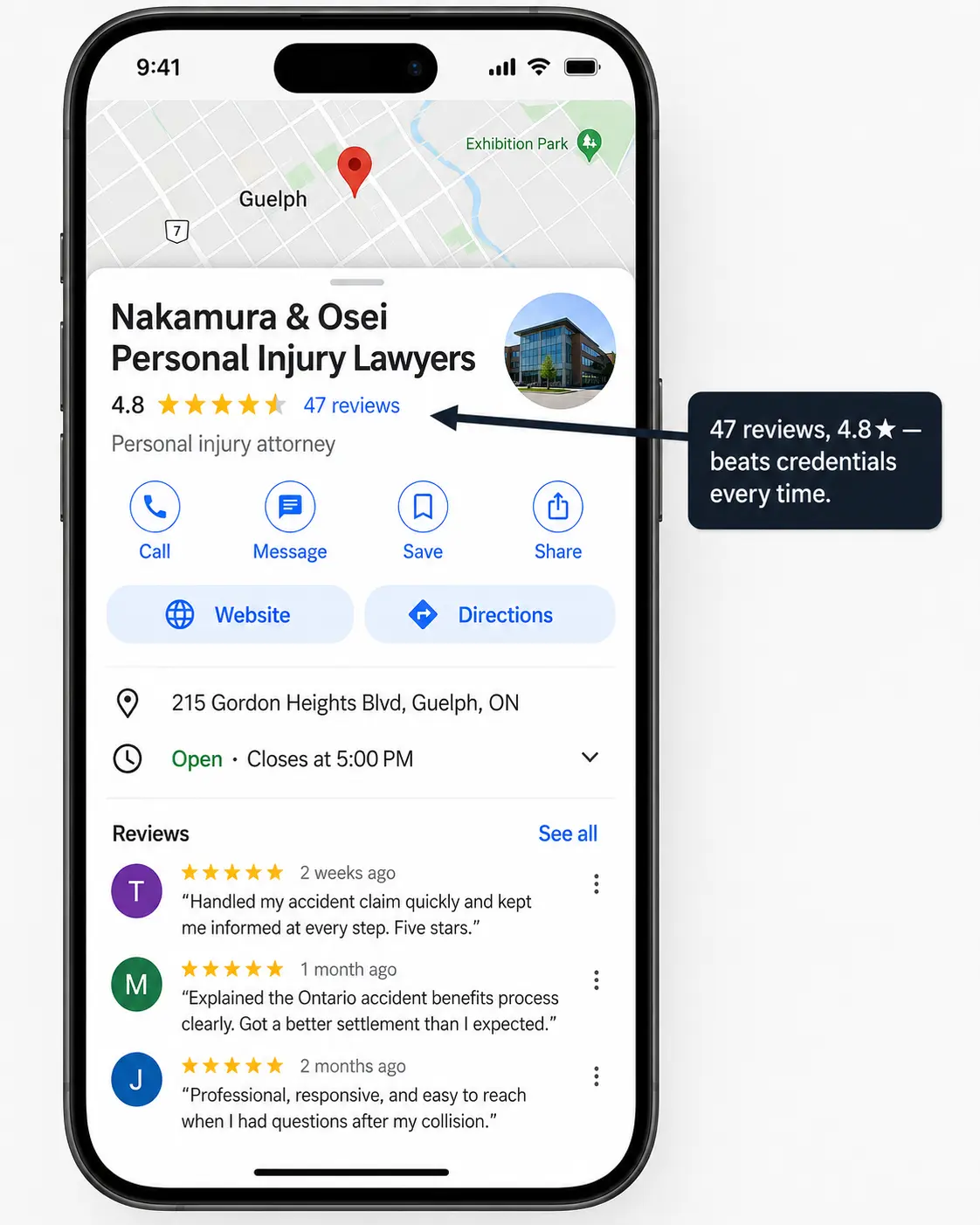
An IAALS analysis of over 2,200 client reviews confirms this pattern. The data shows that clients consistently value communication and accessibility over traditional legal skills when evaluating their experience with an attorney. This is US data from reviews compiled between 2007 and 2017, but the preference for responsiveness over pedigree is human nature, not geography.
Content clarity beats legal jargon
When a potential client lands on your website, they're evaluating whether you understand their problem. Not whether you can cite the relevant statute.
Here's a number that puts this in perspective: 76% of people say they'd leave a law firm website if it didn't provide enough information about the firm (iLawyerMarketing). That's three-quarters of your traffic bouncing because your site doesn't answer their questions.
Content that explains concepts clearly, uses plain language, and directly addresses what the person is worried about builds more trust than content stuffed with legal terminology. The firms that do this well see dramatically better engagement metrics, longer time on site, and higher conversion rates.
Among firms using websites to gather potential client information, an ABA survey found that 90% collect names, 73% collect phone numbers, but only 42% collect email addresses and 37% mailing addresses. That gap matters. If you're capturing names and phone numbers but not emails, you're missing a low-friction follow-up channel. (This is US data from the American Bar Association, but the intake form design principles apply regardless of jurisdiction.)
If your blog reads like every other law firm's blog, it's not doing the work it should be. We've written about why generic legal content fails and what to do instead.
On the topic of blogging: an ABA survey (2023) found that 53% of lawyers who maintain blogs gained clients directly or through referrals from the blog. That's a majority return on a channel many firms treat as an afterthought. Similarly, 31% of lawyers reported retaining a client directly through social media activity. These are US figures, but the dynamics hold for Canadian firms given similar consumer behaviour.
Professional presentation signals competence
Your website is a proxy for how you run your practice. A site that looks like it was built in 2012, with stock photos of gavels and scales of justice, tells a potential client that you haven't invested in your business. Whether that's fair or not is irrelevant. It's how people evaluate professional services online.
Clean design, fast load times, clear navigation, and prominent contact information all signal that this is a firm that takes itself seriously. The common website mistakes we see law firms make are almost always about these basics, not about flashy features.
Google vs. Referrals: It's Not Either/Or
The framing of "Google versus referrals" creates a false choice. In practice, almost every client journey involves both.
Here's the common pattern: someone mentions to a coworker that they were injured in a car accident and are dealing with the insurance company. The coworker says "my cousin used a lawyer for something similar, I think the firm was called [name]." The person goes home, Googles the firm name, reads the Google reviews, looks at the website, and then decides whether to call.
The referral opened the door. Google closed it. If that firm had no reviews, a terrible website, or didn't show up when the person searched the firm name, the referral would have gone nowhere.
This pattern repeats constantly. Even direct referrals from other lawyers get Googled before the client follows through. The idea that referrals bypass the need for a digital presence is outdated. Your online presence is part of the referral pathway, not separate from it.
What This Means for Your Firm
If you're a Canadian law firm trying to grow your client base, the data points in a clear direction.
Take your Google Business Profile seriously. For local searches, which represent the highest-intent traffic you can get, your GBP listing is often the first thing a potential client sees. Complete every field. Post regularly. Respond to every review. Upload real photos of your office and team.
Invest in content that answers real questions. The firms that capture clients at the earliest stage of their search produce content that addresses what people actually type into Google. Real answers to real questions, written in plain language. A strong content strategy is core to law firm marketing that actually produces results. Remember: 53% of lawyers who blog regularly gain clients from it.
Fix your website fundamentals. Mobile performance, page speed, clear calls to action, and professional design aren't nice-to-haves. With 76% of visitors leaving sites that lack sufficient information, your content needs to be thorough and accessible. If your site isn't doing its job, everything else you spend on marketing is partially wasted.
Prepare for AI-driven discovery. ChatGPT usage tripled to 28.1% in just two years, and Google's own AI summaries are consuming clicks. Build third-party signals through directory listings, professional recognitions, and structured data on your website. The firms that adapt now will dominate AI results as this channel keeps growing.
Speed up your response time. With 80% of prospects lost after 48 hours and 67% basing their hiring decision on response speed, intake automation and after-hours response protocols aren't optional. They're the difference between converting a lead and handing it to a competitor.
Build a review strategy. Ask satisfied clients to leave Google reviews. Make it easy by sending them a direct link. Respond to every review, positive or negative. This is the single highest-leverage activity most firms aren't doing consistently.
Set a realistic marketing budget. Law firms typically allocate 2-10% of total revenue toward marketing and client acquisition (Clio, 2025). For a firm earning $500,000 annually, that's $10,000-$50,000. About 65% of that budget should go toward online strategies. SEO delivers some of the best long-term returns, with one industry analysis estimating a 526% ROI within three years. Our guide on what actually moves rankings for law firms in Canada breaks down the five levers that drive those returns.
Don't abandon referral networks. Referrals still work. They just don't work alone anymore. Maintain your professional relationships and referral sources, but recognize that those referrals will be Googled. Your digital presence needs to support and convert referral traffic, not just organic search traffic.
Why Most Law Firm Websites Miss the Mark
Most law firm websites are built to impress other lawyers. The homepage leads with the firm's history, the partners' credentials, and a list of practice areas in legal terminology. The blog, if it exists, is a collection of press releases about firm news and generic articles that could appear on any law firm site in the country.
None of this matches how actual clients search, evaluate, or make decisions. Modern legal web design starts from how clients actually behave, not from how lawyers wish they would.
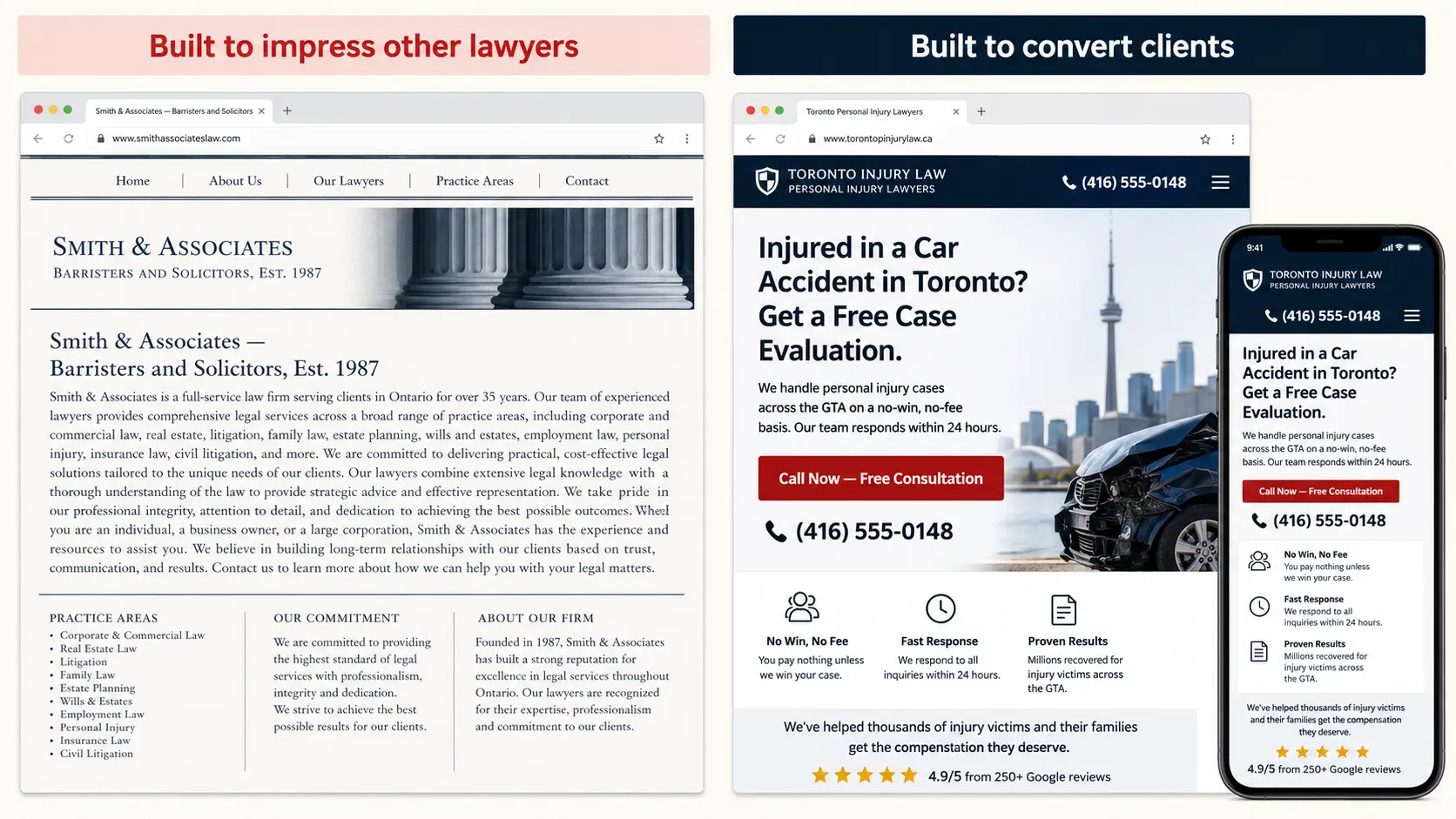
The firms that are growing in 2026 have figured out something simple. Marketing isn't about telling people how good you are. It's about being there when they need you, answering the question they're actually asking, and making it easy to take the next step.
That means content built around the problems your clients face, not the services you offer. A website optimized for the person on their phone at midnight, not the person reviewing your site on a desktop during a partnership meeting. Reviews, responsiveness, and clarity over credentials, jargon, and prestige.
The gap between how lawyers think clients find them and how clients actually find them is where the opportunity lives. The firms that close that gap are the ones filling their intake pipeline. The ones that don't are wondering why the phone isn't ringing despite having a "great reputation."
If your firm's marketing feels like it should be working but isn't, the problem is almost certainly in this gap. We've covered why most law firm SEO efforts in Canada fail and it comes back to the same disconnect: building for how you think the market works instead of how it actually does.