Cet article est aussi offert en français.
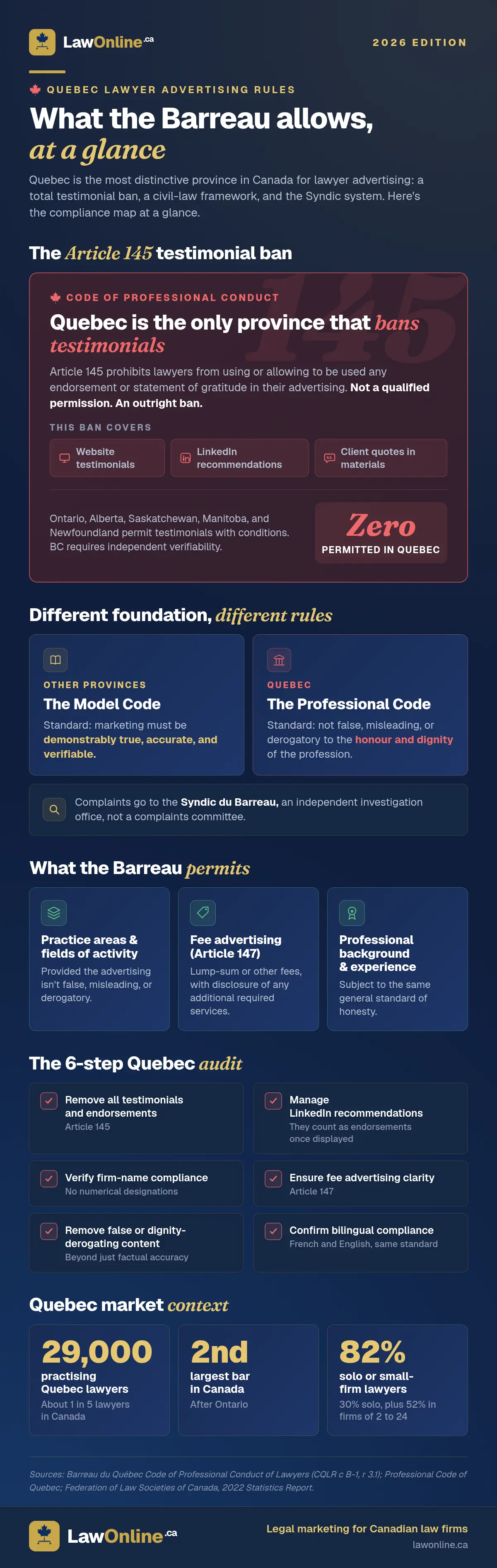
Quebec's lawyer advertising rules are fundamentally different from every other province in Canada.
Most Canadian provinces adopted the Federation of Law Societies of Canada's Model Code of Professional Conduct, which creates a largely consistent framework across the country. Quebec didn't. As a civil law jurisdiction with its own legal tradition, Quebec regulates its lawyers through the Barreau du Québec, the province's equivalent of a law society, under the provincial Professional Code and the Code of Professional Conduct of Lawyers (CQLR c B-1, r 3.1).
The result is a set of advertising rules that diverges from the rest of Canada in significant ways. Some are stricter. Some are more permissive. If you're a lawyer practising in Quebec, or a marketing agency working with Quebec firms, assuming that the rules are "probably the same as Ontario" is a serious mistake.
The Barreau du Québec oversees one of the largest legal professions in the country. The Federation of Law Societies of Canada counts roughly 29,000 practising lawyers in Quebec, about one in five Canadian lawyers and the second-largest bar after Ontario. Most don't work at large firms. Barreau data show that about 30% of advocates practise solo and another 52% work in firms of 2 to 24 lawyers. For these small and mid-sized practices, marketing isn't optional. Getting it right matters. Getting it wrong carries real consequences.
Does Quebec Ban Testimonials in Lawyer Advertising?
Yes. Completely.
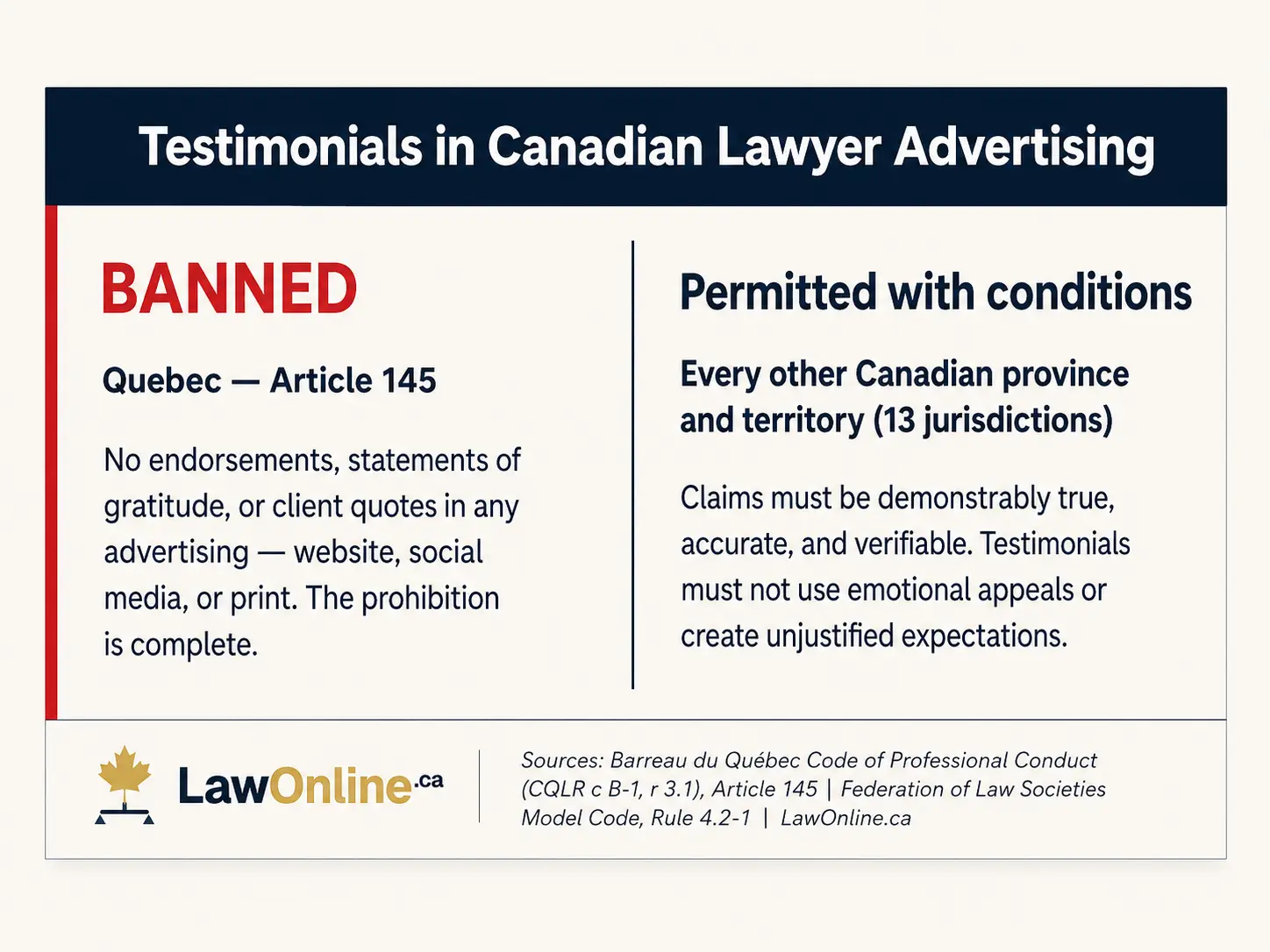
Article 145 of the Code of Professional Conduct of Lawyers states that a lawyer may not use or allow to be used an endorsement or statement of gratitude concerning the lawyer in their advertising.
This is an outright prohibition. Not a qualified permission. Not a "use them carefully" guideline. Quebec is the only Canadian province that flatly bans endorsements and testimonials in lawyer advertising.
The Syndic du Barreau, the supervisory body responsible for investigating professional conduct, has confirmed that the text is clear: public endorsements and statements of gratitude are not permitted in any circumstance.
This affects more than your website's testimonial page. It covers LinkedIn endorsements and recommendations displayed on your profile. It covers quotes from satisfied clients featured in your marketing materials. It covers any form of public praise that you use, allow to be used, or fail to remove from your marketing when you have the ability to do so.
What About Google Reviews?
Google Reviews and other third-party review platforms exist in a grey area. A client who independently leaves a review on Google isn't creating your marketing. But the moment you pull that quote and feature it on your website or in a brochure, it becomes an endorsement in your advertising and violates Article 145.
This is a meaningful practical difference from other provinces. In Ontario, Alberta, and BC, testimonials are permitted provided they're true, accurate, and not misleading. In BC, they must also be independently verifiable. In Quebec, they're simply not allowed.
How Does Quebec's Advertising Standard Compare to the Model Code?
The common-law provinces all share a foundational standard: marketing must be "demonstrably true, accurate, and verifiable." Quebec takes a different approach rooted in its civil law framework and the Professional Code.
Quebec's advertising rules focus on protecting the dignity and honour of the profession, preventing false or misleading advertising, and ensuring that marketing doesn't derogate from the standards expected of a professional. Advertising must not be false, misleading, incomplete, or deceptive. It must not derogate from the honour or dignity of the profession.
The concept of professional dignity carries more weight in Quebec than in common-law jurisdictions. Section 59.2 of the Professional Code establishes that a professional may not commit an act derogatory to the honour or dignity of the profession. Marketing that is technically accurate but undermines professional dignity can still violate the rules.
Can Quebec Lawyers Advertise Their Practice Areas?
Yes. Quebec lawyers can describe their areas of practice and their experience in specific legal fields.
This is where Quebec is actually more permissive than many other provinces. In provinces that follow the Model Code, rules like 4.3-1 prohibit the use of "specialist," "specializing," "expert," and related terms unless the lawyer holds a certification from the law society. Most provinces don't offer specialist certification, making the prohibition effectively absolute.
Quebec operates under a different framework. The Code of Professional Conduct of Lawyers and the Professional Code govern how lawyers may describe their practice. A Quebec lawyer can indicate their practice areas and fields of activity in their advertising, provided the advertising isn't false, misleading, or derogatory to the profession.
This doesn't mean you can make any claim. You still can't say you're "the best immigration lawyer in Montreal" or "Quebec's leading personal injury firm." Claims of superiority, false statements, and misleading language are all prohibited regardless of jurisdiction. But the specific prohibition on the word "specialist" that exists in Ontario, Alberta, BC, Saskatchewan, Manitoba, and the other common-law provinces doesn't apply in the same way in Quebec.
What Are the Fee Advertising Rules in Quebec?
Article 147 allows lawyers to advertise fees, including lump-sum fees. The advertising must indicate whether other professional services may be required that aren't included in the advertised fees.
This is broadly consistent with the approach in other provinces, though the specific requirements differ in detail. The core principle is the same: fee advertising must be clear, accurate, and not misleading about what the client will actually pay.
For personal injury firms working on contingency, clarity about what costs the client may owe regardless of outcome remains critical. Even though the specific article numbers differ from the Model Code's Rule 4.2-2, the practical requirement is the same.
What Makes Quebec's Regulatory Framework Unique?
Several features set Quebec apart from every other Canadian jurisdiction.
Civil Law Foundation
Quebec is Canada's only civil law jurisdiction. Its legal framework is rooted in the Civil Code of Québec rather than the common law tradition. This difference extends to professional regulation. The Professional Code governs all 46 professional orders in Quebec, from lawyers to engineers to dentists. The Barreau du Québec is one of these orders, and its regulatory authority flows from this provincial statute rather than from a self-regulatory tradition.
The Syndic System
Professional conduct complaints in Quebec are handled by the Syndic du Barreau, an independent investigation office within the Barreau. The Syndic investigates complaints, can mediate disputes, and can refer matters to the Professions Tribunal for disciplinary proceedings. This is a different process from the complaints and disciplinary committees used by common-law law societies.
Language Requirements for Marketing
Quebec is officially French-speaking, and this creates specific legal obligations for law firm advertising. Under the Charter of the French Language, when marketing materials use more than one language, the French version must be "markedly predominant." This applies to websites, social media, brochures, directories, and any other commercial advertising.
Quebec raised the bar significantly with Bill 96, which took full effect on June 1, 2025. The law strengthened the old "clearly predominant" standard to "markedly predominant" and introduced a concrete test: French text must occupy at least twice the visual space of any other language in commercial advertising. The Office québécois de la langue française now has broader enforcement powers, and fines range from $3,000 to $30,000 per infraction. For law firms, this applies to everything from your website and Google Ads landing pages to social media posts and printed brochures.
Many firms operate bilingually, particularly in Montreal. English isn't prohibited. But a bilingual Google Ads landing page where the English copy takes up more space than the French version violates Quebec's language laws, even if the content itself is fully compliant under the Barreau's professional rules. The same applies to a website with robust English service pages and sparse French translations. Under the 2:1 rule, your French content must occupy at least double the space of any English content on the same page or material.
This is a practical compliance trap that firms and their marketing agencies frequently miss. The professional conduct rules and the language requirements are separate legal regimes. Meeting one doesn't satisfy the other.
Consumer Protection Act Restrictions
Quebec's Consumer Protection Act prohibits commercial advertising directed at children under 13 (ss. 248-249). This applies to all businesses, including law firms.
Most firms don't target children intentionally. But broadly targeted social media campaigns, event sponsorships at family venues, and ad placements without proper age-targeting controls can create exposure. This requirement sits outside the Barreau's professional conduct rules entirely, and it catches firms that only think about compliance through the lens of their professional regulator.
Firm Naming Rules
A lawyer must not practise under a name or designation that isn't distinctive, that is misleading or deceptive, or that is contrary to the honour, dignity, or reputation of the profession. Numerical designations aren't permitted. This is stricter than some common-law provinces on naming conventions.
Digital Marketing Under Quebec's Rules
Google Ads. "Avocat blessures corporelles Montréal" and "Montreal personal injury lawyer" are both acceptable keyword targets. Ad copy must be accurate and not misleading. Claims of superiority or false statements about services violate the rules just as they would anywhere else.
Quebec firms running Google Ads face a challenge that doesn't exist in other provinces: bilingual campaign management under Bill 96's language requirements. If your landing page serves both English and French audiences, the French content must occupy at least twice the visual space of the English content. That applies to the landing page itself, not just the ad copy. Running separate French and English campaigns with dedicated landing pages is often the cleaner compliance path.
Keyword strategy in Quebec is also inherently bilingual. A personal injury firm in Montreal needs to target both "avocat blessures corporelles Montréal" and "Montreal personal injury lawyer." These aren't duplicates. They reach different audiences with different search behaviours. French-language queries often have lower competition and lower cost-per-click, but they reach the majority of Quebec's population. Ignoring French keywords means leaving the larger audience to your competitors.
Social media.

LinkedIn deserves particular attention in Quebec. LinkedIn endorsements and recommendations can constitute endorsements under Article 145. If clients post recommendations on your LinkedIn profile, the question becomes whether you're "allowing" those endorsements to be used in your advertising. The safest approach is to disable LinkedIn recommendations or not feature them prominently in your professional marketing.
Your website. Common compliance issues specific to Quebec include featuring client testimonials or endorsements anywhere on the site, using firm names that could be considered derogatory to the profession, making claims that aren't supported by verifiable facts, and failing to clearly indicate fee structures when advertising specific services.
Content marketing. Educational content works within Quebec's rules just as it does in other provinces. Blog posts explaining legal processes, practice area pages describing your services, and guides that help potential clients understand their situations are all compliant forms of marketing. For guidance on building this kind of strategy, see our content marketing guide for Canadian law firms.
How Does Quebec Compare to Other Provinces?
The differences between Quebec and the common-law provinces are substantial.
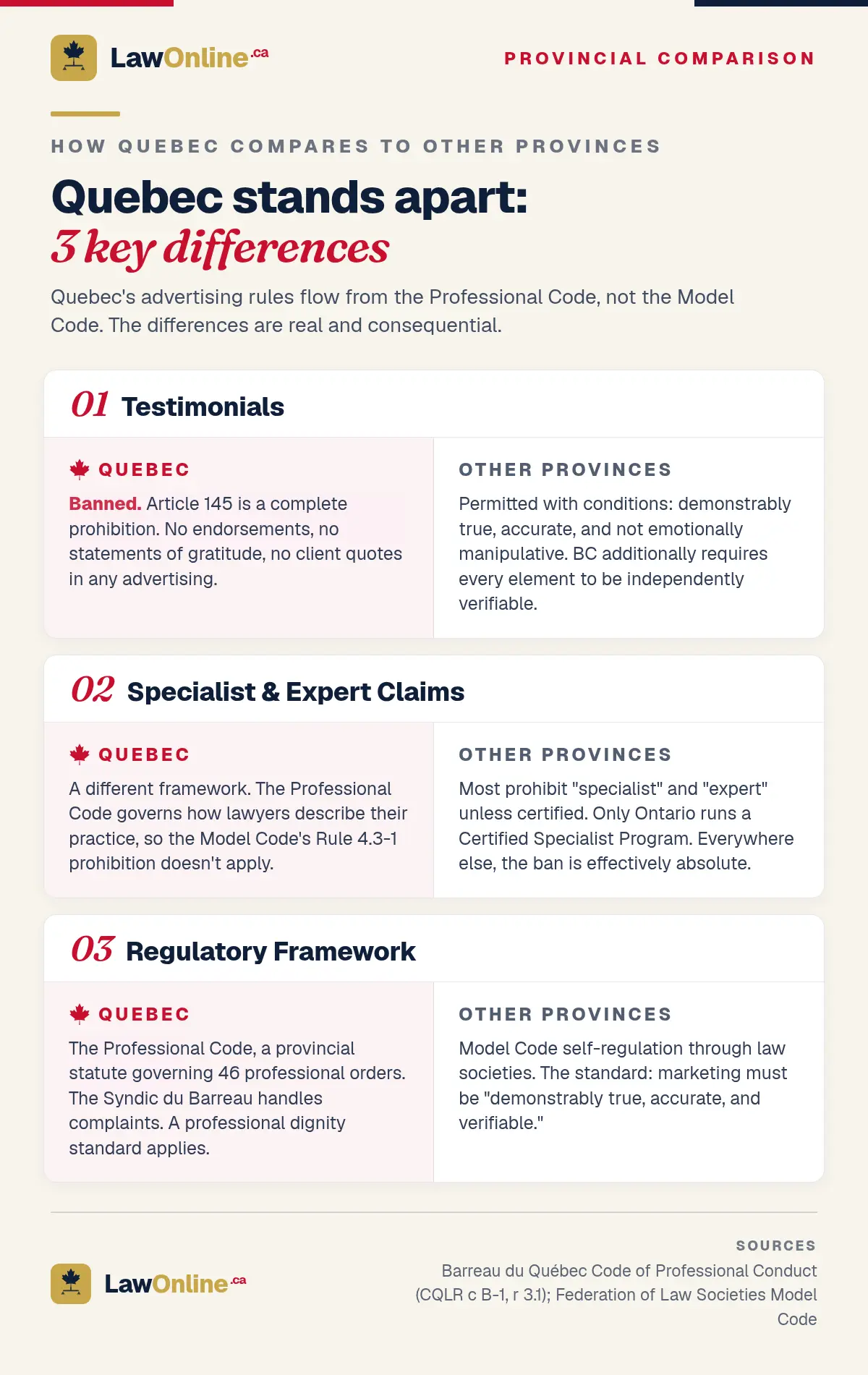
Testimonials. Quebec imposes an outright ban. Ontario, Alberta, Saskatchewan, and Manitoba all permit testimonials provided they're true, accurate, and not emotionally manipulative. BC permits them but requires independent verifiability of every factual claim. Quebec stands alone.
Specialist designations. Most common-law provinces prohibit the use of "specialist" or "expert" unless the lawyer holds a certification from the law society. Only Ontario actually operates a certification program. Quebec's approach is different, governed by the Professional Code's framework for professional orders rather than the Model Code's Rule 4.3-1.
Regulatory framework. Quebec doesn't follow the Federation of Law Societies Model Code. Its rules flow from the provincial Professional Code, making the regulatory structure and the specific provisions genuinely distinct. Assuming that Quebec's rules mirror other provinces is a common and potentially costly mistake.
For detailed breakdowns of each province's rules, see our guides to advertising rules in Ontario, Alberta, BC, Atlantic Canada, Saskatchewan, and Manitoba.
What Happens If You Violate Quebec's Advertising Rules?
The consequences are real, and the process is different from other provinces.
When someone files a complaint about a lawyer's advertising in Quebec, it goes to the Syndic du Barreau. The Syndic's office investigates independently. They can request documents, interview witnesses, and examine your marketing materials. If the Syndic finds sufficient grounds, the complaint is referred to the Disciplinary Council of the Barreau du Québec, which hears the case as an administrative tribunal.
Penalties under Section 156 of the Professional Code range from a reprimand to permanent striking off the roll. Fines run from $2,500 to $62,500 per offence, and those amounts double for repeat violations. Between these poles, the Council can impose temporary suspensions, restrictions on your right to practise, mandatory training, or conditions on your licence.
Disciplinary decisions are public. They're published on the SOQUIJ legal database, searchable by anyone. A finding against you for advertising violations becomes part of your permanent professional record.
The Syndic doesn't only act on complaints. The office can also initiate investigations on its own when it becomes aware of potential violations. A LinkedIn profile full of client recommendations, a website featuring testimonial quotes, or ad copy making unsupported claims can all trigger scrutiny without anyone formally complaining.
This matters for firms that work with out-of-province marketing agencies. An agency that builds your website with a testimonials section or runs ad campaigns with superlative claims isn't the one facing the Disciplinary Council. You are.
How to Audit Your Quebec Firm's Marketing
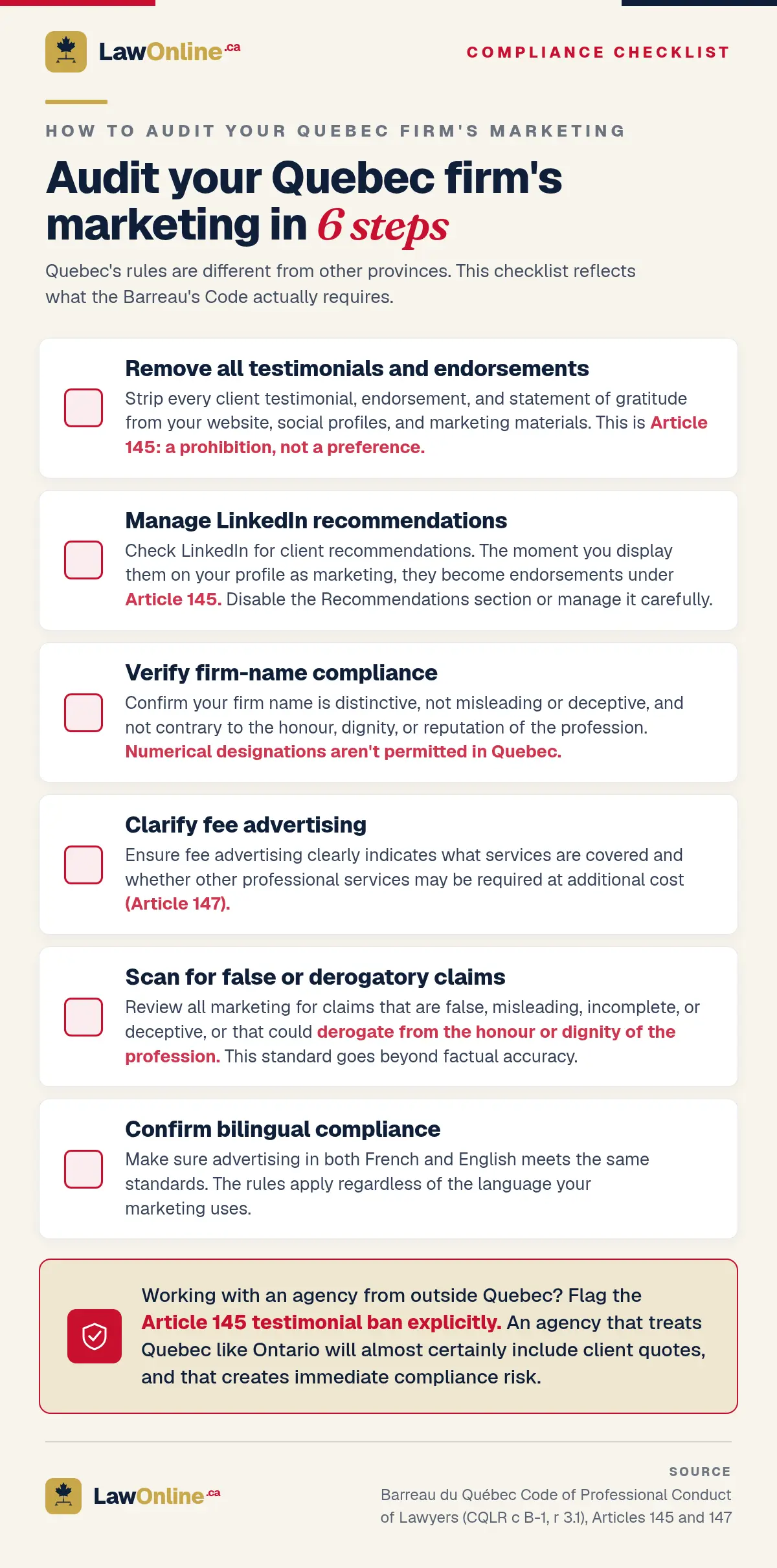
Remove all client testimonials, endorsements, and statements of gratitude from your website, social media profiles, and marketing materials. Check LinkedIn for client recommendations and consider disabling or managing them. Verify that your firm name complies with the naming rules. Ensure that fee advertising clearly indicates what services are covered and what additional costs may apply. Review all marketing for claims that could be considered false, misleading, or derogatory to the profession. Confirm that French occupies at least twice the visual space of any other language on all bilingual marketing materials, including your website, social media profiles, and ad copy. Keep copies of all advertisements for at least 12 months after their last use.
If your firm works with a marketing agency from outside Quebec, share the CBA's Ethics of Advertising toolkit and highlight the specific differences. An agency that treats Quebec like any other province will almost certainly produce materials that include testimonials, and that creates immediate compliance risk.
The Bottom Line
Quebec's advertising rules reflect its distinct legal tradition. The total ban on testimonials is the most visible difference from other provinces, but the underlying framework, built on the Professional Code and the concept of professional dignity rather than the Model Code's "demonstrably true and verifiable" standard, shapes compliance in ways that aren't always obvious.
The firms that market effectively in Quebec lead with substance. Educational content. Clear descriptions of services and fees. Honest representations of experience. These approaches work within Quebec's rules and produce results. They also avoid the compliance risks that come with treating Quebec's framework as interchangeable with the common-law provinces.
If you're building or refreshing your firm's marketing strategy, start with the Barreau du Québec's official resources. Understand the rules that apply specifically in your jurisdiction. Then build a marketing plan, including a well-designed law firm website, that works within them.