Saskatchewan doesn't ban lawyer advertising. It regulates it.
Saskatchewan's advertising rules don't get much attention. Most firms assume they're basically the same as Alberta's, and for the most part that's true. Both provinces adopted the Federation of Law Societies of Canada's Model Code of Professional Conduct, and both enforce Chapter 4's marketing restrictions with similar rigour.
But "basically the same" isn't the same thing as "identical." And the firms that run into compliance problems are usually the ones that treated provincial marketing rules as an afterthought.
It's a smaller market than many realize. The Law Society of Saskatchewan (LSS) reported in its 2025 Annual Report that the province has 2,231 active practising lawyers, with private practice spread across 328 firms, 89% of which have five lawyers or fewer. In a market where most practices are small and competition is local, how you present yourself matters, and a compliance misstep is harder to live down than it would be in Toronto or Vancouver.
The LSS Code of Professional Conduct, Chapter 4, governs the marketing of legal services. These Saskatchewan lawyer advertising rules apply to your website, your Google Ads, your social media profiles, your directory listings, and your print materials. Every channel, every format.
Here's what matters for your firm's marketing.
What Is the Foundational Standard for Lawyer Advertising in Saskatchewan?
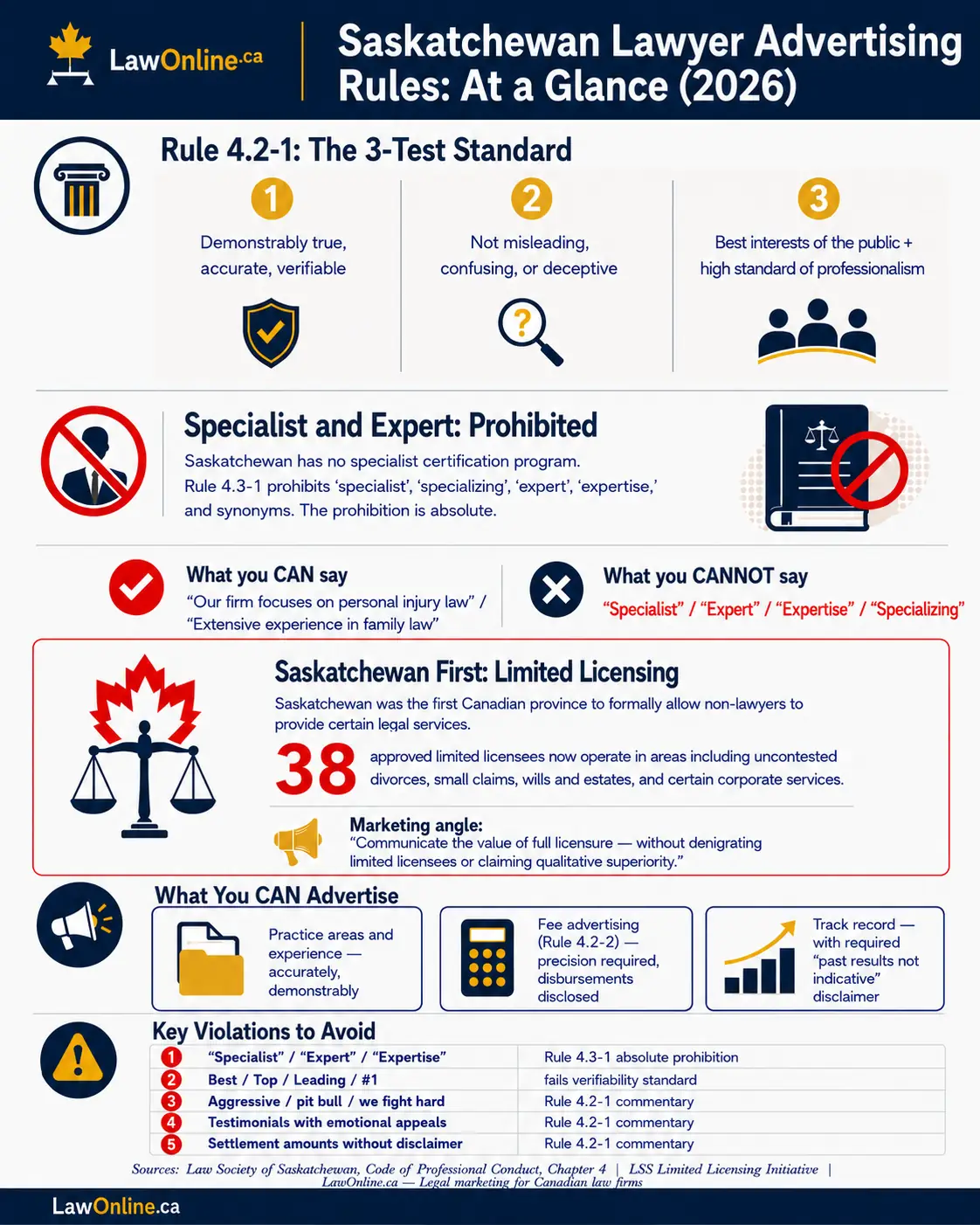
Rule 4.2-1 sets the bar. Your marketing must meet three tests: it must be demonstrably true, accurate, and verifiable; it must not be misleading, confusing, or deceptive, or likely to mislead, confuse, or deceive; it must be in the best interests of the public and consistent with a high standard of professionalism.
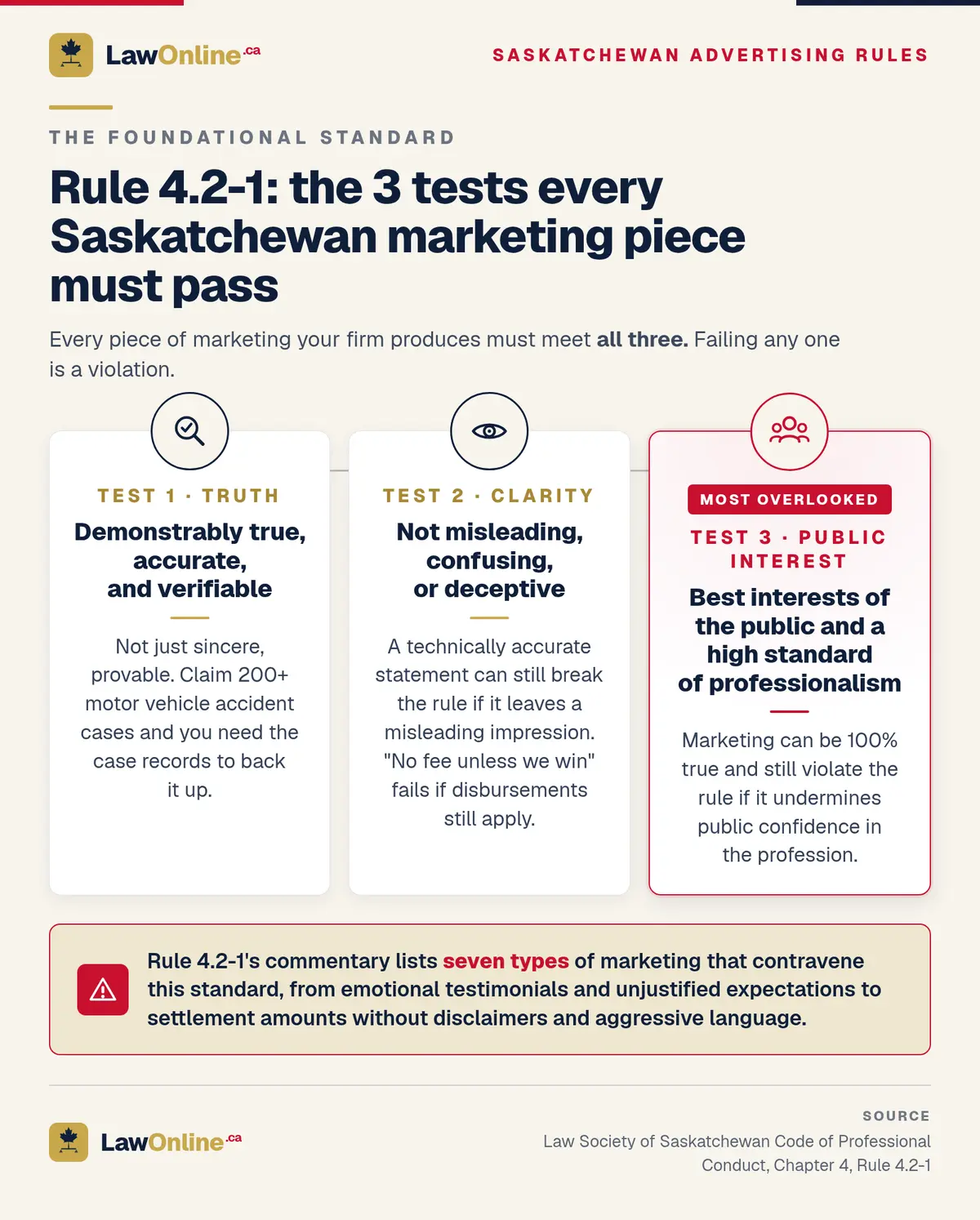
That word "demonstrably" does the heavy lifting. It's not enough for your claims to be true; you need to be able to prove them. If your personal injury firm states that it has handled over 200 motor vehicle accident cases, you'd better have the case records to back that up.
The commentary to Rule 4.2-1 lists examples of marketing that would contravene this standard:
- Stating money recovered for a client without noting that past results aren't indicative of future results.
- Suggesting qualitative superiority to other lawyers.
- Raising expectations unjustifiably.
- Suggesting or implying that the lawyer is aggressive.
- Disparaging other persons, groups, organizations, or institutions.
- Taking advantage of a vulnerable person or group.
- Using testimonials or endorsements that contain emotional appeals.
That's a detailed list, and it catches more firms than you'd expect.
Can Saskatchewan Lawyers Call Themselves Specialists or Experts?
No. Rule 4.3-1 states that the marketing of legal services by a practising lawyer or law firm shall not use the words "specialist," "specializing," "expert," "expertise," or synonyms thereof.
Saskatchewan doesn't operate a specialist certification program. Unlike Ontario, which runs a Certified Specialist Program allowing certified lawyers to use the title, Saskatchewan offers no path to earning a specialist designation. The prohibition is effectively absolute.
This applies everywhere. Website bios, Google Ads headlines, LinkedIn profiles, business cards, directory listings. If it says "specialist" or "expert," it's a compliance issue.
What you can say: "Our firm focuses on personal injury law" or "Jane Smith has extensive experience in family law matters." What you can't say: "Jane Smith, Personal Injury Specialist" or "Saskatchewan's leading experts in criminal defence."
The commentary to Rule 4.3-1 makes the reasoning clear: a claim that a lawyer specializes in an area of law implies that the lawyer has met some objective standard or criteria of expertise established or recognized by the Law Society. In the absence of a certification process, that assertion is misleading and improper.
What Can Saskatchewan Lawyers Advertise?
The restrictions get the attention, but the permissions matter more for building an effective marketing strategy.

Practice areas and experience. You can advertise your areas of practice, preferred practice areas, and restrictions to certain areas of law. A personal injury firm in Regina can state that it handles motor vehicle accidents, slip and fall claims, wrongful death cases, and catastrophic injury. You can describe your experience and your firm's proficiency in an area of law. The representations must be accurate, demonstrably true, and not misleading.
Fees. Rule 4.2-2 allows fee advertising and the Law Society encourages it because it helps consumers compare services. Your fee advertising must be reasonably precise about the services covered. It must state whether other amounts like disbursements and taxes will be charged in addition to the fee. And you must strictly adhere to the advertised fee in every applicable case.
For personal injury firms working on contingency, this means being specific about the percentage and what costs the client may still owe regardless of the outcome. "No fee unless we win" can be misleading if disbursements are the client's responsibility either way.
Track record. You can describe the types of cases you've handled, the courts where you've appeared, and relevant facts about your professional background. Just don't cross the line into superiority claims or unverifiable assertions about outcomes.
What Are the Restrictions on Marketing Language?
Beyond the specialist prohibition, the commentary to Rule 4.2-1 identifies several types of marketing that contravene Saskatchewan's rules.
Superlative Claims
"Best personal injury lawyer in Saskatoon." "Saskatchewan's top-rated family law firm." "The most experienced criminal defence team in the province." These all fail the verifiability test. You can't objectively prove qualitative superiority, so you can't claim it.
Aggressive Language
Suggesting or implying that a lawyer is aggressive violates the standard. "Aggressive" representation, "pit bull" lawyers, "we fight hard for our clients." These are common in American legal marketing, but they don't comply in Saskatchewan.
Alternatives that work: "dedicated," "thorough," "committed to our clients' interests," "results-driven."
Emotional Appeals
Marketing that exploits the physical or emotional vulnerability of potential clients contravenes the rules. A personal injury firm can acknowledge that an accident is a stressful experience. It can't use graphic imagery or fear-based language to pressure someone into calling.
Settlement and Verdict Amounts
Stating money recovered for a client without a clear disclaimer that past results aren't indicative of future results can contravene the rules. Even with a disclaimer, presenting settlement amounts in a way that creates unjustified expectations is problematic.
Testimonials
Testimonials and endorsements aren't outright banned, but they carry risk. The commentary specifically flags testimonials or endorsements that contain emotional appeals. Any testimonial used in your marketing must still meet the overarching standard: demonstrably true, accurate, verifiable, and not misleading.
How Does Saskatchewan Handle Firm Advertising Responsibility?
Rule 4.4-1 creates a duty for individual lawyers regarding their firm's marketing. A lawyer who knows or ought to know that the advertising of the firm violates Rule 4.2 or 4.3 must take reasonable steps to end the violation.
This matters if your firm uses a marketing agency or if different partners handle different aspects of the firm's online presence. You're personally responsible for ensuring compliance, even if someone else wrote the copy.
The LSS reinforces this at the firm level. All Saskatchewan law firms must register with the LSS and appoint a Designated Representative as a primary regulatory contact. Firms also complete a Practice Management Assessment at least once every three years, covering controls, client service, ethical practice, and risk management. Marketing compliance isn't a side concern. It's part of the assessment cycle every firm goes through.
What Changed with Limited Licensing in Saskatchewan?
Saskatchewan became the first Canadian province to formally allow non-lawyer legal professionals to provide certain legal services under a limited licensing framework. The Law Society's limited licensing initiative saw legislative amendments to The Legal Profession Act, 1990 come into force. The limited licensing pilot concluded in December 2025 with 38 approved participants, and formal limited licences began being issued in 2026.
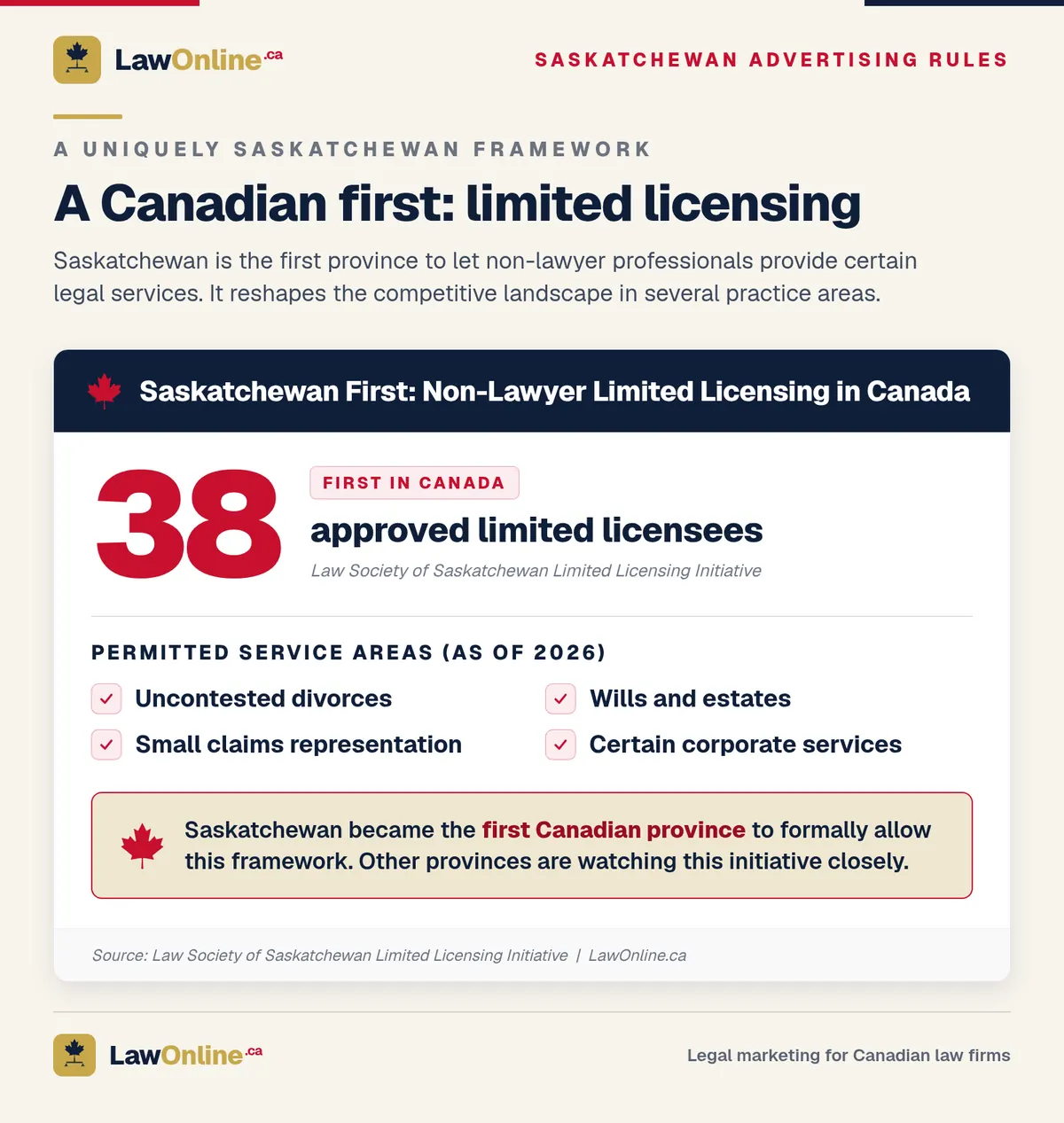
Limited licensees can provide services in areas including uncontested divorces, small claims matters, wills and estates, and certain corporate services. They're regulated by the Law Society and must follow professional standards, including the advertising rules.
This has a practical marketing implication. If your firm competes for clients in practice areas where limited licensees now operate, your marketing advantage lies in clearly communicating the value a fully licensed lawyer provides. But you still can't do that by denigrating limited licensees or making superiority claims. The rules about disparaging others and claiming qualitative superiority apply.
How Do Saskatchewan's Rules Compare to Other Provinces?
Saskatchewan's rules closely follow the Federation of Law Societies Model Code, making them broadly similar to Alberta and Manitoba. The foundational standard is the same across all three Prairie provinces: demonstrably true, accurate, and verifiable.
Saskatchewan and Alberta share the prohibition on specialist designations. Neither province operates a certification program. Ontario is different because the LSO runs a Certified Specialist Program, meaning Ontario lawyers who hold the certification can use the title. We cover the full breakdown in our guide to Ontario lawyer advertising rules.
BC goes further than Saskatchewan in certain areas, particularly the verifiability standard for testimonials. BC requires that every element of a testimonial be independently verifiable by the lawyer. Saskatchewan's rules are less explicitly prescriptive on testimonials, though the general prohibitions still apply. Our BC lawyer advertising rules guide covers these distinctions.
Alberta's prohibition on aggressive imagery and language is more explicitly stated than Saskatchewan's, with specific guidance calling out combative symbols. Saskatchewan addresses aggressiveness through the commentary to Rule 4.2-1 rather than through a standalone provision. For more on Alberta's approach, see our Alberta lawyer advertising rules guide.
Quebec takes a fundamentally different approach. As Canada's only civil law jurisdiction, it doesn't follow the Model Code at all and is the only province that completely bans client testimonials. For firms that serve clients in both provinces, our Quebec lawyer advertising rules guide explains how the Barreau du Québec's framework differs from the Model Code provinces.
Digital Marketing Under Chapter 4
Every digital channel falls under the same rules. If you're building out your firm's online presence, our law firm web marketing guide covers the key channels and how to measure what's working.
Google Ads. "Regina personal injury lawyer" is a fine keyword to bid on. "Regina's best personal injury lawyer" isn't acceptable as ad copy. Landing pages connected to your ads need to comply too. If your ad promises a free consultation, the landing page must confirm that clearly. Watch ad extensions. A "No Win, No Fee" callout works only if your contingency arrangement genuinely operates that way and the client won't owe disbursements on a loss.
Social media. LinkedIn, Facebook, and Instagram posts are all subject to these rules. A post celebrating a court win is generally fine if it doesn't reveal confidential information or create unjustified expectations. For practical guidance on what to post and where, see our social media marketing guide for Canadian law firms.
Your website. Common compliance issues on Saskatchewan law firm websites include team bios using "specialist" or "expert" language, practice area pages listing services the firm doesn't actually offer, homepage taglines with superlative claims, and testimonial sections with unverifiable or emotionally charged claims.
Content marketing. Educational blog posts and practice area pages are encouraged. A post explaining "What to Do After a Car Accident in Saskatchewan" attracts qualified personal injury leads while staying compliant. A post titled "Why We Are the Best PI Firm in Saskatoon" doesn't. For a framework on building effective content marketing for law firms, see our guide.
The Law Society's public directory. The Law Society maintains a searchable public directory where potential clients can find lawyers by location, area of law, language spoken, and pricing model. It's not advertising in the traditional sense, but it functions as a regulator-controlled visibility channel. Making sure your directory listing is complete and accurate is a zero-risk marketing step that many firms skip.
How to Audit Your Firm's Marketing for Compliance
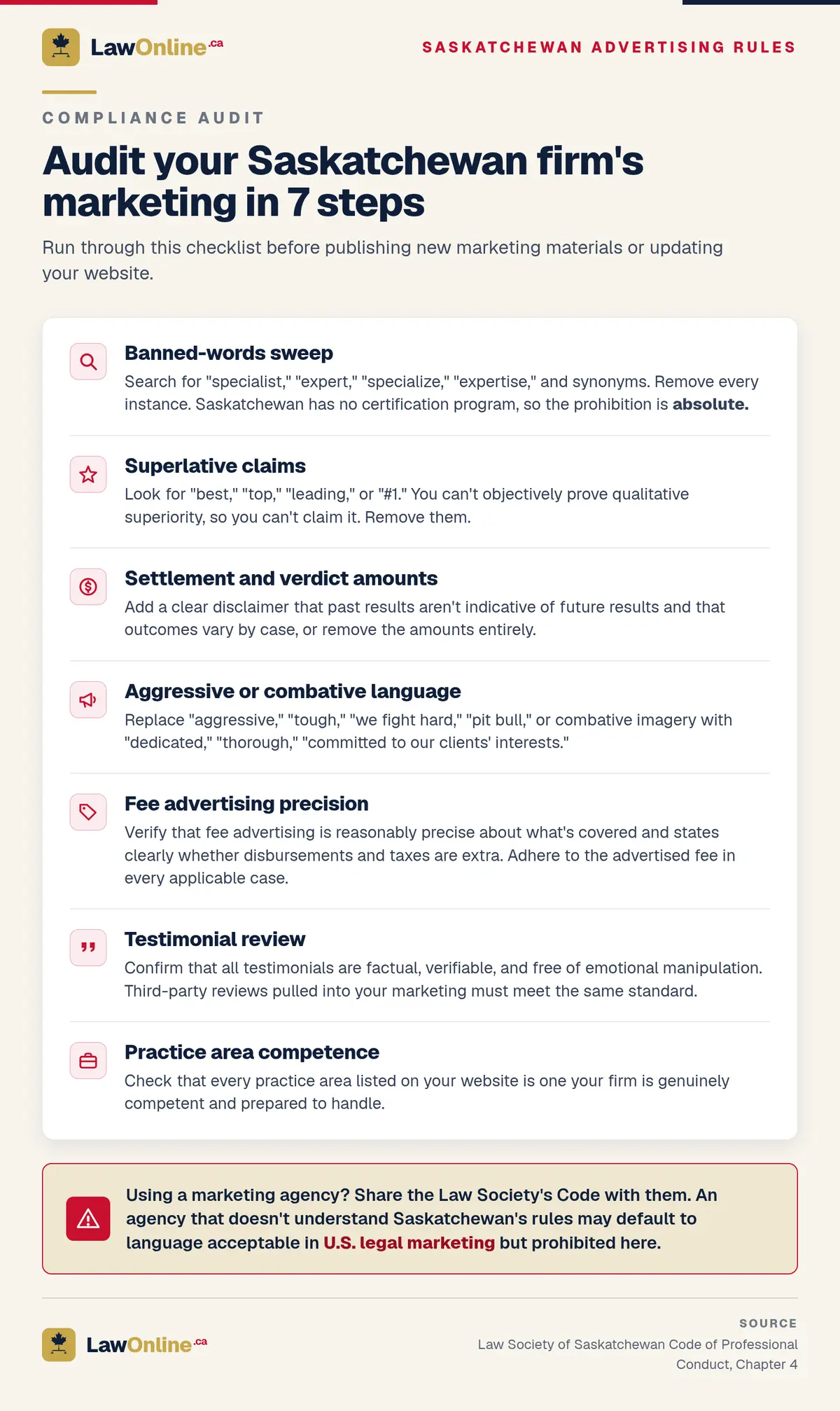
Search all marketing materials for "specialist," "expert," "specialize," "expertise," and synonyms. Remove all instances. Check for superlative claims like "best," "top," "leading," or "#1" and remove them. Review any settlement or verdict amounts and add required disclaimers or remove them. Look for aggressive or combative language and replace it. Verify that fee advertising is precise, includes disbursement disclosures, and matches what you actually charge. Confirm that testimonials are factual, verifiable, and free of emotional manipulation. Check that all practice areas listed are ones your firm is competent and prepared to handle.
If your firm works with a marketing agency, share the Law Society's rules with them. An agency that doesn't understand the difference between what's acceptable in American legal marketing and what's permissible in Saskatchewan can create real compliance problems. This is especially true for content marketing, where outside writers may default to superlatives or aggressive language without knowing it violates the rules. CBA Saskatchewan recommends the national Ethics of Advertising Toolkit as a starting point for navigating the rules.
The Bottom Line
Saskatchewan's advertising rules aren't designed to prevent you from marketing your firm. They're designed to ensure your marketing helps the public make informed decisions rather than being misled. In 2025, the Law Society opened 319 complaint files and 36 resulted in formal disciplinary action. In a province with just over 2,200 practising lawyers, those numbers carry weight.
The firms that market most effectively in this province lead with useful information. Clear descriptions of services. Honest representations of experience. Educational content that demonstrates competence without making unverifiable claims. Starting with a well-designed law firm website built for compliance puts you on solid ground from day one, and if you're looking for a marketing partner who understands the Saskatchewan market, our Saskatoon and Regina service area page covers how we work with firms across the province.
Substance wins over slogans. That's not just a compliance argument. It's a marketing effectiveness argument.