
Most law firms will hire the wrong marketing agency.
That's not pessimism. It's the math. There are thousands of digital marketing agencies in Canada, and the vast majority of them have never worked with a law firm. They don't understand Law Society advertising rules. They don't understand how legal clients actually search. They don't understand that a personal injury firm's marketing needs are fundamentally different from a restaurant's or a dentist's.
The result is predictable: a 12-month contract, $30,000 to $80,000 spent, and a pile of blog posts nobody reads alongside a Google Ads account that bleeds money on irrelevant clicks. Most firms only realize the relationship isn't working around month four or five, when the contract still has six months left on it.
This post isn't a neutral guide to "evaluating your options." It's a filter. We're going to tell you what actually matters when choosing an agency, what should disqualify one immediately, and what questions will tell you more in five minutes than any proposal deck will in an hour.
Why Is It So Hard to Evaluate a Marketing Agency?
Because agencies are better at marketing themselves than they are at marketing your firm.
Every agency website says the same things: "data-driven strategies," "ROI-focused," "results that speak for themselves." The proposals look professional. The case studies are polished. The salespeople are confident and articulate. None of that tells you whether they can actually get a personal injury firm in Hamilton more signed retainers.

The core problem is information asymmetry. You're an excellent lawyer, but unless you've run a marketing agency, you probably don't know what questions separate a good one from a bad one. Most firms evaluate agencies the way they'd evaluate any vendor: they look at the website, read some reviews, sit through a pitch, and go with whoever felt most convincing.
That process selects the agency with the best sales ability, not marketing ability. Those are very different things.
What Should You Actually Look for in a Marketing Agency?
Three things matter above everything else: legal industry experience, a strategy-first approach, and transparent reporting. If an agency is strong on all three, they're worth serious consideration. If they're missing even one, proceed carefully.
Does the Agency Have Real Legal Industry Experience?
This is the single most important factor. It's also the one firms most often compromise on.
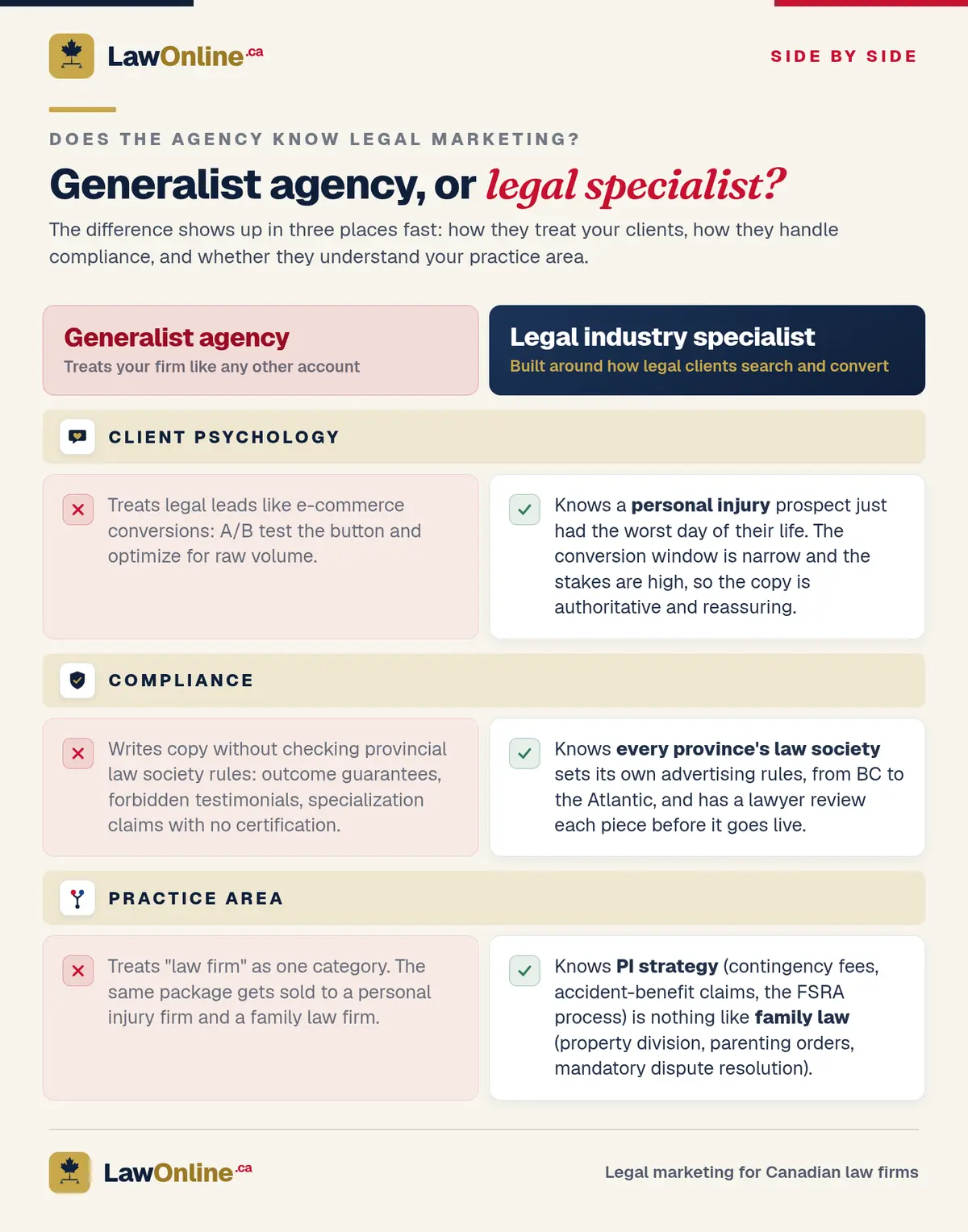
Legal marketing isn't generic digital marketing applied to a law firm. The differences are concrete and specific:
- Client psychology is different. Someone searching for a personal injury lawyer just had the worst day of their life. They're not comparison shopping the way they would for a plumber. The conversion window is narrow, the emotional stakes are enormous, and the marketing needs to reflect that. An agency that mostly does e-commerce or SaaS work won't understand this.
- Compliance creates real constraints. Every provincial Law Society has advertising rules that restrict what you can say in marketing materials. Ontario's rules differ from BC's, which differ from Alberta's. An agency that isn't fluent in these restrictions is a compliance liability, and the Law Society won't care that your agency wrote the copy.
- Practice areas aren't interchangeable. The marketing strategy for a personal injury firm targeting motor vehicle accident cases is completely different from the strategy for a family law firm handling high-net-worth divorces. Content, keywords, ad targeting, conversion paths, all of it changes. An agency that treats "law firm" as a single category is already behind.
Ask for specifics. How many law firm clients do they currently serve? In which practice areas? What results have they produced, with actual numbers?
A credible agency should be able to say something concrete: "We work with seven firms, four in personal injury. Our PI clients average 60 to 90 qualified leads per month at a cost per lead of $150 to $250, depending on market. A Toronto PI shop, for example, will sit at the higher end." If the answer is vague, that tells you everything.
Does the Agency Lead With Strategy or Deliverables?
This question separates real agencies from content mills.
A bad agency leads with deliverables: "You get four blog posts per month, two social media posts per week, a monthly newsletter, and a Google Ads campaign." That's a feature list, not a strategy. It tells you what they'll produce. It says nothing about why any of it connects to signed retainers.
A good agency leads with strategy: "Based on your market, practice area, and competitive landscape, here's what we think will move the needle for your firm in the first 90 days, and here's how we'll measure it."
Pay attention to the questions an agency asks during the sales process. If they ask about your cost per case acquisition, your intake process, which case types are most profitable, and where your current leads come from, they're thinking about your business. If they skip straight to "here's our Standard Law Firm Package," they're not thinking at all.
The scale of this problem goes beyond bad agencies. A CallRail survey found that 53% of law firms don't have an annual marketing budget at all, with only 14% of solo practitioners and 32% of small firms reporting one. Clio's research shows that 26% of firms don't track their leads, and 42% of the time, firms take three or more days to respond to new potential client inquiries. These numbers are from US studies, but Canadian firms face the same structural challenges. An agency that doesn't ask about your intake process and measurement framework in the first conversation isn't doing strategy. It's selling a template with a strategy label on it.
Personal injury firms should listen closely here. PI marketing economics are unique: high case values mean you can afford higher acquisition costs, but the competition for those clicks is fierce. An agency that doesn't understand PI unit economics will either underspend and deliver too few leads, or overspend on the wrong keywords and deliver plenty of leads that never convert to cases. The strategy conversation should get into this level of specificity.
Is the Agency's Reporting Transparent and Outcome-Based?
One of the most common complaints from law firms that have had bad agency experiences is that they couldn't tell what was happening with their money.
Good reporting ties everything back to business outcomes. Not traffic. Not impressions. Not "engagement." Consultations booked, retainers signed, and cost per acquired client by practice area and channel.
A credible agency should provide:
- Source attribution: which specific channels, campaigns, and keywords generated each inquiry
- Lead quality breakdown: what percentage of inquiries converted to consultations, and what percentage of consultations converted to signed clients
- Cost per acquisition by channel: so you can see that Google Ads is bringing in PI cases at $800 each while organic search is running at $200
- Honest performance narrative: what's working, what isn't, and what's changing as a result
This level of clarity is rare. A SeoProfy analysis found that 65% of lawyers don't know which metrics to track in their marketing campaigns. The ABA's own research reinforces it: only about one in five firms receive regular reports on their marketing performance. The data usually exists. Almost nobody is reading it.
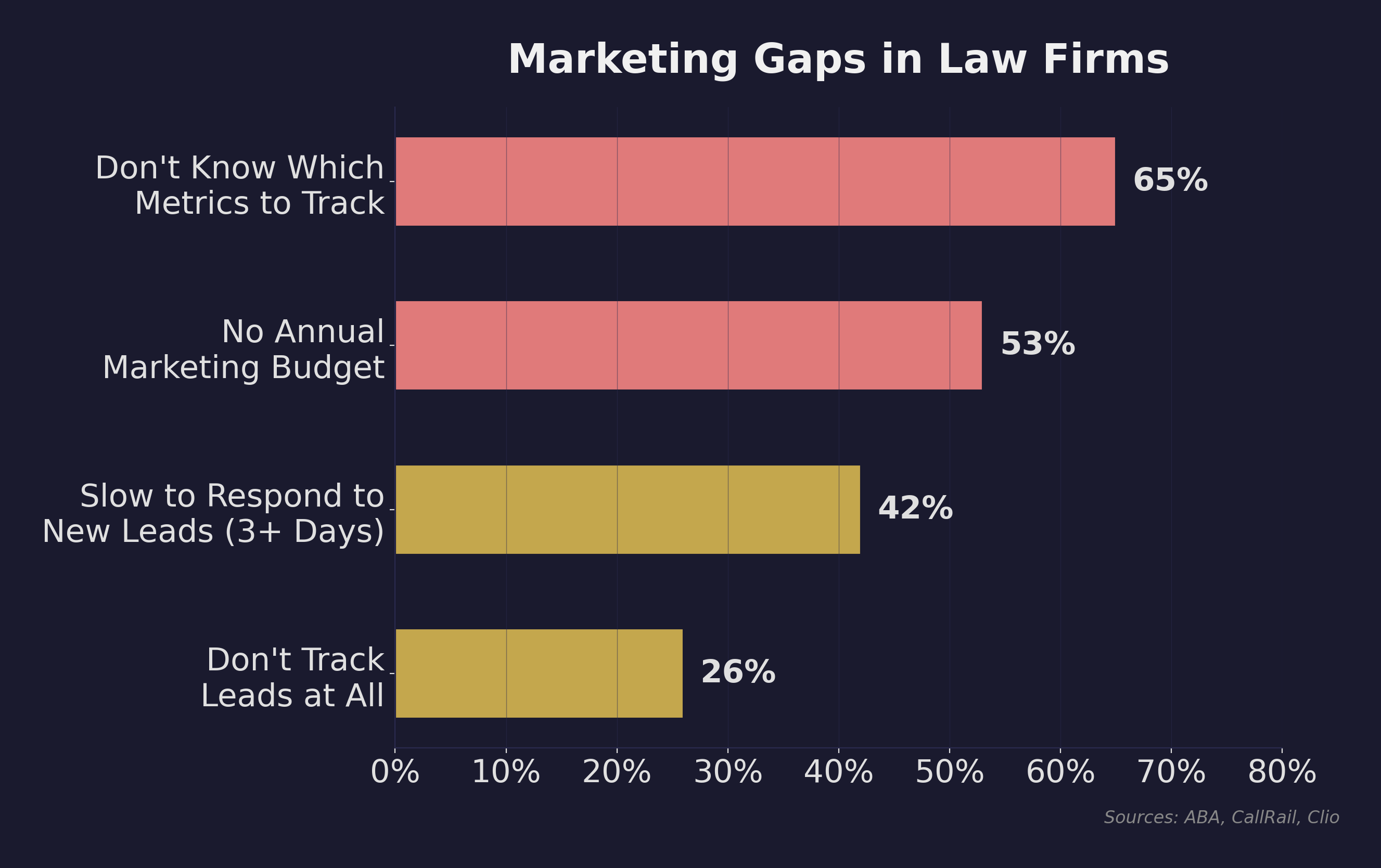
If your agency isn't actively closing these gaps, they're profiting from your confusion.
Ask for a sample monthly report before you sign. If they can't produce one, or if the sample is full of vanity metrics and charts that look impressive but don't connect to revenue, you have your answer.
What Red Flags Should End the Conversation?
Some things should stop a conversation immediately. Not "proceed with caution." End the conversation.
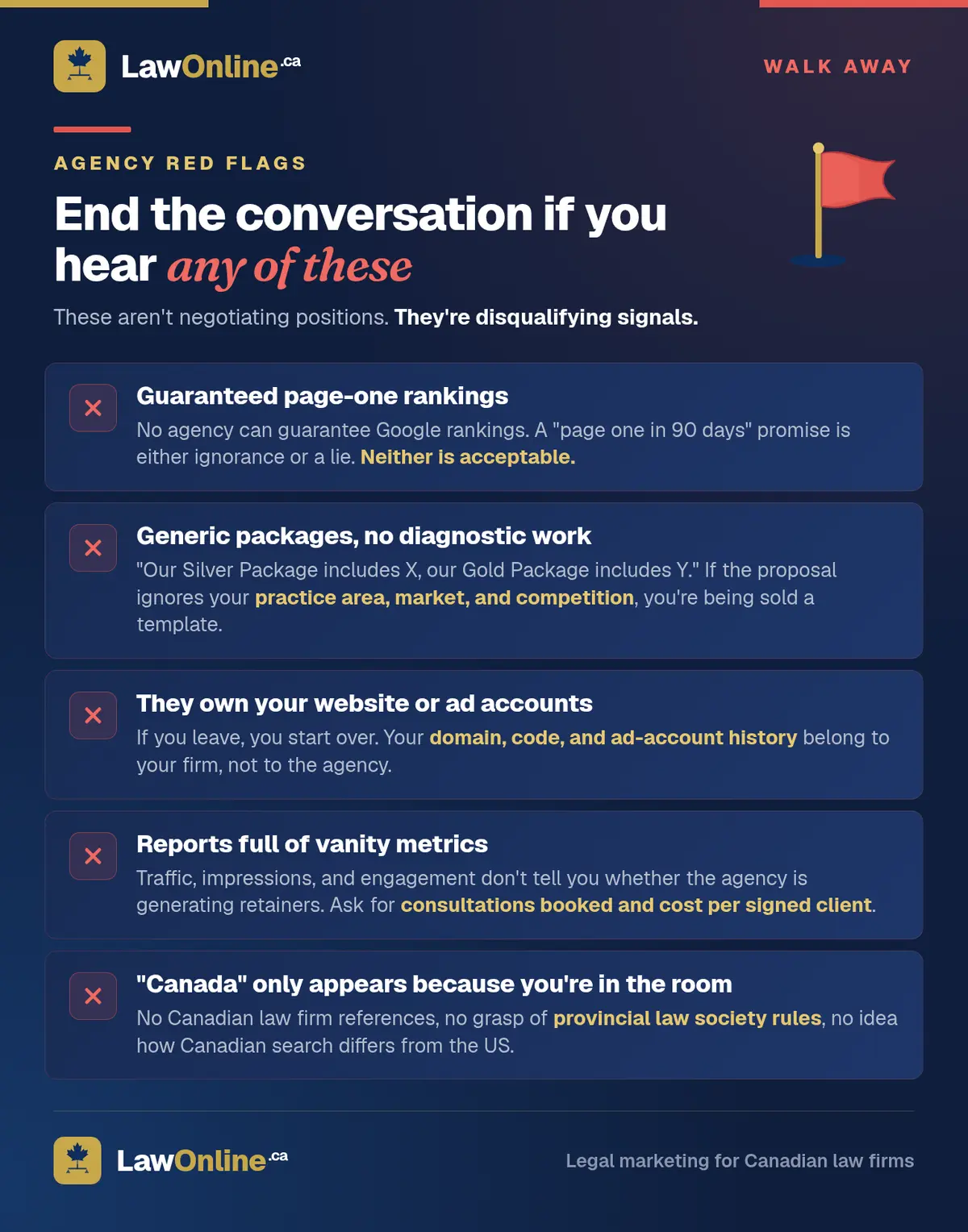
Guaranteed rankings. No agency can guarantee Google rankings. The algorithm considers hundreds of factors, many outside any agency's control. If someone promises you "page one in 90 days," they either don't understand how search works or they're willing to say anything to close the deal. Neither is acceptable. There's a reason most law firm SEO doesn't work, and guarantees are a big part of it.
Generic packages with no diagnostic work. "Our Silver Package includes X, our Gold Package includes Y." If the first proposal looks the same regardless of your practice area, market, or competitive situation, you're being sold a template. Your firm deserves a strategy built for your specific circumstances, not a menu. MyCase's data shows that 78% of law firms use paid search, but 82% of those that do find the ROI underwhelming. That's not a paid search problem. It's a strategy problem.
They own your website or ad accounts. Some agencies build your website on their infrastructure and retain ownership of the domain, the code, or both. If you leave, you start over. This is a hostage situation disguised as a service agreement. Your firm should own its domain, its website files, its Google Ads account, its Google Analytics, and all content. Non-negotiable.
Vague pricing. "Custom packages" that require a discovery call before any numbers are discussed often indicate pricing set to what they think you can afford rather than what the work costs. You don't need exact pricing upfront, but you should be able to compare pricing and service packages between two or three firms before investing an hour in a sales call.
Aggressive upselling before any results. An agency that quotes a baseline package and immediately layers on premium reporting, monthly videos, "reputation management," and social media add-ons before doing any diagnostic work is optimizing for their revenue, not your results.
What Questions Should You Ask Before Signing?
These questions cut through the pitch and expose what an agency actually knows. The answers will tell you more in ten minutes than a polished proposal deck will in an hour.
On legal marketing experience:
- How many law firm clients do you currently work with, and in which practice areas?
- Can you share specific results for a firm similar to mine, with actual numbers?
- What's unique about marketing a personal injury firm versus a family law firm? (If the answer is generic, that's your signal.)
On strategy:
- What would you do differently for my firm compared to your other law firm clients?
- How do you determine which marketing channels to prioritize for a new client?
- What does the first 90 days look like, and what are we measuring?
On compliance:
- Are you familiar with my provincial Law Society's advertising rules?
- Who reviews marketing materials for compliance before they go live?
- How do you handle content that references specific case outcomes or results?
On reporting and accountability:
- What does a typical monthly report look like? Can I see a sample?
- How do you attribute leads to specific marketing channels?
- What happens if results aren't meeting expectations after three months?
On ownership and contracts:
- Who owns the website, domain, ad accounts, and all content?
- What's the minimum contract commitment?
- What does offboarding look like if we end the relationship?
What About Canadian-Specific Considerations?
Many Canadian law firms shopping for legal marketing services in Canada end up working with US-based agencies by default. That isn't automatically disqualifying, but it introduces real gaps.
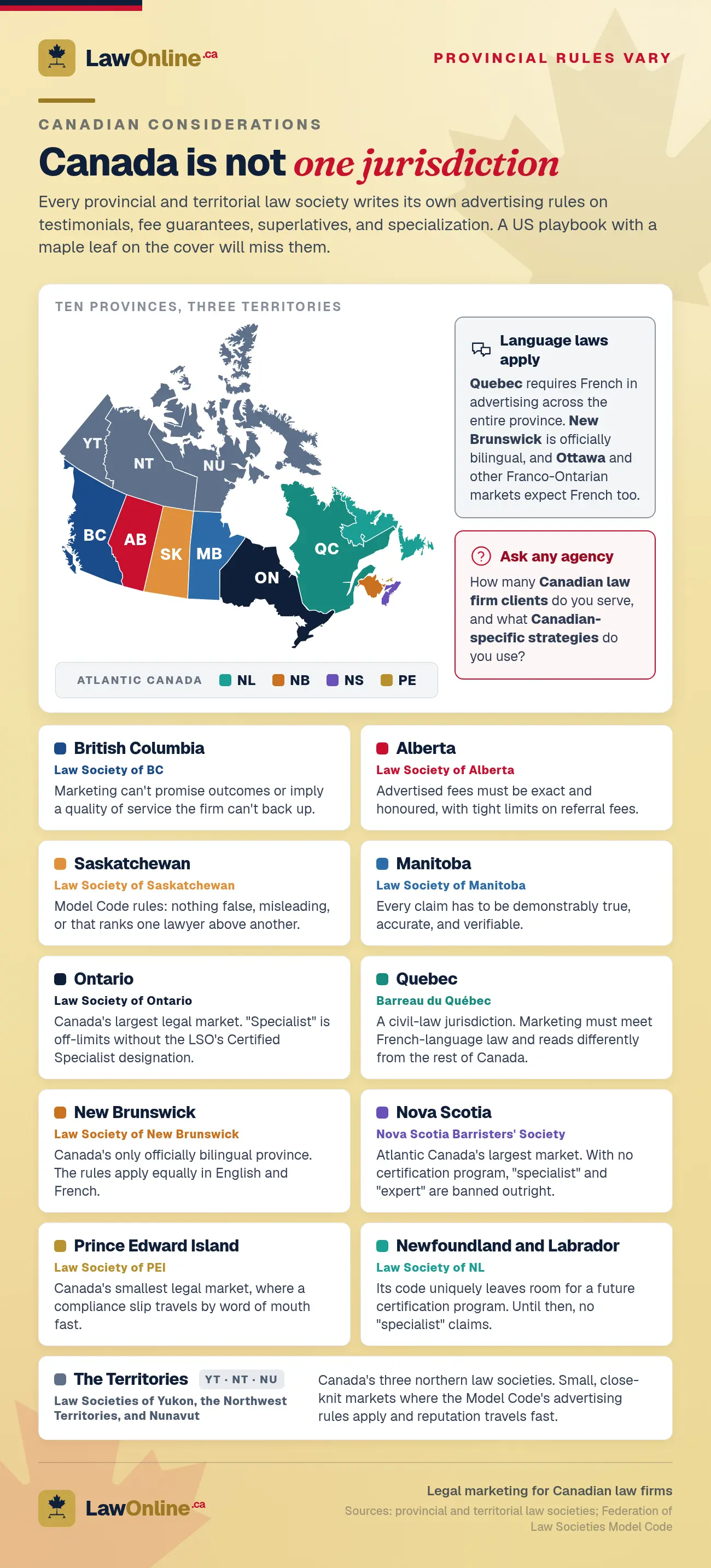
Provincial Law Society rules vary significantly. Ontario, BC, Alberta, and Quebec all have different restrictions around testimonials, outcome guarantees, superlatives, and comparative advertising. Quebec is the strictest of the four: it bans client testimonials and endorsements outright, even on Google and social media. An agency working across provinces needs to know these distinctions, not treat Canada as one jurisdiction.
Search behaviour differs too. "Personal injury lawyer" search volume is dominated by Ontario and BC, while Quebec has entirely different market dynamics. Google Local Services Ads, the screened pay-per-lead ads that sit above the search results, still aren't available to lawyers in Canada at all. The legal category is US-only; the Canadian program covers home-service trades, not law firms. An agency that leans on them is running a US playbook that doesn't apply here.
Language rules add another layer. Quebec's Charter of the French Language requires French in advertising across the entire province. New Brunswick is officially bilingual, and the Franco-Ontarian market around Ottawa expects French too. A US-based agency won't think to address any of it.
Ask specifically: how many Canadian law firm clients do you work with? What Canadian-specific strategies do you use? If the answers are vague, or if "Canada" only appears in their pitch because you're sitting across the table, you're looking at a US playbook with a maple leaf on the cover.
The Bottom Line
Choosing a marketing agency for lawyers is one of the highest-stakes vendor decisions a firm makes. Done right, it transforms your client pipeline. Done wrong, it costs $30,000 to $80,000 and a year of lost momentum.

The firms that get this right don't pick the agency with the best pitch or the lowest price. They pick the one that understands their practice area, leads with strategy instead of deliverables, and can show transparent, outcome-based results for firms like theirs.
Take your time. Ask the hard questions. Pay attention to how the agency reacts when you push back. The good ones welcome scrutiny. The bad ones deflect, rush, or pivot to pressure.
That reaction alone tells you almost everything you need to know.
Frequently Asked Questions
How much does law firm marketing cost, and what should you budget for an agency?
Monthly retainers typically range from $2,000 to $8,000 depending on scope, market, and practice area. Personal injury firms in competitive markets like Toronto or Vancouver generally sit at the higher end because keyword competition and required content depth are more demanding. A strong agency will also understand E-E-A-T, Google's quality framework for legal content, and build it into their content strategy from day one. We break down the full cost picture for Canadian law firms here. Be cautious of agencies quoting significantly below market. The economics of quality legal marketing require meaningful ongoing investment. For context, Vena Solutions' industry benchmarks put the average client acquisition cost in legal services at US$749, with organic channels at US$584 and paid channels at US$1,245 (2023 figures). Firms investing in SEO and content pay more upfront, but their cost per client drops significantly over time compared to paid-only strategies.
What is the best marketing agency for a law firm in Canada: specialist or generalist?
Specialist. The compliance requirements, client psychology, and competitive dynamics of legal marketing are different enough from general digital marketing that a generalist will make avoidable mistakes. They'll produce generic content that doesn't convert, run ads on keywords that bring unqualified leads, and miss Law Society advertising restrictions entirely. The cost difference between a specialist and a generalist is usually small. The performance difference isn't. For a breakdown of the leading legal marketing agencies in Canada and what sets each apart, see our best legal marketing agencies in Canada guide. For firms specifically evaluating content marketing partners, our content agency evaluation guide covers the questions that separate legal content specialists from generalists.
What's the biggest mistake law firms make when hiring a marketing agency?
Choosing based on the pitch rather than the proof. Agencies are excellent at marketing themselves. But a polished proposal and a confident salesperson don't predict whether they can actually generate signed retainers for a personal injury firm in your market. Ask for specific, verifiable results from firms similar to yours. If the agency can't provide them, move on regardless of how good the presentation was.
How long before a new marketing agency delivers results?
SEO and content marketing typically take four to six months before you see meaningful organic traffic growth, with lead generation building from there. Google Ads can produce qualified leads within the first month if campaigns are set up correctly. Any agency promising transformative results in 30 days is either misleading you or defining "results" as something that doesn't affect your bottom line. A credible agency sets realistic timelines during the strategy conversation, not during the sales pitch. Industry analysis by First Page Sage found that law firm SEO delivers an average 526% ROI over three years, with a 14-month break-even. The returns are substantial, but they require sustained investment and patience.