Atlantic Canada has four provinces, four law societies, and four separate Codes of Professional Conduct. If you're a lawyer practising in Nova Scotia, New Brunswick, Prince Edward Island, or Newfoundland and Labrador, your advertising obligations come from your provincial law society, not a shared regional framework. Together, the four Atlantic law societies regulate roughly 5,000 practising lawyers, the vast majority in solo practices or small firms where marketing compliance decisions fall to one or two people.
The good news is that all four provinces adopted the Federation of Law Societies of Canada's Model Code of Professional Conduct, and their Chapter 4 marketing rules are substantially similar. The rules aren't identical in every detail, but the foundational standards and key prohibitions are consistent enough to cover in a single guide.
Here's what you need to know to market your firm compliantly in Atlantic Canada.
What Is the Foundational Standard Across Atlantic Canada?
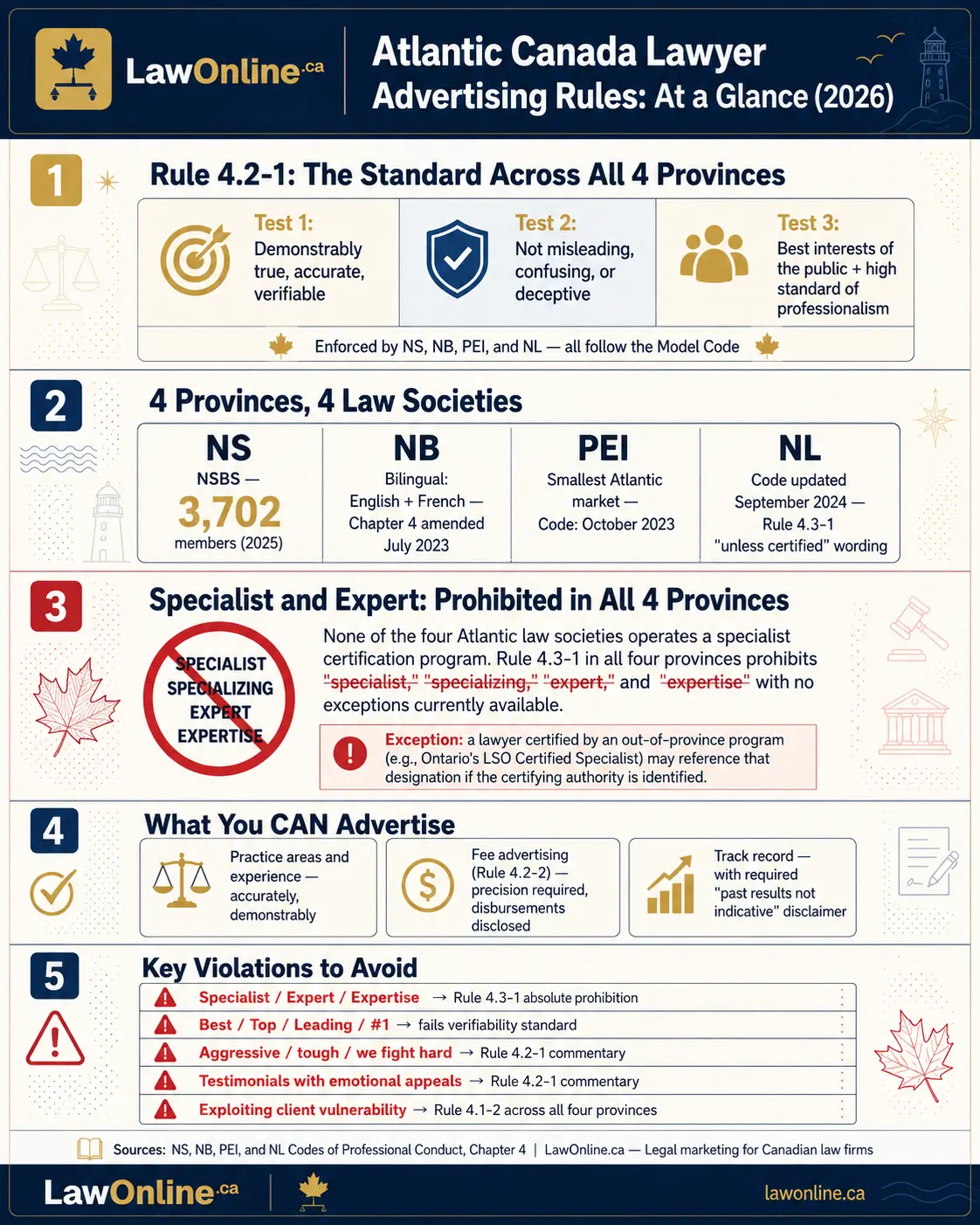
All four Atlantic provinces share the same baseline standard, drawn from Rule 4.2-1 of the Model Code. Your marketing must be demonstrably true, accurate, and verifiable. It must not be misleading, confusing, or deceptive, or likely to mislead, confuse, or deceive. And it must be in the best interests of the public and consistent with a high standard of professionalism.
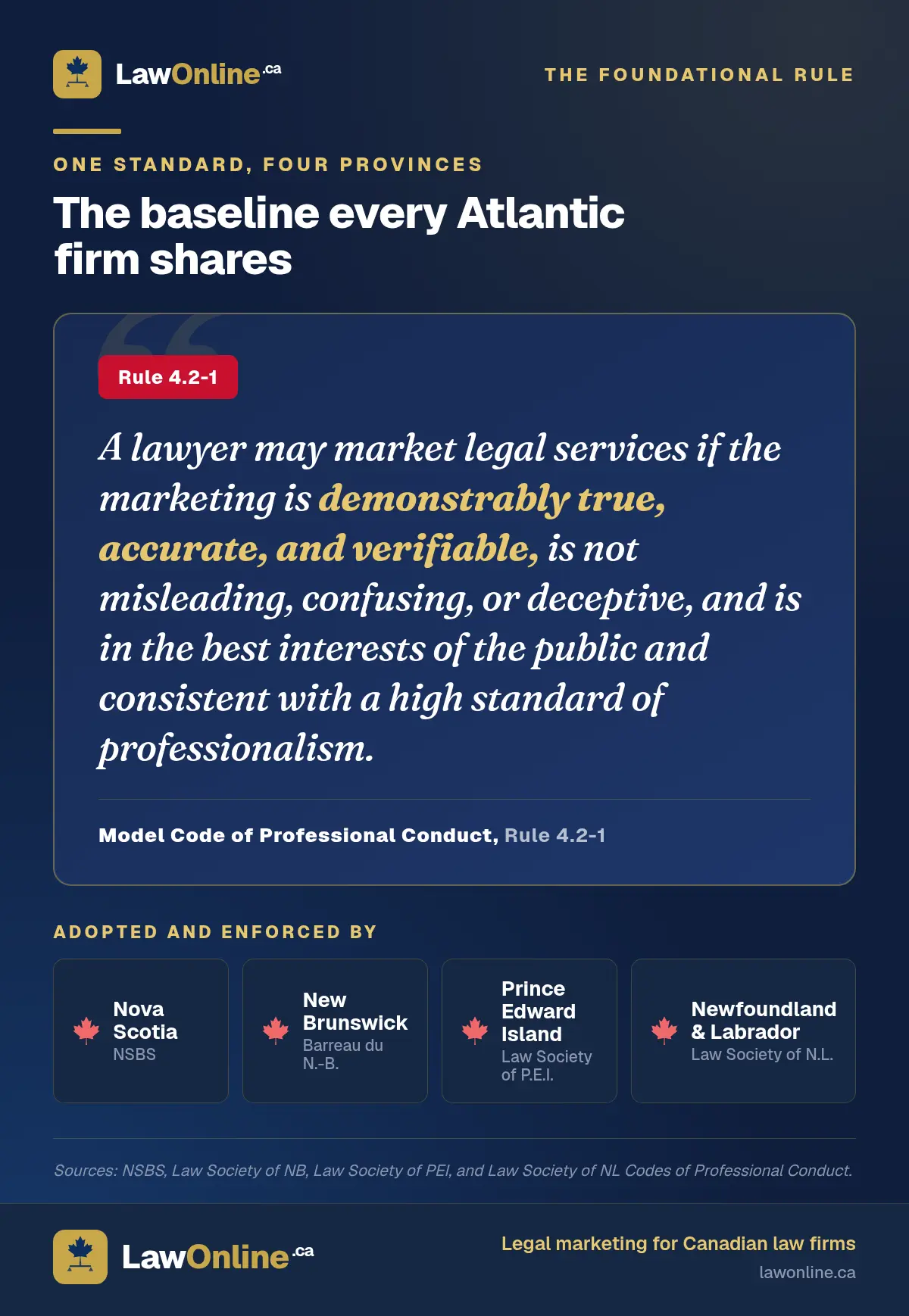
The Nova Scotia Barristers' Society, the Law Society of New Brunswick, the Law Society of Prince Edward Island, and the Law Society of Newfoundland and Labrador all enforce this standard. The commentary in each province's code lists the same examples of marketing that contravenes the rule:
- Stating money recovered for a client or referring to the lawyer's degree of success without noting that past results aren't indicative of future results and that outcomes vary by case
- Suggesting qualitative superiority to other lawyers
- Raising expectations unjustifiably
- Suggesting or implying that the lawyer is aggressive
- Disparaging or demeaning other persons, groups, organizations, or institutions
- Taking advantage of a vulnerable person or group
- Using testimonials or endorsements that contain emotional appeals
If you're familiar with the advertising rules in Alberta or Saskatchewan, this list will look familiar. It's drawn from the same Model Code.
Can Atlantic Canada Lawyers Call Themselves Specialists or Experts?
No. Rule 4.3-1 in all four Atlantic provinces prohibits the use of "specialist," "specializing," "expert," "expertise," or synonyms in the marketing of legal services.
None of the four Atlantic law societies operates a specialist certification program. The prohibition is effectively absolute.
The commentary makes the reasoning explicit: a claim that a lawyer is a specialist or expert implies that the lawyer has met some objective standard or criteria of expertise established or recognized by the law society. In the absence of a certification process, that assertion is misleading and improper.
There is one exception. If your firm practises in more than one jurisdiction, some of which certify or recognize specialization, an advertisement that references a firm member's specialist status doesn't offend this rule if the certifying authority is identified. For example, a firm operating in both Nova Scotia and Ontario could reference a lawyer's Ontario Certified Specialist designation in marketing that circulates in both provinces, provided the LSO is identified as the certifying body.
What you can say: "Our firm focuses on personal injury law" or "Our practice concentrates on family law matters in New Brunswick." You can describe preferred areas of practice, proficiency, and experience, as long as the representations are accurate and demonstrably true.
What you can't say: "Halifax's leading personal injury specialists" or "Expert criminal defence lawyers in St. John's."
What Can Atlantic Canada Lawyers Advertise?
Practice Areas and Experience
You can advertise your areas of practice, preferred practice areas, and your firm's proficiency or experience in specific fields. A personal injury firm in Halifax can state that it handles motor vehicle accidents, slip and fall claims, and medical malpractice cases. You can describe the volume of cases you've handled and the courts where you've appeared. These representations must be accurate and demonstrably true.

Fees
Rule 4.2-2 allows fee advertising across all four Atlantic provinces. The advertising must be reasonably precise about the services offered for each fee quoted. It must state whether other amounts, such as disbursements and taxes, will be charged in addition. And the lawyer must strictly adhere to the advertised fee in every applicable case.
For personal injury firms working on contingency, the same principles apply here as across the country. Be specific about the percentage and what costs the client may owe regardless of the outcome.
Track Record
You can describe your experience and reference your results, but you need to be careful. Stating money recovered without a disclaimer that past results aren't indicative of future outcomes can contravene the rules. The commentary makes this explicit.
What Are the Key Restrictions?
Superlative Claims
"Best personal injury lawyer in Halifax." "Top criminal defence firm in New Brunswick." "PEI's most experienced family law team." All of these fail the verifiability test. Suggesting qualitative superiority to other lawyers contravenes the rules in every Atlantic province.
Aggressive Language
Suggesting or implying that a lawyer is aggressive is specifically identified as contravening Rule 4.2-1 in all four provinces. "Aggressive" representation, "tough" lawyers, "we fight hard." Replace with "dedicated," "thorough," "committed to our clients' interests."
Testimonials and Emotional Appeals
Testimonials and endorsements aren't outright banned in Atlantic Canada. (That distinction belongs to Quebec, which flatly prohibits all endorsements.) But the commentary to Rule 4.2-1 specifically flags testimonials or endorsements that contain emotional appeals as contravening the standard.
A testimonial saying "the firm handled my motor vehicle accident claim professionally" is generally acceptable. One saying "they were the only ones who cared about me during the worst time of my life" crosses into emotional appeal territory.
Exploiting Vulnerability
Marketing that takes advantage of a person who is vulnerable or who has suffered a traumatic experience and has not yet recovered violates Rule 4.1-2 across all four provinces. A personal injury firm can make its services known. It can't use exploitative tactics to solicit clients in the aftermath of an accident.
Province-by-Province Differences Worth Knowing
While the four Atlantic provinces share the same Model Code foundation, there are meaningful differences in market size, structure, and enforcement context that shape how these rules play out in practice.
Nova Scotia Advertising Rules for Lawyers
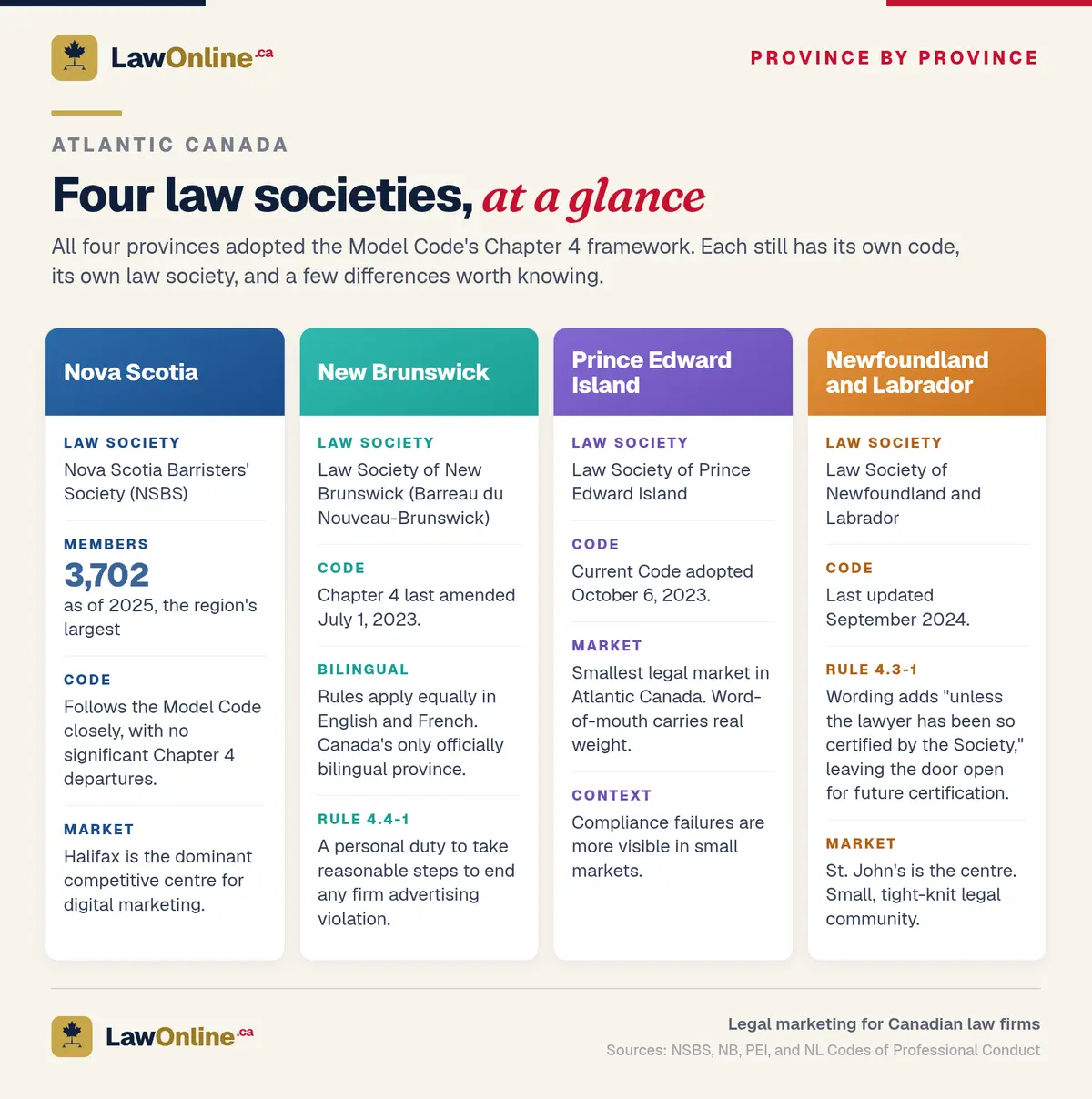
The Nova Scotia Barristers' Society is the largest law society in the region, with 3,702 members as of 2025. According to the Society's 2022 statistical snapshot, Nova Scotia has 2,197 practising lawyers spread across 1,333 registered law firms. Over half of those firms (51%) are solo practices, and only 6% have more than 10 lawyers. Halifax is the competitive centre, home to 51% of practising lawyers, though 61% of firms are actually located outside the city.
Nova Scotia's Code of Professional Conduct follows the Model Code closely, with no significant departures in Chapter 4. What's distinctive is how NSBS treats marketing at the regulatory level. The Society's risk-based framework identifies marketing practices as one of 11 core professional-responsibility risk areas, alongside competence, client service, and trust accounting. Nova Scotia also requires all law firms to register with the Society under an entity-regulation model, meaning advertising expectations apply at the firm-policy level, not just to individual lawyers.
In practice, advertising complaints represent a small but consistent portion of the Society's regulatory workload. NSBS annual reports show that marketing-related complaints have accounted for roughly 6% of total complaints in recent reporting years, with only a handful escalating to formal discipline. The risk is low but not zero, and in a province where half the bar operates as solo practitioners without dedicated compliance support, proactive auditing is the smartest approach.
New Brunswick Advertising Rules for Lawyers
New Brunswick is Canada's only officially bilingual province. The Law Society of New Brunswick (Barreau du Nouveau-Brunswick) operates in both English and French, and the Code of Professional Conduct applies equally in both languages.
The province's bar includes 1,792 active practising lawyers as of 2023. Roughly 60% practise in Fredericton, Moncton, and Saint John, with 53% in private practice and 25% in government roles. It's a compact, community-oriented market where compliance missteps travel fast.
New Brunswick's Chapter 4 follows the Model Code closely. The code was last amended July 1, 2023. One notable feature: Rule 4.4-1 creates a personal duty for lawyers to take reasonable steps to end any advertising violation by their firm. If you know your firm's marketing violates the rules, you're individually responsible for addressing it.
The bilingual dimension adds a practical layer for firms marketing in French. The rules apply to advertising in every language. A francophone personal injury firm in Moncton faces the same restrictions on testimonials, specialist claims, and aggressive language as an anglophone firm in Fredericton. All French-language marketing materials must meet the same "demonstrably true, accurate, and verifiable" standard.
Prince Edward Island (PEI) Advertising Rules for Lawyers
PEI has the smallest legal market in Atlantic Canada by a wide margin. Industry data estimate roughly 103 law firm businesses operating in the province, generating about $58.5 million in total market revenue. PEI is also the only province in Canada that delivers legal aid directly through a government department rather than an independent commission, a structural difference that shapes how the profession operates on the Island.
The Law Society of PEI adopted its current Code of Professional Conduct on October 6, 2023, bringing it into alignment with the Model Code. Chapter 4 mirrors the standard framework without significant departures.
In a market this small, reputation is everything. Word-of-mouth drives a significant portion of client referrals, and compliance issues can damage a firm's standing more quickly than in a larger market. The flip side: a strong, compliant marketing presence can differentiate a PEI firm more effectively than anywhere else in the region, precisely because so few competitors are investing in it.
Newfoundland and Labrador Advertising Rules for Lawyers
The Law Society of Newfoundland and Labrador regulates 781 practising lawyers as of 2024-25. About 48% are based in St. John's, with 52% spread across the rest of the province. The bar is heavily weighted toward small practices: 37% of lawyers work in firms of one to three people, and 61% are in private practice overall.
The Society's Code of Professional Conduct was most recently updated in September 2024. Chapter 4 follows the Model Code framework.
One point worth noting: Rule 4.3-1 in Newfoundland and Labrador states that a lawyer must not advertise that the lawyer is a specialist in a specified field "unless the lawyer has been so certified by the Society." The law society doesn't currently operate a specialist certification program, so the prohibition is effectively absolute. But the rule is worded in a way that leaves the door open for future certification, unlike provinces that prohibit specialist claims without any exception clause.
The LSNL's complaint data offer a useful window into what triggers regulatory attention. In 2024-25, the Society received 112 complaints, with 24% related to communication issues, 19% to billing, and 17% to delay. Only about 9% resulted in formal discipline. Perhaps most relevant for small-firm practitioners: 63% of lawyers involved in discipline matters practised in firms of three lawyers or fewer. If you're a solo or small-firm lawyer in Newfoundland and Labrador, clear and compliant client communications, including your marketing, are your most direct line of defence against complaints.
Digital Marketing Across Atlantic Canada
Every digital channel falls under the same rules in all four provinces. If you're building out your firm's online presence, our law firm web marketing guide covers the key channels.
Google Ads. "Halifax personal injury lawyer" or "St. John's family law firm" are fine as keywords. "Best personal injury lawyer in Halifax" isn't acceptable as ad copy. Landing pages linked to your ads need to comply too. Watch your ad extensions for claims that might cross the line.
Social media. LinkedIn, Facebook, and Instagram content are all marketing under the rules. A post celebrating a career milestone is fine. A post that implies specific outcomes or uses emotionally charged language about client situations is not. For platform-specific guidance, see our social media marketing guide for law firms.
Your website. Common compliance issues on Atlantic Canadian law firm websites:
- Team bios using "specialist," "expert," or similar restricted terms
- Practice area pages listing services the firm doesn't actually offer
- Testimonial sections with emotionally charged or unverifiable claims
- Homepage taglines claiming qualitative superiority
- Results pages without appropriate disclaimers
Content marketing. Educational content is one of the most effective compliant marketing strategies for Atlantic Canadian firms. A blog post explaining "What to Do After a Car Accident in Nova Scotia" attracts personal injury leads while staying well within the rules. Our content marketing guide for Canadian law firms covers how to build this kind of strategy.
How Atlantic Canada Compares to the Rest of the Country
Atlantic Canada's advertising rules are among the most straightforward in the country because all four provinces closely follow the Model Code without major departures.
The key differences from other jurisdictions are worth noting. Ontario permits certified specialists to use the title through the LSO's Certified Specialist Program. Atlantic Canada doesn't offer certification. BC has stricter testimonial rules, requiring every element to be independently verifiable. Atlantic Canada follows the Model Code's general approach, which is less prescriptive on testimonials. Quebec bans testimonials entirely, which is stricter than any Atlantic province.
For full breakdowns, see our guides to Ontario, BC, and Quebec advertising rules.
How to Audit Your Firm's Marketing
This checklist works across all four Atlantic provinces. Search all marketing materials for "specialist," "expert," "specialize," "expertise," and synonyms. Remove them. Check for superlative claims like "best," "top," "leading," or "#1" and remove them. Review any settlement or verdict amounts and add disclaimers or remove them. Look for aggressive or combative language and replace it with professional alternatives. Verify that fee advertising is precise, includes disbursement disclosures, and matches what you actually charge. Confirm that testimonials are factual, verifiable, and free of emotional manipulation. Check that all listed practice areas are ones your firm is competent and ready to handle.
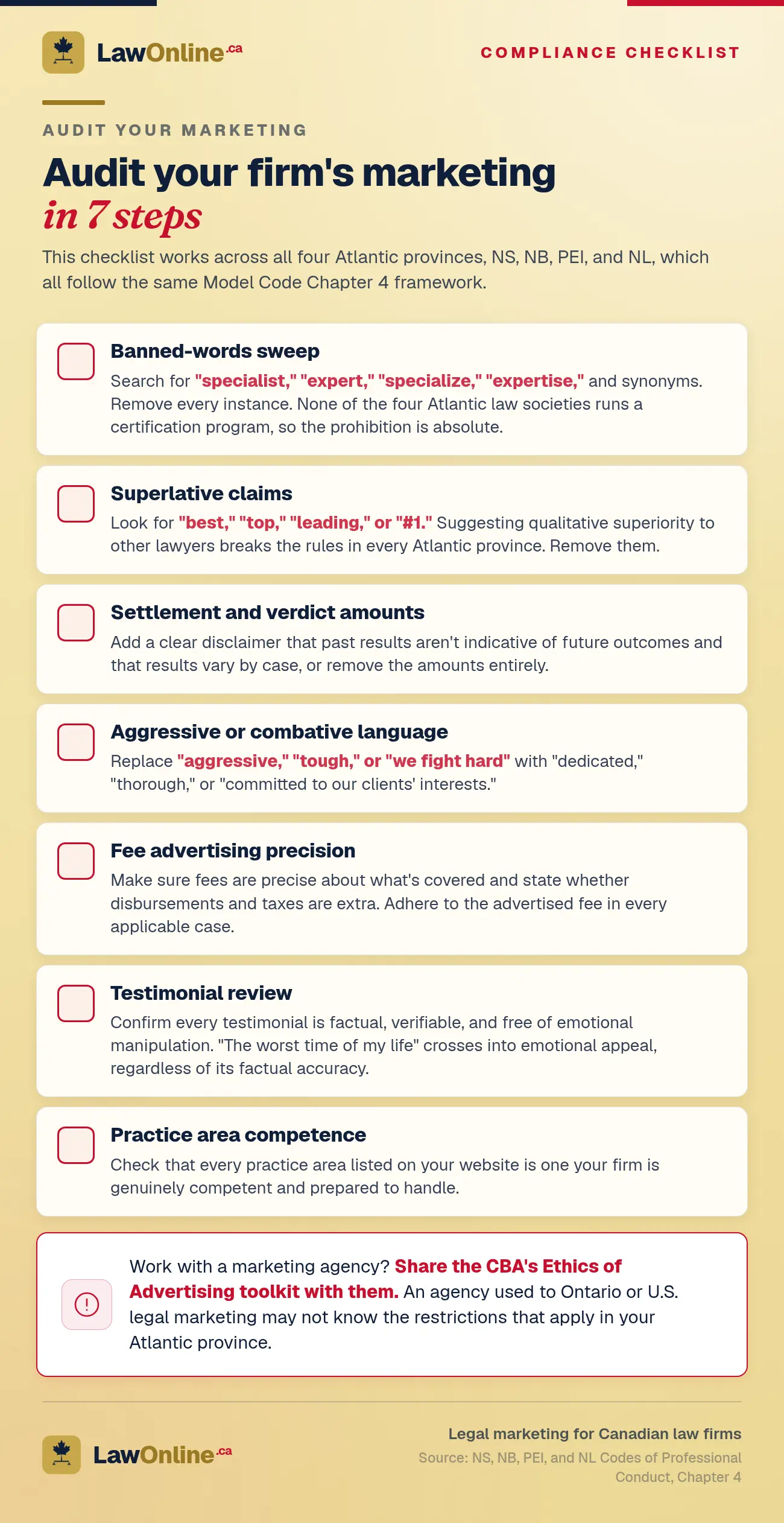
If you work with a marketing agency, share the CBA's Ethics of Advertising toolkit with them. An agency familiar with American or even Ontario legal marketing may not know the specific restrictions that apply in your province.
The Bottom Line
Atlantic Canada's advertising rules follow the national Model Code framework, which means they're consistent, well-established, and straightforward to comply with. The foundational standard is the same across all four provinces: demonstrably true, accurate, verifiable, and in the best interests of the public.
The firms that market most effectively in Atlantic Canada lead with substance. Clear descriptions of services. Honest representations of experience. Educational content that demonstrates competence without overreaching. Starting with a well-designed law firm website built for compliance is the foundation.
In smaller legal markets like PEI and Newfoundland, where everyone knows everyone, the reputational risk of a compliance violation is especially acute. Get it right from the start.