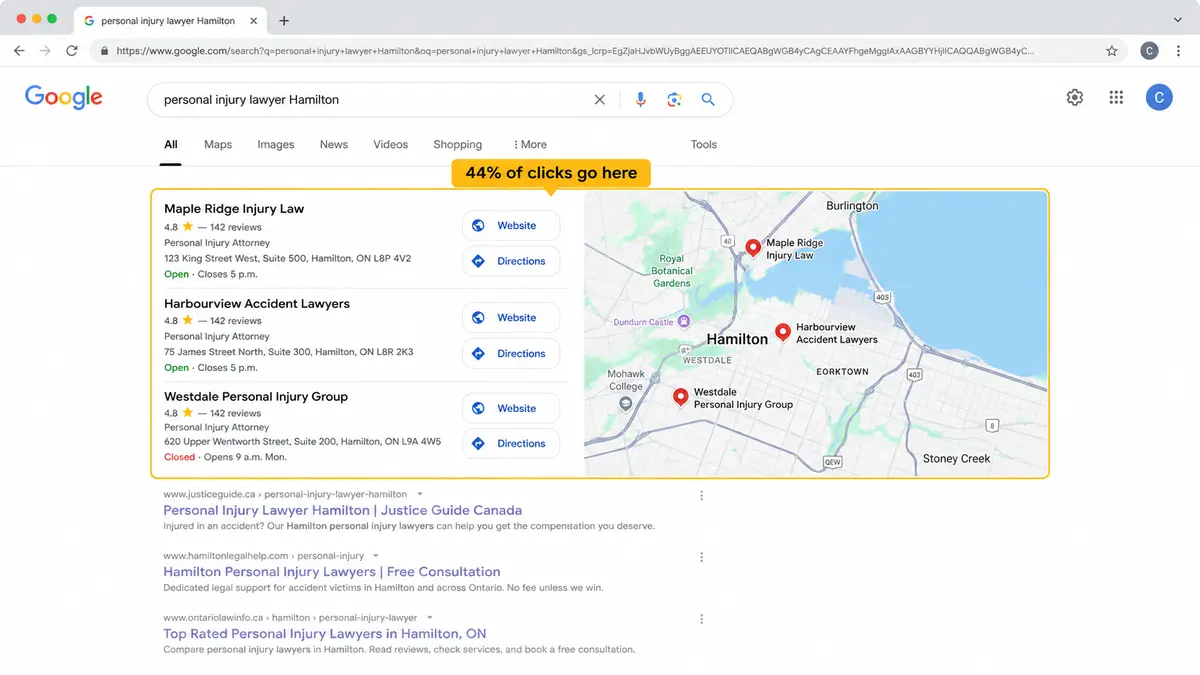
When someone in Hamilton searches "personal injury lawyer near me," the first results they see aren't organic website listings. They're the three Google Maps profiles in the Local Pack (sometimes called the map pack) that appear at the very top of the page. Those profiles come from Google Business Profile (formerly Google My Business), and if your firm's profile isn't optimized, you're invisible to some of the highest-intent clients in your market.
Google Business Profile is free. It takes a few hours to set up properly. For most Canadian law firms, it's the highest-return local SEO activity available right now.
We regularly audit law firm GBP listings and the same gaps come up over and over: incomplete categories, no posts in months, zero photos, and a review profile that's been neglected for years. Fixing those issues is some of the easiest marketing ROI a firm can capture.
This guide covers everything you need to do to optimize your firm's GBP and outperform competitors in local search.
Why Google Business Profile Matters More Than Most Law Firms Realize
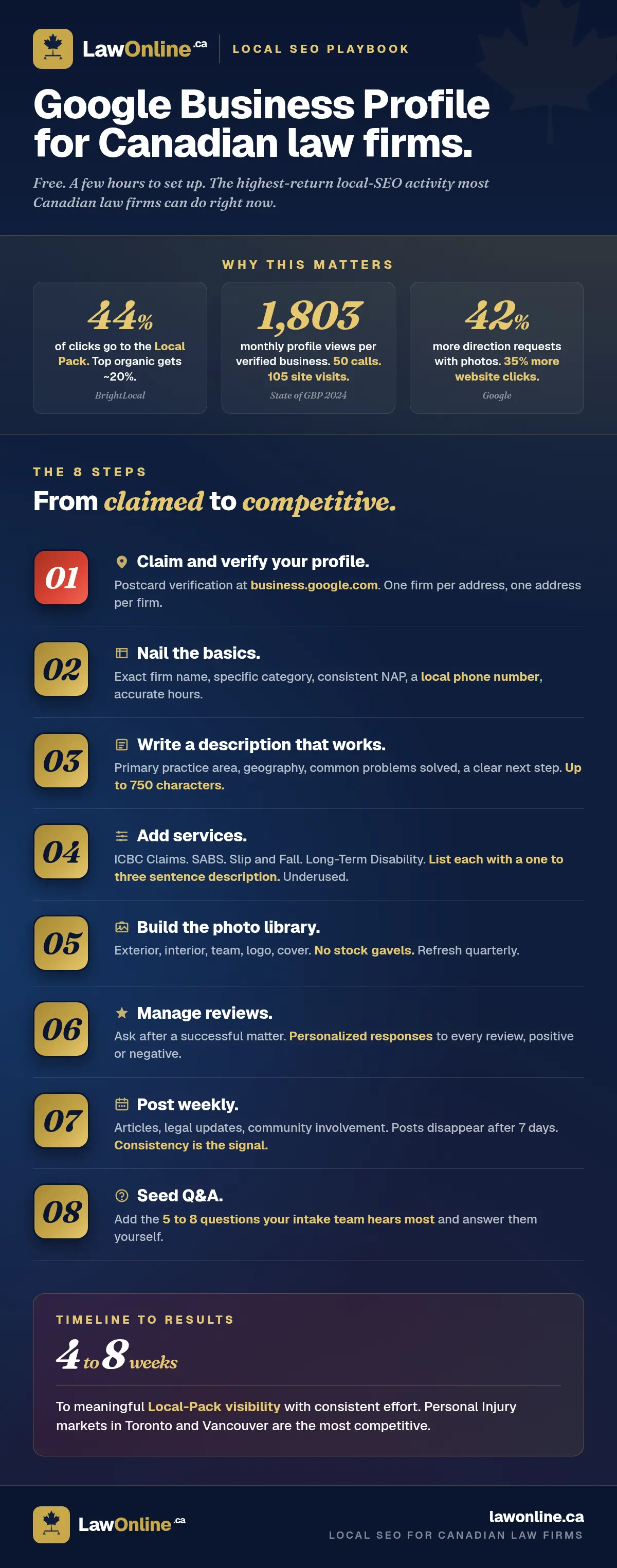
The Local Pack, the three business listings that appear above organic results for local searches, captures a significant share of clicks for service-based queries. Research from BrightLocal consistently shows that Local Pack results receive 44% of clicks on the page, with the top organic result getting around 20%.
The State of Google Business Profile 2024 report puts specific numbers behind this. Verified businesses average 1,803 monthly profile views. 84% of those views come from discovery searches. That means people who aren't searching for a specific firm by name. They're looking for a service, and the profile appears. Those profiles also generate roughly 50 phone calls and 105 website visits per month. For a free tool, that kind of qualified visibility is hard to beat.
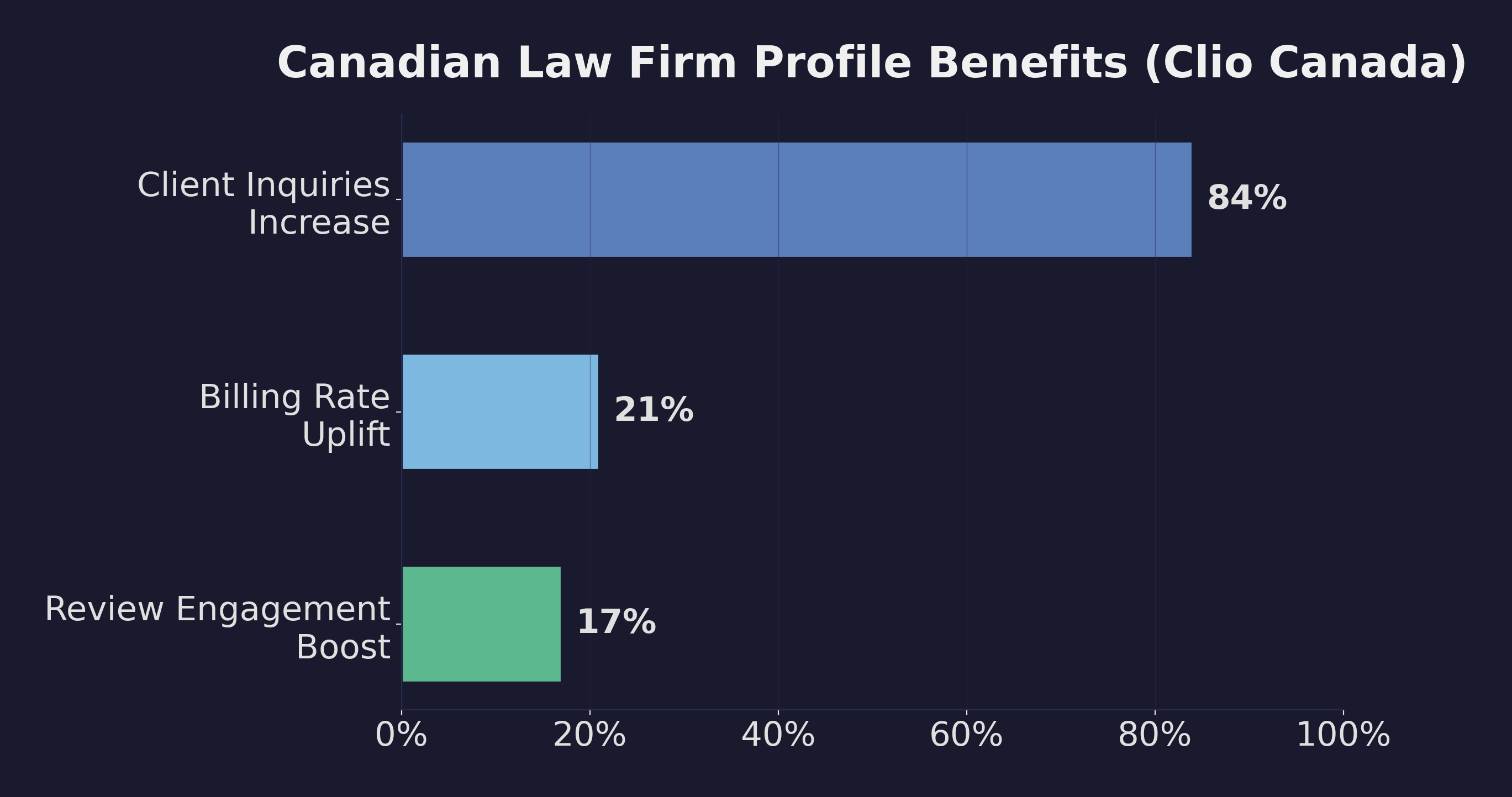
Canadian law firms specifically are seeing results. According to Clio's 2024 Legal Trends Report (Canadian edition), firms with optimized Google profiles report significant gains across the board.
For personal injury law firms, this is especially significant. "Car accident lawyer Toronto," "slip and fall lawyer Ottawa," "motorcycle accident lawyer Calgary." These are high-intent searches. The person searching isn't doing general research. They have a legal problem right now and they're looking for a firm to hire. Getting in the Local Pack for these searches puts your firm in front of those clients at the exact moment of intent.
Even for practice areas where clients do more extended research before calling, family law, estate planning, immigration, a complete and credible GBP sends trust signals before the client ever visits your website.
Step 1: Claim and Verify Your Profile
If you haven't already, claim your Google Business Profile at business.google.com. If your firm already has a profile, verify that you have ownership, it's common for Google to auto-generate profiles from data sources, and these unclaimed profiles can contain errors.
Verification is typically done by postcard (Google mails a code to your office address), though phone and video verification are available for some businesses. Until verification is complete, your profile won't display prominently in search.
One firm per address, one address per firm. If you have multiple office locations, create separate GBP listings for each. Personal injury firms with offices in multiple cities, Hamilton, Kitchener, and Burlington, for example, should have a verified listing for each location, with location-specific content in each.
Step 2: Nail the Basics
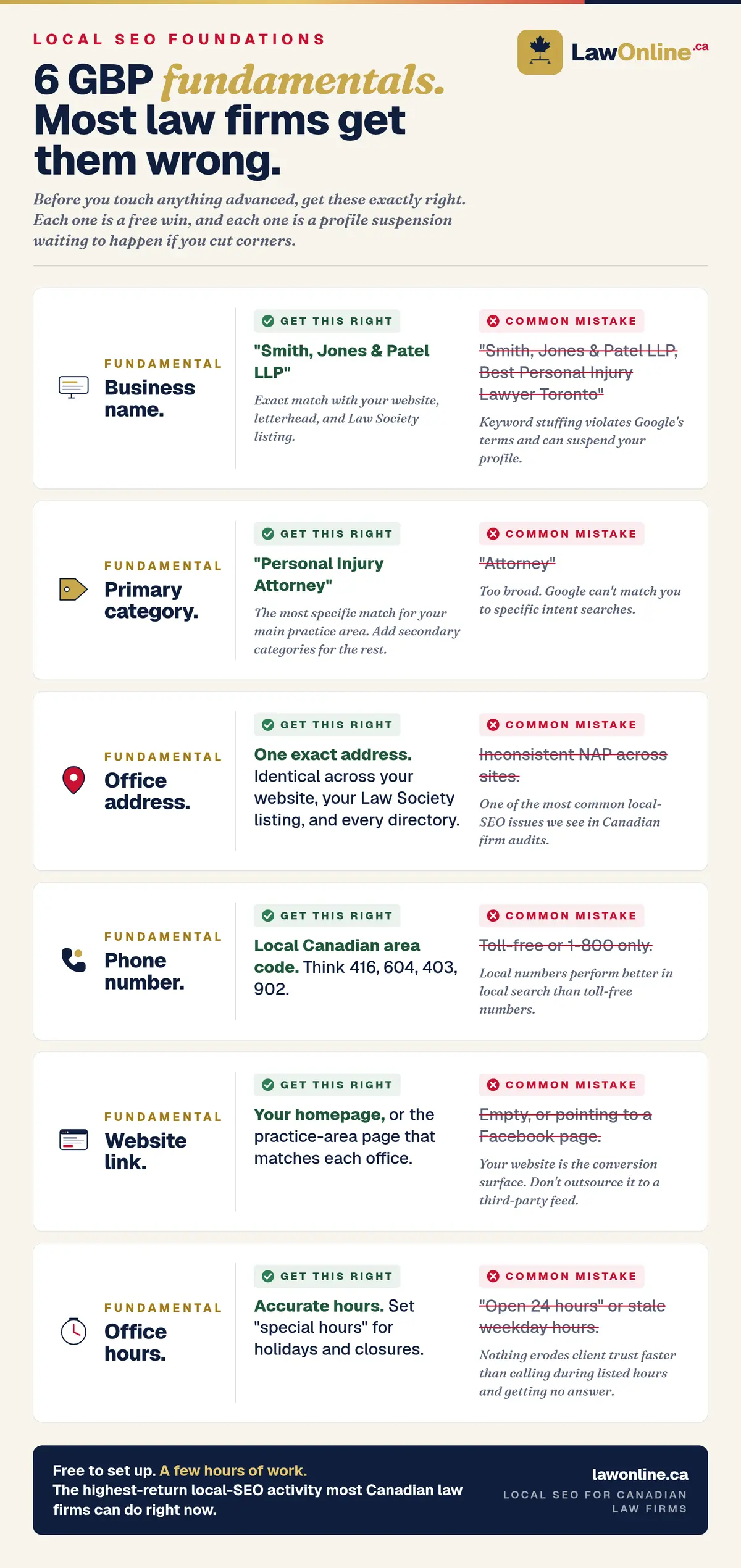
Before you work on anything advanced, ensure these fundamentals are correct:
Business name: Use your legal firm name exactly as it appears on your website and letterhead. Don't add keywords ("Best Personal Injury Lawyer Toronto"), this violates Google's guidelines and can get your profile suspended.
Category: Your primary category should be the most specific option that matches your main practice area. Common options for Canadian firms include "Personal Injury Attorney," "Family Law Attorney," "Immigration Attorney," "Criminal Justice Attorney," "Real Estate Attorney," and "Estate Planning Attorney." You can add secondary categories for additional practice areas your firm handles. Choose specific categories over broad ones, and don't leave secondary categories empty if your firm covers multiple areas.
Address: Use your exact office address. Make sure it matches what's on your website, your provincial law society listing, and other directories. Inconsistencies in NAP (Name, Address, Phone) data across the web are one of the most common local SEO issues law firms face. Our guide to Canadian legal directories covers which listings to fix first and how to keep them consistent.
Phone number: Use a local number, not a toll-free number. Local area codes perform better in local search.
Website: Link to your homepage, or to the relevant practice area landing page if you're running separate GBP listings for different offices.
Hours: Keep these accurate and updated. If your firm has varying hours, use the "special hours" feature for holidays. Nothing erodes client trust faster than calling during listed hours and getting no answer.
Step 3: Write a Business Description That Works
Your business description (up to 750 characters) appears in your profile and can influence both search relevance and client decisions. Most law firms write a generic paragraph that could apply to any firm in the country.
Write a description that:
- Mentions your primary practice area and the geographic area you serve
- Includes the most common client problems you solve (for personal injury: car accidents, slip and fall, long-term disability)
- Has a clear next step ("Call for a free consultation")
Example for a personal injury firm:
"[Firm Name] represents accident victims across the Greater Toronto Area. Our personal injury lawyers handle car accidents, slip and fall injuries, motorcycle accidents, and long-term disability claims, on a contingency fee basis, meaning you pay nothing unless we win. We offer free consultations by phone or in person. Serving clients in Toronto, Mississauga, Brampton, and surrounding communities."
This description is specific, mentions real search terms, answers the "what do you do and where" question, and includes a trust signal (contingency fee).
Step 4: Add Services
The Services section of GBP lets you list specific services with names, descriptions, and optional prices. This is underused by most law firms and represents a real opportunity.
For a personal injury firm, add services like:
- Car Accident Claims
- Slip and Fall Injuries
- Motorcycle Accident Claims
- Pedestrian Accident Claims
- Long-Term Disability Appeals
- ICBC Claims (for BC firms)
- Accident Benefits (for Ontario firms)
Write a 1-3 sentence description for each service. These descriptions are indexed by Google and contribute to relevance for specific searches. A profile that lists "ICBC Claims" as a service is more likely to appear when someone searches "ICBC lawyer Vancouver" than one that doesn't.
Step 5: Build Your Photo Library
GBP profiles with photos receive significantly more clicks than those without. According to Google's own data, businesses with photos receive 42% more requests for directions and 35% more website clicks.
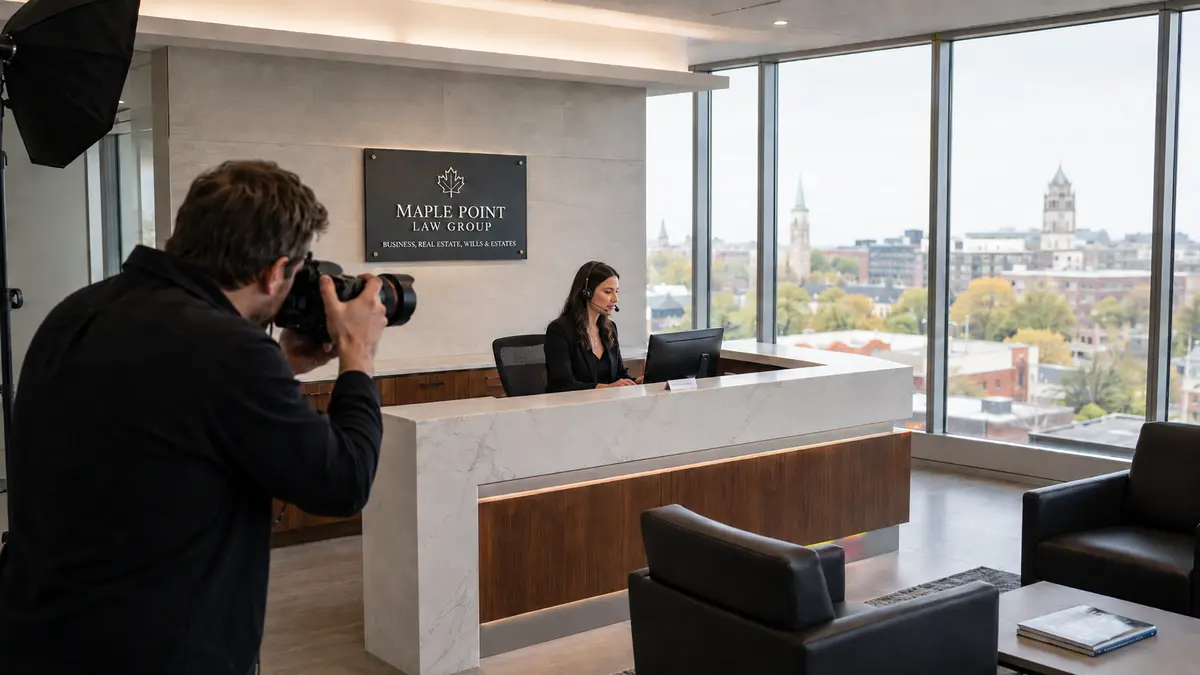
For law firms, photos should be professional but not sterile. Clients are evaluating whether they can trust you. Photos help with that.
What to include:
- Exterior photo: Your building from the street, ideally with your firm's signage visible. This helps clients find you and confirms you're a real, established business.
- Interior photos: Reception area, boardroom, individual offices. These set expectations and reduce anxiety for clients coming in for a first consultation.
- Team photos: Lawyers and staff. Faces matter. Personal injury clients especially want to see the people they'll be working with.
- Logo: Upload a clean version of your firm's logo as the logo image.
- Cover photo: Choose an image that represents your firm well, your building, your team, or a professional shot of your main office.
Avoid stock photos of courtrooms, gavels, or scales of justice. These look generic and don't help build trust.
Add new photos at least quarterly. Google's algorithm gives some preference to profiles with recent activity.
Step 6: Manage and Respond to Reviews
Reviews are one of the most important ranking factors in local search and one of the most significant trust signals for prospective clients. A personal injury firm with 80 four-star-plus reviews will consistently outrank a competitor with 12 reviews, all else being equal.
Getting more reviews:
The most reliable method is simply asking. After a matter concludes successfully, email your client a direct link to your Google review form (you can generate this from your GBP dashboard). A brief, sincere request, "If you're willing to share your experience, a Google review helps other accident victims find our firm", works better than automated review request campaigns.
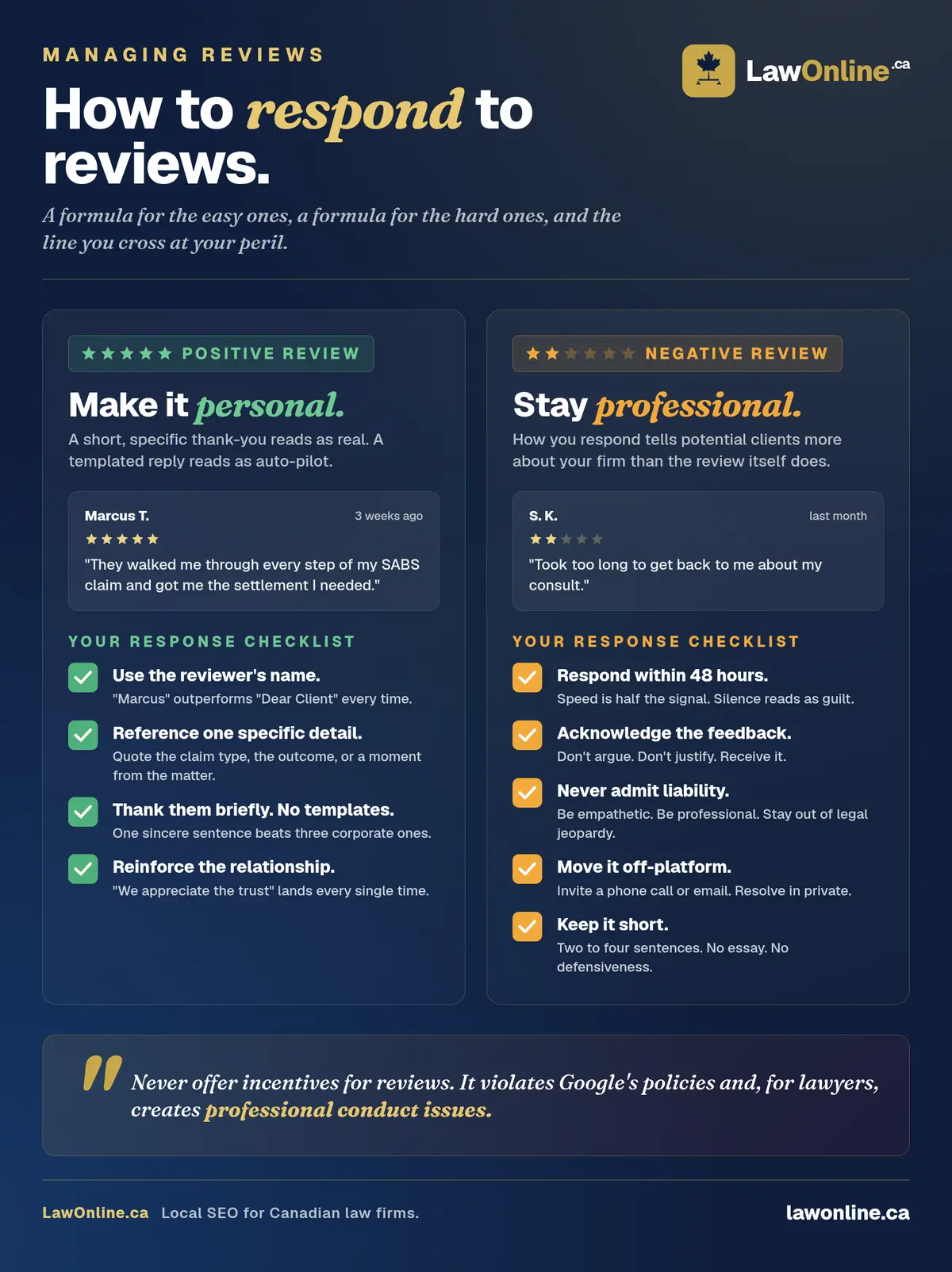
Never offer incentives for reviews. This violates Google's policies and, for lawyers, potentially creates professional conduct issues.
Responding to reviews:
Respond to every review, positive and negative. For positive reviews, a brief, personalized thank-you (not a template) reinforces the relationship and shows prospective clients that you're engaged. For negative reviews, respond professionally, acknowledge the feedback without admitting liability, and invite the reviewer to contact your office directly to resolve the matter.
How you respond to negative reviews tells potential clients more about your firm than the negative review itself does.
Step 7: Post Updates Regularly
GBP has a Posts feature that allows you to publish updates, news, and offers directly on your profile. Most law firms ignore this entirely.
Posts appear on your profile and can contain text, photos, and calls to action. For a personal injury firm, good post topics include:
- Recent blog articles ("New article: What to do in the first 24 hours after a car accident")
- Legal updates ("Ontario changes to auto insurance: what accident victims need to know")
- Community involvement ("Our team at the Hamilton Stoney Creek Charity Walk")
- Free consultation reminders
Post at least once per week. Posts disappear after seven days (for "Update" posts), so consistent posting keeps your profile looking active. This frequency of activity is also a local SEO signal.
Step 8: Use Q&A Proactively
The Questions & Answers section on GBP allows anyone to ask and answer questions about your business, including you. Many law firms don't know they can seed this section with their own FAQs.
Add the 5-8 questions your intake team hears most often, and answer them directly. For a personal injury firm, this might include:
- "Do you take cases on a contingency fee basis?"
- "How long does a car accident claim typically take in Ontario?"
- "Do I need to see a doctor before contacting a lawyer?"
- "Do you have a free consultation?"
Pre-populating Q&A not only helps prospective clients, it also adds indexed content to your profile that can improve relevance for specific searches.
Common Mistakes Canadian Law Firms Make
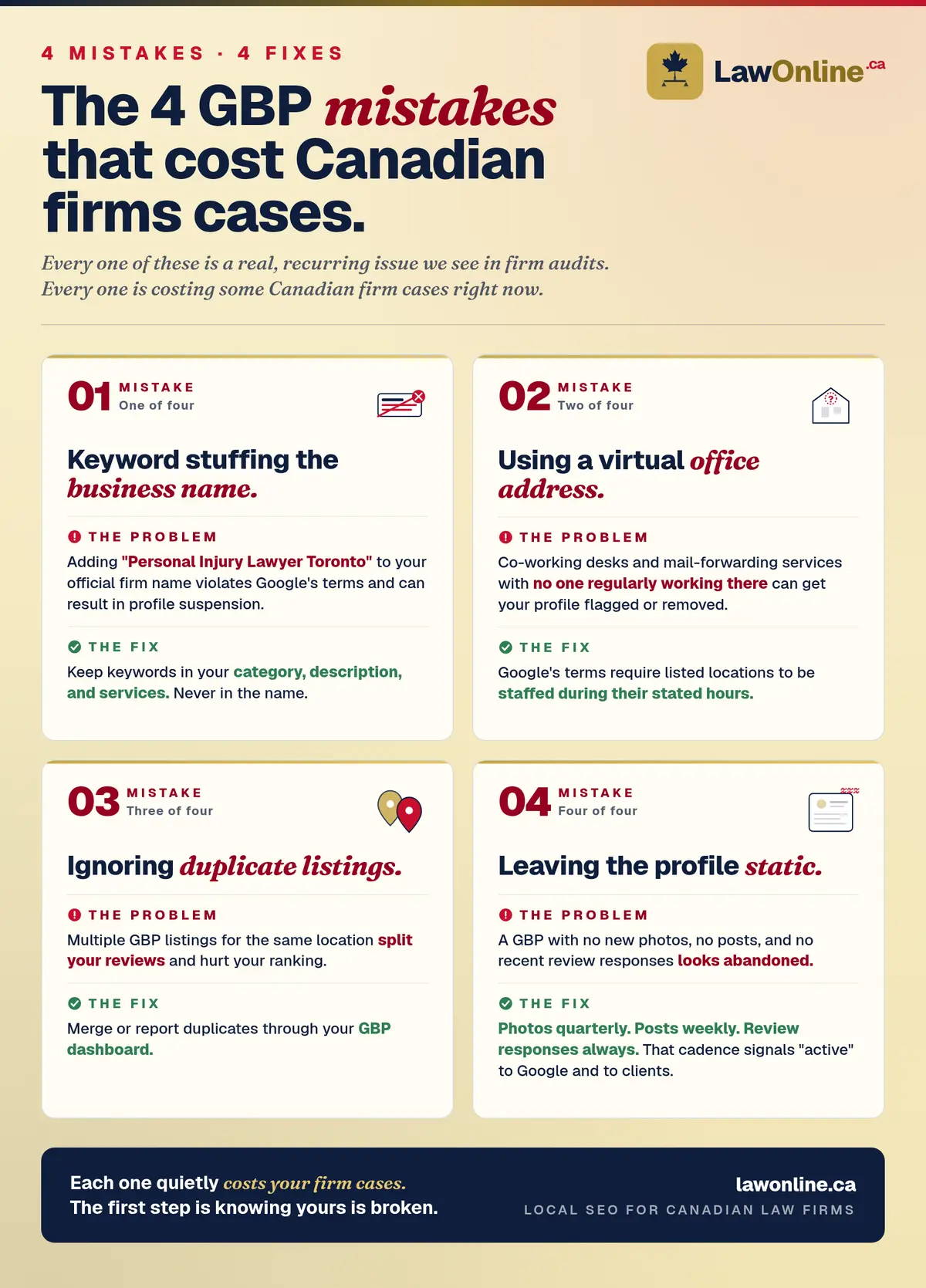
Keyword stuffing the business name. Adding "Personal Injury Lawyer Toronto" to your official firm name violates Google's terms and can result in your profile being suspended. Your category, description, and services are the right places for keywords.
Using a virtual office address. If the address on your GBP is a shared co-working space or mail forwarding service and nobody is regularly working there, your profile may be flagged or removed. Google's terms require that listed locations be staffed during their stated hours.
Ignoring duplicate listings. If your firm has multiple GBP listings for the same location, they can split your reviews and hurt your ranking. Merge or report duplicates through your GBP dashboard.
Leaving the profile static. A GBP with no new photos, no posts, and no recent review responses looks abandoned. Regular activity signals to Google, and to prospective clients, that your firm is active and engaged.
How Long Until You See Results?
For firms starting from scratch or with poorly optimized profiles, meaningful improvement in Local Pack visibility can happen in 4-8 weeks with consistent effort. The main variables are your market's competitiveness (personal injury in major cities like Toronto and Vancouver is highly competitive), the strength of your review profile, and the consistency of your NAP data across the web.
Google Business Profile optimization isn't a one-time project. The firms that maintain a competitive edge in local search are the ones that treat GBP as an ongoing channel, not a checkbox.
LawOnline.ca helps Canadian law firms optimize their Google Business Profile and local SEO presence. If you want a free audit of your current GBP and local search performance, reach out through our contact form.
Frequently Asked Questions
How do I claim my law firm's Google Business Profile?
Go to business.google.com and search for your firm. If a profile exists, you can request ownership. If not, create one. Verification is typically done by postcard to your office address, though phone and video verification are available for some businesses. Until verification is complete, your profile won't display prominently in search results.
What category should I choose for my law firm's Google Business Profile?
Choose the most specific category that accurately describes your primary practice area. Personal injury firms should select "Personal Injury Attorney," family law firms "Family Law Attorney," immigration practices "Immigration Attorney," and so on. You can add secondary categories for additional practice areas. Avoid adding keywords to your business name. That violates Google's guidelines and can lead to profile suspension.
How do Google reviews affect a law firm's local search ranking?
Google reviews are one of the strongest signals in the local ranking algorithm. The volume, recency, and average rating of your reviews all influence where your profile appears in the Local Pack, the map-based results that appear at the top of the page for local legal queries. A consistent stream of genuine, recent reviews is more valuable than a large number of older ones.
Does my Google Business Profile affect AI Overview results?
Yes. Google's AI Overviews draw heavily from Business Profile data for local law firm queries. A complete, verified, and optimized profile with strong reviews and regular activity increases the likelihood that your firm appears accurately in AI-generated local results. This is becoming more important as AI Overviews expand across Canadian search queries. Our GEO guide for Canadian law firms covers how to optimize for AI search surfaces beyond just Google.