You've probably seen the advice before. "Publish two blog posts a month." "Create a content calendar." "Stay consistent."
So your firm opens a spreadsheet, brainstorms 24 topics, assigns them to months, and calls it a legal content plan.
Six months later, half the posts haven't been written. The ones that did get published sit at zero traffic. Nobody at the firm can explain how the blog connects to actual case intake. The spreadsheet gets quietly abandoned.
This is how most law firm editorial calendars die. Not because the firm lacked discipline, but because the calendar was built wrong from the start.
That's a problem worth solving. Canadian Industry Statistics count over 52,000 legal services establishments in Canada, and 99.5% of them have fewer than 100 employees. In a market that saturated with small firms, consistent content is one of the few advantages you can build without hiring another associate.
Why Most Law Firm Editorial Calendars Fail
The typical law firm content calendar is a list of topics. "Blog about slip and fall claims in January." "Write about child custody in February." Topics get chosen based on what feels relevant, what a competitor published, or what an associate volunteered to write about.
That's a topic list, not a law firm content strategy.

A 2026 synthesis of 12 publishing studies found that businesses posting 11 or more times per month saw 3.5 times more organic traffic than those publishing once a month. The research is US-based, but the underlying dynamic applies anywhere Google is the primary discovery channel: consistent output compounds, and a calendar that collapses after six months wastes whatever momentum it built.
An effective editorial calendar starts with search intent, not topics. Every piece of content should answer a question that a specific person is already typing into Google. When you build from intent, you're creating content that has a built-in audience. When you build from topics, you're guessing.
A personal injury firm that publishes "Understanding Negligence in Ontario" is covering a topic. The same firm publishing "What Happens After a Slip and Fall in a Grocery Store in Ontario" is answering a question that someone with a real legal problem is searching right now. The second piece will rank faster, attract more qualified traffic, and convert at a higher rate.
The other failure mode is treating every month the same. Legal demand is seasonal. Personal injury searches spike after long weekends and during winter driving season. Family law queries jump in January (post-holiday separation filings) and September (back-to-school custody disputes). Criminal defence searches surge around major holidays. An editorial calendar that ignores these patterns is leaving traffic on the table.
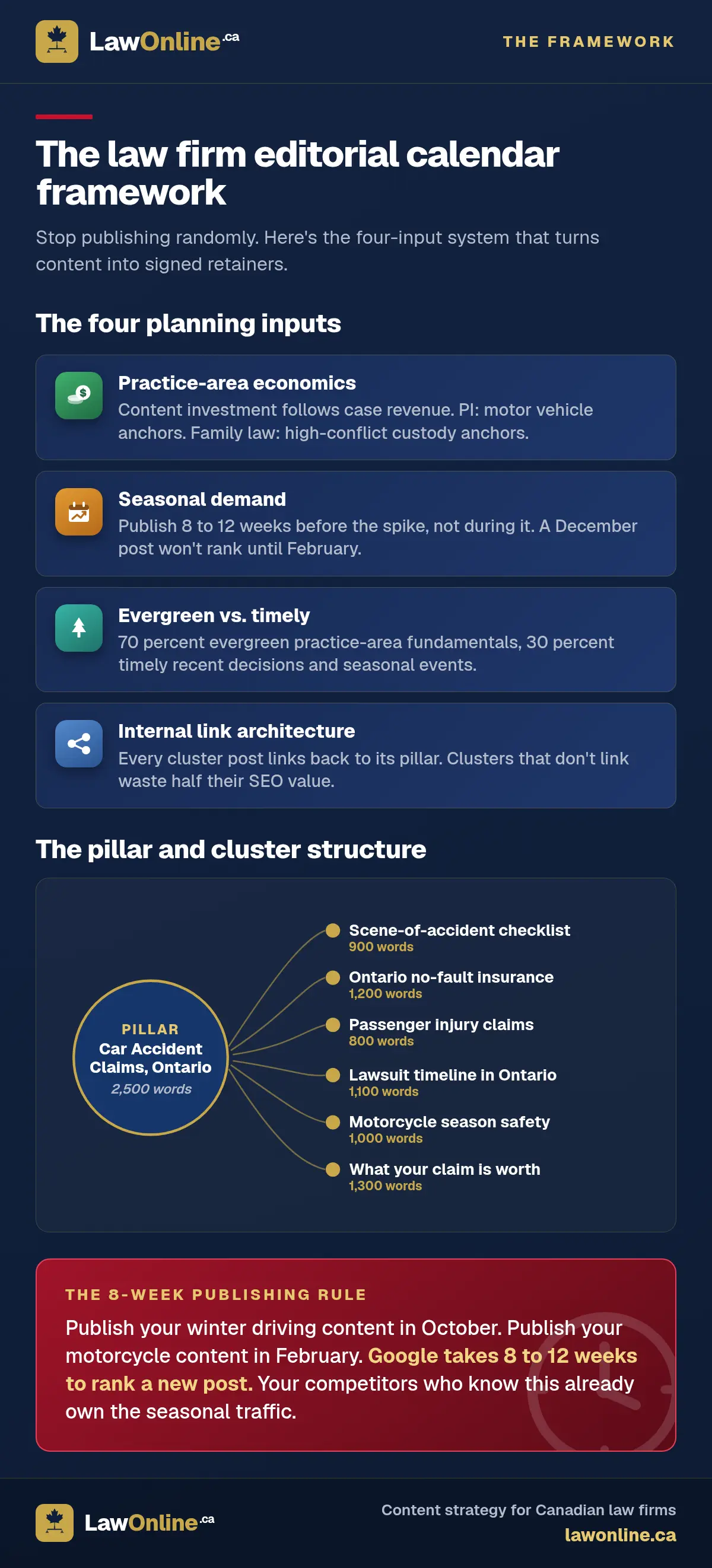
The Four Inputs to Your Law Firm Content Strategy
Before you slot a single topic into your legal content marketing plan, you need four pieces of information.
1. Practice-Area Economics
Not all cases are worth the same to your firm. A personal injury firm might generate $50,000 to $500,000 per motor vehicle accident case on contingency, while a small estate matter brings in $3,000. Your content investment should reflect that gap. The average Canadian legal services SME generates about $398,000 in annual revenue, so a single additional high-value case brought in by well-targeted content can meaningfully shift the bottom line.
Map your practice areas by revenue per case and volume of cases per year. The practice areas that generate the most total revenue deserve the most content. For a PI firm, motor vehicle accidents, slip and falls, and medical malpractice should dominate the calendar. Supporting areas like dog bites or product liability fill gaps but don't anchor the plan.
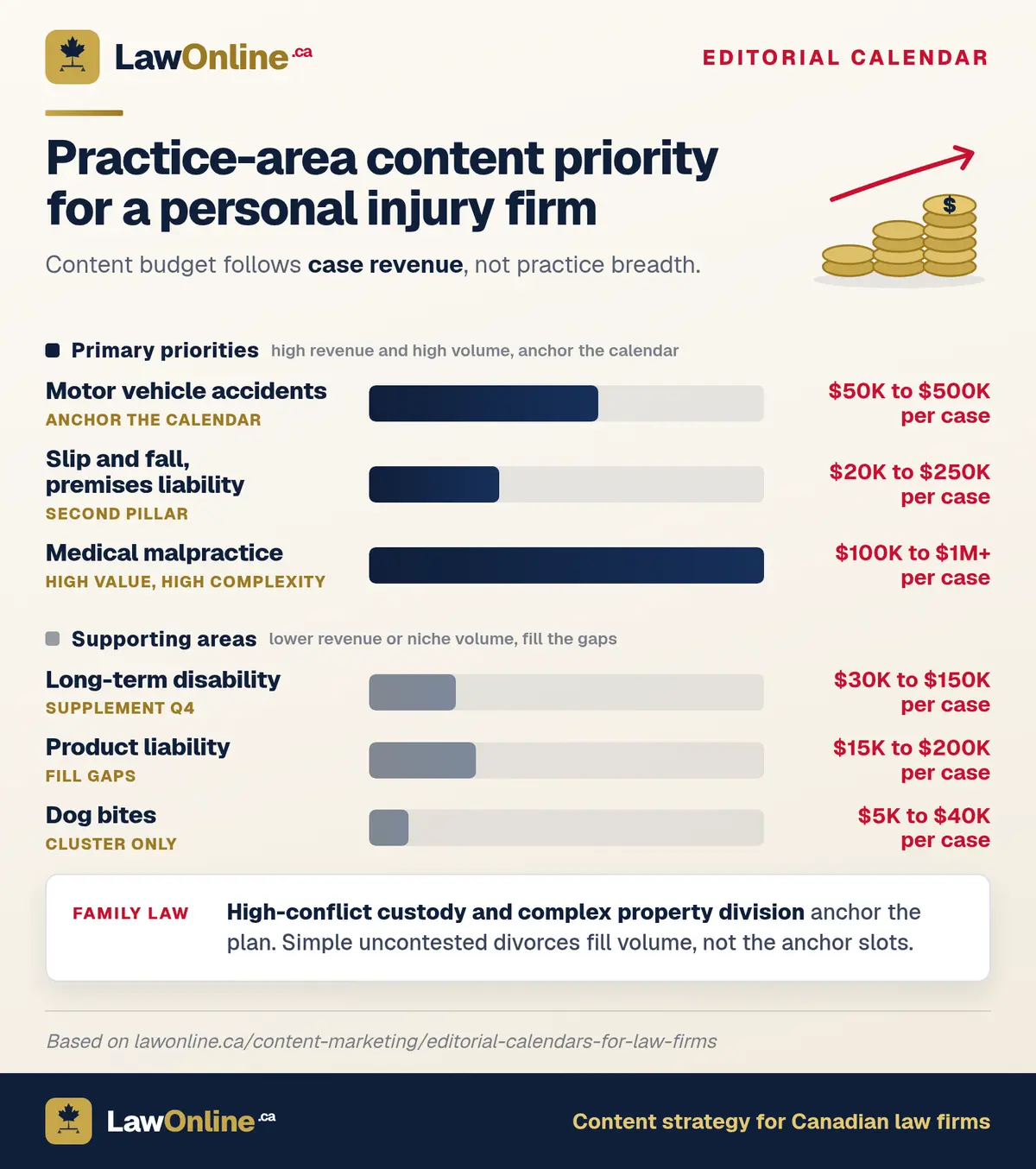
For a family law firm, high-conflict custody cases and complex property division are typically the highest-value files. Simple uncontested divorces bring volume but lower per-file revenue. The calendar should weight content toward the high-value matters where a single new client justifies months of content production.
2. Seasonal Demand
Search volume for legal topics follows predictable seasonal patterns. You want your content published and indexed before the seasonal spike, not during it. Google needs time to crawl, index, and rank new content. Publishing a winter driving accident post in December means it won't rank until February, when search volume for that topic has already dropped.
Here's what the seasonal curve typically looks like for personal injury:
- January to March: Slip and fall claims (ice, snow, parking lots). Winter driving accident searches peak.
- April to June: Motorcycle season opens. Construction site accident searches increase as building season starts.
- July to September: Long weekend accident spikes (Canada Day, August civic holiday, Labour Day). Cycling accident searches peak in summer months.
- October to December: Early winter driving accidents. Holiday-related incidents (impaired driving, slip and falls at retail locations).
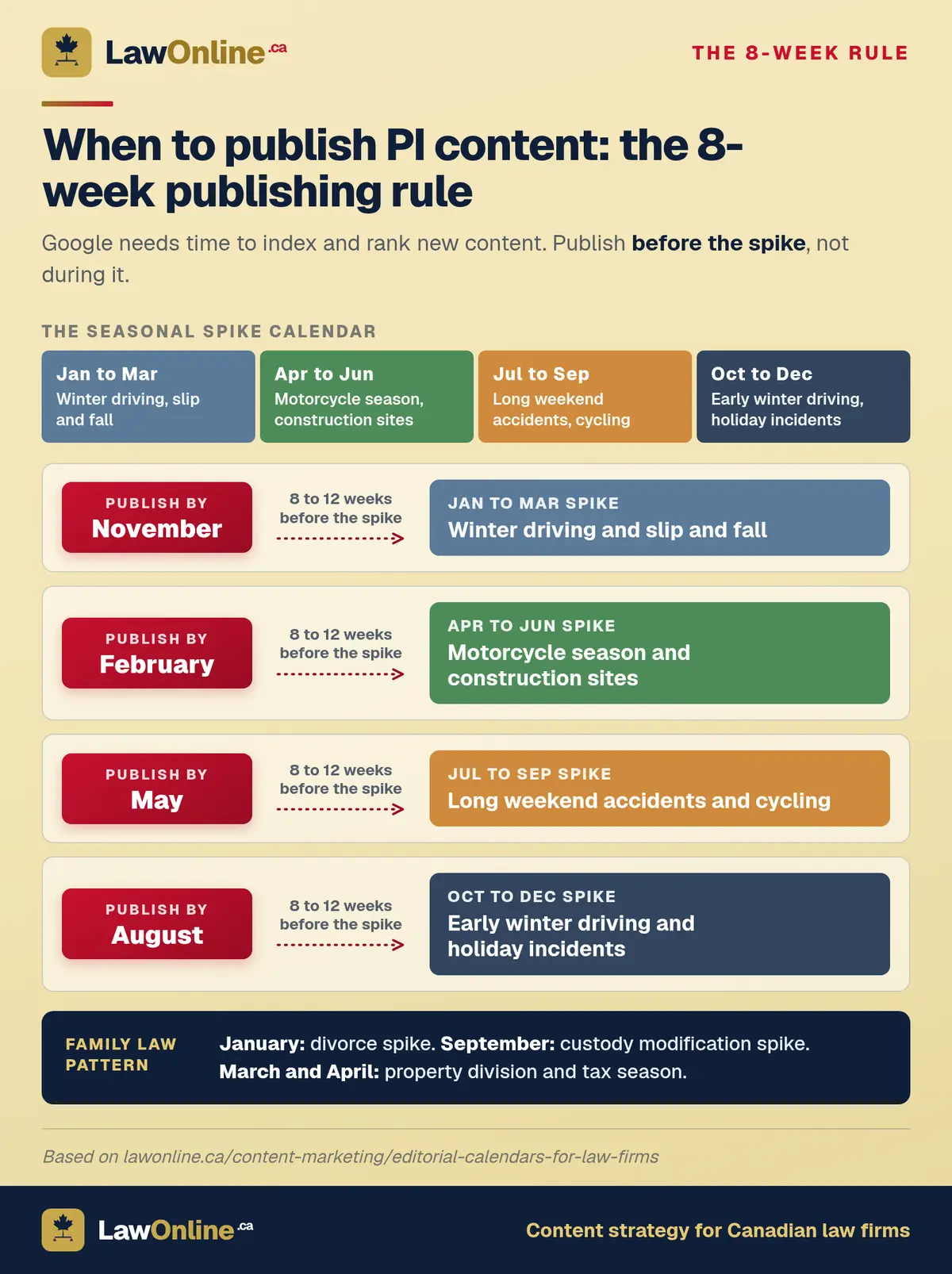
For family law, the pattern is different:
- January: Highest search volume for divorce and separation queries. The "January effect" after the holidays is well-documented.
- September: Second spike tied to back-to-school custody modifications.
- March to April: Tax season triggers searches about spousal support calculations and property division.
The rule of thumb: publish content 8 to 12 weeks before its seasonal demand peak. That gives Google enough time to index and rank the page before searches start climbing.
3. Evergreen vs. Time-Sensitive Content
Your calendar needs both types, in the right ratio.
Evergreen content answers questions that people search for year-round: "How long does a personal injury lawsuit take in Ontario?" or "What does a family lawyer cost in Alberta?" These pieces generate steady traffic for years with minimal updates. They're the foundation of your content marketing strategy.
Time-sensitive content responds to legal developments, new court decisions, regulatory changes, or seasonal events. A post about a major Supreme Court of Canada decision in personal injury law. An article about changes to Ontario's Family Law Rules. These pieces spike in traffic when published and then taper off.
The right ratio for most law firms is roughly 70/30 in favour of evergreen. Your evergreen pieces compound over time, building a growing base of organic traffic. Time-sensitive content supplements that base with short-term spikes and demonstrates that your firm stays current.
A common mistake is going 100% evergreen and never publishing anything timely. That makes your blog look stale. Another mistake is chasing every news cycle and never building the foundational content that ranks long-term.
4. Internal Link Architecture
Every new piece of content should strengthen your existing content. Before you finalize your calendar, map out how each planned post connects to your pillar pages, service pages, and other articles.
A personal injury firm might have a main practice area page at /personal-injury/ and sub-pages for each case type: /personal-injury/car-accidents/, /personal-injury/slip-and-fall/, /personal-injury/medical-malpractice/. Blog posts about specific PI topics should link to the relevant practice area page, to related blog posts, and to other service pages where they make sense. This internal linking structure tells Google which pages matter most and helps readers navigate deeper into your site.
Plan your links before you write, not after. When you know that your March post about motorcycle accidents needs to link to your general PI pillar page and your existing post about types of legal content, you can write transitions that make those links feel natural rather than forced.
The 12-Month Framework: Pillar Months vs. Cluster Months
Here's the framework we recommend for planning a law firm's content year.
Pillar months are when you publish major, comprehensive pieces. These are your 2,000+ word guides that target high-volume keywords and serve as the hub for related content. Plan one pillar piece per quarter, aligned with your highest-value practice areas.
Cluster months fill in between pillar months with supporting content. These are shorter, more specific posts that target long-tail keywords and link back to your pillar content. Each pillar piece should have two to four cluster posts that support it.
The pattern looks like this:
- Month 1: Pillar piece for top practice area
- Month 2: Two cluster posts supporting the Month 1 pillar
- Month 3: One cluster post + one time-sensitive or seasonal piece
- Month 4: Pillar piece for second practice area
- Month 5: Two cluster posts supporting the Month 4 pillar
- Month 6: One cluster post + one time-sensitive piece
Repeat for the second half of the year with your next two priority practice areas.
This structure works because it concentrates topical authority. Instead of scattering random posts across 12 months, you build deep coverage around specific practice areas in focused blocks. Google rewards this depth, and readers benefit from comprehensive coverage of their actual legal questions.
Personal Injury Editorial Calendar: 12-Month Example
Here's what a full year looks like for a mid-size personal injury firm in Ontario. This assumes two to three posts per month, weighted toward the firm's highest-revenue case types.
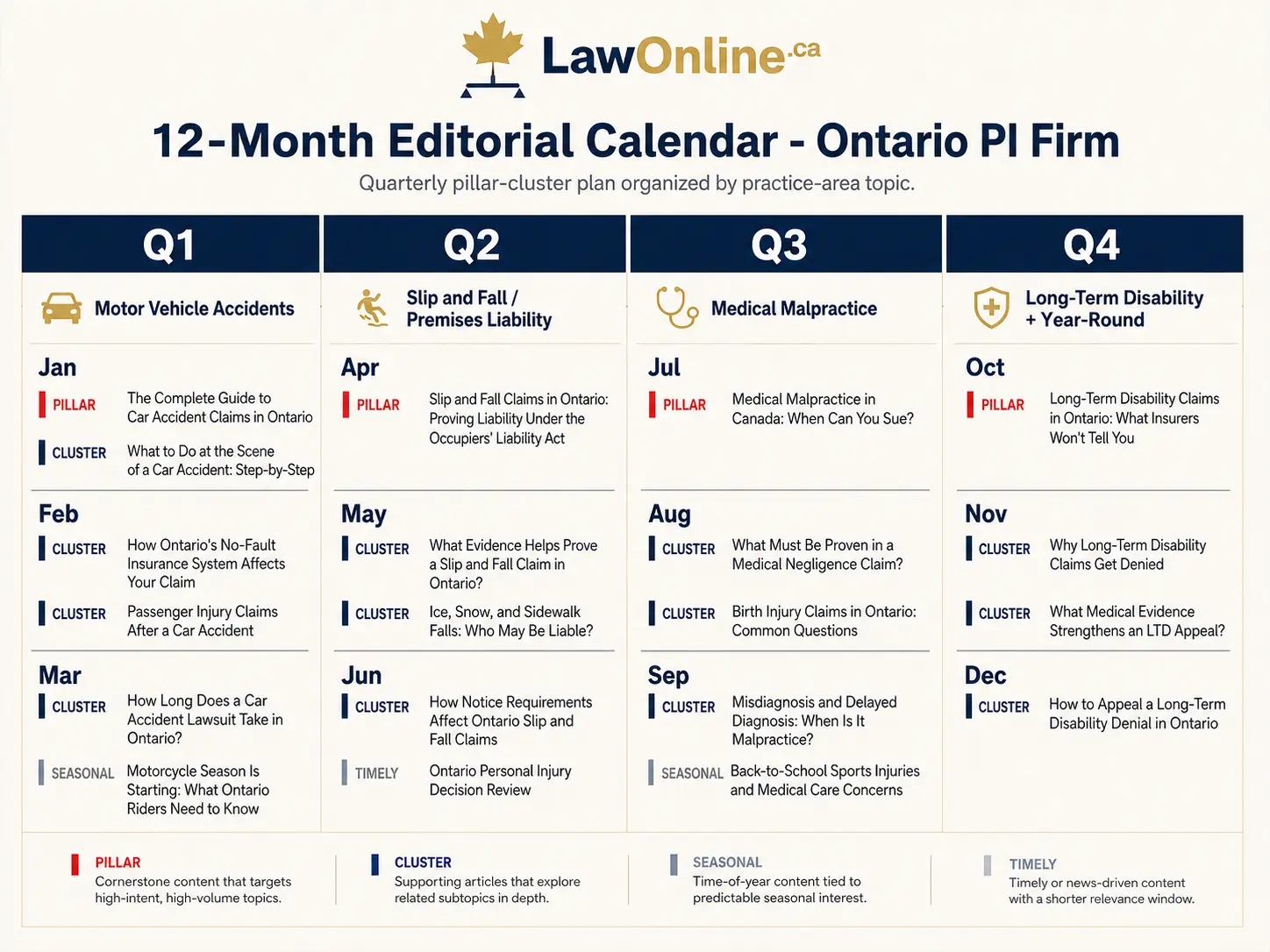
Q1 (January to March) - Motor Vehicle Accidents
- January (Pillar): "The Complete Guide to Car Accident Claims in Ontario" (2,500 words, targets "car accident lawyer Ontario")
- January (Cluster): "What to Do at the Scene of a Car Accident in Ontario: A Step-by-Step Checklist"
- February (Cluster): "How Ontario's No-Fault Insurance System Affects Your Accident Claim"
- February (Cluster): "Passenger Injury Claims After a Car Accident: What Ontario Law Says"
- March (Cluster): "How Long Does a Car Accident Lawsuit Take in Ontario?"
- March (Seasonal): "Motorcycle Season Is Starting: What Ontario Riders Need to Know About Liability"
Q2 (April to June) - Slip and Fall / Premises Liability
- April (Pillar): "Slip and Fall Claims in Ontario: Proving Liability Under the Occupiers' Liability Act"
- April (Cluster): "Slip and Fall in a Grocery Store: Who's Responsible in Ontario?"
- May (Cluster): "Construction Site Injuries in Ontario: Workers' Compensation vs. Civil Claims"
- May (Cluster): "What Counts as 'Reasonable Maintenance' for Property Owners in Slip and Fall Cases"
- June (Cluster): "Swimming Pool and Waterpark Injuries: Liability in Ontario"
- June (Timely): Review of any notable Ontario personal injury decision from the spring court term
Q3 (July to September) - Medical Malpractice
- July (Pillar): "Medical Malpractice in Canada: When Can You Sue a Doctor or Hospital?"
- July (Cluster): "Surgical Error Claims in Ontario: What You Need to Prove"
- August (Cluster): "Misdiagnosis Lawsuits in Canada: How Delayed Diagnosis Becomes Negligence"
- August (Seasonal): "Long Weekend Driving: What to Do If You're in an Accident on a Highway"
- September (Cluster): "Birth Injury Claims in Ontario: Statute of Limitations and What Parents Need to Know"
- September (Cluster): "How Expert Witnesses Work in Canadian Medical Malpractice Cases"
Q4 (October to December) - Insurance Disputes + Year-End
- October (Pillar): "Dealing with Insurance Companies After an Injury: A Guide for Ontario Claimants"
- October (Cluster): "How to Challenge a Denied Long-Term Disability Claim in Ontario"
- November (Cluster): "Accident Benefits in Ontario: What Your Auto Insurance Actually Covers"
- November (Cluster): "Pedestrian Accidents in Ontario: Liability and Compensation"
- December (Seasonal): "Holiday Season Accidents: Impaired Driving Claims and Winter Slip and Falls"
- December (Planning): "Year in Review: Key Ontario Personal Injury Decisions from [Year]"
Notice the structure: every quarter anchors on a pillar piece for a different PI sub-category. Cluster posts drill into specific scenarios within that category. Seasonal and timely posts are scattered throughout based on when demand peaks, not when they're convenient to write.
The entire calendar maps to revenue. Motor vehicle accidents come first because they're typically the highest-value cases. Medical malpractice gets a full quarter because those cases, while lower in volume, carry the highest average settlement values.
Family Law Editorial Calendar: 12-Month Example
Family law follows a different rhythm. Here's a condensed example for a family law firm in Ontario.
Q1 (January to March) - Divorce and Separation
- January (Pillar): "Filing for Divorce in Ontario: The Complete Process from Separation to Decree" (capitalize on the January search spike)
- February (Cluster): "Division of Property in Ontario Divorce: What's Included and What's Not"
- March (Cluster): "Spousal Support Calculations: How Ontario Courts Determine Amount and Duration"
Q2 (April to June) - Child Custody
- April (Pillar): "Child Custody and Parenting Time in Ontario: How the Best Interests Test Works"
- May (Cluster): "Relocation with Children After Separation: What Ontario Law Requires"
- June (Cluster): "Summer Parenting Schedules: Modifying Custody Arrangements for School Breaks"
Q3 (July to September) - Financial Issues
- July (Pillar): "Family Law Costs in Ontario: What to Budget for a Divorce or Custody Case"
- August (Cluster): "Child Support Modifications: When and How to Request a Change in Ontario"
- September (Seasonal): "Back-to-School Custody Disputes: Handling School Enrollment and Extracurricular Disagreements"
Q4 (October to December) - Alternative Processes
- October (Pillar): "Mediation vs. Litigation in Ontario Family Law: Costs, Timelines, and Outcomes"
- November (Cluster): "Collaborative Family Law in Ontario: Is It Right for Your Situation?"
- December (Timely): "Preparing for January: What to Know Before Starting Divorce Proceedings in the New Year"
The January pillar piece is the most important post on this calendar. Family law searches peak in January, and your content needs to be live and indexed by then. That means writing and publishing it in November at the latest, not on January 2nd when everyone else is scrambling.
Choosing the Right Tools
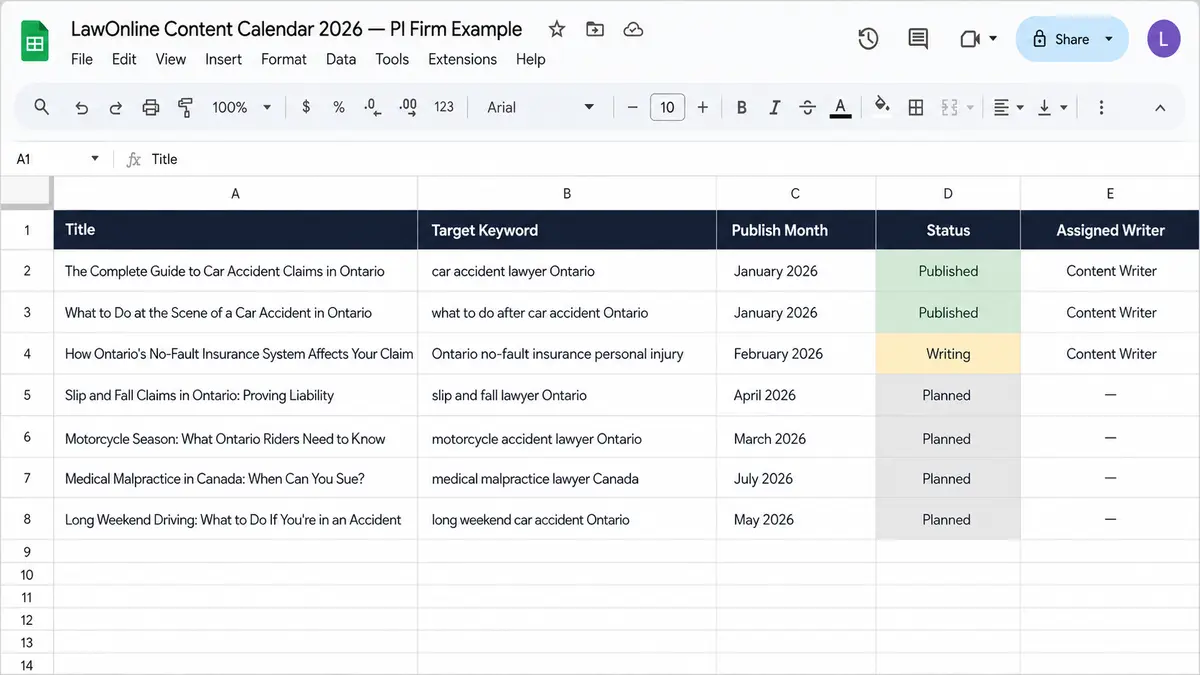
Whether you call it an editorial calendar or a content calendar, you don't need expensive software to run one. What matters is that your system tracks four things: the topic, the target keyword, the publish date, and the current status.
Spreadsheets (Google Sheets, Excel) work well for firms publishing two to four posts per month. A simple sheet with columns for title, target keyword, publish month, status (planned/writing/review/published), and the assigned writer handles everything a small team needs. The advantage is simplicity. Everyone already knows how to use a spreadsheet.
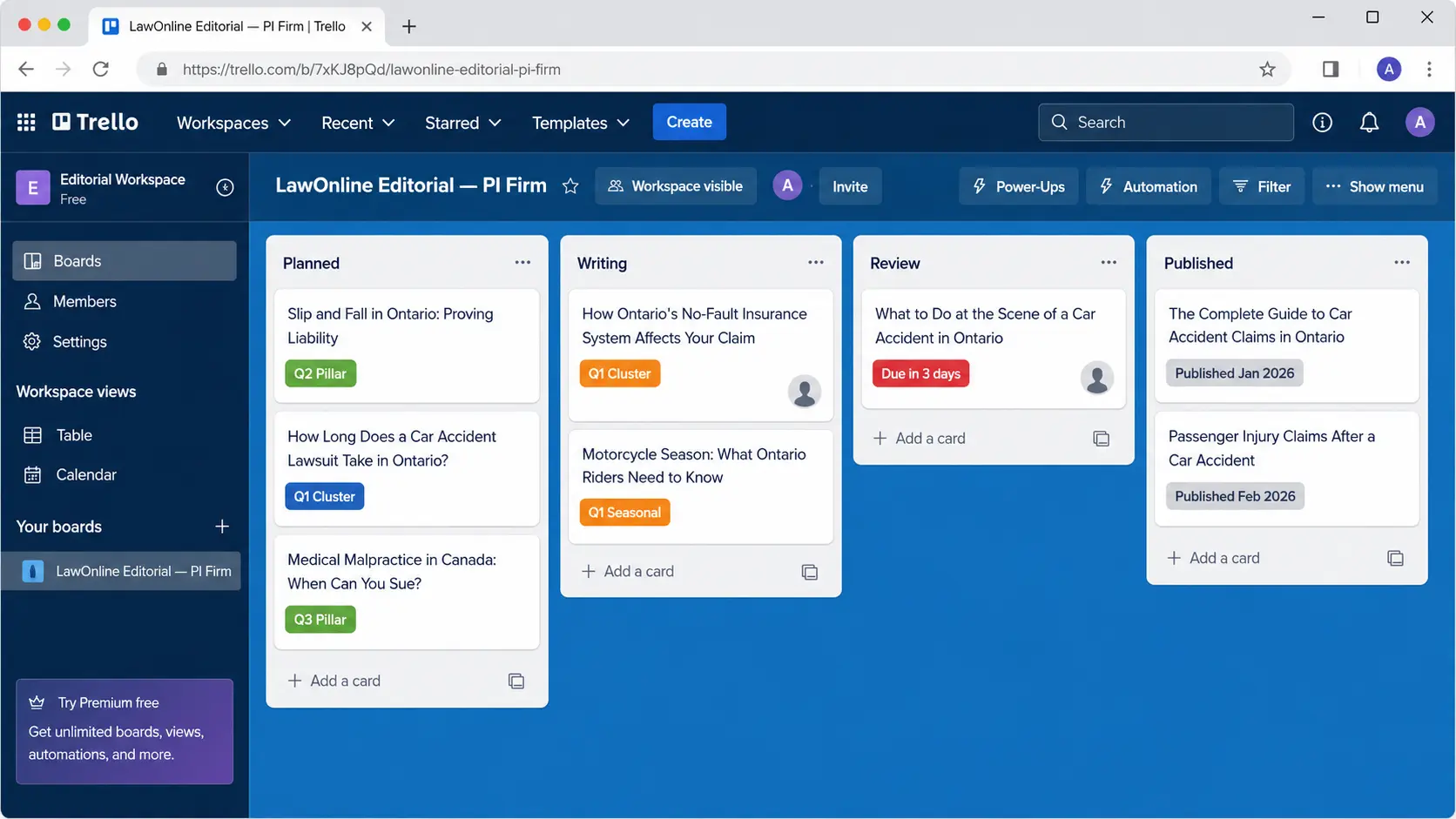
Project boards (Trello, Asana, Monday.com) add visual workflow management. Cards move from "Planned" to "Writing" to "Review" to "Published." This works better when multiple people contribute to content production, because the board makes bottlenecks visible. If six cards are stuck in "Review," you know your approval process is the constraint.
CMS editorial tools (WordPress Editorial Calendar, HubSpot) integrate the calendar directly into your publishing platform. This reduces the gap between planning and execution, but it also ties your planning to a specific tool. If you switch CMS platforms, your calendar history doesn't come with you.
Our recommendation: start with a spreadsheet. It forces you to think about the content plan without the distraction of configuring workflows and automations. AI tools can help with topic ideation and gap analysis once your framework is in place, but they supplement the strategic thinking rather than replacing it. If your content operation grows to more than four posts per month with multiple writers, graduate to a project board.
Integrating Your Editorial Calendar with Paid and Social
Your editorial calendar shouldn't exist in isolation. Every piece of content you publish can work harder if you coordinate it with your paid advertising and social media.
Paid search: When you publish a new pillar piece, consider running a small Google Ads campaign targeting the same keyword cluster for four to six weeks. The paid traffic generates immediate visibility while the organic rankings build. Once the organic ranking stabilizes, you can scale back the ad spend. This is especially effective for high-value PI keywords where organic rankings take months to achieve. Check our guide on how much law firm marketing costs in Canada for budgeting context.
Social media: Every blog post should generate at least two to three social media posts. Not just "new blog post" announcements. Pull a specific stat, a counterintuitive finding, or a practical tip from the article and turn it into a standalone social post. Link back to the full article. Schedule these across the week following publication and again two to three weeks later.
Email: If your firm maintains a mailing list of past clients or referral sources, a monthly content digest keeps you visible. Don't send the full article. Send a two-sentence summary with a link. Past PI clients who receive a monthly email about safety topics and legal developments are more likely to refer friends and family.
The editorial calendar is where you coordinate this. Add columns for "social posts scheduled" and "email included" so your team can see the full distribution plan alongside the publishing schedule.
Common Mistakes to Avoid
Writing for lawyers instead of clients. Your blog's audience is people with legal problems, not other lawyers. If your planned topic is "Recent Developments in Ontario Tort Law," reframe it as "New Court Rulings That Affect Your Personal Injury Claim in Ontario." Same substance, different entry point.
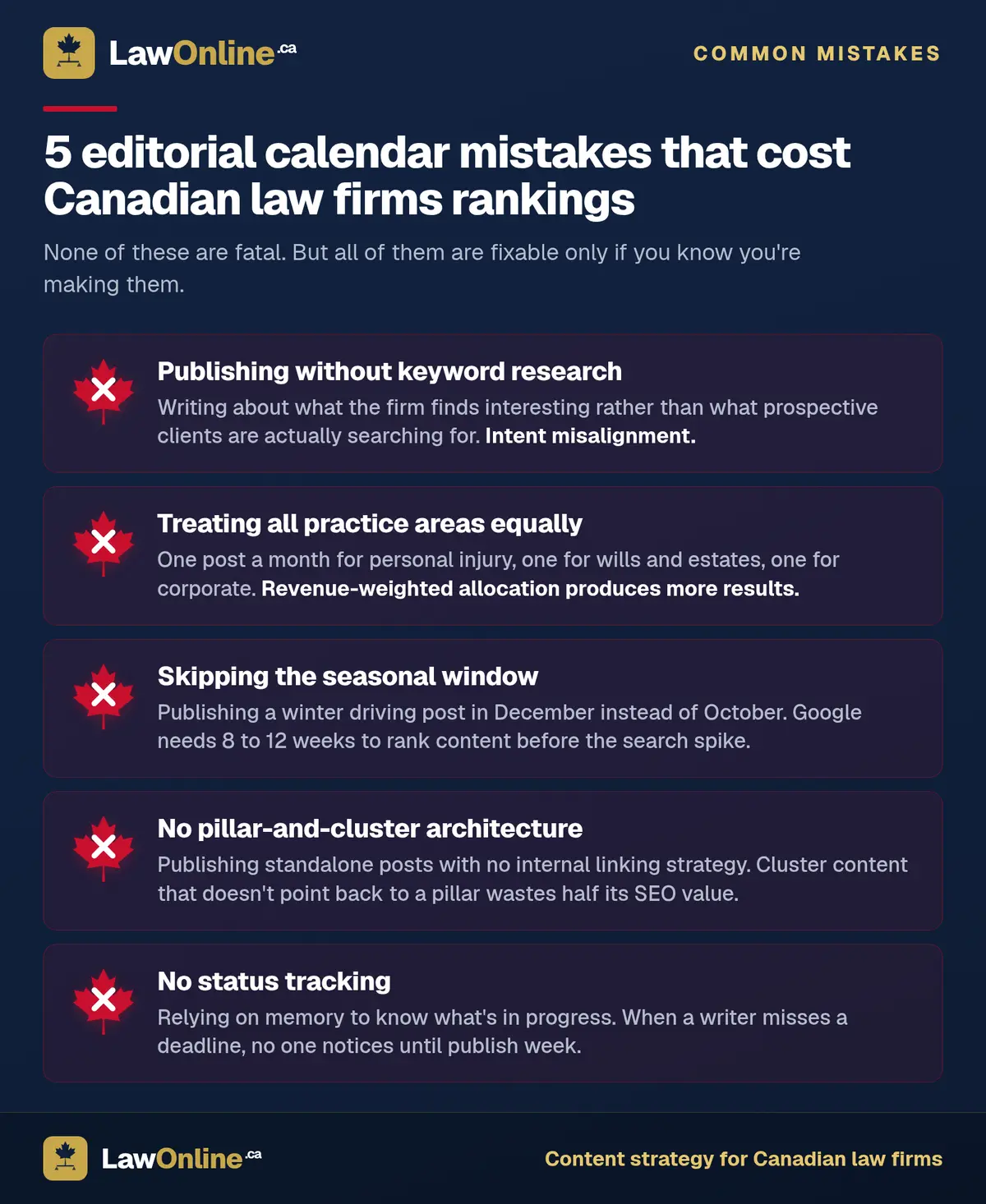
Treating legal blog planning as a one-time exercise. Your editorial calendar is a living document. Review it quarterly. Drop topics that no longer make strategic sense. Add new topics driven by search trends or practice area developments. The calendar is a plan, not a contract. The Canadian Bar Association puts it plainly: occasional posts are not effective, and firms should establish a regular posting routine to keep content fresh. A Law Society of British Columbia business development guide goes further, recommending firms blog at least once a week. That regularity only happens when the calendar gets reviewed and updated, not filed away.
Ignoring what's already working. Before planning new content, check your analytics. Which existing posts generate the most traffic? Which ones convert visitors into consultations? Your editorial calendar should include updates to high-performing existing content, not just new pieces. Refreshing a top-performing post with updated information and additional depth often delivers more ROI than writing something entirely new.
Treating all practice areas equally. If 60% of your firm's revenue comes from personal injury and 10% comes from real estate closings, your content calendar should not give both practice areas equal space. Weight your content investment toward the practice areas that drive revenue.
Not committing to a realistic blog posting schedule. How often should a law firm blog? For most firms, two to four posts per month is a realistic and effective cadence, enough to build topical authority without burning out whoever has to write them. The 11+ posts/month benchmark cited above works for agencies and media companies with dedicated content teams, but a five-lawyer firm doesn't have that infrastructure. Set a frequency you can actually maintain for 12 consecutive months, because a calendar that produces 10 posts in January and none by April is worse than one that delivers two posts every month all year.
Not building in buffer time. Content production always takes longer than planned. Associates get pulled into trial prep. External writers miss deadlines. Build a two-week buffer into your publishing schedule so that one delayed post doesn't cascade into a missed month.
Getting Started This Week
You don't need to build a perfect 12-month calendar on day one. Use the pillar-and-cluster framework above as your law firm editorial calendar template, and start with these three steps:
List your practice areas by revenue. Rank them from highest total revenue to lowest. The top two or three will anchor your first six months of content.
Identify your first pillar topic. Pick the highest-value practice area and write (or commission) one comprehensive guide targeting the primary keyword. For a PI firm, that's probably "car accident claims" or "personal injury claims" in your province. For family law, it's probably "divorce process" in your jurisdiction.
Map three cluster topics around that pillar. These should be specific questions your clients actually ask during consultations. Not topics you think are important. Questions you hear every week. (Need inspiration? See our 50 law firm blog topic ideas organized by practice area.)
From there, build outward. One quarter at a time, one pillar at a time. The firms that succeed with content aren't the ones that build elaborate 12-month plans on January 1st. They're the ones that execute consistently on a realistic plan, review what's working, and adjust.
If you want help building an editorial calendar tied to keyword research and your firm's actual economics, see how we approach content marketing for law firms.