
How do you choose a law firm content marketing agency? Start by accepting that most legal content agencies are not built for law firms. They write for SaaS companies, dentists, and real estate agents, and they bolt on a "legal" vertical when a firm comes knocking. The result is content that sounds professional enough on the surface but falls apart under scrutiny: wrong terminology, no compliance review, and blog posts so generic they could belong to any firm in any province.
Outsourcing content marketing to a specialist agency is how most Canadian law firms build organic traffic without hiring in-house, but the agency you choose determines whether you get results or just invoices.
A personal injury firm that hires the wrong content agency doesn't just waste its retainer. It ends up with articles that misstate limitation periods, confuse accident benefits with tort claims, and rank for nothing because the keyword research was pulled from American search data. Meanwhile, the firm's competitors who chose better are building organic traffic that compounds month after month.
Content marketing isn't experimental for law firms anymore. A joint survey by Good2bSocial and the Legal Marketing Association found that 76% of law firms already use content marketing and firms rate it the single most effective digital tactic at 7.38 out of 10, ahead of email, client alerts, and SEO. The challenge isn't convincing firms that content works. It's finding an agency that can execute it at the level legal content demands.
This guide gives you a practical framework for evaluating content marketing for Canadian law firms, comparing agencies, and knowing what to expect before you sign anything. If you're new to the topic, our beginner's guide to legal content marketing covers the fundamentals first.
What Does a Law Firm Content Marketing Agency Actually Do?
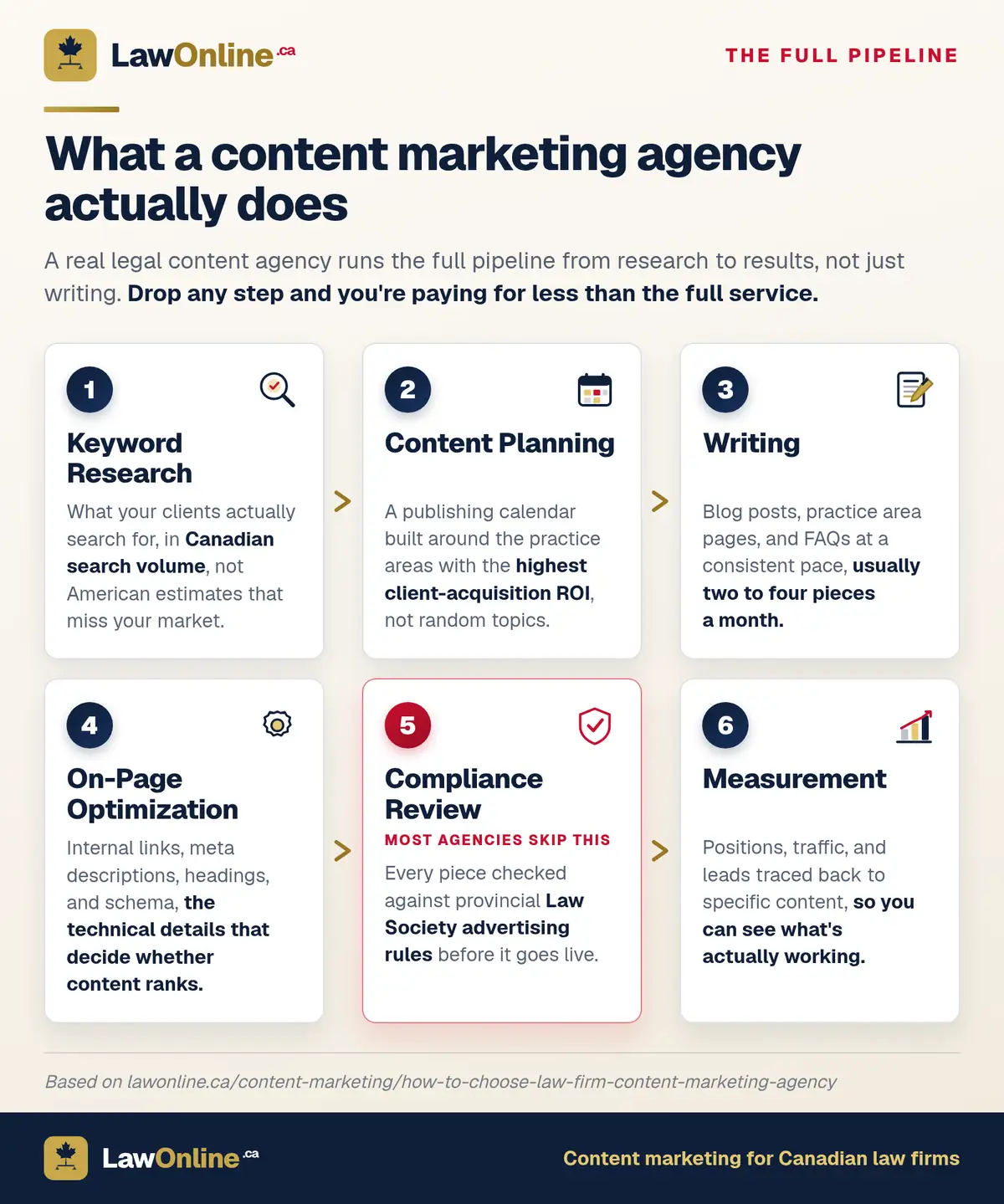
A good legal content marketing agency handles the full pipeline from research to results, not just writing. Here's what that pipeline looks like when it's done well:
- Keyword research: Identifying what your potential clients search for, in Canadian search volume, not American estimates that don't reflect your market.
- Content planning: Building a content strategy for your firm around practice areas with the highest client-acquisition ROI, organized into a publishing calendar rather than random topics the agency thinks sound interesting.
- Writing: Producing law firm blog posts, practice area pages, FAQs, and other content at a consistent pace, usually two to four pieces per month.
- On-page optimization: Internal linking, meta descriptions, heading structure, schema markup, and the technical details that determine whether content actually ranks.
- Compliance review: Checking every piece against provincial Law Society advertising rules before it goes live.
- Measurement: Tracking positions, traffic, and leads back to specific content so you can see what's working.
Not every agency does all of these equally well. Some are strong on writing but weak on SEO. Others run solid keyword research but outsource the writing to generalists who don't know the difference between a summary conviction and an indictable offence. Ask where each agency's strengths actually sit before assuming the retainer covers everything.
Why Is Legal Content Different from General Marketing Content?
Legal content operates under constraints that most industries don't face, and agencies that ignore those constraints produce content that creates problems instead of solving them.
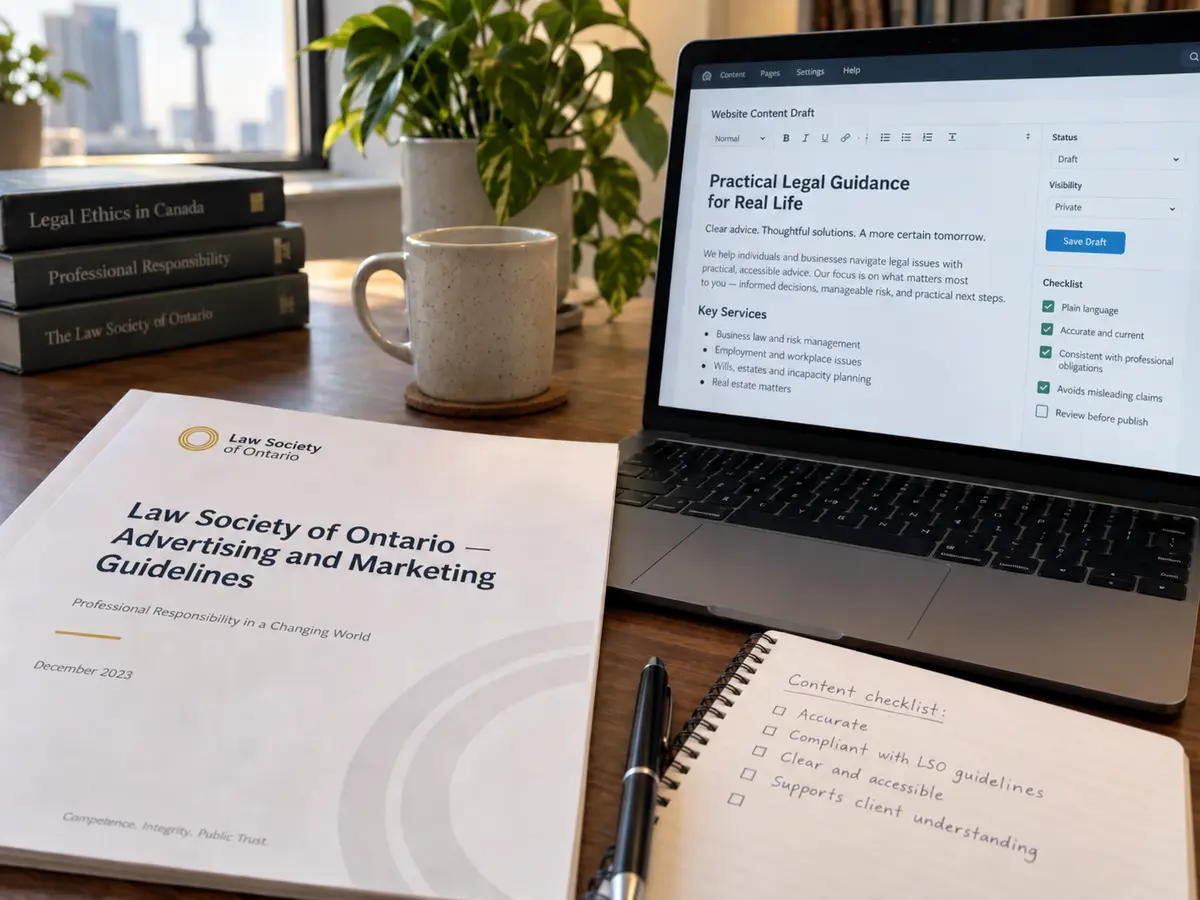
Compliance requirements are real, and they're enforced. The Federation of Law Societies of Canada's Model Code requires that all lawyer marketing be "demonstrably true, accurate and verifiable" and never misleading, confusing, or deceptive. Beyond that national baseline, each province adds its own rules: the Law Society of Ontario's advertising requirements differ from those in British Columbia, where a 2025 ethics advisory reaffirmed that any marketing a lawyer authorizes must not be false, inaccurate, or capable of misleading the public. An agency writing for firms in multiple provinces needs to know both the national standard and each province's specific rules, not just apply a generic "legal compliance" label and hope for the best.
Terminology precision matters. A writer who doesn't understand tort law will use "personal injury" as a catch-all when the content should distinguish between motor vehicle accidents, slip-and-fall claims, medical malpractice, and long-term disability disputes. That imprecision isn't just sloppy writing. It signals to potential clients that the firm doesn't specialize, and it signals to Google that the content lacks the depth needed to meet E-E-A-T requirements.
Case-type specificity drives results. A personal injury firm needs content about accident benefits under Ontario's no-fault system, not generic "what to do after a car accident" posts recycled from an American template. The specificity is what earns rankings on the long-tail keywords that actually convert.
Canadian vs. American context is non-negotiable. Most legal content marketing agencies are American. That matters for citations (Canadian case law, provincial statutes, court systems), terminology (plaintiff vs. claimant, discovery vs. examination for discovery), and SEO (Google.ca search volumes differ substantially from google.com). An agency citing California precedent in a post meant for Ontario lawyers is worse than useless.
What Questions Should You Ask a Content Marketing Agency Before Signing?
These six questions separate agencies that understand legal content from those that treat it as another vertical. Ask all of them before you sign a contract.
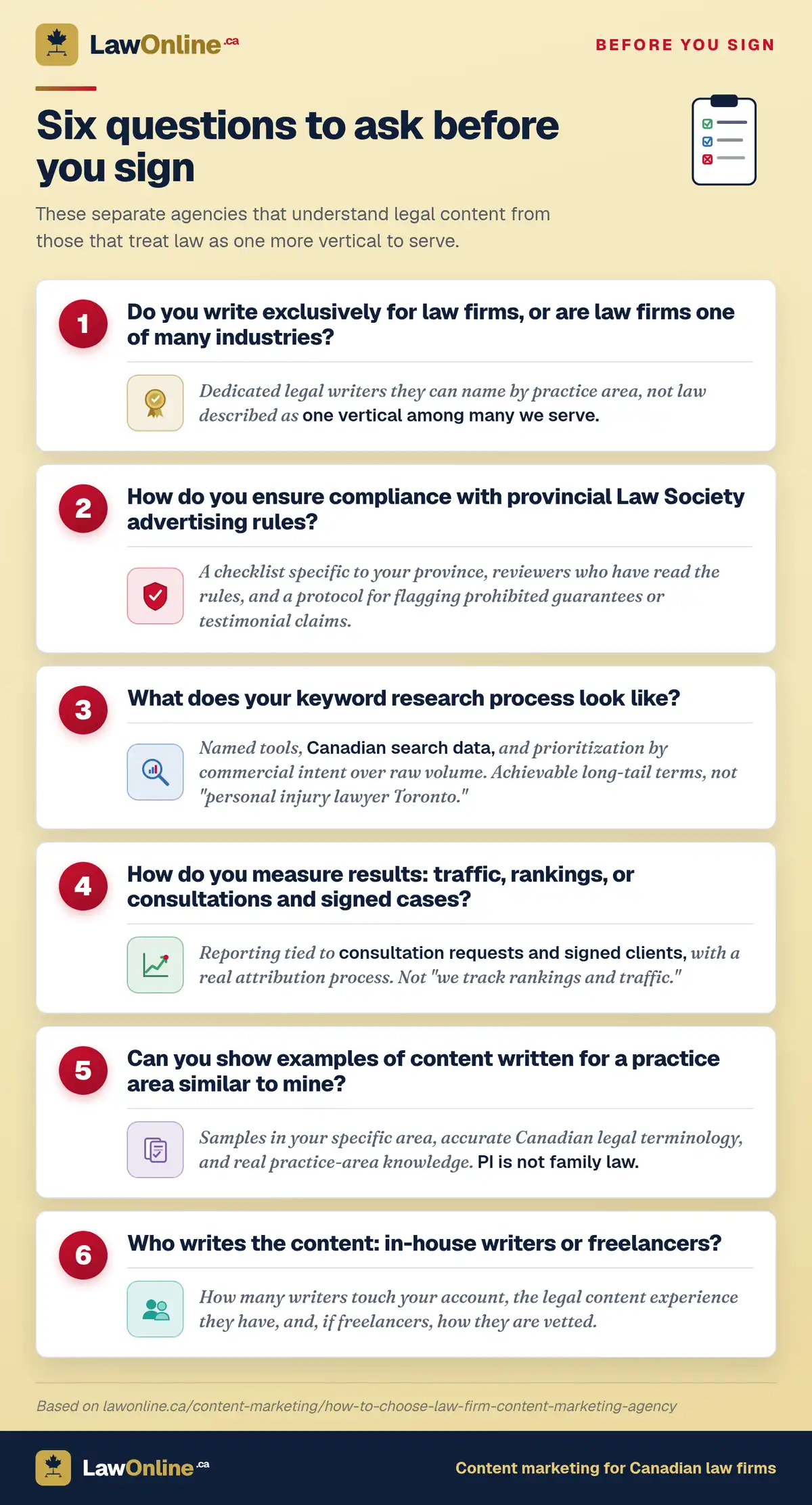
1. Do you write exclusively for law firms, or are law firms one of many industries?
Agencies that serve every industry spread their expertise thin. That doesn't mean a multi-industry agency can't produce decent legal content, but you need to know whether they have dedicated legal writers or whether they're assigning your account to whoever's available that week. A PI firm's content requires writers who understand contributory negligence and statutory deductibles, not someone who was writing about HVAC installation last month.
2. How do you ensure compliance with provincial Law Society advertising rules?
If the answer is vague or nonexistent, that's your answer. A real compliance process involves a checklist specific to your province, review by someone who's read the rules, and a clear protocol for flagging content that makes guarantees or testimonial claims the Law Society prohibits.
3. What does your keyword research process look like?
You're looking for specifics: which tools they use, whether they pull Canadian search data (not just US defaults), and how they prioritize keywords by commercial intent rather than raw volume. An agency that targets "personal injury lawyer" (impossibly competitive) instead of "how long does a car accident claim take in Ontario" (specific, achievable, high-intent) doesn't understand legal SEO.
4. How do you measure results: traffic, rankings, or consultations and signed cases?
Traffic alone is a vanity metric. Rankings matter more because they're predictive, but the real measure is whether content drives consultation requests and ultimately signed clients. CallRail's 2022 marketing outlook found that law firms rate their digital channels as both the most valuable and most underperforming part of their marketing, a disconnect that almost always traces back to poor attribution. An agency that can't connect its content to your intake pipeline is perpetuating exactly that problem.
5. Can you show examples of content written for a practice area similar to mine?
Ask for samples in your specific area. A family law writing sample won't tell you much if you're a personal injury firm. Look at whether the content uses accurate legal terminology, cites Canadian sources, and demonstrates genuine understanding of the practice area's client journey.
6. Who writes the content: in-house writers or freelancers?
Neither answer is automatically better, but you need to know. In-house writers tend to develop deeper expertise in legal topics over time. Freelancers can be excellent if the agency vets them properly, but a rotating pool of generalists produces inconsistent quality. Ask how many writers will touch your account and what their legal content experience looks like.
What Red Flags Should You Watch For?
Some warning signs are obvious. Others are subtle enough that firms don't notice until they're three months into a contract that isn't delivering.

- Guaranteed rankings or traffic numbers within 30 days. No legitimate agency promises specific positions or traffic targets on a fixed timeline. SEO doesn't work that way, and anyone who says otherwise is either lying or planning to use tactics that will get your site penalized.
- No compliance review process. If the agency can't explain exactly how they check content against Law Society rules, they're not checking. The risk isn't theoretical: firms have faced regulatory complaints over marketing content that made prohibited claims.
- Content produced entirely by AI with no legal review. AI-generated content isn't inherently bad, but content that goes from ChatGPT to your blog without a knowledgeable human reviewing it for accuracy, tone, and compliance is a liability. Ask how AI fits into their process, if at all.
- Writing for every industry with no legal specialization. An agency whose portfolio spans restaurants, fitness studios, and law firms is unlikely to have the depth your content needs, and the result is usually generic content that doesn't rank or convert. The quality ceiling for legal content is higher than most verticals, and generalist agencies rarely clear it.
- Pricing based on word count rather than strategy. Paying per word incentivizes volume over quality. A 2,000-word post that targets the wrong keyword and includes no internal linking or optimization is worth less than a well-researched 1,200-word post built around a high-intent search term. Look for agencies that price by outcome and scope, not by the word. For a detailed breakdown of what Canadian firms actually pay, see our guide on law firm content marketing cost.
What Should You Expect in Year One?
Content marketing is a compounding investment, not a switch you flip. Here's a realistic timeline for a firm that commits to a consistent publishing schedule with a competent agency.
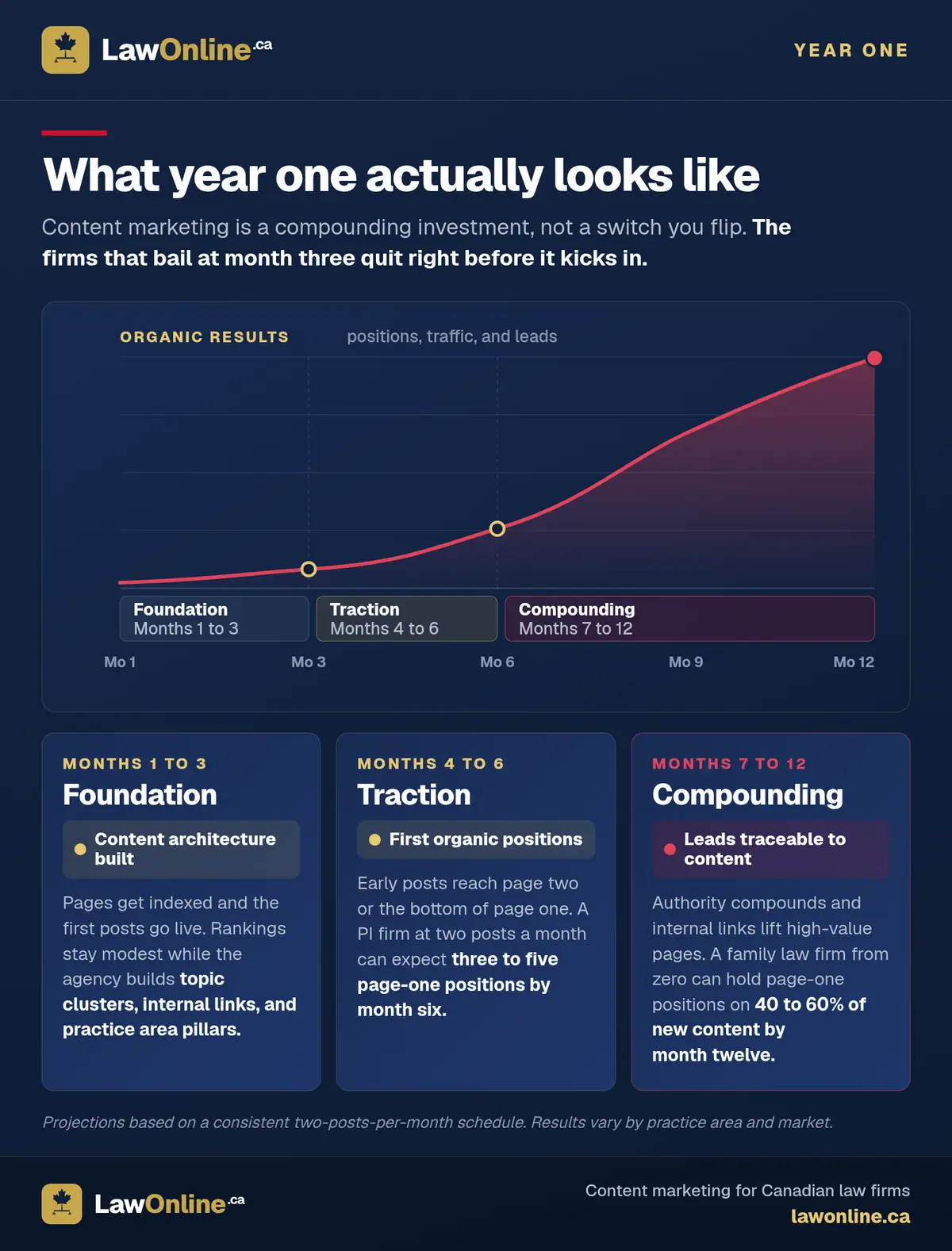
Months 1 to 3: Foundation. Keyword research, content strategy, and the first posts go live. You'll start seeing your pages indexed by Google, but rankings will be modest. This is the phase where the agency should be building your content architecture: topic clusters, internal linking structures, and practice area pillars that give future content something to link into.
Months 4 to 6: Traction. Early posts begin ranking on page two or the bottom of page one for long-tail keywords. Organic traffic starts showing up in your analytics, though it won't be dramatic yet. A PI firm publishing two posts per month on accident benefits, slip-and-fall claims, and long-term disability can realistically expect page-one positions on three to five long-tail terms by month six.
Months 7 to 12: Compounding. This is where the investment starts paying off visibly. Earlier posts have built authority and internal links point new content toward your highest-value pages. Positions stabilize, organic traffic grows predictably, and you should be able to trace consultation requests back to specific pieces of content. A family law firm that started from zero organic presence and published consistently through year one can expect 40 to 60% of its new content to hold page-one positions by month twelve. That is when the ROI becomes visible and defensible.
The firms that bail after three months because they "didn't see results" are the ones every content agency dreads, because they quit right before the compounding kicks in. Set expectations with your agency at the start and hold them accountable at the six-month mark, not the six-week mark.
What Does Strong Agency Reporting Look Like?
Reporting separates agencies that are accountable from those that hide behind vanity metrics. Here's what you should expect in a monthly report from a legal content writer or content marketing agency that takes measurement seriously:
- Keyword position tracking: Not just "you rank for 47 keywords" but which keywords, what positions, and how they've moved since last month. Positions on your target terms matter far more than total keyword count.
- Qualified lead attribution: Which specific pieces of content drove consultation requests or contact form submissions. If the agency can't connect content to leads, they're not tracking what matters.
- Practice-area-level ROI: Breaking results down by practice area so you can see whether your PI content is outperforming your family law content and adjust the strategy accordingly.
- Monthly accountability against targets: The agency should set measurable targets at the start of the engagement (positions, traffic, leads) and report against them every month. If they resist setting targets, that tells you something about their confidence in their own work.

Good reporting isn't just a deliverable. It's how you know whether to renew the contract or start looking for a replacement.
Choosing the Right Agency
The right content marketing agency for your law firm isn't the one with the slickest website or the biggest client list. It's the one that understands your practice areas, knows Canadian legal marketing rules, measures what matters, and can show you a realistic path from where you are now to where you want to be in twelve months.
If you're also evaluating a law firm SEO agency, the evaluation framework is similar but the technical questions are different.
Take the time to ask the hard questions, check the references, and evaluate the samples before signing. The cost of choosing wrong isn't just the retainer you'll waste. It's the six months of compounding organic growth you'll lose while your competitors build theirs.
If you're evaluating agencies and want to talk through what a content program would look like for your firm, get in touch. We'll give you an honest assessment of where you stand and what it would take to get results.