
Most law firms eventually face this decision. They've committed to content marketing for the firm and they know it works. Now they need to figure out who actually does the writing. The choice between hiring a content writer in-house and outsourcing to a legal content agency isn't just about your law firm marketing budget. It's about what your firm can realistically sustain at the quality and volume that a content marketing strategy requires to produce results.
The stakes are higher than many firms realize; research from the Canadian Forum on Civil Justice found that 48.4% of Canadian adults experience at least one serious everyday legal problem within a three-year period, yet only about 19% of those people seek formal legal advice, according to Department of Justice Canada research. That gap between people who need legal help and people who actually contact a lawyer is exactly where content marketing operates. The firm that consistently publishes useful, findable content about accident benefits, custody arrangements, or estate planning reaches potential clients long before they pick up the phone.
Both models can succeed. Both can fail. A personal injury firm in Toronto with a dedicated marketing coordinator and a clear law firm marketing plan can build a strong content program internally. A family law firm in Ottawa outsourcing to a specialized agency can do the same thing at a fraction of the management overhead. The deciding factor isn't which model is objectively "better." It's which one fits your firm's size, budget, practice area, and appetite for managing the process.
This post walks through the real trade-offs so you can make an informed call.
What Does In-House Content Look Like for a Law Firm?
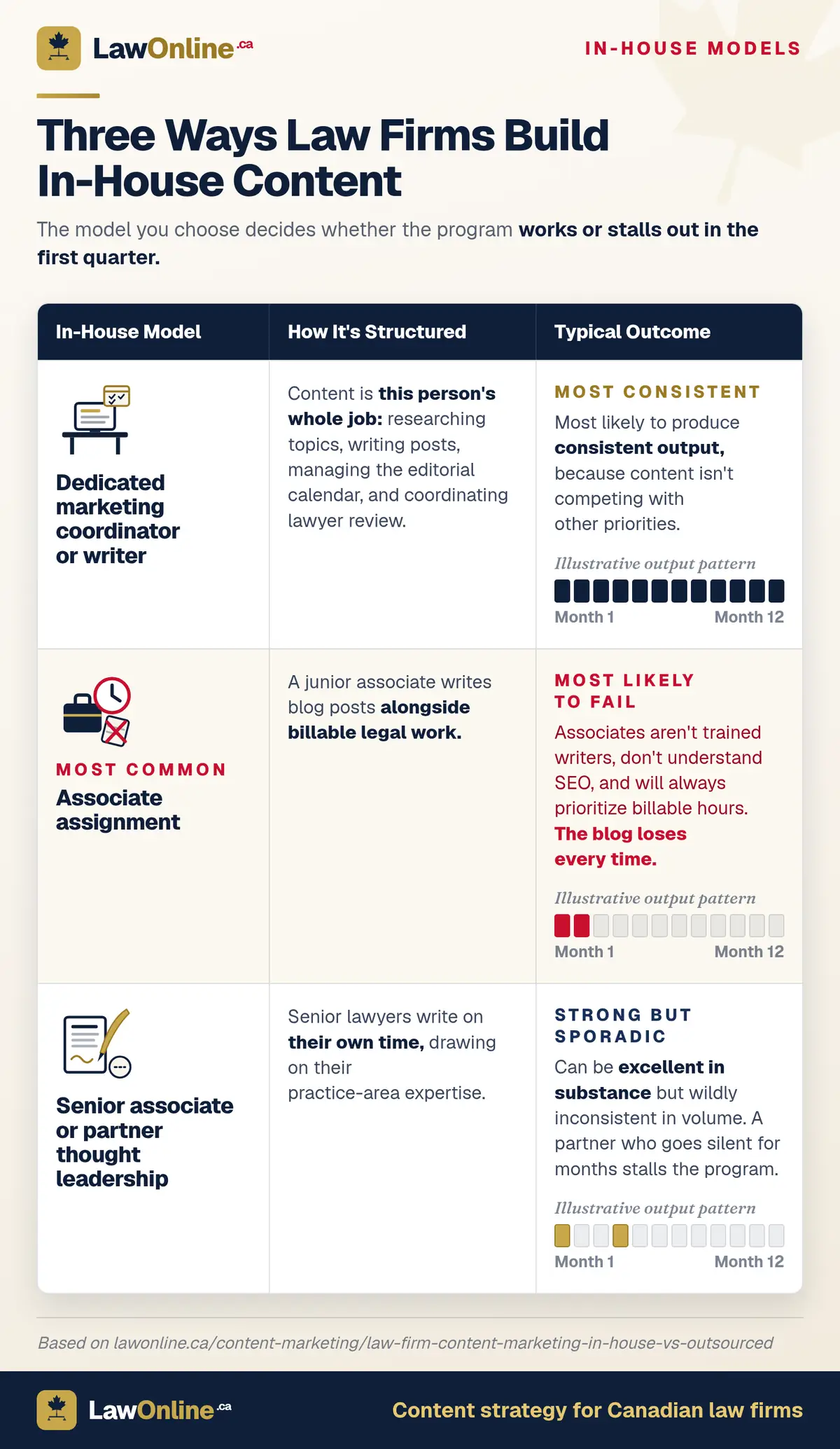
In-house content programs take a few different shapes, and the model you choose determines whether it works or stalls out in the first quarter. Before looking at the options, it helps to understand how most Canadian organizations actually staff their marketing. A 2025 Digital Marketing Sector Council survey found that 50% to 60% of Canadian marketing teams have three or fewer people, and 70% to 80% report feeling stretched or under-resourced. Law firms are no exception. When marketing is a one-person job, that person has to cover strategy, content, social media, advertising, analytics, and often reception overflow, all at once.
The strongest version is a dedicated marketing coordinator or writer on staff. This person's job is content, full stop: they own the content marketing strategy, write blog posts, manage the editorial calendar, and coordinate with lawyers for technical review. It's the model most likely to produce consistent output because content isn't competing with other priorities for their attention.
In reality, though, what most law firms do is different: a junior associate gets assigned to write blog posts alongside their legal work. Unfortunately, this is also the model most likely to fail. Associates are not trained writers. They don't understand SEO. And they'll always prioritize billable hours over a blog post. The content plan loses every time.
A third version involves senior associates or partners writing thought leadership on their own time. This can produce content that's excellent in substance but wildly inconsistent in volume. A personal injury partner writing about changes to accident benefits legislation brings genuine authority to the page. But that authority doesn't help if the post goes up once every three months and then the partner goes silent for the rest of the year.
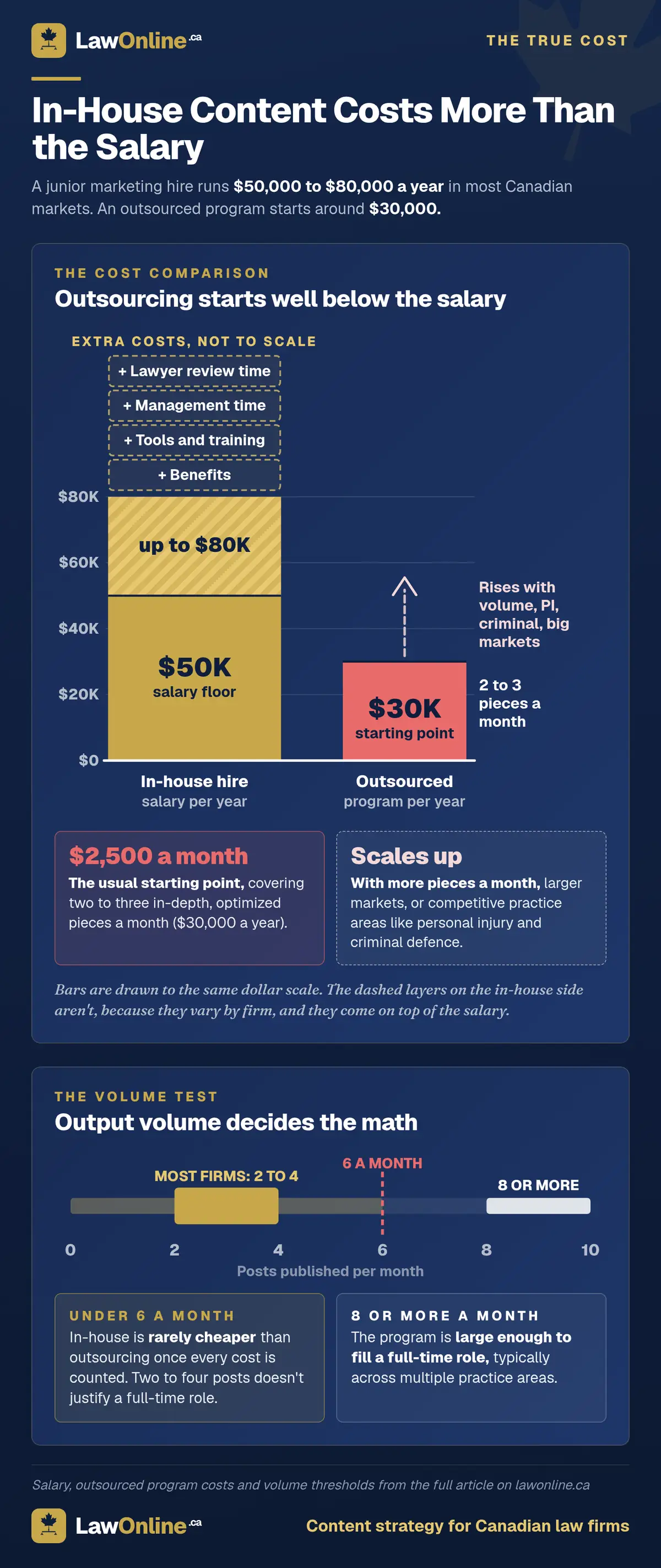
What it costs: a marketing coordinator salary in Canada starts at $50,000 to $80,000 per year in most markets, plus benefits, management overhead, and the tools they'll need to do the job. That's before you account for the time lawyers spend reviewing content and providing subject-matter input.
What Do You Give Up Going In-House?
The biggest trade-off with in-house content is depth. A marketing generalist can learn a lot about your practice area over time, but they rarely bring the keyword research skills, technical SEO knowledge, or editorial systems that a specialized content writing service has built over years of working exclusively with law firms.
SEO is the clearest example. Effective legal content isn't just well-written. It's built on keyword research that identifies what potential clients are actually searching for, competitive analysis that shows what's already ranking, and on-page optimization that gives the content its best shot at performing. Google's helpful content guidelines set a higher quality bar for legal and financial content, which means the SEO work required to compete is more demanding than in most industries. The same DMSC survey found that only 20% to 30% of Canadian marketers feel fully equipped to use emerging technologies confidently, and 35% to 40% identify AI and marketing automation as their biggest skills gap. A solo marketing hire juggling blog writing, social media, and email campaigns typically doesn't have the bandwidth or training to do that work at the level it requires.
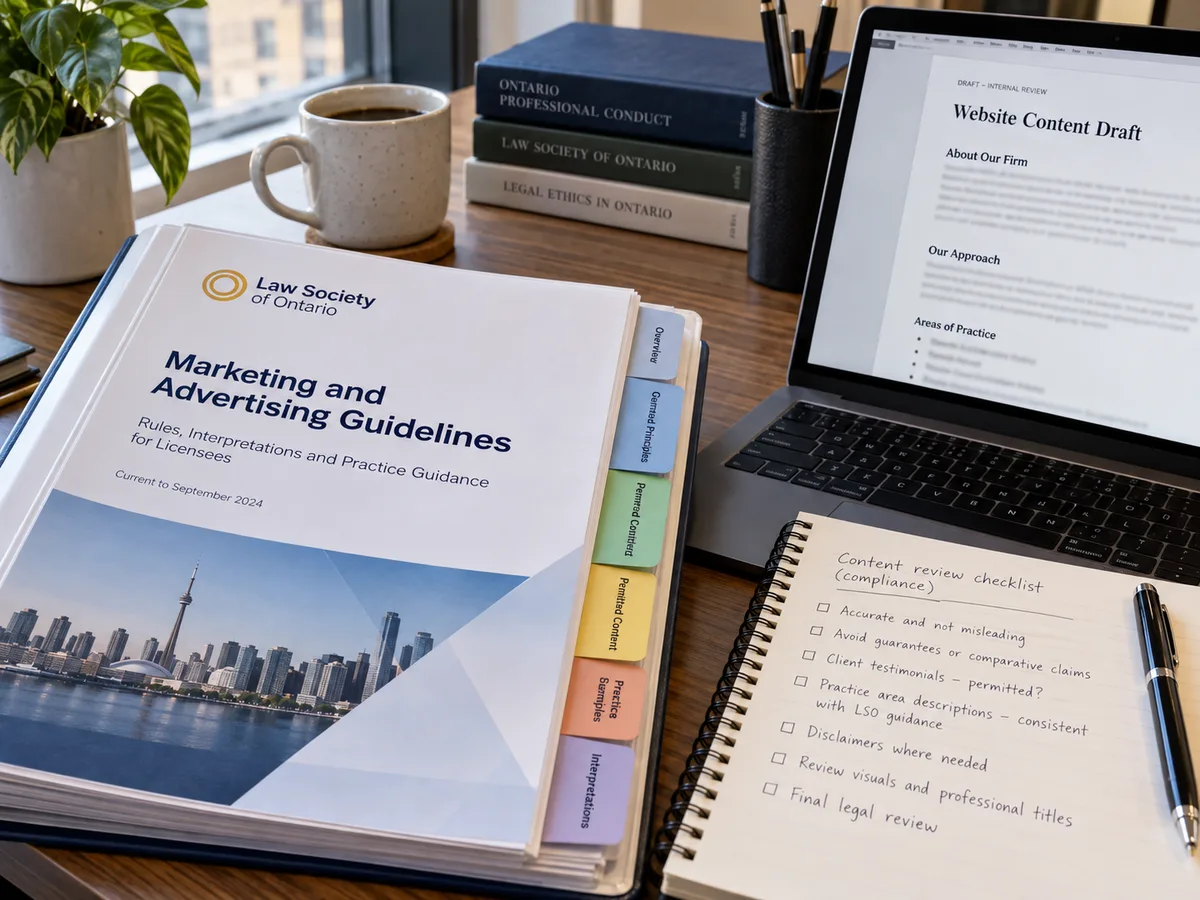
Law Society compliance is another gap. Every province has advertising and marketing rules that govern what law firms can say publicly. Ontario's advertising guidelines set specific boundaries on testimonials, guarantees, and how services can be described. Unless your in-house hire specifically understands legal advertising regulations, compliance review falls back on the lawyers, adding another task to already full schedules.
For personal injury firms, the knowledge gap is especially sharp. Writing effective PI content requires understanding accident benefits, tort thresholds, limitation periods, the Statutory Accident Benefits Schedule, and the litigation process from intake to settlement. That's a specific knowledge set that a generalist marketing hire won't have on day one, and building it takes months of dedicated ramp-up time while the content calendar sits empty.
What Does Outsourcing Bring?
The core advantage of outsourcing is access to specialized legal knowledge, SEO expertise, and editorial infrastructure without the management overhead of a full-time hire.
A legal content agency that works exclusively with law firms already understands practice-area terminology, knows what topics drive qualified traffic, and has writers who can produce content that reads as credible to lawyers and useful to potential clients. For a personal injury firm, that means content about motor vehicle accidents, slip and fall claims, long-term disability denials, and wrongful death actions written by people who understand the subject matter and its procedural context. You don't spend months training someone before your first post goes live.
The SEO piece is integrated into the writing process, not bolted on afterward. Keyword research happens before the outline is created. Internal linking, meta descriptions, and heading structure are all part of the workflow from the start. The result is content that's built to perform from day one rather than content that needs to be retroactively optimized.
Compliance review is built in as well. Agencies working in the legal space understand provincial advertising rules and flag content that could create regulatory problems before it's published. The Canadian Bar Association publishes marketing guidance, but the rules vary by province and evolve over time, so staying current requires ongoing attention that a specialist handles more reliably than a generalist.
From an operational standpoint, outsourcing eliminates benefits, HR overhead, performance management, and the risk that your entire content program dies when one person leaves or gets pulled into other work. Canadian brands appear to recognize the value: a 2021 Google Canada and Forrester Consulting study found that 74% of Canadian brands were satisfied or very satisfied with their agencies' digital-strategy capabilities, and demand for external creative services and content production was expected to rise by 39% over three years.
The cost difference is significant. Outsourced content programs for law firms typically start around $2,500 per month, or $30,000 a year, covering two to three in-depth, optimized pieces a month. Firms that need more volume, or that compete in larger markets and practice areas like personal injury and criminal defence, should budget more. Even so, an entry-level outsourced content program costs well below the salary alone for a junior in-house hire, before benefits, tools, and management time.
What About the Hybrid Model?
Some firms do both, and when it's structured correctly, the hybrid approach can be the strongest option. The data suggests this is where most organizations eventually land. Deloitte's 2024 Global Outsourcing Survey found that 50% of executives use outsourced services for front-office capabilities including marketing, while 70% have selectively brought previously outsourced work back in-house at some point. That isn't a contradiction. It's evidence that most organizations treat the in-house and outsourced question as an ongoing calibration rather than a permanent decision.
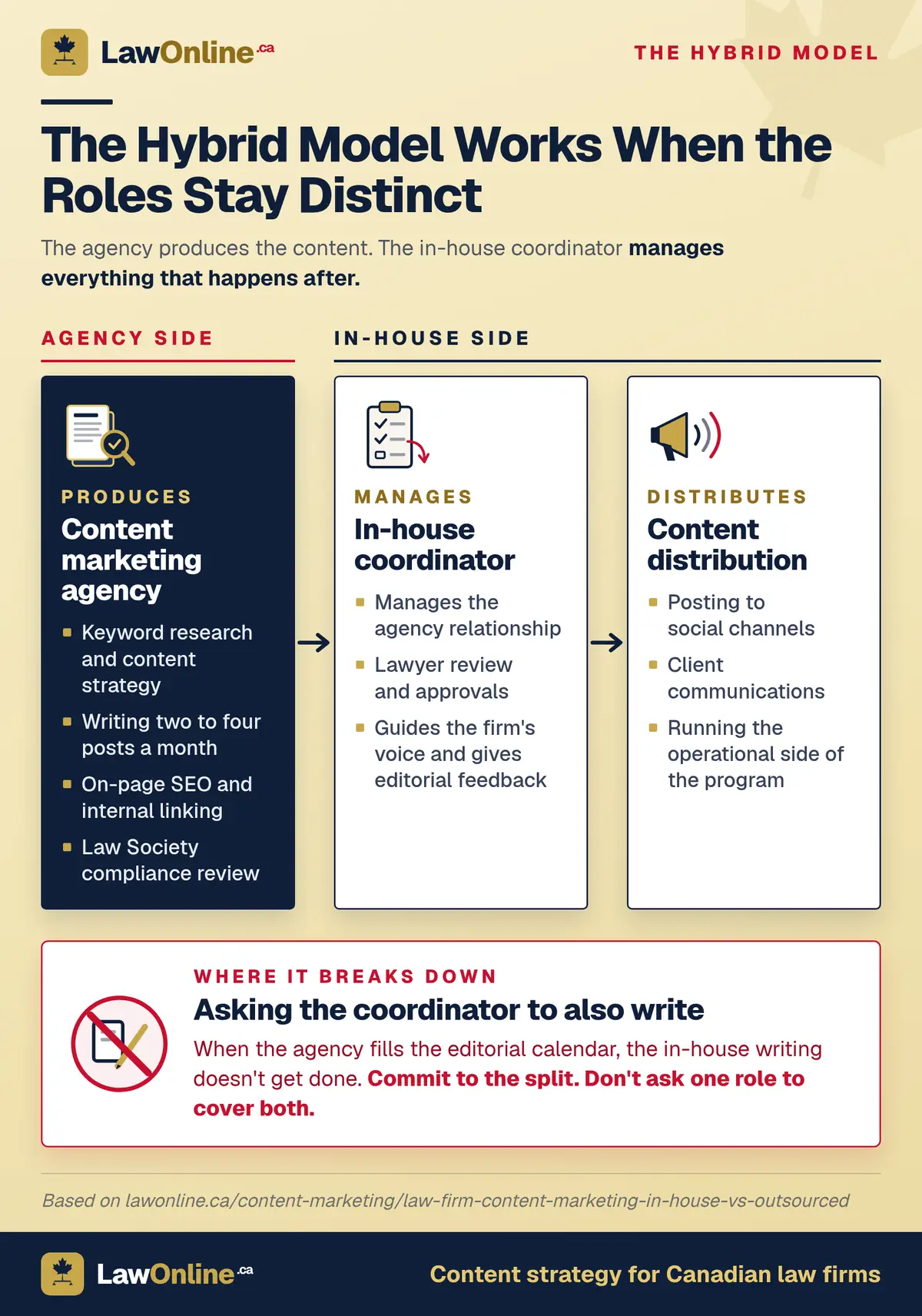
The typical version looks like this: a law firm marketing coordinator manages the relationship with an agency while handling distribution, social media, and client communications internally. This works because it plays to each side's strengths. The agency produces the content with the SEO and practice-area expertise it requires. The in-house coordinator knows the firm's voice, manages approvals, posts to social channels, and handles the operational side of the content program.
Where it breaks down is when the in-house person is also expected to write. You're paying for an agency and paying a salary, and the in-house writing typically doesn't get done because the agency deliverables fill the calendar. If you're going hybrid, commit to the split: strategy and production from the agency, distribution and relationship management from the in-house role. Don't ask one person to do both and expect consistent results from either.
When Does Each Model Make Sense?
In-house makes sense when:
- Your firm has the budget for a dedicated content hire, not a shared marketing generalist who also does reception overflow
- The content program is large enough to fill a full-time role, typically eight or more posts per month across multiple practice areas
- You want complete control over voice and editorial direction
- You're willing to invest in SEO tools and training on top of salary
Outsourcing makes sense when:
- You want to start producing content faster than a new hire can ramp up
- The volume doesn't justify a full-time position, which is the case for most firms producing two to four posts per month
- Your practice area requires specialized knowledge that's hard to hire for, and you'd rather outsource content marketing to people who already have it
- You want SEO expertise integrated into the content process rather than layered on afterward
For personal injury firms, outsourcing typically wins. The Federation of Law Societies of Canada's 2024 statistics show that the Canadian legal profession is dominated by sole practitioners and small firms, which means most practices don't have the revenue base to support a dedicated content hire alongside the SEO specialist, designer, and analytics capacity that effective content marketing demands. The practice-area specificity required, from accident benefits to tort thresholds to limitation periods, is genuinely hard to find in a generalist marketing hire. The learning curve directly affects content quality during ramp-up, and weak PI content doesn't just fail to rank; it erodes credibility with potential clients who know the difference between authoritative information and surface-level summaries. Firms in family law, estate planning, or corporate law face a similar decision but may find that a strong generalist can get up to speed faster because the subject matter, while complex, doesn't demand the same level of procedural and statutory knowledge.

What Questions Should You Ask Before Deciding?
Before you commit to either model, work through these questions honestly:
- Can you sustain two to four posts per month from an in-house hire indefinitely? Content marketing is a long-term investment. If your in-house person burns out at month six or gets pulled into other duties, the program stalls and the organic traffic you've built starts to decay.
- Do you have someone who understands SEO, or would you need to hire for that separately? Content without SEO is just a blog. Content with SEO is a client acquisition channel. Those are very different things.
- How will you handle Law Society compliance review? Someone needs to check every post against provincial advertising rules before it goes live. The requirements vary between provinces and change over time.
- What's the true total cost of the in-house model? Salary, benefits, tools, management time, and the opportunity cost of lawyer time spent reviewing content. When you add it all up, in-house is rarely cheaper than outsourcing for firms producing fewer than six posts per month.
- Can you measure content marketing ROI? The DMSC's 2025 survey found that only 16% to 18% of Canadian marketing teams use pipeline contribution or ROI as their primary success measure. Most still track vanity metrics like traffic and social followers. Whichever model you choose, you need someone who can connect content output to actual client inquiries and retained matters, not just pageviews.
Making the Right Call for Your Firm
The in-house versus outsourced question doesn't have a universal answer. It depends on your firm's size, your budget, your practice area, and your willingness to manage a content operation internally. The staffing decision should be part of a broader law firm marketing plan, not a standalone call made in isolation.
What doesn't change is the quality bar. The content needs to be accurate, authoritative, optimized for search, and compliant with Law Society advertising rules regardless of who produces it. If you go the outsourcing route, knowing how to hire a legal content writer who understands your practice area is the most important step you'll take, and our guide to choosing a content marketing agency covers the evaluation process in detail.
If you're evaluating your options and want to understand what a content marketing services program would look like for your firm, we're happy to walk through the specifics. Get in touch and we'll give you an honest assessment of what makes sense for your situation.