
What should a law firm blog about? The answer isn't "whatever the partner feels like writing about this month." It's the questions your prospective clients are typing into Google right now, organized by the practice areas that generate revenue for your firm.
The difference between a blog that drives client inquiries and one that collects dust is topic selection. Not all blog ideas for lawyers are worth writing. A personal injury firm that publishes "Our Firm Celebrates 20 Years" gets zero search traffic. The same firm publishing "How Long Do I Have to File a Personal Injury Claim in Ontario?" captures someone who's actively looking for a lawyer.
This list contains 50 legal blog topic ideas organized by practice area, each selected for commercial intent (the searcher is closer to hiring a lawyer than just casually browsing), meaningful search volume in Canadian markets, and the potential to rank with well-written, jurisdiction-specific content. For each topic, we've included a short note on why it has commercial intent and what good content on the topic looks like. Think of this as your starting library of law firm content ideas for Canadian markets, not a finishing line.
Before diving in, a framing note: search-query-driven topic selection consistently outperforms editorial instinct. Your blog isn't a newsletter for colleagues. It's a client acquisition channel. Every post should answer a question that a real person with a real legal problem is searching for. The topics below are organized from highest to lowest revenue potential, with personal injury leading because the case values and search volumes are the highest in Canadian legal marketing.
There's real demand behind these topics. A national survey by the Canadian Forum on Civil Justice found that 48.4% of adult Canadians experience at least one serious legal problem in any three-year period, yet only 19% obtain any form of legal advice. A third search online for answers instead. That's millions of Canadians each year typing questions into Google and finding whichever firm published the clearest answer.
For a broader look at how to build a content program around topics like these, see our content marketing starter guide, or our breakdown of the types of blog and website content law firms need.
Personal Injury (15 Topics)
Personal injury leads the list because it's the most searched and highest-value practice area for content marketing. A single signed PI case can generate $15,000 to $500,000+ in contingency fees, making the ROI on ranking content extraordinary. More on the economics: personal injury law firm marketing.

1. How long do I have to file a personal injury claim in Ontario? Limitation periods are one of the most searched PI topics in Canada. The two-year limit under the Limitations Act, 2002 is a concrete, useful answer that builds trust.
2. How much does a personal injury lawyer cost? Contingency fee questions drive massive search volume. Answering clearly (you pay nothing unless we win, typical percentages) immediately overcomes the biggest barrier to contacting a firm.
3. What to do after a car accident in Ontario The highest-volume PI topic. Captures searchers at the moment of need: immediately after an accident, looking for guidance.
4. How Ontario accident benefits work The SABS process confuses most accident victims. A clear guide covering income replacement, medical/rehab, and attendant care benefits is a staple for any Ontario PI firm.
5. Slip and fall accidents: who is responsible? Premises liability content targets a different PI subcategory with strong search volume, especially during winter months in Canadian markets.
6. What compensation can I get after a car accident? Breaks down tort claims vs. statutory benefits. High commercial intent because the searcher is evaluating their options.
7. How long does a personal injury case take? Timeline questions show up consistently in PI search data. Honest answers (18 to 24 months for most MVA claims) build credibility.
8. Can I sue if I was partially at fault? Comparative negligence is poorly understood by the public. Explaining it in plain language targets a high-intent query.
9. What's the difference between accident benefits and a tort claim? A foundational explainer that helps PI firms build topical authority in the insurance dispute cluster.
10. Medical malpractice claims in Canada: what you need to know Complex practice area with high search volume. Requires careful, accurate content about standard of care, expert evidence, and limitation periods.
11. Motorcycle accident claims: your rights in Ontario Distinct from car accident claims because motorcycle riders aren't eligible for certain SABS benefits. Targets a specific PI subcategory.
12. Dog bite injuries: liability and compensation in Ontario A niche PI topic with less competition but consistent search volume, especially in suburban and rural markets.
13. What is a structured settlement? Explains how PI settlements are paid out. Targets a question that arises late in the claims process when the searcher is close to settling.
14. Wrongful death claims in Ontario High-stakes, high-emotion topic. The content needs to be accurate and compassionate. Strong authority-building potential.
15. How to choose a personal injury lawyer A comparison-intent query that captures searchers at the decision stage. An opportunity to explain what makes a good PI firm without being overtly promotional.
Family Law (8 Topics)
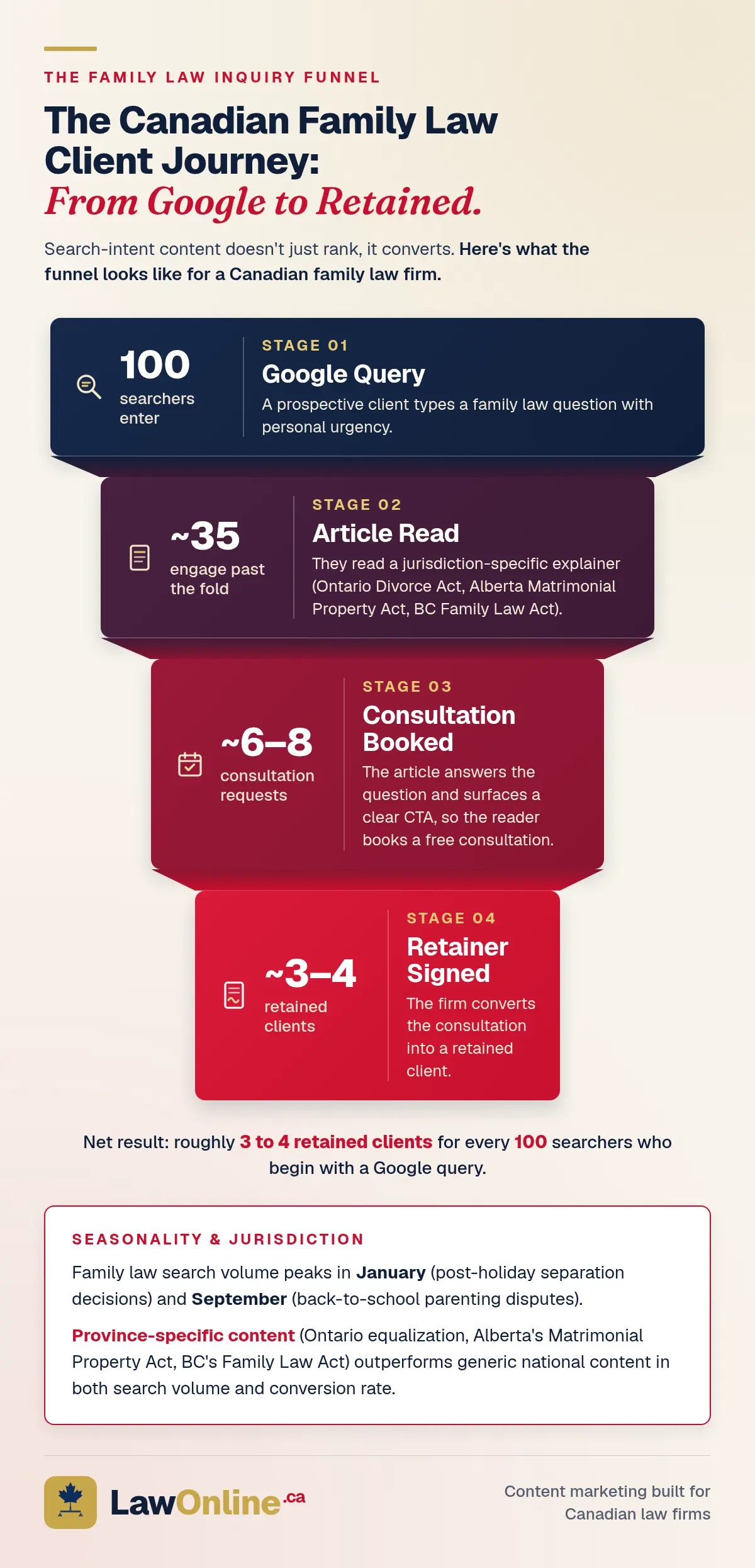
Family law generates one of the heaviest court workloads in Canada. Statistics Canada reported 275,296 active family law cases in 2019/2020, with divorce applications accounting for 39% and custody or access disputes making up another 16%. Family cases averaged 11 court events per case, nearly double the six-event average for other civil matters. That procedural complexity means people have questions at every stage, and a well-structured blog can answer them.
16. How divorce works in [Province] The starting point for any family law content program. Province-specific content is essential because family law varies across jurisdictions.
17. Child custody and parenting orders in Canada One of the most emotionally charged search topics. Clear explanations of the Divorce Act's "best interests of the child" framework perform well.
18. How child support is calculated in Canada The federal Child Support Guidelines and provincial tables provide concrete numbers to include. Specificity makes this content rank.
19. Division of property in a divorce Provincial differences (e.g., Ontario's equalization vs. Alberta's Matrimonial Property Act) make jurisdiction-specific content essential.
20. How much does a divorce cost in Canada? A cost-comparison topic with high search volume. See our approach to pricing content in the law firm marketing cost guide.
21. Spousal support: who qualifies and how much? The Spousal Support Advisory Guidelines provide a framework, but the answer is complex. Detailed content builds authority.
22. Common-law separation rights in Ontario Common-law rights differ significantly from married couples' rights. This distinction confuses many people and drives searches.
23. Mediation vs. litigation in family law A process-comparison post that targets searchers evaluating their options. It's a natural fit for firms that offer collaborative family law.
Criminal Defence (7 Topics)
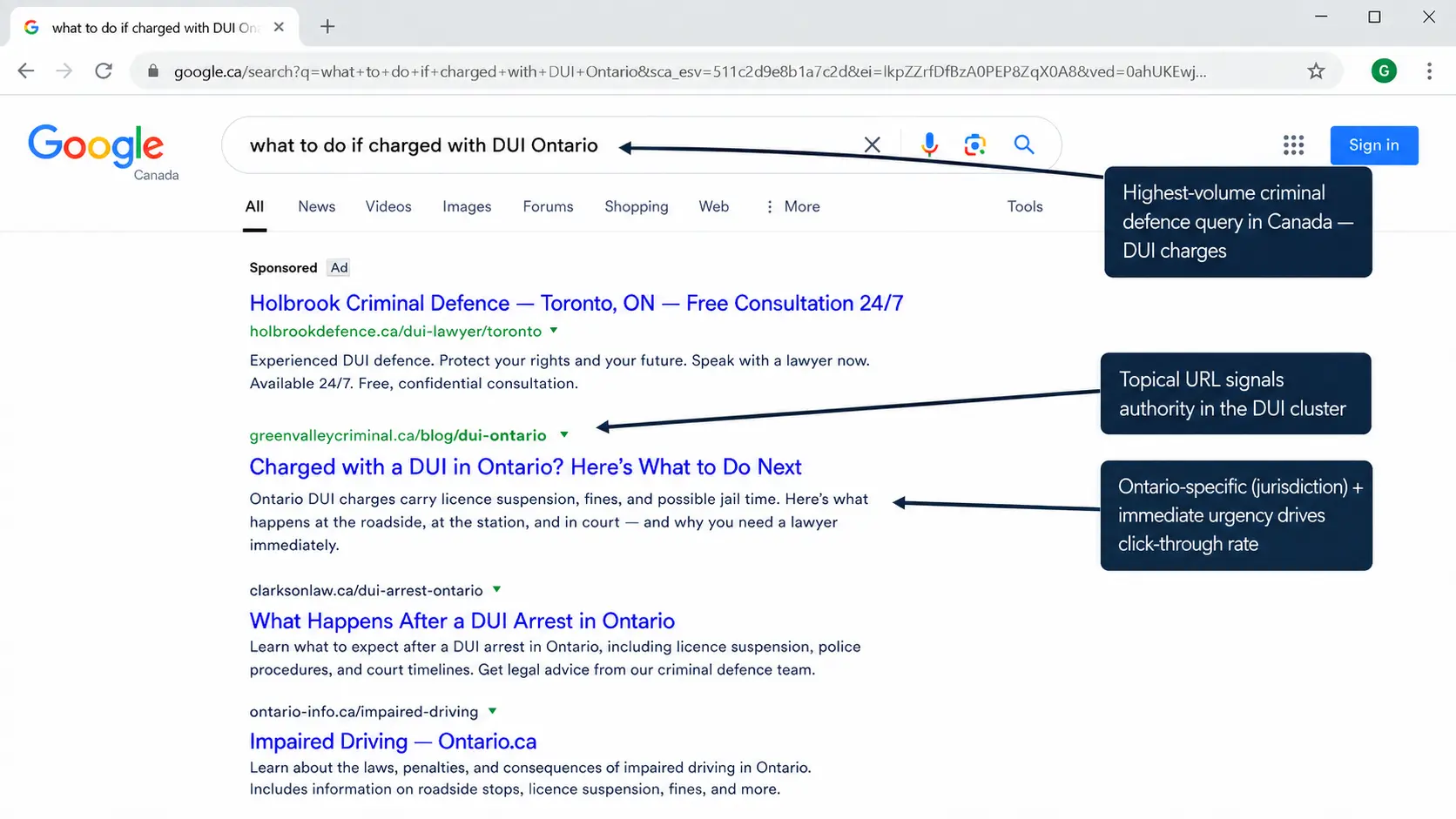
24. What to do if you're charged with a DUI in [Province] The single highest-volume criminal defence search query. Province-specific content is critical because impaired driving penalties vary.
25. How bail works in Canada A process-explainer that targets people or their family members immediately after an arrest. High urgency, high intent.
26. Assault charges in Canada: what to expect Common charge with significant search volume. Content should cover the types of assault (common, with a weapon, aggravated) and typical outcomes.
27. Drug possession charges: your rights and options Federal law, but enforcement and diversion programs vary by province. An opportunity to discuss alternatives to conviction.
28. Will a criminal record affect my job? A consequence-focused query that captures people evaluating the impact of charges. It's a natural bridge to record suspension (pardon) content.
29. How to get a record suspension (pardon) in Canada Practical, step-by-step content with clear eligibility criteria. Targets a high-intent audience that's ready to take action.
30. Youth criminal justice: what parents need to know The Youth Criminal Justice Act creates a distinct process. Parents searching this topic are actively seeking legal help.
Employment Law (5 Topics)
Employment disputes are more common than most firms realize. The Canadian Forum on Civil Justice's national legal problems survey found employment to be the third most common type of everyday legal problem in Canada, affecting 16.4% of adult Canadians in any three-year period. Only consumer and debt issues ranked higher. That makes wrongful dismissal, severance, and workplace harassment topics with a large, built-in search audience.
31. Wrongful dismissal in Ontario: what are my rights? The anchor topic for employment law blogs. High search volume, clear legal framework, strong commercial intent.
32. How much severance pay am I entitled to in Canada? The common-law reasonable notice framework and the ESA minimums provide concrete, useful information that drives conversions.
33. Can my employer fire me without cause? A yes-or-no question that leads to nuanced content about reasonable notice, just cause, and constructive dismissal.
34. Non-compete agreements in Canada: are they enforceable? Ontario's 2021 ban on non-competes for most employees makes this a jurisdiction-specific topic with strong search demand.
35. Workplace harassment: your legal options A topic that intersects employment law and human rights law. Addresses a growing search category.
Wills, Estates, and Estate Planning (5 Topics)
36. How to make a will in [Province] A process-explainer that targets people who've been putting off estate planning. Province-specific requirements (e.g., Ontario's Succession Law Reform Act) make jurisdiction detail essential.
37. What happens if you die without a will in Ontario? Intestacy rules are confusing and jurisdiction-specific. This is a perennial high-volume search topic.
38. Power of attorney vs. living will: what's the difference? A common point of confusion that drives consistent searches. Clear definitions and practical guidance perform well.
39. How probate works in Canada Probate fees, timelines, and processes vary by province. Content that explains the local process is more useful than generic overviews.
40. Estate planning for blended families A growing search category that addresses a complex, emotionally charged topic. Less competitive than core estate topics.
Immigration (5 Topics)

41. How to sponsor a spouse for Canadian immigration One of the highest-volume immigration search queries. The process is complex and changes frequently, making expert content valuable.
42. Work permit options for newcomers to Canada An overview topic that captures a broad audience. Should cover LMIA-based permits, open work permits, and IEC permits.
43. What to do if your immigration application is refused A high-intent query that targets people who need immediate legal help. Explains judicial review and reapplication options.
44. Express Entry explained: how the points system works CRS score calculation, draws, and profile optimization tips make this an information-rich topic with strong search demand.
45. Refugee claims in Canada: the process and timeline A topic that requires careful, accurate handling. Content should explain the IRB hearing process and available legal aid.
Real Estate Law (5 Topics)
46. How much does a real estate lawyer cost in Ontario? A direct cost question with high commercial intent. Related to our broader Ontario marketing costs coverage.
47. What does a real estate lawyer actually do? A basic explainer that captures first-time homebuyers. Addresses a surprisingly common search query.
48. Title insurance vs. lawyer's opinion: what Ontario buyers need to know A comparison topic that targets a decision-stage query. The answer requires jurisdiction-specific knowledge.
49. Closing costs when buying a home in [Province] A practical, numbers-heavy topic that attracts high search volume around real estate market cycles.
50. Condo law in Ontario: what buyers need to know The Condominium Act, 1998 and the cooling-off period create unique content opportunities for Ontario-focused real estate practices.
How to Choose Your First 12 Law Firm Blog Topics
If you're starting from zero, don't try to write all 50 law firm blog topic ideas at once. Pick 12 and commit to publishing them over six months at a pace of two per month. An editorial calendar that maps topics to seasonal demand and practice-area revenue keeps that schedule from collapsing. For Canadian firms, province-specific content consistently outranks generic posts, so add your province or city to each title.
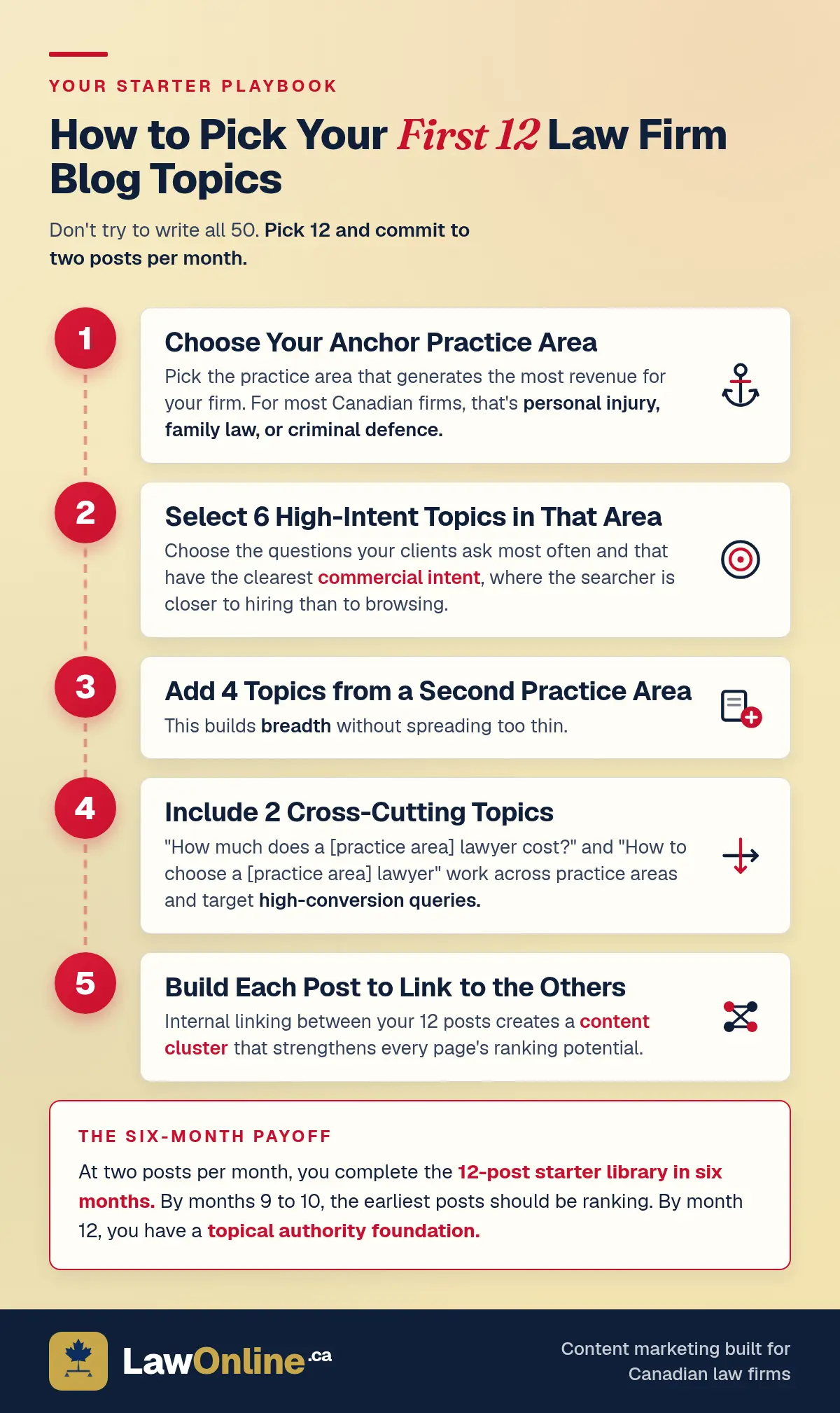
Step 1: Choose your anchor practice area. Pick the practice area that generates the most revenue for your firm. For most firms reading this, that's personal injury, family law, or criminal defence.
Step 2: Select the 6 highest-intent topics in that practice area. From the list above, choose the questions your clients ask most often and that have the clearest commercial intent (meaning the searcher is closer to hiring a lawyer).
Step 3: Add 4 supporting topics from a second practice area. This starts building breadth without spreading too thin.
Step 4: Include 2 cross-cutting topics. Posts like "How much does a [practice area] lawyer cost?" and "How to choose a [practice area] lawyer" work across practice areas and target high-conversion queries.
Step 5: Build each post to link to the others. Internal linking between your 12 posts creates a content cluster that strengthens every page's ranking potential. For a detailed guide on internal linking and content architecture, see our advice on why Canadian law firms need SEO.
The pattern: start with your highest-revenue practice area, write the most-asked questions first, and link everything together. Our content marketing service follows exactly this approach.
A Worked Example: PI Firm in Ontario, Starting from Zero
If you're a personal injury firm in Toronto starting a blog today, here are the first 12 topics from this list in the order you should write them:
- What to do after a car accident in Ontario (Topic #3)
- How Ontario accident benefits work (Topic #4)
- How long do I have to file a personal injury claim in Ontario? (Topic #1)
- How much does a personal injury lawyer cost? (Topic #2)
- What compensation can I get after a car accident? (Topic #6)
- Slip and fall accidents: who is responsible? (Topic #5)
- How long does a personal injury case take? (Topic #7)
- Can I sue if I was partially at fault? (Topic #8)
- What's the difference between accident benefits and a tort claim? (Topic #9)
- How to choose a personal injury lawyer (Topic #15)
- Wrongful death claims in Ontario (Topic #14)
- Medical malpractice claims in Canada (Topic #10)
The first four posts capture the highest-volume, highest-intent queries. Posts five through eight build depth around the car accident cluster. Posts nine through twelve expand into adjacent PI subcategories.
At two posts per month, you complete this in six months. By month nine or ten, the earliest posts should be ranking and generating organic traffic. By month twelve, you have a content library that positions your firm as an authority on personal injury law in Ontario.
Frequently Asked Questions
Should a law firm blog about topics outside its practice areas?
Generally, no. Your blog should focus on the practice areas where you want to attract clients. A personal injury firm blogging about corporate tax law confuses both readers and search engines about your firm's expertise. Stick to your lanes and go deep.
How do I know which of these topics has the most search volume in my market?
Use Google's free Keyword Planner to estimate monthly search volume for each query in your province or city. Add your city name as a modifier (e.g., "wrongful dismissal lawyer Toronto") to see local volume. Alternatively, a law firm SEO provider can run this analysis as part of a keyword research engagement.
Can I use these exact titles as blog post titles?
Use them as starting points. The best titles include a geographic modifier (your city or province) and are phrased the way your clients actually search. "How Long Do I Have to File a Personal Injury Claim in Ontario?" is stronger than "Personal Injury Limitation Periods."
How long should each of these blog posts be?
It depends on the topic. A straightforward FAQ (like "How bail works in Canada") might be 800 to 1,000 words. A comprehensive guide (like "How Ontario accident benefits work") warrants 1,500 to 2,500 words. Write enough to fully answer the question, and stop there.
How often should a law firm publish blog posts?
Two posts per month is the practical minimum for building topical authority within 6 to 12 months. More is better, but consistency beats frequency. A firm that publishes twice a month every month outperforms one that publishes eight posts in January and nothing for the next five months.
Should I hire a writer or write these myself?
Most law firms benefit from a collaborative approach: the lawyer provides direction and reviews for accuracy, while a professional legal writer handles research, writing, and SEO optimization. The lawyer-as-sole-author route works for some firms, but be honest about your billable-hour opportunity cost and the risk of shipping thin content. For context on why generic, hastily-written legal blogs underperform, see our piece on the problem with generic legal content.