
You hired an agency. You paid them $3,000 a month for a year. They sent you monthly reports with traffic graphs that went up and to the right. And after twelve months, your personal injury firm in Toronto hasn't signed a single new client from organic search.
This isn't a hypothetical. It's the most common outcome of law firm SEO in Canada: firms hiring agencies that don't understand the legal industry. The strategies they use work for e-commerce stores, SaaS companies, even restaurants. They don't work for lawyers. The regulatory environment is different, the competitive dynamics are different, and the way potential clients search for legal help is fundamentally different from how they search for almost anything else.
SEO does work for lawyers. Organic search drives roughly 53% of all law firm website traffic, making it the single largest source of new clients for most practice areas. A 2026 analysis of Canadian legal SEO benchmarks found that 28 to 42% of new client acquisition in professional services firms is now attributable to SEO-driven channels, with the upper range concentrated among firms publishing original, Canadian-context research. But the gap between SEO that generates cases and SEO that generates reports is enormous. This post covers what actually moves rankings for Canadian law firms, how strategy needs to change based on your practice area, and what year one realistically looks like.
Why Is SEO for Lawyers Different From Other Industries?
Legal SEO operates under constraints that most industries don't face. Understanding these constraints explains why generic playbooks fail and why law firms need a fundamentally different approach.
Google classifies legal content as YMYL. "Your Money or Your Life" content faces stricter quality evaluation because it can directly impact someone's financial stability, health, or safety. A blog post about the best hiking boots gets the benefit of the doubt. A blog post about whether you can sue for a slip-and-fall injury in Ontario does not. Google holds legal content to a higher standard for accuracy, authoritativeness, and trustworthiness, which means shortcuts that work in other industries actively hurt law firms.
Provincial Law Societies regulate what you can say. Every province has its own advertising rules. The Law Society of Ontario prohibits misleading advertising and imposes specific requirements around testimonials and fee claims. Alberta, BC, and other provinces each have their own variations. A generic SEO agency writing your content likely doesn't know these rules exist, let alone how to navigate them. We've written detailed breakdowns of the Ontario, Alberta, and BC rules if you want the specifics.
Legal search is overwhelmingly local. When someone needs a personal injury lawyer, they search "personal injury lawyer Toronto," not "personal injury lawyer Canada." This creates a hyperlocal competitive dynamic where you're fighting for visibility in a specific city against other firms investing heavily in the same keywords. National ranking strategies are nearly useless. What matters is dominating your local market.
Multi-jurisdiction complexity. Canadian law firms often practice across multiple provinces, each with different laws, different courts, and different search behaviour. A family lawyer in Ottawa might serve clients in both Ontario and Quebec, requiring content that addresses two entirely different legal systems. Most generic SEO agencies don't account for this.
These constraints aren't minor complications. They're structural features of legal marketing that make or break an SEO campaign. For a deeper look at why these issues cause most law firm SEO to fail, see our breakdown of why most law firm SEO in Canada fails.
What Are the 5 Levers That Actually Move Rankings for Law Firms?
After working with law firms across Canada, we've identified five specific areas that consistently separate firms ranking on page one from everyone else. All five matter. Ignore any one of them and you're leaving rankings on the table.
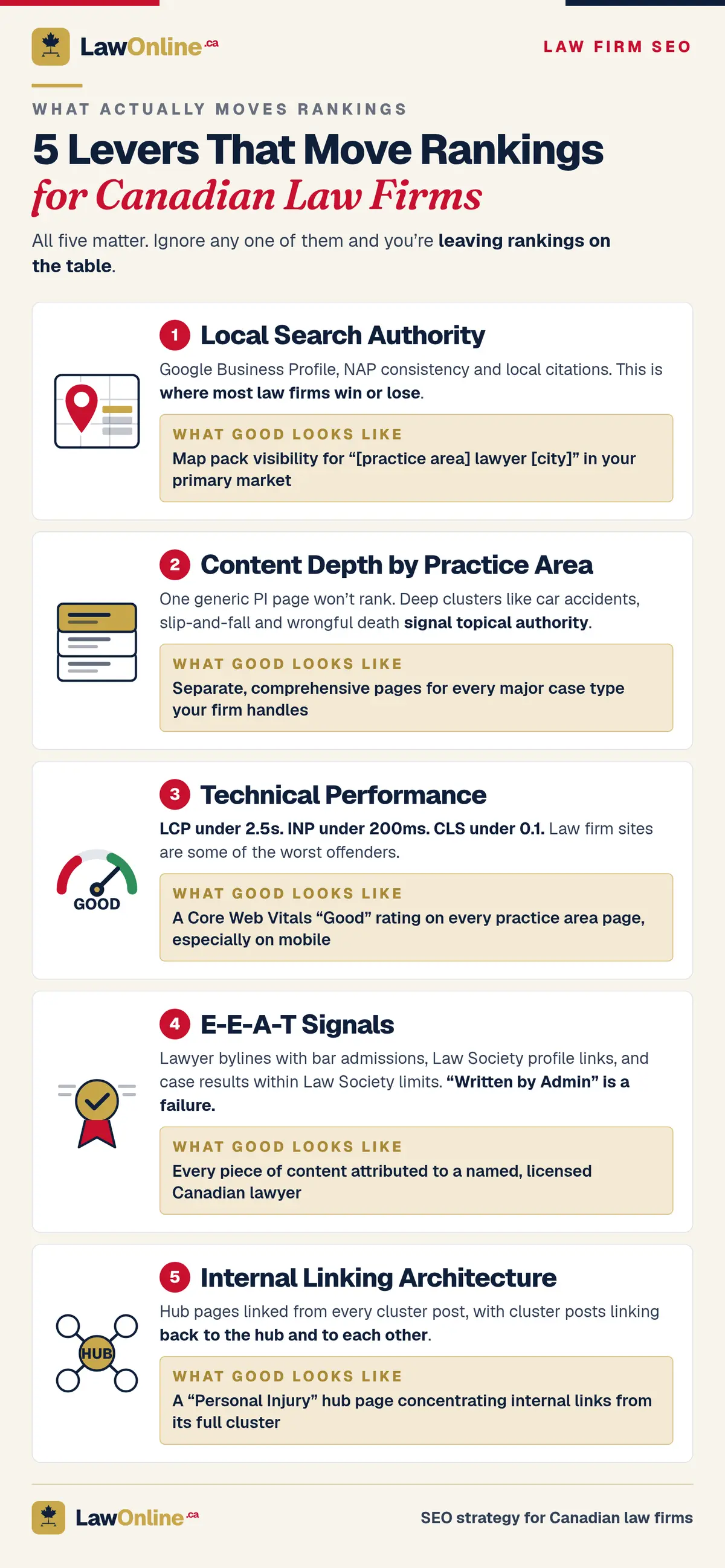
1. Local Search Authority
Local search is where most law firms win or lose. When someone searches "car accident lawyer Brampton" or "divorce lawyer Calgary," Google serves a mix of organic results and the local map pack. Getting into that map pack is often more valuable than ranking #1 in organic results because it sits above the fold with your phone number, reviews, and directions. A 2026 UK legal SEO study found that the Local Pack captures 42% of all clicks for local legal queries. No equivalent Canadian study exists yet, but the pattern is consistent across common-law markets where Google dominates search.
Building local authority requires three things working together:
- Google Business Profile optimization. Your GBP needs complete, accurate information: practice areas, service areas, hours, photos of your actual office and team, and regular posts. Firms that treat their GBP as a "set it and forget it" listing get outranked by firms that actively manage it.
- NAP consistency. Your firm's name, address, and phone number need to be identical across every directory, citation source, and website where you appear. Inconsistencies confuse Google and dilute your local authority.
- Local citations and backlinks. Listings in legal directories, local chamber of commerce sites, and provincial bar association directories all reinforce your local relevance. A personal injury firm in Vancouver with citations on the Law Society of BC directory, local legal aid pages, and Vancouver business directories builds a local footprint that generic national content can't replicate.
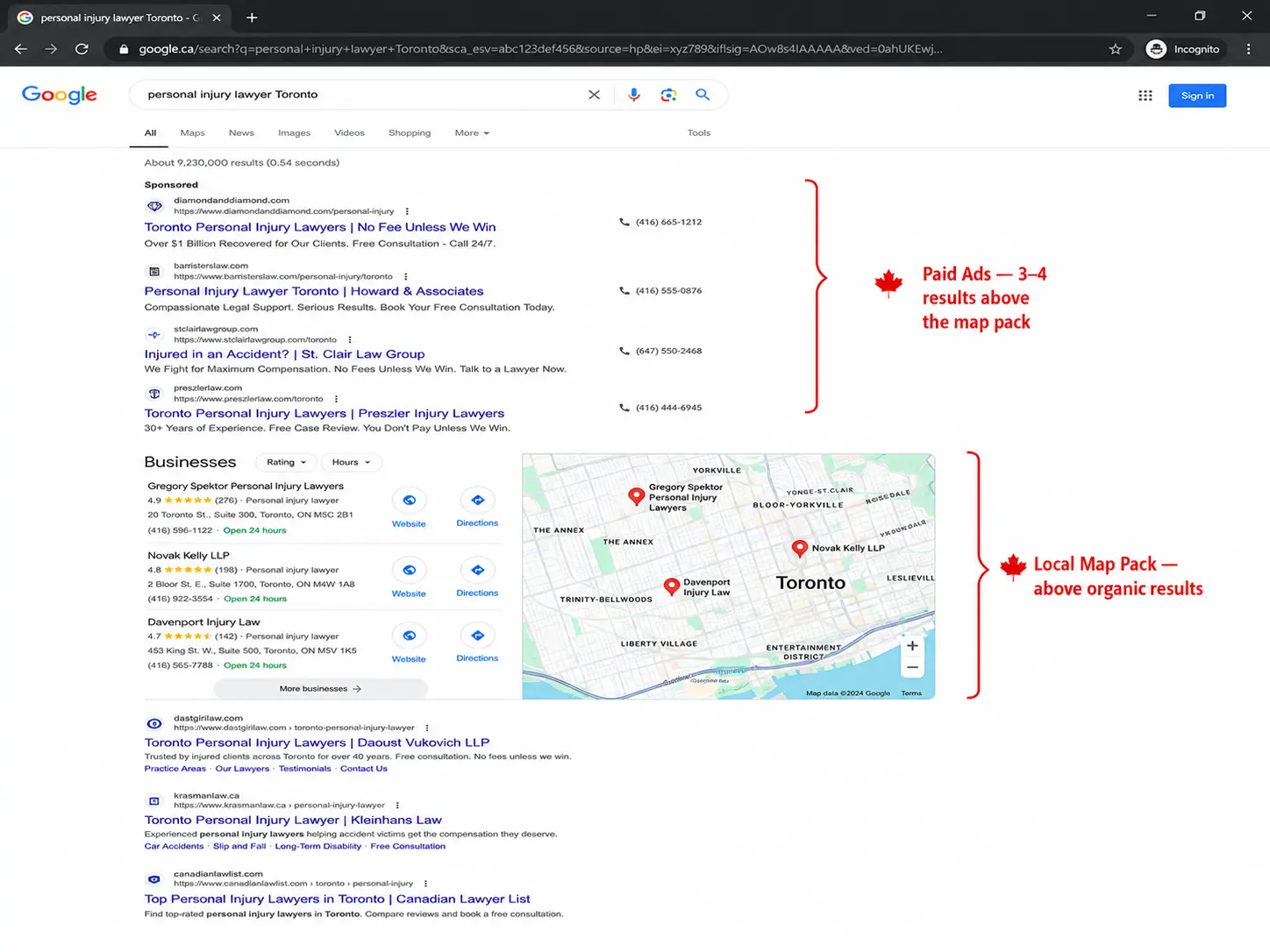
For a complete tactical breakdown, our local SEO guide for Canadian law firms covers advanced strategies beyond the basics.
2. Content Depth by Practice Area
Most law firm websites have a page for each practice area: personal injury, family law, criminal defence, corporate law. A paragraph or two of generic copy. Maybe a stock photo. That's not enough.
The firms ranking on page one have deep content ecosystems around each practice area. A personal injury firm doesn't just have one PI page. It has separate pages for car accident claims, motorcycle accidents, slip-and-fall cases, dog bite injuries, wrongful death claims, and WSIB disputes. Each page targets specific search terms, answers specific questions, and links to related content.
Depth beats breadth. A 2025 Ontario-focused study that analyzed 69 law firms across five practice areas found that auditing and restructuring content around clear topical boundaries, removing cannibalizing pages, and building differentiated location content led to significant improvements in organic visibility. Google wants to see that you're a genuine authority on the topics you're targeting, not a firm with a thin page on twenty practice areas. A family law firm in Toronto that publishes comprehensive guides on child custody in Ontario, spousal support calculations, and divorce mediation timelines signals topical authority that a competitor with one generic "family law" page can't match.
This approach also feeds AI citation. Tools like ChatGPT and Google's AI Overviews increasingly pull from content that thoroughly covers a topic. A deep, well-structured practice area page is far more likely to be cited as a source than a surface-level overview.
3. Technical Performance
A slow website kills your rankings before your content strategy has a chance to work. Google uses Core Web Vitals as ranking signals, and law firm websites are some of the worst offenders. A 2026 study of UK law firm websites found that 28% fail Core Web Vitals entirely. There's no reason to assume Canadian firms fare much better.
The three metrics that matter:
- Largest Contentful Paint (LCP): How quickly your main content loads. Target: under 2.5 seconds.
- Interaction to Next Paint (INP): How quickly your site responds when someone clicks or taps. Target: under 200 milliseconds.
- Cumulative Layout Shift (CLS): How much your page layout jumps around while loading. Target: under 0.1.
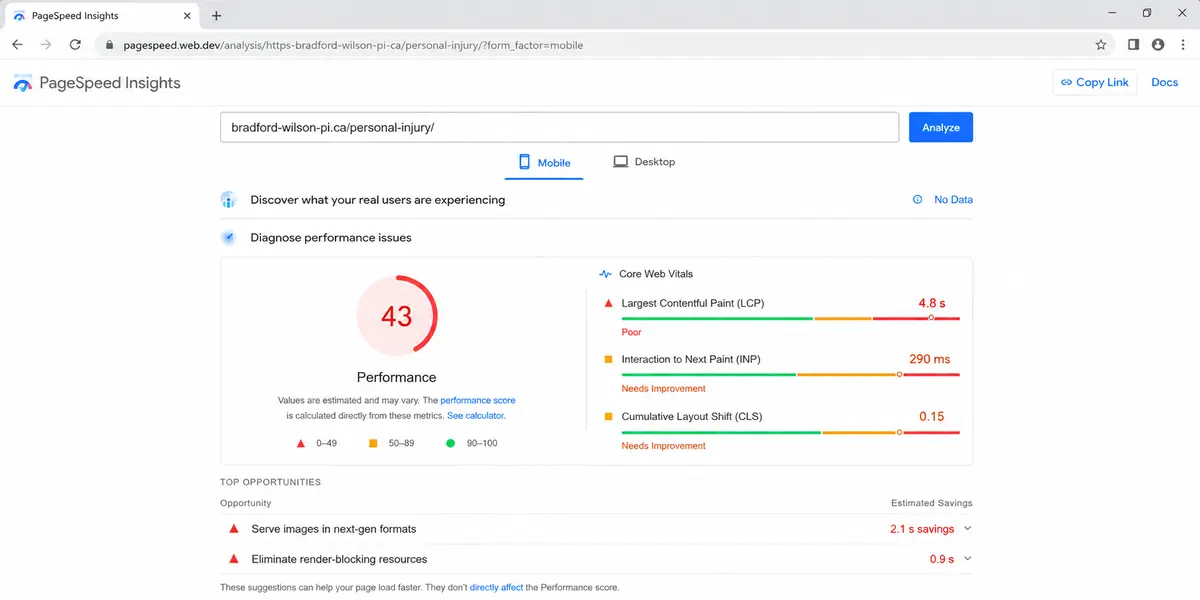
Personal injury firm websites are particularly prone to poor technical performance. Heavy hero images, chat widgets that load synchronously, embedded video players, and bloated WordPress themes all drag down speed. A PI firm in Toronto with a 6-second load time on mobile is invisible to the 53% of visitors who won't wait more than 3 seconds for a page to load.
For a complete diagnostic approach, see our guide on law firm website speed and Core Web Vitals.
4. E-E-A-T Signals Specific to Legal
E-E-A-T stands for Experience, Expertise, Authoritativeness, and Trustworthiness. It's important to understand what E-E-A-T actually is: Google's own documentation clarifies that E-E-A-T is a quality evaluation framework used by human raters, not a direct ranking factor or algorithmic score. There's no "E-E-A-T number" you can optimize. But Google's ranking systems are designed to surface content that aligns with what those raters look for, and E-E-A-T matters more for YMYL law firms and legal professionals than almost any other category.
For law firms, strong E-E-A-T signals include:
- Author credentials on every piece of content. Blog posts should carry the name of a licensed lawyer with their bar admission and practice area expertise visible. "Written by Admin" is an E-E-A-T failure.
- Bar membership and professional association pages. Link to your Law Society profile, Canadian Bar Association membership, and any specialty certifications. These external validations of expertise are exactly what Google looks for.
- Case results and notable outcomes. A personal injury firm that publishes case results (within the bounds of Law Society rules) demonstrates real-world experience that no amount of blog content can replicate.
- Detailed lawyer biography pages. Each lawyer at your firm should have a substantive bio covering education, bar admissions, practice areas, publications, and speaking engagements. These pages often rank for "[lawyer name]" searches and serve as E-E-A-T anchors for the rest of your content.
- Secure, well-maintained website. HTTPS, up-to-date software, a clear privacy policy, and easily accessible contact information all contribute to trust signals.
For a deeper breakdown with a self-audit checklist, see our complete E-E-A-T guide for law firms.
5. Internal Linking Architecture
Most law firm websites have weak or nonexistent internal linking. Pages exist in isolation, connected only through navigation menus. This is a significant missed opportunity.
A strong internal linking architecture uses hub pages and cluster content. Your main "Personal Injury" page acts as a hub, linking out to detailed cluster pages on specific topics (car accidents, slip-and-fall, etc.), and each cluster page links back to the hub and to related clusters. This structure tells Google that your hub page is the authoritative resource for personal injury law at your firm, boosting its ranking potential.
The principle is straightforward: pages that receive more internal links carry more authority. By strategically linking from your blog posts, practice area pages, and FAQ content to your most important pages, you concentrate ranking power where it matters most. Our law firm SEO program is built around this hub-and-spoke model because it consistently outperforms flat site architectures.
How Does SEO Strategy Differ by Practice Area?
Not all law firm SEO is the same. The competitive landscape, search behaviour, and client journey vary dramatically by practice area. Here's how strategy needs to shift.
Personal Injury SEO (Highest Competition in Canada)
Personal injury is the most competitive legal SEO category in Canada. The economics explain why: a single contingency case can generate $15,000 to $60,000 in fees, which means firms can justify aggressive SEO spending. In Toronto, the top PI firms invest $5,000 to $15,000 per month on SEO alone.
The competitive intensity means PI firms need to excel at all five levers, not just one or two. Local authority matters enormously because "personal injury lawyer [city]" is the primary search pattern. Content depth is critical because Google needs to see comprehensive coverage across injury types. Technical performance can't be an afterthought because every PI firm's competitor has a fast site.
PI firms also face heavy PPC competition. Google Ads clicks for personal injury keywords in major Canadian cities regularly cost $50 to $150 each. This makes SEO even more valuable: the long-term cost per acquisition through organic search is a fraction of what PPC delivers, but the timeline is longer. Firms that can invest patiently in SEO while running PPC for immediate leads build a durable competitive advantage. Our personal injury SEO strategy guide covers the complete keyword matrix, content calendar, and year-one timeline, and our personal injury law firm marketing guide covers the full playbook beyond SEO. For what this costs in practice, see our law firm SEO pricing guide.
Criminal Defence SEO (Urgent Intent)
Criminal defence clients search differently. When someone is charged with a crime, they need a lawyer now. Search patterns reflect this urgency: "criminal lawyer near me," "DUI lawyer Toronto tonight," "bail hearing lawyer." Page speed and mobile experience are especially critical because these searches happen on phones, often late at night or on weekends.
Criminal defence SEO should prioritize Google Business Profile optimization and local pack visibility above almost everything else. When someone is sitting in a police station parking lot at 11 PM searching for a lawyer, they're calling the first credible result they see in the map pack. Your content strategy should focus on specific charges (assault, DUI, fraud, drug offences) rather than broad "criminal law" content.
Family Law SEO (Research-Heavy Intent)
Family law clients take their time. Divorce, custody, and spousal support decisions are emotionally charged and financially significant. Potential clients research extensively before contacting a lawyer, often visiting multiple firm websites over weeks or months.
This makes content depth especially important for family law firms. Comprehensive guides on topics like "how child custody works in Ontario" or "spousal support calculation in Canada" serve dual purposes: they rank well because Google rewards thorough content, and they build trust with potential clients who are still in the research phase. Blog content that addresses emotional concerns alongside legal information tends to resonate with family law prospects in a way that purely technical content doesn't.

Corporate and Business Law (Thought Leadership)
Corporate clients rarely search "business lawyer Toronto" and hire the first result. They look for evidence of expertise in specific areas: M&A, commercial real estate, intellectual property, startup financing. The search volume is lower, but the client value is higher and competition is often less intense than PI or criminal.
SEO for corporate law firms should emphasize thought leadership content: analysis of regulatory changes, commentary on significant transactions (without revealing confidential details), and guides to complex business structures. LinkedIn and professional network visibility complement SEO for this practice area in ways that don't apply to consumer-facing practices.
What Does Year One of Law Firm SEO Actually Look Like?
One of the biggest reasons law firm SEO fails is misaligned expectations. Industry data consistently shows that SEO takes 3 to 6 months to produce initial measurable movement, 6 to 12 months for significant traction on competitive terms, and 12 to 24 months to reach peak competitive rankings. But firms expect results in three months because that's what their agency promised. When rankings don't materialize on that timeline, they cancel and conclude that SEO doesn't work.
Here's what year one realistically looks like for a mid-size personal injury firm in Toronto investing $4,000 to $6,000 per month in SEO.

Months 1 to 3: Foundation
This phase is all infrastructure. Your agency should be conducting a full technical audit, fixing site speed issues, cleaning up your Google Business Profile, auditing your existing content, and building a keyword strategy based on actual search data. You won't see ranking improvements during this phase. That's normal.
Visible deliverables during the foundation phase: a technical audit report with prioritized fixes, a keyword map connecting practice areas to target terms, GBP optimization, and the beginning of content production. If your agency isn't sharing these deliverables transparently, that's a red flag.
Industry benchmarks suggest that at the 90-day mark, a healthy SEO program should show 15 to 30% growth in total keyword impressions and first-page appearances for 20 to 30% of your target long-tail keywords. These are leading indicators, not revenue metrics, but they tell you whether the foundation work is actually moving the needle.
Months 4 to 6: Content Velocity
With the technical foundation in place, the focus shifts to content production and optimization. Your agency should be publishing practice area pages, blog posts targeting specific case types, and FAQ content aligned with how potential clients actually search. Internal linking between new content and existing pages starts building topical authority.
During this phase, you'll start seeing lower-competition keywords move. Long-tail terms like "what to do after a car accident in Brampton" or "how long does a personal injury claim take in Ontario" may start appearing on page one. Your primary keywords ("personal injury lawyer Toronto") won't have moved much yet. That's still normal.

Months 7 to 12: Ranking Movement
This is where the compounding effect of consistent SEO work starts showing. Primary keywords begin climbing as Google recognizes your site's growing authority. Your GBP may start appearing in the local map pack for competitive terms. Organic traffic increases, and more importantly, inquiry volume starts rising.
By month 12, a well-executed campaign should show measurable improvements in keyword rankings, organic traffic, and most critically, contact form submissions and phone calls from organic search. The firms that see the strongest results are the ones that committed to the full twelve months without cutting budget when month three didn't produce leads.
The patience pays off. Compiled legal marketing data puts the 3-year ROI for an average law firm marketing program at roughly 526%, which explains why the firms that win at SEO are the ones that treat it as a multi-year investment rather than a quarterly experiment.
It's worth noting what year one doesn't look like. It doesn't look like dominating the map pack for "personal injury lawyer Toronto" in six months. It doesn't look like outranking firms that have been investing in SEO for five years. Year one builds the foundation. Year two is where the real competitive gains happen.
What Should You Do Next?
SEO for lawyers isn't a generic marketing service. It requires an understanding of YMYL standards, provincial advertising rules, local search dynamics, and the specific ways potential clients search for legal help in Canada. Generic agencies applying e-commerce playbooks to law firms consistently produce reports that look good and results that don't.
Survey data shows that 65% of law firms report their website brings the highest return on investment among all marketing channels, and 83% now hire external teams to handle their marketing. If your firm is evaluating SEO, the five levers covered in this post (local authority, content depth, technical performance, E-E-A-T signals, and internal linking) are where to focus your questions when interviewing agencies. Ask how they handle Law Society compliance. Ask for examples of law firm clients they've grown. Ask what month-three deliverables look like versus month-twelve outcomes. Our guide to choosing a law firm SEO agency in Canada covers the full evaluation framework, from the questions that reveal real expertise to the red flags that should end the conversation. For a side-by-side look at which agencies are worth considering, see our comparison of law firm SEO companies in Canada.
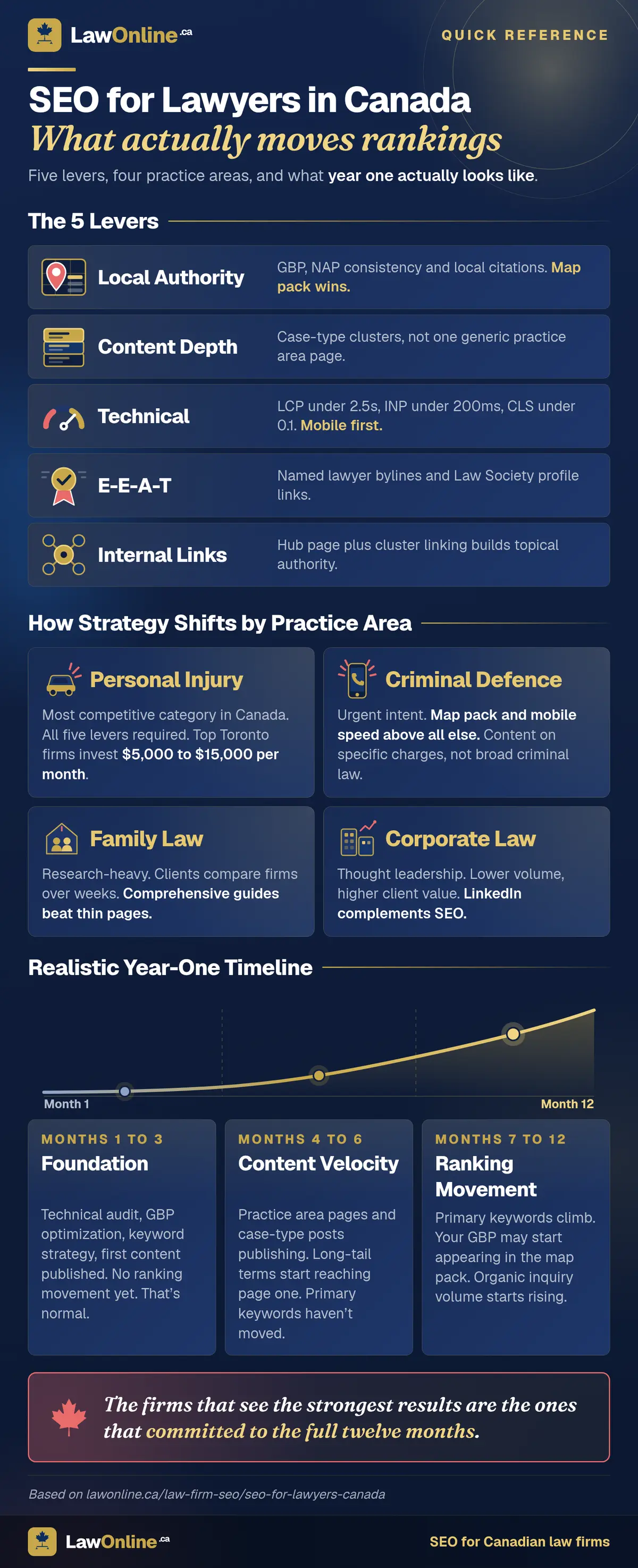
If you want to see how we approach these five levers for Canadian law firms, explore our law firm SEO program for the full methodology.