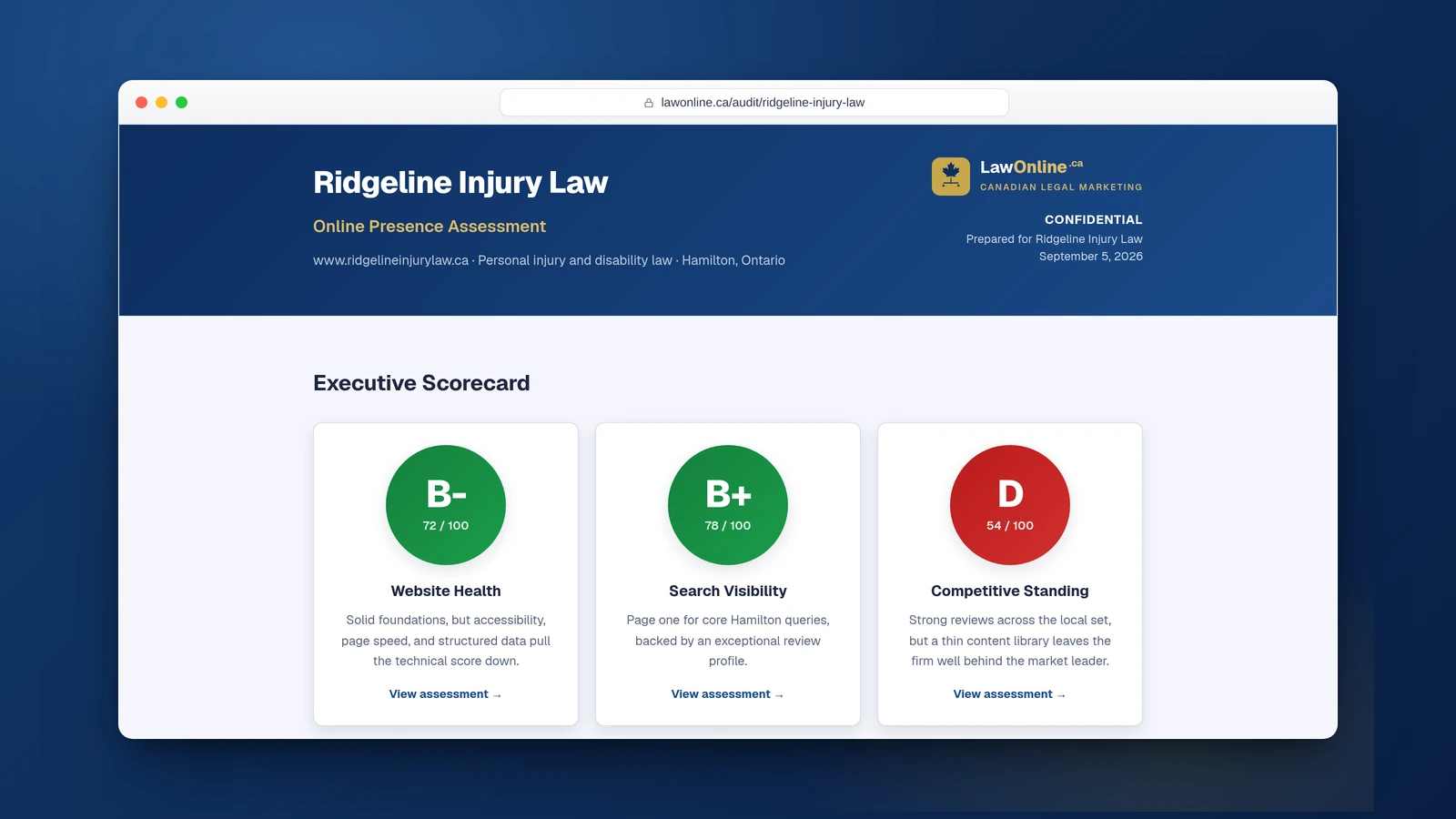
You're a personal injury firm partner in Ontario. You've been through two SEO agencies in three years. The first one produced blog posts that nobody read and rankings for keywords nobody searched. The second one showed you traffic graphs that went up every month while your phone stayed quiet. You're about to sign a third contract, and you're wondering what you should do differently this time.
Here's what should be different: the way you evaluate the agency before you sign.
Most law firms pick SEO providers the same way they'd pick any vendor, whether it's a dedicated law firm SEO company, a freelance consultant, or a full-service agency. They read the website, sit through the pitch, and go with whoever sounds most convincing. That process selects for sales ability, not SEO ability, and those are very different things. A 2024 survey by Law Firm Marketing Pros found that 79% of law firms rate SEO as their most effective marketing channel (the data is US-based, but Canadian firms report the same dynamic). That makes the agency running your SEO one of the highest-stakes vendor decisions you'll face. This post gives you a concrete framework for evaluating a law firm SEO agency in Canada, so the third time actually works.
What Separates a Legal-Specialist SEO Agency From a Generalist?
The difference isn't branding. It's whether the agency actually understands law firm search engine optimization, not just generic digital marketing with a legal coat of paint. There are four things that generalist SEO shops consistently get wrong when they work with law firms.

Canadian law firm content compliance. Every provincial Law Society has advertising rules that affect what you can publish online. Ontario's rules around testimonials, fee guarantees, and comparative claims differ from BC's, which differ from Alberta's. A generalist agency won't know this, and the Law Society won't care that your agency wrote the copy. You're the one who faces the complaint. An agency that works with Canadian law firms should know these rules cold and have a review process for every piece of content before it goes live. For the full picture on Ontario's advertising restrictions, we've covered the specifics.
Legal keyword research depth. SEO for a personal injury firm targeting "car accident lawyer Brampton" is a completely different discipline than SEO for a family law firm targeting "divorce lawyer Calgary." The search intent is different. The competitive landscape is different. The content requirements are different. A legal-specialist agency understands practice area depth, local modifiers, and how searchers move from informational queries to high-intent commercial ones. A generalist treats "law firm" as one keyword category and builds a single template strategy.
Legal business model fluency. Law firms don't sell products. They sell retainers, consultations, and case outcomes. A good SEO agency understands how firms generate and close cases, which practice areas have the highest lifetime value, and why a personal injury firm's marketing economics look nothing like a real estate lawyer's. That understanding shapes everything from keyword targeting to conversion tracking. Without it, you get SEO that produces traffic reports, not signed clients.
Canadian market knowledge. A lot of agencies selling SEO to Canadian law firms are running American playbooks with .ca URLs. The directories are different. The competitive dynamics are different. Google Local Services Ads still aren't available to Canadian lawyers at all, so an agency pitching them is selling a US product that doesn't exist here. Bilingual markets in Ottawa, Montreal, and New Brunswick require French-language content strategy and keyword research that a US-based agency won't think to address. "We serve clients in Canada" isn't the same as understanding the Canadian legal market.
What Are the 6 Questions to Ask Before Signing With a Law Firm SEO Agency?
These six questions cut through sales decks and expose what any law firm SEO company or agency actually knows. Ask all of them. Pay attention to how they answer, not just what they say.
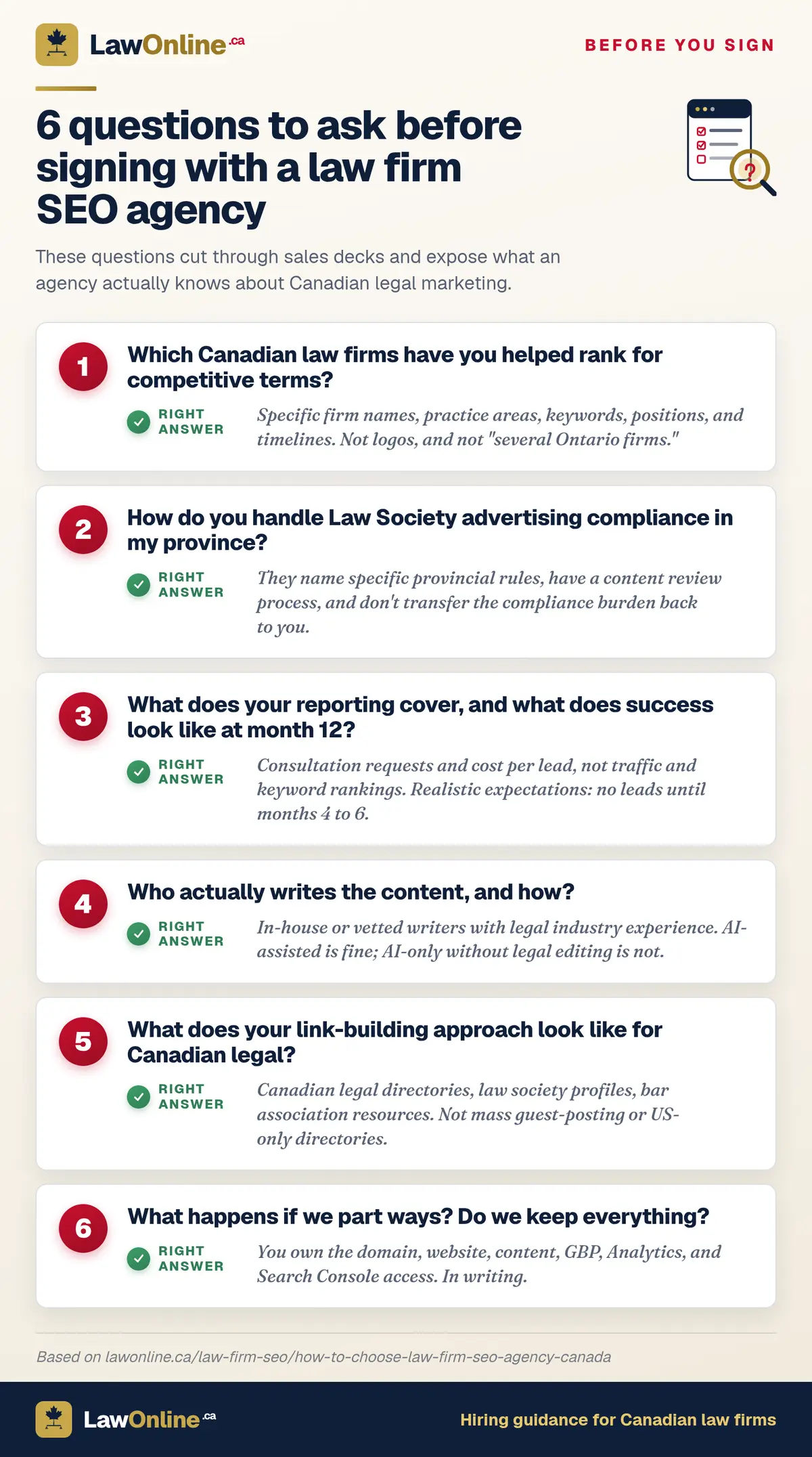
1. Which Canadian law firms have you helped rank for competitive terms?
This is the most important question and the one agencies struggle with most. You're not asking for a logo wall or a generic case study. You're asking for a track record: which firms, which practice areas, which keywords, what position before and after, and over what timeframe.
A credible answer sounds like: "We helped a PI firm in the GTA move from page three to position four for 'personal injury lawyer Toronto' over eight months, which contributed to a 40% increase in consultation requests." A bad answer is: "We've worked with several law firms across North America."
For a sense of what transparent results look like, consider a Toronto SEO agency that published a case study showing a 118% increase in organic clicks for Pomp & Circumstance PR, with specific tactics listed: thought-leadership content targeting service queries, title tag and meta description rewrites, and earned media placements. That's for a PR firm, not a law firm, but the level of specificity and the willingness to name the client is exactly what you should demand from any legal SEO agency.
If they can't name Canadian law firms they've worked with, that's your first data point.
2. How do you handle Law Society advertising compliance in my province?
The right answer demonstrates familiarity with your specific province's rules. For Ontario, that means they know the restrictions around testimonials, fee guarantees, and comparative advertising under the Law Society of Ontario's rules. For BC or Alberta, the details differ.
What you're really testing is whether they have a content review process that catches compliance issues before publication. An agency that says "we'll run everything by you for approval" is transferring the compliance burden back to you. That's not what you're paying for.
3. What does your reporting cover, and what does success look like at month 12?
Beware of agencies that define success as traffic growth and keyword rankings. Those are inputs, not outcomes.
A good agency ties reporting to business results: consultation requests, phone calls from organic search, cost per lead by practice area, and how those numbers trend over time. They should also set realistic expectations. SEO doesn't produce meaningful results in 30 days. A credible agency will tell you that months one through three are foundational (technical fixes, content strategy, initial production) and that measurable lead generation typically starts around month four to six.
Ask what their month-12 benchmark looks like for a firm similar to yours. If the answer is vague or overly optimistic, that tells you something.
4. Who actually writes the content, and how?
Content is the engine of law firm SEO. The quality of that content directly affects your rankings, your firm's credibility, and whether visitors actually contact you.
Ask whether writers are in-house or contracted. Ask whether they use AI-generated content, and if so, what the editing and quality control process looks like. There's nothing wrong with AI-assisted content, but there's a difference between AI as a drafting tool with experienced human editors and AI output published with minimal review. The latter reads like it, and Google's helpful content system is built to detect it.
For a personal injury firm, the content needs to demonstrate real understanding of the claims process, the types of cases your firm handles, and the questions potential clients actually ask. Generic legal content that reads like it was written by someone who's never spoken to an injured person doesn't convert.
5. What does your link-building approach look like for Canadian legal?
Link building for law firms in Canada is different from link building for e-commerce or tech companies. The tactics that work in other industries (mass guest posting, link exchanges, paid placements) can actively damage a law firm's reputation and risk Google penalties.
A credible SEO agency for lawyers will build links from Canadian legal directories, provincial law society profiles, bar association resources, local business listings, and earned media through legal publications. Ask specifically about their approach to Canadian directories versus American ones. An agency building links exclusively from US-based directories for a Canadian firm is wasting your money.

6. What happens if we part ways? Do we keep everything?
This question exposes one of the most common traps in the agency world. Some agencies build your site on proprietary platforms, manage your Google Business Profile under their account, or retain ownership of content they've produced.
You should own everything: your domain, your website code and hosting, your Google Business Profile, your Google Ads account, your Analytics and Search Console access, and every piece of content. If the agency uses a proprietary CMS that you can't migrate away from, that's a lock-in strategy, not a service. Walk away.
Get the ownership terms and cancellation clause in writing before you sign. Ask about contract length too: month-to-month arrangements are rare at this price point, but an agency that won't discuss exit terms until after you've signed isn't one you want to work with.
What Red Flags Should Make You Walk Away?
Some things aren't yellow flags. They're exit signs. If you see any of these during the evaluation process, end the conversation.
Guaranteed ranking promises. No one can guarantee Google rankings. The algorithm considers hundreds of factors, and Google itself states that no one can guarantee a #1 ranking. An agency that promises "page one in 90 days" either doesn't understand how search works or doesn't care about telling you the truth. Neither is acceptable. There's a reason most law firm SEO in Canada fails, and unrealistic expectations set by agencies are a big part of it.
No Canadian law firm case studies or references. An agency that claims to specialize in legal SEO should be able to point to specific Canadian law firms they've helped. Not just logos. Not just "a mid-size firm in Ontario." Names, practice areas, and results. If they can't produce references, they haven't done the work.
AI-generated content with no editing layer. Publishing raw AI output as law firm content is a shortcut that damages your firm's credibility and risks ranking penalties. Ask to see sample content. If it reads like a Wikipedia summary of "personal injury law," that's what your blog will look like.
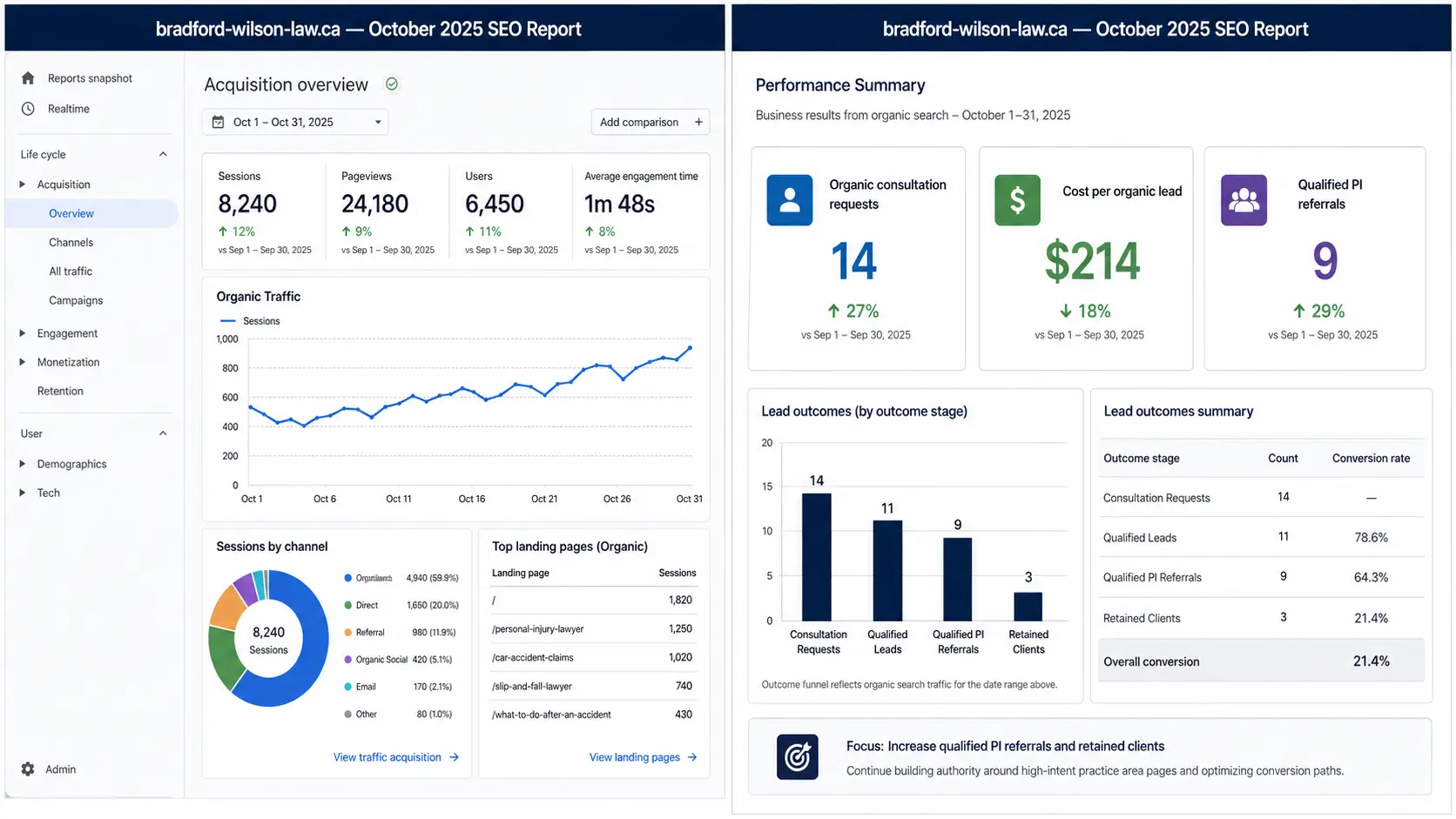
Reporting on traffic and keywords instead of leads and signed cases. An agency that reports on sessions, page views, and "keyword rankings improved" without connecting those numbers to consultations and retainers is hiding behind vanity metrics. They might be doing good work. But if they can't show you the connection between SEO activity and business results, you can't evaluate the investment.
Proprietary website platforms that hold your site hostage. If the agency insists on building your site on their platform, you don't own a website. You're renting one. When the relationship ends, you start over with a blank domain and zero content. This is the single most expensive mistake law firms make with agencies, because it means every dollar you've invested in content, backlinks, and domain authority walks out the door with them.
How Are Law Firm SEO Contracts and Pricing Structured?
Most law firm SEO companies in Canada use one of two pricing models: monthly retainers or project-based engagements.
Monthly retainers are the standard for ongoing SEO. For Canadian law firms, expect ranges from $1,500 to $5,000 per month for a solo practitioner or small firm in a less competitive market, $5,000 to $10,000 per month for mid-size firms in competitive practice areas like personal injury, and $10,000 to $25,000 per month for multi-location firms or firms targeting the most competitive keywords in major metro areas. For a detailed breakdown of what's included at each price point, see our full pricing guide for law firm SEO in Canada.
Those ranges track with what agencies actually publish. A 2024 whitepaper from Vancouver-based Jelly Marketing lists SEO audits starting at $750 for a basic technical review and running to $2,500 for a comprehensive audit that covers analytics, ads, and PR. Their ongoing retainers start at $2,000 per month for onsite SEO during the first three months (dropping to $1,000 after), and $5,000 per month for offsite work including link building (dropping to $2,500). When you're comparing proposals, published pricing like this gives you a useful sanity check.
For context on what Canadian firms can actually afford: federal industry data from ISED counts 52,204 legal services establishments in Canada, with 99.5% employing fewer than 100 people. Average SME revenue sits around $398,000 and 84.7% of these businesses are profitable. SEO retainers aren't trivial at that scale, which is exactly why getting the agency choice right matters: you need the investment to produce actual returns, not just activity reports.
Project-based work typically covers a specific scope: a technical SEO audit, a website redesign with SEO migration, or a content strategy buildout. These are useful when you have a defined need and want to evaluate an agency before committing to an ongoing retainer. Most law firm SEO contracts run six to twelve months for retainer engagements, which reflects the time search engine optimization genuinely needs to produce results. Shorter contracts exist but usually come at a higher monthly rate.
What's usually included in a monthly retainer: technical SEO maintenance, content strategy and production (a set number of pages or posts per month), on-page optimization, local SEO management, link building, monthly reporting, and a strategy call. What's typically an add-on: Google Ads management, social media, website design or development work, and video production. Our guide to what law firm SEO services actually include breaks down each of those deliverables and what to expect at every stage of the engagement.
Watch for two pricing red flags. First, agencies that won't discuss pricing at all before a discovery call. That often means they price to what they think you can afford. Second, retainers under $1,500 per month. The economics of quality SEO, which requires a strategist, a writer, a technical specialist, and link-building outreach, simply don't work at that budget. You'll get either inexperienced staff or minimal work.
What Can Your Website Tell You Before You Call Anyone?
Before you start evaluating agencies, spend 15 minutes with your own site. What you find will shape the conversation and help you identify whether an agency is asking the right questions.
Site speed. Run your homepage and one practice area page through Google PageSpeed Insights. If your mobile score is below 50, you've got technical problems that need addressing before any content strategy will perform. Note the specific issues flagged, as a good agency will mention them without being prompted.
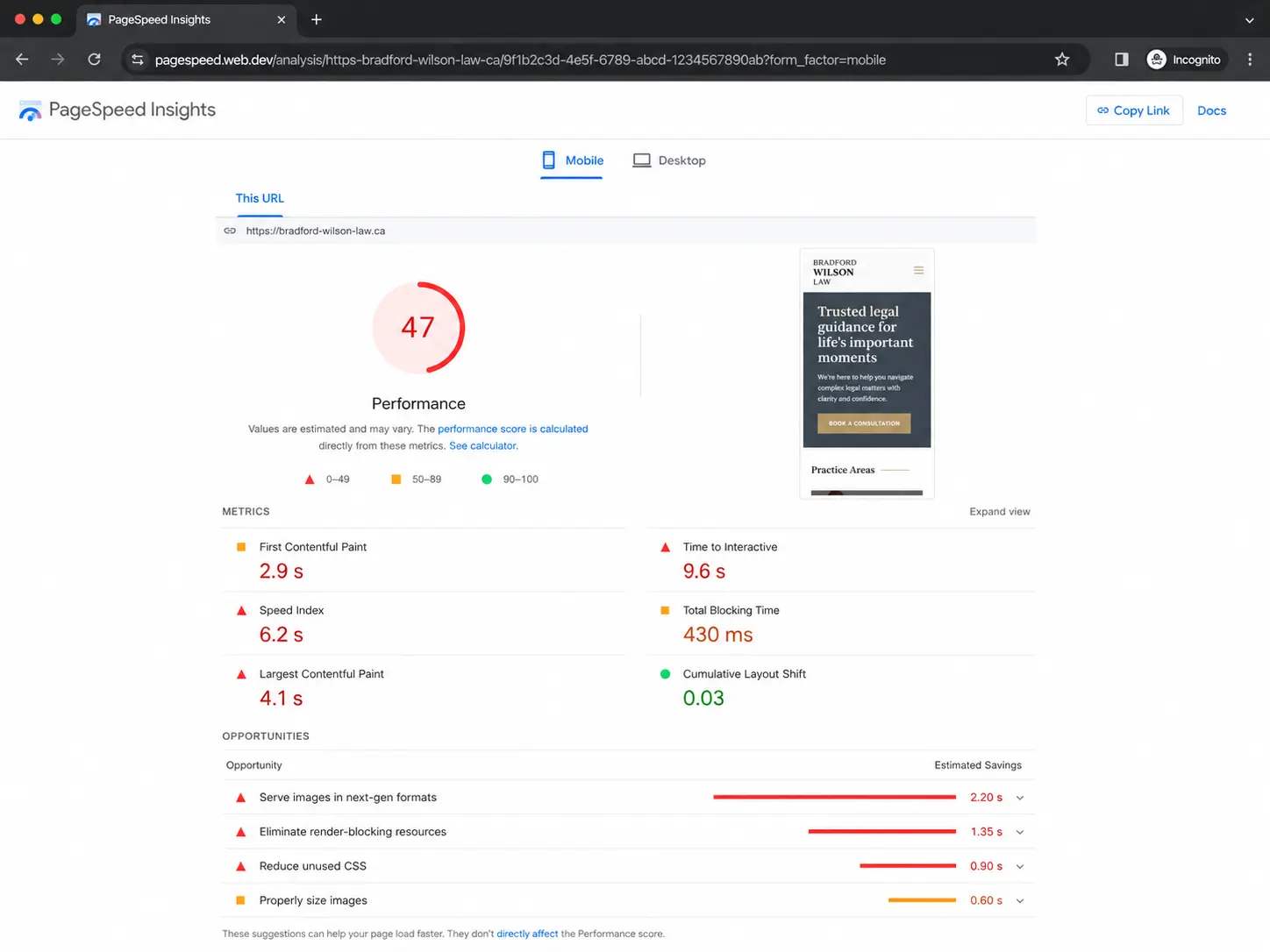
Mobile experience. Open your site on your phone. Can you find your phone number in under three seconds? Does the contact form work? Is the text readable without zooming? More than 60% of legal searches happen on mobile devices. If your site doesn't work well on a phone, you're losing potential clients before SEO even enters the picture.
Google Business Profile. Search your firm name on Google. Is your Business Profile complete? Are there recent reviews? Are the hours, address, and phone number accurate? An incomplete or outdated GBP is one of the easiest wins in local SEO, and it costs nothing to fix.
Existing content volume. Count the pages on your site. How many practice area pages do you have? How many blog posts? Is the content current, or are you still running a "2022 legal trends" post on the homepage? Thin content signals to agencies (and to Google) that there's foundational work to be done.
Google Search Console data. If you have Search Console set up, check your average position for your target keywords. If you don't have Search Console, that's the first thing any agency should set up. It's free, and it's the only source of real keyword performance data.
This self-assessment doesn't replace a professional audit. But it arms you with enough information to evaluate whether an agency's proposal actually addresses your firm's real problems, or whether they're selling a template that could apply to any law firm in the country.
How Do You Find the Right Law Firm SEO Agency?
There's no shortcut to this decision. The firms that get it right don't pick the agency with the best website or the most confident pitch. They pick the one that demonstrates genuine understanding of their practice area, their market, and their business goals. Whether you're evaluating a full-service SEO agency for lawyers or a solo law firm SEO expert, the same principle applies: demonstrated expertise in your specific practice area matters more than firm size or polished marketing.
Ask the hard questions from this guide. Pay attention to how the agency reacts when you push back. The good ones welcome scrutiny and answer with specifics. The bad ones deflect, get vague, or try to redirect the conversation back to their slide deck.
Take your time. SEO needs a 12-month horizon to mature, so plan to give the work a full year. That's a reason for patience, though, not a reason to sign a 12-month lock-in: the best agencies earn each month by delivering results, not by holding you to a contract you signed up front. Signing the wrong contract costs you money, momentum, and the opportunity cost of what a competent agency could have done in that same period.
For a deeper look at what effective law firm SEO involves and what it should produce, start with our law firm SEO services overview. It covers the strategy, the process, and what separates agencies that produce rankings from agencies that produce results.
If you'd rather compare specific options first, our roundup of the best law firm SEO companies in Canada profiles seven agencies with honest strengths and limitations for each.