
Family law is one of the most searched practice areas in Canadian legal. Divorce, custody disputes, separation agreements, child support variations, these are life-altering situations, and the demand is enormous. In the 2024/2025 fiscal year, there were over 278,500 active family law cases in Canadian civil courts, accounting for roughly 30% of the entire civil caseload. Most of the people involved in those cases are searching for help online.
But marketing a family law practice presents challenges that don't exist in other areas. The emotional sensitivity of the subject, the complexity of referral dynamics, and the ethical constraints on advertising all require a more nuanced approach than simply running Google Ads and waiting for the phone to ring.
This guide covers family law digital marketing strategy in Canada, what works, what doesn't, and how to build a sustainable client acquisition system.
Understanding the Family Law Client
Before building any marketing strategy, you need to understand how family law clients think and search.

The search is often private. Many people researching separation or divorce are doing so from a home computer, often without their spouse knowing. They're in an emotionally difficult situation, and the privacy and tone of your digital presence matter enormously. A website that feels aggressive, transactional, or combative can drive leads away before you ever speak to them.
Many potential clients are navigating the system alone. A Statistics Canada profile of family law cases found that 58% of family law litigants were self-represented, a figure that's been climbing since at least 2014/2015. These aren't people who decided they don't need a lawyer. They're people who haven't found the right one yet, or who don't know where to start. That's the gap a strong digital presence fills.
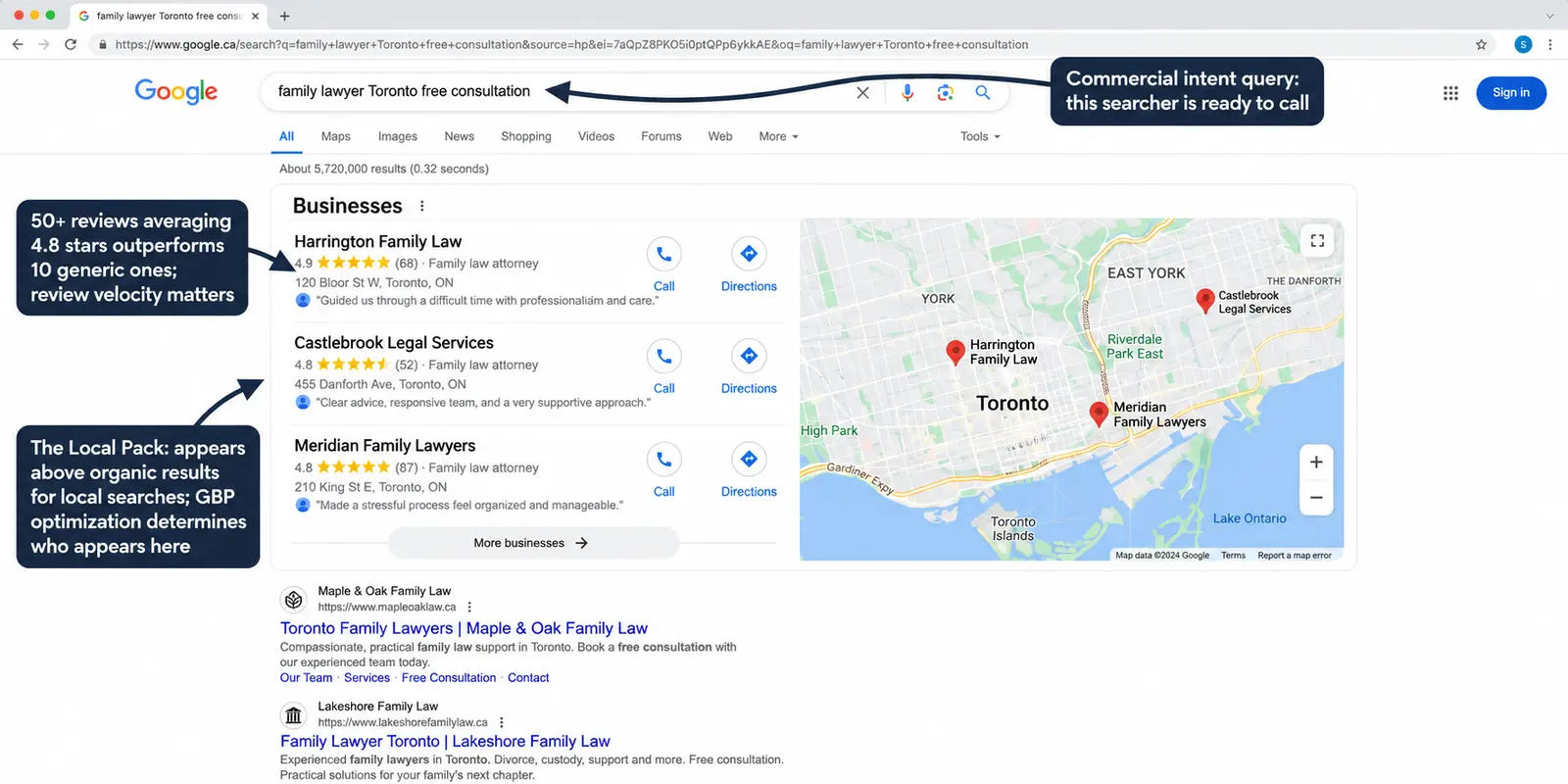
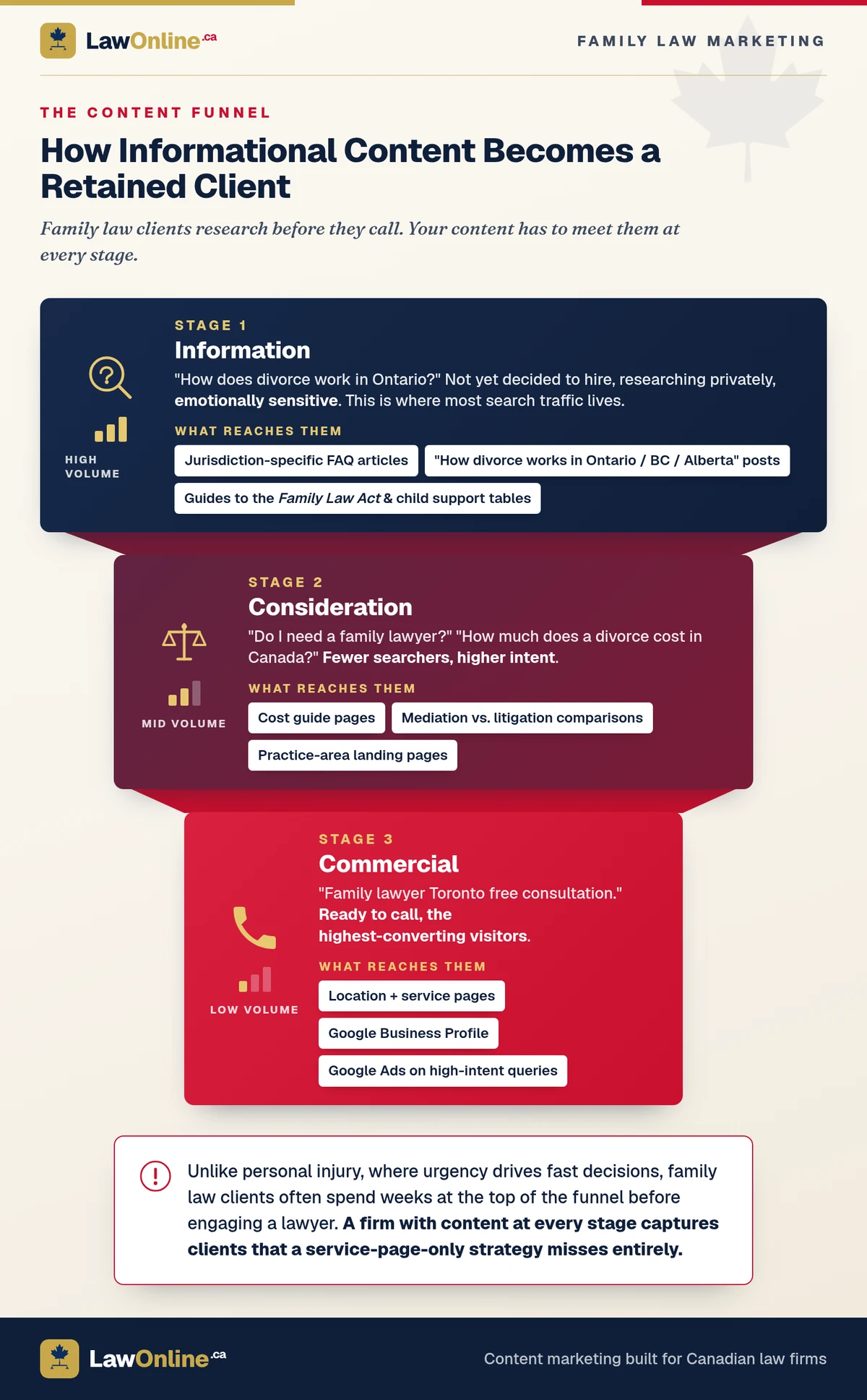
Search intent varies widely by stage. Someone searching "how does divorce work in Ontario" is at the information stage, they haven't decided to hire a lawyer yet. Someone searching "family lawyer Toronto free consultation" is ready to call. Your content and conversion strategy need to address both stages.
Referrals are significant but hard to systematize. Many family law clients find lawyers through trusted personal referrals, from friends who've been through divorce, from therapists, from financial advisors, or from accountants. These referrals are valuable but unpredictable. Digital marketing fills the gaps and amplifies word of mouth, but shouldn't be the only strategy. And the market is substantial. A 2021 Canadian Legal Problems Survey commissioned by Justice Canada found that 34% of people in Canada's provinces reported at least one dispute or legal problem, with 9.7% of the most serious problems involving family or relationship breakdown. That's a lot of potential clients who need help but haven't yet found a lawyer.
Trust is everything. More than almost any other practice area, family law clients need to trust their lawyer before they call. A 2022 National Justice Survey by the Department of Justice Canada found that 38% of Canadians who had contact with the family justice system reported difficulty accessing it, and nearly half (48%) weren't confident it's fair to all people. That skepticism shapes how potential clients evaluate you. Trust is built through your website's tone, your online reviews, your content, and what other clients say about you.
Local SEO for Family Law Firms
Most family law clients search for lawyers in their city. "Family lawyer Toronto," "divorce lawyer Ottawa," "separation agreement Calgary", these are highly localized searches with commercial intent. Local SEO should be the cornerstone of any family lawyer marketing strategy.
Google Business Profile
Your Google Business Profile (GBP) is often the first thing a potential client sees when they search for a family lawyer in your city. It appears in the "Local Pack", the three-result map block that dominates many legal searches.
Optimize your GBP by:
- Selecting the right primary category. "Family Law Attorney" is the most specific primary category available in the Canadian market. Avoid generic "Law Firm" as your primary if family law is your focus.
- Writing a description that speaks to family law specifically. Describe your services clearly, divorce, separation, custody, support, property division, and note any specific sub-specializations (high-net-worth divorce, international custody disputes, LGBTQ+ family law).
- Posting updates regularly. Google Business Profile posts (short articles or announcements) keep your profile active and signal to Google that you're engaged. A monthly post about a relevant family law topic keeps the profile fresh.
- Collecting and responding to reviews. Reviews are the primary trust signal on your GBP. A family law firm with 50+ detailed reviews will dramatically outperform one with 10 generic ones, all else being equal. Respond professionally to all reviews, including critical ones.
On-Page Local SEO
Your website should include location-specific pages if you serve multiple cities or regions. A firm based in Mississauga that also serves Brampton and Oakville should have individual location pages optimized for each city, not just a single page that mentions all three.
Key on-page elements for family lawyer SEO:
- Practice area landing pages for each major service: divorce, separation agreement, child custody, child support, property division, spousal support. These pages should be substantive (800+ words), answer common client questions, and include local signals (province-specific law references, city names).
- Schema markup for Law Firm, with correct NAP (name, address, phone), consistent with your GBP.
- Location signals throughout the site, city and province references in headings, body text, and metadata where natural.
Building Local Citations
Consistent business listings across legal directories and local business directories reinforce your local SEO signals. Key platforms for Canadian family law firms include:
- CanadianLawyerMag.com directory
- LawyerLocate.ca
- JusticeNet.ca (if applicable)
- YellowPages.ca
- Yelp.ca
- Better Business Bureau
Consistency is the goal, your firm name, address, and phone number should match exactly across all listings.
Content Marketing for Family Law
Content marketing is more valuable for family law than almost any other practice area, because of the information-stage searcher. The same 2022 National Justice Survey found that only 26% of Canadians reported being knowledgeable about the family justice system, while 40% said they were not knowledgeable at all. People going through separation or divorce have hundreds of questions before they're ready to call a lawyer, and most don't know where to start. A website that answers those questions authoritatively builds trust over time and captures clients before they've even identified which firm they want.
High-value content topics for family law in Canada:
- "How is property divided in a divorce in Ontario?"
- "What is a separation agreement in Canada?"
- "Can I change a child custody order in BC?"
- "How is child support calculated in Canada?"
- "What's the difference between legal separation and divorce in Canada?"
- "How long does a divorce take in Ontario?"
These questions are searched thousands of times per month. A well-written, authoritative blog post or FAQ page optimized for each one can generate consistent organic traffic for years.
Important note on legal accuracy. Family law is jurisdiction-specific. Content for Ontario clients needs to reference the Family Law Act and OLRB processes; content for BC clients needs to reference the Family Law Act (BC); Quebec is entirely distinct. Generic Canadian family law content underperforms localized content. If you operate in one province, write specifically for that province.
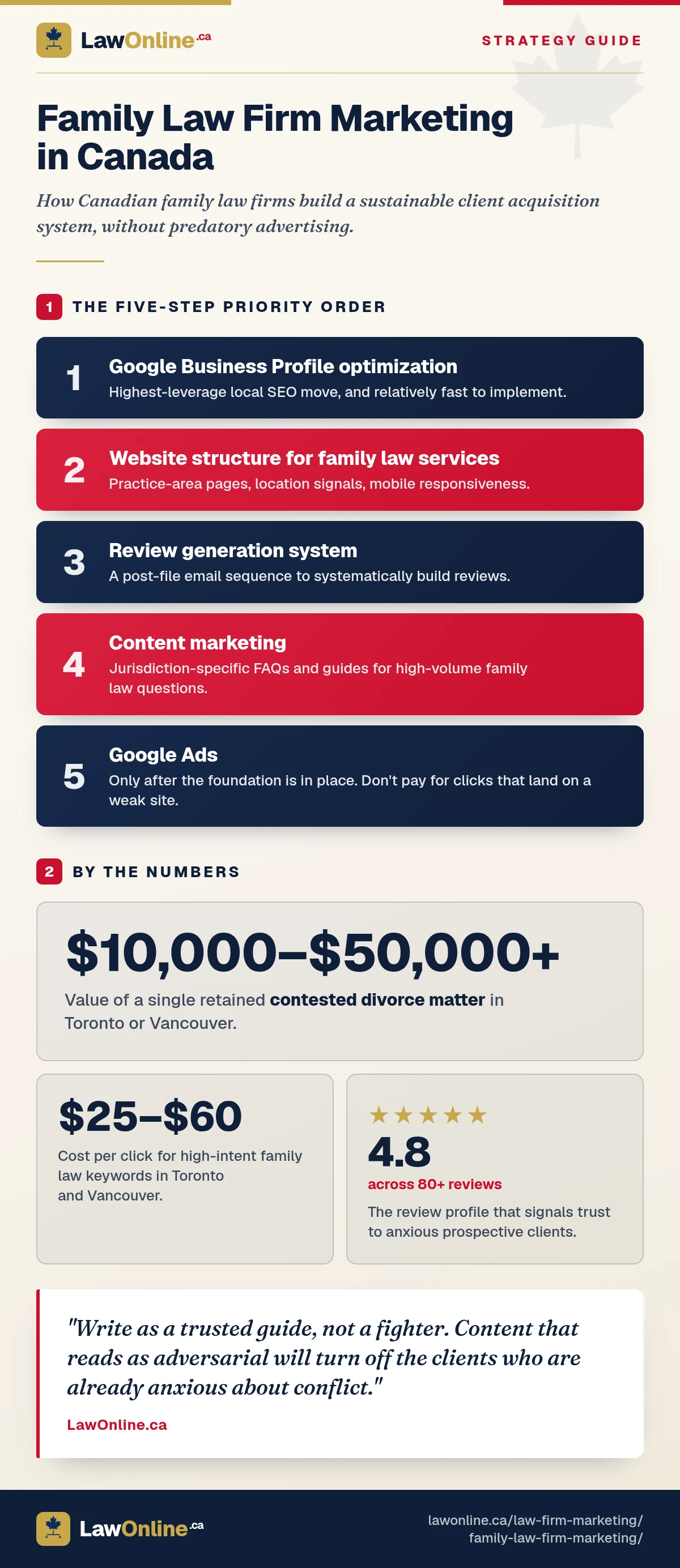
Tone matters for family law content. Unlike personal injury content, which can be assertive and outcome-focused, family law content should be measured, informative, and empathetic. Content that reads as adversarial or combative will turn off the clients who are already anxious about conflict. Write as a trusted guide, not a fighter.
Reviews and Reputation Management
Online reviews are particularly powerful, and particularly sensitive, in family law. Clients who've been through divorce are often willing to leave detailed, personal reviews because the experience was significant. A family law firm with 80 reviews averaging 4.8 stars tells a powerful story to someone who is evaluating their options.

How to generate reviews ethically:
Post-file follow-up is the most effective approach. Once a matter has concluded and the client relationship is in a good place, a personal email or call thanking the client and asking if they'd be willing to share their experience works well. The Federation of Law Societies' Model Code of Professional Conduct permits lawyers to market their services as long as the marketing is "demonstrably true, accurate and verifiable" and not misleading or deceptive. Provincial law society rules in most Canadian provinces don't prohibit soliciting reviews, only making false or misleading statements.
Some family law firms create a simple one-click review link (using Google's review link generator) and include it in their file-closing communications. A line like "If you'd like to share your experience with others who might be in a similar situation, we'd really appreciate a Google review" is appropriate and effective.
Handling negative reviews:
Family law is an emotionally charged practice. Not every client will be satisfied, and some will leave unfair or inaccurate reviews. The professional response is brief, empathetic, and offline: acknowledge that you're sorry they feel that way, note that you take all feedback seriously, and invite them to call the office directly. Don't disclose case details or defend specific actions in a public response, this risks confidentiality breaches and rarely improves the situation.
Google Ads for Family Law
Family law keywords are among the most competitive in Canadian legal advertising, though less expensive than personal injury. Divorce lawyer marketing is especially heated in Toronto and Vancouver, where you can expect to pay $25–$60 per click for high-intent keywords. That's not cheap, but a single retained client for a contested divorce matter can represent $10,000–$50,000+ in fees.
Campaign structure for family law:
Separate ad groups by service type. "Divorce lawyer Toronto" searchers should see ads and land on a page specifically about your divorce services, not a generic family law landing page. The more specific the match between search intent and landing page, the higher your Quality Score and the lower your cost per click.
The data supports this approach. Statistics Canada's 2024/2025 family law court profile shows that divorce applications alone accounted for 45% of all active family law cases, while parenting, support, and child protection matters each carry distinct search patterns. Building your campaigns around these real-world case types means you're matching how people actually search.
Key service types worth building separate ad groups around:
- Divorce
- Separation agreement
- Child custody
- Spousal support
- Property division
- Emergency court orders (restraining orders, urgent custody matters)
Bidding strategy note: For family law, modified broad match or phrase match often works better than broad match alone. Queries like "family lawyer" can attract clicks from people searching for immigration family sponsorship or estate family disputes, unrelated to your practice. Adding negative keywords ("immigration," "estate," "probate," "criminal") early prevents budget waste.
After-hours matters. Like PI, family law inquiries can arrive at all hours, particularly in crisis situations (emergency custody applications, domestic situations). An after-hours intake solution, even just a virtual receptionist service, can capture these high-urgency leads before competitors do.
Social Media for Family Law Firms
Social media is less central to family law client acquisition than for some other practice areas, but it plays a supporting role in credibility and content distribution.
LinkedIn is relevant for family law firms targeting high-net-worth clients, business owners dealing with corporate-asset divorce, or those seeking referrals from financial advisors, therapists, or accountants. Educational content about complex property division, business valuations in divorce, and co-parenting agreements resonates with professional audiences.
Facebook and Instagram are occasionally useful for brand awareness, particularly in smaller markets. Boost posts about resources, legal change announcements, or community involvement, avoid anything that could be read as predatory targeting of people going through emotional distress.
What to avoid on social media: Don't post content that glorifies conflict, paints opposing parties as villains, or frames divorce as a battle to be won. This may feel counter-intuitive, "tough" messaging works in some legal advertising, but it is almost universally counterproductive for family law, where clients are often looking for a lawyer who can help them get through a painful situation with their sanity intact.
Referral Networks: The Underutilized Channel
For family law practices, professional referral networks are often underutilized compared to PI, and the potential is significant. Family law files aren't one-and-done transactions. Statistics Canada data shows that 61% of active family law cases in 2024/2025 were ongoing from a previous fiscal year, a proportion that's been climbing since 2014/2015. Custody variations, support adjustments, and enforcement motions mean a single client relationship can span years. That makes the referral source especially valuable.
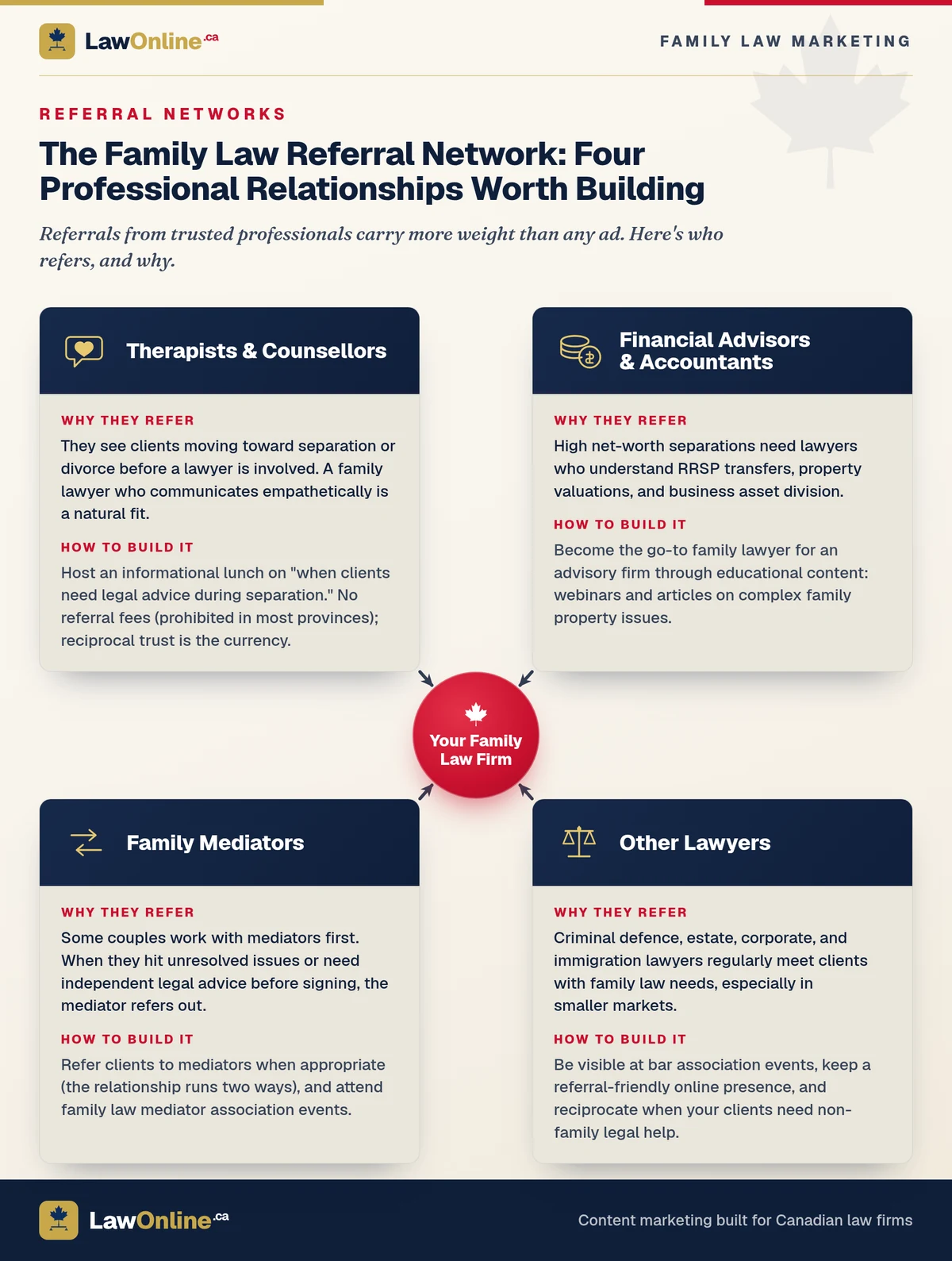
Therapists and counsellors. Family therapists, marriage counsellors, and psychologists frequently see clients who are moving toward separation or divorce. A family lawyer who develops genuine relationships with local therapists, not through formal referral fees (which are prohibited in most Canadian provinces under Law Society rules), but through reciprocal trust and familiarity, will receive consistent referrals over time. Hosting an informational lunch for local therapists on "when clients need legal advice during separation" is a legitimate and effective way to establish these relationships.
Financial advisors and accountants. High-net-worth separations often involve complex asset division. Financial advisors whose clients are going through divorce need family lawyers who understand RRSP transfers, property valuations, and business asset division. Being the go-to family lawyer for a financial advisory firm is a significant source of valuable files.
Family mediators. Some separated couples first work with mediators before involving lawyers. Family mediators often refer clients to lawyers to review agreements, provide independent legal advice, or proceed with unresolved issues. This is a two-way relationship, family lawyers can also refer clients to mediators when appropriate.
Other lawyers. Criminal defence lawyers, estate lawyers, corporate lawyers, and immigration lawyers all occasionally encounter clients with family law needs. These cross-referrals are worth cultivating, particularly in smaller markets where the legal community is tight-knit.
Measuring What Matters
The metrics that matter for a family law marketing program are similar to other areas, but with a few specific considerations.
Inquiry-to-retainer conversion rate. More important than raw lead volume. Family law conversion rates are typically lower than PI (because more clients are still shopping, not yet committed to proceeding) but should be tracked consistently.
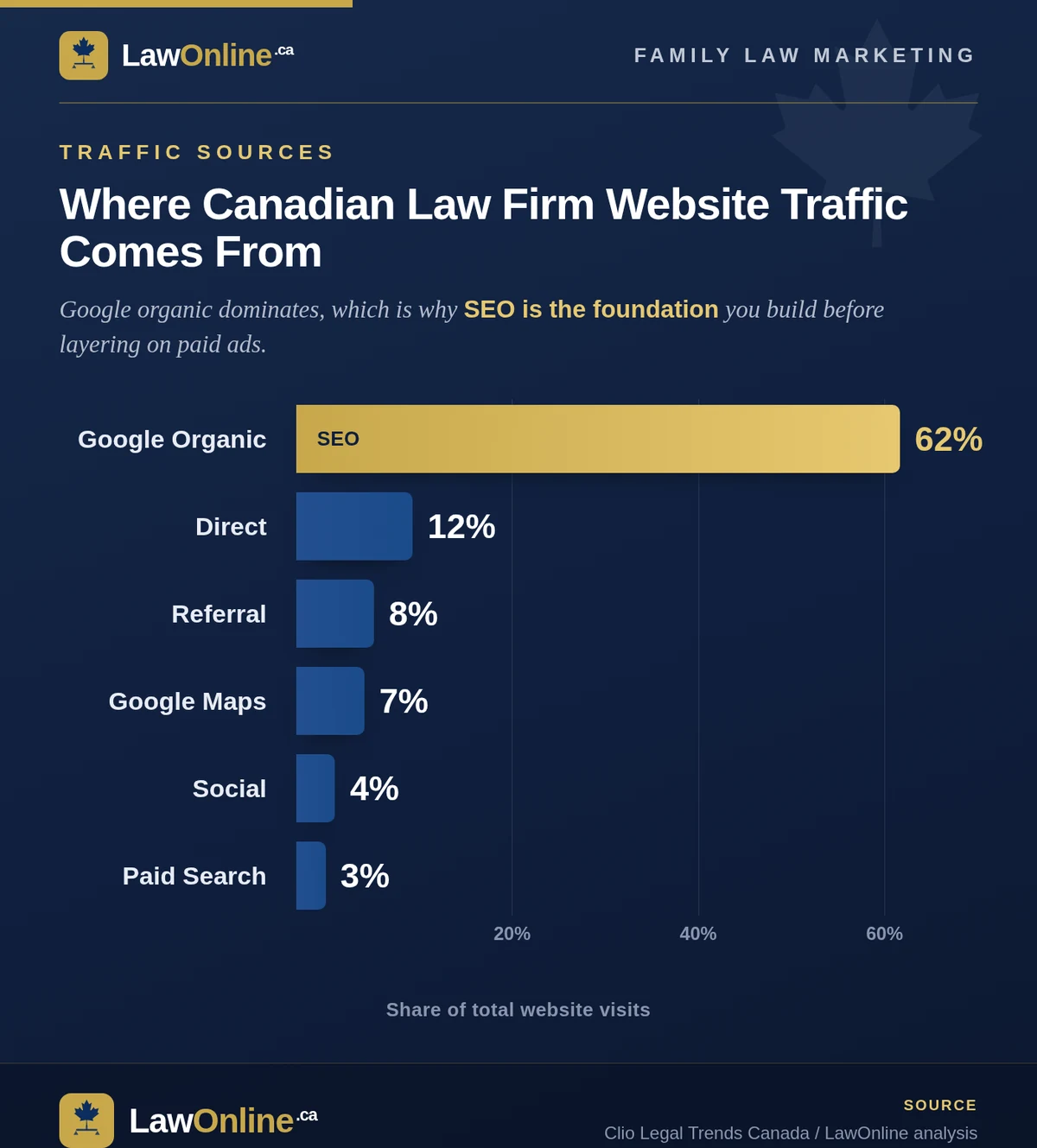
Source attribution. Which channel is generating inquiries that actually retain? Organic search may generate high volume but lower-quality leads than word-of-mouth referrals. Google Ads may generate immediately-ready leads at higher cost. Understanding the cost per retained client by channel, not cost per inquiry, is what drives smart budget allocation.
Average file value by matter type. A contested divorce involving property division and custody is worth far more than a simple uncontested divorce. If your marketing is attracting mostly simple matters, your average file value may be lower than you'd like. Content and advertising strategy can be refined to attract more complex, higher-value matters.
Review velocity. Tracking how many new Google reviews you're collecting per month is a useful leading indicator of future local search performance.
Where to Start
For a family law firm building or rebuilding its digital marketing program, the priority order is usually:
- Google Business Profile optimization, highest-leverage local SEO move, relatively fast to implement
- Website structure for family law services, practice area pages, location signals, mobile responsiveness
- Review generation system, post-file email sequence to systematically build reviews
- Content marketing, jurisdiction-specific FAQs and guides for high-volume family law questions
- Google Ads, only after the above foundation is in place; don't pay for clicks that land on a weak site
The family law market is competitive in every major Canadian city, but it's rarely won by the firm with the biggest budget. It's won by the firm that communicates empathy, builds trust, and makes it easy for anxious clients to take the first step.
LawOnline.ca works with family law firms across Canada to build digital marketing programs that generate consistent client inquiries. Contact our team to discuss your firm's growth goals.