Manitoba has 2,369 practising lawyers, and the overwhelming majority practise in Winnipeg. That concentration makes the city's legal market intensely competitive, especially for personal injury, family law, and criminal defence firms that depend on digital marketing to attract clients.
The Law Society of Manitoba's Code of Professional Conduct, Chapter 4, sets the province's law firm advertising rules. They apply to your website, your Google Ads, your social media profiles, your directory listings, and everything else that promotes your practice. The rules follow the Federation of Law Societies of Canada's Model Code closely, but knowing the general framework isn't the same as knowing the specific obligations.
Here's what you need to understand.
What Is the Foundational Standard for Lawyer Advertising in Manitoba?
Rule 4.2-1 sets the baseline. A lawyer may market professional services, provided the marketing is demonstrably true, accurate, and verifiable. It must not be misleading, confusing, or deceptive, or likely to mislead, confuse, or deceive. And it must be in the best interests of the public and consistent with a high standard of professionalism.
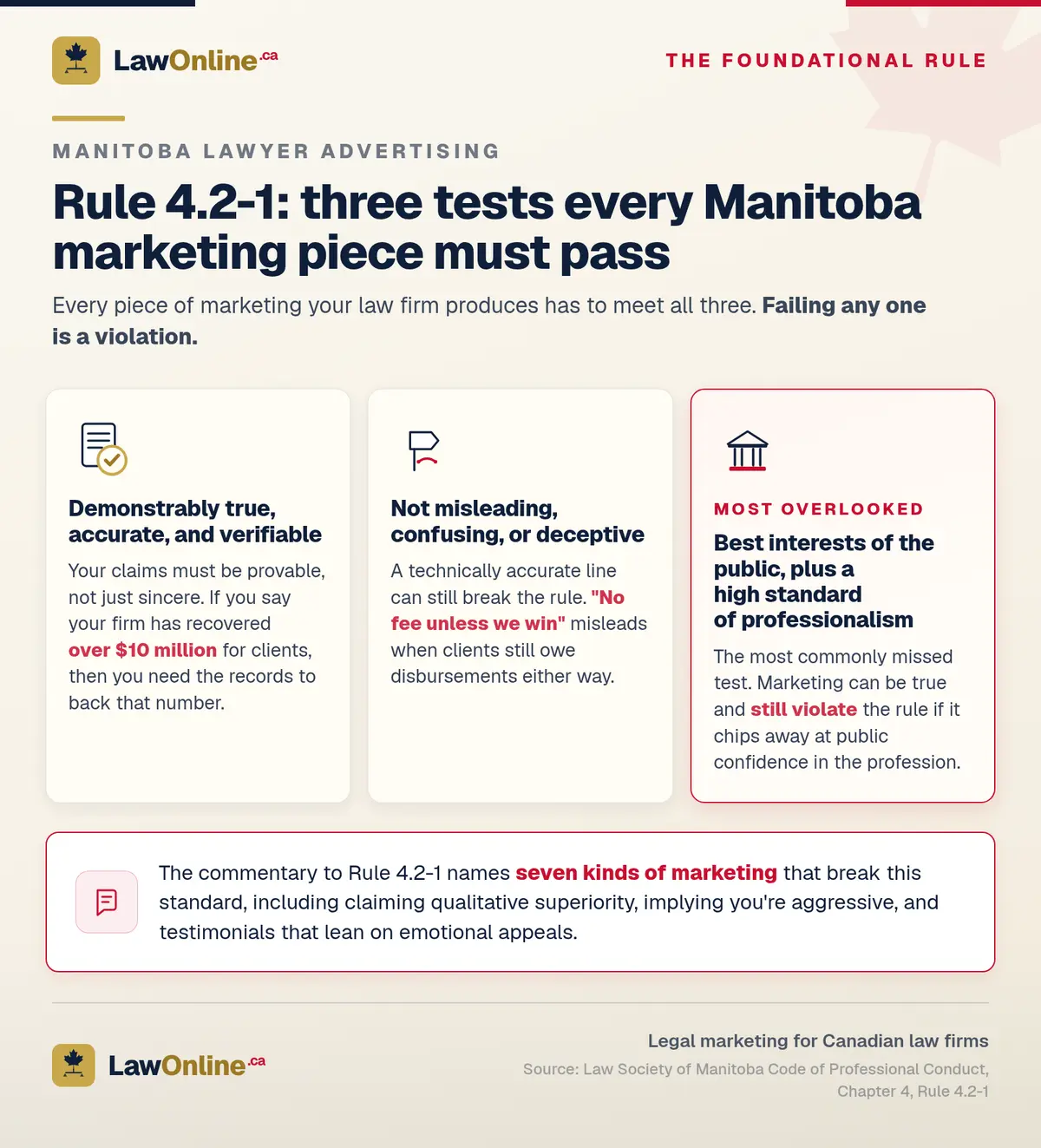
The word "demonstrably" matters. Your marketing claims must be provable, not just sincere. If your personal injury firm says it has recovered over $10 million for clients, you need records to support that number. If you say you've been practising criminal defence for 15 years, that needs to be verifiable.
The commentary to Rule 4.2-1 lists specific examples of marketing that contravenes this standard:
- Stating money recovered for a client or referring to the lawyer's degree of success without noting that past results aren't indicative of future results and that outcomes vary by case
- Suggesting qualitative superiority to other lawyers
- Raising expectations unjustifiably
- Suggesting or implying that the lawyer is aggressive
- Disparaging or demeaning other persons, groups, organizations, or institutions
- Taking advantage of a vulnerable person or group
- Using testimonials or endorsements that contain emotional appeals
Can Manitoba Lawyers Call Themselves Specialists or Experts?
No. Rule 4.3-1 prohibits the use of "specialist," "specializing," "expert," "expertise," or synonyms in the marketing of legal services.
Manitoba doesn't operate a specialist certification program. There's no path to earning a specialist designation in this province. The prohibition is effectively absolute.
What you can say: "Our practice focuses on motor vehicle accident claims" or "Our firm has extensive experience in family law." What you can't say: "Winnipeg's family law specialists" or "Expert criminal defence lawyers."
The commentary clarifies that a lawyer may advertise preferred areas of practice provided the advertisement doesn't claim, directly or indirectly, that the lawyer is a specialist or expert. A lawyer can also include a description of the firm's proficiency or experience in an area of law, as long as the representations are accurate and not misleading.
If your firm practises in more than one jurisdiction, some of which certify or recognize specialization, an advertisement that references a member's specialist status doesn't offend this rule if the certifying jurisdiction is identified. This is relevant for Manitoba firms with lawyers who hold Ontario's Certified Specialist designation, for example.
What Can Manitoba Lawyers Advertise?
Practice areas and experience. A personal injury lawyer in Winnipeg can state that the firm focuses on motor vehicle accidents, slip and fall claims, medical malpractice, and wrongful death cases. You can describe the types of cases you've handled and the courts where you've appeared. You can state facts about your professional background. Keep it accurate and provable.
Fees. Rule 4.2-2 allows fee advertising, and the Law Society encourages it. The advertising must be reasonably precise about the services covered for each fee quoted. It must state whether other amounts, such as disbursements and taxes, will be charged in addition. And the lawyer must strictly adhere to the advertised fee in every applicable case.
For personal injury firms working on contingency, this means being clear about the percentage and what costs the client may still owe regardless of the outcome. "No fee unless we win" isn't misleading on its face, but it can be if clients are still responsible for disbursements in every scenario.
Track record. You can describe your experience and the results you've achieved, provided you include appropriate disclaimers. Stating that your firm has recovered a specific amount for clients requires a clear note that past results aren't indicative of future outcomes and that each case turns on its own facts.
What Are the Key Restrictions?
Superlative Claims
"Best personal injury firm in Manitoba." "Winnipeg's top-rated criminal lawyers." "The most experienced family law team in the province." These all fail the verifiability test. You can't prove qualitative superiority, so you can't claim it.
Aggressive Language
Suggesting or implying that a lawyer is aggressive violates Manitoba's advertising standards. "Aggressive representation," "we fight hard," "pit bull lawyers." These are common south of the border, but they contravene Chapter 4 in Manitoba.
What works instead: "dedicated," "thorough," "committed to our clients' interests," "results-driven."
Emotional Appeals
Marketing that takes advantage of a vulnerable person or group contravenes the rules. A personal injury firm can acknowledge that accidents are traumatic. It can't use graphic imagery or fear-driven language designed to pressure someone into calling.
Testimonials
Testimonials and endorsements aren't banned outright, but the commentary specifically flags testimonials that contain emotional appeals as contravening Rule 4.2-1. Any testimonial you use must meet the same standard as every other piece of marketing: demonstrably true, accurate, verifiable, and not misleading.
Google Reviews and other third-party review platforms add nuance. You can encourage satisfied clients to leave genuine reviews. But if you pull quotes from those reviews for your website, they become part of your marketing and must comply with the rules.
What Makes Manitoba's Legal Market Unique?

Manitoba's legal profession is small, concentrated, and steadily growing. The province had 1,677 practising lawyers in 1996 and 2,020 by 2017, according to the Law Society of Manitoba's 2018 annual report. By 2022, there were 2,286 active practising members and 474 firms and sole practitioners in private practice. The 2025 annual report puts the current count at 2,369, with the vast majority based in Winnipeg. More lawyers competing in one city means marketing matters more than ever, and marketing missteps travel faster.
The Law Society received 368 formal complaints in 2025 and closed 384 files. Family law matters generated 27.8% of all complaints, with 25 complaints related to excessive fees. The Society resolved 91% of complaints within 12 months and 97% within 18 months.
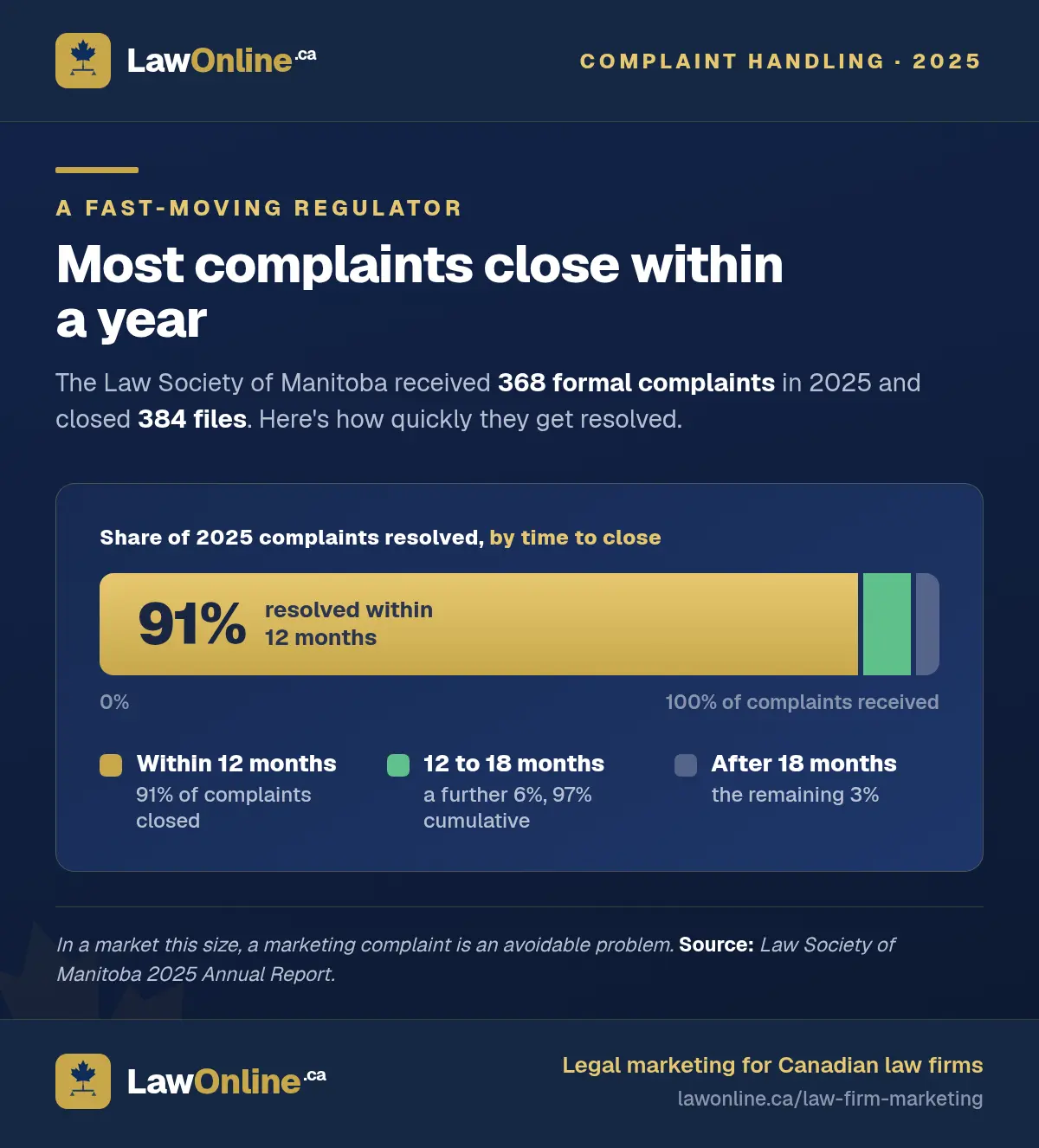
These numbers matter because a marketing complaint is an avoidable problem in a market this size.
How Do Manitoba's Rules Compare to Other Provinces?
Manitoba follows the Federation of Law Societies Model Code closely, making its lawyer advertising rules broadly similar to Saskatchewan's and Alberta's. All three Prairie provinces share the same foundational standard: demonstrably true, accurate, and verifiable.
Manitoba and Saskatchewan both lack specialist certification programs, making the prohibition on specialist and expert claims effectively absolute. Alberta is in the same position. Ontario stands apart because the LSO operates a Certified Specialist Program, allowing certified lawyers to use the designation. We cover Ontario's full framework in our Ontario lawyer advertising rules guide.
BC's testimonial rules are stricter than Manitoba's. BC requires every element of a testimonial to be independently verifiable by the lawyer, effectively prohibiting subjective praise. Manitoba's rules are less prescriptive on testimonials specifically, though the general standard still applies. For details on BC's approach, see our BC lawyer advertising rules guide.
Alberta more explicitly addresses aggressive imagery, calling out combative symbols and language in its guidance. Manitoba addresses the issue through the commentary to Rule 4.2-1. Our Alberta lawyer advertising rules guide covers the differences.
Quebec is in a category of its own. It doesn't follow the Model Code, regulates lawyers through the Barreau du Québec under a separate Professional Code, and is the only province that outright bans client testimonials. Our Quebec lawyer advertising rules guide covers the full scope of the differences.
How Does Chapter 4 Apply to Digital Marketing?
Every digital channel falls under the same rules. Our law firm web marketing guide covers the full range of channels and how to measure what's working.
Google Ads. "Winnipeg personal injury lawyer" is a fine keyword. "Winnipeg's best personal injury lawyer" fails the verifiability standard. Landing pages linked to your ads need to comply too. If your ad promotes a free consultation, the landing page must confirm that clearly.
Social media. LinkedIn posts, Facebook ads, and Instagram content are all marketing under the rules. A post celebrating a career milestone or a case result is fine as long as it doesn't create unjustified expectations or reveal confidential information. For platform-specific strategy, see our social media marketing guide for law firms.
Your website. The most common compliance issues we see on Manitoba law firm websites:
- Team bios using "specialist," "expert," or similar restricted terms
- Practice area pages with unverifiable superlative claims
- Testimonial sections featuring emotionally charged endorsements
- Results pages stating settlement amounts without appropriate disclaimers
- Homepage taglines claiming qualitative superiority
Content marketing. Blog posts and educational content are an effective way to market within the rules. A post explaining "What Happens After a Car Accident in Manitoba" attracts personal injury leads while staying compliant. Our content marketing guide for Canadian law firms covers how to build this kind of strategy.
How to Audit Your Firm's Marketing
, from banned specialist terms to fee precision and testimonial checks.](/images/infographics/manitoba-law-society-advertising-rules-audit-checklist.webp)
Run through this checklist. Search all marketing materials for "specialist," "expert," "specialize," "expertise," and synonyms. Remove all instances. Check for superlative claims and remove them. Review any settlement or verdict amounts and add disclaimers or remove them. Look for aggressive or combative language and replace it with professional alternatives. Verify that fee advertising is precise and includes disbursement disclosures. Confirm that testimonials are factual, verifiable, and free of emotional manipulation. Check that all listed practice areas are ones your firm is competent and ready to handle.
If your marketing agency isn't familiar with Manitoba's rules, share the CBA's Ethics of Advertising toolkit with them. Compliance is the lawyer's responsibility, not the agency's.
The Bottom Line
Manitoba's law firm advertising rules aren't anti-marketing. They're anti-deception. The Law Society of Manitoba's own practice management guide calls client development "an urgent priority" for new firms and recommends tactics like professional signage, announcements to peers and existing contacts, and outreach to referral sources such as accountants and real estate agents. The regulator wants you to market your practice. It wants you to do it honestly.
In a concentrated market like Winnipeg's, where word-of-mouth and professional reputation already carry enormous weight, the firms that market most effectively lead with substance.
Clear descriptions of services. Honest representations of experience. Educational content that demonstrates competence. That approach works within the rules, builds trust with potential clients, and produces better results than pushing boundaries with aggressive language or superlative claims.
Start with a well-designed law firm website built for compliance, and the rest of your marketing strategy falls into place.