Canada's three territories have some of the smallest legal markets in the country. Yukon, the Northwest Territories, and Nunavut each have their own law society, their own Code of Professional Conduct, and their own regulatory oversight. But with legal communities this small, the practical implications of advertising rules are different from what firms face in Toronto, Calgary, or Vancouver.
When every judge, opposing counsel, and potential referral source knows your name, a compliance issue doesn't just risk a regulatory complaint. It risks your professional reputation in a community where that reputation is your most valuable asset.
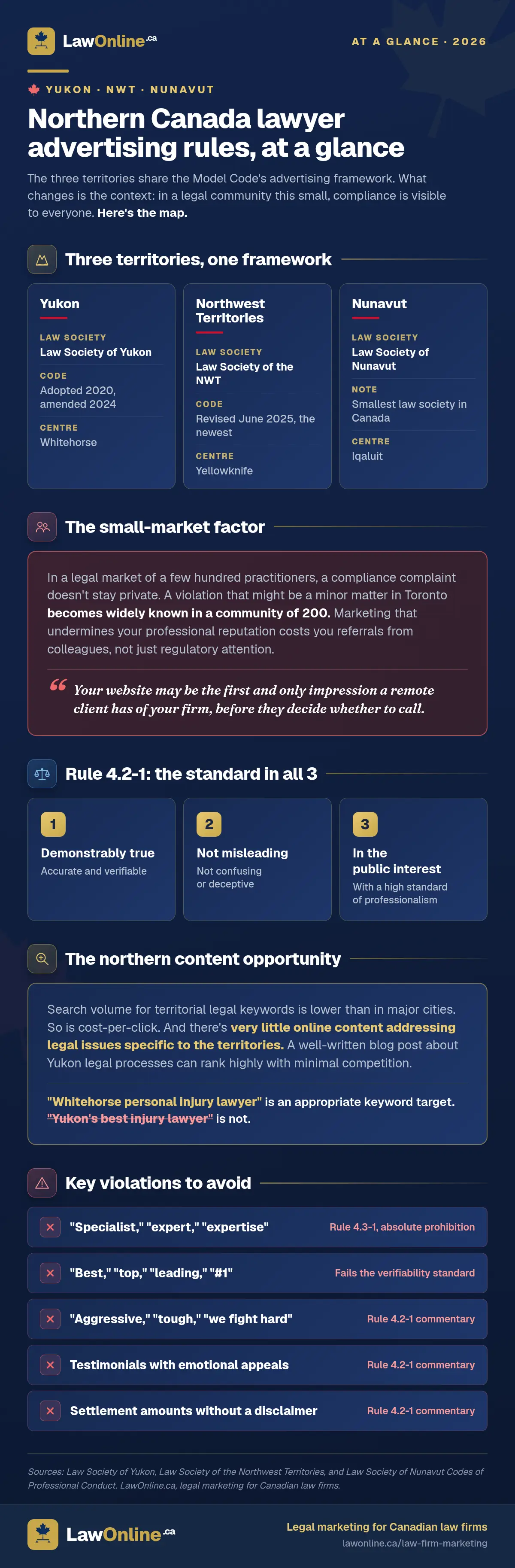
All three territories adopted the Federation of Law Societies of Canada's Model Code of Professional Conduct, and their law firm advertising rules follow the same framework as the provinces. Here's what matters for your firm's marketing.
What Are the Advertising Rules in Canada's Territories?
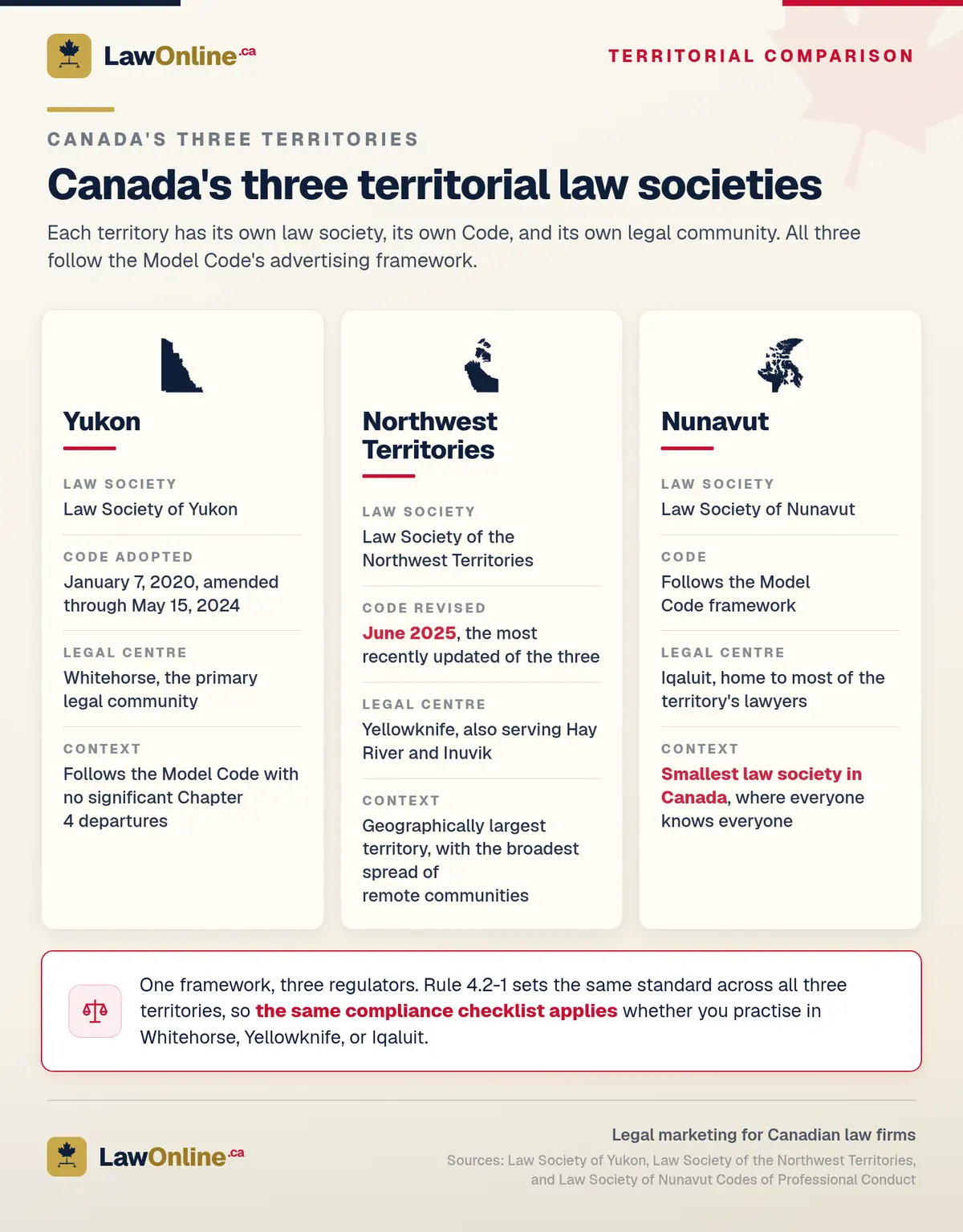
The three territorial law societies are the Law Society of Yukon, the Law Society of the Northwest Territories, and the Law Society of Nunavut. Each administers its own Code of Professional Conduct, with Chapter 4 governing the marketing of legal services.
The foundational standard is the same across all three territories. Rule 4.2-1 requires that your marketing be demonstrably true, accurate, and verifiable. It must not be misleading, confusing, or deceptive. And it must be in the best interests of the public and consistent with a high standard of professionalism.
The commentary lists the same examples of prohibited marketing found in every other Model Code jurisdiction:
- Stating money recovered without disclaimers about past results
- Suggesting qualitative superiority to other lawyers
- Raising expectations unjustifiably
- Suggesting or implying that the lawyer is aggressive
- Disparaging others
- Taking advantage of vulnerable persons
- Using testimonials or endorsements with emotional appeals
Can Territorial Lawyers Use "Specialist" or "Expert"?
No. Rule 4.3-1 across all three territories prohibits the use of "specialist," "specializing," "expert," "expertise," or synonyms in marketing.
None of the three territorial law societies operates a specialist certification program. The prohibition is effectively absolute. You can describe your preferred areas of practice, your proficiency, and your experience, but you can't call yourself a specialist or expert.
What Can Territorial Lawyers Advertise?
Practice areas and experience. You can state your areas of practice and describe your experience. A personal injury lawyer in Whitehorse can say "our firm focuses on motor vehicle accident claims and slip and fall cases." You can describe the types of matters you've handled and the courts where you've appeared. Keep it accurate and verifiable.
Fees. Rule 4.2-2 allows fee advertising, provided it's reasonably precise about the services covered, states whether additional amounts like disbursements and taxes apply, and the lawyer strictly adheres to the advertised fee.
Track record. You can reference your experience and results with appropriate disclaimers. The same restrictions that apply across the country apply here: past results must not be presented as indicative of future outcomes.
How Does the Small Market Change Things?
This is where the territories genuinely differ from the provinces. Not in the rules themselves, but in how those rules play out in practice.

Reputation Is Everything
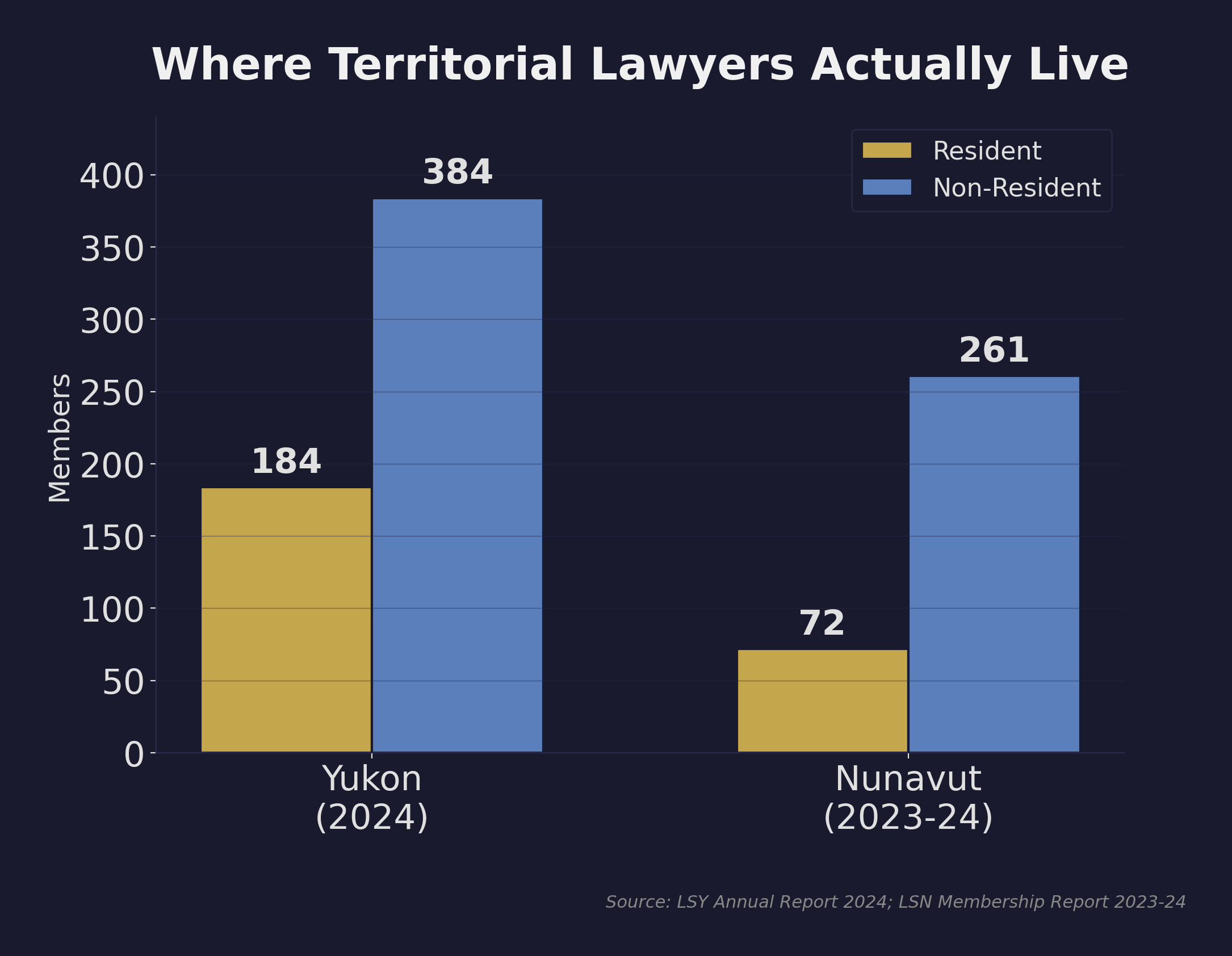
The numbers tell the story. The Law Society of Yukon's 2024 annual report counts 568 members, but only 184 of them actually reside in the territory. In Nunavut, the gap is even starker: the Law Society of Nunavut's 2023-2024 membership report lists 333 active members, but just 72 live in Nunavut itself. The rest are based in other provinces, primarily Ontario and Alberta.
When the entire resident bar could fit in a single conference room, word travels fast. A compliance complaint that might be a private matter in a city of 50,000 lawyers becomes widely known in a community of 72 or 184. The reputational cost of a violation is disproportionately high.
This isn't just about avoiding complaints. It's about how other lawyers, judges, and potential referral sources perceive your firm. Law firm marketing that pushes boundaries may attract a client or two, but it can cost you referrals from colleagues who view it as unprofessional.
Limited Competition, Different Strategy
Territorial legal markets have less competition than urban centres. There may be only a handful of firms handling personal injury, family law, or criminal defence in a given territory, though outside counsel regularly steps in. The Law Society of Yukon issued 98 Certificates of Permission to Act to out-of-territory lawyers in 2023, with 49 in civil litigation and 20 in family law. But the marketing challenge for local firms isn't standing out in a crowded field. It's being visible and accessible to potential clients who may not know where to turn for legal help.
This makes educational content marketing particularly effective. A blog post explaining "What to Do After a Car Accident in the Yukon" can rank well in search results because there's less content competing for those terms. And it positions your firm as a helpful, knowledgeable resource without making any claims that could run afoul of the rules.
Geographic Considerations
The territories are vast, and many communities are remote. Clients may be hundreds of kilometres from the nearest law firm. This makes your online presence disproportionately important. Your website may be the first and only impression a potential client has of your firm before they decide to call.
That means compliance on your website isn't just a regulatory concern. It's a client service concern. Your site needs to be accurate, professional, and clear about what services you offer and how to reach you. For guidance on building an effective site, see our law firm website design guide.
Territory-Specific Details
Yukon
The Law Society of Yukon adopted its Code of Conduct on January 7, 2020, with amendments through May 15, 2024. Chapter 4 follows the Model Code without significant departures. The legal community is based primarily in Whitehorse, and it's growing: membership rose from 442 in 2020 to 568 in 2024, a 29% increase in four years. Of those 568 members, only 184 are resident in Yukon, so the majority of the bar practises from elsewhere in Canada.
Northwest Territories
The Law Society of the Northwest Territories revised its Code of Professional Conduct most recently in June 2025, making it the most recently updated code among the territories. The LSNT's 2024 AGM package reports $741,805 in membership dues from active members, a figure that reflects the modest size of the bar. The legal community is centred in Yellowknife, with some lawyers serving Hay River, Inuvik, and other communities.
Nunavut
The Law Society of Nunavut is the smallest law society in Canada, and the numbers make that clear. Its 2023-2024 membership report lists 333 active members and 44 inactive members, but only 72 active members actually reside in Nunavut. Most are based in Ontario and Alberta. Cross-territorial practice is minimal: just four Nunavut-admitted lawyers live in Yukon, and none reside in the Northwest Territories. The Nunavut Law Foundation's 2023 annual report records total disbursements of just $41,848, including $10,000 in general grants and $9,522 in Lucien Ukaliannuk Awards, numbers that underscore how small the territory's legal ecosystem is.
Iqaluit is home to most of the territory's local lawyers. Given the extremely small market, virtually all marketing considerations involve the additional dynamic of personal familiarity. Everyone knows everyone.
Digital Marketing in the Territories
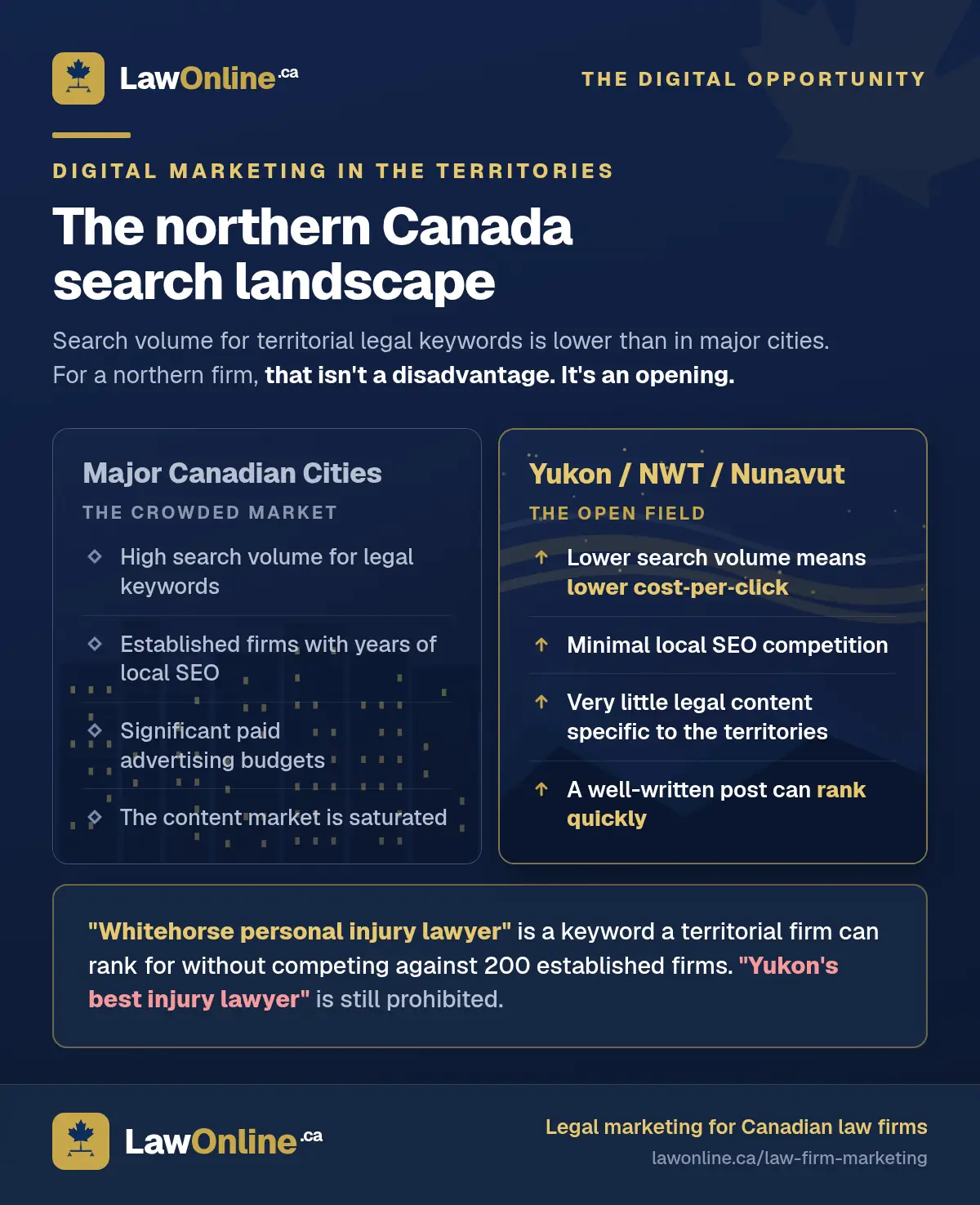
Google Ads. Search volume for legal terms in the territories is low, which means cost-per-click tends to be lower than in major urban centres. "Whitehorse personal injury lawyer" or "Yellowknife family lawyer" are appropriate keyword targets. Ad copy must comply with the same rules as everywhere else: no specialist claims, no superlatives, no aggressive language.
Social media. In small communities, social media plays a particularly important role. Many territorial lawyers are active on Facebook and LinkedIn, and these posts are marketing under the rules. A post celebrating a community involvement milestone is fine. A post that makes unverifiable claims about your practice is not. For platform guidance, see our social media marketing guide for law firms.
Your website. Common compliance issues on territorial law firm websites mirror those found everywhere:
- Team bios using "specialist" or "expert" language
- Practice area pages listing services the firm doesn't actually provide
- Superlative claims on the homepage
- Testimonials with emotional appeals
Content marketing. This is where territorial firms have an outsized opportunity. There's very little online content addressing legal issues specific to the territories, and the demand is real: the Yukon Legal Services Society's 2024-25 annual report shows the territory's legal aid system alone served 1,631 people in one year, with 70% of its workload in criminal law and 20% in family law. A well-written blog post about local legal processes can rank highly in search results with minimal competition. Law firm SEO delivers a better return in the territories than in urban markets precisely because the field is open. For a framework on building this strategy, see our content marketing guide for Canadian law firms.
How Do the Territories Compare to the Provinces?
The legal advertising rules are nearly identical to those in provinces that follow the Model Code. Saskatchewan, Manitoba, Alberta, and the Atlantic provinces all share the same foundational standard and the same key prohibitions.
The territories don't operate specialist certification programs, which puts them in the same position as most provinces outside Ontario. Ontario's Certified Specialist Program is the exception that allows certain lawyers to use the specialist title. In the territories, as in most of Canada, the prohibition is effectively absolute.
BC has stricter testimonial rules, requiring every element to be independently verifiable. The territories follow the Model Code's general approach. Quebec bans testimonials entirely. For detailed breakdowns of other jurisdictions, see our guides to Ontario, Alberta, Saskatchewan, Manitoba, BC, and Quebec.
How to Audit Your Firm's Marketing
The compliance checklist is the same as it would be in any Model Code jurisdiction. Search all marketing materials for "specialist," "expert," and synonyms. Remove them. Check for superlative claims and remove them. Review settlement or verdict amounts and add disclaimers or remove them. Replace aggressive language with professional alternatives. Verify fee advertising for precision and accuracy. Confirm testimonials are factual and free of emotional manipulation. Check that all listed practice areas are ones you're competent to handle.
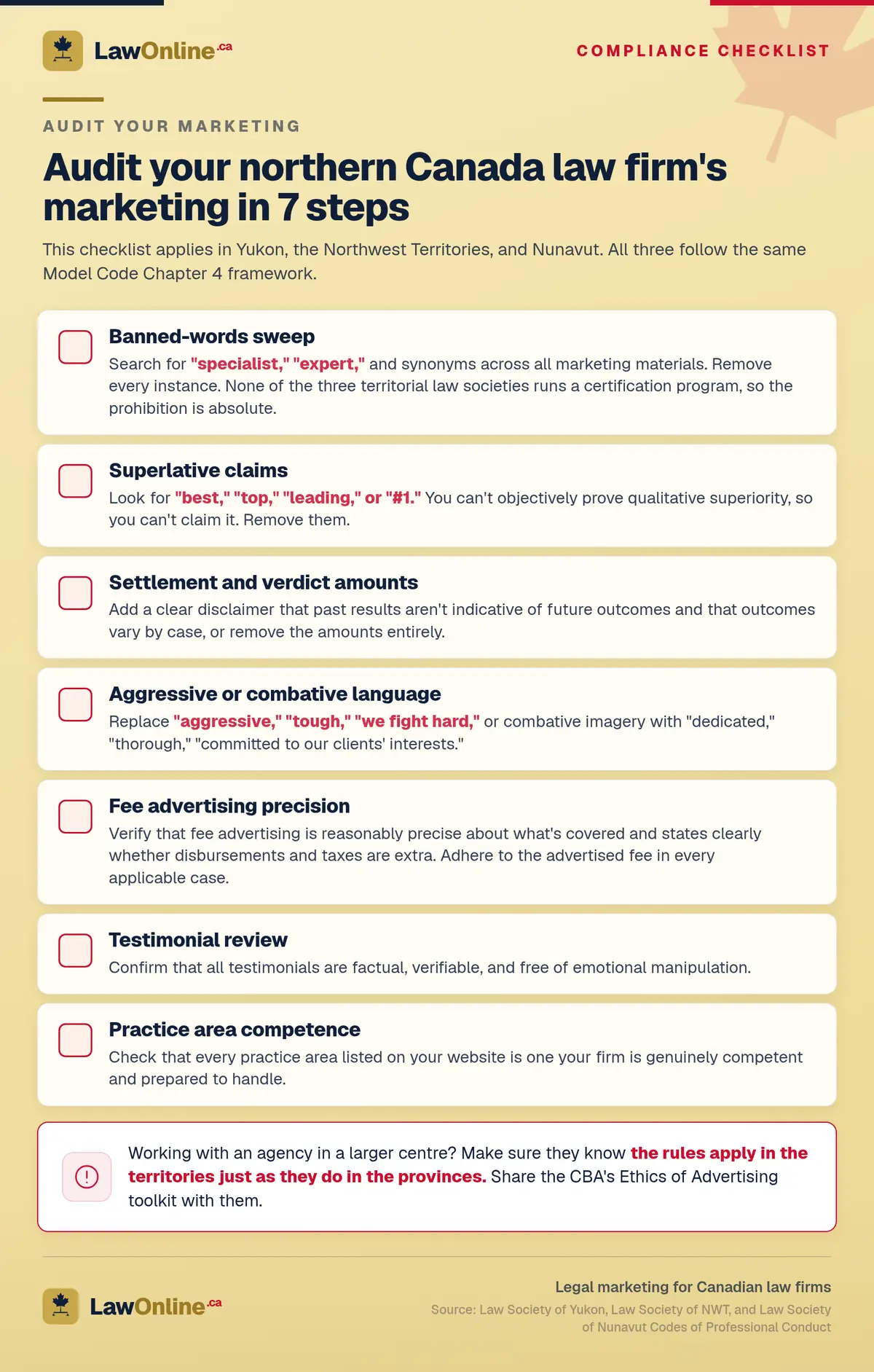
If your firm works with a marketing agency based in a larger centre, make sure they understand that the rules apply in the territories just as they do in the provinces. The CBA's Ethics of Advertising toolkit is a good starting resource to share.
The Bottom Line
The territories follow the same advertising framework as most of the country. The rules aren't different. But the context is.
In a legal market where everyone knows everyone, where a single compliance complaint becomes public knowledge across the entire legal community, and where your website may be the only way remote clients can find you, getting your marketing right matters more, not less.
The best approach is the same one that works everywhere: lead with substance. Educational content, clear descriptions of services, honest representations of experience. These law firm marketing strategies are effective, compliant, and they build the kind of trust that drives referrals in a close-knit professional community.