Content note: this post discusses allegations of sexual assault. Support is available through the Department of Justice's Victim Services Directory.
On October 2, a Quebec Superior Court judge authorized (certified) a class action against Nordik Spa-Nature in Chelsea, Quebec. The case began in August 2025 with one plaintiff who alleges she was sexually assaulted by a massage therapist in December 2024.
By early July 2026, 143 people had joined, and Nordik Spa news coverage and court documents note allegations of assaults involving at least 36 massage therapists between 2007 and 2026. While the case may now proceed, it's in early stages and the allegations are untested.
Whatever the outcome, the lawsuit highlights a marketing challenge for Canadian class action and mass tort firms. Because people often don't know they're part of a proposed or certified class, some of the strategies needed to reach them differ from other practice areas.
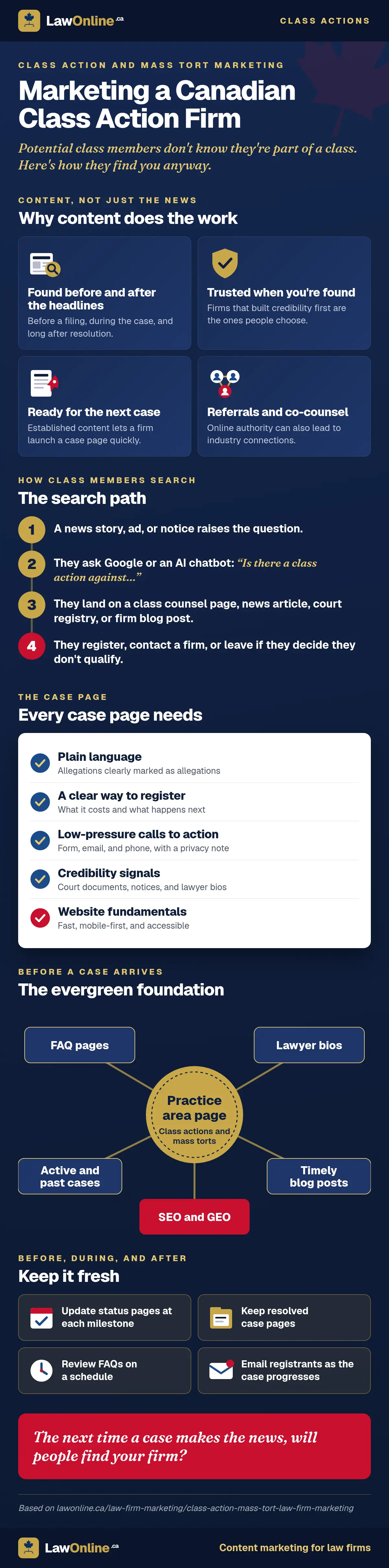
Why Content Marketing Matters for Class Action Firms
In general, more people come forward when there's media coverage about a proposed or certified class action. But firms that rely on the news to reach potential class members limit their own growth.

Law firm content marketing has an integral role in:
- Being found before and after the headlines. Being visible matters before a filing, while a case is active, and after resolution (people still look for information on claims, deadlines, and payments). Class action firms that are invisible at any of these stages miss connecting with people they could have helped.
- Being trusted when you're found. When a proposed or certified class action makes the news, interest rises. The firms that have already built credibility through content are the ones people find and choose.
- Being ready for the next case. Established, optimized legal content lets a firm launch a case page quickly. Existing content becomes evidence of experience.
- Industry connections. Content marketing for class action firms goes beyond garnering leads; authority built through a solid online presence can also lead to referrals and co-counsel opportunities.
Bottom line? When a story does break, the firms that have already earned trust and have clear, easily discoverable content are the ones people find.
How People Research Class Actions in Canada
Potential class members are often unsure if they have a claim, so they research carefully before contacting anyone, but they don't start by searching "class action". People start with a situation: a data breach notice, a failed product, or a news story that sounds like their own experience.
Most Canadian class actions run on an opt-out basis, so those who meet the class definition are generally included automatically unless they opt out. But they start looking long before a case is certified or reported on.
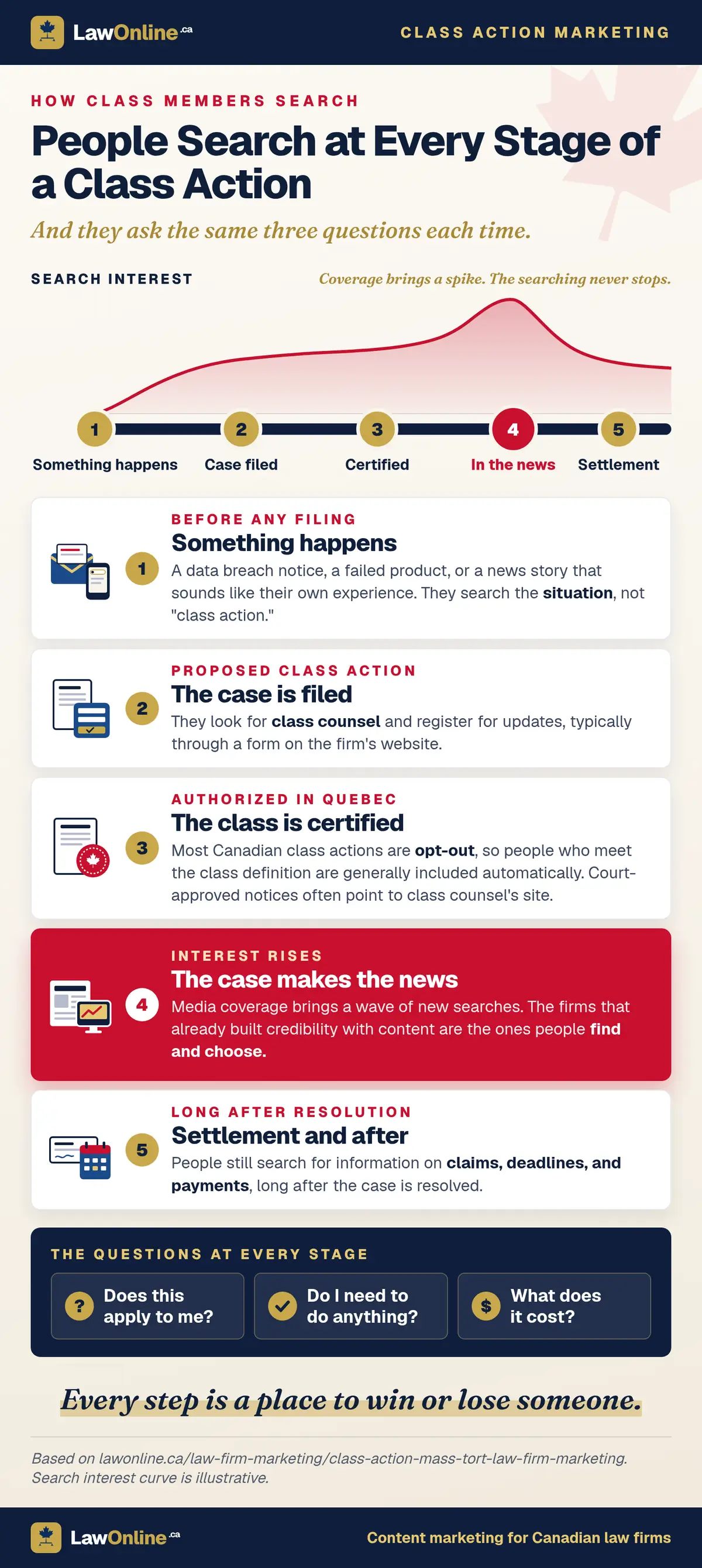
They ask the same questions at every stage: Does this apply to me? Do I need to do anything? What does it cost? To get answers, they tend to look for class counsel and register for updates, typically through a form on the firm's website. Court-approved notices issued after certification or authorization often point to class counsel's site too.
The typical path of potential class members looks like this:
- A news story, ad, or notice raises the question.
- They search Google or an AI chatbot in plain language: "Is there a class action against…" or "How do I join the class action about…"
- They land on a class counsel page, news article, court registry, or firm blog post.
- They register, contact a firm, or leave if they decide they don't qualify.
Every step is a place to win or lose someone.
What to Include on a Firm's Class Action Page
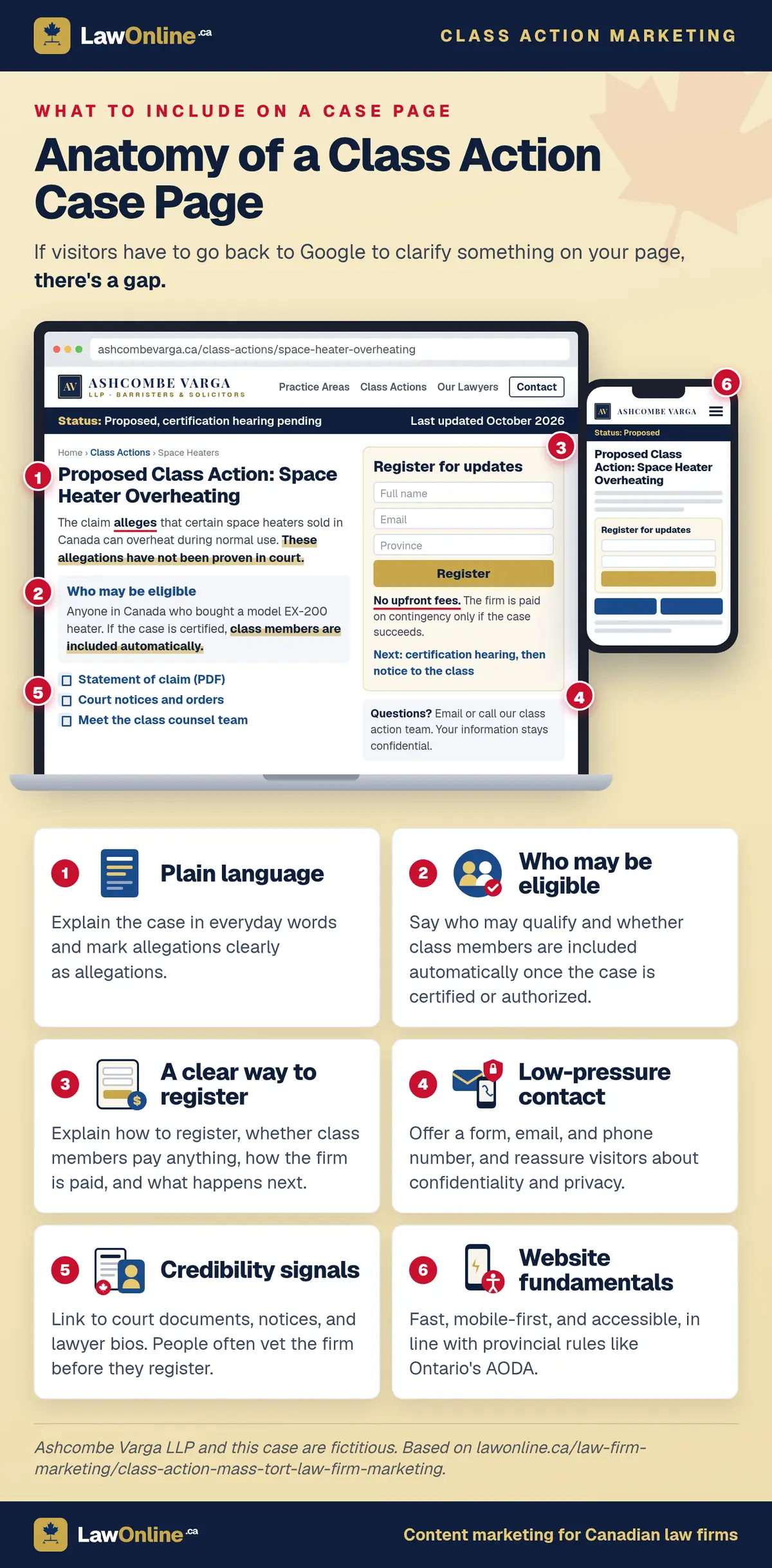
For Canadian class action law firms, website content for a specific case needs to cover or clearly direct visitors (through internal links and calls to action) to everything they need to know. If they have to go back to Google to clarify something on your page, there's a gap.
Whether a case is current or recently settled, the anatomy of a strong class action page includes:
- Plain language. Explain the case, mark allegations clearly as allegations, and say who may be eligible and whether class members are included automatically once the case is certified or authorized.
- A clear way to register. Explain how to register for updates and if class members pay anything (and if so, how the firm is paid, such as contingency). Detail what happens next, including the authorization or certification process and timelines.
- Low-pressure calls to action. Offer a form, email address, and phone number, link naturally to general class action content on the site. Reassure visitors about confidentiality and privacy.
- Credibility signals. Link to court documents, notices, and lawyer bios. People often vet the firm before registering, so bio pages need to demonstrate experience and credibility.
- Website fundamentals. Class action firms must have fast, mobile-first, accessible websites. Review provincial accessibility laws, like Ontario's AODA website requirements.
The Nordik Spa case shows how this can work. A quick Google search for how to join the lawsuit produces an AI Overview, which cites and links to the plaintiffs' law firm's dedicated class action page. Once there, the registration form follows a case explanation, the lead plaintiff's account, the allegations, and who the claim targets.
The key takeaway is that effective content marketing for law firms meets people where they are in their research.
Build the Foundation Before a Class Action Arrives
Firms with people-first content are a step ahead when a class action emerges because many of the questions people ask have nothing to do with a specific filing. Instead, they research how the process works, who's eligible, what other legal options exist besides joining the class, and how long cases take.
Content like this helps visitors, but it also gives search engines and AI systems the information needed to understand what the firm does and verify its credibility.

Strong evergreen content for class action firms includes:
- A class action and mass tort practice area page. Explain what the firm handles and how it works with class members.
- Supporting FAQ pages and posts: Focus on questions people actually ask: What is a class action? What does it cost? What happens after certification? What should I do if I receive a notice? How do settlement claims work? Keep these general and informational. Point readers to lawyers at the firm so they can ask for advice on their situation.
- Lawyer bios: Show class action experience, in line with advertising rules, including the types of cases previously involved in. List credentials, professional memberships, and awards. Add personal details and any community involvement.
- A hub structure. Link the practice area page to active and past cases, and any supporting pages and blog articles to build authority. Include FAQs (AI systems tend to favour a direct question/answer format when generating answers).
- Timely blog posts. Leverage the firm's blog by responding to news and emerging issues, always linking back to the evergreen pages.
- SEO and GEO. Add FAQs, legal-service structured data, schema, proper headings, and internal links from practice area pages, articles, and bios. Keep key pages current and write in the language people search with. Read our on-page SEO guide for law firms to learn more.
No single tactic does the work alone, but when combined, evergreen content can help turn site visitors into clients and stay visible and competitive.
Content Freshness Before, During, and After a Class Action
A crucial part of content marketing for lawyers is keeping content fresh; outdated pages weaken a firm's credibility with readers and can undermine how search engines and AI tools view it.
Class action firms should follow these strategies:
- Update status pages at each milestone, with a visible "last updated" date.
- Keep resolved case pages. Clearly mark passed deadlines and record the outcome, but don't delete the page. People continue searching long after a settlement, and past cases show real experience.
- Review evergreen content, especially FAQs, on a schedule (quarterly, semi-annually, or annually).
- Email registrants as the case progresses.
Fresh content and clear communication with class members shows firms are reliable and engaged and keeps them visible regardless of whether they're involved in an active case.
Marketing Within the Rules: Law Society Compliance
Like all practices, class action firms must follow law society advertising rules: don't guarantee outcomes, make misleading claims about compensation, or use pressure tactics. Rules vary across Canada, so check your province or territory's requirements.
How LawOnline.ca Can Help
The next time a case makes the news, will people find your firm? Whether you think your firm needs to improve its online presence, don't know how it measures up against competitors or want to know if there are any gaps, we can help.
LawOnline.ca works exclusively with Canadian law firms. Our SEO and GEO, content marketing, web design, and brand management services are guided by factors unique to the legal industry. We provide solutions backed by decades of experience helping firms build a digital presence for long-term growth.
If your firm handles Canadian class actions or mass torts, contact us to learn more about how we can help.
We also offer a free website audit and an AI Readiness Check that show firms what their sites are doing well and where they can improve.