
You've invested in SEO, Google Ads, a polished website, and a steady stream of inquiries. But here's a question most law firms avoid: how many of those inquiries are actually converting into retained clients?
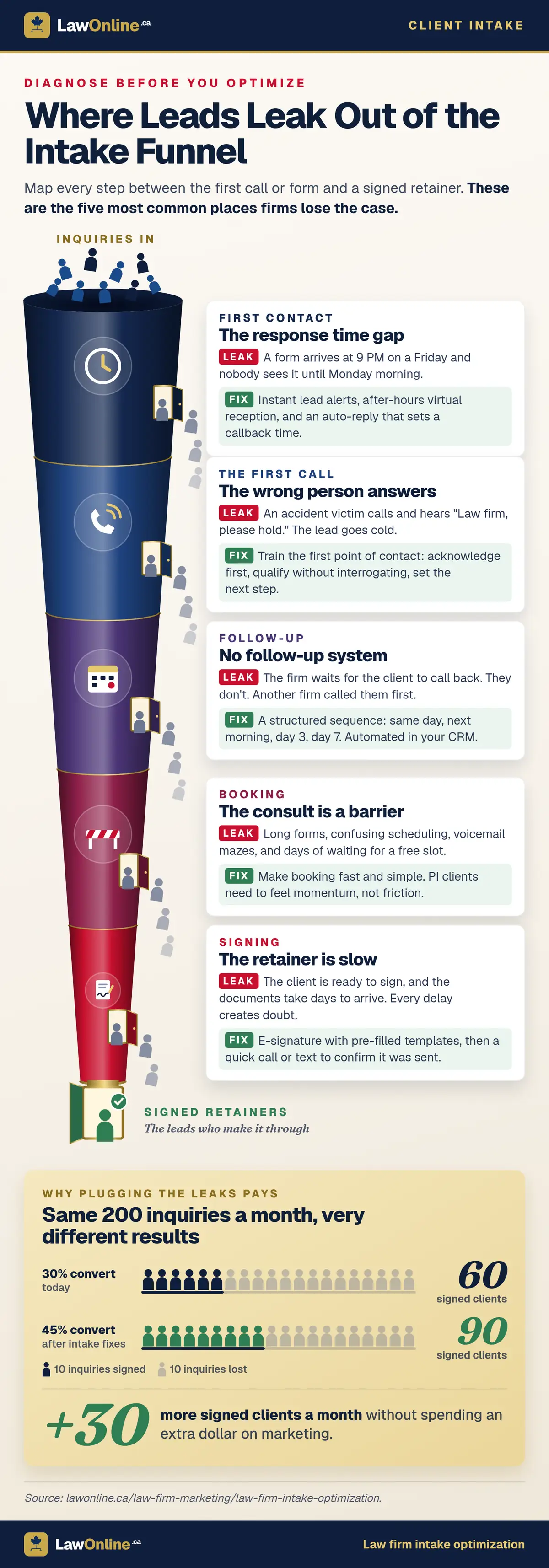
For personal injury law firms, the gap between inquiries and signed clients is often the single largest source of lost revenue. A firm generating 200 inquiries per month with a 30% conversion rate is signing 60 clients. If they optimize intake to 45%, they sign 90, without spending an extra dollar on law firm marketing.
Intake optimization isn't glamorous. It doesn't generate likes or impressions. But it compounds every other marketing investment you make. This guide covers the mechanics of a high-converting intake process for Canadian law firms, with particular focus on personal injury intake, where the stakes are highest. For the channels that bring those inquiries in to begin with, see our guide to personal injury law firm marketing. This guide is useful to all practice areas, not just PI.
Why Intake Is a Bigger Problem Than Firms Admit
Personal injury firms often measure marketing success by lead volume. The phone rings, the form gets submitted, and the marketing is deemed to be working. The fact that half those leads never become clients is treated as a sales problem, not a marketing problem. In practice, it's both.
The numbers back this up. A 2026 ShareFile survey found that 47% of lawyers report their intake process takes four days or longer, even though 94% said faster intake would help them deliver results sooner. In Canada, slow intake isn't just a revenue problem. A Canadian Bar Association ethics guide reported that client-service issues, including failures to communicate, represented 56% of complaints received by Ontario's law society. Intake is where most of those communication failures begin.
Three patterns come up again and again in legal intake:
- Speed matters more than almost anything else. A lead that receives a callback within 5 minutes converts at dramatically higher rates than one that waits 24 hours. A 2025 legal consumer survey found that 72% of people will move on if they don't hear back within 24 hours, and more than a third expect a same-day callback. Many PI firms operating on normal business hours are effectively discarding most after-hours inquiries.
- First impressions are formed in the first 60 seconds. The tone, empathy, and competence of the person who answers the phone, whether that's a legal receptionist, legal assistant, or intake specialist, sets the context for everything that follows.
- Multiple touchpoints are expected. Very few leads sign after a single contact. A structured follow-up sequence that includes a call, an email confirmation, and a follow-up call the next day will outperform hoping the client calls back.
For personal injury in particular, the urgency calculus is different. A motor vehicle accident victim who calls three PI firms is likely to sign with the first one who makes them feel heard and understood. Speed and empathy are the deciding factors, not price.
The Intake Funnel: Where Leads Die
Before optimizing, you need to diagnose. Map out every step between a lead submitting a contact form or calling your office, and the moment they sign a retainer. (If too few visitors get in touch at all, that's a website conversion problem, and it's worth fixing first.) Common failure points include:
The response time gap. A contact form submitted at 9 PM on a Friday. Who sees it, and when? If the answer is "someone on Monday morning," you've lost most of those leads by then, and that matters because so many people search for a lawyer late at night and on their phones. Competitors running after-hours intake (through live virtual receptionist services) are picking up the cases you're ignoring. How common is this? In Clio's mystery-shopper research, 60% of law firms didn't respond to email inquiries at all.
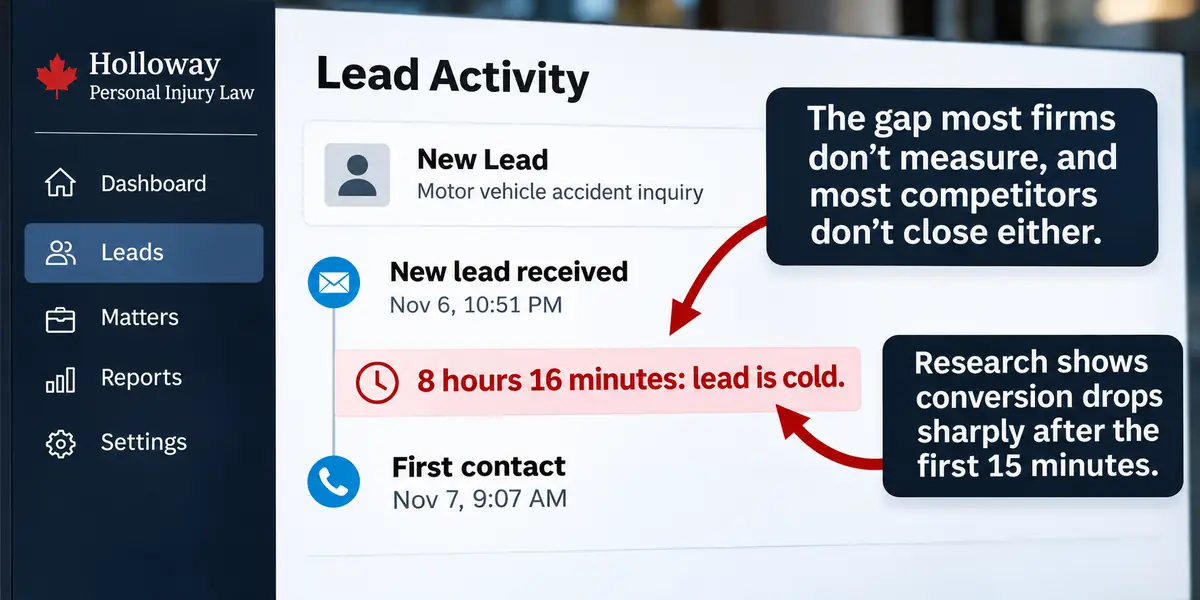
The wrong person answers the call. A personal injury client who just got into a car accident and calls your office shouldn't be greeted with "Law firm, please hold." First impressions matter. If the person who answers can't speak to their situation with some basic competence and empathy, the lead goes cold. A 2025 CallRail report found that 28% of calls to law firms are missed entirely, and 96% of firms surveyed said slow or absent responses could cost them cases.
No follow-up system. Many law firms rely on the client to call back if they're interested. They won't. Life gets busy, other firms called them back, and the moment passed. A defined follow-up sequence, not aggressive, but structured, dramatically improves conversion rates.
The consult is a barrier, not a bridge. Some firms make it too hard to book a consultation. Long intake forms, confusing scheduling, voicemail mazes, and waits of several days before a free consultation slot is available all reduce conversion. PI clients need to feel momentum, not friction.
The retainer process is slow. Once a client is ready to sign, some firms take days to prepare and send documents. Every delay creates doubt. eSign tools like DocuSign or Clio's e-signature feature let you send and collect a signed retainer in minutes.
Building a High-Converting Intake Process
Speed: The Non-Negotiable
For personal injury firms, the goal should be a callback within 15 minutes of any inquiry, including the ones that come in after hours. An inquiry that sits overnight until someone gets to it the next morning has usually gone cold, so after-hours leads need coverage that night, not a callback the next day.
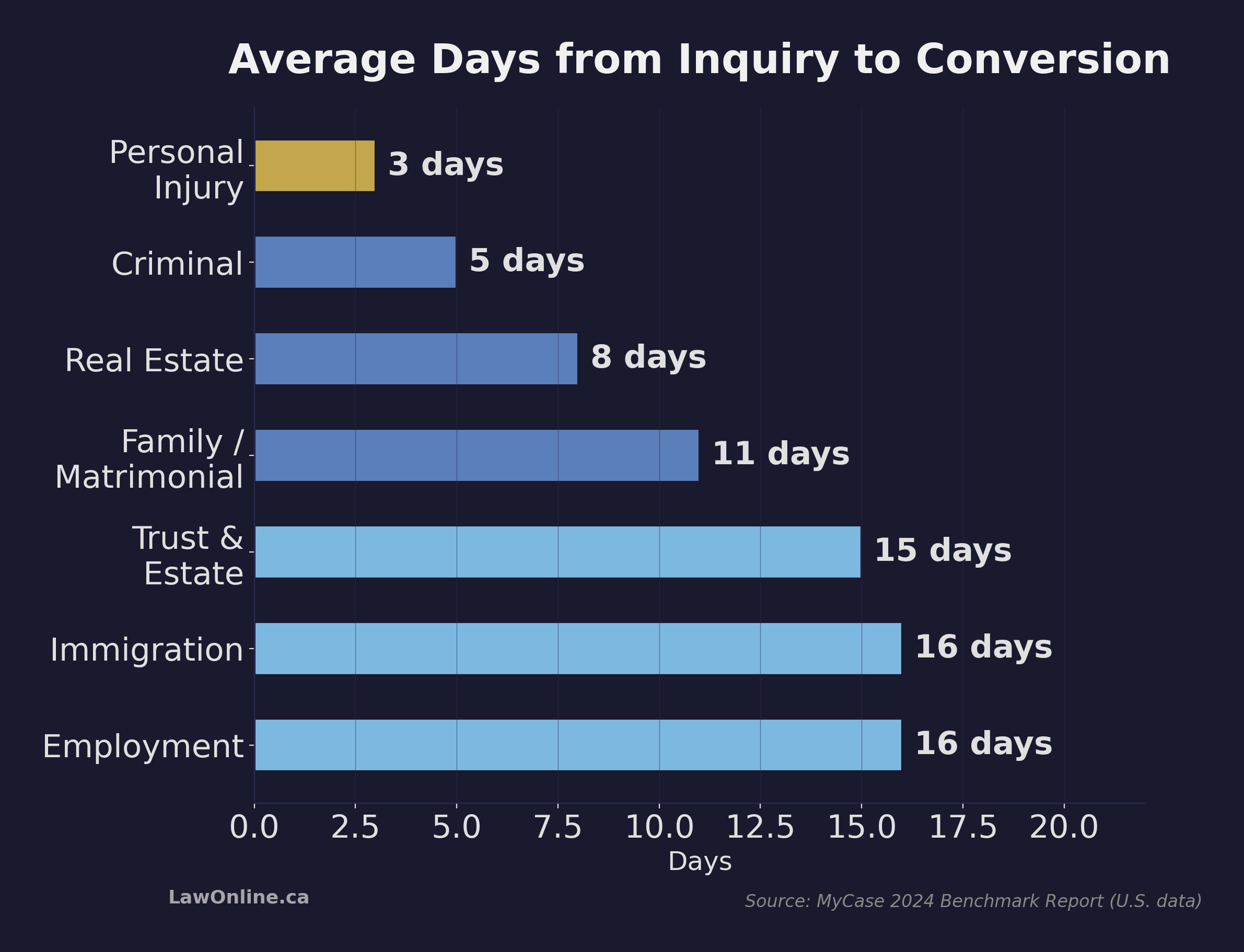
The data makes the case clearly. A 2024 MyCase benchmark study covering 1.6 million leads found that personal injury inquiries convert in an average of 3 days from first contact, faster than any other practice area. Criminal law averages 5 days, real estate 8, and family law 11. That speed cuts both ways: PI prospects decide quickly, which means the firm that responds first usually wins.
Achieving this requires:
- Alerts for every new lead. Your intake team should be notified instantly when a form is submitted. Most CRMs and intake platforms (Clio Grow, Lawmatics, Needles) can trigger real-time alerts via SMS or email.
- After-hours coverage. Virtual receptionist services like Ruby, Smith.ai, or LEX Reception can handle calls and web chats outside business hours, qualify leads, and escalate urgent cases. For a PI firm, this often pays for itself with a single additional retained client per month.
- Auto-responder with timeline. If a human can't respond immediately, an automated response that acknowledges the inquiry, sets expectations ("We'll call you within 2 business hours"), and provides a number to call for urgent matters keeps the client engaged.
Empathy: Training the First Point of Contact
For personal injury firms especially, the person who answers the call, whether in-house or through a virtual receptionist service, needs to be trained to handle clients who are often in distress.

Basic intake training should cover:
- Acknowledge the situation first. Before asking any qualifying questions, acknowledge what the client is going through. "I'm really sorry to hear about your accident, let me help you understand what your options are" goes further than immediately asking for dates and case details.
- Qualify without interrogating. You need to understand the facts of the case, but the tone should feel like a caring conversation, not an intake form being read aloud. Integrate questions naturally.
- Set clear next steps. End every intake call with a defined next step: "I'm going to pass your information to one of our lawyers who will call you within the hour." Clients who know what's happening next are far less likely to call someone else.
The Follow-Up Sequence
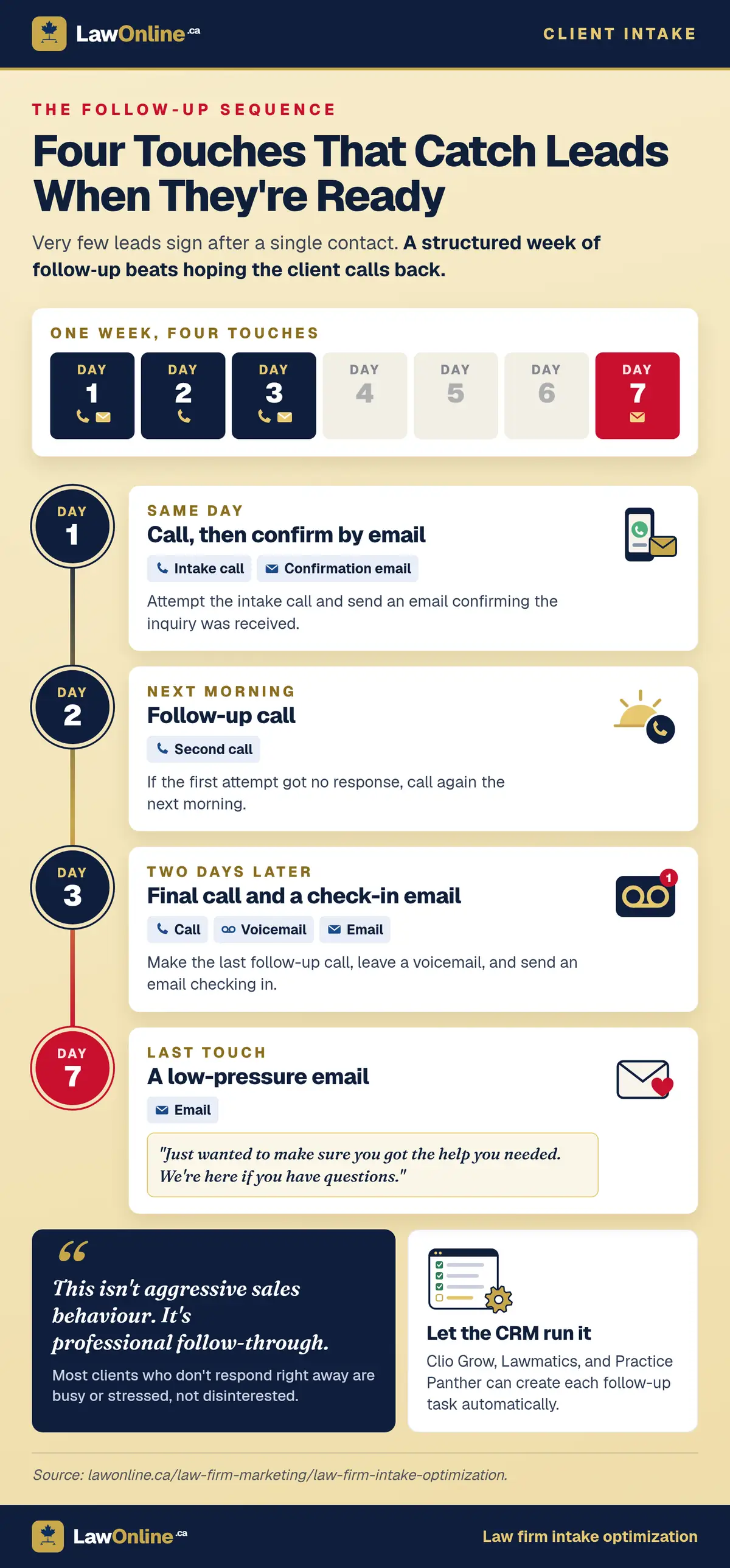
A structured follow-up sequence for unconverted leads should be standard at any PI firm generating significant inquiry volume. A basic sequence:
- Same day: Intake call attempt + email confirmation of inquiry received
- Next morning: Follow-up call if no response to previous attempt
- Day 3: Final follow-up call with voicemail + email checking in
- Day 7: Low-pressure email ("Just wanted to make sure you got the help you needed, we're here if you have questions")
This isn't aggressive sales behaviour. It's professional follow-through. Most clients who don't respond immediately are busy or stressed, not disinterested. A structured sequence catches them when they're ready.
Many law firms use a CRM with automated task creation to make this systematic. Clio Grow, Lawmatics, and Practice Panther all have intake workflow features that can automate parts of this sequence. For firms already on Clio Manage, Clio Grow integrates with the same account, so a signed retainer in Clio Grow automatically opens a matter in Clio Manage.
Streamlining the Retainer Process
Once a client decides they want to proceed, the fastest path to a signed legal retainer wins. Delays at this stage introduce doubt, and doubt is where other firms find openings.
Best practices:
- Use e-signatures. Send retainer agreements digitally and track when they're opened and signed. Services like Clio's e-signature, DocuSign, or even Adobe Sign reduce the time from "verbal agreement" to "signed client" from days to minutes. Data from the 2025 Legal Trends report found that solo firms using e-signatures saw a 10% improvement in conversion rates compared with firms that didn't, and text-messaging capabilities added another 7%.
- Pre-fill what you know. Your CRM should auto-populate retainer templates with the client's information from the intake record, reducing friction for both sides.
- Confirm by phone or text. After sending a retainer digitally, a quick call or text saying "Just sent the paperwork to your email, let me know if you have any questions" dramatically improves the signing rate versus just sending and waiting.
Measuring Intake Performance
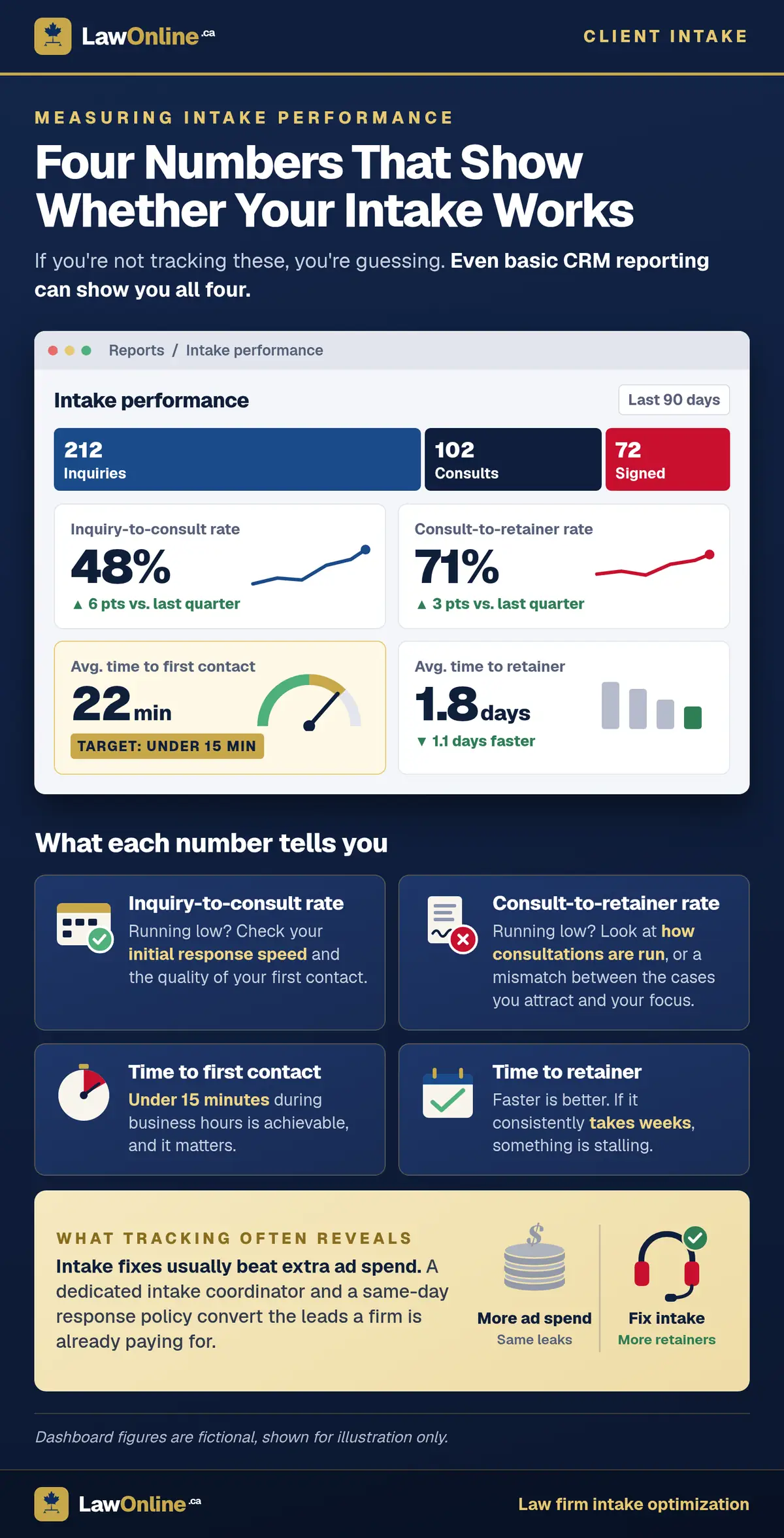
If you're not tracking these metrics, you're guessing:
Inquiry-to-consult rate. What percentage of inquiries result in a booked consultation? A low rate suggests a problem with initial response speed or intake quality.
Consult-to-retainer rate. What percentage of consultations result in a signed retainer? A low rate here often indicates a problem with how consultations are conducted, or a mismatch between the types of cases being attracted and the firm's focus.
Time-to-first-contact. Average time from inquiry submission to first human contact. Under 15 minutes during business hours is achievable and material.
Time-to-retainer. Average time from intake call to signed retainer. The faster this is, the better, but it's also a quality signal. If it consistently takes weeks, something is stalling.
For personal injury firms tracking these metrics with even basic CRM reporting, the insights are often immediately actionable. A common finding is that a dedicated intake coordinator and a same-day response policy lift the inquiry-to-retainer rate more than extra marketing spend would, because they convert leads the firm is already paying for.
There's a Canadian example of what happens when an organization takes intake measurement seriously. Legal Aid BC reported that in 2024/25, after hiring 10 dedicated intake staff, it reduced average call-centre wait times from 34 minutes to 24 minutes while handling double the family-law application volume compared with the prior year. Private firms rarely publish this kind of operational data, but the principle is the same: dedicated intake resources, measured consistently, improve both speed and capacity without requiring more marketing spend.
Which Intake Tools Actually Help?
Technology helps once the process is defined, but it won't make up for slow callbacks or missing follow-up. Most firms only need tools in four categories, and the right choice depends on your volume and practice area.
- Website chat catches visitors who won't call or fill in a form, and it works best when a person or a well-scripted system answers quickly.
- After-hours answering covers evenings and weekends, when a lot of personal injury calls come in.
- AI screening can ask the first qualifying questions and route urgent matters to a lawyer, but someone at the firm still needs to review what it collects.
- CRM follow-up turns the sequence above into tasks and reminders, so no inquiry depends on someone's memory.
The Canadian Bar Association identifies client intake as an area where automation is appropriate, but warns that cloud-based intake tools can raise confidentiality and data-protection concerns. Before adopting any intake software, confirm that the vendor stores data in Canada (or at minimum in a jurisdiction your provincial law society accepts), that access is limited to authorized staff, and that the platform's terms don't grant the vendor rights to use your client data for other purposes.
Start with the gap your intake numbers point to, and add the tool that closes it.
The Economics: Why Intake ROI Is Unusually High
For personal injury firms, intake optimization has some of the best unit economics in marketing because:
- The value per retained client is high. A motor vehicle accident case might represent $15,000–$75,000+ in contingency fees. A single additional retained client per month more than covers any investment in intake infrastructure.
- You're capturing leads you already paid to generate. Every Google Ad click, every SEO ranking, every referral that comes through represents sunk marketing cost. Improving intake conversion doesn't require you to spend more on acquisition, it extracts more value from existing spend.
- Competitors often haven't figured this out. Intake quality varies dramatically across the Canadian PI market. Many large advertising firms still have slow, impersonal intake processes. Competing on intake is often easier than competing on Google Ads spend.
A PI firm spending $15,000/month on Google Ads and converting inquiries at 25% would sign more clients from that same $15,000 spend if they invested $2,000/month in intake infrastructure and moved conversion to 35%. The math is straightforward, and yet most firms spend the extra money on more ads.
The addressable market is larger than most firms realize. A Department of Justice Canada study found that 11.4 million Canadian adults experience at least one serious legal problem over a three-year period, but only about 19% seek formal legal advice. Many people who don't reach out cite barriers that a well-designed intake process can help address: unclear costs, intimidating processes, and not knowing where to start. A firm that makes it easier to get in touch and easier to understand the next steps isn't just improving conversion from existing leads. It's expanding the pool of people who feel comfortable picking up the phone.
What to Do First
If you're reading this and haven't measured your intake conversion rate, start there. Pull 90 days of data: how many inquiries came in, how many consultations were booked, how many clients signed. The gap between inquiries and signed clients will tell you whether intake is a priority.
From there, the highest-leverage fixes are almost always:
- Faster first response (same-day callback at minimum, 15-minute target during business hours)
- After-hours coverage for a practice area like PI where urgency is real
- A structured follow-up sequence for unconverted leads
None of these require expensive technology. They require systems, accountability, and a recognition that intake is a core business function, not an afterthought.
LawOnline.ca helps Canadian law firms grow through digital marketing. If you're investing in SEO, PPC, or content and want to make sure those efforts are actually converting into retained clients, get in touch with our team.