
Immigration law is one of the most distinct practice areas to market in Canada, and one of the most competitive. Unlike personal injury law, where clients search in moments of crisis, immigration clients often plan ahead. Unlike family law, where most clients share a language with their lawyer, immigration clients speak dozens of languages and may have arrived in Canada last month.
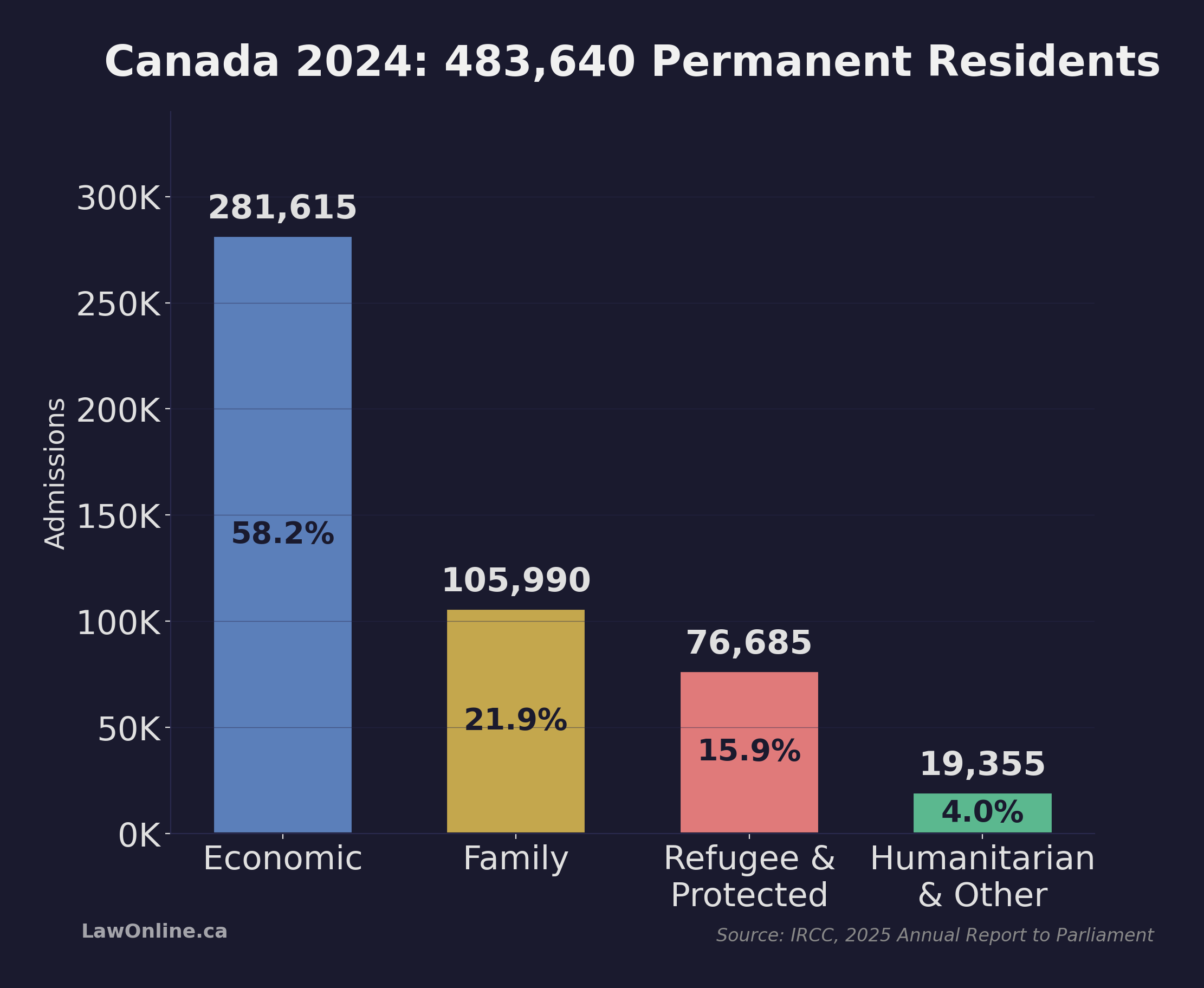
The marketing challenges are real: you compete with Regulated Canadian Immigration Consultants (RCICs) who can offer similar services often at lower prices, your clients may distrust institutions by default, and paid advertising in immigration is tightly restricted. But the opportunity is substantial. Canada admitted 483,640 permanent residents in 2024, and the refugee-protection system ended 2025 with nearly 300,000 claims still waiting for a hearing. Immigration and refugee legal-aid certificates jumped 52% nationally in a single year, and a single complex case can generate $5,000–$20,000 in professional fees.
This guide covers immigration lawyer marketing strategy for Canadian firms and RCIC practices, with a focus on what works in this specific market.
Understanding the Immigration Law Client
Immigration clients aren't a homogeneous group. Before building any marketing strategy, understand who you're actually trying to reach.

Economic immigrants and skilled workers. Applying through Express Entry, the Provincial Nominee Program, or the Atlantic Immigration Program. Often well-educated, employed, and comfortable using the internet to research their options. They may be evaluating multiple firms simultaneously and will compare fees, timelines, and credentials carefully. The competition these clients face is intense: IRCC received 468,073 Express Entry profiles in 2024 but issued only 98,903 invitations to apply, meaning roughly one in five applicants received an invitation. That competitive pressure is what drives skilled-worker clients to seek legal guidance, and it's what makes them willing to pay for it. This group often finds lawyers through Google search, professional association referrals (their employer's HR department), or LinkedIn.
International students and post-graduate work permit applicants. Younger, social media-literate, and price-sensitive. Often reach out via Instagram DM or through referral from a university international student centre. Trust signals matter: university partnerships, testimonials from former students, active social presence.
Spousal sponsorship and family reunification clients. Often Canadian citizens or permanent residents trying to bring a partner or parent to Canada. Emotional stakes are high. They want to know that you understand the specific pathway (inland vs. outland, Temporary Resident Permit options, humanitarian and compassionate grounds) and can communicate clearly about timelines. These clients often come through referrals from settlement agencies, multicultural community centres, or community members who used your firm.
Refugees and humanitarian clients. May have limited funds and significant trauma. Often connected to legal services through refugee legal aid programs, NGOs, or community organizations. Less likely to find you through paid advertising. The scale of need here is large: Canada received 171,840 asylum claims in 2024, with Ontario accounting for more than half. By the end of 2025, nearly 300,000 refugee claims were waiting for a hearing, and the median time to a decision had reached 20 months. In Ontario alone, immigration and refugee legal-aid applications nearly doubled to 44,762 in 2023–24.
Employers and corporate immigration. HR departments at growing companies in tech, healthcare, agriculture, or hospitality who need to regularize foreign workers' status or bring international hires. These clients are B2B in nature, they can be reached through LinkedIn, employer associations, and professional network referrals. High case volume, recurring relationship potential.
Understanding your primary client type is the first strategic decision in immigration marketing, because the channels, messaging, and language that work for one group are quite different from what works for another.

Local SEO for Immigration Law Firms
Like personal injury firms, immigration practices are fundamentally local businesses. Even though immigration law is federally regulated and you could technically help clients from anywhere in Canada, the reality is that most immigration law clients want to meet their lawyer in person, especially for complex or high-stakes matters. The search data backs this up: "immigration lawyer near me" generates over 4,000 monthly searches in Canada, dwarfing any individual program-specific query.
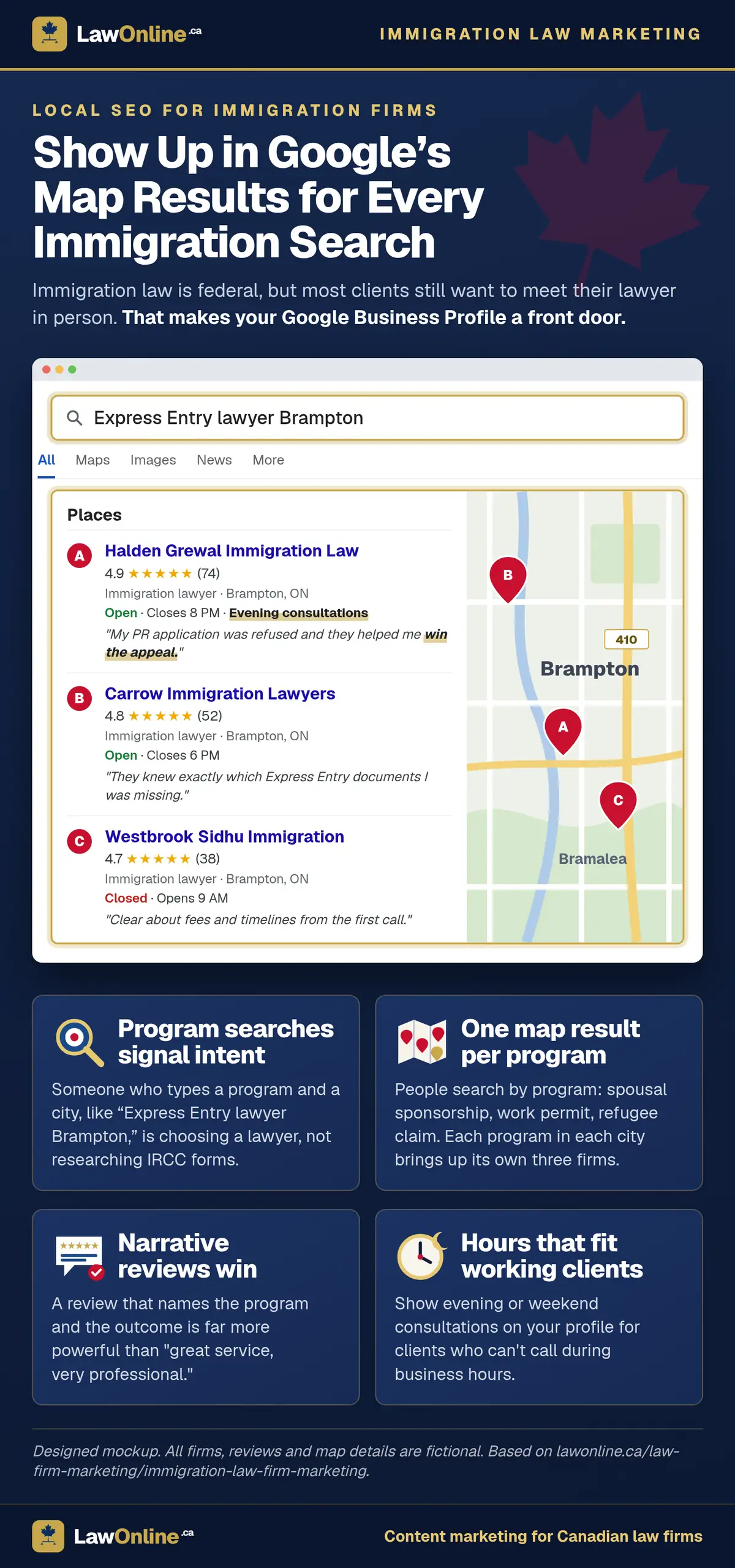
Google Business Profile optimization for immigration firms follows the same principles as other practice areas: verified listing, complete service categories ("Immigration Attorney," "Immigration Lawyer"), current hours including whether you offer evening or weekend consultations (important for clients who work full-time and can't call during business hours), and a consistent stream of reviews. Getting immigration lawyer SEO right at this local level means treating each GBP category, each pathway page, and each city variation as a separate ranking opportunity.
Keyword targeting for immigration law covers both the general practice-area terms and the pathway-specific queries that clients actually type:
- "immigration lawyer [city]" / "immigration lawyer near me"
- "Express Entry lawyer [city]"
- "spousal sponsorship lawyer [city]"
- "work permit lawyer Canada"
- "immigration consultant vs lawyer [city]"
- "PGWP extension lawyer [city]"
- "refugee lawyer [city]"
The general queries dominate volume: "immigration lawyer near me" draws roughly 4,400 monthly searches in Canada and "immigration lawyer Toronto" another 3,600. But immigration search behaviour is also fragmented across dozens of specific program and pathway searches. "Spousal sponsorship lawyer" pulls about 170 monthly searches nationally and "Express Entry lawyer" around 40. Each city-specific variation adds incrementally, so the total opportunity is in the combined volume of these long-tail combinations on top of the core practice-area term.
City and neighbourhood-specific content works for immigration practices in high-immigration markets. A Toronto immigration firm writing about the settlement resources available to new Peel Region residents, the immigrant entrepreneur support programs in Mississauga, or the specific employment patterns in Brampton's logistics sector can attract more relevant traffic than a generic "immigration lawyer Brampton" page.
Google Ads for Immigration Lawyers
Immigration is one of the categories with specific Google Ads restrictions. Google's policies around immigration and asylum services have fluctuated, and certain types of advertising, particularly ads that could target asylum seekers or displaced persons, face restrictions under Google's sensitive event and housing/employment/credit policies.
For immigration law firms:
- Standard legal service ads (Express Entry, work permits, spousal sponsorship) are generally permitted.
- Ads that could be interpreted as targeting refugees or asylum seekers specifically face higher scrutiny and potential disapproval.
- Google's personalized advertising policies restrict certain audience targeting options in immigration-adjacent contexts.
Before investing in Google Ads for immigration, verify current policy status with a legal marketing professional familiar with this space. Policies change, and a campaign built on today's assumptions may run into compliance issues.
When Google Ads does work for immigration practices, cost-per-click tends to be significantly lower than personal injury law. A PI firm in Toronto might pay $75–$120 per click on competitive keywords. An immigration firm can often run campaigns at $8–$25 per click for highly specific pathway keywords. The tradeoff is lower search volume, "Express Entry lawyer Toronto" has far fewer monthly searches than "car accident lawyer Toronto", but the qualified conversion rate from those searches is high.
Negative keywords are essential. Immigration search queries include enormous amounts of DIY research traffic, people trying to understand IRCC requirements, fill out their own forms, or figure out if they even need a lawyer. A well-structured campaign with aggressive negative keywords (filtering out informational searchers who are clearly not prospects) dramatically improves efficiency. Adding negatives like "free," "without lawyer," "DIY," "IRCC forms," and "application instructions" is a starting point.
Multilingual Marketing: When It Matters
The question every immigration firm eventually asks: should we invest in marketing in Mandarin, Tagalog, Hindi, Arabic, Spanish, or other languages?
The numbers suggest the audience is there. Roughly 10.7 million Canadians can hold a conversation in a non-official language, including 1.2 million Spanish speakers, 987,000 Mandarin speakers, 942,000 Punjabi speakers, and 838,000 Arabic speakers. More than one in five Canadian households are multilingual, and nearly 670,000 workers use a non-official language on the job. For immigration firms in Toronto, Vancouver, or Calgary, the addressable market for multilingual services is substantial.
The honest answer on whether to invest: it depends on your market and your capacity to serve those clients.
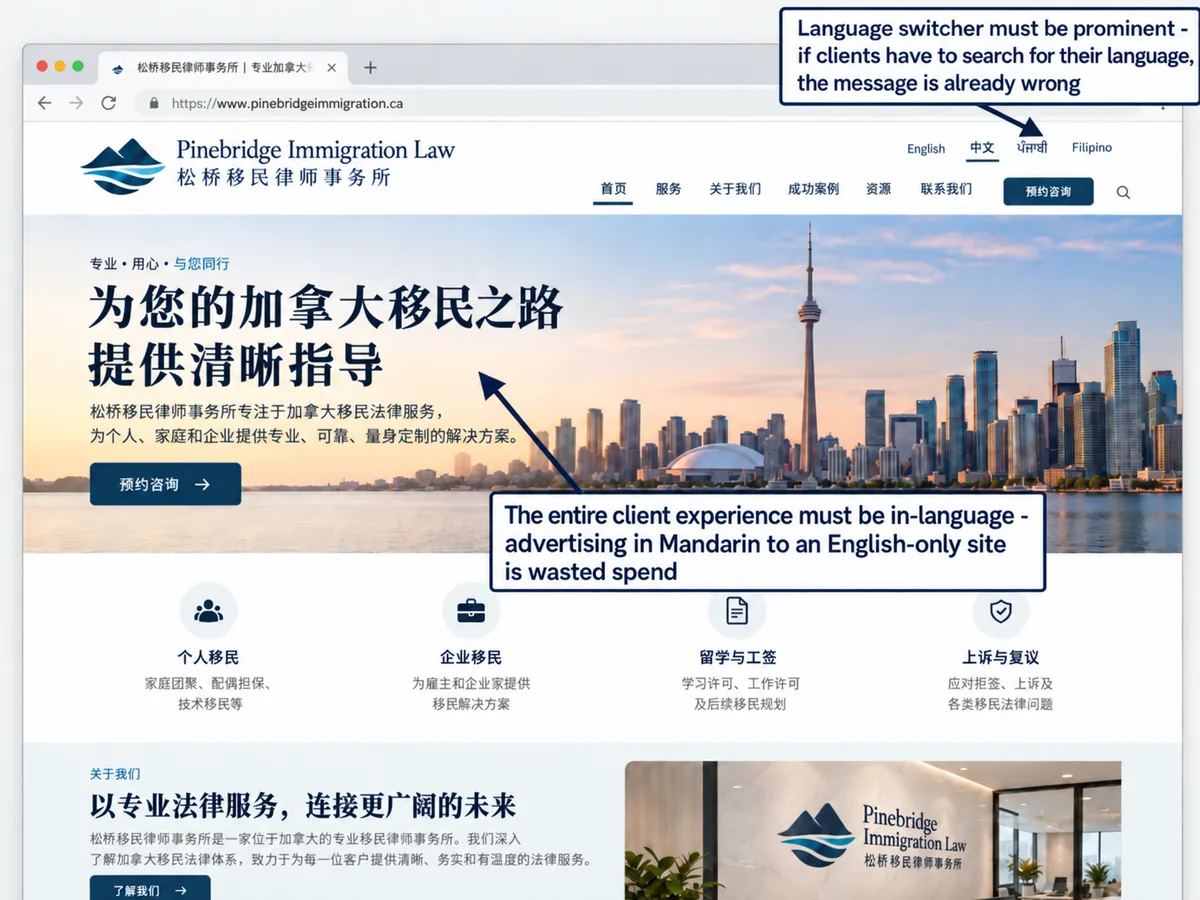
Multilingual marketing only works if the entire client experience is multilingual. Running Mandarin Google Ads that send people to an English landing page with an English intake form handled by English-speaking staff isn't a multilingual marketing strategy, it's a wasted spend. The multilingual commitment has to run through the entire funnel: advertising, website, intake, client communication, and case management.
If your firm genuinely has lawyers or staff fluent in Mandarin or Cantonese, and you have a practice that serves Chinese-Canadian immigrant clients well, then:
- A Simplified Chinese or Traditional Chinese version of your website landing pages (not a machine-translated version, a professionally translated version) is worth the investment
- Google Ads in Chinese-language keywords will face less competition and lower CPCs than English equivalents
- WeChat Official Account presence has meaningful reach in the Chinese-Canadian community, particularly for professionals and entrepreneurs
- Chinese-Canadian community associations and trade groups are strong referral sources
Similar logic applies to South Asian communities (Google Ads in Hindi or Punjabi, presence in Indian-Canadian professional networks, relationships with local temples and cultural associations), Filipino communities (active Facebook groups, community organization partnerships), and other significant immigrant communities in your market.
The efficiency gain from multilingual marketing in immigration is real. It's also a significant commitment, don't start something you can't support through to a genuine client relationship.
Content Marketing: Building Authority Through Practical Guides
Immigration law lends itself exceptionally well to content marketing. The process of immigrating to Canada is genuinely complicated, constantly changing (IRCC policy updates several times per year), and the consequences of errors are serious. Potential clients are hungry for authoritative, trustworthy information.
High-performing content types for immigration firms:
Program-specific guides. Comprehensive, thoroughly researched guides to specific immigration pathways, "The Complete Guide to Express Entry for Software Engineers," "How Spousal Sponsorship Works in Canada," "Employer-Specific Work Permits: A Step-by-Step Overview." These are long (2,000–4,000 words), accurate (updated as IRCC policy changes), and rank for dozens of long-tail search queries. They also demonstrate credibility to prospective clients who are evaluating whether you understand their specific situation.
Policy update posts. When IRCC changes draw deadlines, updates Express Entry scoring thresholds, or introduces new programs (like the recent Rural and Northern Immigration Pilot expansions), publishing a prompt, accurate summary of what changed and what it means for applicants builds authority and generates search traffic. With nearly 300,000 pending refugee claims and a median processing time of 20 months, even small policy shifts have immediate implications for thousands of applicants. These posts need to be accurate, immigration law clients will catch errors.
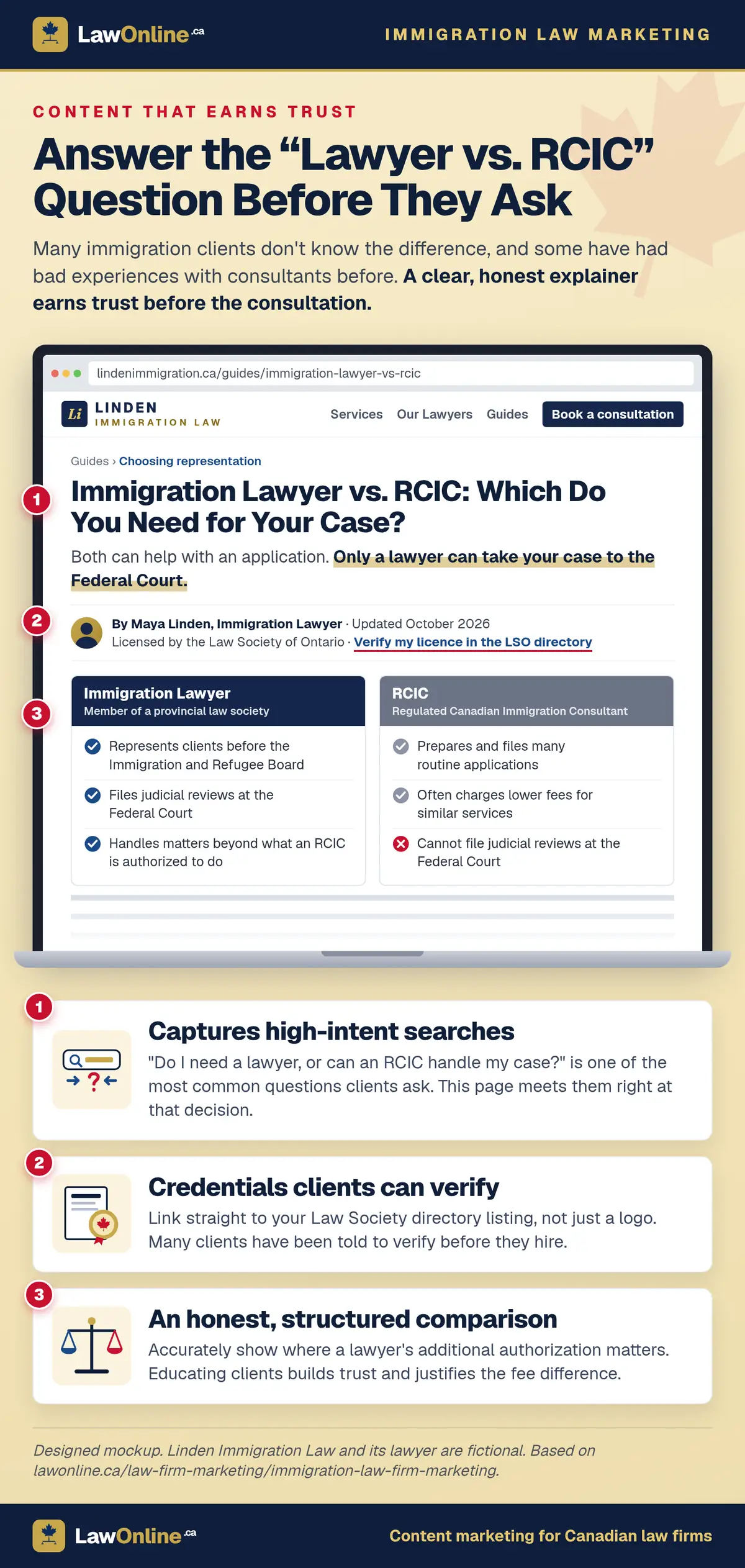
"Immigration lawyer vs. consultant" content. One of the most common questions potential clients have: do I need a lawyer, or can an RCIC handle my case? Writing honestly about this distinction (while accurately representing the cases where a lawyer's additional authority matters, such as a judicial review at the Federal Court) attracts clients actively evaluating their options.
Fee and cost transparency pages. "Immigration lawyer cost" and "how much does an immigration lawyer charge" are among the highest-volume queries potential clients search before they ever contact a firm. A page that honestly breaks down fee ranges by case type (Express Entry applications, spousal sponsorship, refugee hearings, judicial reviews) answers the question Google is being asked hundreds of times per month in Canada. Firms that publish their fee structures attract clients who are already price-qualified and ready to book.
Case outcome stories. Subject to Law Society of Ontario (or provincial equivalent) advertising rules, sharing case studies, with client consent and appropriate anonymization where needed, that illustrate how you navigated a complex matter builds trust. An immigration refusal successfully appealed at the Immigration Appeal Division is a more compelling credential than any number of keyword-stuffed practice area pages.
Compare this to personal injury firms, where content marketing typically focuses on legal rights after accidents, insurance claim timelines, and what SABS benefits cover. The strategic logic is the same: create content that answers the questions your prospective clients are actively researching, establish authority, and be the firm they think of when they're ready to hire.
Reviews and Trust Signals
Immigration clients often have good reasons to distrust institutions. Many come from countries with unreliable legal systems, or have had negative experiences with immigration consultants who overcharged them or misrepresented their chances. Building trust is central to the marketing challenge.
Google reviews matter here as much as they do for personal injury firms, and the review volume, recency, and content are all evaluated. But immigration lawyer reviews tend to be particularly narrative: clients describe their specific situation, explain how the firm helped them, and what outcome they achieved. A review that says "My PR application was denied and [law firm] helped me win the appeal" is far more powerful than "great service, very professional."
Law Society credentials. Making your Law Society membership verifiable and prominent, not just an "as seen in" logo, but a direct link to your law society directory listing, reassures clients who have been told to verify before they hire.
RCIC vs. lawyer distinction. If you're a lawyer, your website should explain clearly why this matters for specific case types: only lawyers can file judicial reviews and appeals at the Federal Court, and every lawyer can represent clients before the Immigration and Refugee Board, while an RCIC needs a separate IRB licence class to do the same. Many immigration clients don't know this distinction, educating them builds trust and justifies the fee difference.
Testimonial specificity. Generic testimonials ("highly recommend," "very helpful") are less effective than specific ones. Ask satisfied clients to describe their specific immigration pathway, the challenge they faced, and what resolution they achieved. More specific testimonials earn more trust.
Referral Networks in Immigration Law
Immigration law referral networks are different from those in personal injury or family law. Here's who sends immigration lawyers their best clients:
Settlement agencies and immigrant-serving organizations. Organizations like ACCES Employment, COSTI Immigrant Services, Centre for Immigrant and Community Services, and dozens of regional equivalents refer clients with complex immigration matters. Building relationships with case workers at these organizations, through pro bono assistance, speaking at community events, or simply being responsive when they refer a difficult case, generates referrals.
Employers and HR professionals. Companies hiring international talent repeatedly refer employees to immigration lawyers. Establishing a relationship with HR departments at tech firms, healthcare networks, universities, or large manufacturers can generate recurring corporate immigration work.
Other lawyers. Family law lawyers regularly encounter clients with intersecting immigration issues (domestic violence and immigration status, for example). Criminal defence lawyers have clients facing immigration consequences. Establishing clear channels for cross-referral with lawyers in adjacent practice areas makes sense.
Accountants and financial advisors. Business immigration clients, investor class, entrepreneur stream, intra-company transfer, often work with accountants who encounter immigration questions. Being the referral partner of choice for a handful of accountants in your city can produce consistent business immigration referrals.
Community organizations. Cultural associations, religious communities, and ethnic business associations are genuine referral sources for immigration firms that have invested in those communities. This isn't transactional, it requires showing up, contributing value, and earning trust over time.
Measuring What Works
For immigration practices, the metrics that matter most:
Consultation-to-retained ratio. Immigration consultations often result in retained engagements quickly, the client has a deadline (application deadline, status expiry, hearing date) and needs to act. If your consultation-to-retained rate is below 40%, that's a conversion problem worth investigating: is it fee sensitivity, unclear process explanations, or failure to address the specific concerns clients bring to the consultation?
Source tracking on new clients. Where are your paying clients actually coming from? Immigration firms often find their paid advertising generates inquiries but their referral network generates retainers. That's important information for allocating budget.
Cost per consultation and cost per retained client by channel. Different channels produce different economics. Google Ads might deliver a $150 cost per consultation. Referral partnerships might deliver a $0 cost per consultation. Understanding the true cost per retained client (not just cost per lead) by channel is the right framework for budget decisions.
Marketing an immigration law firm in Canada requires understanding who your clients are, where they look for help, and what makes them trust a firm enough to hire them. The fundamentals, local SEO, strategic content, trustworthy reviews, and strong referral relationships, are the same as in any practice area. But the specifics are shaped by the unique client base immigration lawyers serve.
If you're an immigration law firm looking to build a more systematic client acquisition system, contact LawOnline.ca to discuss a strategy tailored to your market and practice type.