
Google Ads is one of the fastest ways to get a law firm in front of people who are searching for legal help right now, and it's also one of the easiest ways to spend thousands of dollars with nothing to show for it. Whether it's worth it for your firm comes down to three things: what your cases are worth, how competitive your market is, and whether you can track which clicks become signed clients.
Search advertising is the largest category in Canadian digital marketing, generating over $9 billion in revenue in 2025 and accounting for 43% of Canada's $21 billion digital ad market according to IAB Canada. Law is consistently among the highest-cost categories on the platform. In competitive Canadian markets, personal injury firms regularly pay $50 to $150 per click, and a click isn't a client or even a lead. It's a visitor who may or may not call, qualify, or hire you, so without the right setup and tracking, the budget disappears and the returns are impossible to measure.
We provide Google Ads management for law firms across Canada, and the biggest difference between a profitable campaign and an expensive one usually isn't budget, it's structure. This guide covers pay-per-click (PPC) advertising for law firms, starting with whether it suits your firm at all, then what it costs, how to set a campaign up, and what to expect in the first few months.
Who Should Use PPC (And Who Probably Shouldn't)
PPC is well-suited for:
Personal injury firms that need a consistent volume of new client inquiries and can afford to invest in advertising while their SEO builds. Personal injury is a high-value case type, a single successful motor vehicle accident case can generate $15,000–$100,000+ in fees. Even at $150 per click and a 3% conversion rate from click to signed client, the math can work.
Law firms entering a new market. If a personal injury firm in Hamilton opens a second office in London, Ontario, PPC can generate immediate visibility while the new office builds its local SEO presence and review profile. Organic SEO takes 6–18 months in competitive markets. PPC starts working immediately.
Firms promoting specific, high-value services. A wills and estates firm launching a new capacity assessment practice, or an immigration firm running a targeted campaign for LMIA applications, can use PPC to reach clients searching for that specific service.
PPC is less well-suited for:
Firms without a tracked intake process. If you can't tell which calls came from Google Ads, you can't measure ROI and you can't make informed spending decisions. Before running PPC, set up call tracking.
Firms with very low average case values. Real estate law, general corporate work, and similar practice areas may not generate the case economics to justify legal PPC rates. Do the math before committing.

Understanding the Cost Structure
Law firm advertising on Google operates on a second-price auction. You set a maximum bid per keyword; your actual cost-per-click depends on the competition and quality of your ads.
In the most competitive Canadian markets, here's what to expect:
| Market | Keyword | Typical CPC Range |
|---|---|---|
| Toronto | personal injury lawyer | $80–$150 |
| Vancouver | ICBC lawyer | $60–$120 |
| Calgary | car accident lawyer | $50–$100 |
| Ottawa | family lawyer | $30–$70 |
| Hamilton | personal injury lawyer | $40–$90 |
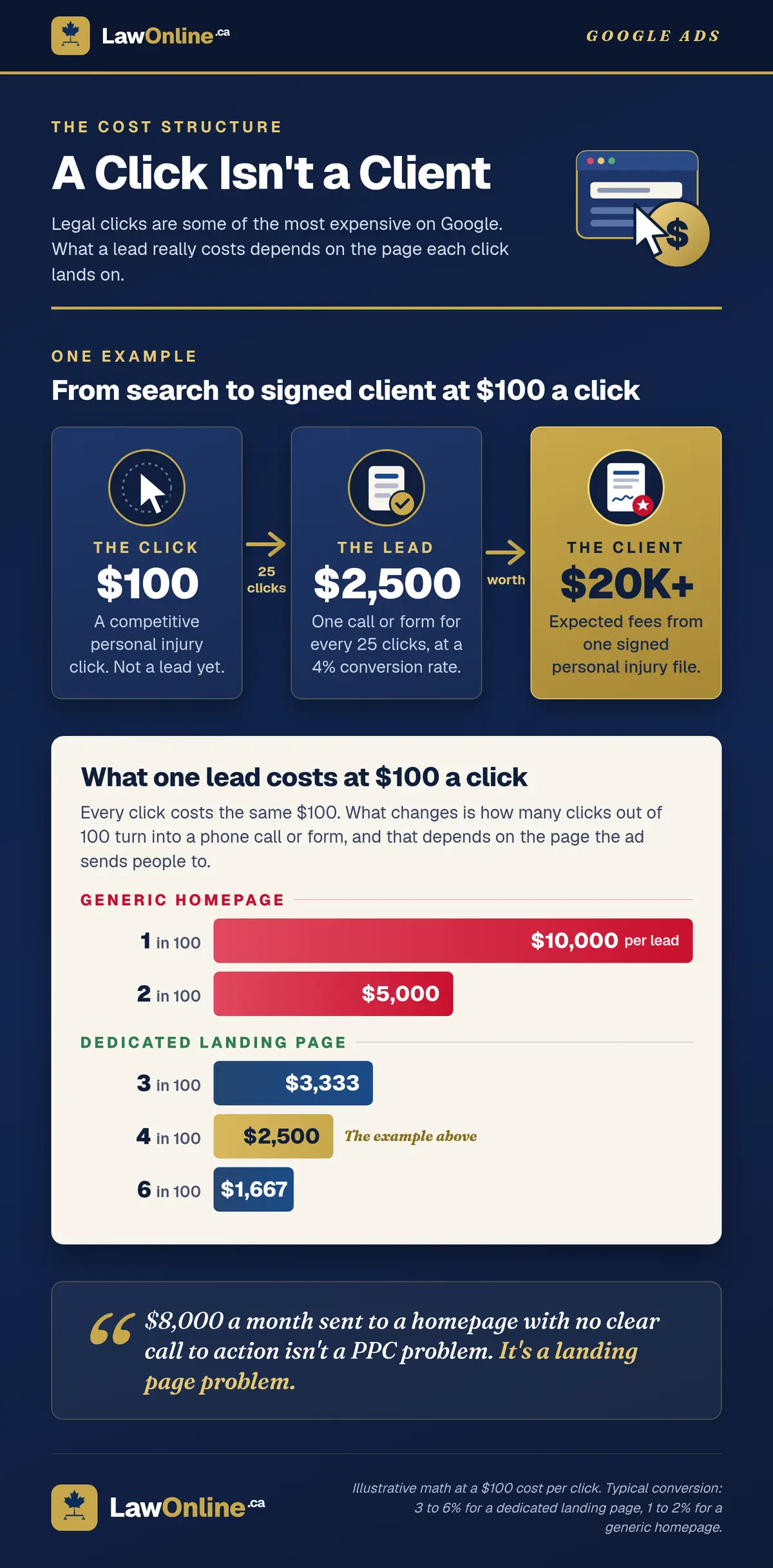
These are click costs, not lead costs. To estimate your cost per qualified lead, you need to account for conversion rates. A well-built landing page with strong social proof typically converts 3–6% of clicks into phone calls or form submissions. A generic homepage might convert at 1–2%.
How does that compare to the broader legal advertising market? A FindLaw analysis citing Unbounce's Conversion Benchmark Report found that legal-service PPC advertisers averaged an 11.8% conversion rate, but the median was just 4.4%. That's important to keep in mind: a handful of firms with optimized landing pages and tight keyword targeting pull the average way up, while most campaigns sit well below it. If you're benchmarking your own campaign, the 4.4% median is a more honest starting point than the average.
At $100/click and a 4% conversion rate (that's one conversion for every 25 clicks), your cost per lead is $2,500. That's expensive, but for a personal injury firm where a signed client generates $20,000+ in expected fees, it's potentially very profitable.
The math changes dramatically if your conversion rate drops or your landing page is weak.
It's common to see firms spending $8,000 a month on Google Ads while sending all that traffic to a homepage with no clear call to action, and in that case the problem is the landing page, not the ads.
Keyword Strategy: What to Bid On (and What to Avoid)
The most common PPC mistake law firms make is bidding on broad, generic keywords without understanding match types and intent.
High-intent keywords to prioritize:
These are the searches you want. The person is actively looking for a lawyer right now.
- "personal injury lawyer [city]"
- "car accident lawyer [city]"
- "slip and fall lawyer [city]"
- "motorcycle accident lawyer [city]"
- "ICBC lawyer [city]" (BC)
- "family lawyer [city] consultation"
- "immigration lawyer [city] LMIA"
Informational keywords to avoid (or bid on separately at lower rates):
These searches are research-oriented. The person isn't necessarily looking to hire a lawyer today.
- "how to file a personal injury claim"
- "how long does a car accident lawsuit take"
- "what is a contingency fee"
If you bid on these without separating them, you'll pay near-premium rates for traffic that converts at a fraction of the rate of high-intent keywords. If you use them at all, put them in a separate campaign with a lower bid and a content-focused landing page.
Use exact and phrase match, not broad match. Broad match keywords in legal advertising are dangerous. "Accident lawyer" on broad match will trigger your ad for irrelevant searches. Use phrase match ("Hamilton personal injury lawyer") or exact match ([personal injury lawyer Toronto]) to maintain control over what triggers your ads.
Negative keywords are mandatory. Add a comprehensive negative keyword list from day one to prevent your ads from showing for irrelevant searches. Common negatives for personal injury firms include: "free," "pro bono," "DIY," "lawyer jokes," "law school," "salary," and so on. Review your search terms report weekly and add new negatives as you see irrelevant clicks come through.
Landing Pages: Where PPC Campaigns Actually Win or Lose
Most Canadian law firms send their PPC traffic to their homepage. This is one of the most expensive mistakes in lawyer advertising.
Your homepage is designed to explain your firm to a general visitor. A PPC landing page needs to do one thing: convert a specific visitor, someone who just searched for "car accident lawyer Hamilton", into a phone call or form submission.
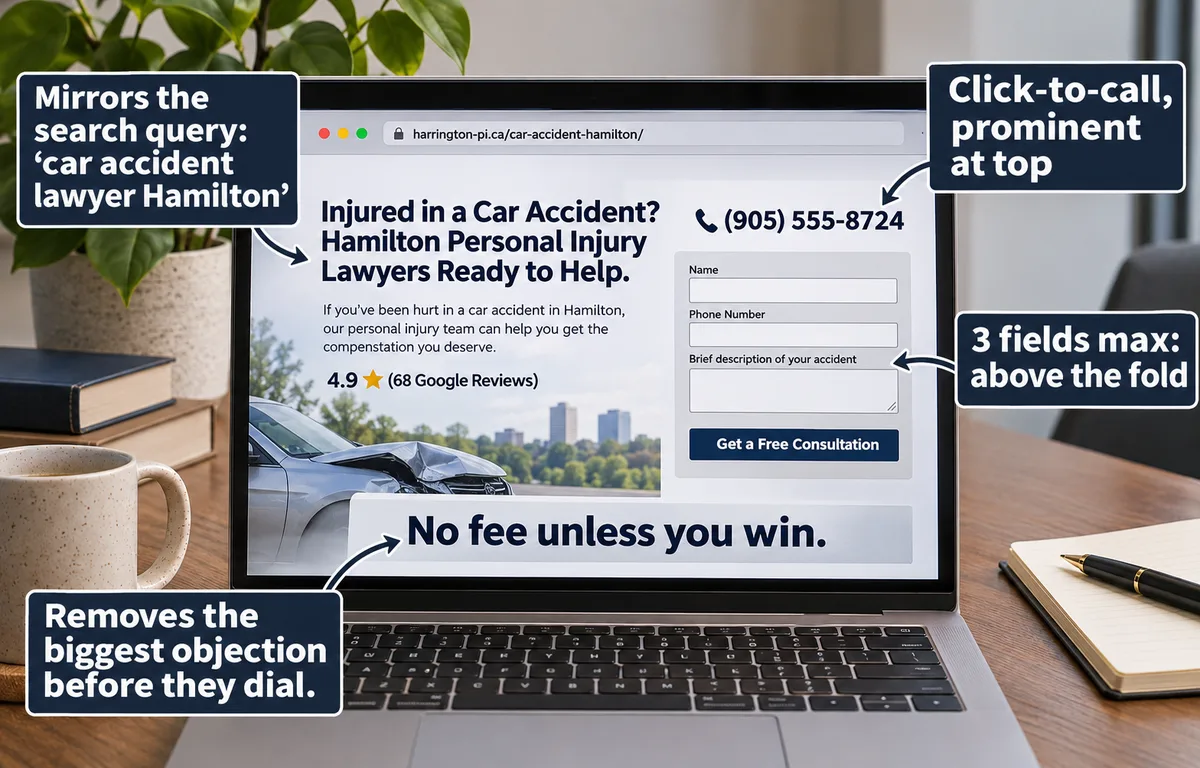
An effective personal injury PPC landing page includes:
- A headline that mirrors the search intent: "Injured in a Car Accident? Speak to a Hamilton Personal Injury Lawyer Today."
- A prominent phone number at the top of the page (click-to-call on mobile)
- A short intake form (name, phone, brief description of the accident), keep it above the fold
- Social proof: Google review count and star rating, notable results (without violating professional conduct guidelines), years in practice
- Contingency fee assurance: "No fee unless you win" in large text, this removes a major objection
- A clear statement of what happens next: "Call now for a free, no-obligation consultation"
Keep the page focused. Remove the navigation menu if possible, every link is an opportunity for the visitor to leave without calling. The goal is a single conversion action.
Build separate landing pages for each campaign. If you're running campaigns for car accidents, slip and falls, and motorcycle accidents separately, build a dedicated landing page for each. A visitor who searched "motorcycle accident lawyer Calgary" should land on a page that speaks specifically to motorcycle accidents, not a generic personal injury page.
Campaign Structure: How to Organize Your Ads
A well-organized Google Ads account for a law firm typically looks like this:
Campaign 1: Core PI, Motor Vehicle Accidents (Toronto)
- Ad Group: Car Accident Lawyer Toronto
- Ad Group: Auto Accident Lawyer Toronto
- Ad Group: MVA Lawyer Toronto
Campaign 2: Core PI, Slip and Fall (Toronto)
- Ad Group: Slip and Fall Lawyer Toronto
- Ad Group: Trip and Fall Lawyer Toronto
Campaign 3: Competitor Keywords (Toronto)
- Ad Group: Competitor Firm Names
Google lets you bid on another firm's name as a keyword, but be careful with this campaign. Don't name the other firm in your ad or compare yourself to it. Law societies frown on marketing that suggests you're better than other lawyers or puts them down, and the firm whose name you're bidding on is likely to notice. Check your law society's marketing rules before you launch it.
Separating by case type allows you to track which services drive the most valuable leads, set different bids based on case value, and tailor ad copy to match the specific search.
Don't run one big campaign with all your keywords mixed together. You'll lose visibility into what's working and overpay on categories where the economics don't justify it.
Ad Copy: What Actually Gets Clicked
In Google Search Ads, your copy competes directly with 2–3 other ads plus the Local Pack. In legal advertising, most law firm ads look nearly identical:
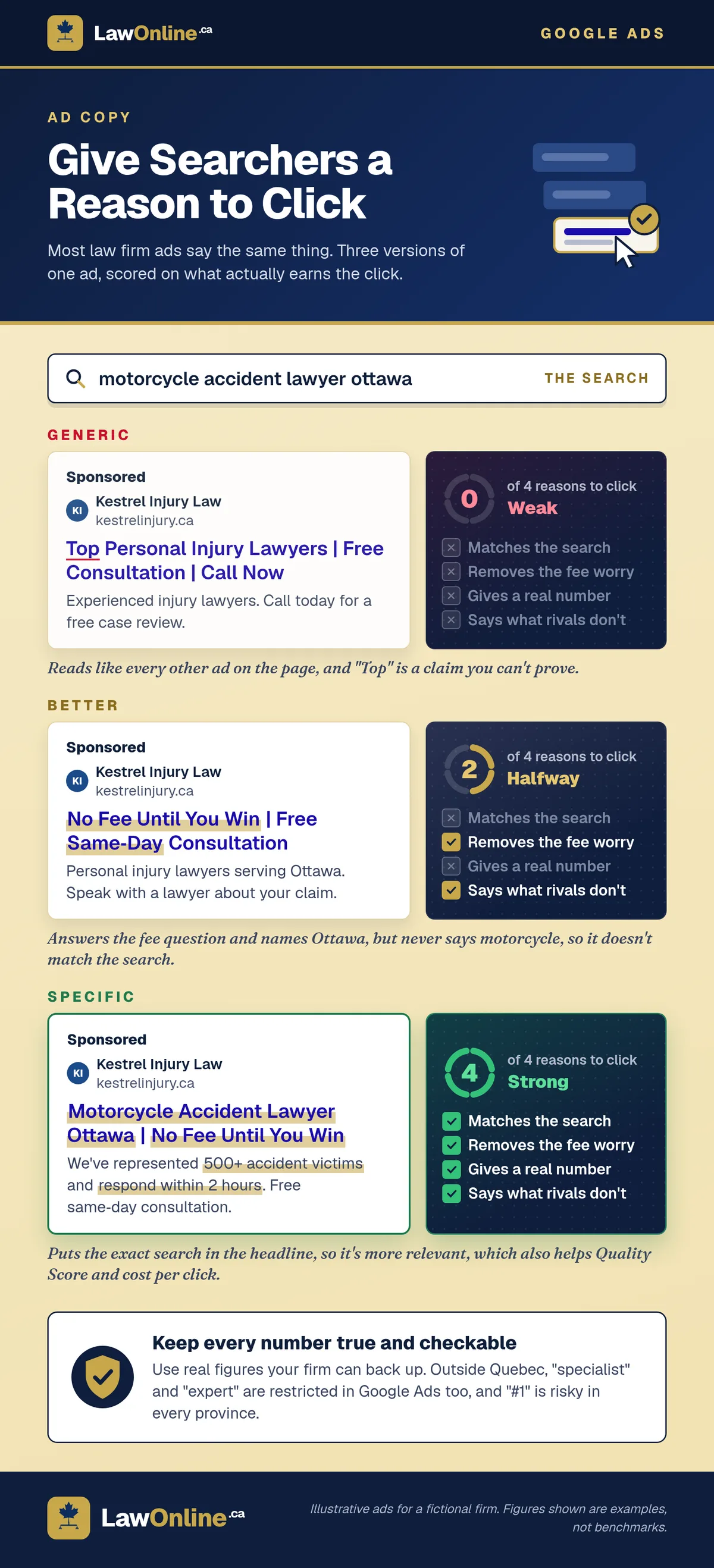
"Top Personal Injury Lawyers | Free Consultation | Call Now"
You'll rarely win on that type of generic copy. Instead, be specific:
Lead with what makes you different:
- "Calgary Injury Lawyers, 500+ Clients Represented"
- "No Fee Until You Win, Free Same-Day Consultation"
- "ICBC Claims Lawyers, Serving Vancouver Since 2003"
Use numbers where you can. Specific claims are more credible than vague superlatives. "Free consultation" is table stakes, every firm offers it. "Responded within 2 hours" or "Represented 500+ accident victims" gives a real reason to click.
Match copy to the search. If someone searched "motorcycle accident lawyer Ottawa," your headline should say "Motorcycle Accident Lawyer Ottawa," not just "Personal Injury Lawyer." Ad relevance affects both click-through rates and Quality Score (which affects your cost-per-click). The closer your ad matches the search intent, the better it performs.
One thing to watch in Canadian legal ad copy: every province and territory except Quebec restricts "specialist" and "expert" in lawyer marketing, and only Ontario offers a certification that lets lawyers use the title. Claims like "best" and "#1" are a problem everywhere, Quebec included. Those rules apply to Google Ads the same way they apply to your website. The Canadian Bar Association's advertising toolkit puts it plainly: a lawyer's marketing must be "demonstrably true, accurate and verifiable" and can't be "misleading, confusing or deceptive." That covers ad headlines, landing page claims, and any results or outcomes you reference.
This isn't theoretical risk. Ad Standards Canada's 2025 annual report found that advertising complaints rose 27% year over year to 776, and online media accounted for 52% of all complaints received. Of the 53 ads formally adjudicated by the Standards Council, 48 were found to contravene the Canadian Code of Advertising Standards. PPC campaigns aren't exempt from this scrutiny, and a complaint about misleading ad copy or an unsupported claim on your landing page is the kind of problem no firm needs.
Our guide to law society rules for Google Ads covers what's compliant and what isn't.
Tracking: Non-Negotiable
You can't manage a legal PPC campaign without conversion tracking. This means knowing:
Which clicks led to a phone call. Google Ads has built-in call tracking at no extra cost. It counts calls from your ads and from your website, and attributes each one to the campaign and keyword that drove it.
Which clicks led to a form submission. Set up Google Ads conversion tracking on your intake form's thank-you page.
Which calls and form submissions became signed clients. This is the most important metric, and it requires your intake team to record the lead source in your case management system.
Without call tracking, you're flying blind. You might be generating plenty of calls, but if they're all from people looking for the wrong type of case, no clicks-to-calls conversion rate tells you that.
What does a properly tracked campaign actually reveal? A 2025 U.S. family-law PPC case study reported 334 leads over four months at $45.81 per lead, with a 21.8% click-to-contact conversion rate (calls plus form submissions combined). A separate criminal-defence campaign in Houston generated 1,611 calls over 12 months at $60.90 per call. These are American vendor case studies rather than Canadian benchmarks, but the point isn't the specific numbers. It's that with proper tracking, both firms knew exactly what each lead cost and could calculate whether the math worked. Without it, all you have is a credit card bill.
Set up a monthly reporting cadence. Review cost per click, cost per lead, and (as it becomes available) cost per signed client. Make bid and keyword adjustments based on what the data shows.
Realistic Expectations for Canadian Law Firms
Budget: Most personal injury firms in major Canadian markets need a minimum of $5,000–$10,000/month to run a competitive PPC campaign. Below that threshold, you're competing against firms with much larger budgets and you'll struggle to generate meaningful volume. In smaller markets (mid-size Ontario cities, provincial capitals outside Toronto/Vancouver), $2,000–$4,000/month is often enough to see real results.
Timeline: Unlike SEO, PPC generates traffic immediately. But optimizing a campaign, refining keyword lists, testing landing pages, adjusting bids, takes 60–90 days to do properly. Budget for that learning period before drawing conclusions.
Who should manage it: Digital marketing for law firms is specialized. A generalist law firm marketing agency that mostly works with retail or hospitality clients will make expensive mistakes in legal advertising. Look for agencies with specific law firm PPC experience and ask to see examples of campaigns they've managed in your practice area.
The Integration Advantage: PPC + SEO + GBP
Law firms that see the strongest returns from PPC don't run it in isolation. They run it as part of an integrated digital marketing strategy:
- SEO builds long-term organic visibility for high-intent searches
- Google Business Profile captures local search traffic in the Local Pack
- PPC fills the gaps immediately and generates volume while SEO builds
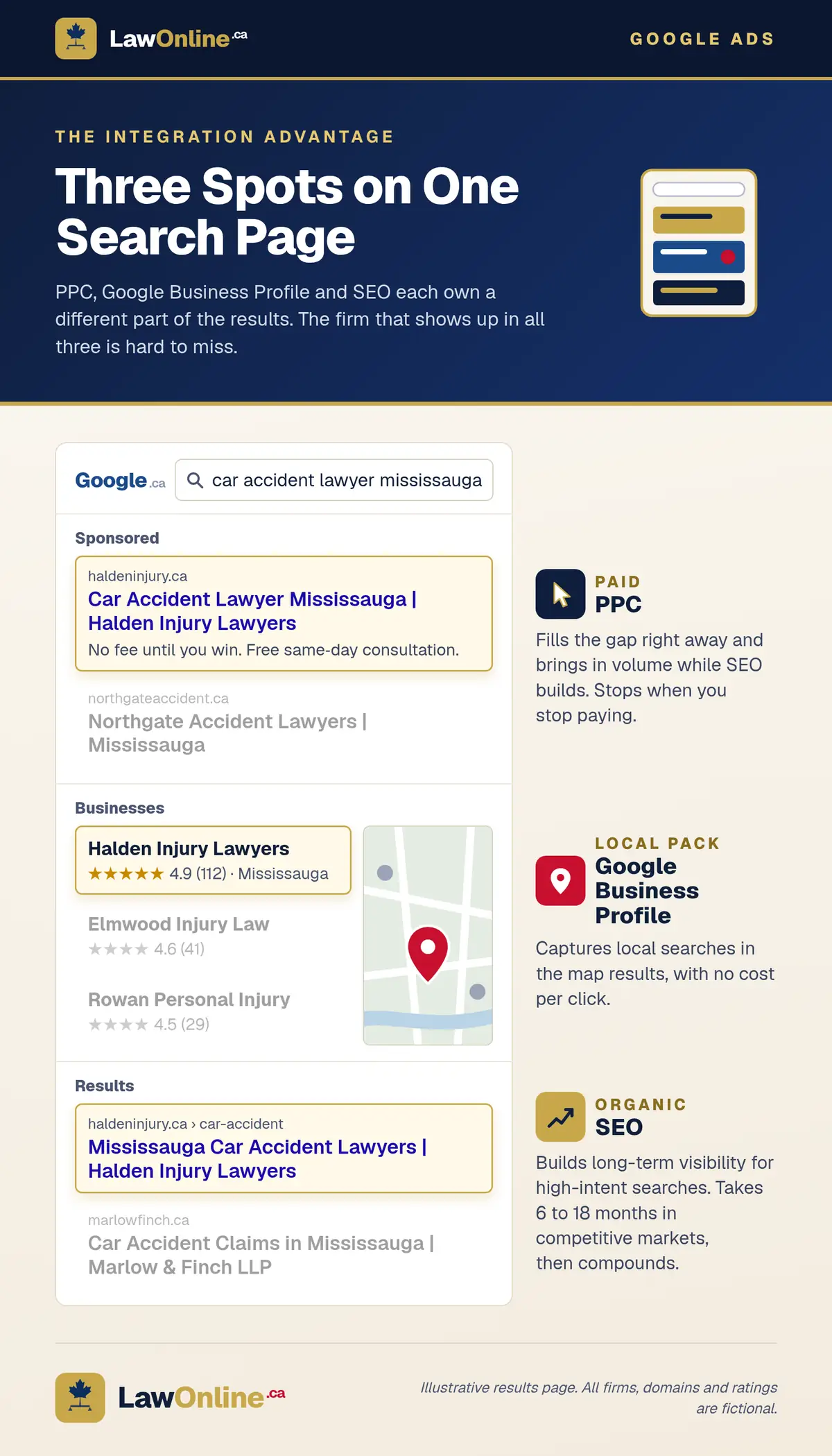
A firm that ranks organically for "car accident lawyer Mississauga," appears in the Local Pack, and runs PPC will consistently outpace competitors using only one channel. The combined presence across all three placements on a single search results page is a significant competitive advantage.
You may have heard that ChatGPT now sells ads, and it does for most businesses, but OpenAI doesn't allow legal-services advertising in Canada. For now, Google Ads and Microsoft Ads are the only paid search channels available to Canadian law firms.
LawOnline.ca builds and manages Google Ads campaigns specifically for Canadian law firms. If you're considering PPC or not sure whether your current campaigns are performing well, reach out for a free audit.
Frequently Asked Questions
How much does Google Ads cost for a Canadian law firm?
Personal injury lawyer advertising is among the most expensive paid search categories in Canada. Personal injury firms in major Canadian cities regularly pay $50–$150 per click in competitive markets like Toronto, Vancouver, and Calgary. Monthly budgets for an effective PI campaign typically start at $3,000–$5,000. The cost per click varies significantly by practice area. Family law and criminal defence are generally less expensive than personal injury.
How is Google Ads different from SEO for a law firm?
PPC generates immediate visibility by paying for placement at the top of search results. SEO builds organic rankings over months and years. PPC stops the moment you stop paying; SEO compounds over time. Most high-performing Canadian law firms run both. PPC handles immediate lead volume while SEO builds as a long-term asset. PPC is particularly useful for new offices or new practice areas where organic rankings haven't been established yet.
What is a landing page and why does it matter for legal PPC?
A landing page is a standalone web page designed to convert a specific type of visitor, someone who clicked a PPC ad. For a personal injury law firm, the ideal landing page focuses on one practice area, one city, with a single strong call to action, a contact form or phone number, and minimal distractions. Sending ad traffic to a generic homepage is one of the most common reasons law firm PPC campaigns underperform.
How do I measure whether my law firm's Google Ads campaign is working?
Track cost per signed client, not just cost per click. Set up call tracking so you know which calls originated from Google Ads. Track form submissions. Then work backward from your client acquisition cost: if you pay $5,000 in ads in a month and sign two personal injury cases, your cost per acquisition is $2,500. Compare that against the average value of a signed case to determine whether the campaign is profitable.
Should a law firm run PPC themselves or hire an agency?
Legal PPC is specialized enough that generalist agencies routinely make expensive mistakes. Legal keywords require careful match type selection, granular negative keyword management (without it, you'll pay for clicks from people searching "personal injury definition" or "personal injury law school"), precise geographic targeting, and compliance awareness. Look for agencies with verifiable law firm PPC experience and ensure they provide monthly reporting showing spend, clicks, calls, and signed clients.