
The practice area page is the most important page on your law firm's website. Not the homepage. Not the blog. The practice area page is where someone who already knows they have a legal problem decides whether to call you.
When a prospective client searches "car accident lawyer Toronto" or "divorce lawyer Calgary," they don't land on your homepage and browse. They land on a practice area page, and they make a decision in under 30 seconds: does this firm understand my situation, and should I contact them?
Most law firm practice area pages fail this test. They're thin, generic, and interchangeable. They list services like a menu without explaining why this firm, in this city, is the right choice for this specific problem. The result is a law firm practice area page that neither ranks in search results nor converts the traffic it does get.
Legal copywriting is the discipline of fixing that. Sometimes called copywriting for lawyers, it's not the same as blog writing, content marketing, or general-purpose SEO content. It's conversion-focused writing for pages that directly generate client inquiries. This guide covers how to do it well, with worked examples for personal injury and family law practices.
What Is Legal Copywriting (and What It Isn't)?

Legal copywriting (also called law firm copywriting, law firm content writing, or law firm content development, depending on who's selling it) is writing that persuades a prospective client to take action, usually to call or submit an intake form. It's specific to the legal industry because of three constraints that don't apply to most businesses:
Regulatory compliance. Every province has advertising rules that restrict what you can say and how. The Law Society of Ontario's advertising rules prohibit certain types of testimonials, require specific disclaimers, and limit comparative claims. BC and Alberta have their own versions. A copywriter who doesn't know these rules will write content that puts your firm at risk.
High-stakes decision-making. Your reader is usually stressed, often scared, and making one of the most consequential decisions of their life. The copy needs to be authoritative and reassuring without being manipulative. Hard-sell tactics that work for consumer products backfire badly in legal services.
Technical accuracy. The claims you make about legal processes, timelines, and outcomes need to be correct. A personal injury page that states the wrong limitation period or mischaracterizes the accident benefits process erodes trust and creates liability exposure.
Legal copywriting is not blog writing. Blog content builds topical authority and captures informational searches. Practice area pages capture commercial-intent searches and convert them to inquiries. Both matter, but they serve different purposes and require different approaches. Our content marketing starter guide covers the broader strategy; this article focuses on the conversion side.
Why the Practice Area Page Is Your Highest-Leverage Asset
Here's the economics. A personal injury firm in Ontario might spend $3,000 to $5,000 per month on content marketing. Most of that investment goes toward blog posts, guides, and FAQs that build search authority over time. A single well-written practice area page that ranks for "car accident lawyer Waterloo" or "slip and fall lawyer Moncton" can generate more signed cases than 20 blog posts combined.
The data confirms this. Research published by Attorney at Work using Clio survey data found that 57% of people searching for legal representation do it on their own, not through referrals. Among the channels they use, law firm websites and search engines each account for 17%, while blogs and articles contribute another 7%. Your practice area page sits at the center of that self-directed discovery process.
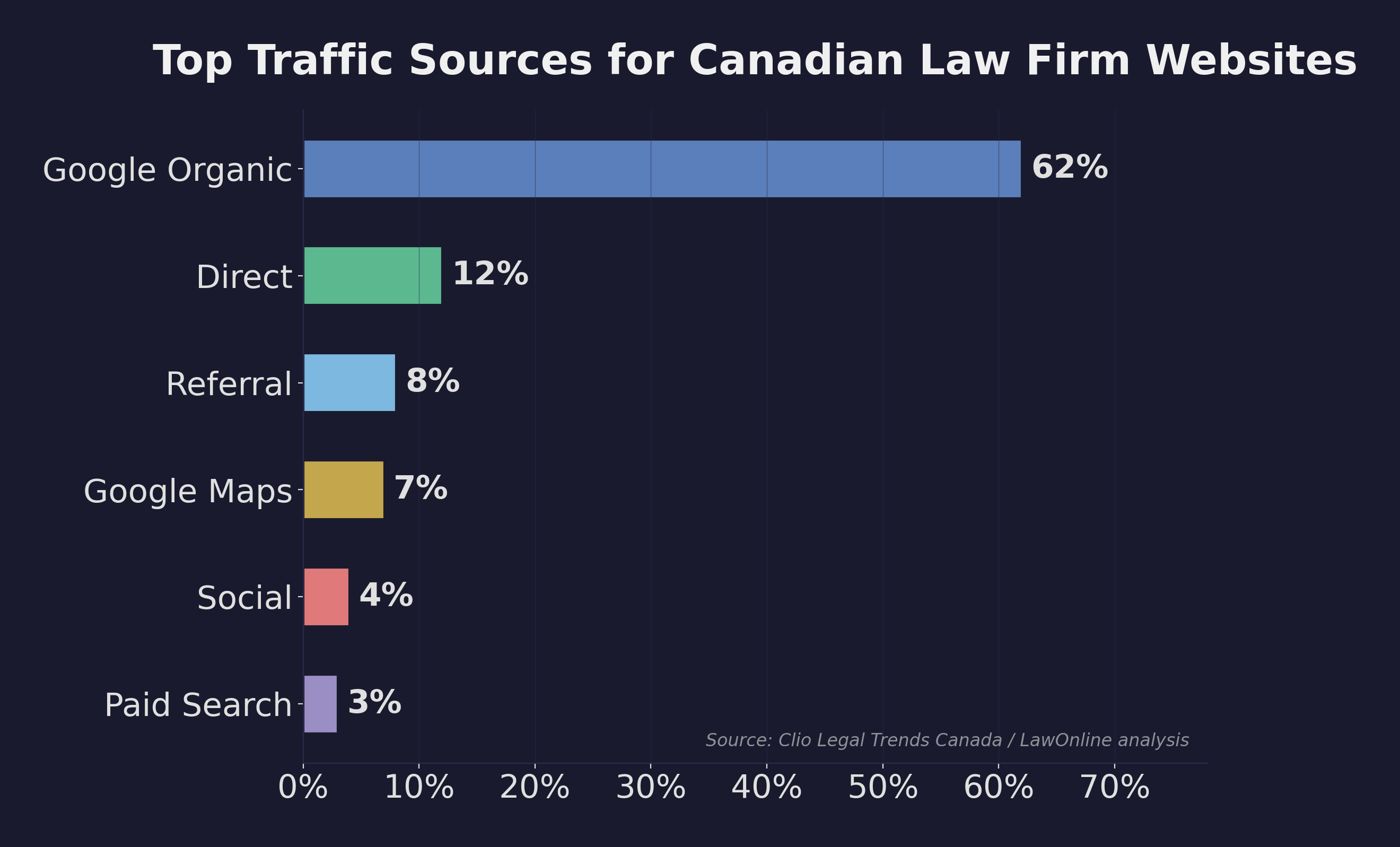
The reason is intent. Someone searching "what to do after a car accident in Manitoba" is researching. Someone searching "car accident lawyer Winnipeg" is hiring. The practice area page is where you meet the person who's ready to act.
That's why law firm copywriting commands premium rates. A strong practice area page costs $400 to $1,000 to produce, but a single signed PI case can be worth $15,000 to $500,000+ in contingency fees. The return on a well-written page is extraordinary.
The Structure That Converts: A Framework
After analyzing what works across Canadian law firm websites, here's the structure that consistently converts visitors into inquiries. Every effective practice area page follows this pattern, whether the practice area is personal injury, family law, criminal defence, or immigration.
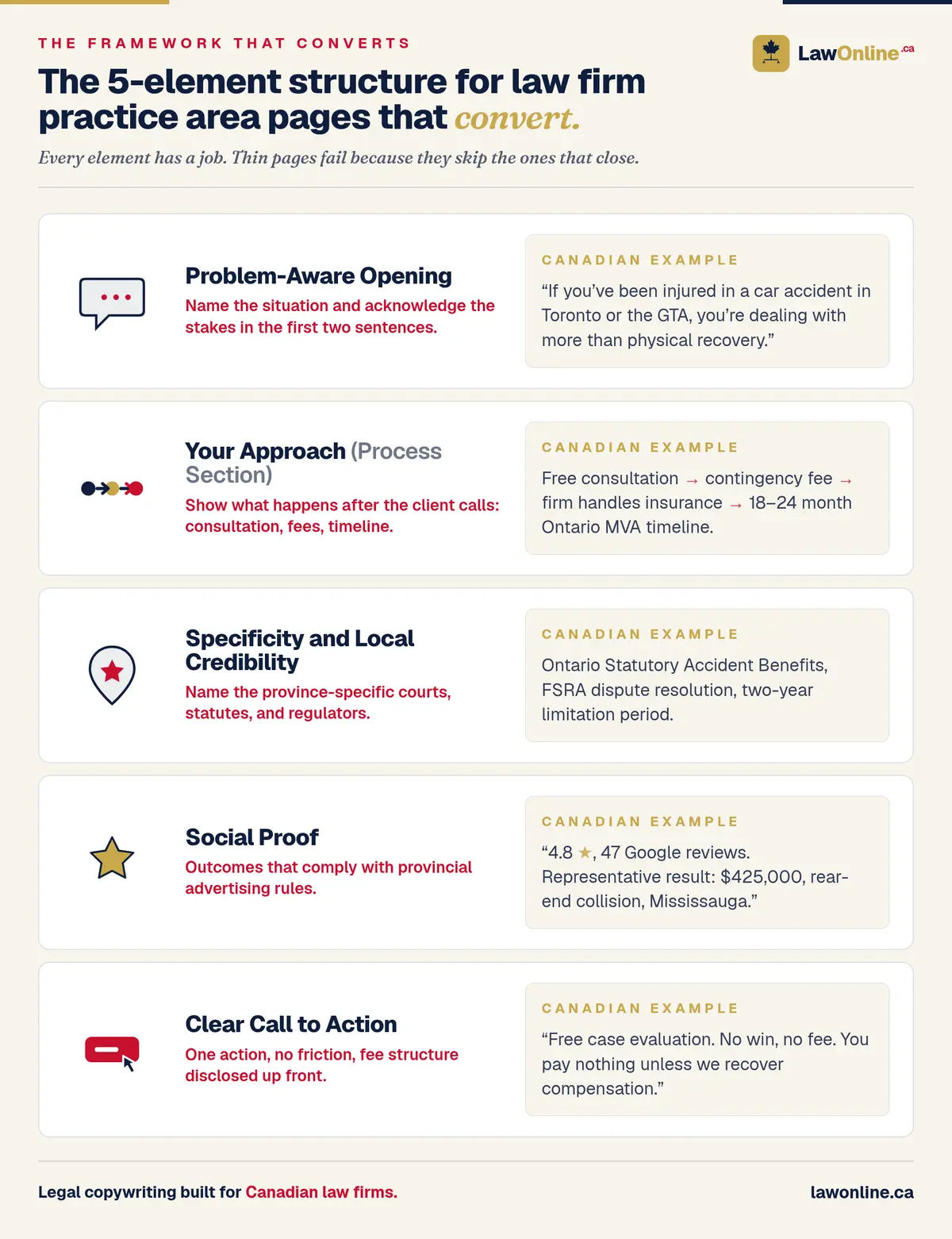
1. Problem-Aware Opening (Above the Fold)
The first thing a visitor sees must demonstrate that you understand their specific situation. Not your credentials. Not your firm history. Their problem.
Don't open with "Welcome to [Firm Name]. We have 30 years of experience in personal injury law." Open with the problem they're experiencing and the outcome they want.
The opening should do three things in under 100 words:
- Name the specific situation (car accident, wrongful dismissal, custody dispute)
- Acknowledge the emotional state (uncertainty, fear, frustration)
- State what the visitor needs (legal representation, answers, someone who's handled this before)
2. Your Approach (Process Section)
Once the visitor knows you understand their problem, they want to know what happens next. Walk them through your process in plain language. How does the first consultation work? What information do they need? What's the timeline?
For PI firms, this is where you explain contingency fees. "You don't pay unless we win" is powerful, but it needs more context than a slogan. Explain how the fee structure works, what costs the firm covers upfront, and what the client's obligations are. Transparency builds trust.
3. Specificity and Local Credibility
This is where most practice area pages fall apart. They describe the practice area in generic terms that could apply to any firm in any province. Canada has over 130,000 practising lawyers (Federation of Law Societies of Canada, 2022) and more than 14,600 legal services businesses, 97% of which have fewer than 100 employees (Statistics Canada, 2022). The typical firm is a small practice competing against dozens of similar operations in the same city and practice area. Generic copy doesn't cut it.
A strong practice area page for a Toronto PI firm references Ontario's no-fault insurance system, the statutory accident benefits schedule, the deductible under Section 267.5 of the Insurance Act, and the specific courts where cases are heard. A Calgary family law page references the Family Law Act (Alberta), parenting orders under the Divorce Act, and the expectations of Calgary family court judges.
This specificity does two things: it proves to the visitor that you actually handle these cases in this jurisdiction, and it signals to search engines that your content is relevant for location-specific queries. It's a core local SEO practice with direct conversion benefits.
4. Social Proof
Case results, client reviews, and professional recognition sections belong on the practice area page, not just the homepage. The social proof should be relevant to the specific practice area.
A PI practice area page should show PI results. A family law page should show family law outcomes. Generic "we're great lawyers" testimonials placed on every page dilute credibility.
Follow your provincial law society's advertising rules for case results and testimonials. The Law Society of Ontario's advertising guidelines restrict how results can be presented. Other provinces have similar requirements.
5. Clear Call to Action
Every practice area page needs a single, prominent call to action. Not three different CTAs competing for attention. One clear ask: call this number, or fill out this form. The same Clio consumer research found that 68% of prospective clients reached for the phone as their first contact method, far outpacing email or web forms. Lead with a phone number.
The CTA should reinforce what makes the consultation easy: "Free consultation," "No obligation," "We respond within 24 hours." Remove friction.
Worked Example: Personal Injury Lawyer Website Copy
Here's how the framework applies to a motor-vehicle-accident practice area page for a Toronto PI firm.
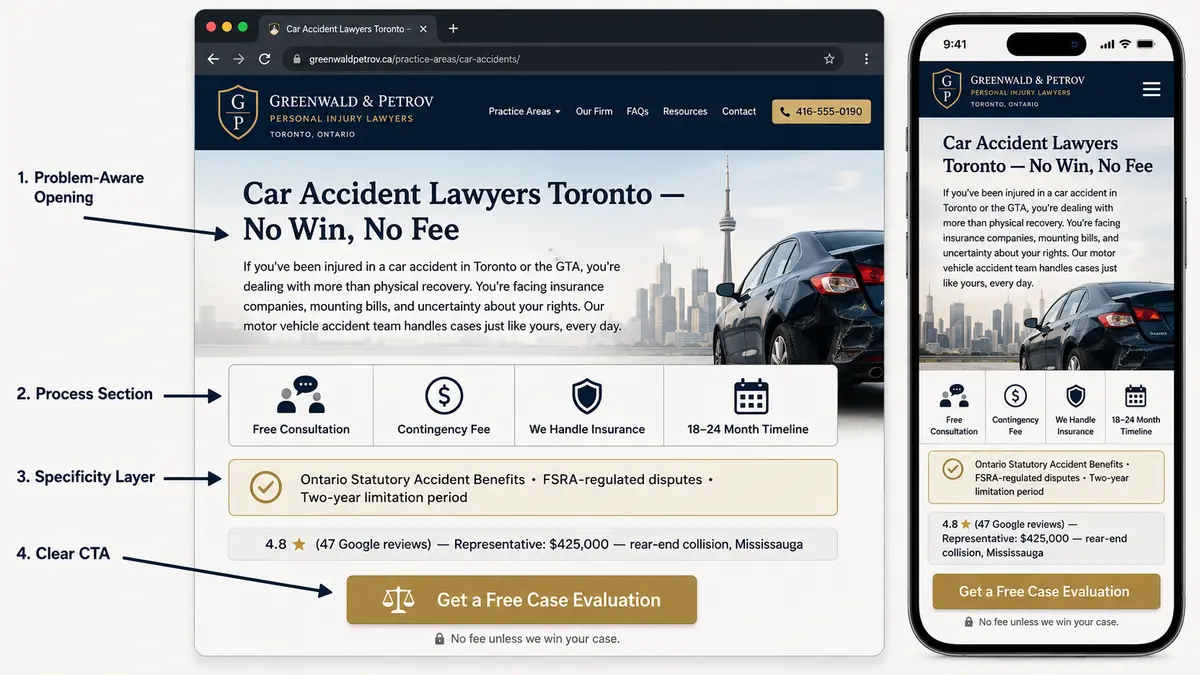
Opening: "If you've been injured in a car accident in Toronto or the GTA, you're dealing with more than physical recovery. You're facing insurance companies, mounting bills, and uncertainty about your rights. Our motor vehicle accident team handles cases just like yours, every day."
Notice what this does: it names the situation (car accident), acknowledges the pain points (insurance, bills, uncertainty), and establishes relevance (Toronto/GTA, dedicated team).
Process section:
- Free initial consultation (in person, phone, or video)
- Contingency fee: you pay nothing unless the firm recovers compensation
- Firm handles all communication with insurance companies
- Timeline: most MVA claims in Ontario resolve within 18 to 24 months; complex cases may take longer
Specificity section:
- Ontario's threshold for pain and suffering claims under the Insurance Act
- Statutory accident benefits (income replacement, medical/rehabilitation, attendant care)
- The two-year limitation period for filing a lawsuit
- The role of FSRA in accident benefits disputes
Social proof:
- Representative case results (anonymized per LSO rules): "$425,000 settlement for a rear-end collision in Mississauga," "$1.2 million jury award for a pedestrian struck in downtown Toronto"
- Google review rating, number of reviews
CTA:
- "Call [number] for a free case evaluation. We handle motor vehicle accident cases on contingency. You don't pay unless we recover compensation for you."
Worked Example: Family Law Practice Area Page
For a divorce and separation page at a Calgary family law firm:
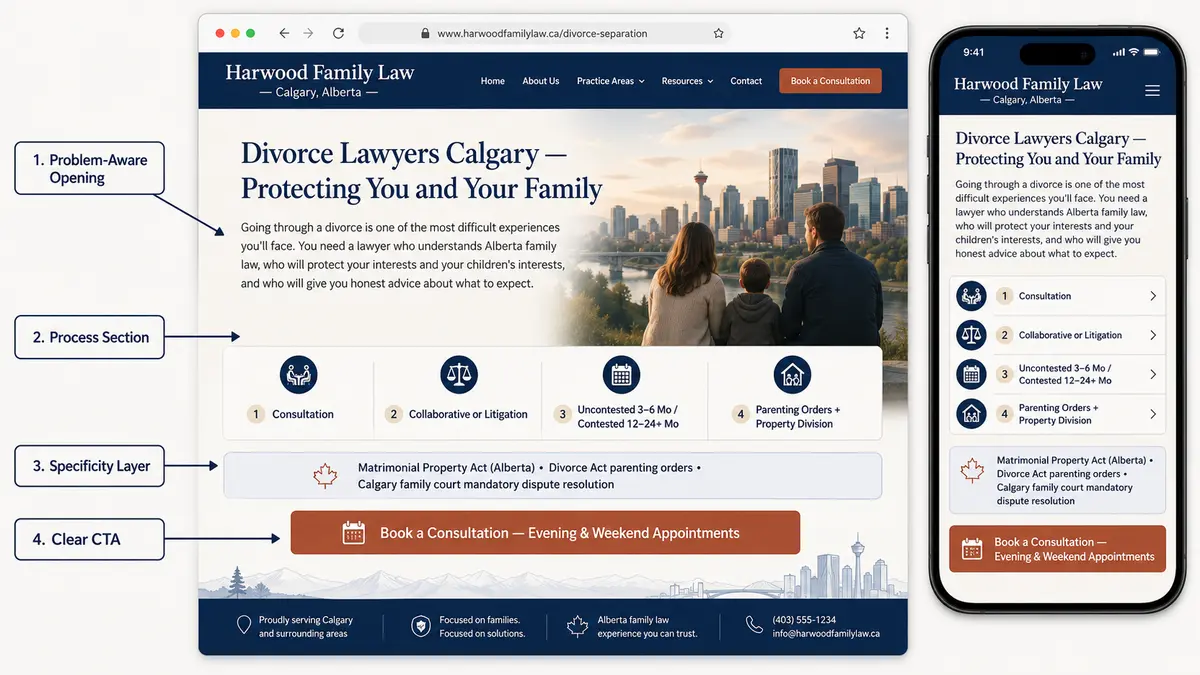
Opening: "Going through a divorce is one of the most difficult experiences you'll face. You need a lawyer who understands Alberta family law, who will protect your interests and your children's interests, and who will give you honest advice about what to expect."
Process section:
- Initial consultation to understand your situation and goals
- Full-service representation or unbundled legal services depending on complexity and budget
- Collaborative family law or litigation depending on the circumstances
- Timeline: uncontested divorces in Alberta can resolve in 3 to 6 months; contested matters take 12 to 24 months or longer
Specificity section:
- Division of matrimonial property under the Matrimonial Property Act (Alberta)
- Parenting orders and parenting time under the Divorce Act
- Child support guidelines (federal) and spousal support advisory guidelines
- The expectations of Calgary family court for mandatory dispute resolution
Social proof:
- Client testimonials (compliant with Law Society of Alberta rules)
- Professional designations, family law certifications
CTA:
- "Book a consultation to discuss your options. We offer flexible scheduling, including evening and weekend appointments."
The SEO Layer: Making Practice Area Pages Rank
A practice area page that converts visitors is only valuable if visitors find it. The SEO layer is what makes the page discoverable. Law firms take this seriously: MyCase's 2026 marketing survey found that firms allocate 45% of their marketing budgets to SEO, more than any other single channel.
Keyword Targeting
Each practice area page should target one primary keyword and two to three closely related terms.
For a PI MVA page: primary "car accident lawyer Toronto," supporting "motor vehicle accident lawyer GTA," "Toronto car accident attorney," "MVA lawyer Ontario."
Avoid keyword stuffing. The primary keyword should appear in the title tag, H1, first paragraph, one H2, and naturally throughout the body. Two to three occurrences per 500 words is sufficient. For a full walkthrough of how title tags, headings, and schema work together on a practice area page, see our on-page SEO guide for law firms.
Schema Markup
Structured data (schema.org markup) helps search engines understand your page. LegalService schema, FAQ schema for any FAQ section, and LocalBusiness schema for your firm's address and service area are all relevant.
Schema doesn't directly improve rankings, but it increases the likelihood of rich results in search and can improve your visibility in AI-generated answers.
Internal Linking
Every practice area page should link to related blog posts, and those blog posts should link back. A PI MVA page should link to your guides on accident benefits, limitation periods, and settlement processes. Those guides should link back to the practice area page.
This internal linking structure builds topical authority and distributes ranking signals across your site. It's one of the most underutilized tactics in law firm SEO.
FAQ Section
Adding four to six questions at the bottom of a practice area page targets long-tail searches and provides concise answers that AI systems can reference. Questions should mirror what clients actually ask: "How long do I have to file a car accident claim in Ontario?" not "Personal injury limitation periods overview." For detailed guidance on structuring FAQ content for AI Overviews and featured snippets, see our guide to FAQ pages for law firms.
What Goes Wrong: Common Practice Area Page Mistakes
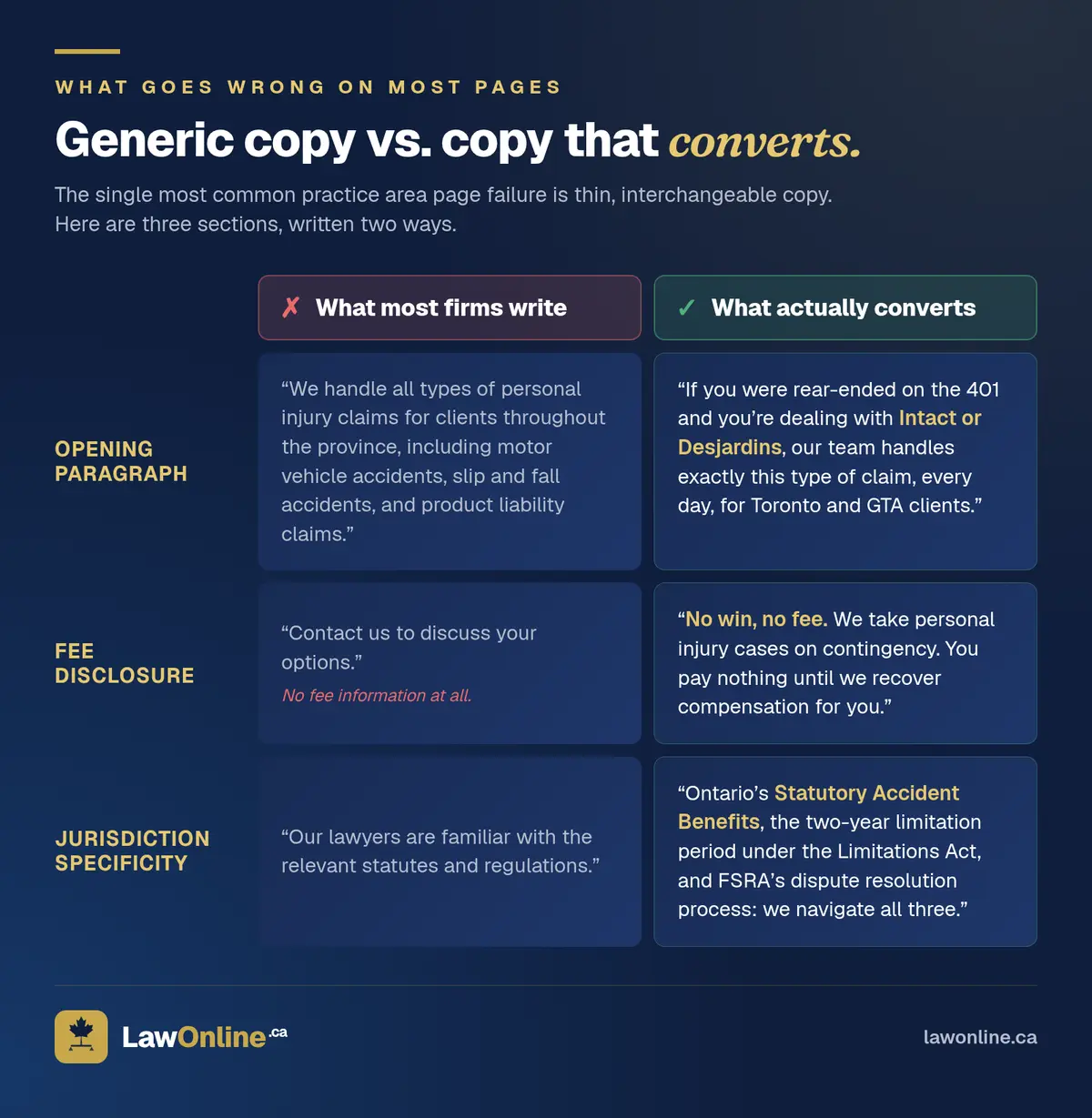
Templated copy that could be any firm's page. If you swap out the firm name and the law firm practice area page still reads the same, it's not working. Every firm handles cases differently. The specificity of your experience is your differentiator.
US-sourced content repurposed for Canada. References to "states," the ABA, or US court procedures signal to Canadian clients that you don't understand their jurisdiction. It signals the same thing to search engines.
No geographic specificity. "We handle personal injury cases" is generic. "We handle motor vehicle accident cases in Toronto, Mississauga, Brampton, and across the GTA" is specific and targets the searches your clients actually make.
Fee disclosure misses. If you offer contingency fees, say so clearly and early. If you charge retainers, provide a range. The biggest conversion killer on law firm websites is forcing prospects to call just to find out if they can afford you.
Wall-of-text formatting. Long paragraphs with no subheadings, no bullet points, and no visual breaks drive visitors away. Practice area pages need to be scannable. Most visitors won't read every word. They'll scan headings and bullets to decide if you're worth contacting. Effective law firm website design handles the visual structure so the copy can do its job.
The Compliance Layer: Getting It Right
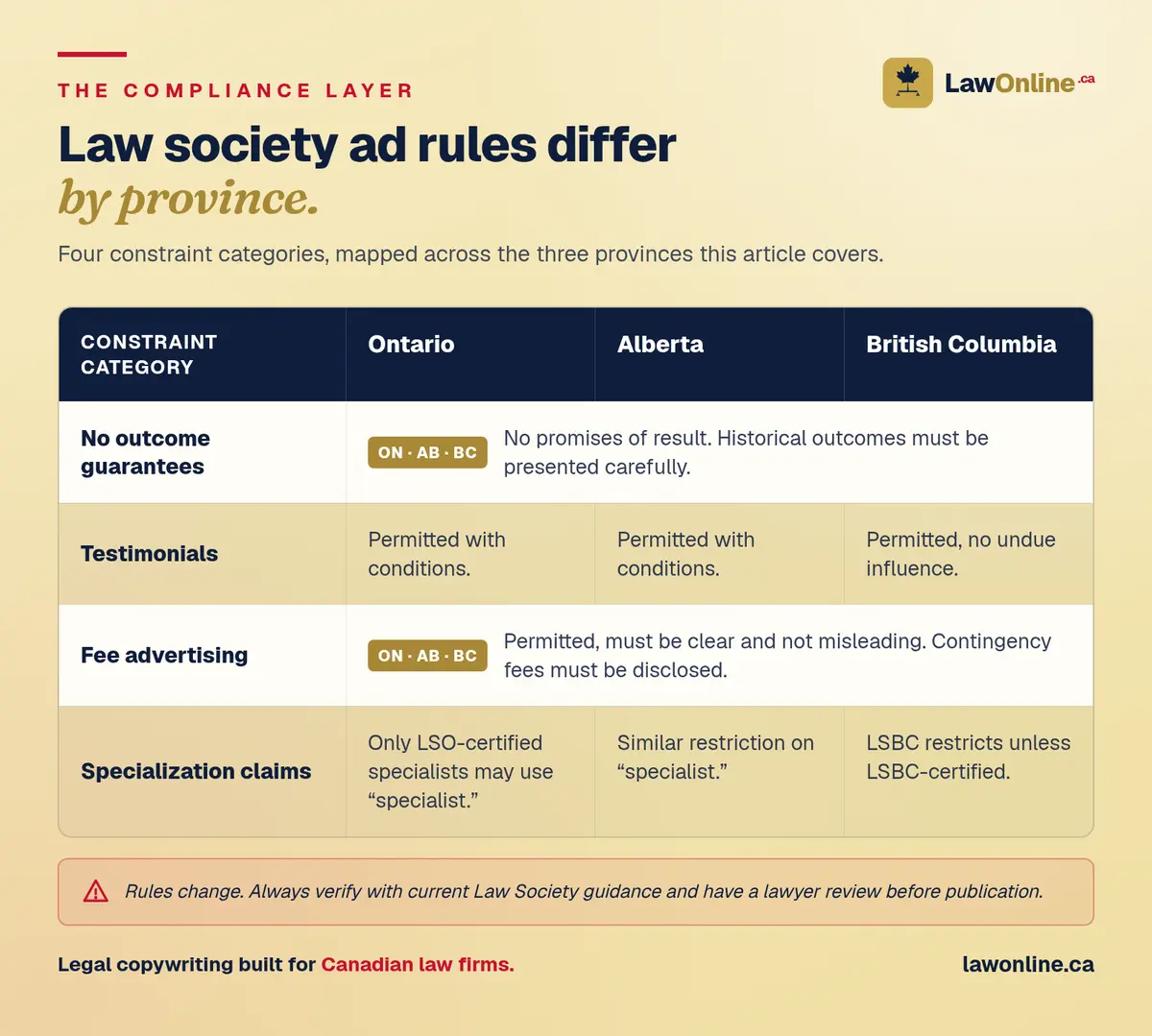
Legal copywriting in Canada must comply with provincial law society advertising rules. The requirements vary by province, but common themes include:
- No guarantees of outcome. You can share results; you can't promise them.
- Testimonial restrictions. Some provinces restrict or prohibit client testimonials in advertising. Others allow them with conditions.
- Fee advertising rules. Most provinces allow fee advertising but require it to be clear and not misleading.
- Specialization claims. Most provinces restrict how lawyers can claim to be "specialists" unless they hold a certified specialization.
If you're outsourcing legal copywriting, the writer or agency needs to understand these rules. Content that violates advertising rules isn't just bad marketing; it's a regulatory risk. A lawyer at your firm should review every practice area page before publication.
For province-specific details: our guides cover Ontario's rules, Alberta's rules, and BC's rules.
Frequently Asked Questions
How long should a law firm practice area page be?
Most effective practice area pages run 1,000 to 2,000 words. That's enough to cover the problem, your approach, jurisdiction-specific details, social proof, and a clear CTA without overwhelming the reader. Complex practice areas (personal injury with multiple subcategories, for example) may warrant 2,000 to 3,000 words. The right length fully answers the questions a prospective client would have before picking up the phone.
How much does it cost to have a practice area page professionally written?
Professional law firm copywriting (sometimes priced as law firm content writing or law firm content development) for a practice area page typically costs $400 to $1,000 per page in Canada. That includes research, writing, one to two rounds of revision, and basic SEO optimization. Law firm specialist writers sit at the higher end of that range. When you consider that a single signed case from that page could generate $5,000 to $500,000+ in fees depending on the practice area, the investment is modest.
Should every practice area have its own page?
Yes. Each distinct practice area or subcategory should have its own dedicated page. A personal injury firm needs separate pages for car accidents, slip and falls, medical malpractice, wrongful death, and product liability. Each page targets different search terms and addresses different client situations. A single "personal injury" page trying to cover everything will rank for nothing and convert poorly.
What's the difference between a practice area page and a blog post?
A practice area page is a permanent, conversion-focused page that targets commercial-intent searches (e.g., "car accident lawyer Toronto"). A blog post is a time-stamped, informational piece targeting research-intent searches (e.g., "what to do after a car accident in Ontario"). Both are important, but they serve different functions. Practice area pages convert; blog posts build the authority that helps practice area pages rank. For a full breakdown of content types, see our guide to the types of content law firms need.
Do I need to hire a law firm copywriter, or can I write practice area pages myself?
You can write them yourself if you're willing to invest the time in learning conversion copywriting principles and SEO fundamentals. Many solo practitioners do exactly that. The tradeoff is time: a lawyer billing $300 to $500 per hour spending 8 to 10 hours writing and optimizing a single page may find it more cost-effective to hire a specialist who charges $400 to $1,000 for the finished product.
Can AI tools write effective practice area pages for law firms?
AI can help with research, outlines, and first drafts, but an AI-generated practice area page published without substantial human editing will underperform. Practice area pages need jurisdiction-specific accuracy, genuine firm voice, and the kind of case-specific detail that only comes from a lawyer's experience. Google's quality systems also increasingly distinguish between substantive expert content and AI-generated filler.