Criminal defence breaks the rules that govern the rest of legal marketing. In most practice areas, clients plan ahead. They ask a friend for a name, read a few websites over a week, and book a consultation when it suits them. Your clients do none of that. They're calling from a police station, searching at midnight, or trying to help a family member who was arrested three hours ago.
That single difference decides how you get hired. The client searches once, under real stress, and calls whoever looks credible and picks up. There's rarely a second search, and almost never a referral, because most people never tell anyone they hired a criminal lawyer. So the firm that wins isn't the one with the strongest brand or the biggest blog. It's the one that's easy to find and easy to reach in the twenty minutes the client is deciding.
This guide covers what actually works in criminal defence marketing for Canadian firms, what wastes money, and why nearly all of it comes back to being present at the moment someone is holding their phone at 11pm on a Saturday.

Understanding the Criminal Defence Client
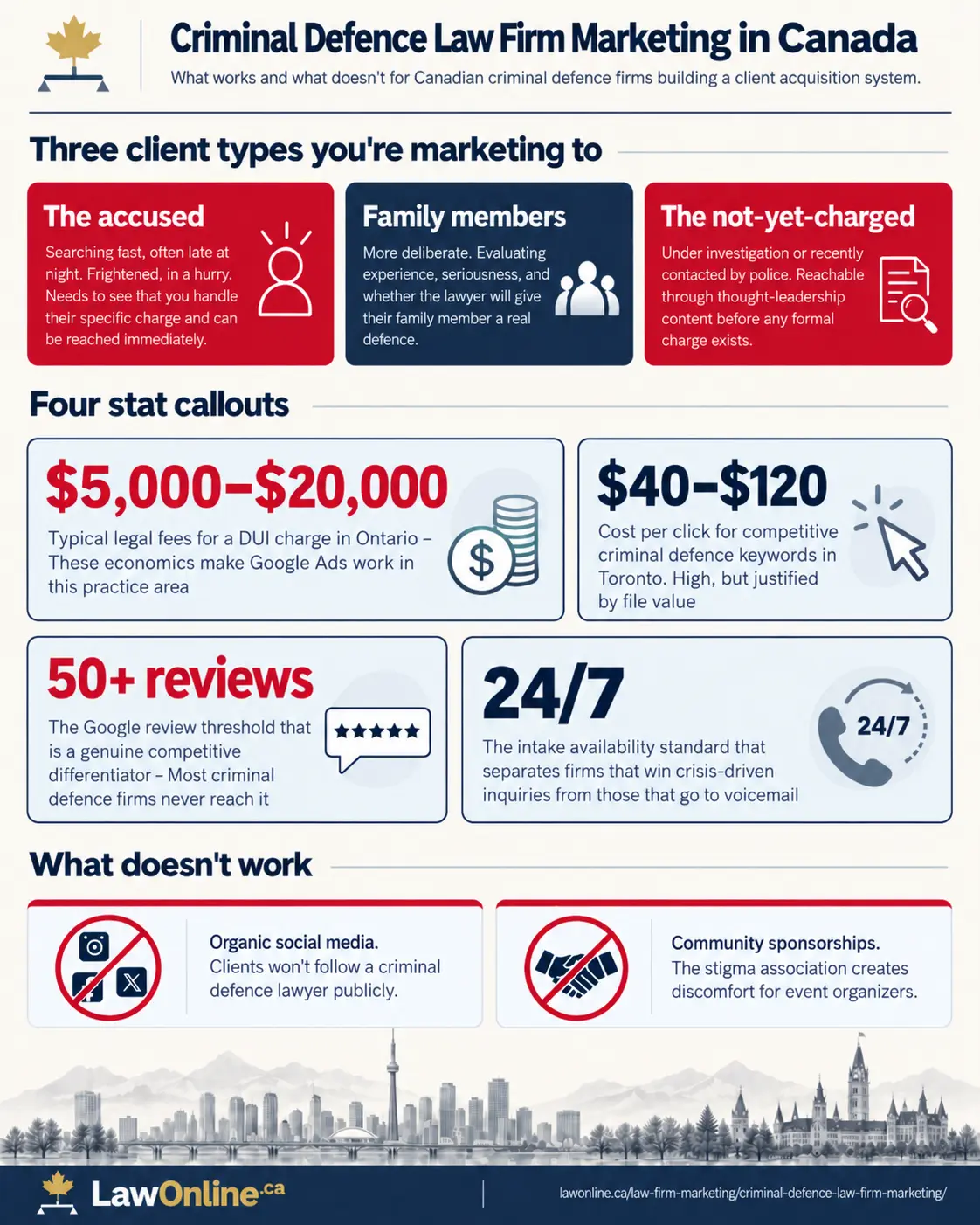
Every tactic in this guide comes back to who's searching, and there are three distinct groups.
The accused. Someone charged with an offence, DUI, assault, drug possession, fraud, or something more serious, who needs representation now. They may be in custody or just released on bail. They're usually searching late at night, frightened and in a hurry. They need to see, fast, that you handle their exact charge, that you're serious, and that you can be reached today.
Family members. Often a spouse, parent, or sibling doing the searching on the accused's behalf. They have more composure and will spend longer weighing options. They want proof that you handle serious charges, have real courtroom experience, and won't push their family member toward a quick plea on a case that deserves a fight.
The not-yet-charged. Someone under investigation, contacted by police, or present at an incident who wants to understand their exposure before anything formal happens. They can act deliberately, and they respond to genuinely useful content, a post on what to do when police want to talk, or on what a production order means, long before a competitor has reached them.
These three groups represent a large and specific market. Canada's legal aid programs alone handled 230,074 adult criminal cases in 2022-23, according to a Department of Justice Canada report, with base criminal legal aid funding running $142.4 million annually nationwide. That's only the publicly funded side; privately retained criminal defence work adds substantially more. The demographic profile is equally specific: males aged 18 to 34 make up 34% of criminal legal aid clients, and males 35 to 49 account for another 27%. Your core prospect is a man under 50, searching on his phone, under real stress.
Criminal defence runs on search, not word of mouth. The stigma around charges means clients don't post about it, don't ask around for names, and don't tell anyone who they hired. The referral engine that feeds personal injury and family law barely exists here. Your visibility in search, and your response the moment someone finds you, is close to the entire game.
Local SEO for Criminal Defence Firms
Because the search is local and the decision is fast, local SEO is the foundation of any serious criminal lawyer marketing program.
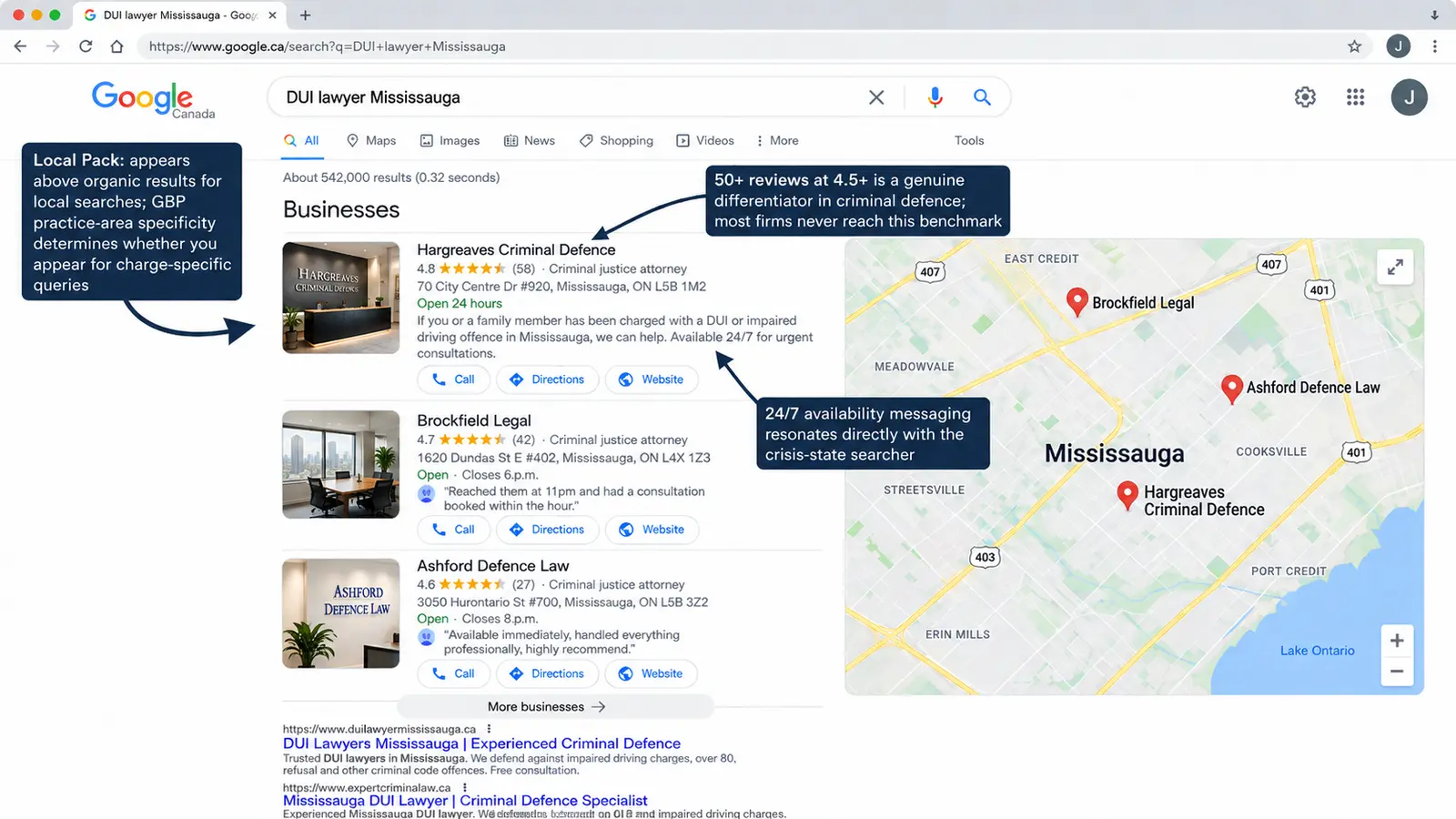
Google Business Profile is non-negotiable. Your listing needs to be fully built out, kept current, and actively generating reviews. Specify your real practice areas, DUI and impaired driving, assault, drug offences, fraud, not just "criminal law." That specificity is what tells Google to show you for charge-specific searches.
Your GBP description is prime real estate. Use it to speak to someone in crisis: "If you or a family member has been charged with a criminal offence in [city], we can help. Available 24/7 for urgent consultations." That language matches the searcher's actual state of mind.
Target charge-specific keywords. "Criminal lawyer Toronto" is high-volume and fiercely competitive. "DUI lawyer Mississauga," "assault defence lawyer Hamilton," and "drug possession lawyer Ottawa" are more specific, more convertible, and often cheaper to win. Build landing pages around the charges you handle in the areas you serve. Personal injury firms do the same thing with injury-type pages ("slip and fall lawyer Toronto," "motorcycle accident lawyer Ottawa"), and the logic carries straight over. Google treats "criminal defence lawyer" and "criminal defense lawyer" as equivalent queries, so your pages rank for both the Canadian and American spellings regardless of which convention your copy uses.
Service-area pages for each location you serve. A GTA firm should have pages built for Brampton, Mississauga, Scarborough, Etobicoke, and North York, not Toronto alone. Each one targets searches in that area and reinforces that you serve those clients.
Directories carry more weight here. Justia, FindLaw, and provincial law society referral directories matter more in criminal defence than in most practice areas, precisely because the stigma pushes people toward neutral third-party sources instead of asking a friend.
Getting Reviews as a Criminal Defence Lawyer
Reviews are harder to earn here than almost anywhere else in law. Clients don't want their friends and family knowing they hired a criminal lawyer, and a public Google review leaves exactly that trace.
The firms that pull it off do two things:
They ask at the right moment. That moment is right after a favourable outcome, charges stayed, an acquittal, a conditional discharge, or a sentence the client is happy with. What they feel then is relief and gratitude, and a real wish to help the lawyer who got them through it. Wait a few weeks and that window closes as the privacy worry returns.
They make the privacy concern manageable. Tell clients plainly that a Google review needs no full name and no case details, and that many people post a short, deliberately vague line ("professional, thorough, available, would recommend"). Some post under a first name, some from a business account. Naming the objection out loud is usually what removes it.
Criminal defence firms in Ontario with 50-plus reviews at 4.5 stars are genuinely uncommon, which is exactly why building that profile is worth the effort. In the Local Pack, it's often the deciding signal.
Google Ads for Criminal Defence
Google Search Ads can deliver strong results for criminal lawyer advertising, but only with tight management.
The economics work on serious charges. A DUI in Ontario typically runs $5,000 to $20,000 in legal fees, and weapons, assault, or fraud charges often run higher. Against clicks at $40 to $120 for competitive criminal terms in Toronto (still below personal injury), the math holds for any firm with a reliable process from click to signed client.
Campaign structure should mirror charge categories. Build separate ad groups, or separate campaigns, for DUI and impaired driving, assault, drug charges, fraud, and sex offences. That lets you write copy that matches the search ("Charged with DUI in Brampton? Free consultation today") and send each click to a charge-specific landing page, which converts far better than dropping everyone on your homepage.
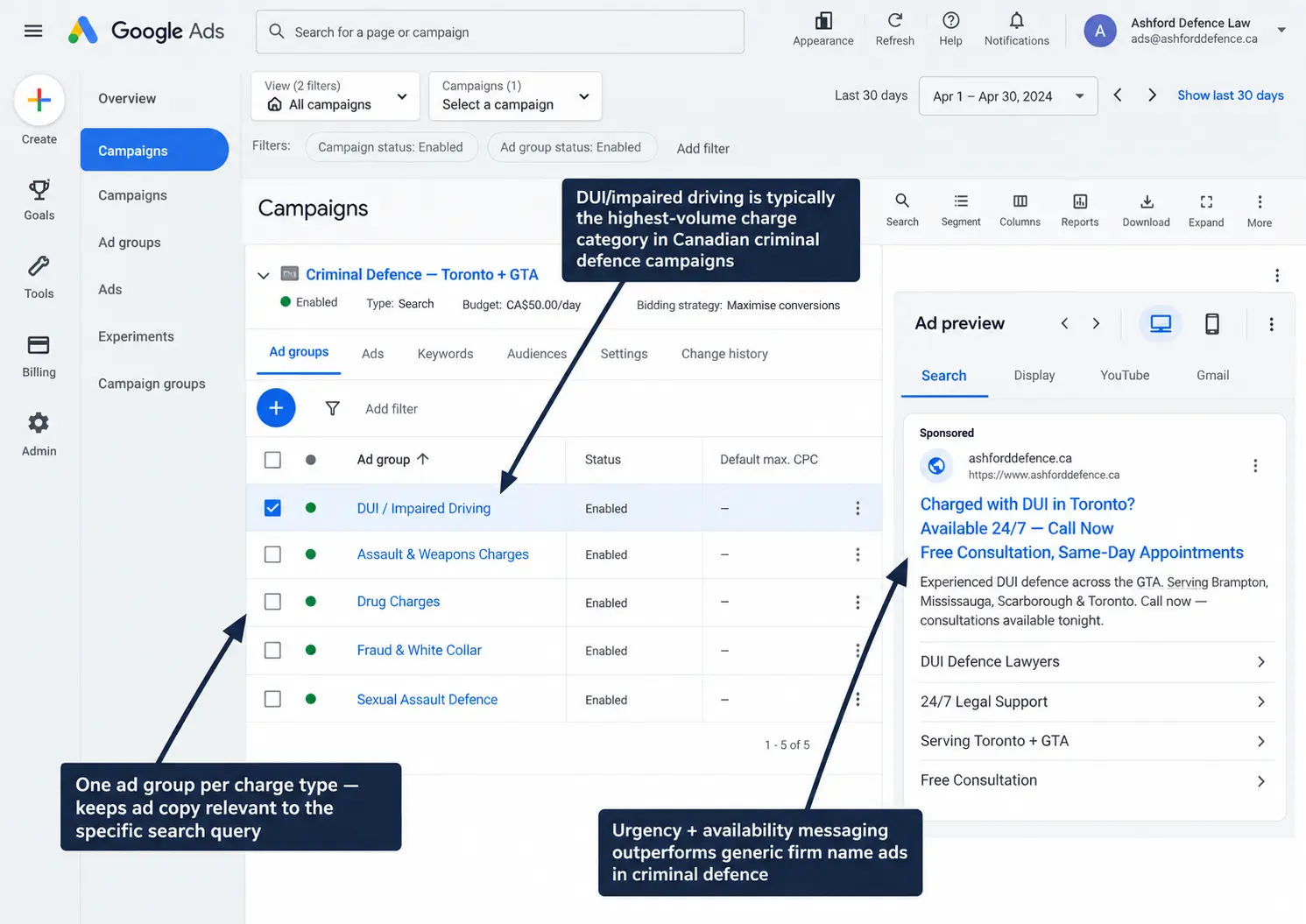
Available 24/7 messaging converts in this practice area. Criminal calls come after hours. Ads that run evenings and weekends, with copy that leads on 24/7 availability, consistently beat ads confined to business hours. If you can't take the calls yourself, a virtual receptionist earns its cost quickly.
Google Local Services Ads aren't an option in Canada. Those are the screened, pay-per-lead ads with the green badge that sit above regular results, and you may have seen US firms running them. The legal category is US-only. Google's Canadian Local Services program covers home-service trades like plumbers and electricians, not law firms, so criminal defence firms here can't buy them no matter the budget. Put that spend into Search Ads and local SEO instead.
Content Marketing for Criminal Defence
A real resource section does two jobs: it builds organic authority, and it's the trust-building material prospects read before they decide to call.
Answer the questions people search in fear. "What happens after you're charged with assault in Ontario?" "Can I be convicted of impaired driving on a roadside breath test?" "What is diversion, and do I qualify?" These rank for the exact queries people type in a moment of panic, and they ask nothing of the reader, a low bar for someone still deciding whether to get a lawyer.
Explain specific charges properly. A detailed piece on how DUI charges are prosecuted in Ontario, the sentencing exposure on a trafficking charge, or how a peace bond works ranks for those queries and educates the client at the same time.
Cover what to do when police make contact. "The police called and want to talk to me, what do I do?" is a search that happens before any charge exists. A genuinely useful post can reach that prospect before anyone else does.
One hard rule: don't promise outcomes. The Federation of Law Societies of Canada's Model Code of Professional Conduct requires that all lawyer marketing be "demonstrably true, accurate and verifiable" and not "misleading, confusing or deceptive." Provincial law society advertising rules reinforce this at the local level, and in criminal defence, the result always turns on the specific facts, so outcome guarantees are both unethical and legally risky.
Reputation and Trust: The Core Challenge
Trust is the whole problem. A client is handing one of the worst moments of their life to a stranger, deciding fast, under stress, with no real way to judge legal quality. Four signals close that gap quickly.

A professional, substantive website. Credible, not flashy. Lawyer bios with real substance, case results where the rules allow, and content that reads like a practitioner wrote it. Set two firms side by side and the client picks the one that looks less like a lead-generation funnel.
Reviews, in volume. Harder to earn here and more valuable for it. Treat them as a standing priority, not an afterthought.
Clear specialization. "We handle all criminal charges" is weaker than "We do criminal defence, and only criminal defence, no family law, no wills, no personal injury." For high-stakes work, focus reads as competence.
A live answer. In criminal defence, reaching a real person immediately isn't a marketing nicety. It's a direct signal of how the firm runs. Answer at 9pm and you win the client. Send them to voicemail and they call the next name on the page.
What Doesn't Work in Criminal Defence Marketing
A few things that sound reasonable and mostly underperform here.
Organic social media. Facebook and Instagram are weak acquisition channels, because clients don't want their social circle seeing they follow a criminal defence lawyer. LinkedIn is beside the point for consumer work, though it holds some value for white-collar and regulatory matters. Paid social can retarget site visitors, but organic social does little.
Community sponsorships and events. These build brand nicely for a personal injury firm. In criminal defence, the association with the practice area can make community organizations uncomfortable, so it rarely fits.
Non-legal referral networks. Personal injury firms build pipelines with chiropractors and physiotherapists. Criminal defence has no natural equivalent. Your most productive referrals come from other lawyers, family law firms with a client facing a related criminal matter, or lawyers who don't touch criminal work.
Building a Criminal Defence Marketing System
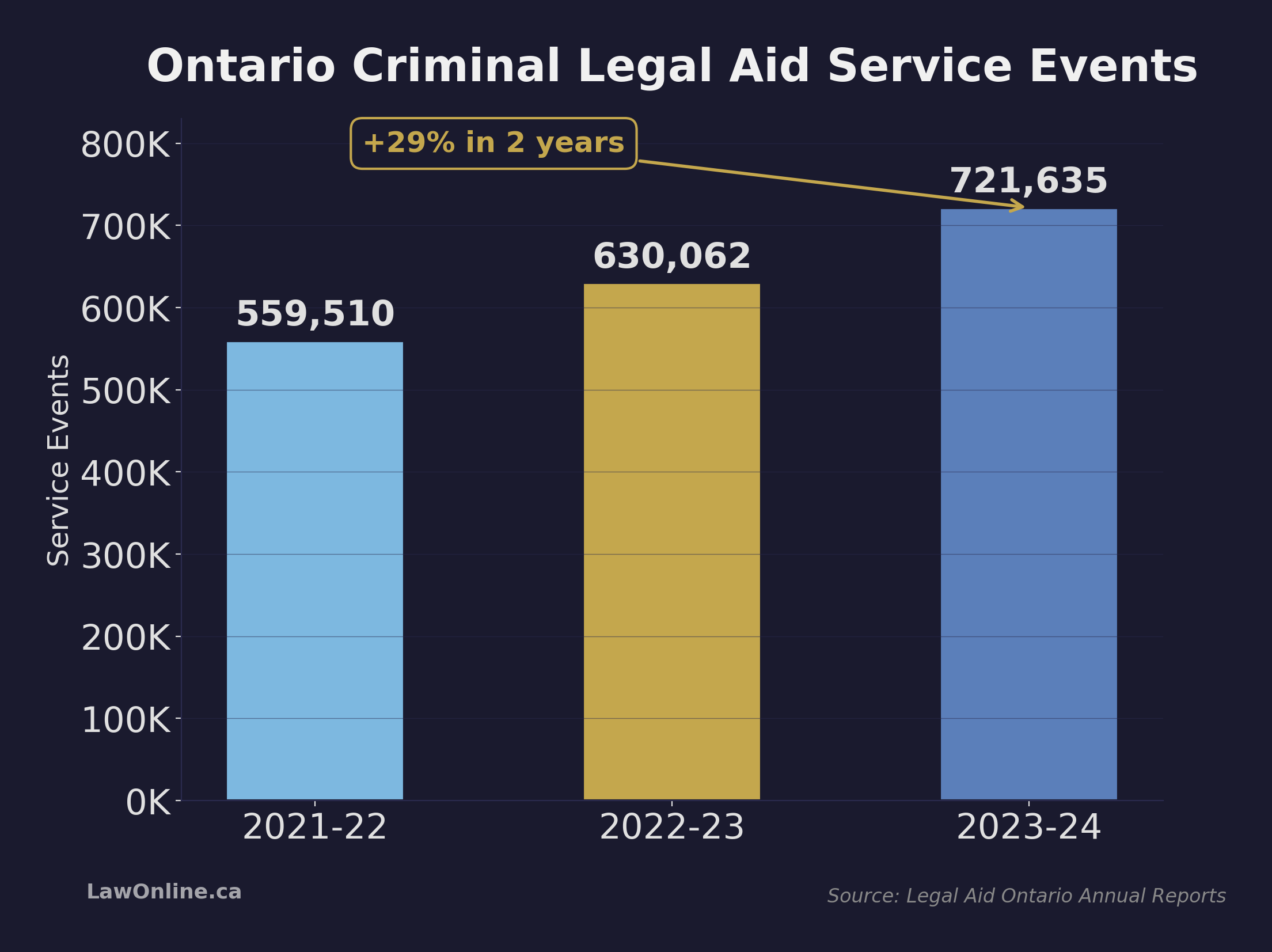
The firms that win consistently aren't running anything exotic. They run the same five things, and they run the last one better than everyone else. And the underlying demand is growing: Legal Aid Ontario's annual reports show criminal service events jumping from 559,510 in 2021-22 to 721,635 in 2023-24, a 29% increase in just two years. The firms with strong acquisition systems in place are the ones positioned to capture that volume.
- Strong local SEO so they appear for their charge types and service areas, the primary long-term channel
- Google Ads running 24/7 with charge-specific campaigns and available-now copy, the reliable volume driver
- Active review generation after every favourable outcome, to clear the trust bar in the Local Pack
- Substantive content that ranks for charge and process queries and reaches people before they're charged
- Fast intake with a live answer, extended well into evenings and weekends
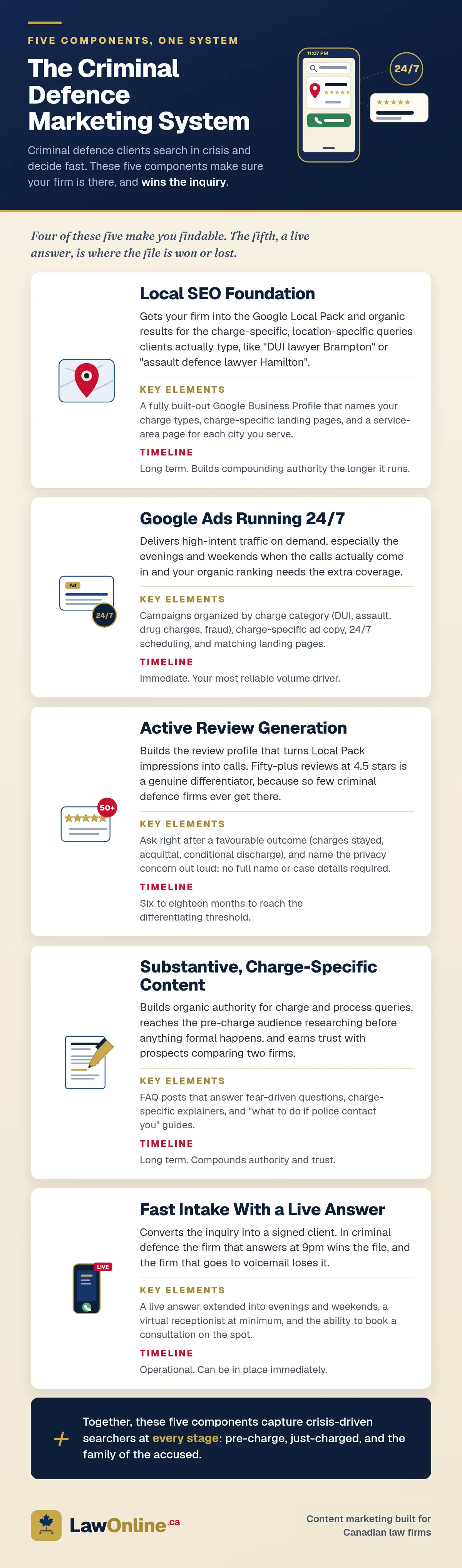
The first four make you visible. The fifth is where the client actually gets signed, and it's where most firms quietly lose. A prospect who reaches a person at 9pm books the consultation. A prospect who hits voicemail dials the next firm. You can do everything else right and still lose the file at the final step because no one picked up.
The difference isn't sophistication. It's showing up reliably when the call comes. Criminal defence clients search once, in crisis, and hire fast. Show up credible, answer live, and you'll win more than your share.