First appeared on directory.lawonline.ca.
When people shop for a lawyer they ask about price and reviews, but rarely about focus: does this firm do one kind of law, or twenty? It turns out to be one of the more useful questions you can ask, because most firms are more focused than the "full-service" label suggests. Of the 10,895 firms in the LawOnline directory that list at least one practice area, the typical one lists just three.
Most firms are focused, not sprawling
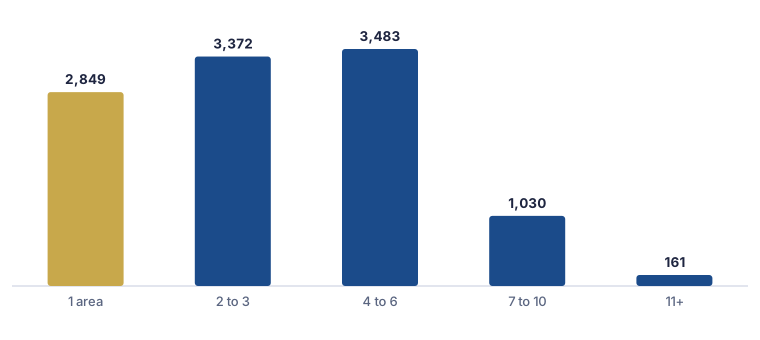
The median firm lists three practice areas and the average is 3.5, so the picture is one of focus, not breadth. About a quarter of firms, 2,849 of them or 26 percent, list a single area and nothing else. Another 31 percent list two or three, and 32 percent list four to six. Firms that range across seven or more areas are the exception: only about one in ten do, and just 161 firms in the whole directory list eleven areas or more.
The sprawling shop that claims to do everything is rare. Far more common is a firm that has picked a lane, or a handful of related ones, and stayed in it.
What the one-thing-only firms do
The firms that focus on a single area aren't spread evenly across the law. They cluster in a few high-stakes, high-volume areas that ordinary people actually hire for.
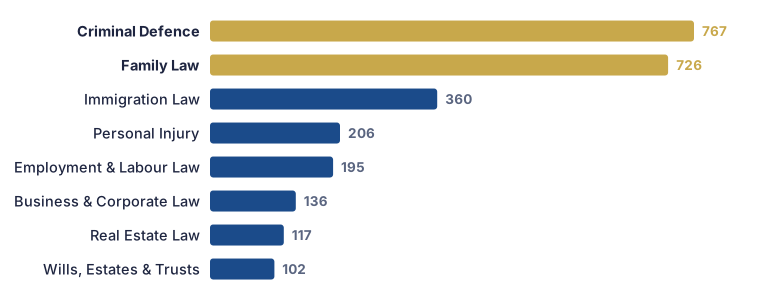
Criminal defence and family law top the list, with 767 and 726 single-focus firms, so between them they account for about half of all the one-area firms. Immigration, personal injury, and employment follow. These are exactly the matters where a dedicated specialist is easy to find, which is good news if you're facing one of them: you don't have to settle for a firm that dabbles.
Generalist or specialist: which do you want?
It depends on your matter, and both have a place.
For a single serious problem, a specialist is often the right call. If you're charged with an offence, in a custody fight, hurt in an accident, or fired without a fair package, a firm that does only that work sees your kind of case every day, and that experience shows. The data says you can find one.
For everyday legal needs, a small general practice is usually the better fit. Buying a house, making a will, incorporating a small business, or handling a simple estate are the bread and butter of the solo and small firms that make up most of the profession, and getting them all done under one roof is convenient and often cheaper.
One caveat keeps this honest. These counts reflect the areas a firm highlights in our directory, not a promise. A firm that lists one area may take on a bit more, and a long list of areas isn't proof of depth in each one. So the real move is to ask directly: who at the firm handles your kind of case, and how often do they do it? For more on how firms describe their work, see what Canadian law firms actually do. When you're ready to compare, you can start your search here.
Frequently asked questions
Should I hire a specialist or a general practice lawyer?
Match it to the matter. For a single high-stakes problem like a criminal charge, a custody dispute, or an injury claim, a firm that focuses on that area brings depth you can feel. For common needs like a house purchase, a will, or a small incorporation, a general practice handles everything in one place, often at a lower cost.
How many practice areas does a typical law firm have?
In our directory, the median firm lists three practice areas and the average is 3.5, as of October 2026. About a quarter list a single area, and only about one in ten list seven or more.
Does a firm that lists many practice areas mean it's good at all of them?
Not necessarily. A long list shows range, not depth. Ask which lawyer would handle your specific matter, how much of that work they do, and how recently, rather than relying on the number of areas a firm advertises.