
Website design, SEO, and legal content writing for firms across Newfoundland and Labrador. This page walks through our services, the local market from St. John’s to Corner Brook and Labrador, and how to get started.
Table of Contents
- Why Newfoundland and Labrador Law Firms Need a Marketing Strategy
- Services for Newfoundland and Labrador Law Firms
- The St. John's Legal Market
- The Mount Pearl, Paradise, and Conception Bay South Legal Market
- The Corner Brook and West Coast Legal Market
- Gander and the Central Region
- Labrador and Smaller Communities
- Newfoundland and Labrador in Canadian Legal History
- How Much Does Law Firm Marketing Cost in Newfoundland and Labrador?
- Practice Areas We Market in Newfoundland and Labrador
- Frequently Asked Questions
- Ready to Grow Your Newfoundland and Labrador Practice?
Why Newfoundland and Labrador Law Firms Need a Marketing Strategy
Newfoundland and Labrador is a distinctive legal market. Outside of Prince Edward Island, it's the smallest provincial bar in the country, with a population of roughly 533,000 scattered across an island and a vast mainland territory. Most of the lawyers in the province work within easy distance of the St. John's census metropolitan area, which holds about 215,000 people across the capital, Mount Pearl, Paradise, and Conception Bay South. Corner Brook anchors the west coast, Gander sits near the geographic centre of the island, and the Law Society of Newfoundland and Labrador oversees the bar from offices in St. John's. The regulator's 2024-2025 Annual Report, published in May 2025, listed 829 practising lawyers (602 insured, 227 uninsured) and 1,115 total members once non-practising and life members are counted.
A small bar doesn't mean a small legal need. Newfoundlanders and Labradorians turn to Google the same way everyone else does when they need counsel.
The search queries stack up quickly. Injuries from collisions on the Outer Ring Road, the Veterans Memorial Highway, and Route 1 as it crosses the island. Family matters in a province whose population is finally expanding again after a generation of decline. Accused persons looking for defence counsel in Provincial Court in St. John's, circuit courts in Grand Falls-Windsor and Happy Valley-Goose Bay, and scheduled sittings scattered across outport Newfoundland. Home purchases by Ontario and Alberta migrants chasing the cheapest detached housing market east of Winnipeg. Corporate files tied to Hibernia, the inshore fishery, and the iron ore operations in western Labrador.
Every one of those queries is somebody's first step toward hiring a lawyer. Whoever owns the top of the results page wins the retainer.
LawOnline.ca exists to make sure that firm is you. We work only with Canadian law firms. We know the advertising expectations that flow from Rule 4 of the Law Society of Newfoundland and Labrador Code of Professional Conduct. We know how search volume in this province breaks down by city, practice area, and season. And we know how ranking in an isolated market differs from ranking in the rest of Atlantic Canada, never mind Toronto or Calgary. Generalist agencies don't bring that specific knowledge. We do. For a full breakdown of what Newfoundland and Labrador lawyers can and can't advertise, see our guide to Atlantic Canada lawyer advertising rules.
Services for Newfoundland and Labrador Law Firms
Website Design for St. John's Law Firms
A pretty template-driven website that never climbs past page three of Google is a liability, not an asset.
Our approach to law firm website design in Newfoundland starts with three priorities: speed, conversion, and search ranking. Visual polish follows. Every build includes structured data, WCAG-compliant accessibility, proper Canadian legal industry schema, mobile-first layouts, and consultation booking flows placed where a stressed visitor can actually reach them. Page loads land under two seconds on a mobile connection from Corner Brook the same way they do from downtown Mississauga. That isn't an aesthetic preference. It's how Google ranks websites for law firms in 2026 and how real clients decide whether to call you.
Law Firm SEO in St. John's and Across Newfoundland and Labrador
SEO for law firms in Newfoundland looks nothing like the templated packages sold to general-business clients. An offshore energy partnership in St. John's and a sole practitioner in Gander are chasing different searchers with different intent, and neither one gets served well by generic legal-vertical content. Our law firm SEO services cover both layers: the infrastructure side (page speed, crawl health, structured data, site architecture) and the editorial side (practice-area pages, geographically targeted content, queries mapped to actual search intent). We build campaigns that speak to the full range, technical audits that fix crawl issues and Core Web Vitals problems, information architecture that maps cleanly to how searchers phrase queries in this province, and content that targets the gaps your actual competitors are leaving open.
Search competition here is thin compared to Vancouver, Toronto, or Calgary. That's an opportunity, not a drawback. With focused work, a St. John's firm can reach the top of the results for high-value personal injury, family, and criminal keywords inside six months, at a budget that would barely buy a month of PPC in the big Ontario markets. For context on the broader argument, read our guide on why Canadian law firms need SEO.
Google Business Profile Optimization
For most "lawyer near me" queries in St. John's, the three-pack on the map is what clients see first, above every organic result.
We run every part of that profile: accurate name, address, and phone records, the right primary and secondary categories for your practice, service-area definitions, booking links, photography, weekly posts, and a review-generation cadence that doesn't run afoul of Law Society rules. Each Google Business Profile covers one location. A firm with offices in St. John's and Corner Brook needs two separate profiles, two separate optimization plans, and two location-specific landing pages tied back to each one. Consolidating them into a single listing is one of the fastest ways to waste a Google presence.
Content Marketing for Newfoundland and Labrador Law Firms
Content marketing for law firms in Newfoundland covers practice-area pages, FAQ libraries, and longer articles that answer the actual questions a client types into a search bar before they ever pick up the phone. Our legal content writing for NL clients goes further than most: our writers research Newfoundland-specific issues (Workplace Health, Safety and Compensation Commission claims, Family Justice Services, offshore petroleum regulation, the quirks of Newfoundland real property registration) before they put a word on the page. Every draft is reviewed against the Law Society's advertising guidelines before it leaves our desk. We don't publish AI slop with your name on it. If you want the full strategy behind content marketing for law firms, see our content marketing starter guide.
Website Migrations and Hosting
Moving off a legacy Clio Grow site, an outdated WordPress build, or a locked-in proprietary CMS? We handle the migration end to end, with URL mapping, 301 strategy, and post-launch monitoring that protects every ranking you have earned to date.
The St. John's Legal Market
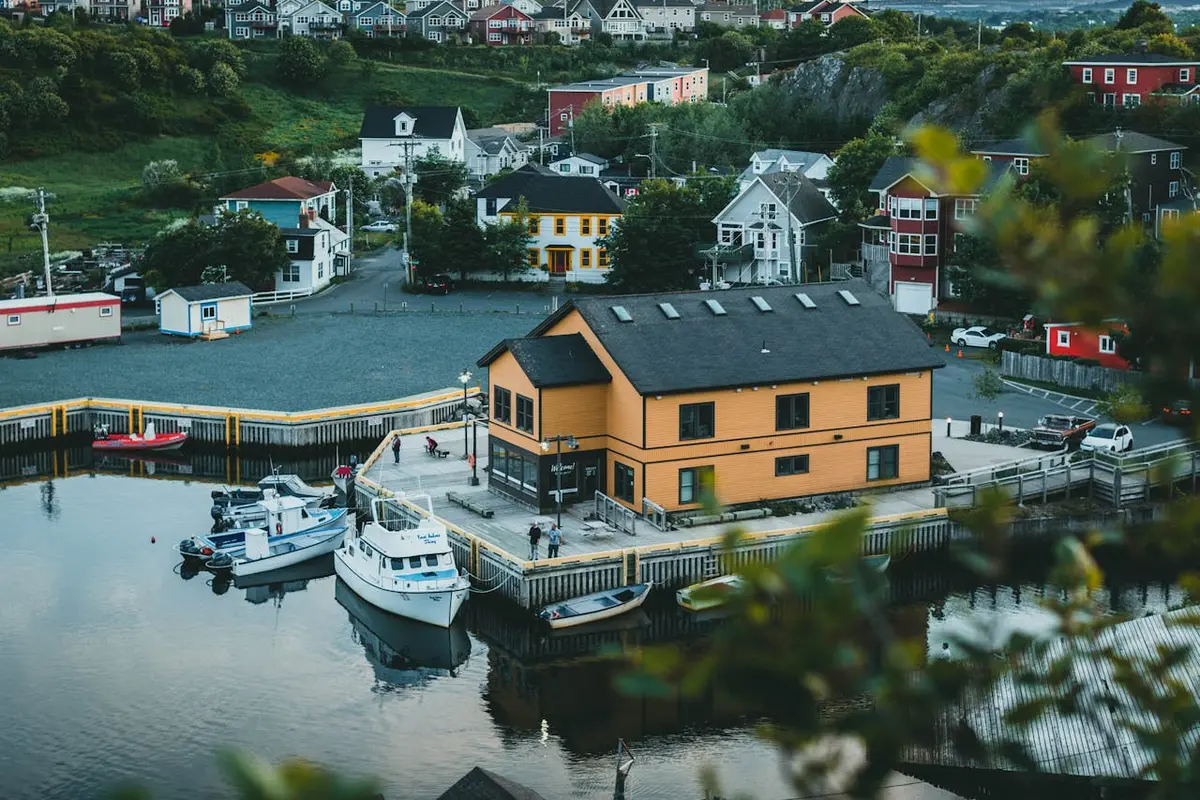
St. John's is the oldest English-founded city in North America and the provincial capital. The city proper is home to roughly 111,000 people, and the census metropolitan area, which also captures Mount Pearl, Paradise, and Conception Bay South, sits at about 215,000 as of the most recent census.
- Where government, business, and the bar concentrate. The legislature at Confederation Building, the provincial ministries, Memorial University, and the majority of the provincial bar operate out of St. John's. If your firm does commercial, regulatory, administrative, or government-relations work in this province, the client meetings and the filings almost all route through the capital.
- The Supreme Court of Newfoundland and Labrador. The building at 309 Duckworth Street houses the General Division, the Family Division, and the Court of Appeal, which is the final word on provincial litigation. Every reported appellate decision in Newfoundland and Labrador is handed down from this courthouse.
- Atlantic Canada's offshore energy capital. The administrative footprint of Hibernia, Terra Nova, White Rose, and Hebron sits in and around St. John's. That produces corporate, regulatory, labour, environmental, and commercial litigation work that no other Atlantic province generates at the same concentration.
- A province growing again. After decades of slow population loss, Newfoundland and Labrador has posted positive net migration for several consecutive years, and St. John's is absorbing the largest share of that growth. Real estate, immigration, employment, and family practice workloads have all risen accordingly.
The Mount Pearl, Paradise, and Conception Bay South Legal Market
The three municipalities ringing St. John's hold a disproportionate share of the metro's growth and their own steady legal demand.
- Mount Pearl. Roughly 22,000 residents, immediately west of the capital, with one of the highest median incomes in the province. Donovans Industrial Park anchors a corporate base that feeds commercial, employment, and real estate work.
- Paradise. Also near 22,000 residents, and the fastest-growing municipality in the province. Paradise's population has nearly doubled since 2006. Young families, new subdivisions, and interprovincial movers drive residential real estate, family law, and wills and estates intake.
- Conception Bay South. About 27,000 residents stretched along the south shore of Conception Bay, serving as both a commuter belt for the capital and a regional hub for Avalon-Peninsula clients outside the St. John's city boundaries.
Civil, family, and criminal matters from all three municipalities are heard in the St. John's courts, which means firms based anywhere in the metro are competing for the same pool of searchers on Google.
The Corner Brook and West Coast Legal Market
Corner Brook, population roughly 19,800, is the largest city on the island's west coast and the regional anchor for Deer Lake, Stephenville, Port aux Basques, the Bay of Islands, and the Humber Valley.
- The Corner Brook courthouse. Houses a Provincial Court and a Supreme Court circuit, covering criminal, family, and civil files across a catchment that stretches from Gros Morne to the Burgeo-Ramea coast. A significant share of west coast litigation funnels through this building.
- Resource-driven local economy. Corner Brook Pulp and Paper, seasonal tourism tied to Gros Morne National Park and Marble Mountain, and forestry activity produce employment, environmental, corporate, and commercial disputes that are distinct from anything on the Avalon.
- A real opening in local search. Digital marketing investment is thin on the ground here. Firms that make a modest, focused effort can rank for competitive west-coast keywords faster than in almost any other Atlantic Canadian market.
Gander and the Central Region
Gander sits at the middle of the island, with a population of roughly 11,500. It's internationally remembered for sheltering 38 diverted flights on September 11, 2001, and its international airport remains a meaningful employer alongside the town's role as a regional service hub.
- The Gander courthouse. Houses Provincial Court and a Supreme Court circuit that serve a catchment running from Grand Falls-Windsor through Fogo Island and Twillingate. Family, criminal, and property files dominate the docket.
- A thinly populated but wide-reaching region. Gander is the practical headquarters for lawyers serving central Newfoundland. The local practice mix leans toward family law, residential real estate, wills and estates, and criminal defence.
- Almost no search competition. Very few firms in central Newfoundland operate a meaningful website. A well-built local campaign here can essentially claim the top of the results page without much resistance.
Labrador and Smaller Communities
Labrador occupies more than 70% of the province's land area but houses fewer than 6% of its people. Happy Valley-Goose Bay, population around 8,100, is the largest community and the administrative centre for government, health, and legal services across the region. Labrador City and Wabush form the iron-ore mining hub in western Labrador.
- Happy Valley-Goose Bay. A Provincial Court location serving central and coastal Labrador. Files here include criminal defence, family law, and matters tied closely to Innu and Inuit self-government, land claims, and residential-school-era litigation.
- Labrador City. The legal work is almost entirely tied to the Iron Ore Company of Canada and the related supply chain. Corporate, environmental, labour relations, and occupational-health files dominate.
- Remote coastal communities. The outports along the Labrador coast and the Great Northern Peninsula rely on circuit courts, Legal Aid, and whatever Internet-based counsel they can reach. For firms willing to service clients remotely, there is a real population here with no consistent local representation.
In a province this spread out, a firm's website often is its reception desk. For clients in Postville or Mary's Harbour, finding you on Google isn't a convenience. It's the only way.
Newfoundland and Labrador in Canadian Legal History
Newfoundland arrived in Confederation later than every other province. It was a self-governing dominion, then a British colony under Commission of Government, and only joined Canada in 1949 under the Newfoundland Act and the Terms of Union. Those Terms are part of the Constitution, and the province has generated case law that reshaped doctrines of federalism, contract, and public inquiry practice far beyond its own boundaries.
The most recent Supreme Court of Canada ruling to turn on this province's circumstances is Churchill Falls (Labrador) Corporation Ltd v Hydro-Québec, 2018 SCC 46. CFLCo asked the Supreme Court of Canada to reopen the 1969 long-term power contract that locked hydro prices for 65 years, arguing that the bargain had become radically unbalanced and that Hydro-Québec owed a duty of good faith cooperation to renegotiate. The Court refused, 7-1, and entrenched a strict view of the sanctity of long-term commercial contracts under both Quebec civil law and common law. Churchill Falls is now the reference point in Canadian commercial litigation whenever one party argues that changed economic conditions should unwind a bargain.
Decades earlier, on the night of February 15, 1982, the Ocean Ranger drilling platform capsized during a winter storm 267 kilometres east of St. John's. All 84 crew on board died. The Royal Commission on the Ocean Ranger Marine Disaster, chaired by Chief Justice T. Alex Hickman, produced a two-volume report that forced Canadian offshore operators, regulators, and insurers to rebuild how they approached platform design, crew training, and emergency response. The modern framework administered by the Canada-Newfoundland and Labrador Offshore Petroleum Board traces its DNA directly to Hickman's recommendations.
Through 1989 to 1992, Samuel Hughes's commission of inquiry investigated decades of physical and sexual abuse at the Mount Cashel Orphanage and the failures of the Royal Newfoundland Constabulary and the Christian Brothers to stop it. The Hughes Inquiry report set the template for how Canadian institutions investigate and compensate historical abuse, and its reasoning still surfaces in residential school settlements, clergy abuse litigation, and other institutional-abuse claims across the country.
How Much Does Law Firm Marketing Cost in Newfoundland and Labrador?
Newfoundland and Labrador sits at the small-market end of the Canadian legal marketing spectrum. Pricing is well below Ontario, British Columbia, and Alberta, but a touch higher than Nova Scotia or New Brunswick because the province's isolation adds logistical costs that Maritimers don't face to the same degree.
| Service | Typical Cost Range |
|---|---|
| Local SEO retainer (monthly) | $1,500 to $3,000 |
| Custom law firm website | $3,500 to $8,500 |
| Full-service marketing package (monthly) | $2,000 to $4,500 |
| Content writing (monthly) | $600 to $1,500 |
Firms competing in crowded St. John's practice areas (personal injury, criminal defence, family law) should plan to invest near the top of each range. Corner Brook, Gander, Happy Valley-Goose Bay, and smaller outport markets face almost no digital competition, so a focused campaign at the bottom of the range can still dominate local search results.
Across every category, Newfoundland and Labrador pricing runs 25 to 35% below equivalent Toronto spend. For province-by-province comparisons, see our guide to law firm marketing costs in Canada. Our model keeps overhead low, specializes tightly in law firms, and delivers big-market quality at Atlantic pricing. The dollars stretch further, and the strategic focus is tighter.
Practice Areas We Market in Newfoundland and Labrador
- Personal injury: Motor vehicle collisions on Route 1, the Outer Ring Road, the Veterans Memorial Highway, and the Trans-Labrador Highway. Slip and falls, medical malpractice, and long-term disability. Offshore workplace injuries and maritime personal injury tied to the fishery and the oil platforms. Personal injury produces the highest-value files in any Canadian legal market, and Newfoundland is no exception.
- Family law: Divorce, custody, parenting time, child and spousal support, and property division. Most cases go through the Family Division of the Supreme Court in St. John's and through Provincial Court family lists elsewhere in the province.
- Criminal defence: Provincial Court matters across the island and Labrador, with serious indictable charges routed to the Supreme Court. Files span impaired driving, domestic violence, drug offences, and assault. Legal Aid NL completed 5,385 cases in 2023-24, but staff solicitors handled 99% of the caseload (only 35 went to private certificate counsel). Unlike Ontario or BC, where legal aid certificates flow regularly to the private bar, criminal clients in this province reach private firms through direct search almost every time, which makes online visibility the single biggest intake lever available.
- Real estate law: Residential and commercial transactions. Mainland buyers chasing affordability have fuelled activity across St. John's, Paradise, Conception Bay South, the rest of the Avalon, and increasingly Corner Brook.
- Wills, estates, and elder law: Estate planning, powers of attorney, estate administration, capacity disputes, elder abuse, and long-term care. Newfoundland and Labrador has one of the oldest median ages in the country, which keeps the estate planning side of any practice book consistently busy.
- Corporate, commercial, and resource law: Incorporation, shareholder agreements, commercial disputes, offshore petroleum compliance, fisheries regulation, and mining and environmental work in Labrador. The St. John's corporate bar serves an unusual concentration of the province's largest employers for its size.
- Employment and labour law: Wrongful dismissal, workplace investigations, occupational health and safety, and collective bargaining. Public service, hospital, and resource-sector unions keep this category in steady demand.
- Immigration law: Work permits, permanent residence, and citizenship applications. The Newfoundland and Labrador Provincial Nominee Program, combined with the Atlantic Immigration Program, has pushed immigration filings sharply upward over the last decade.
Frequently Asked Questions
How long does SEO take to work for a St. John's law firm?
Expect measurable movement within three to six months for competitive practice areas such as personal injury, criminal defence, and family law. Lower-competition areas like wills and estates, real estate, or immigration can start showing ranking gains in six to ten weeks. The province's thin SEO competition compresses the timeline compared to Ontario or Alberta.
How much does law firm marketing cost in Newfoundland and Labrador?
Most firms in the province budget somewhere between $2,000 and $4,500 per month once SEO, content, and Google Business Profile management are bundled together. An SEO-only retainer typically runs $1,500 to $3,000 monthly. New websites land between $3,500 and $8,500 for most small and mid-sized firms. Newfoundland and Labrador is one of the most affordable legal marketing markets in the country, slightly above Nova Scotia or New Brunswick because of the province's geographic isolation, but still 25 to 35% under Toronto.
Is Newfoundland and Labrador too small a market to bother with law firm SEO?
No. A small market cuts both ways. It means less search volume, but also sharply lower competition and sharply lower cost to rank. A well-positioned St. John's firm can hold a top-three position for a high-intent keyword with a monthly budget that wouldn't buy a week of PPC in Toronto. The per-case economics are often better here than in the big markets.
Should a firm in Corner Brook or Gander target province-wide keywords?
Usually both, in combination. Provincial keywords ("Newfoundland family lawyer", "NL personal injury lawyer") bring in lower-intent but higher-volume traffic. City-level keywords ("Corner Brook family lawyer", "Gander estate lawyer") bring in fewer visitors with much higher buying intent. A properly built site carries pages for both levels and cross-links them intelligently.
Does my St. John's firm need a separate landing page for every surrounding community?
If you want to show up for Mount Pearl, Paradise, or Conception Bay South searches, yes. Google treats each of those municipalities as its own local market, and a generic "St. John's" page will lose to firms with dedicated community-level content. One page per community is the standard, with unique copy, addresses where relevant, and local links.
What marketing strategy works best for a small Newfoundland law firm?
Three priorities in order: a fast, mobile-first website that converts visitors into consultations, a properly built Google Business Profile tied to your primary office, and four or five practice-area pages written tightly for the services you actually want to grow. Small firms in this province don't need to outspend their provincial competitors. They need to be sharper and more specific. A solo family lawyer in St. John's who ranks for "divorce lawyer St. John's" will pull more qualified calls than a national firm with a generic site and a directory listing.
Ready to Grow Your Newfoundland and Labrador Practice?
If you aren't showing up when potential clients in St. John's, Corner Brook, Gander, or Happy Valley-Goose Bay search for a lawyer, the retainers are going somewhere else. We'll audit your current online presence, highlight where the real gaps are, and map out what a concrete marketing plan would look like for your practice areas and market. No pressure, no obligation, and no canned deck.