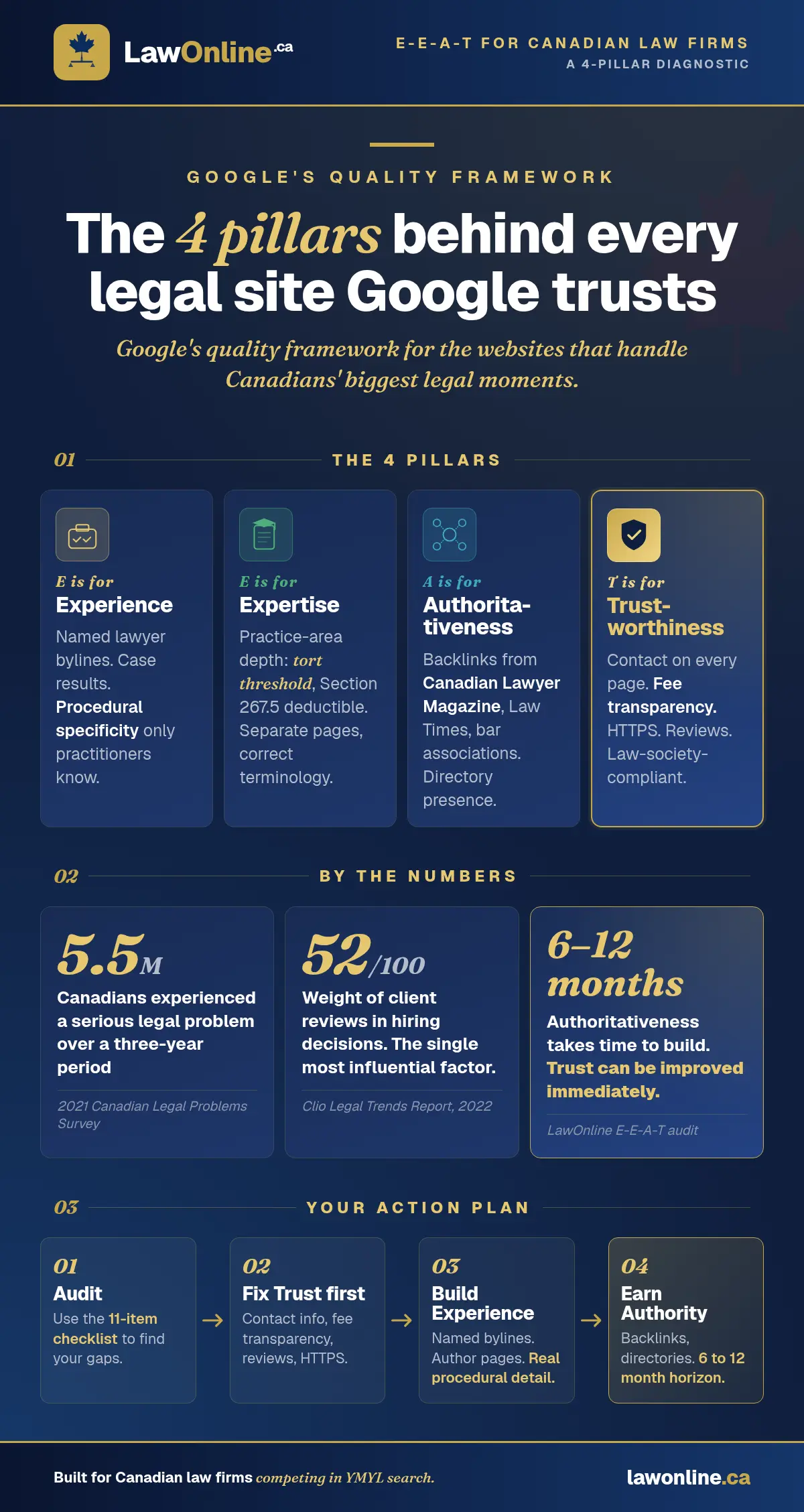
What is E-E-A-T and why does it matter for law firms? E-E-A-T (also written EEAT) stands for Experience, Expertise, Authoritativeness, and Trustworthiness. It's the framework Google's quality raters use to evaluate whether content deserves to rank. For law firms, E-E-A-T isn't a nice-to-have. It's the single most important factor determining whether your website appears in search results and AI overviews for the queries that generate client inquiries.
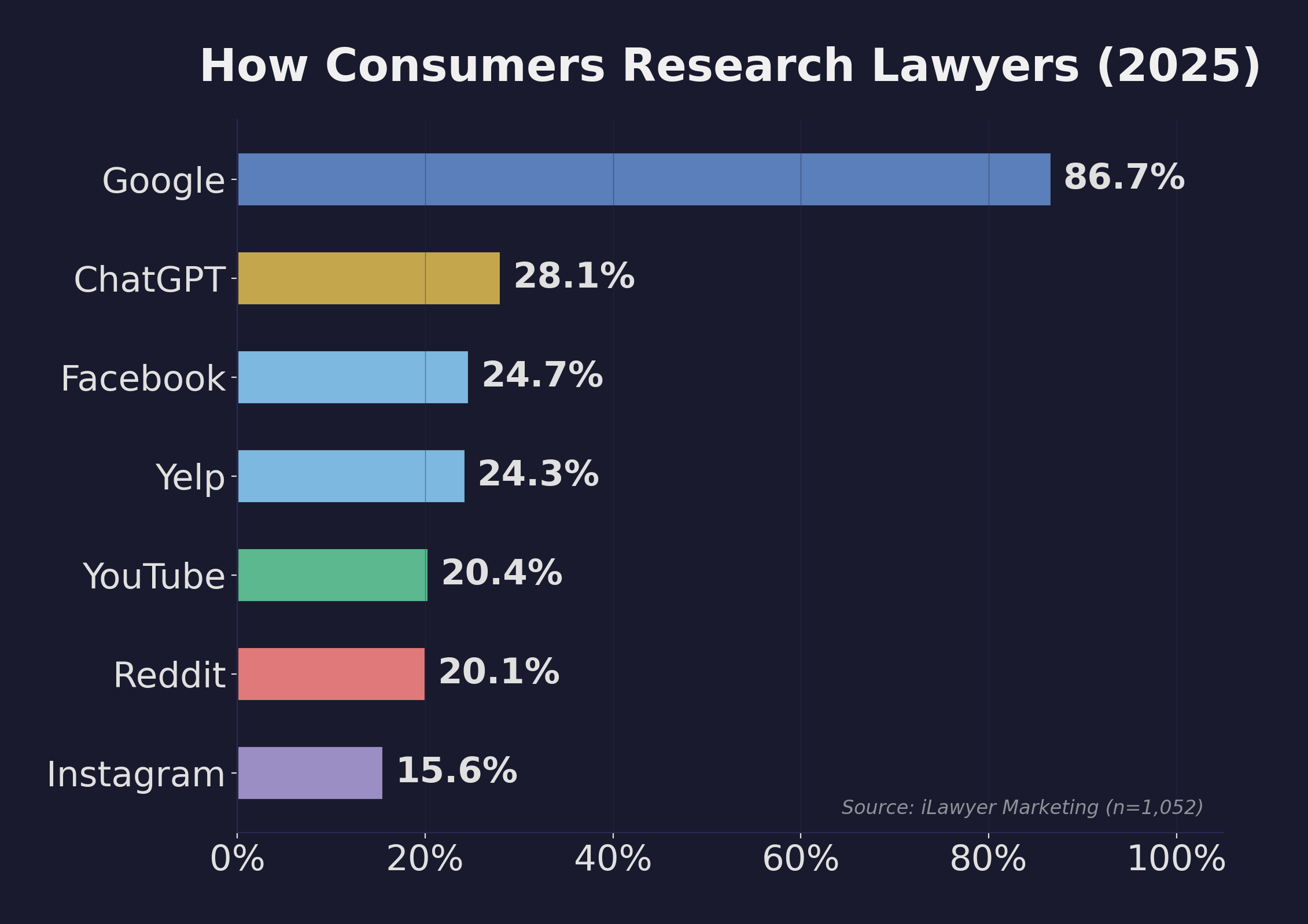
The numbers make the stakes clear. A 2025 consumer survey by iLawyer Marketing (n=1,052) found that 86.7% of consumers would use Google to research a lawyer, and a companion study confirmed that 87% use Google specifically to help decide which firm to hire. That's not just discovery. It's evaluation. When nearly nine out of ten prospective clients are judging your firm through Google's lens, the quality signals Google rewards become the quality signals that generate revenue.
Google classifies legal content as "Your Money or Your Life" (YMYL), the highest-scrutiny category in its Search Quality Rater Guidelines. YMYL stands for "Your Money or Your Life," a label Google applies to content where inaccurate or misleading information could harm a reader's health, safety, finances, or legal rights. Legal content is one of the four YMYL categories, alongside health, finance, and safety. The threshold for what Google considers "good enough" to rank is significantly higher for a page about Ontario limitation periods than for a page about gardening tips.
That classification has practical consequences. A law firm website with thin content, no visible author credentials, no reviews, and no external validation will struggle to rank even if the technical SEO is perfect. Meanwhile, a competitor with strong E-E-A-T signals, deep practice area content, named authors, and backlinks from legal publications, will outrank you with less effort.
The scale of opportunity makes this worth getting right. The 2021 Canadian Legal Problems Survey found that roughly one in five Canadian adults, about 5.5 million people, experienced at least one serious legal problem over a three-year period. For the firms competing to serve those people, E-E-A-T signals are what separate the websites Google trusts from the ones it buries.
This guide breaks down what E-E-A-T means in practice for Canadian law firms, how each pillar applies to legal content, and includes an 11-item audit checklist you can use to evaluate your own site.
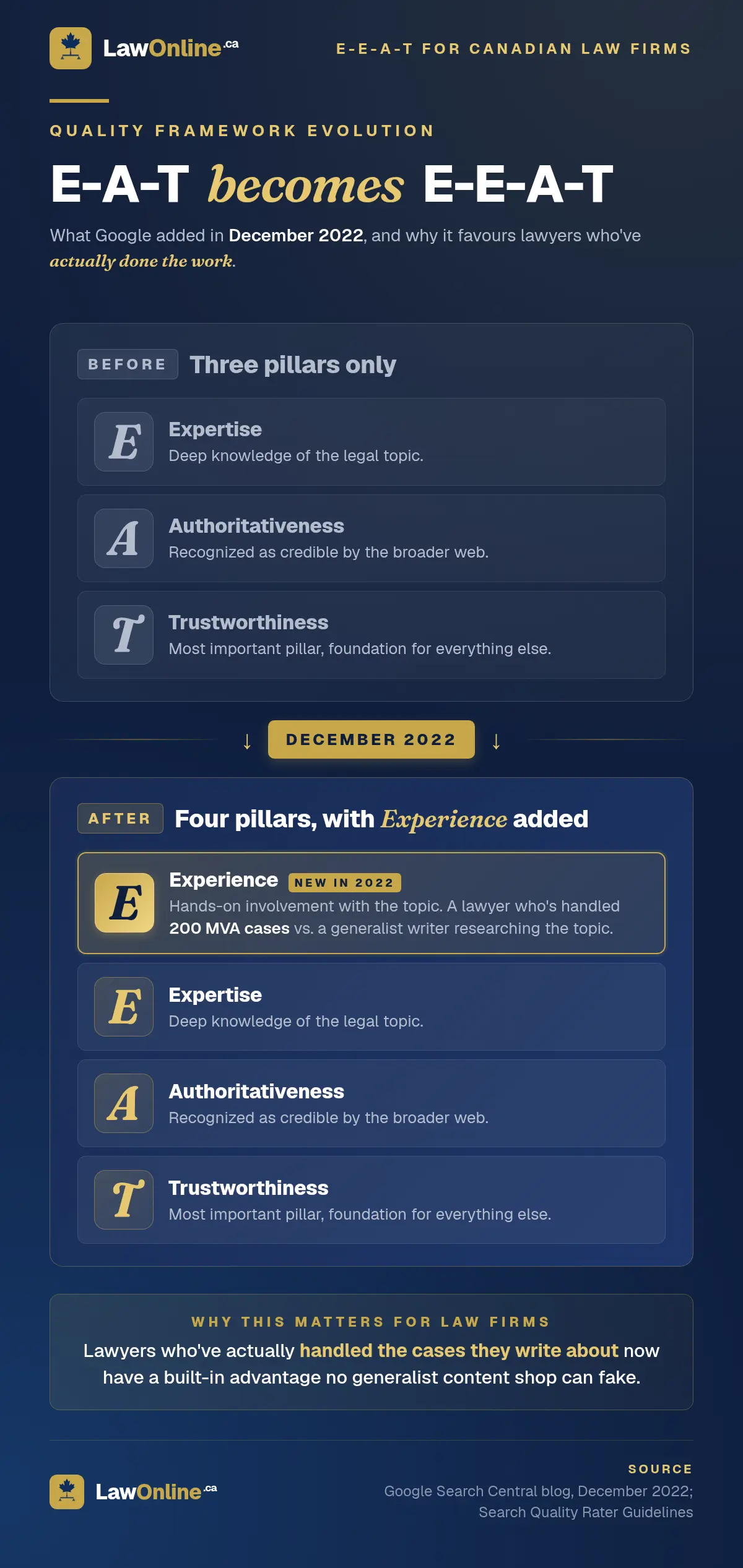
E-A-T to E-E-A-T: What Changed in 2022
Google's original framework was E-A-T: Expertise, Authoritativeness, Trustworthiness. In December 2022, Google formally added "Experience" to create E-E-A-T. If you've come across older guides referencing "E-A-T for lawyers" or "Google E-A-T," that's this same framework before the 2022 update. The addition of the second "E" reflects a simple insight: someone who has actually done the thing they're writing about produces more valuable content than someone who's just researching it.
For law firms, this addition is good news. Lawyers who've handled hundreds of personal injury cases, navigated complex custody disputes, or argued criminal defence matters bring firsthand experience that no generalist content writer can replicate. The question is whether your website makes that experience visible to Google.
What Is YMYL and Why Does Legal Content Fall Under It?
YMYL is Google's classification for content topics where bad information can cause real-world harm. The Search Quality Rater Guidelines define four YMYL categories: health and safety, financial information, legal information, and civic or societal topics. Legal content sits squarely in this group because someone acting on incorrect information about limitation periods, accident benefits, or custody rights could suffer serious consequences.
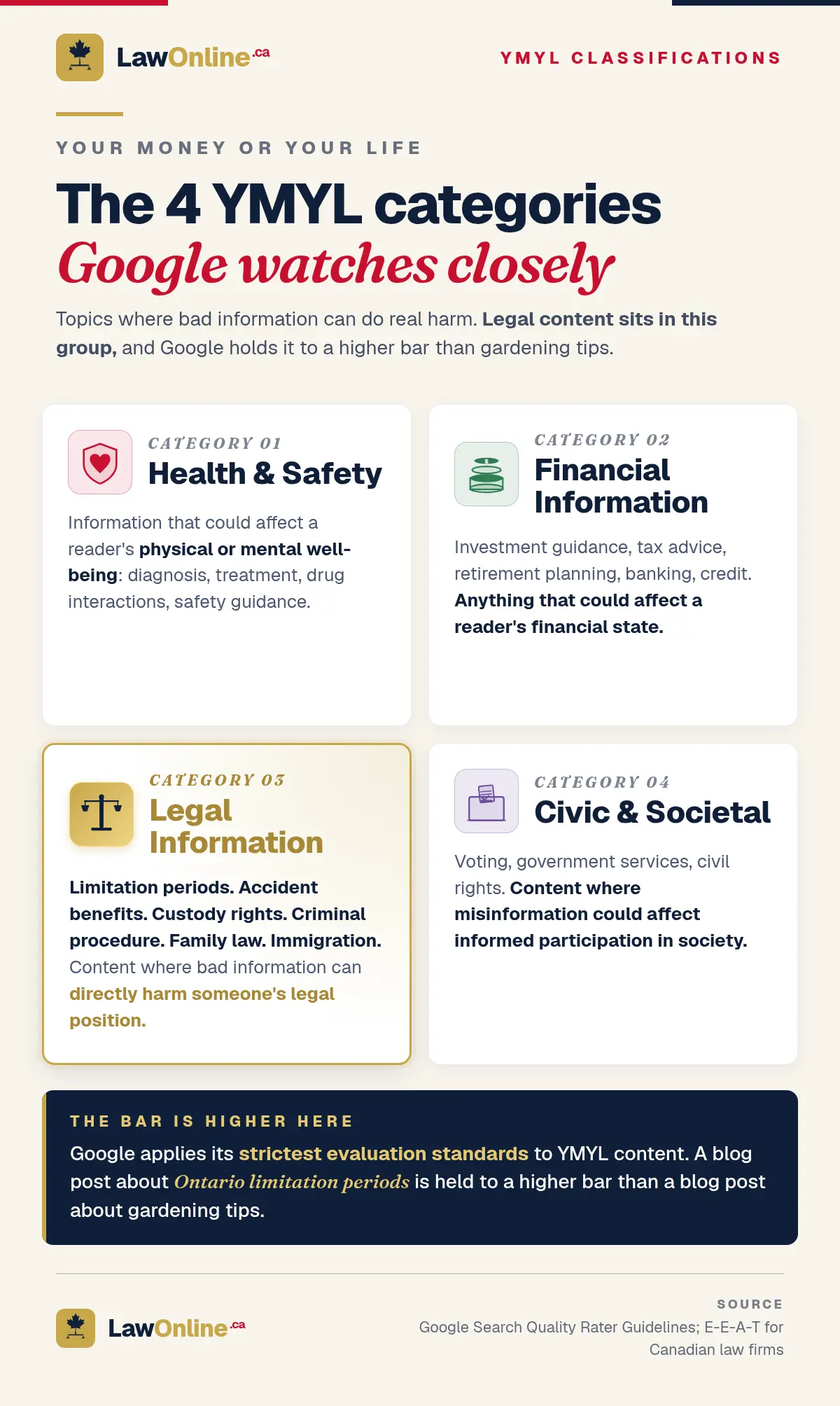
For law firms, the YMYL classification means Google applies its strictest evaluation standards to your pages. A blog post about gardening can rank with decent writing and a few backlinks. A blog post about Ontario personal injury law needs to demonstrate that the author has real legal expertise, that the content is accurate and current, and that the publishing site is trustworthy. That's a higher bar, but it's also a moat. Firms that clear it face far less competition than they would in a non-YMYL space.
The opportunity is enormous precisely because the market is fragmented. Canadian Industry Statistics report more than 52,000 legal-services establishments operating across Canada, and 74.4% of those with employees are micro-firms (fewer than five staff). Most of these firms don't have dedicated marketing teams or content strategies. A firm that invests in strong E-E-A-T signals is competing against thousands of websites that barely meet minimum quality thresholds.
The practical question is: does your website make it obvious to Google's systems that your content meets the YMYL standard? That's what the four E-E-A-T pillars address.
The Four E-E-A-T Pillars: Experience, Expertise, Authoritativeness, Trustworthiness
Experience: Showing You've Done This Before
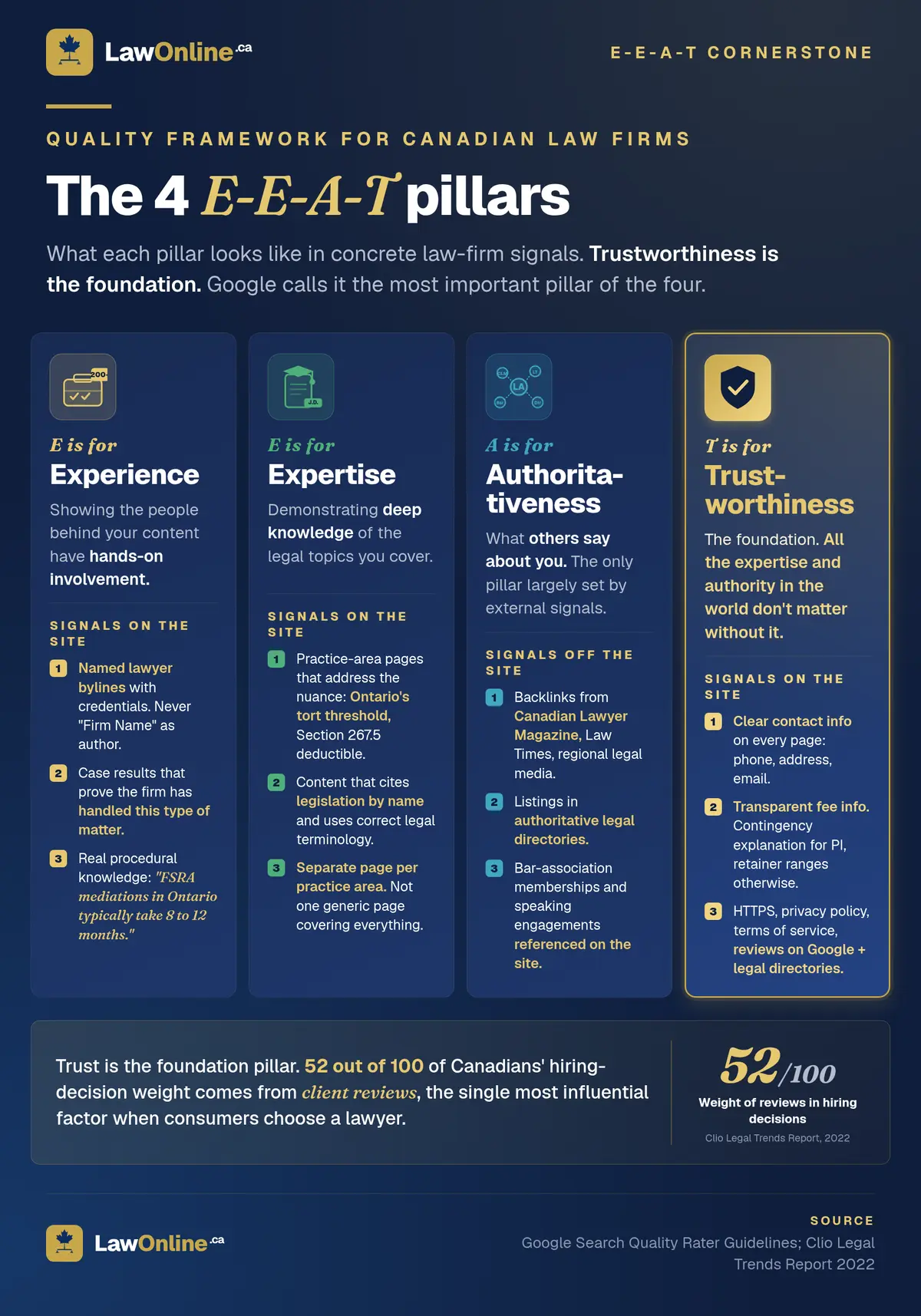
Experience signals tell Google (and prospective clients) that the people behind your content have hands-on involvement with the topics they're writing about.
What it looks like for law firms:
- Named lawyer bylines with visible lawyer credentials on practice area pages and blog posts, not just "Firm Name" as the author
- Case results that demonstrate the firm has handled this type of matter (anonymized as required by your provincial law society)
- Content that references real procedural knowledge: "In our experience, FSRA mediations in Ontario typically take 8 to 12 months" rather than the kind of generic legal content that appears on hundreds of other firm sites
- Descriptions of your approach to specific case types that only someone who's handled them would write
For a personal injury firm, experience signals include content that discusses the actual sequence of an accident benefits application, the common pitfalls in SABS disputes, or the practical realities of negotiating with insurance adjusters. A PI lawyer who's handled 200 car accident cases can write about the process with a specificity that's impossible to fake.
The author byline question. Many Canadian law firms publish content under the firm name rather than individual lawyer names. This is a missed opportunity. Google's systems increasingly look for individual author signals, including author pages, linked credentials, and consistent byline patterns across the site. Adding named bylines doesn't mean the lawyer wrote every word. It means a lawyer with relevant experience reviewed and stands behind the content.
Expertise: Proving You Know Your Subject
Expertise signals demonstrate deep knowledge of the specific legal topics you cover.
What it looks like for law firms:
- Practice area pages that go beyond surface-level descriptions and address the nuances that matter: Ontario's tort threshold for pain and suffering claims, the deductible under Section 267.5 of the Insurance Act, the difference between income replacement benefits and non-earner benefits
- Content that cites relevant legislation by name, references provincial court procedures, and uses the correct legal terminology
- Separate, dedicated pages for each practice area and subcategory rather than one generic page trying to cover everything
- FAQ sections that answer the specific questions prospective clients actually ask
The key distinction: expertise isn't about using complex legal jargon. It's about demonstrating depth in a way that's accessible to non-lawyers. A PI practice area page that explains Ontario's threshold test in plain language demonstrates more expertise than one that simply states "we handle personal injury cases." Google's own helpful-content documentation explicitly warns against mass-producing content via automation or writing to arbitrary word-count targets. Expertise signals are the foundation of legal SEO: without genuine depth, the rest of the technical optimization work doesn't compound.
Authoritativeness: What Others Say About You
Authoritativeness is, in plain terms, your law firm reputation as the broader web sees it. It's the only E-E-A-T pillar that's largely determined by external signals. You can control your content and your credentials, but authoritativeness depends on whether the broader web recognizes your firm as a credible source.
What it looks like for law firms:
- Backlinks from legal publications, bar association websites, and reputable news outlets
- Mentions in Canadian Lawyer Magazine, Law Times, or regional legal media
- Listing in authoritative legal directories
- Bar association memberships, board positions, and speaking engagements referenced on the site
- Awards and recognitions from legal industry bodies
For PI firms: a link from a provincial trial lawyers' association carries significant authority. A quote in a news article about personal injury law in Ontario signals to Google that journalists consider your firm a credible source.
Building authority takes time. But the foundation starts with publishing content that's good enough for others to reference and link to. That circles back to law firm content quality, which is why E-E-A-T and content marketing are inseparable.
Trustworthiness: The Foundation
Google describes trustworthiness as the most important E-E-A-T pillar. Trustworthiness signals are how lawyer credibility online translates into search performance. All the expertise and authority in the world don't matter if users and search engines can't trust your site.
What it looks like for law firms:
- Clear, accessible contact information on every page (phone number, physical address, email)
- Transparent fee information: contingency fee explanations for PI, retainer ranges for other practice areas
- Secure website (HTTPS) with a valid SSL certificate
- Privacy policy and terms of service
- Client reviews on Google Business Profile and legal directories
- Compliance with provincial law society advertising rules
- Accurate, current content that's updated when the law changes
Canadian compliance matters here. Every province has its own law society advertising rules, and violating them erodes trustworthiness in ways that go beyond Google's algorithms. The Federation of Law Societies of Canada's Model Code of Professional Conduct emphasizes honesty, integrity, and duties to the public, values that align directly with what E-E-A-T measures. The Law Society of Ontario, the Law Society of British Columbia, and their counterparts across the country each set constraints on how firms can present case results, testimonials, and fee guarantees. A page that prominently features settlement amounts without the required disclaimers might convert well in the short term, but it risks a law society complaint and sends a trust-negative signal to informed searchers.
Beyond advertising rules, Canadian law firms must also comply with PIPEDA's 10 fair information principles covering accountability, consent, safeguards, and transparency. A clear, well-maintained privacy policy isn't just a legal requirement. It's a trust signal that Google's systems can evaluate. Building E-E-A-T trustworthiness for Canadian law firms means working within those rules, not around them.
The numbers reinforce how much trust signals matter. Research from iLawyer Marketing found that nearly 70% of consumers use more than one online platform when researching law firms. They're cross-referencing your website against your Google reviews, your directory profiles, and your social media presence. Inconsistency anywhere in that chain erodes trust.
Clio's 2022 Legal Trends Report found that client reviews scored an impact of 52 out of 100 in hiring decisions, making them the single most influential factor when consumers choose a lawyer. Location and responsiveness tied for a distant second at just 16. Canadian-specific data from Clio tells the same story: clients rank a firm's reputation and reviews above rapid email responsiveness when selecting representation.
A personal injury firm that clearly states "We handle motor vehicle accident cases on contingency. You pay nothing unless we recover compensation for you" builds more trust than one that forces visitors to call just to understand the fee structure.
Worked Example: Rebuilding a PI Practice Area Page with E-E-A-T
Consider a personal injury firm's motor-vehicle-accident page that currently reads:
"We handle car accident cases. If you've been in an accident, contact our experienced team for a free consultation."
That's two sentences. No E-E-A-T signals of any kind. Here's how to rebuild it.
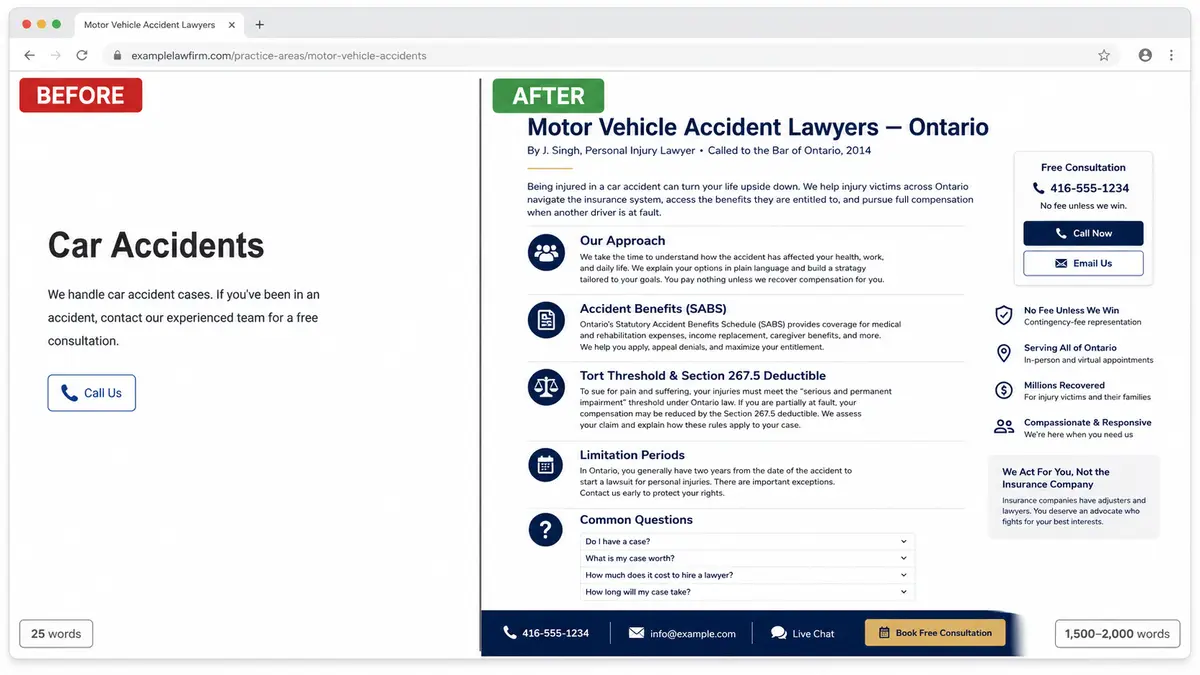
Add Experience signals:
- Named lead attorney with bio link, written in the form: "[Lawyer name] has represented [N]+ car accident victims across [region] since [year]"
- Include a "Our Approach" section that describes the firm's actual process for handling MVA claims
- Reference specific case types the firm handles: T-bone collisions, rear-end accidents, pedestrian accidents, motorcycle crashes
Add Expertise signals:
- Explain the accident benefits process under the SABS (Statutory Accident Benefits Schedule)
- Describe the tort threshold and Section 267.5 deductible
- Cover limitation periods (2 years for a lawsuit, 30 days for accident benefits application)
- Address common questions: "What if I was partially at fault?" "What if the other driver was uninsured?"
Add Authoritativeness signals:
- Link to the firm's relevant memberships (Ontario Trial Lawyers Association, OTLA)
- Reference any media mentions or legal publications that have cited the firm
- Include structured data (LegalService schema, FAQ schema)
Add Trustworthiness signals:
- Clear contingency fee explanation in the first few paragraphs
- Phone number and intake form prominently displayed
- Client review aggregate (e.g., "[X.X] stars from [N] Google reviews")
- "Last updated: [date]" to show the content is maintained
The rebuilt page might be 1,500 to 2,000 words. The original was 25. That's the difference between a page that ranks and a page that doesn't.
The 11-Item E-E-A-T Audit Checklist for Canadian Law Firm Websites
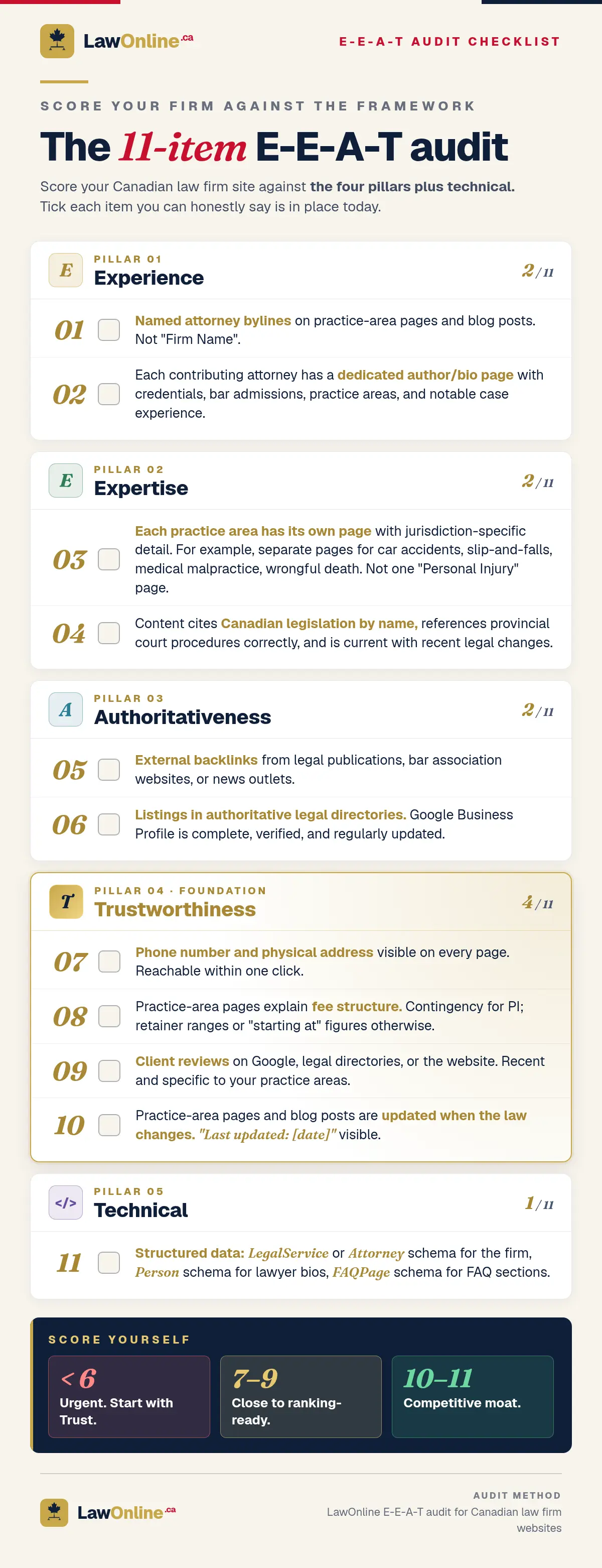
Use this E-E-A-T audit checklist for your law firm website to score yourself against the four pillars.
Experience
Named attorney bylines. Are practice area pages and blog posts attributed to named lawyers with relevant experience? If everything is published under "Firm Name," you're leaving experience signals on the table.
Author pages. Does each contributing attorney have a dedicated author/bio page that lists their credentials, bar admissions, practice areas, and notable case experience?
Expertise
Practice area depth. Does each practice area have its own dedicated page with jurisdiction-specific detail? A single "Personal Injury" page covering all subcategories signals less expertise than separate pages for car accidents, slip and falls, medical malpractice, and wrongful death.
Legal accuracy. Does your content cite relevant Canadian legislation by name? Does it reference provincial court procedures correctly? Is it current with recent legal changes?
Authoritativeness
External backlinks. Does your site have links from legal publications, bar association websites, or news outlets? If not, this is often the weakest pillar for small and mid-size firms.
Directory presence. Is your firm listed in authoritative legal directories? Is your Google Business Profile complete, verified, and regularly updated?
Trustworthiness
Contact information. Is your phone number, physical address, and email visible on every page? Can someone reach a human within one click from any page on your site?
Fee transparency. Do your practice area pages explain your fee structure? PI firms should explain contingency fees. Other practices should provide retainer ranges or "starting at" figures.
Reviews and social proof. Do you have client reviews on Google, legal directories, or your website? Are they recent and specific to the practice areas you're promoting?
Content freshness. Are your practice area pages and blog posts updated when the law changes? A page referencing a statute that's been amended signals neglect.
Technical
- Structured data and Core Web Vitals. Does your site use
LegalServiceorAttorneyschema for the firm,Personschema for lawyer bios, andFAQPageschema for FAQ sections? Structured data doesn't guarantee rich results, but it gives Google explicit machine-readable signals about your credentials, practice areas, and content structure. It's one of the few E-E-A-T signals you can implement in an afternoon. On the performance side, Google recommends keeping LCP under 2.5 seconds, INP under 200 milliseconds, and CLS below 0.1. A slow, janky site undermines trust regardless of how strong your content signals are.
Is E-E-A-T a Direct Google Ranking Factor?
Not directly. There's no single "E-E-A-T score" in Google's ranking algorithm, and no toggle you can flip to boost your rating. E-E-A-T is a framework used by Google's human quality raters to evaluate search results. Those evaluations inform how Google develops and tunes its algorithms, but they don't feed directly into real-time rankings.
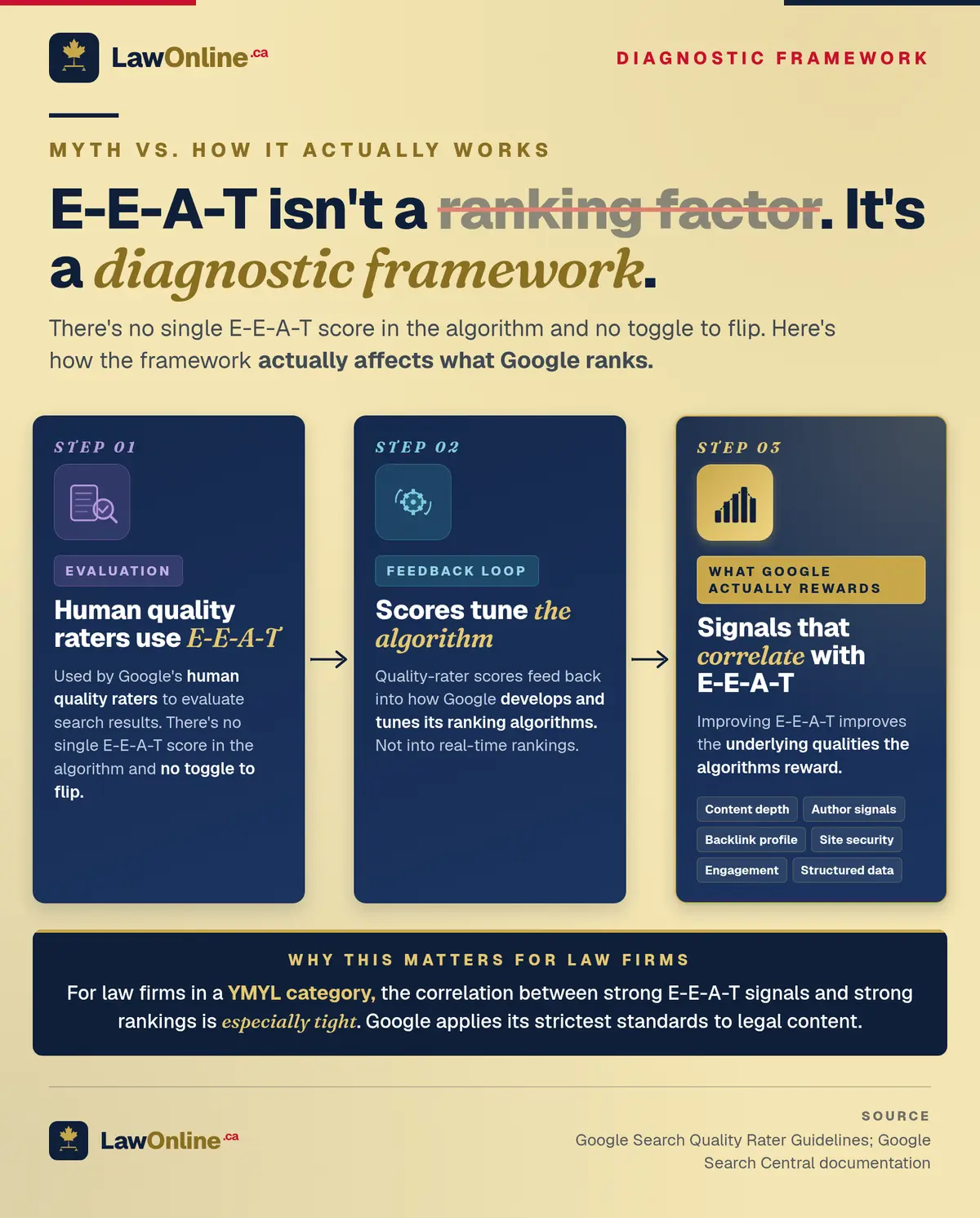
What Google does have are dozens of algorithmic signals that correlate with E-E-A-T qualities. Content depth, author signals, backlink profiles, site security, user engagement patterns, and structured data all contribute to how Google's systems assess whether a page deserves to rank for a given query. A 2026 analysis of ranking factors estimates that topical authority now accounts for roughly 13% of Google's algorithm weight, equal to backlinks. That's a meaningful shift: depth and relevance in a specific topic area now carries the same weight as external links.
The data also shows that surface-level metrics don't predict rankings the way many assume. A 2026 study by Custom Legal Marketing analyzed 2,418 ranking law-firm pages across eight practice areas and 24 major U.S. metropolitan areas. Their finding: word count explained less than 1% of ranking variation. Pages under 250 words actually outperformed pages in the 250-to-500-word range for top positions. The implication is clear. Google doesn't reward length. It rewards relevance, authority, and trust, which is what E-E-A-T measures.
The right mental model: E-E-A-T is a diagnostic framework, not a scoring system. If you improve your E-E-A-T signals, you're improving the same underlying qualities that Google's algorithms reward. For law firms in a YMYL category, the correlation between strong E-E-A-T signals and strong rankings is especially tight because Google applies the strictest standards to legal content.
How E-E-A-T Connects to AI Search Visibility
E-E-A-T isn't just about traditional search rankings anymore. AI search tools, including Google's AI Overviews, ChatGPT, and Perplexity, preferentially cite content from sources that demonstrate strong E-E-A-T signals. These AI systems rely on the same signal stack that informs Google's quality rater guidelines: content depth, author credentials, site authority, and trustworthiness markers.
This matters more than most firms realize. Research shows that 28.1% of consumers would now use ChatGPT to help find an attorney, up from 20.5% just a year earlier. But here's the critical nuance: more than 94% of those ChatGPT users also use Google. AI doesn't replace search. It supplements it. Prospective clients are checking both, which means your firm needs E-E-A-T signals strong enough to surface in both channels.
The broader search landscape reinforces this urgency. Current data shows 58.5% of Google searches now end without a click, and AI Overviews appear on up to 30% of queries. When Google answers the question directly on the results page, the only firms that get cited are those with content authoritative enough to be quoted. That's E-E-A-T in action.
When someone asks an AI assistant "How does the accident benefits process work in Ontario?", the AI pulls from sources it considers authoritative. Firms with strong E-E-A-T signals are more likely to be cited, which drives both brand visibility and direct traffic.
Our guide on generative engine optimization for Canadian law firms goes deeper on this topic, but the foundation is the same: E-E-A-T signals determine whether AI systems trust your content enough to reference it.
Frequently Asked Questions
Does Google directly measure E-E-A-T as a ranking factor?
Not directly. E-E-A-T is a framework used by Google's human quality raters to evaluate search results. Those evaluations inform Google's algorithm development, but there's no single "E-E-A-T score" in Google's ranking system. What Google does have are numerous algorithmic signals that correlate with E-E-A-T qualities: content depth, author signals, backlink profiles, site security, and user engagement metrics. Treating E-E-A-T as an optimization target rather than a ranking factor is the right mental model.
How important is E-E-A-T for personal injury law firms specifically?
Extremely important. PI content falls squarely into Google's YMYL category because inaccurate information about limitation periods, accident benefits, or legal rights could directly harm someone. Google applies its highest quality standards to this content. PI firms that invest in strong E-E-A-T signals (named lawyer bylines, jurisdiction-specific depth, case results, bar association backlinks) have a significant ranking advantage over firms relying on generic, thin content. Our deeper guide on personal injury law firm marketing in Canada covers how E-E-A-T fits into the broader PI client-acquisition picture.
Should every lawyer at the firm have their own author page?
Every lawyer who has a byline on content should have an author page. The page should include their bar admission, practice areas, notable experience, education, and links to their content. If your firm has lawyers who contribute content in specific practice areas, each should have a page that reinforces their expertise in that area. Author pages are a low-effort, high-impact E-E-A-T signal.
How long does it take to improve E-E-A-T signals?
Content depth and author signals can be improved in weeks to a few months. Authoritativeness, which depends on external validation (backlinks, media mentions, directory listings), typically takes 6 to 12 months to build meaningfully. Trustworthiness signals like contact information, fee transparency, and reviews can be improved immediately. The key is to treat E-E-A-T improvement as an ongoing process, not a one-time project.
Can small law firms compete on E-E-A-T with large firms?
Yes. Canadian Industry Statistics show that 74.4% of legal-services establishments with employees are micro-firms (fewer than five staff). Most of your competitors are in the same position you are. E-E-A-T advantages accrue to depth, not breadth. A solo PI practitioner in Hamilton who publishes 20 deeply researched, jurisdiction-specific articles about Ontario personal injury law can demonstrate stronger E-E-A-T signals in that niche than a national firm with 200 shallow pages across every practice area. Small firms compete by going deep in their practice area and their local market, not by trying to cover everything.
There's a practical dimension too. Clio's Legal Trends data shows lawyers still spend roughly two-thirds of their workday on non-billable tasks. For a solo or small firm, redirecting even a fraction of that time toward E-E-A-T fundamentals (author pages, deeper practice area content, structured data markup) creates a compounding advantage that larger firms often neglect in specific practice niches.