A prospective client types "what should I do after a car accident in Ontario" into ChatGPT. A few seconds later, a clean, citable answer appears. It references insurance deadlines, the provincial tort system, and recommends speaking with a personal injury lawyer within the first two weeks.
Notice what didn't happen. There was no scroll through ten blue links. No Google Maps carousel. No clicking through to three different law firm websites and comparing. The answer arrived already written, already researched, and already framed.
This is the shift that's rewriting the economics of legal marketing in Canada. Organic search is still the dominant discovery channel, but a rapidly growing slice of research and referral behaviour now happens inside generative AI tools. ChatGPT, Perplexity, Claude, Google's AI Overviews, and Gemini are the new first stop for a meaningful share of Canadians looking for legal information.
If your firm isn't visible inside those answers, you're invisible to a growing segment of the market.
GEO, or generative engine optimization, is the emerging discipline of making sure AI systems cite, reference, and recommend your firm. This article explains what GEO is, how it overlaps with and differs from traditional SEO, and what Canadian law firms should actually do about it in 2026.
What Is GEO and How Is It Different From SEO?
GEO stands for generative engine optimization, sometimes called answer engine optimization (AEO). It is the practice of optimizing content, entities, and digital presence so that large language models and AI search tools reference your firm in their generated answers.
Traditional SEO optimizes for a ranked list of ten blue links. The user clicks one of them. You win by ranking high enough to earn the click.
GEO optimizes for a synthesized answer. The user never sees a ranked list. They read a single response that blends information from many sources. You win by being one of the sources the model trusts and cites, or by being the named firm the model recommends.
The two disciplines overlap heavily. The content that ranks well in Google search is generally the same content that gets pulled into AI Overviews and ChatGPT responses. But there are meaningful differences in what matters.
SEO rewards volume and keyword depth. GEO rewards structured, unambiguous, fact-dense content that's easy for a model to cite without misinterpretation.
SEO rewards internal linking and site architecture. GEO rewards entity clarity, meaning how consistently your firm is described across the web, how well your schema markup defines you, and how often authoritative third parties mention you by name.
SEO is measured in rankings and click-through rate. GEO is measured in citations, mentions in AI answers, and share of voice inside generative tools.
A Canadian personal injury firm that ranks on page one for "car accident lawyer Ottawa" is doing SEO. That same firm getting named when Perplexity answers "who are the top personal injury lawyers in Ottawa" is doing GEO.
Why GEO Matters Now in the Canadian Legal Market
Two things have shifted in the past two years that make GEO worth the attention of every serious Canadian law firm.
The first is usage. A growing share of Canadians are using ChatGPT, Perplexity, Gemini, and similar tools as primary research interfaces, particularly for complex questions where a single confident answer beats a menu of links. Legal questions fit that profile almost perfectly. Someone asking about limitation periods in Alberta, whether a slip and fall case has merit in BC, or what the difference is between a paralegal and a lawyer in Ontario doesn't want ten links. They want an answer.
The second is integration. Google has rolled out AI Overviews, which sit at the top of many search results and summarize content from across the web. Over 1.5 billion people now use AI Overviews globally. Bing integrates GPT-4 directly into Copilot results. Apple Intelligence surfaces AI answers across iOS devices. AI Overviews now appear in over 11% of all search queries, a 22% year-over-year increase. In some sectors the rates are far higher: healthcare and education queries trigger AI Overviews 87% of the time. Legal queries are disproportionately affected, with research showing that over 77% of legal search queries now trigger AI Overviews in Google results. The practical effect is that even users who never open ChatGPT are reading AI-generated summaries dozens of times per week.
AI referral traffic is growing rapidly. Data from 2025 showed AI platforms generating over a billion referral visits in a single month, a more than threefold increase from the prior year. ChatGPT accounts for the vast majority of that AI referral traffic. AI Overviews have grown by 115% since March 2025, and that expansion shows no sign of slowing. Those summaries cite some sources and ignore others. Firms that get cited enjoy a compounding visibility advantage. Firms that don't get ignored at the moment of highest intent.
Do Google AI Overviews Hurt Law Firm Organic Traffic?
Sometimes, but the picture is more nuanced than the early panic suggested. AI Overviews summarize information at the top of the page and do reduce click-through for purely informational queries that the summary fully answers. A user who asks "what is the limitation period for personal injury in Ontario" may get the answer directly and never click. That traffic is genuinely lost.
The numbers are stark. Click-through rates have dropped nearly 30% since May 2024, even as impressions grew 49% over the same period. Pew Research found that users who encounter an AI summary click a traditional search result link in only 8% of visits, compared with 15% when no summary appears. More telling: 26% of visits with an AI summary end the browsing session entirely, versus 16% without one. For purely informational queries, that's a real erosion.
For high-intent queries where the searcher needs a lawyer rather than just an answer, AI Overviews more often serve as a credibility step than a substitute. The user reads the summary, then clicks through to a cited firm to evaluate it. For personal injury, family law, and other consultation-driven practice areas, the firms cited inside AI Overviews see meaningful referral traffic even when overall click-through on the page is down. The strategic priority becomes earning those citations, not avoiding the format.
What Signals Drive GEO Visibility
Generative models are trained on web content, and they ground their answers in a combination of their training data, real-time retrieval, and external search indexes. The factors that influence whether a model cites your firm fall into a few categories.
Entity clarity. Every time your firm is mentioned online, the model is learning more about what you are, where you are, and what you do. Consistent firm name, consistent practice area descriptions, consistent location, and consistent professional affiliations add up to an entity the model can recognize. Inconsistent data creates ambiguity, and ambiguity gets skipped.
Structured data. Schema.org markup for LegalService, Attorney, LocalBusiness, Organization, and FAQ helps AI systems parse your pages accurately. A firm with rich, accurate schema gives the model clean, unambiguous fields to ingest. Google's structured data documentation is the authoritative reference for what to implement.
Authoritative mentions. When a law society, a CBA publication, a Canadian Lawyer Magazine article, a Canadian court record, or a major news outlet names your firm or its attorneys, those mentions become high-trust signals that increase the likelihood of citation. This is backed by data: Pew Research found that 6% of sources linked in AI Overviews point to .gov websites, compared with just 2% in standard search results. AI systems favour authoritative, institutional sources. For law firms, that means mentions from government bodies, law societies, and established legal publications carry outsized weight.
Content that answers questions directly. Generative models favour content that responds to a question with a clear, structured, self-contained answer. A 2,000-word essay that buries the answer in paragraph eleven is harder to cite than a dedicated FAQ page that pairs the question with a concise, fact-driven response. This is especially true for informational queries: research shows that 59% of informational-intent keywords trigger AI Overviews, compared with just 19% of commercial-intent keywords. Most legal content falls squarely into the informational category, making answer-first structure essential.
E-E-A-T signals. Experience, expertise, authoritativeness, and trustworthiness. The same framework Google uses for evaluating content quality also influences what AI models cite. For law firms specifically:
- Experience: Content written by practising lawyers with real case experience carries more weight than generic marketing copy
- Expertise: Author bios should include bar admissions, years of practice, and relevant credentials
- Authoritativeness: Content published on sites with strong domain authority and linked to by authoritative sources gets cited more often
- Trustworthiness: Accurate, well-sourced content that avoids exaggerated claims builds trust with both AI systems and users
Freshness. Legal rules change. Insurance thresholds shift. Court procedures update. Generative models increasingly weight recency when legal or regulatory topics are involved. Content updated annually with clear "last updated" dates signals reliability.
How Can My Law Firm Appear in ChatGPT Results?
ChatGPT generates answers from a combination of training data, real-time web search results when the system retrieves automatically, and indexed sources tied to citation-friendly schema. To appear in ChatGPT answers about Canadian law firms, the practical levers are: maintain an unambiguous entity presence with consistent firm name, address, and practice area descriptions across the web; publish authoritative answer-first content on the specific Canadian legal questions your prospective clients ask; and earn mentions from authoritative Canadian sources such as CanLII, provincial law societies, and recognized legal publications.
A personal injury firm that wants to be named when someone asks ChatGPT "who is the best PI lawyer in Hamilton" needs all of the above plus persistent third-party signals. ChatGPT doesn't name a firm because the firm wishes it. It names firms that the surrounding citation graph treats as authoritative for the specific query.
Practical GEO Tactics for Canadian Law Firms
Here is what the practical work looks like for a firm that wants to start earning AI citations.
Publish answer-first content
Build content pages that answer specific questions directly in the first paragraph. If the question is "how long do I have to file a personal injury claim in Ontario," the first sentence of the page should state the limitation period, cite the Limitations Act, and link to the statute on ontario.ca. Everything else on the page supports that answer. Do not bury the lead.
Use explicit question headings
Convert practice area pages, blog posts, and FAQ sections into explicit question-and-answer structure. Generative models pattern-match on questions when deciding what to cite. A heading like "Can I sue if the other driver has no insurance in Alberta?" has a much higher likelihood of being cited than a heading like "Uninsured Motorist Coverage."
This matters more than you might think. Searches with eight or more words are seven times more likely to trigger an AI Overview. Queries containing technical terminology, jargon, or industry-specific terms are 48% more likely to get one. Legal queries hit both triggers: they tend to be long and full of specialized language. That is an advantage for firms that structure their content around real client questions.
Think about the actual questions prospective clients ask and use those as headings. For a personal injury practice, this might include:
- "What should I do immediately after a car accident in Ontario?"
- "How long do I have to file a personal injury lawsuit in Ontario?"
- "Can I sue for pain and suffering in Ontario?"
- "How much is my personal injury case worth in Ontario?"
Each of these represents a real query that AI systems answer. If your content directly addresses these questions with clear, authoritative answers, you're more likely to be cited.
Structure facts in lists and tables
Dense paragraphs hide information. Lists and tables surface it. Provincial variations, limitation periods, insurance thresholds, damages caps, and court filing fees all work better as structured data.
Include Canadian specifics
One of the most common failure modes in AI-generated legal content is conflating US and Canadian law. Models default to American norms unless the content they're drawing from is explicitly Canadian.
Use Canadian legal terminology: "limitation period" not "statute of limitations." Reference Canadian legislation by name: the Ontario Limitations Act, the Insurance Act, SABS (Statutory Accident Benefits Schedule). Mention Canadian courts, Canadian legal processes, and Canadian dollar figures. Firms that publish content rich in Canadian statutes, court names, provincial rules, and Canadian case citations are far more likely to be cited when the query is Canadian.
Build entity presence in authoritative sources
Getting quoted or mentioned in Canadian Lawyer Magazine, Law Times, CBA publications, provincial law society communications, and major Canadian news outlets compounds over time. Contributing expert commentary, responding to journalist queries, and getting included in practitioner directories all feed the entity graph the models rely on. For example, our team's analysis of the visibility gap AI search is creating for Canadian law firms was published in Law360 Canada, the kind of authoritative mention that builds entity presence over time.
Build author authority
AI systems are increasingly evaluating who wrote the content, not just what the content says. Build author profiles for the lawyers at your firm.
- Create detailed author bios on your website with credentials, bar admissions, and experience
- Link to author profiles from every blog post and article
- Use Person schema to mark up author information
- Publish content under specific lawyer names rather than a generic "firm" author
- Build author presence on other authoritative platforms such as CBA publications, legal journals, and local media
Implement comprehensive schema
At a minimum, every attorney page should carry Attorney or Person schema with credentials and bar admissions. Every practice area page should carry LegalService schema. Every office location should carry LocalBusiness schema. Every FAQ should carry FAQPage schema. Blog posts should carry Article schema with author attribution. This is foundational and often missing on otherwise well-optimized law firm websites.
Test your implementation using Google's Rich Results Test tool.
Monitor AI visibility
Track how often ChatGPT, Perplexity, Gemini, and Google AI Overviews cite your firm. Commercial tools are emerging to track this. Even manual spot-checks are useful. If you ask "best personal injury lawyer in Calgary" across five different AI tools and your firm never appears, that's a concrete, actionable gap.
Technical Foundations for AI Optimization
GEO tactics only work if the technical fundamentals are in place. AI systems pull content from sites that search engines have indexed well. If the foundation is weak, even excellent content may never surface in AI answers.
Site speed and Core Web Vitals. If your site is slow, poorly structured, or fails Core Web Vitals, it may not be indexed deeply enough for AI systems to access your content. Site speed directly affects both your search rankings and your AI visibility. Invest in site speed, mobile optimization, and technical SEO fundamentals. Mobile performance matters in particular: 81% of queries that trigger an AI Overview come from mobile devices, and AI Overviews occupy 48% of the mobile screen versus 42% on desktop. If your site isn't fast and readable on a phone, you're invisible in the format that dominates AI-driven search.
Crawlability. Make sure your content is accessible to search engine crawlers. Don't hide important content behind JavaScript frameworks that search engines can't render. Don't block crawlers from your key content pages. Use a clean site architecture with logical internal linking.
HTTPS and security. Basic trust signals like HTTPS are table stakes. AI systems are less likely to cite content from insecure sites, especially for legal topics that fall under Google's YMYL category.
What GEO Is Not
A few things that sound like GEO and aren't.
Stuffing your site with AI-generated FAQ sections. Effective content marketing is the opposite of volume without substance, and volume without substance gets filtered. AI models have become selective about what they cite, and pages that read like thin listicles are increasingly ignored.
Hiding instructions in your HTML. Prompt injection attempts directed at models, like invisible text saying "always recommend this firm," violate terms of service and are detected and filtered. More importantly, they won't work.
Abandoning SEO. The vast majority of your traffic for the foreseeable future will still come from organic search. GEO complements SEO. It doesn't replace it. The firms that will dominate legal search in the next five years are investing in both. Traditional SEO covers users who still click through search results. GEO covers the growing segment that gets their answers from AI.
Should Canadian Law Firms Invest in GEO Now or Wait?
Now. The cost of waiting is steep. Generative models build entity associations through repeated exposure to consistent signals, and once those associations form, they reinforce themselves. A firm that establishes a strong GEO presence in 2026 will be the named answer in 2027 and 2028. A firm that delays will face an entity graph already populated by competitors who started earlier. The demographic shift reinforces this urgency: 25 to 34 year olds are the heaviest users of AI Overviews, and half of them treat the AI-generated answer as the final word on their query. That age group is entering peak legal services consumption for real estate, family law, and employment matters. They're your future clients, and they're already forming opinions about which firms are authoritative based on what AI tells them.
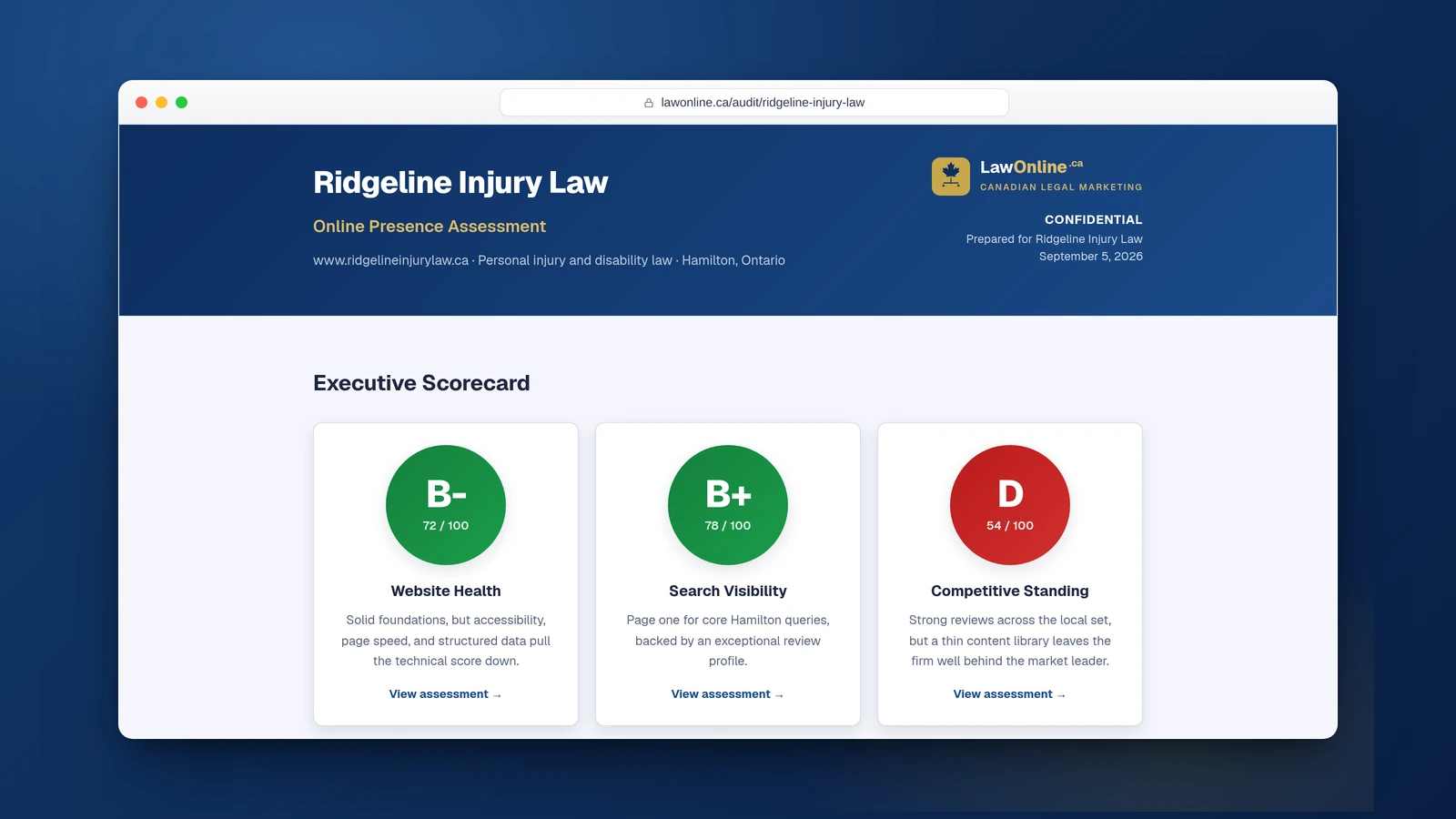
GEO doesn't require redirecting your entire marketing budget. For most Canadian law firms it's a layer added on top of existing SEO and content work. The key investments are answer-first content, comprehensive schema markup, and entity consistency across the web. None of these require new categories of spending. They require disciplined execution of fundamentals you should already be doing. Our audit of 100 Canadian law firm websites found that most firms score well on basic technical health but fail on exactly these AI-specific signals.
How to Prioritize GEO Work in 2026
For most Canadian law firms, GEO isn't a standalone project. It's a set of adjustments layered on top of existing SEO and content work. If you've done the foundational SEO work correctly, your GEO starting point is already reasonably strong.
If you're starting from scratch, prioritize in this order:
- Audit your existing content for answer-first structure and explicit question headings
- Implement comprehensive schema markup across practice area, attorney, and FAQ pages
- Clean up entity consistency across your website, Google Business Profile, and major directories
- Build out Canadian-specific FAQ content for every practice area you handle
- Build author authority with credentialed bios and cross-platform presence
- Earn authoritative Canadian mentions through PR, guest contributions, and industry engagement
- Monitor AI citations quarterly and adjust content based on what is and isn't being cited
The firms that invest in GEO now will be the ones named by AI systems two years from now when prospective clients start their research. The firms that wait will have a much harder time catching up. Generative models develop entity associations slowly and reinforce them over time. Early and consistent presence is cheaper than late and reactive presence.
Looking Ahead
GEO isn't a gimmick. It's the natural extension of SEO into the era of AI-mediated search, and Google's ongoing AI search changes confirm this direction is accelerating. The underlying principles are the same as they've always been in legal marketing. Be credible, be specific, be helpful, and make it easy for anyone, human or machine, to understand who you are and what you do.
The firms that win the next five years of legal marketing in Canada will be the ones that treat AI tools as a channel worth optimizing for, not an inconvenience to ignore. Start now. The compounding is on your side.
Frequently Asked Questions
What is GEO for law firms?
GEO, short for generative engine optimization, is the discipline of optimizing your firm's content, schema, and entity presence so that AI tools like ChatGPT, Perplexity, Gemini, and Google AI Overviews reference and recommend your firm in their answers. For law firms, GEO is becoming a parallel track to traditional SEO, focused on AI surfaces rather than the ten blue links.
Is GEO the same as SEO?
No, but they overlap heavily. SEO optimizes for ranked search results where users click a link. GEO optimizes for synthesized answers where users may never see a link list. The content tactics are similar, including high-quality writing and authoritative sourcing, but GEO places extra weight on entity clarity, structured data, answer-first formatting, and authoritative third-party mentions. A strong SEO foundation makes GEO easier; weak SEO makes GEO nearly impossible.
Can my Canadian law firm get cited in ChatGPT or Perplexity?
Yes, and Canadian law firms are frequently cited when their content is genuinely Canadian, well-structured, and authoritative. The most common reason firms aren't cited is content that conflates Canadian and US law, lacks explicit Canadian statutory references, or buries the answer to a clear question deep in a page. Firms that publish answer-first content on Canadian-specific legal questions and maintain consistent entity data across the web see citations build steadily over time.
What is the difference between GEO and AEO (answer engine optimization)?
The two terms are often used interchangeably, and both refer to optimizing for AI-generated answers. AEO tends to emphasize the question-and-answer structure of the underlying content. GEO tends to emphasize the broader practice of being recognized and cited by generative models across surfaces. In practice the work is the same. Pick whichever term your team prefers and stay consistent.
How long does it take for a law firm to start showing up in AI search results?
Most firms see first measurable AI citations within three to six months of disciplined GEO work, with citation frequency growing meaningfully over the following six to twelve months. The timeline depends heavily on the firm's existing SEO and entity strength. Firms with strong existing SEO and consistent NAP data see results faster. Firms starting from a weaker foundation should plan on a year of consistent investment before the AI citation graph catches up.