
How do you hire a legal content writer or content marketing agency for your law firm? Start by understanding what you actually need. Choosing the right content marketing agency for lawyers, or the right freelance writer, shouldn't feel like a gamble. Most firms that are unhappy with their content didn't hire the wrong person. They hired before they knew what "right" looked like.
A personal injury firm in Toronto that hires a generalist copywriter to write about accident benefits and tort thresholds will get content that's either legally inaccurate, too generic to rank, or both. A family law practice in Calgary that signs a six-month agency retainer without asking about the agency's compliance review process risks publishing content that violates Law Society of Alberta advertising rules.
The stakes are higher than most firms realize. Bad legal content doesn't just underperform. It can erode client trust, create regulatory risk, and damage your search rankings in ways that take months to recover from.
This guide walks through the decision, from deciding whether you need a writer at all to evaluating candidates, choosing between freelancers and agencies, and knowing what red flags to watch for.
The Decision Tree: Four Options for Law Firm Content
Before you start hiring, understand the options. Each has a cost, a quality ceiling, and a realistic time commitment.

Option 1: Do Nothing
This is the default for most Canadian law firms. No blog, no content strategy, no practice area page optimization. It's a viable short-term position, especially for firms with strong referral networks.
But data from the Law Society of Ontario shows how wide the gap is between "having a website" and "using it to attract clients." While 87% of Ontario sole practitioners have a website, only 29% use blogs or newsletters for practice development. Among firms with 2 to 10 lawyers, 49% produce blog content. For firms with 11 or more, it's 63% (LSO, 2022).
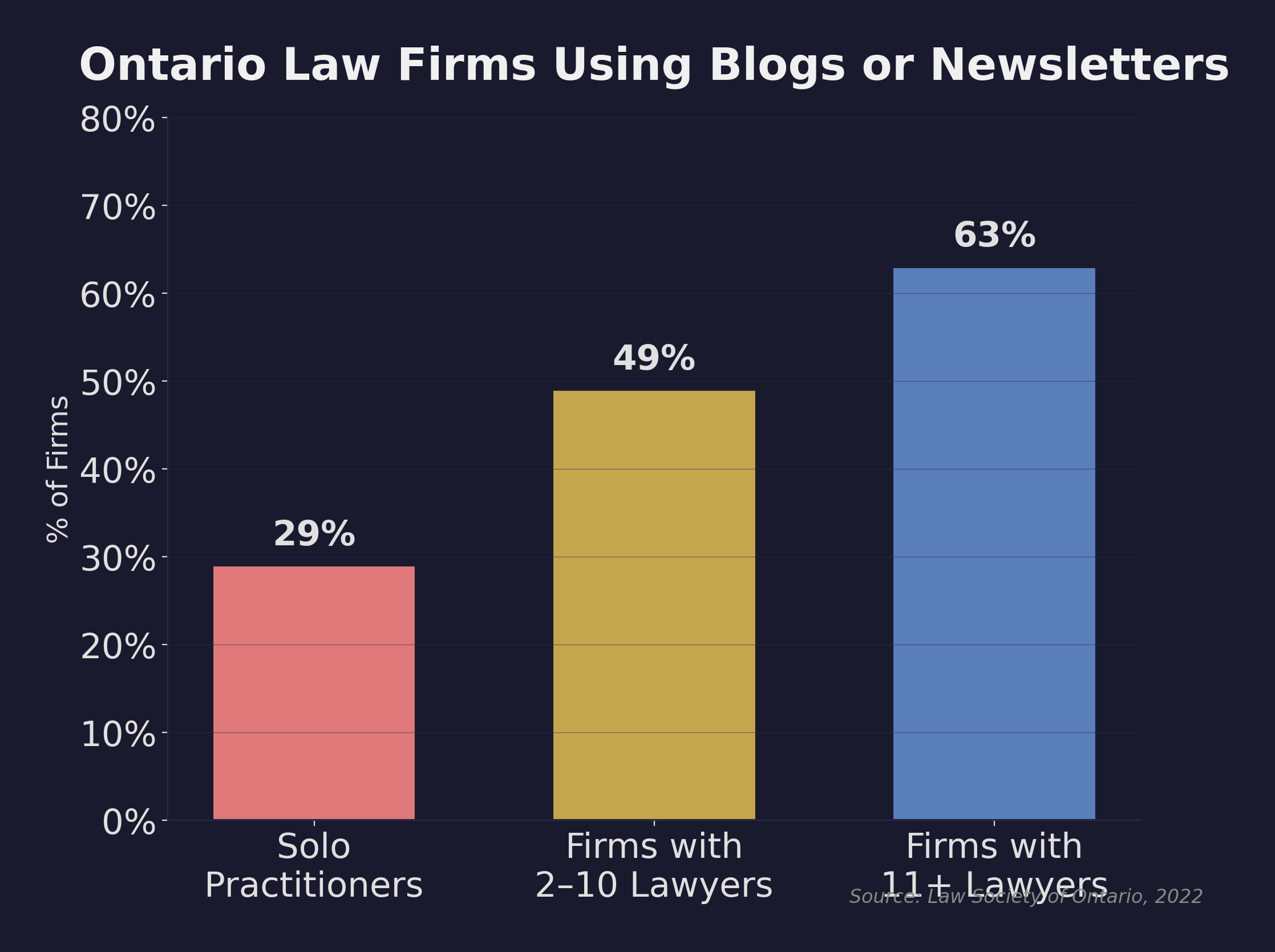
The larger the firm, the more likely it treats content as a core marketing activity. That means doing nothing doesn't just leave opportunity on the table. It means ceding search visibility to the growing number of competitors who are publishing. Every month without content is a month they own that traffic.
Option 2: Lawyers Write the Content Themselves
This captures the deepest expertise. Nobody understands your practice area better than the lawyers who handle these cases daily. A PI lawyer writing about the accident benefits process brings authentic, hard-earned knowledge.
The reality: most lawyers don't have the time. A 1,500-word blog post takes six to ten hours to research, write, edit, and optimize when done properly. At a $400/hour billing rate, that's $2,400 to $4,000 in opportunity cost per post. Very few firms can sustain this.
When it works: when a senior partner writes one to two thought leadership pieces per quarter and the firm supplements with professional writers for the rest.
Option 3: Hire a Freelance Legal Content Writer
A freelance writer who specializes in legal content can produce two to six posts per month at $300 to $1,000 per piece (depending on length, complexity, and the writer's experience). This is the most common entry point for firms testing content marketing.
Cost: $1,200 to $6,000 per month for a steady content calendar.
Advantages: Lower overhead than an agency. Direct relationship with the writer. Flexibility to scale up or down.
Limitations: A single freelancer handles writing, not strategy. You don't get keyword research, competitor analysis, editorial planning, performance reporting, or technical SEO support. You need someone at the firm to manage the content calendar, review for accuracy, and handle publication.
There's also a reliability dimension worth understanding. A 2026 survey of freelance writers found that only 22% report having predictable, consistent work. About 45% treat writing as supplementary income rather than a primary career, and 60% work ten hours per week or less. None of that makes individual freelancers unreliable. It means the pool is fragmented, and you need to vet for availability and commitment before signing someone on.
For a solo practitioner or small firm publishing two to four posts per month in a moderately competitive market, a good freelance law firm content writer is often the right starting point.
Option 4: Hire a Content Marketing Agency for Law Firms
A content marketing agency for lawyers handles the full pipeline: strategy, keyword research, editorial calendar, writing, SEO optimization, publication, and performance reporting. You provide direction and approve content; the agency handles execution. This model is more common than many firms realize: a 2026 industry survey found that 84% of companies outsource their content creation to freelancers or agencies.
Cost: $1,000 to $10,000 per month depending on scope, with price tiers reflecting differences in volume, strategy depth, and reporting cadence. Our guide to content marketing costs for law firms breaks down these tiers in detail.
Advantages: Integrated strategy. You get a team, not a single point of failure. Agencies that focus on law firms understand compliance requirements, competitive dynamics, and the nuances of legal search.
Limitations: Higher cost. Potential for less personalized attention unless you choose an agency that specializes in your firm's size. You'll need to evaluate the agency's legal expertise, not just its marketing credentials.
Why Most Law Firms Get Content Hiring Wrong
The problem isn't that content marketing fails. It's that most law firms make one of three false-economy decisions that doom their efforts before they start.

Hiring on Price Alone
A personal injury firm that hires the cheapest writer available might pay $80 for a 1,000-word blog post. That post will almost certainly be generic, lack jurisdiction-specific detail, and fail to rank. The firm publishes 12 of them over three months, spends $960, gets zero inquiries, and concludes that "content marketing doesn't work."
Meanwhile, investing $500 to $700 in a single well-researched post about Ontario accident benefits, written by someone who understands the legal landscape, could rank for years and generate dozens of inquiries.
Not Verifying Canadian Legal Knowledge
The majority of freelance legal writers available on platforms like Upwork, Fiverr, and Contently are based in the US or write primarily about American law. If your "Canadian" content references "states" instead of "provinces," cites the ABA instead of the Canadian Bar Association, or describes US court procedures, you've wasted your money. Worse, Canadian clients will notice immediately.
Skipping the Compliance Review Step
Every province has advertising rules that govern what law firms can say in their marketing. The Law Society of Ontario's advertising rules restrict testimonial use, require certain disclaimers, and limit comparative claims. Alberta and BC have similar requirements.
Content that violates these rules isn't just bad marketing. It's a regulatory risk. Any content production arrangement, whether freelance or agency, needs a built-in compliance review step where a lawyer at your firm reviews content before publication.
What to Look for in a Legal Content Writer or Content Marketing Agency
Whether you're evaluating a freelance legal copywriter, a law firm content writing specialist, or a full-service content marketing agency, here's what matters.

Canadian Legal Knowledge
The writer should be able to distinguish between provincial and federal jurisdiction on common topics. They should know that personal injury claims in Ontario are governed by different rules than claims in BC or Alberta. They should reference Canadian statutes, not American ones.
Practice Area Familiarity
Legal writing isn't monolithic. A writer who produces excellent immigration content might struggle with personal injury. The research demands, terminology, and audience expectations vary significantly between practice areas.
For PI firms: look for writers who understand accident benefits, tort thresholds, limitation periods, and contingency fee structures. For family law: look for familiarity with the Divorce Act, provincial family law statutes, and child support guidelines.
SEO Competence
Content that doesn't rank doesn't generate clients. At minimum, the writer should understand keyword targeting, heading structure, meta descriptions, and internal linking. Ideally, they should be able to identify target keywords for a given topic without being handed them.
Writing Quality
This seems obvious, but it's worth stating: the content should be well-written, clear, and free of jargon that a non-lawyer wouldn't understand. Prospective clients are the audience, not other lawyers.
Read the writer's samples as if you were a stressed person with a legal problem. Do the samples answer questions directly? Are they structured for scanning? Do they build trust?
Compliance Awareness
The writer doesn't need to be a regulatory expert, but they should know that law society advertising rules exist and that content needs to be reviewed for compliance. Writers who've worked with law firms before understand this. Writers who haven't will need training.
Agency-Specific Criteria: Evaluating a Legal Content Marketing Agency
If you're considering an agency rather than a solo writer, the evaluation expands. Ask about team size and whether you'll have a dedicated account manager or get rotated between junior writers. Monthly reporting should be standard, not optional: you want to see keyword rankings, traffic growth, and inquiry attribution, not just word counts.
The best legal marketing agencies integrate content with SEO and web design rather than treating them as separate services. An agency that handles keyword research, on-page optimization, and content strategy under one roof will produce more cohesive results than one that only writes blog posts and hands them off.
Canadian compliance workflow matters at the agency level too. The agency should have a documented process for routing content through a lawyer at your firm before publication. If they skip this step or treat it as your problem alone, they haven't worked with enough law firms to understand the risk.
Freelance Legal Content Writer vs. Content Marketing Agency: The Real Tradeoff
The freelance-vs-agency decision comes down to what you need beyond the writing itself. Here's how legal content writers and content marketing agencies for lawyers compare on the dimensions that matter for Canadian firms. For context on the cost spectrum: a full-time in-house content writer costs roughly USD $78,000 or more per year in salary alone, and building an in-house team of five runs over $400,000 annually before benefits, tools, and management overhead (OMNIUS, 2026). Both freelancers and agencies look more affordable by comparison.

| Factor | Freelance Writer | Content Marketing Agency |
|---|---|---|
| Monthly cost | $1,200 to $6,000 | $1,000 to $10,000 |
| Strategy and planning | You handle it | Included |
| Keyword research | You handle it (or request it) | Included |
| SEO optimization | Basic (varies by writer) | Comprehensive |
| Performance reporting | None | Monthly |
| Compliance process | You manage review | Built into workflow |
| Scalability | Limited by one person | Team-based |
| Firm management time | 4 to 8 hours/month | 1 to 2 hours/month |
For a PI firm spending $3,000+ per month on content and competing in a major market, an agency typically makes more sense. The strategy, keyword research, and performance reporting justify the premium.
For a smaller firm spending $1,000 to $2,000 per month and willing to manage the editorial calendar internally, a freelance writer offers better unit economics.
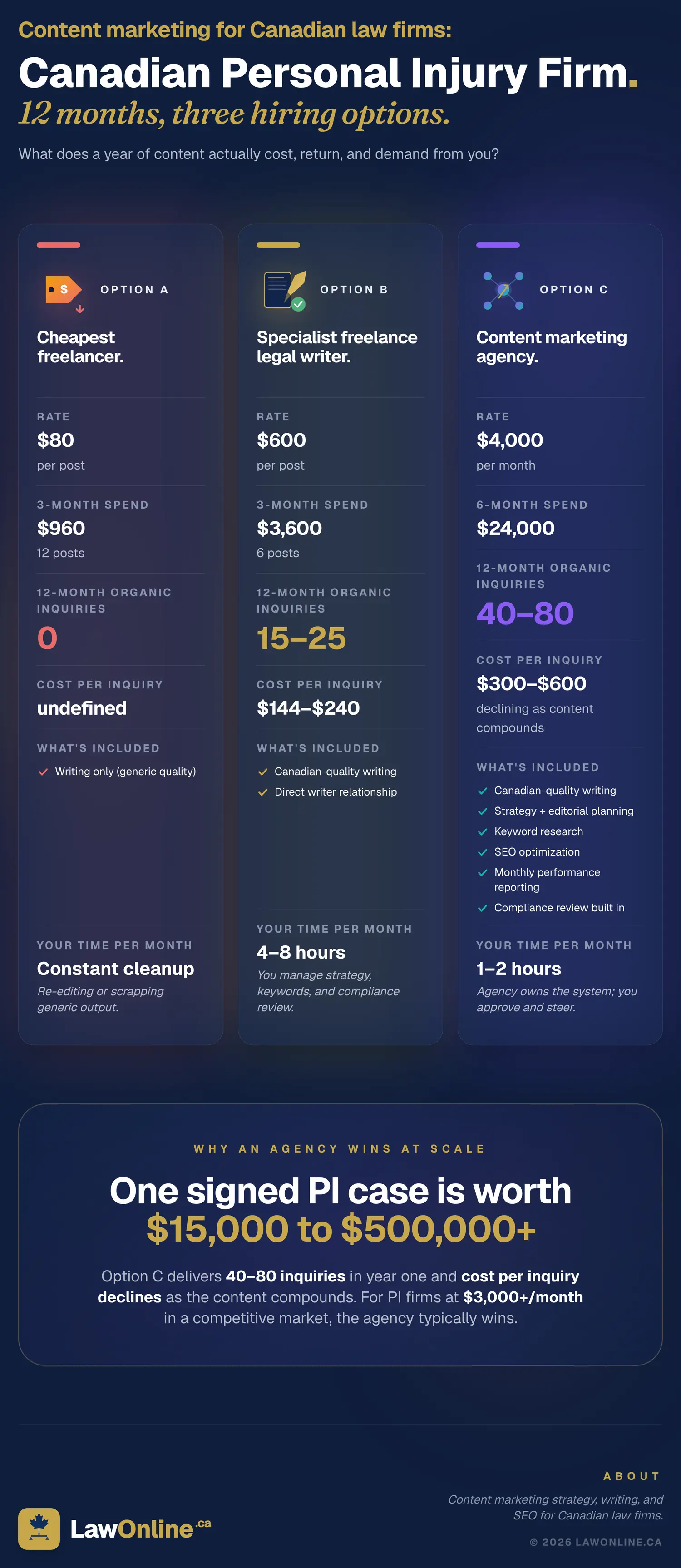
PI Case Example: Comparing Three Hiring Options
Consider a personal injury firm in Toronto that wants to publish content targeting "car accident lawyer Toronto" and related terms.
Option A: Cheapest freelancer ($80/post) The firm publishes 12 posts over 3 months. Total cost: $960. The posts are generic, lack Ontario-specific legal detail, and don't target specific keywords. After 6 months: zero organic traffic from these posts, zero inquiries. Cost per inquiry: undefined.
Option B: Specialist freelance legal writer ($600/post) The firm publishes 6 well-researched posts over 3 months. Total cost: $3,600. Each post targets a specific keyword, includes Ontario legal references, and is optimized for search. After 6 months: two posts begin ranking on page 1. After 12 months: 15 to 25 organic inquiries. Cost per inquiry: $144 to $240.
Option C: Content marketing agency for lawyers ($4,000/month) The firm runs a 6-month engagement. Total cost: $24,000. The agency handles strategy, keyword research, 8 to 10 pieces per month, and SEO optimization. After 6 months: multiple posts ranking, steady inquiry flow building. After 12 months: 40 to 80 organic inquiries. Cost per inquiry: $300 to $600 in year one, declining as content compounds.
The cheapest option costs the most. The mid-range freelancer delivers strong ROI if the firm can manage the strategy side. The agency delivers the highest volume but requires a larger upfront commitment.
All three scenarios assume a single signed PI case is worth $15,000 to $500,000+ in contingency fees. Even at the most conservative case value, Option B breaks even with a single signed client from 12 months of content.
Red Flags When Evaluating Legal Content Writers or Agencies
Watch for these warning signs during the evaluation process:
No Canadian legal writing samples. If every sample references American law, the writer won't produce content that resonates with Canadian clients or ranks for Canadian searches.
AI-only output. Some writers and agencies use AI tools to generate all content with minimal human editing. The output tends to be generic, occasionally inaccurate, and increasingly penalized by search engines. This matters because AI in content workflows is now mainstream: 76% of marketers who use generative AI apply it to content development and copywriting (OMNIUS, 2026). AI as a drafting aid is reasonable. AI as the primary content production method is a red flag. The distinction is whether a qualified human is shaping the strategy, verifying accuracy, and adding expertise that AI can't. Our analysis of AI-generated vs human-written content for law firms covers why this matters.
No compliance review process. If the writer or agency doesn't ask about your law society's advertising rules or doesn't have a process for legal review, they've never worked with a law firm before.
Promising specific rankings or traffic numbers. No writer or agency can guarantee that a piece of content will rank #1 or generate a specific number of leads. Anyone making those promises is either dishonest or inexperienced.
No portfolio or case studies. Writers and agencies doing good work can show it. If they can't share samples, writing assessments, or client references, proceed cautiously.
Volume-focused pitches. An agency pitching "50 blog posts per month" is selling quantity, not quality. Low-cost law firm copywriting services that promise unlimited posts almost always deliver thin, generic content. Four well-researched, strategically targeted posts will outperform fifty generic ones every time.

Questions to Ask a Legal Content Writer or Marketing Agency During Evaluation
Whether you're vetting a content writer for law firms or interviewing a legal content marketing agency, use these questions to evaluate candidates:
Can you show me Canadian legal content you've written? The single most important qualifying question. No Canadian samples, no hire.
How do you handle law society advertising compliance? The right answer involves a review step where a lawyer approves content before publication. The wrong answer is a blank stare.
What's your process for keyword research and SEO optimization? Writers should be able to explain how they identify target keywords. Agencies should walk you through their editorial planning process.
How do you handle practice-area-specific content? For PI content specifically: ask how they'd approach a post about Ontario accident benefits or limitation periods. The depth of their answer reveals their legal content experience.
What's your revision process? One to two rounds of revision should be standard. Unlimited revisions sounds generous but often means the first draft will be rough.
How do you measure success? Writers should care about whether their content ranks and drives inquiries, not just whether the client is happy with the prose.
Frequently Asked Questions
How do I find a legal content writer who knows Canadian law?
When you search for a legal content writer in Canada, start with agencies and freelancers that explicitly serve Canadian law firms. Check for portfolio samples that reference Canadian legislation, provincial court procedures, and specific Canadian regulatory bodies like the Law Society of Ontario or the CBA. Avoid writers whose portfolios are exclusively US-focused, even if they claim they can "adapt." The jurisdictional knowledge gap is real and affects both content quality and search performance.
Should a personal injury firm hire a freelancer or an agency for content?
It depends on budget and internal capacity. PI firms spending $3,000+ per month on content and competing in major markets like Toronto or Vancouver typically benefit from an agency that handles strategy, keyword research, and performance tracking alongside writing. Smaller PI firms or those in less competitive markets can get strong results from a specialist freelance writer at $500 to $800 per post, provided someone at the firm manages the editorial calendar and keyword targeting.
What's the difference between a legal content writer and a content marketing agency for lawyers?
A legal content writer handles the writing itself. You get articles, blog posts, and practice area page copy. You still need to handle keyword research, editorial planning, SEO optimization, and performance tracking on your own. A content marketing agency for lawyers covers the full pipeline: strategy, keyword targeting, writing, optimization, publication, and monthly reporting. The core tradeoff is control versus capacity. A freelance writer gives you more direct oversight at lower cost. An agency gives you a team and a system, but at a higher monthly commitment.
How much does a content marketing agency for lawyers cost in Canada?
Most content marketing agencies serving Canadian law firms charge $1,000 to $10,000 per month, with the range reflecting differences in content volume, strategy depth, and reporting frequency. A basic package with two to four blog posts per month and light SEO optimization typically runs $1,000 to $3,000. A comprehensive engagement with eight or more pieces per month, full keyword strategy, and detailed performance reporting falls in the $4,000 to $10,000 range. Our law firm content marketing cost guide breaks down these tiers in detail.
How many blog posts should a law firm publish per month?
Consistency matters more than volume. One to two well-researched, substantive posts per month is a realistic and effective starting point for most Canadian law firms. Firms in competitive practice areas (personal injury, criminal defence) or markets (Toronto, Vancouver) may need four to eight posts per month to build topical authority fast enough to compete. Our guide to content marketing for law firms covers how to build a sustainable publishing cadence. The right number depends on your practice area, market competition, and budget.
What should I expect to pay a freelance legal content writer in Canada?
Freelance legal content writers in Canada charge $0.30 to $0.80 per word for law-firm-specific content. That translates to roughly $300 to $800 for a 1,000-word blog post and $600 to $1,500+ for a 2,000-word guide. Entry-level freelancers charge less ($0.08 to $0.15 per word), but the quality gap is significant for legal content, where accuracy, jurisdiction-specific knowledge, and compliance awareness matter.
How do I know if my law firm's content marketing is actually working?
Track three metrics: organic traffic to content pages (via Google Analytics), keyword rankings for target terms (via any rank tracking tool), and qualified inquiries from organic search. If traffic is growing but inquiries aren't, the content is attracting the wrong audience or the conversion path needs work. Most firms should expect measurable traffic growth within four to six months and inquiry growth within seven to twelve months of consistent publishing.