
AI writing tools have made it cheaper and faster than ever to produce legal content. ChatGPT, Claude, Gemini, and dozens of specialized legal AI tools can draft a blog post, practice area page, or attorney bio in minutes. For law firms watching their marketing budgets, the appeal is hard to ignore.
But cheaper and faster does not mean better. And when it comes to legal content, "good enough" can quietly cost your firm the clients you never knew you lost.
This article breaks down where AI content falls short for law firms, where it can legitimately help, and why the most effective law firm content strategy in 2026 still depends on human expertise.
What We Mean by "Legal Content"
Before getting into the AI question, it helps to define what we're talking about. Legal content includes everything a law firm publishes to attract and convert potential clients online:
Practice area pages. These are the backbone of your website. A personal injury firm needs pages covering motor vehicle accidents, slip and falls, wrongful death, and each specific area the firm handles. These pages need to demonstrate genuine expertise, reference relevant legislation, and speak to the specific concerns of someone who just got hurt and is deciding whether to call a lawyer.
Blog posts. Regular articles that answer the questions potential clients are actually searching for. "How long does a personal injury claim take in Ontario?" or "What happens if the at-fault driver has no insurance?" Blog content builds organic search visibility over time and positions the firm as an authority.
Attorney bios. The page a potential client reads right before they decide whether to call. A bio needs to communicate experience, personality, and trustworthiness in a way that feels authentic.
Social media content. LinkedIn posts, Facebook updates, and other platform-specific content that keeps the firm visible between major marketing pushes.
Each of these content types has different requirements. What works for a quick social media post does not work for a practice area page that needs to rank in Google and convince someone to pick up the phone.
Why Google Cares About Who Writes Your Content
Google uses a framework called E-E-A-T (Experience, Expertise, Authoritativeness, Trustworthiness) to evaluate content quality. This matters for every website, but it matters significantly more for law firms.
Legal content falls under what Google classifies as YMYL: Your Money or Your Life. These are topics where bad information can cause real harm. Medical advice, financial guidance, and legal information all receive heightened scrutiny from Google's quality evaluation systems. Content in these categories needs to demonstrate that the author actually knows what they are talking about.
Here is the problem with AI-generated legal content: it cannot demonstrate experience. An AI tool has never represented a client in court. It has never navigated a contentious discovery process. It has never sat across from an insurance adjuster who is lowballing a settlement offer on a catastrophic injury claim.
When a personal injury lawyer writes about the challenges of proving liability in a multi-vehicle collision, that content carries weight because it comes from someone who has done it. When an AI generates the same content, it produces grammatically correct text that reads like a Wikipedia summary. It covers the topic without ever revealing that the author has actually been in the room.
Google's systems are getting better at distinguishing between these two types of content. Not because they can detect AI writing per se, but because AI-generated content tends to lack the specificity, nuance, and practical insight that characterizes genuine expertise. This is one of the reasons law firm SEO in Canada has shifted from keyword density to demonstrable expertise over the past several years.
The Data on AI Content for Law Firms
The conversation around AI content for law firms has generated real research at this point, and the findings are instructive.
A 2026 study published by Law Firm Newswire found that purely AI-generated content showed no statistically significant ranking advantage over human-written content. More revealing was the performance over time: AI-only content tended to rank comparably in the short term but slid in rankings over a six-month period. The content that performed best was a blend of AI-assisted drafting with substantial human editorial oversight, with posts using 26-50% AI input achieving an average ranking position of 2.83.
This aligns with what Google has communicated publicly. There is no blanket penalty for AI-generated content. But there is a quality bar, and content that fails to meet it gets filtered out over time regardless of how it was produced.
The practical takeaway: AI content can rank initially because Google has not yet fully evaluated it. But as the algorithms gather user engagement signals (how long visitors stay, whether they click through to other pages, whether they return to the search results and click a different link) thin content drops.
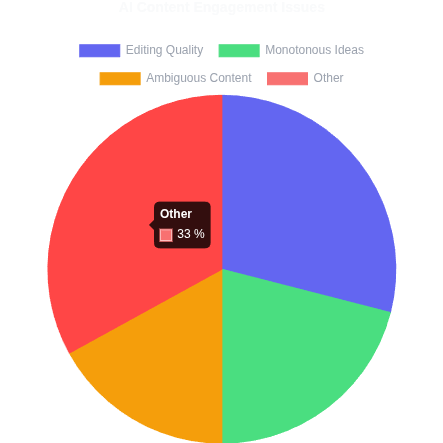
Research into engagement with AI-generated content has identified the specific failure modes behind that drop. A 2025 study published in the Journal of Theoretical and Applied Information Technology found that 29% of engagement issues with AI-generated content trace back to suboptimal editing quality, 21% to monotonous ideas, and 17% to ambiguous phrasing. Those are the same patterns that make an insurance adjuster, opposing counsel, or a prospective client close the tab.
Where AI Content Falls Short for Law Firms
The problems with AI-generated legal content are specific and predictable. Understanding them helps explain why the "just use ChatGPT" approach consistently underdelivers.
Accuracy and Jurisdiction
AI models are trained on broad datasets that mix jurisdictions, outdated statutes, and sometimes outright errors. A personal injury practice area page generated by AI might reference limitation periods, damages caps, or procedural rules that apply in another province or country entirely.
For a firm in Ontario, the content needs to reflect the Ontario-specific legislative framework: the two-year limitation period under the Limitations Act, the threshold for general damages under the Insurance Act, the accident benefits regime, and the specific court rules that govern how personal injury claims proceed. AI tools frequently get these details wrong, and the errors are often subtle enough that a non-lawyer reviewer would miss them.
This is not a minor inconvenience. Publishing inaccurate legal information on your firm's website creates liability exposure and damages credibility with the exact audience you are trying to reach: people sophisticated enough to notice when something does not sound right.
Tone and Voice
AI-generated content has a recognizable quality to it. The sentence structures are uniform. The tone is blandly authoritative without being specific. It reads like it was written by someone who studied the topic for fifteen minutes rather than someone who practices in the area daily.
Lawyers and their potential clients both notice this. A personal injury client dealing with a serious injury is not looking for a generic overview of negligence law. They want to feel like the lawyer on the other end of the phone has handled situations like theirs before. Content that reads like it was assembled from search results does not build that confidence.
Academic research reinforces the credibility gap. A 2025 study presented at the Marketing Trends Congress, based on 271 survey responses, found that when audiences identified material as AI-generated, perceptions of authenticity, credibility, creativity, and originality all dropped compared to content produced by humans. For law firms, credibility is not a nice-to-have. It is the entire product being sold before the first call.
Missing Local Context
A family law firm in Calgary operates in a different environment than one in Toronto or Halifax. The courts are different. The judges have different tendencies. The local legal community has its own dynamics. This kind of context is what separates genuinely useful content from surface-level coverage.
AI tools have no access to this information. They cannot tell you that a particular courthouse has a six-month wait for case conferences, or that a specific region has a shortage of duty counsel, or that local practice norms differ from what the textbook says. This is exactly the kind of detail that demonstrates real expertise to both Google and potential clients.
The Compounding Problem
One AI-generated blog post might not cause visible harm. But law firm content marketing is a long-term strategy. Firms that publish regularly build topical authority over time. That authority is what pushes them to the top of search results.
When a firm publishes twenty AI-generated posts, the cumulative effect is a website full of content that says roughly the same things in roughly the same way as every other firm using the same tools. There is no differentiation. There is no voice. And there is no competitive advantage.
Where AI Can Legitimately Help
This is not an argument that AI has no place in legal content creation. Used properly, AI tools can make the content process more efficient without sacrificing quality.
Research and outline generation. AI is good at synthesizing information quickly. Using it to generate an initial outline, identify subtopics, or compile research notes can save significant time. The human writer then brings expertise, voice, and accuracy to the actual draft.
First-draft acceleration. For lower-stakes content like internal newsletters, social media captions, or event announcements, AI can produce a workable first draft that a human editor refines. The key is that someone with actual knowledge reviews and revises the output.
Editing and proofreading. AI tools can catch grammatical errors, suggest clearer phrasing, and flag inconsistencies. This is a legitimate use case that improves efficiency without introducing the risks associated with fully AI-generated content.
The common thread: AI works best as a tool in the hands of someone who already knows the subject matter. It fails when it replaces that person entirely.
Content Types and the AI Suitability Spectrum
Not all legal content carries the same risk when AI is involved. Here is how different content types break down.
Practice area pages: Low AI suitability. These pages need to demonstrate deep expertise, reference jurisdiction-specific law, and convert visitors into leads. They are the pages Google scrutinizes most heavily under E-E-A-T. AI can help with research, but the writing needs to come from someone who understands the practice area.
Blog posts: Moderate AI suitability with heavy oversight. Blog posts cover a range of topics and complexity levels. A post answering a straightforward procedural question ("How do I file a small claims court action in Ontario?") can lean more heavily on AI-assisted drafting. A post analyzing recent case law or offering strategic advice needs substantially more human input.
Attorney bios: Very low AI suitability. A bio needs to sound like the actual lawyer. AI-generated bios are immediately recognizable. They are generic, they overuse superlatives, and they fail to communicate anything that distinguishes one lawyer from another. These should always be written by a human, ideally with input from the lawyer themselves.
Social media: Higher AI suitability. Short-form content for social platforms is lower stakes and higher volume. AI can draft social posts that a human reviews for tone and accuracy. The risk of harm is lower because social content is ephemeral and does not carry the same SEO weight.
What a Law Firm Content Strategy Actually Looks Like
Effective content marketing for law firms is not about volume. Publishing three well-researched, expertly written articles per month will outperform thirty AI-generated posts every time.
A real content strategy starts with understanding what your potential clients are searching for. For a personal injury firm, that means identifying the questions people ask after a car accident, a workplace injury, or a medical malpractice incident. Then creating content that answers those questions with genuine authority.
It means having someone who understands both the law and SEO write content that serves both audiences: the human reader who needs helpful information, and the search engine that needs clear signals about expertise and relevance.
It means building topical authority systematically, with practice area pages supported by blog content that covers related subtopics in depth. Each piece of content strengthens the others. This is how a well-planned content architecture generates compounding returns over time.
And it means reviewing and updating content regularly. Legal information changes. Statutes get amended. New case law shifts the landscape. A piece of content that was accurate when published can become misleading six months later. AI tools do not flag these changes. A human expert does.
The Bottom Line
AI content tools are useful. They are not a replacement for expertise.
For Canadian law firms competing online, the content on your website is one of your most important marketing assets. It determines whether Google shows your firm to potential clients. It determines whether those potential clients trust you enough to call. And it shapes the long-term authority your firm builds in its practice areas.
Publishing AI-generated content without expert oversight is a shortcut that saves money in the short term and costs visibility in the long term. The firms that invest in quality, human-informed content will continue to outperform those that do not.
If you are evaluating your firm's content strategy, the question is not whether to use AI at all. It is whether you have the expertise in-house to use it effectively, or whether that expertise is better sourced from a team that understands both legal marketing and the content standards that Google rewards. The same question comes up in the DIY website vs. marketing agency debate: the tools are accessible, but knowing how to use them well is where results come from.