
AI is changing how people find lawyers. Google's AI Overviews, ChatGPT, and Perplexity are answering legal questions directly, and they're choosing which law firms to cite based on signals most firms have never thought about.
We wanted to know: how ready are Canadian law firm websites for this shift?
So we audited 100 of them. This audit measures AI search visibility for Canadian law firms, specifically what AI systems see when they decide which firms to cite.
Using the LawOnline AI Readiness Checker, we crawled and scored law firm websites across 9 provinces, 18 cities, and 10 practice areas. The tool evaluates 73 checks across 6 categories, with a heavy emphasis on the structural and content signals that AI systems use to decide which sources to trust and cite.
All 100 firms were successfully audited. What follows is the most comprehensive Canadian law firm website audit for AI readiness that anyone has published.
The short version: the average firm scores a B, but that grade is masking serious structural gaps in the signals that actually matter to AI.
Table of Contents
- The Headline Numbers
- How We Measured AI Readiness
- Overall Score Distribution
- The Six Categories: Where Firms Succeed and Fail
- AI Infrastructure Deep Dive: The Six Sub-Categories
- Scores by Practice Area
- Firm Size and AI Readiness: The Big Firm Gap
- Scores by Province and City
- Domain Authority vs. AI Readiness: Why Backlinks Don't Help
- The Big Firm Problem
- What the Top Performers Do Differently
- The Five Most Common AI Readiness Failures
- Top 10 and Bottom 10 Firms
- What AI Readiness Means for Your Law Firm
The Headline Numbers
Before we dig into the details, here's what the data shows at a glance:
- Average AI readiness score: 75.2 out of 100 (B). The median is 78. Scores ranged from 40 to 89.
- 13 firms earned an A grade (85+). No firm scored 90 or above. The top performer is Valent Legal in Halifax, a personal injury firm, with an 89.
- AI Infrastructure (avg 68.2) trails Technical Health (avg 82.4) by 14.2 points. Firms are building technically sound websites that AI systems struggle to understand.
- LLM Formatting is the weakest AI sub-category at 56.0. Entity Authority (56.4) is nearly as low. These are the signals AI systems use to parse answers and verify credibility.
- Large firms score the worst. The 7 large firms averaged 66.6, while mid-size firms averaged 79.0.
- Personal injury firms lead the pack at 78.0 average. Corporate/business firms trail at 67.4.
How We Measured AI Readiness
We selected 100 Canadian law firms to represent a realistic cross-section of the market. Personal injury firms were intentionally over-represented (42%) because PI is the most competitive practice area for online marketing, which makes it the most useful benchmark.
| Practice Area | Firms Audited | % of Sample |
|---|---|---|
| Personal Injury | 42 | 42% |
| Family Law | 20 | 20% |
| Criminal Defence | 8 | 8% |
| Corporate/Business | 8 | 8% |
| Immigration | 6 | 6% |
| Employment | 5 | 5% |
| Real Estate | 5 | 5% |
| Estate/Wills | 2 | 2% |
| Intellectual Property | 2 | 2% |
| Tax | 2 | 2% |
The remaining 58% spans 9 other practice areas across every major market in Canada. Firms were distributed across 9 provinces, 18 cities, and 4 size categories (solo, small, mid, large). No firms from the territories were included.
Each website was crawled for up to 14 pages: homepage, practice area pages, blog posts, attorney bios, contact page, reviews/testimonials page, and office subpages. The audit evaluated 73 individual checks across six scoring categories:
- AI Infrastructure (35% weight) - 6 sub-categories measuring how well AI systems can find, read, and understand your content
- Trust & Credibility (15% weight) - reviews, testimonials, credentials, awards
- Practice Area Optimization (14% weight) - how clearly services are described
- Local SEO (13% weight) - geographic signals and local search optimization
- Content & Authority (13% weight) - depth, originality, and usefulness of content
- Technical Health (10% weight) - speed, mobile responsiveness, security
A few caveats worth noting. The audit measures what's publicly visible. Internal systems, CRM integrations, and offline marketing don't factor in. Domain authority data comes from Open PageRank (0-10 scale), so it's directional rather than current. And the audit crawls up to 14 pages per site. For solo and small firms, that often represents most of the website. For large firms with hundreds of pages, it's a fraction. But the categories where large firms score worst (AI Infrastructure, Local SEO) are structural and site-wide. A larger crawl wouldn't change those numbers.
Overall Score Distribution
| Grade | Score Range | Firms | % |
|---|---|---|---|
| A | 85-89 | 13 | 13% |
| A- | 80-84 | 27 | 27% |
| B+ | 77-79 | 16 | 16% |
| B | 73-76 | 14 | 14% |
| B- | 70-72 | 6 | 6% |
| C+ | 67-69 | 4 | 4% |
| C | 60-66 | 13 | 13% |
| D | 50-59 | 5 | 5% |
| F | Below 50 | 2 | 2% |
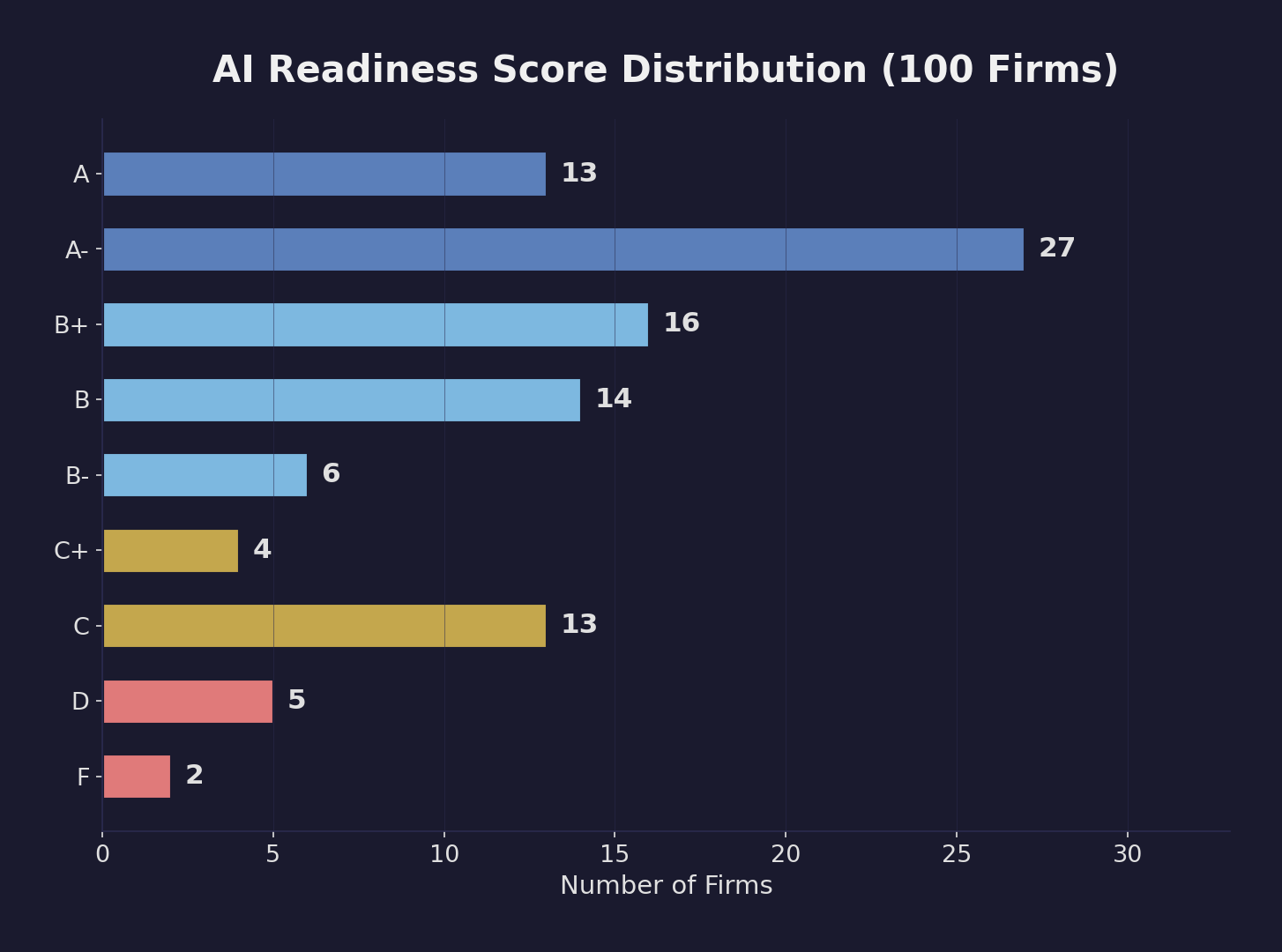
40% of firms scored in the A range (80+). That's the good news. The distribution clusters in the upper-middle: 76 of 100 firms scored 73 or above, earning at least a B.
The bottom of the distribution tells a different story. 7 firms scored below 60 (D or F). The lowest score was 40, earned by Haller Law in Moncton, a solo family law practice.
What do these grades mean in practical terms?
A range (80+): AI systems will reliably find, understand, and cite your content. You're visible in AI search.
B range (70-79): Good foundation. AI systems can work with your site, but competitors with better structure will be cited first.
C range (60-69): Inconsistent. Some AI tools will surface your content, others won't. You're losing visibility you don't know about.
D and F (below 60): Significant gaps. Your website is effectively invisible to most AI-powered search tools.
The Six Categories: Where Firms Succeed and Fail
| Category | Average | Weight |
|---|---|---|
| Practice Area Optimization | 88.1/100 | 14% |
| Technical Health | 82.4/100 | 10% |
| Content & Authority | 82.0/100 | 13% |
| Trust & Credibility | 77.9/100 | 15% |
| AI Infrastructure | 68.2/100 | 35% |
| Local SEO | 65.0/100 | 13% |
Technical Health isn't the problem. At 82.4 average, Canadian law firms have largely solved the basics: site speed, mobile responsiveness, HTTPS. Modern hosting platforms and CMS tools have commoditized technical health. As Google's own performance documentation notes, these fundamentals are table stakes.
AI Infrastructure is the weakest weighted category. At 68.2 average and carrying 35% of the total score, it's the single biggest drag on overall grades. This is the category that measures whether AI systems can actually parse your content, and it trails Technical Health by 14.2 points. Most firms have websites that work fine for humans but are structurally opaque to AI.
Local SEO is the weakest category overall. At 65.0, it trails Technical Health by over 17 points. Given that legal services are inherently local, this is a significant missed opportunity. When someone asks ChatGPT for "a personal injury lawyer in Calgary," the AI needs clear geographic signals to know your firm serves that market.
Trust & Credibility improved significantly in this audit. At 77.9 average, trust signals are stronger than we initially expected across the Canadian legal market. Firms that display client testimonials, Google reviews, team credentials, and professional memberships consistently outperform those that don't.
AI Infrastructure Deep Dive: The Six Sub-Categories
The AI Infrastructure category score (avg 68.2) breaks down into six sub-categories. This is where the real story emerges.
| Sub-Category | Average | What It Measures |
|---|---|---|
| Technical Access | 88.8/100 | Crawlability, robots.txt, server response |
| Discoverability | 77.7/100 | Indexability, AI crawler access, OG cards, sitemap |
| Content Clarity | 66.9/100 | Reading ease, sentence structure, direct-answer statements |
| Schema | 63.5/100 | JSON-LD structured data, legal industry schema |
| Entity Authority | 56.4/100 | Author/org schema, citable facts, review schema |
| LLM Formatting | 56.0/100 | Heading hierarchy, FAQ blocks, lists, semantic HTML |
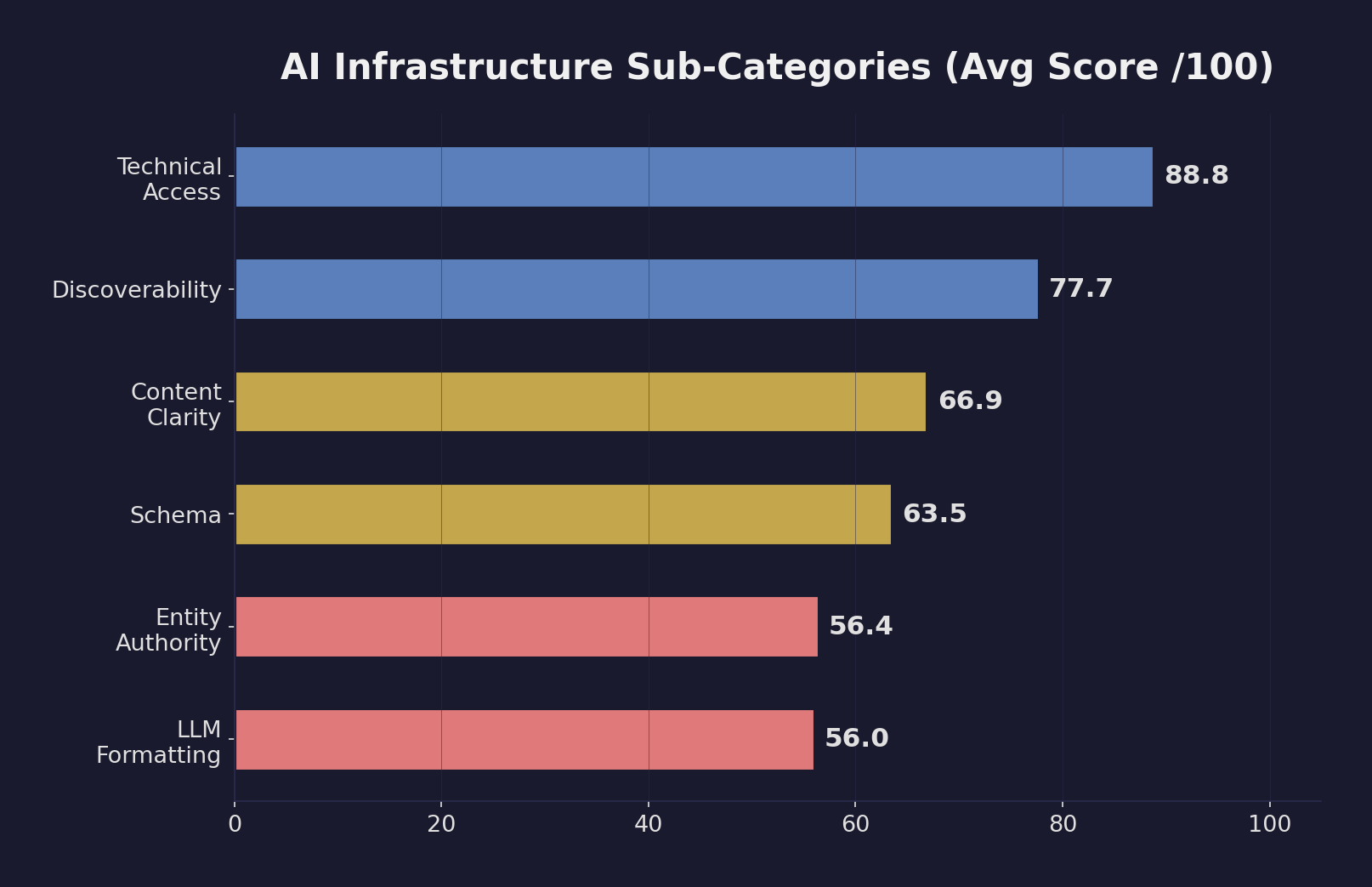
The pattern is stark. The plumbing works. The signals don't.
Technical Access (88.8) and Discoverability (77.7) tell us that AI systems can reach these websites without issue. Robots.txt files are properly configured. Sitemaps exist. Pages are crawlable. The problem is what AI finds when it gets there.
LLM Formatting is the weakest sub-category at 56.0. This measures whether content is structured with proper heading hierarchies, FAQ blocks, data tables, lists, and semantic HTML that language models can parse into clean answers. Most law firm websites are built as visual experiences. The content looks polished to a human visitor but gives AI systems no structural cues about what's important, what's a question, and what's an answer.
Entity Authority signals are nearly as weak at 56.4. This measures whether the site communicates who the lawyers are, what their credentials are, and what the firm's expertise is in a machine-readable way. Many firms have "About" pages with partner names but no structured data that AI systems can parse. These are the signals AI systems use to determine whether your firm is a credible source worth citing in AI Overviews and ChatGPT responses.
Schema markup remains a major gap at 63.5. Without structured data, AI systems must guess what your site is about by parsing raw HTML. They can do it. They do it poorly and they do it less often.
The 80/20 of AI Infrastructure
The top of this chart (Technical Access, Discoverability) reflects investments firms have already made through competent web hosting and modern CMS platforms. The bottom (LLM Formatting, Entity Authority, Schema) reflects investments almost nobody has made yet.
That's actually good news for firms willing to act. The gap between the middle of the pack and the top is small enough to close quickly with deliberate effort.
The firms pulling ahead are the ones that have:
- Implemented schema markup (Organization, Person, LegalService, FAQPage)
- Structured content with clear headings, FAQ blocks, and semantic HTML
- Published clear author attribution with credentials
None of these changes are expensive. They're strategic.
Scores by Practice Area
| Practice Area | Firms | Average Score |
|---|---|---|
| Employment | 5 | 79.6 |
| Personal Injury | 42 | 78.0 |
| Criminal Defence | 8 | 76.4 |
| Immigration | 6 | 75.5 |
| Family Law | 20 | 73.7 |
| Real Estate | 5 | 72.2 |
| Estate/Wills | 2 | 70.5 |
| Tax | 2 | 69.0 |
| Corporate/Business | 8 | 67.4 |
| Intellectual Property | 2 | 65.0 |
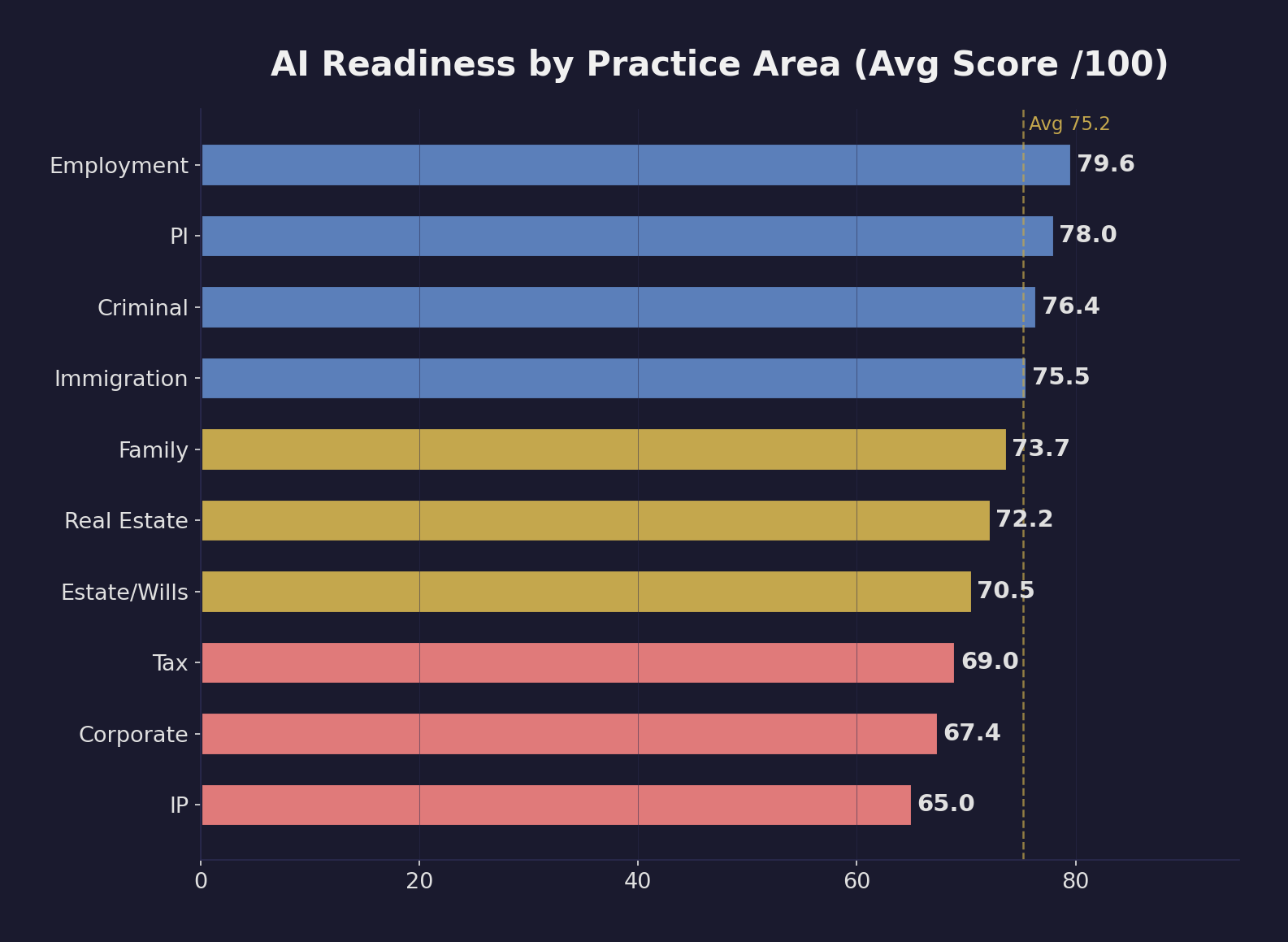
Why Personal Injury Firms Lead
PI firms consistently outperform, and the explanation is straightforward: competition. Personal injury is the most lucrative practice area for online client acquisition. Contingency fees and high case values mean PI firms invest more in digital marketing than any other practice area. That investment shows up everywhere.
PI firms in this audit averaged 82.3 on Trust (vs. 77.9 nationally), 88.0 on Content (vs. 82.0 nationally), and 70.5 on AI Infrastructure (vs. 68.2 nationally). They display client testimonials, case results, and professional certifications far more consistently than other practice areas. They publish more blog content, FAQ pages, and educational resources.
A personal injury firm writing about "what to do after a car accident in Ontario" is naturally producing the kind of question-and-answer content that AI systems love to surface. Firms like Valent Legal (89, A), Preszler Law (88, A), and Neinstein (88, A) have invested in digital marketing for years and it shows in their AI readiness scores.
The Corporate/Business Deficit
Corporate firms score 7.8 points below the national average and trail PI firms by over 10 points.
The gap is concentrated in two areas. Corporate firms averaged 59.1 on AI Infrastructure (vs. 68.2 nationally) and 66.5 on Trust (vs. 77.9 nationally). These firms rely on reputation and referrals, not website trust signals. They rarely display reviews, testimonials, or awards.
This is rational for now. BigLaw generates business through relationships, reputation, and RFPs. Nobody at Torys is worried about someone Googling "corporate lawyer Toronto." But AI search is growing rapidly. When in-house counsel start asking ChatGPT for outside counsel recommendations on a specific type of matter, the firms with AI-readable websites will be the ones that get cited.
Employment Law: The Quiet Winner
Employment law firms posted the highest overall average (79.6) of any practice area. With only 5 firms in the sample, this isn't statistically definitive. But the pattern is notable.
Employment firms tend to publish high-quality educational content about employee rights, wrongful dismissal, and severance. They maintain strong author attribution. And they build content that directly answers the questions employees search for. That content strategy aligns naturally with what AI systems are looking for: authoritative, question-driven content from credible sources.
Firm Size and AI Readiness: The Big Firm Gap
| Firm Size | Firms | Average Score |
|---|---|---|
| Mid | 23 | 79.0 |
| Small | 66 | 75.1 |
| Solo | 4 | 71.3 |
| Large | 7 | 66.6 |
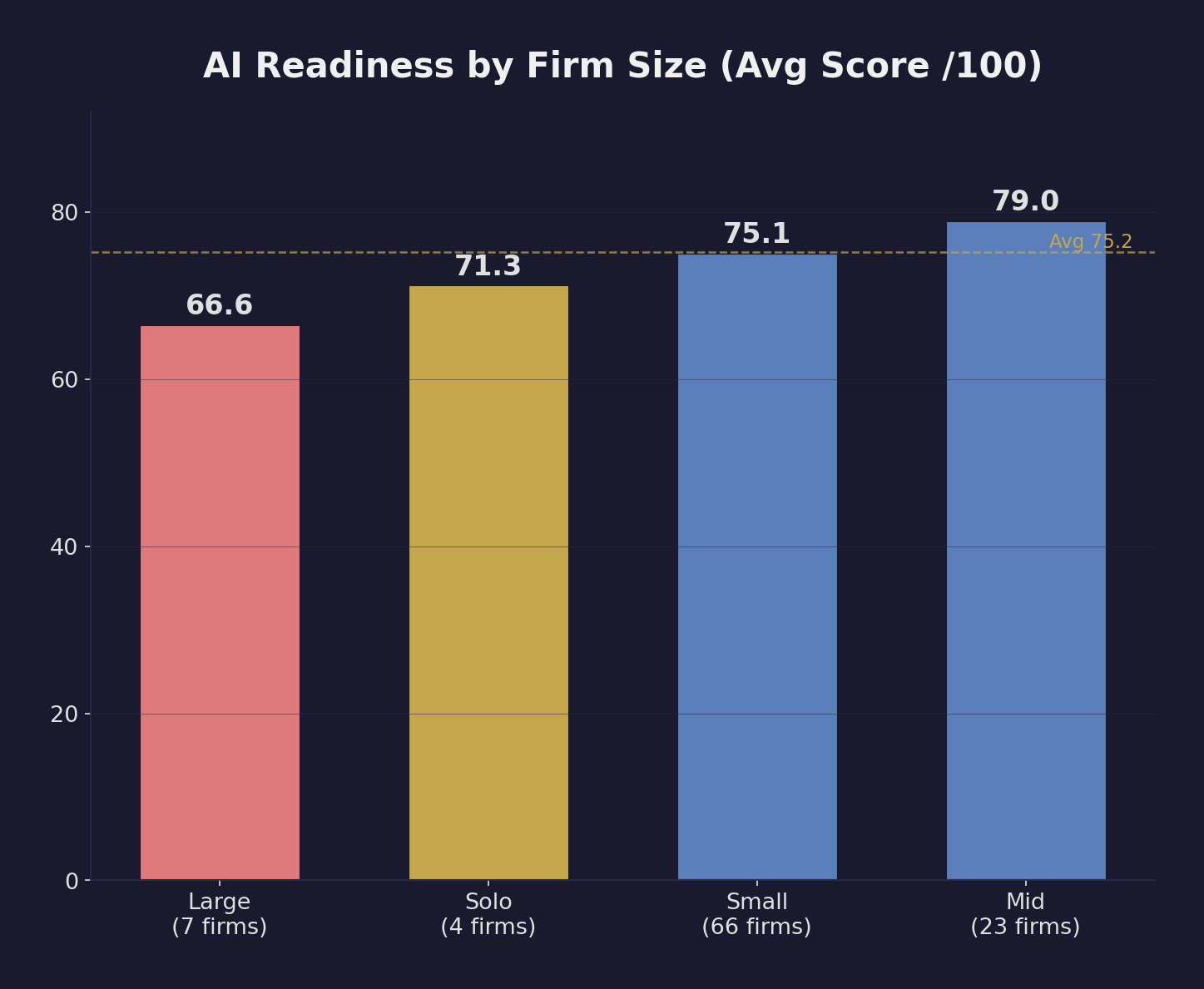
Large firms trail every other size category. A 12.4-point gap separates mid-size firms (79.0) from large firms (66.6).
This isn't a fluke. It reflects fundamentally different approaches to a web presence.
Mid-size firms hit the sweet spot (79.0 avg). They combine the lead generation urgency of small firms with the resources to invest in quality content and technical infrastructure. They posted the highest overall average of any size category.
Small firms are the backbone of this audit (75.1 avg, 66 firms). They treat their website as their primary business development tool. Every lead matters, so they invest in the signals that generate them: trust, content, and local visibility. A solo personal injury lawyer in Barrie who depends on Google for new clients will naturally build a more AI-friendly website than a 500-lawyer Bay Street firm that generates business through partner relationships.
Large firms treat their website as a digital brochure (66.6 avg). It exists to confirm what someone already knows about the firm. These firms are technically competent (averaging 78.6 on Technical Health) but their AI Infrastructure scores averaged just 54.3, nearly 14 points below the national average. They haven't made the structural investments in machine-readability that smaller competitors have.
The pattern is consistent: firms that depend on their website for business build AI-friendly websites. Firms that don't, don't.
Scores by Province and City
By Province
| Province | Firms | Average Score |
|---|---|---|
| Nova Scotia | 4 | 81.3 |
| Alberta | 14 | 78.5 |
| Ontario | 50 | 76.7 |
| Quebec | 3 | 76.0 |
| British Columbia | 19 | 72.5 |
| Newfoundland & Labrador | 3 | 72.0 |
| Manitoba | 2 | 71.5 |
| New Brunswick | 4 | 61.3 |
| Prince Edward Island | 1 | 54.0 |
By City (2+ Firms)
| City | Firms | Average Score |
|---|---|---|
| Mississauga | 2 | 82.5 |
| Halifax | 4 | 81.3 |
| Edmonton | 2 | 79.5 |
| Ottawa | 4 | 78.3 |
| Calgary | 12 | 78.3 |
| Barrie | 3 | 77.3 |
| Toronto | 38 | 76.2 |
| Montreal | 3 | 76.0 |
| Surrey | 3 | 73.3 |
| Vancouver | 16 | 72.4 |
| St. John's | 3 | 72.0 |
| Winnipeg | 2 | 71.5 |
| Moncton | 3 | 63.3 |
Nova Scotia leads the country. With 4 firms averaging 81.3, Nova Scotia is the top-performing province. Halifax specifically (81.3) leads all cities with 2+ firms. Marketing-forward firms like Valent Legal (89) and MacGillivray Law (87) are pulling the average up, but even the lower-scoring Halifax firms perform above the national average.
Alberta punches above expectations. At 78.5, Alberta's average is second only to Nova Scotia. Calgary (78.3) outperforms Toronto (76.2). Alberta firms tend to have stronger local SEO and content optimization, possibly reflecting the competitive marketing culture in Calgary's legal market.
British Columbia underperforms. BC's 72.5 average is 2.7 points below the national average despite having the second-largest sample (19 firms). Vancouver specifically (72.4) trails Toronto (76.2) by nearly 4 points. The gap is concentrated in trust signals and local SEO rather than Technical Health.
New Brunswick trails significantly. At 61.3 average across 4 firms, New Brunswick is the weakest province with a meaningful sample. Moncton (63.3) is the lowest-scoring city with multiple firms.
Domain Authority vs. AI Readiness: Why Backlinks Don't Help
We correlated Open PageRank domain authority scores with audit results across 91 firms with available DA data.
Correlation coefficient: 0.162
That's essentially no correlation. Domain authority, which measures a site's backlink profile and overall web authority, has almost no relationship with AI readiness.
High Authority, Low AI Readiness (Wasted Potential)
| Firm | Domain Authority (OPR) | Score | Grade |
|---|---|---|---|
| Stikeman Elliott | 3.13 | 63 | C |
| Blake, Cassels | 2.95 | 64 | C |
| Shulman & Partners | 2.78 | 67 | C+ |
| Torys | High | 60 | C |
These firms have strong domain authority from years of backlinks and brand recognition. AI systems would love to cite them. But the content and structure of their websites prevent it. They're sitting on a foundation they're not using.
Low Authority, High AI Readiness (Punching Above Their Weight)
| Firm | Domain Authority (OPR) | Score | Grade |
|---|---|---|---|
| MG Lawyers | 1.63 | 86 | A |
| Edwards Injury Law | 1.39 | 84 | A- |
| McLeish Orlando | 1.89 | 84 | A- |
| Murphy Battista | 1.41 | 83 | A- |
| Goldwater Droit | 1.97 | 81 | A- |
These firms have modest domain authority but have built AI-friendly websites through good structure, clear content, and proper schema markup. They're maximizing the visibility they can get from the authority they have.
The takeaway for smaller firms is encouraging. You don't need to compete with BigLaw on backlinks to compete on AI visibility. You need better structure, clearer content, and proper markup.
The Big Firm Problem
The 7 large firms in this audit averaged 66.6 out of 100. Every single one scored below the national average.
| Firm | Score | AI Infra | Trust | Local SEO | Content | Technical |
|---|---|---|---|---|---|---|
| MLT Aikins | 76 | 66 | 83 | 67 | 80 | 87 |
| Aird & Berlis | 73 | 63 | 83 | 57 | 70 | 83 |
| McLeod Law | 66 | 48 | 94 | 44 | 75 | 63 |
| Smart & Biggar | 64 | 48 | 83 | 45 | 80 | 69 |
| Blake, Cassels | 64 | 53 | 61 | 50 | 90 | 82 |
| Stikeman Elliott | 63 | 51 | 72 | 67 | 62 | 86 |
| Torys | 60 | 51 | 67 | 45 | 65 | 80 |
The story here isn't about everything being broken. Large firms have adequate Trust (avg 77.6, near the national average), and their Technical Health (avg 78.6) and Content (avg 74.6) are respectable.
The problem is specific and concentrated:
AI Infrastructure (avg 54.3). That's 13.9 points below the national average. These firms have weak schema, poor entity signals, and content that isn't structured for machine consumption. The Canadian Bar Association's practice management resources increasingly emphasize the importance of digital discoverability, but BigLaw has been slow to adapt.
Local SEO (avg 53.6). That's 11.4 points below average. Large firms operate across multiple offices and jurisdictions, which makes local SEO harder. But most haven't even attempted it. Google Business Profile integration, LocalBusiness schema, and location-specific content are largely absent.
These firms invest in polished design and quality content, but they haven't made the structural investments that make their websites parseable by AI. It's the most expensive version of the "brochure website" problem in the Canadian legal market.
What the Top Performers Do Differently
The 13 firms that earned an A grade share several common traits.
How AI Systems Decide Which Law Firms to Cite
AI systems don't evaluate law firms the way a human would. They can't meet you, sit in your office, or ask a colleague for a referral. They scan your website for structured signals: schema markup, author credentials, content that directly answers a question, and geographic specificity. The firms that score highest on AI readiness are the ones that have made these signals explicit and machine-readable.
1. Schema Markup is Non-Negotiable
Every A-grade firm has strong structured data. The top performer (Valent Legal, 89/100) has extensive JSON-LD markup. Firms that invest in schema markup tell AI systems exactly what they are, who their lawyers are, what they practice, and where they're located. As Google's structured data documentation explains, this markup is how search engines understand the meaning behind your pages.
2. Trust is Earned and Displayed
A-grade firms averaged 88.5 on Trust, more than 10 points above the national average. They prominently display:
- Google review ratings and testimonials
- Case results and settlement amounts
- Professional memberships and bar admissions
- Awards, rankings, and media mentions
- Years of experience
Valent Legal earned a perfect Trust score of 100. Four other top-10 firms scored 94 or higher: Preszler Law, Neinstein, AH Injury Law, and Maclean Family Law. These aren't vanity metrics. They're the signals AI systems use to decide whether your firm is a credible source worth citing.
3. Content Answers Real Questions
Top performers write content that addresses the specific questions potential clients search for. They don't write generic practice area descriptions. They write "What to do after a car accident in Ontario" and "How long do I have to sue for medical malpractice in Alberta."
This content is naturally AI-friendly because it mirrors the questions AI systems are trying to answer. A personal injury firm that publishes a clear, authoritative answer to "what is the limitation period for personal injury claims in Ontario" is exactly what ChatGPT wants to cite. The top 13 firms averaged 99.5 on Content, near-perfect scores driven by this question-and-answer approach.
4. Local SEO is Specific
Top performers don't just mention their city. They have Google Business Profile integration, local schema markup, locally-focused content, and NAP (Name, Address, Phone) consistency across their site. AH Injury Law in Ottawa scored 92 on Local SEO, and Zinati Kay in Toronto scored 95. For a deeper look at local optimization, see our guide to local SEO for Canadian law firms.
The Five Most Common AI Readiness Failures
1. No LLM-Friendly Formatting
LLM Formatting scored the lowest of any AI sub-category at 56.0 average. Most law firm websites present content as unstructured prose. No FAQ blocks, no data tables, no clear heading hierarchies that match search queries.
The fix is structural: add FAQ schema on content pages, use headings that match the questions people actually ask, incorporate bulleted lists and comparison tables, and ensure every page has a logical heading hierarchy from H1 through H3.
2. Missing Entity Authority Signals
Entity Authority averaged just 56.4. The site doesn't clearly communicate who the lawyers are, what their credentials are, and why they're authoritative sources in a machine-readable format.
The fix: detailed author bios with bar admissions, years of practice, and areas of specialization. Person schema on attorney profile pages. Author attribution on blog posts. These signals are what AI systems use to evaluate whether your firm is a credible source worth citing. The Law Society of Ontario's public directory is one of many sources AI systems cross-reference when verifying lawyer credentials.
3. Weak or Absent Schema Markup
Schema scored 63.5 average. Without structured data, AI systems must guess what your site is about by parsing raw HTML. They can do it. They do it poorly and they do it less often.
The fix is straightforward: implement Organization, LegalService, Person, and LocalBusiness schema at minimum. FAQPage schema on content pages adds additional AI visibility. Schema markup remains the strongest predictor of overall audit performance.
4. Content Written for Humans Only
Content Clarity averaged 66.9. The problem isn't bad content. It's content structured in a way that AI systems can't easily extract answers from.
Common patterns we saw:
- Burying the answer under three paragraphs of context
- Writing in a narrative style rather than an answer-first style
- Not using clear headings that match the questions people actually search
- Omitting jurisdiction-specific details that would distinguish Canadian content from American content
That last point matters more than most firms realize. AI systems serving a user in Ontario need to know that your content is specifically about Ontario law, not generic North American legal content.
5. Local SEO as an Afterthought
The average Local SEO score (65.0) is the weakest of any main category. Many firms have basic NAP information but lack Google Business Profile integration, LocalBusiness schema, location-specific content, and service area specifications.
For a practice that's inherently local, this is a critical gap. If you're a personal injury lawyer in Calgary, AI systems need to understand that you serve Calgary specifically, not just that you exist somewhere in Canada. Our guide to local SEO for Canadian law firms covers the fundamentals.
Top 10 and Bottom 10 Firms
Top 10
| Rank | Firm | City | Practice | Score | Grade | AI Infra | Trust |
|---|---|---|---|---|---|---|---|
| 1 | Valent Legal | Halifax | PI | 89 | A | 78 | 100 |
| 2 | Preszler Law | Toronto | PI | 88 | A | 80 | 94 |
| 3 | Neinstein | Toronto | PI | 88 | A | 79 | 94 |
| 4 | AH Injury Law | Ottawa | PI | 88 | A | 80 | 94 |
| 5 | Maclean Family Law | Vancouver | Family | 88 | A | 74 | 94 |
| 6 | Zinati Kay | Toronto | Real Estate | 88 | A | 83 | 89 |
| 7 | MacGillivray Law | Halifax | PI | 87 | A | 79 | 83 |
| 8 | MG Lawyers | Mississauga | PI | 86 | A | 80 | 72 |
| 9 | DeVry Smith Frank | Toronto | Real Estate | 86 | A | 76 | 92 |
| 10 | Matthew Jeffery | Toronto | Immigration | 86 | A | 77 | 89 |
Six of the top 10 are personal injury firms. Nine of the 10 have trust scores of 72 or above. Toronto leads with 4 of the top 10, followed by Halifax with 2.
Bottom 10
| Rank | Firm | City | Practice | Score | Grade | AI Infra | Trust |
|---|---|---|---|---|---|---|---|
| 91 | Haller Law | Moncton | Family | 40 | F | 38 | 56 |
| 92 | McCrea Law | Vancouver | Immigration | 48 | F | 47 | 53 |
| 93 | CCL Family Law | Toronto | Family | 51 | D | 54 | 17 |
| 94 | Terra Law | Vancouver | Real Estate | 53 | D | 47 | 61 |
| 95 | Key Murray Law | Charlottetown | Corporate | 54 | D | 47 | 44 |
| 96 | Leading Law | Fredericton | PI | 55 | D | 46 | 44 |
| 97 | Pazder Law | Vancouver | Real Estate | 57 | D | 64 | 28 |
| 98 | Torys | Toronto | Corporate | 60 | C | 51 | 67 |
| 99 | Narwal Litigation | Vancouver | Criminal | 62 | C | 62 | 50 |
| 100 | FamilyLaw.ca | Montreal | Family | 62 | C | 68 | 67 |
Torys, one of Canada's most prestigious corporate law firms, is in the bottom 10. Vancouver accounts for 4 of the bottom 10 entries. The bottom 10 includes firms from 6 practice areas and ranges from solo practitioners to BigLaw. What they share isn't a practice area or a size category. It's a failure to build their websites for anything beyond basic information display.
What AI Readiness Means for Your Law Firm
AI-powered search isn't coming. It's here. Google AI Overviews already appear in a significant percentage of legal searches. ChatGPT, Perplexity, and Claude are answering legal questions and recommending firms. The question isn't whether AI search will affect your firm. It's whether your website is ready for it.
Based on this Canadian law firm website audit of 100 firms across the country, here's what actually moves the needle.
1. Implement schema markup. This is the highest-impact, lowest-cost improvement available. Organization, Person, LegalService, and LocalBusiness schema take a developer a few hours and create a measurable improvement in AI visibility. It's the single strongest predictor of overall audit performance. If you do one thing after reading this, do this.
2. Structure content for AI consumption. Use headings that match real search queries. Add FAQ blocks with direct answers. Incorporate lists and comparison tables. Answer questions in the first sentence, then expand. Include jurisdiction-specific terminology. Reference Canadian legislation, provincial courts, and Canadian legal concepts by name. Our post on why Canadian law firms need SEO covers how search visibility works for the Canadian legal market specifically.
3. Build entity authority signals. Every lawyer should have a detailed bio page with structured credentials. Every blog post should have clear author attribution. These signals are increasingly important as AI systems evaluate source credibility before deciding what to cite.
4. Invest in local SEO. Claim and optimize your Google Business Profile. Add LocalBusiness schema. Create location-specific content. Your law practice is local. Your website needs to communicate that clearly to AI systems.
5. Don't assume your brand speaks for itself. This audit shows that domain authority and brand prestige have almost zero correlation with AI search visibility. The firms getting cited by ChatGPT and appearing in AI Overviews aren't the most famous. They're the ones that have built their websites to communicate clearly with machines as well as humans.
This Canadian law firm website audit shows the average firm scores a B on AI readiness. 40% earn an A range grade. But the AI Infrastructure sub-categories tell the real story: LLM Formatting at 56, Entity Authority at 56, Schema at 64. The gap between overall scores and AI-specific signals is where the opportunity lives.
Want to see where your firm stands? Run your own audit with our free AI Readiness Checker.